LLM Monitoring for Enterprise: Observability, Reliability, and AI Compliance at Scale
2026-03-30
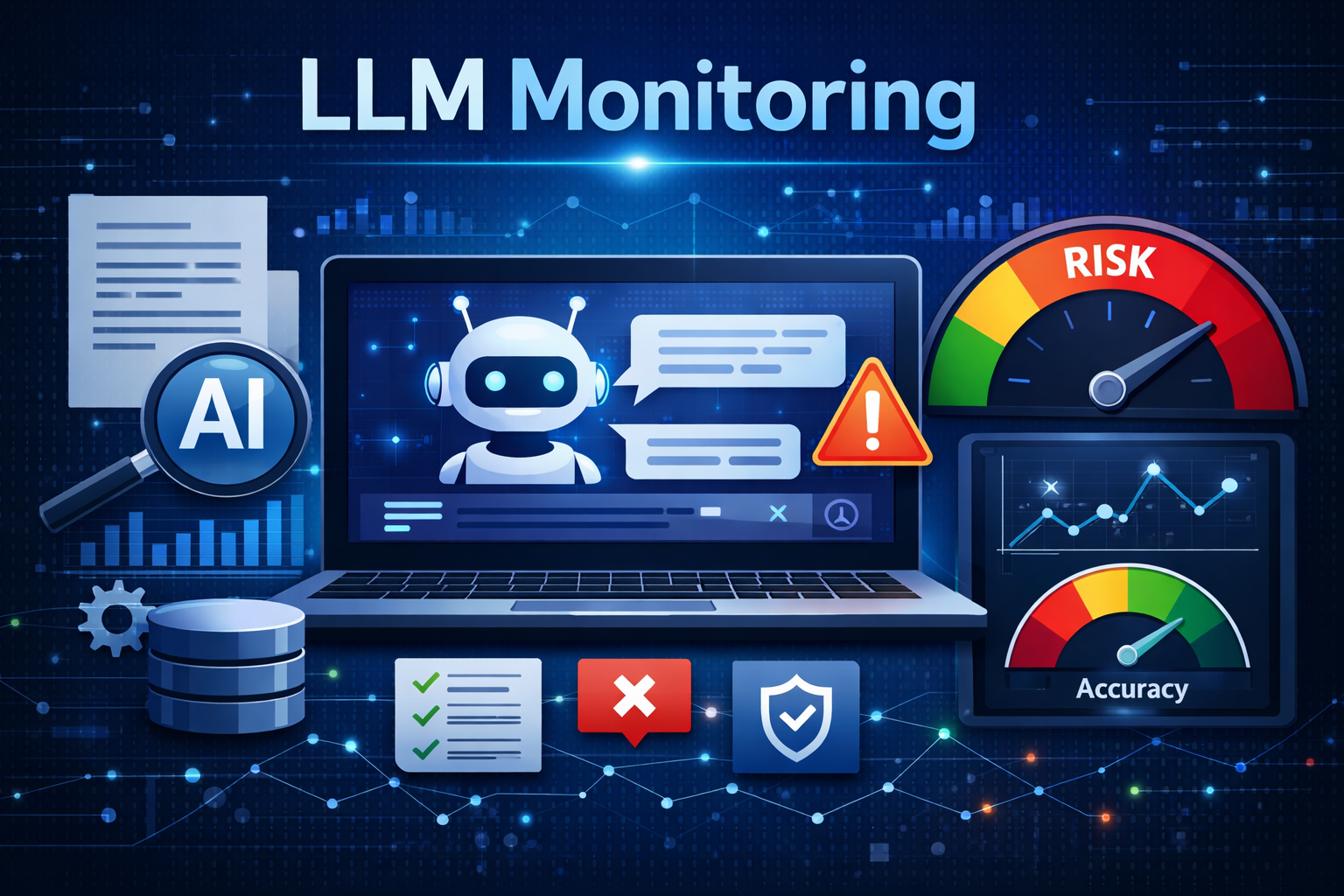
LLM Monitoring for Enterprise: Ensuring Reliable, Secure, and Compliant AI at Scale
Introduction
Enterprises are rapidly integrating Large Language Models (LLMs) into critical workflows—from underwriting and customer support to internal copilots. But as adoption grows, so does a fundamental challenge: lack of visibility into how these models behave in real-world scenarios.
Unlike traditional software, LLMs are non-deterministic. The same input can produce different outputs. Policies may not be consistently applied, and edge cases can trigger unexpected results.
This is where LLM monitoring for enterprise becomes essential—not just as a technical layer, but as a core capability for managing risk, ensuring compliance, and maintaining trust in AI-driven decisions.
What is LLM Monitoring for Enterprise?
LLM monitoring for enterprise refers to the continuous tracking, evaluation, and validation of large language model behavior in production environments.
While traditional AI monitoring focuses on metrics like accuracy, latency, and drift, LLM monitoring expands into areas such as:
- Prompt-response tracking
- Output quality and factual correctness
- Policy adherence
- Context-aware behavior across workflows
In enterprise settings, monitoring isn’t just about performance—it’s about ensuring AI outputs align with business rules, regulatory requirements, and real-world expectations.
Why Enterprises Need LLM Monitoring
1. Unpredictable Outputs (Hallucinations)
LLMs can generate confident but incorrect responses. Without proper monitoring, these issues can silently impact decisions and user experience.
2. Model Drift & Changing Behavior
As usage patterns evolve, model outputs can shift. Continuous monitoring helps detect and address these changes early.
3. Regulatory & Compliance Risks
In sectors like fintech and lending, decisions must be explainable and auditable. Monitoring ensures adherence to policies and regulations.
4. Limited Visibility & Auditability
Without structured logs and validation, it becomes difficult to trace or justify AI-driven decisions.
Key Components of Effective Enterprise LLM Monitoring
To be effective, LLM monitoring must go beyond surface-level metrics and focus on real-world behavior.
✅ Real-Time Output Validation
Evaluate responses against predefined standards for accuracy and compliance.
✅ Policy & Rule Enforcement
Ensure outputs follow internal guidelines such as risk thresholds and regulatory constraints.
✅ Workflow-Level Observability
Track how models behave across complete workflows—not just isolated prompts.
✅ Risk Scoring & Alerts
Identify anomalies and trigger alerts when outputs deviate from expected behavior.
✅ Audit Logs & Explainability
Maintain detailed records to support audits and improve transparency.
Enterprise Use Cases
🏦 Lending & Underwriting
Ensure AI recommendations align with credit policies and risk frameworks.
💬 Customer Support Automation
Monitor responses for accuracy, tone, and compliance to prevent misinformation.
🧑💻 Internal AI Copilots
Track how AI tools assist employees and reduce the risk of incorrect outputs.
🔍 Fraud Detection
Validate AI-driven signals and ensure consistency with fraud detection rules.
Best Practices for Implementing LLM Monitoring
1. Monitor at the Workflow Level
Focus on end-to-end decision flows rather than isolated model outputs.
2. Continuously Test Edge Cases
Simulate real-world scenarios to uncover hidden risks before deployment.
3. Define Clear AI Policies
Establish rules that models must follow and validate outputs accordingly.
4. Integrate into CI/CD Pipelines
Make monitoring continuous and automated.
5. Combine Testing and Monitoring
Use pre-deployment validation alongside real-time monitoring for full coverage.
How Trusys AI Enables Enterprise-Grade LLM Monitoring
Trusys AI acts as a trust layer for enterprise AI, helping organizations confidently deploy and scale LLMs.
With Trusys AI, enterprises can:
- 🔍 Test AI workflows before deployment
- ✅ Validate outputs against business policies
- 📊 Monitor real-time behavior in production
- 📁 Generate compliance-ready audit reports
- ⚠️ Detect failures before they impact decisions
Unlike generic observability tools, Trusys focuses on decision integrity, policy validation, and real-world AI behavior—making it well-suited for enterprise environments.
Conclusion
LLMs offer powerful capabilities, but they also introduce new risks when deployed at scale.
For enterprises, implementing LLM monitoring for enterprise is no longer optional. It is essential for ensuring:
- Reliable AI performance
- Regulatory compliance
- Trust in automated decision-making
Organizations that succeed with AI will be those that continuously validate, monitor, and improve their systems in production.
❓ FAQs on LLM Monitoring for Enterprise
1. What is LLM monitoring in enterprise environments?
LLM monitoring involves continuously tracking how language models behave in production, including validating outputs, detecting anomalies, and ensuring compliance with business rules.
2. How is it different from traditional AI monitoring?
Traditional monitoring focuses on structured metrics, while LLM monitoring evaluates unstructured outputs, context, and policy adherence.
3. Why is it important for enterprises?
It helps reduce risk, improve reliability, and ensure compliance in high-stakes environments.
4. What risks exist without proper monitoring?
Common risks include hallucinations, policy violations, bias, lack of explainability, and undetected failures.
5. What metrics should be tracked?
Key metrics include output accuracy, consistency, compliance rate, latency, and anomaly detection.
6. How can hallucinations be detected?
Through validation rules, structured data checks, and scenario-based testing.
7. What role does monitoring play in compliance?
It ensures auditability, policy enforcement, and transparency in AI decision-making.
8. Can LLM monitoring be automated?
Yes, modern platforms enable real-time validation, alerting, and automated reporting.
9. When should enterprises implement it?
Ideally before deployment and continuously throughout production.
10. How does Trusys AI help?
Trusys AI provides testing, validation, monitoring, and compliance tools to ensure reliable AI performance.
11. Which industries benefit the most?
Financial services, healthcare, insurance, and SaaS platforms.
12. What are best practices?
Define policies, monitor workflows, test continuously, and integrate monitoring into pipelines.
Stop guessing.
Start measuring.
Join teams building reliable AI with TruEval. Start with a free trial, no credit card required. Get your first evaluation running in under 10 minutes.
Questions about Trusys?
Our team is here to help. Schedule a personalized demo to see how Trusys fits your specific use case.
Book a Demo

Ready to dive in?
Check out our documentation and tutorials. Get started with example datasets and evaluation templates.
Start Free Trial
Free Trial
No credit card required
10 Min
To first evaluation
24/7
Enterprise support


Benefits
Specifications
How-to
Contact Us
Learn More

LLM Monitoring for Enterprise: Observability, Reliability, and AI Compliance at Scale
2026-03-30
LLM Monitoring for Enterprise: Ensuring Reliable, Secure, and Compliant AI at Scale
Introduction
Enterprises are rapidly integrating Large Language Models (LLMs) into critical workflows—from underwriting and customer support to internal copilots. But as adoption grows, so does a fundamental challenge: lack of visibility into how these models behave in real-world scenarios.
Unlike traditional software, LLMs are non-deterministic. The same input can produce different outputs. Policies may not be consistently applied, and edge cases can trigger unexpected results.
This is where LLM monitoring for enterprise becomes essential—not just as a technical layer, but as a core capability for managing risk, ensuring compliance, and maintaining trust in AI-driven decisions.
What is LLM Monitoring for Enterprise?
LLM monitoring for enterprise refers to the continuous tracking, evaluation, and validation of large language model behavior in production environments.
While traditional AI monitoring focuses on metrics like accuracy, latency, and drift, LLM monitoring expands into areas such as:
- Prompt-response tracking
- Output quality and factual correctness
- Policy adherence
- Context-aware behavior across workflows
In enterprise settings, monitoring isn’t just about performance—it’s about ensuring AI outputs align with business rules, regulatory requirements, and real-world expectations.
Why Enterprises Need LLM Monitoring
1. Unpredictable Outputs (Hallucinations)
LLMs can generate confident but incorrect responses. Without proper monitoring, these issues can silently impact decisions and user experience.
2. Model Drift & Changing Behavior
As usage patterns evolve, model outputs can shift. Continuous monitoring helps detect and address these changes early.
3. Regulatory & Compliance Risks
In sectors like fintech and lending, decisions must be explainable and auditable. Monitoring ensures adherence to policies and regulations.
4. Limited Visibility & Auditability
Without structured logs and validation, it becomes difficult to trace or justify AI-driven decisions.
Key Components of Effective Enterprise LLM Monitoring
To be effective, LLM monitoring must go beyond surface-level metrics and focus on real-world behavior.
✅ Real-Time Output Validation
Evaluate responses against predefined standards for accuracy and compliance.
✅ Policy & Rule Enforcement
Ensure outputs follow internal guidelines such as risk thresholds and regulatory constraints.
✅ Workflow-Level Observability
Track how models behave across complete workflows—not just isolated prompts.
✅ Risk Scoring & Alerts
Identify anomalies and trigger alerts when outputs deviate from expected behavior.
✅ Audit Logs & Explainability
Maintain detailed records to support audits and improve transparency.
Enterprise Use Cases
🏦 Lending & Underwriting
Ensure AI recommendations align with credit policies and risk frameworks.
💬 Customer Support Automation
Monitor responses for accuracy, tone, and compliance to prevent misinformation.
🧑💻 Internal AI Copilots
Track how AI tools assist employees and reduce the risk of incorrect outputs.
🔍 Fraud Detection
Validate AI-driven signals and ensure consistency with fraud detection rules.
Best Practices for Implementing LLM Monitoring
1. Monitor at the Workflow Level
Focus on end-to-end decision flows rather than isolated model outputs.
2. Continuously Test Edge Cases
Simulate real-world scenarios to uncover hidden risks before deployment.
3. Define Clear AI Policies
Establish rules that models must follow and validate outputs accordingly.
4. Integrate into CI/CD Pipelines
Make monitoring continuous and automated.
5. Combine Testing and Monitoring
Use pre-deployment validation alongside real-time monitoring for full coverage.
How Trusys AI Enables Enterprise-Grade LLM Monitoring
Trusys AI acts as a trust layer for enterprise AI, helping organizations confidently deploy and scale LLMs.
With Trusys AI, enterprises can:
- 🔍 Test AI workflows before deployment
- ✅ Validate outputs against business policies
- 📊 Monitor real-time behavior in production
- 📁 Generate compliance-ready audit reports
- ⚠️ Detect failures before they impact decisions
Unlike generic observability tools, Trusys focuses on decision integrity, policy validation, and real-world AI behavior—making it well-suited for enterprise environments.
Conclusion
LLMs offer powerful capabilities, but they also introduce new risks when deployed at scale.
For enterprises, implementing LLM monitoring for enterprise is no longer optional. It is essential for ensuring:
- Reliable AI performance
- Regulatory compliance
- Trust in automated decision-making
Organizations that succeed with AI will be those that continuously validate, monitor, and improve their systems in production.
❓ FAQs on LLM Monitoring for Enterprise
1. What is LLM monitoring in enterprise environments?
LLM monitoring involves continuously tracking how language models behave in production, including validating outputs, detecting anomalies, and ensuring compliance with business rules.
2. How is it different from traditional AI monitoring?
Traditional monitoring focuses on structured metrics, while LLM monitoring evaluates unstructured outputs, context, and policy adherence.
3. Why is it important for enterprises?
It helps reduce risk, improve reliability, and ensure compliance in high-stakes environments.
4. What risks exist without proper monitoring?
Common risks include hallucinations, policy violations, bias, lack of explainability, and undetected failures.
5. What metrics should be tracked?
Key metrics include output accuracy, consistency, compliance rate, latency, and anomaly detection.
6. How can hallucinations be detected?
Through validation rules, structured data checks, and scenario-based testing.
7. What role does monitoring play in compliance?
It ensures auditability, policy enforcement, and transparency in AI decision-making.
8. Can LLM monitoring be automated?
Yes, modern platforms enable real-time validation, alerting, and automated reporting.
9. When should enterprises implement it?
Ideally before deployment and continuously throughout production.
10. How does Trusys AI help?
Trusys AI provides testing, validation, monitoring, and compliance tools to ensure reliable AI performance.
11. Which industries benefit the most?
Financial services, healthcare, insurance, and SaaS platforms.
12. What are best practices?
Define policies, monitor workflows, test continuously, and integrate monitoring into pipelines.
Stop guessing.
Start measuring.
Join teams building reliable AI with TruEval. Start with a free trial, no credit card required. Get your first evaluation running in under 10 minutes.
Questions about Trusys?
Our team is here to help. Schedule a personalized demo to see how Trusys fits your specific use case.
Book a Demo
Ready to dive in?
Check out our documentation and tutorials. Get started with example datasets and evaluation templates.
Start Free Trial
Free Trial
No credit card required
10 Min
To first evaluation
24/7
Enterprise support
LLM Monitoring for Enterprise: Observability, Reliability, and AI Compliance at Scale
2026-03-30
LLM Monitoring for Enterprise: Ensuring Reliable, Secure, and Compliant AI at Scale
Introduction
Enterprises are rapidly integrating Large Language Models (LLMs) into critical workflows—from underwriting and customer support to internal copilots. But as adoption grows, so does a fundamental challenge: lack of visibility into how these models behave in real-world scenarios.
Unlike traditional software, LLMs are non-deterministic. The same input can produce different outputs. Policies may not be consistently applied, and edge cases can trigger unexpected results.
This is where LLM monitoring for enterprise becomes essential—not just as a technical layer, but as a core capability for managing risk, ensuring compliance, and maintaining trust in AI-driven decisions.
What is LLM Monitoring for Enterprise?
LLM monitoring for enterprise refers to the continuous tracking, evaluation, and validation of large language model behavior in production environments.
While traditional AI monitoring focuses on metrics like accuracy, latency, and drift, LLM monitoring expands into areas such as:
- Prompt-response tracking
- Output quality and factual correctness
- Policy adherence
- Context-aware behavior across workflows
In enterprise settings, monitoring isn’t just about performance—it’s about ensuring AI outputs align with business rules, regulatory requirements, and real-world expectations.
Why Enterprises Need LLM Monitoring
1. Unpredictable Outputs (Hallucinations)
LLMs can generate confident but incorrect responses. Without proper monitoring, these issues can silently impact decisions and user experience.
2. Model Drift & Changing Behavior
As usage patterns evolve, model outputs can shift. Continuous monitoring helps detect and address these changes early.
3. Regulatory & Compliance Risks
In sectors like fintech and lending, decisions must be explainable and auditable. Monitoring ensures adherence to policies and regulations.
4. Limited Visibility & Auditability
Without structured logs and validation, it becomes difficult to trace or justify AI-driven decisions.
Key Components of Effective Enterprise LLM Monitoring
To be effective, LLM monitoring must go beyond surface-level metrics and focus on real-world behavior.
✅ Real-Time Output Validation
Evaluate responses against predefined standards for accuracy and compliance.
✅ Policy & Rule Enforcement
Ensure outputs follow internal guidelines such as risk thresholds and regulatory constraints.
✅ Workflow-Level Observability
Track how models behave across complete workflows—not just isolated prompts.
✅ Risk Scoring & Alerts
Identify anomalies and trigger alerts when outputs deviate from expected behavior.
✅ Audit Logs & Explainability
Maintain detailed records to support audits and improve transparency.
Enterprise Use Cases
🏦 Lending & Underwriting
Ensure AI recommendations align with credit policies and risk frameworks.
💬 Customer Support Automation
Monitor responses for accuracy, tone, and compliance to prevent misinformation.
🧑💻 Internal AI Copilots
Track how AI tools assist employees and reduce the risk of incorrect outputs.
🔍 Fraud Detection
Validate AI-driven signals and ensure consistency with fraud detection rules.
Best Practices for Implementing LLM Monitoring
1. Monitor at the Workflow Level
Focus on end-to-end decision flows rather than isolated model outputs.
2. Continuously Test Edge Cases
Simulate real-world scenarios to uncover hidden risks before deployment.
3. Define Clear AI Policies
Establish rules that models must follow and validate outputs accordingly.
4. Integrate into CI/CD Pipelines
Make monitoring continuous and automated.
5. Combine Testing and Monitoring
Use pre-deployment validation alongside real-time monitoring for full coverage.
How Trusys AI Enables Enterprise-Grade LLM Monitoring
Trusys AI acts as a trust layer for enterprise AI, helping organizations confidently deploy and scale LLMs.
With Trusys AI, enterprises can:
- 🔍 Test AI workflows before deployment
- ✅ Validate outputs against business policies
- 📊 Monitor real-time behavior in production
- 📁 Generate compliance-ready audit reports
- ⚠️ Detect failures before they impact decisions
Unlike generic observability tools, Trusys focuses on decision integrity, policy validation, and real-world AI behavior—making it well-suited for enterprise environments.
Conclusion
LLMs offer powerful capabilities, but they also introduce new risks when deployed at scale.
For enterprises, implementing LLM monitoring for enterprise is no longer optional. It is essential for ensuring:
- Reliable AI performance
- Regulatory compliance
- Trust in automated decision-making
Organizations that succeed with AI will be those that continuously validate, monitor, and improve their systems in production.
❓ FAQs on LLM Monitoring for Enterprise
1. What is LLM monitoring in enterprise environments?
LLM monitoring involves continuously tracking how language models behave in production, including validating outputs, detecting anomalies, and ensuring compliance with business rules.
2. How is it different from traditional AI monitoring?
Traditional monitoring focuses on structured metrics, while LLM monitoring evaluates unstructured outputs, context, and policy adherence.
3. Why is it important for enterprises?
It helps reduce risk, improve reliability, and ensure compliance in high-stakes environments.
4. What risks exist without proper monitoring?
Common risks include hallucinations, policy violations, bias, lack of explainability, and undetected failures.
5. What metrics should be tracked?
Key metrics include output accuracy, consistency, compliance rate, latency, and anomaly detection.
6. How can hallucinations be detected?
Through validation rules, structured data checks, and scenario-based testing.
7. What role does monitoring play in compliance?
It ensures auditability, policy enforcement, and transparency in AI decision-making.
8. Can LLM monitoring be automated?
Yes, modern platforms enable real-time validation, alerting, and automated reporting.
9. When should enterprises implement it?
Ideally before deployment and continuously throughout production.
10. How does Trusys AI help?
Trusys AI provides testing, validation, monitoring, and compliance tools to ensure reliable AI performance.
11. Which industries benefit the most?
Financial services, healthcare, insurance, and SaaS platforms.
12. What are best practices?
Define policies, monitor workflows, test continuously, and integrate monitoring into pipelines.
Stop guessing.
Start measuring.
Join teams building reliable AI with Trusys. Start with a free trial, no credit card required. Get your first evaluation running in under 10 minutes.
Questions about Trusys?
Our team is here to help. Schedule a personalized demo to see how Trusys fits your specific use case.
Book a Demo

Ready to dive in?
Check out our documentation and tutorials. Get started with example datasets and evaluation templates.
Start Free Trial
Free Trial
No credit card required
10 Min
to get started
24/7
Enterprise support