Protecting Sensitive Data in AI Systems: A Guide to Preventing Model Leakage
2026-03-13
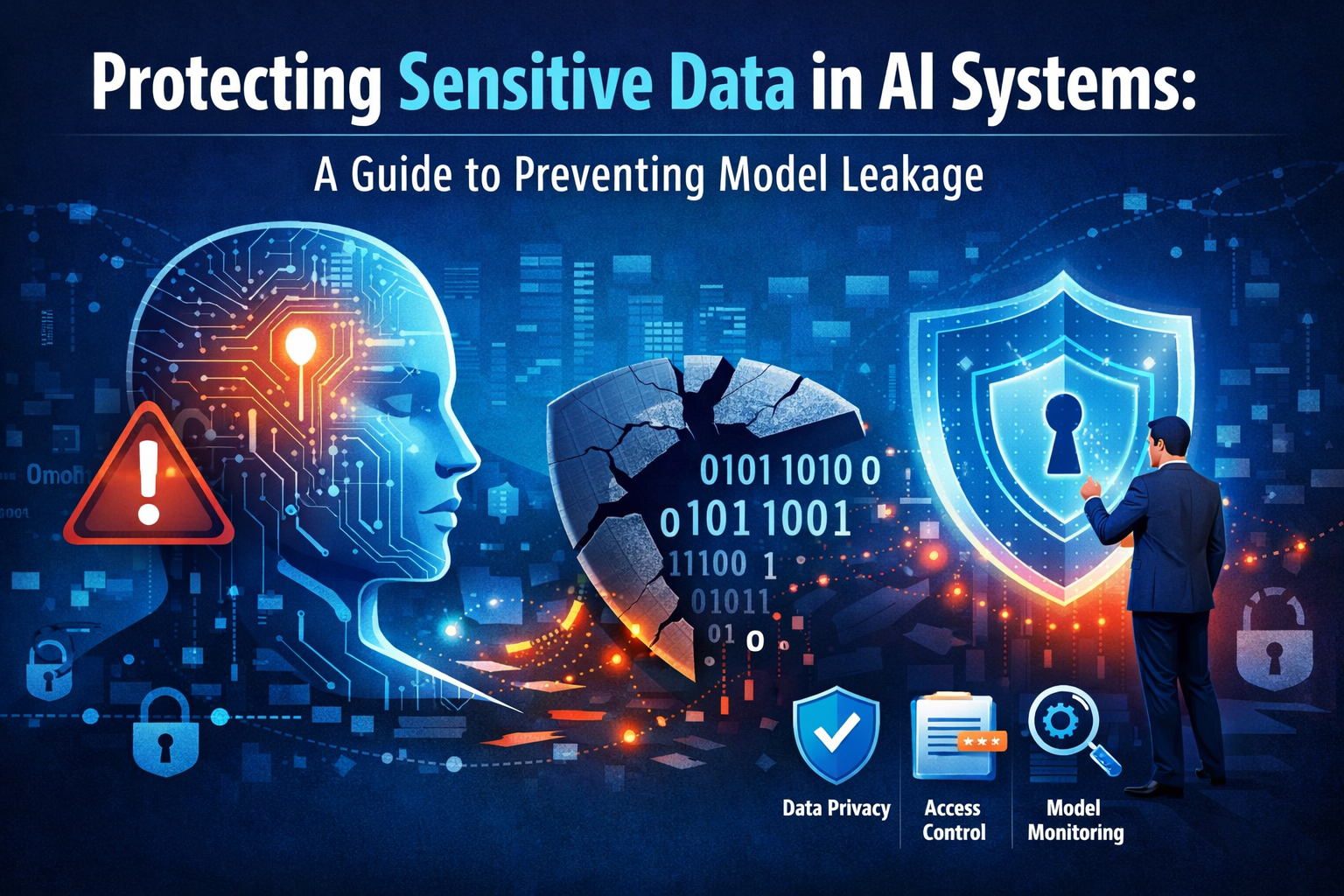
Artificial intelligence is rapidly transforming how enterprises operate. From predictive analytics and recommendation systems to automated customer support and fraud detection, organizations are integrating AI into nearly every layer of their digital infrastructure. However, as AI adoption grows, so do the security risks associated with training and deploying machine learning models.
One of the most critical yet often overlooked threats is AI data leakage—a scenario where AI models unintentionally expose sensitive information from their training data. If not properly managed, these leaks can compromise user privacy, expose proprietary business data, and create serious regulatory liabilities.
For organizations building AI-driven systems—such as those leveraging solutions from Trusys.ai—understanding and mitigating data leakage risks is essential to maintaining trust, compliance, and security.
This guide explores what AI data leakage is, how it happens, and the strategies enterprises can implement to prevent sensitive data exposure in AI systems.
What Is AI Data Leakage?
AI data leakage occurs when a machine learning model inadvertently reveals information that should remain confidential. This information often originates from the datasets used during the model’s training phase.
Unlike traditional data breaches, which involve external attackers accessing databases or servers, AI data leakage can occur through the model itself. The AI system may unintentionally reproduce or infer details about the data it learned during training.
For example, a language model trained on internal company documents might reveal fragments of confidential reports when prompted in specific ways. Similarly, models trained on healthcare data could potentially expose patient details under certain query conditions.
How AI Models Leak Sensitive Information
AI models can expose sensitive information in several ways. Understanding these mechanisms is the first step toward preventing them.
1. Overfitting
Overfitting occurs when a model memorizes training data instead of learning general patterns. When this happens, the model may reproduce specific pieces of the training data during predictions.
For example:
- Customer names appearing in AI-generated responses
- Proprietary documents being reconstructed from prompts
- Personal identifiers being inferred by the model
When overfitting occurs, the model becomes a potential repository of sensitive information.
2. Model Inversion Attacks
In a model inversion attack, attackers query a machine learning model repeatedly to reconstruct features from its training dataset.
For instance, an attacker could:
- Infer medical attributes from a healthcare model
- Reconstruct facial images from biometric recognition systems
- Extract demographic information from recommendation algorithms
These attacks exploit the statistical relationships stored within the model.
3. Membership Inference Attacks
Membership inference attacks allow adversaries to determine whether a specific data record was part of the training dataset.
This may reveal whether a person:
- Appears in a medical database
- Is part of a financial dataset
- Was included in a private research dataset
Even without revealing the full record, confirming dataset membership can expose highly sensitive information.
4. Poor Data Governance
Many AI data leakage issues arise from weak data governance practices, such as:
- Training models on unfiltered internal data
- Using production datasets without anonymization
- Lack of strict access control policies
- Insufficient dataset documentation
Without strong governance policies, organizations risk embedding sensitive data directly into their models.
Risks of Sensitive Data Exposure in AI Systems
When AI systems leak sensitive information, the consequences can be severe.
Privacy Violations
Exposure of personal information may violate user privacy laws and ethical standards. Sensitive data such as medical records, financial details, and personal identifiers must be protected at all times.
Regulatory Compliance Risks
Organizations handling personal or financial data must comply with regulations such as:
- GDPR (General Data Protection Regulation)
- HIPAA (Health Insurance Portability and Accountability Act)
- Financial data protection regulations
AI data leakage could result in significant legal penalties and compliance violations.
Intellectual Property Exposure
Companies often train AI systems on internal documentation, research, or proprietary datasets. If these models leak internal knowledge, competitors could gain access to valuable intellectual property.
Reputational Damage
Trust is critical in the digital economy. Data exposure incidents involving AI can significantly damage an organization's reputation.
Customers expect companies deploying AI to protect sensitive information responsibly.
Strategies to Prevent AI Data Leakage
Preventing data leakage requires a combination of technical safeguards, governance frameworks, and security practices throughout the AI lifecycle.
Below are key strategies organizations can implement.
1. Data Anonymization
Before training models, organizations should remove or anonymize personally identifiable information (PII) and sensitive records.
Techniques include:
- Data masking
- Tokenization
- Data aggregation
- Removing identifiers
By limiting the exposure of sensitive attributes, the risk of leakage decreases significantly.
2. Differential Privacy
Differential privacy adds controlled noise to training data or model outputs to prevent the model from revealing specific data points.
Benefits include:
- Strong privacy guarantees
- Reduced risk of membership inference attacks
- Protection of individual data records
Many modern AI frameworks now include built-in differential privacy capabilities.
3. Secure Model Training
Secure AI development practices ensure that training pipelines remain protected.
Important measures include:
- Secure data storage
- Controlled dataset access
- Encrypted training environments
- Secure compute infrastructure
These safeguards reduce the chances of both internal and external data exposure.
4. Federated Learning
Federated learning enables models to train across distributed datasets without centralizing sensitive data.
Instead of transferring raw data to a central server, models learn locally and only share model updates.
Advantages include:
- Reduced data exposure
- Better privacy protection
- Compliance with data sovereignty requirements
This approach is increasingly used in healthcare, finance, and mobile AI applications.
5. Model Auditing and Monitoring
Regular security audits help detect potential data leakage vulnerabilities.
Key practices include:
- Red-team testing of AI models
- Monitoring unusual model queries
- Testing against inversion and inference attacks
- Continuous performance evaluation
Security-focused AI platforms, such as those developed by Trusys.ai, often incorporate monitoring tools to help enterprises detect and mitigate leakage risks.
Best Practices for Enterprises
To build secure AI systems, organizations should integrate security and privacy considerations into the entire AI development lifecycle.
Implement a Secure AI Development Lifecycle
Security must be included at every stage:
- Data collection
- Data preprocessing
- Model training
- Deployment
- Monitoring and updates
Embedding security into these stages helps reduce vulnerabilities.
Establish Strong Data Governance Policies
Effective governance ensures responsible data usage.
Policies should define:
- What data can be used for training
- Who has access to datasets
- Data retention rules
- Privacy compliance procedures
Clear governance frameworks reduce the risk of accidental data exposure.
Conduct Regular Security Testing
AI systems should undergo continuous testing to identify vulnerabilities.
Testing methods include:
- Adversarial testing
- Penetration testing
- Model robustness evaluation
These processes help identify risks before attackers exploit them.
The Future of AI Security
As AI systems continue to evolve, data protection will become a central component of AI governance.
Organizations deploying advanced machine learning models must move beyond traditional cybersecurity and embrace AI-specific security strategies.
Protecting sensitive information within AI systems is no longer optional—it is essential for maintaining privacy, compliance, and trust.
By implementing strong data governance practices, adopting privacy-preserving technologies, and continuously auditing AI models, enterprises can significantly reduce the risk of AI data leakage.
Conclusion
AI technologies are unlocking powerful new capabilities across industries, but they also introduce new security challenges. AI data leakage represents one of the most critical threats facing organizations deploying machine learning systems.
Without proper safeguards, models may inadvertently expose sensitive information embedded in training data.
Enterprises must adopt proactive strategies—such as anonymization, differential privacy, federated learning, and model auditing—to prevent data leakage and secure AI systems.
By prioritizing AI security from the start, organizations can confidently harness the benefits of artificial intelligence while protecting the data that powers it.
Stop guessing.
Start measuring.
Join teams building reliable AI with TruEval. Start with a free trial, no credit card required. Get your first evaluation running in under 10 minutes.
Questions about Trusys?
Our team is here to help. Schedule a personalized demo to see how Trusys fits your specific use case.
Book a Demo

Ready to dive in?
Check out our documentation and tutorials. Get started with example datasets and evaluation templates.
Start Free Trial
Free Trial
No credit card required
10 Min
To first evaluation
24/7
Enterprise support


Benefits
Specifications
How-to
Contact Us
Learn More

Protecting Sensitive Data in AI Systems: A Guide to Preventing Model Leakage
2026-03-13
Artificial intelligence is rapidly transforming how enterprises operate. From predictive analytics and recommendation systems to automated customer support and fraud detection, organizations are integrating AI into nearly every layer of their digital infrastructure. However, as AI adoption grows, so do the security risks associated with training and deploying machine learning models.
One of the most critical yet often overlooked threats is AI data leakage—a scenario where AI models unintentionally expose sensitive information from their training data. If not properly managed, these leaks can compromise user privacy, expose proprietary business data, and create serious regulatory liabilities.
For organizations building AI-driven systems—such as those leveraging solutions from Trusys.ai—understanding and mitigating data leakage risks is essential to maintaining trust, compliance, and security.
This guide explores what AI data leakage is, how it happens, and the strategies enterprises can implement to prevent sensitive data exposure in AI systems.
What Is AI Data Leakage?
AI data leakage occurs when a machine learning model inadvertently reveals information that should remain confidential. This information often originates from the datasets used during the model’s training phase.
Unlike traditional data breaches, which involve external attackers accessing databases or servers, AI data leakage can occur through the model itself. The AI system may unintentionally reproduce or infer details about the data it learned during training.
For example, a language model trained on internal company documents might reveal fragments of confidential reports when prompted in specific ways. Similarly, models trained on healthcare data could potentially expose patient details under certain query conditions.
How AI Models Leak Sensitive Information
AI models can expose sensitive information in several ways. Understanding these mechanisms is the first step toward preventing them.
1. Overfitting
Overfitting occurs when a model memorizes training data instead of learning general patterns. When this happens, the model may reproduce specific pieces of the training data during predictions.
For example:
- Customer names appearing in AI-generated responses
- Proprietary documents being reconstructed from prompts
- Personal identifiers being inferred by the model
When overfitting occurs, the model becomes a potential repository of sensitive information.
2. Model Inversion Attacks
In a model inversion attack, attackers query a machine learning model repeatedly to reconstruct features from its training dataset.
For instance, an attacker could:
- Infer medical attributes from a healthcare model
- Reconstruct facial images from biometric recognition systems
- Extract demographic information from recommendation algorithms
These attacks exploit the statistical relationships stored within the model.
3. Membership Inference Attacks
Membership inference attacks allow adversaries to determine whether a specific data record was part of the training dataset.
This may reveal whether a person:
- Appears in a medical database
- Is part of a financial dataset
- Was included in a private research dataset
Even without revealing the full record, confirming dataset membership can expose highly sensitive information.
4. Poor Data Governance
Many AI data leakage issues arise from weak data governance practices, such as:
- Training models on unfiltered internal data
- Using production datasets without anonymization
- Lack of strict access control policies
- Insufficient dataset documentation
Without strong governance policies, organizations risk embedding sensitive data directly into their models.
Risks of Sensitive Data Exposure in AI Systems
When AI systems leak sensitive information, the consequences can be severe.
Privacy Violations
Exposure of personal information may violate user privacy laws and ethical standards. Sensitive data such as medical records, financial details, and personal identifiers must be protected at all times.
Regulatory Compliance Risks
Organizations handling personal or financial data must comply with regulations such as:
- GDPR (General Data Protection Regulation)
- HIPAA (Health Insurance Portability and Accountability Act)
- Financial data protection regulations
AI data leakage could result in significant legal penalties and compliance violations.
Intellectual Property Exposure
Companies often train AI systems on internal documentation, research, or proprietary datasets. If these models leak internal knowledge, competitors could gain access to valuable intellectual property.
Reputational Damage
Trust is critical in the digital economy. Data exposure incidents involving AI can significantly damage an organization's reputation.
Customers expect companies deploying AI to protect sensitive information responsibly.
Strategies to Prevent AI Data Leakage
Preventing data leakage requires a combination of technical safeguards, governance frameworks, and security practices throughout the AI lifecycle.
Below are key strategies organizations can implement.
1. Data Anonymization
Before training models, organizations should remove or anonymize personally identifiable information (PII) and sensitive records.
Techniques include:
- Data masking
- Tokenization
- Data aggregation
- Removing identifiers
By limiting the exposure of sensitive attributes, the risk of leakage decreases significantly.
2. Differential Privacy
Differential privacy adds controlled noise to training data or model outputs to prevent the model from revealing specific data points.
Benefits include:
- Strong privacy guarantees
- Reduced risk of membership inference attacks
- Protection of individual data records
Many modern AI frameworks now include built-in differential privacy capabilities.
3. Secure Model Training
Secure AI development practices ensure that training pipelines remain protected.
Important measures include:
- Secure data storage
- Controlled dataset access
- Encrypted training environments
- Secure compute infrastructure
These safeguards reduce the chances of both internal and external data exposure.
4. Federated Learning
Federated learning enables models to train across distributed datasets without centralizing sensitive data.
Instead of transferring raw data to a central server, models learn locally and only share model updates.
Advantages include:
- Reduced data exposure
- Better privacy protection
- Compliance with data sovereignty requirements
This approach is increasingly used in healthcare, finance, and mobile AI applications.
5. Model Auditing and Monitoring
Regular security audits help detect potential data leakage vulnerabilities.
Key practices include:
- Red-team testing of AI models
- Monitoring unusual model queries
- Testing against inversion and inference attacks
- Continuous performance evaluation
Security-focused AI platforms, such as those developed by Trusys.ai, often incorporate monitoring tools to help enterprises detect and mitigate leakage risks.
Best Practices for Enterprises
To build secure AI systems, organizations should integrate security and privacy considerations into the entire AI development lifecycle.
Implement a Secure AI Development Lifecycle
Security must be included at every stage:
- Data collection
- Data preprocessing
- Model training
- Deployment
- Monitoring and updates
Embedding security into these stages helps reduce vulnerabilities.
Establish Strong Data Governance Policies
Effective governance ensures responsible data usage.
Policies should define:
- What data can be used for training
- Who has access to datasets
- Data retention rules
- Privacy compliance procedures
Clear governance frameworks reduce the risk of accidental data exposure.
Conduct Regular Security Testing
AI systems should undergo continuous testing to identify vulnerabilities.
Testing methods include:
- Adversarial testing
- Penetration testing
- Model robustness evaluation
These processes help identify risks before attackers exploit them.
The Future of AI Security
As AI systems continue to evolve, data protection will become a central component of AI governance.
Organizations deploying advanced machine learning models must move beyond traditional cybersecurity and embrace AI-specific security strategies.
Protecting sensitive information within AI systems is no longer optional—it is essential for maintaining privacy, compliance, and trust.
By implementing strong data governance practices, adopting privacy-preserving technologies, and continuously auditing AI models, enterprises can significantly reduce the risk of AI data leakage.
Conclusion
AI technologies are unlocking powerful new capabilities across industries, but they also introduce new security challenges. AI data leakage represents one of the most critical threats facing organizations deploying machine learning systems.
Without proper safeguards, models may inadvertently expose sensitive information embedded in training data.
Enterprises must adopt proactive strategies—such as anonymization, differential privacy, federated learning, and model auditing—to prevent data leakage and secure AI systems.
By prioritizing AI security from the start, organizations can confidently harness the benefits of artificial intelligence while protecting the data that powers it.
Stop guessing.
Start measuring.
Join teams building reliable AI with TruEval. Start with a free trial, no credit card required. Get your first evaluation running in under 10 minutes.
Questions about Trusys?
Our team is here to help. Schedule a personalized demo to see how Trusys fits your specific use case.
Book a Demo
Ready to dive in?
Check out our documentation and tutorials. Get started with example datasets and evaluation templates.
Start Free Trial
Free Trial
No credit card required
10 Min
To first evaluation
24/7
Enterprise support
Protecting Sensitive Data in AI Systems: A Guide to Preventing Model Leakage
2026-03-13
Artificial intelligence is rapidly transforming how enterprises operate. From predictive analytics and recommendation systems to automated customer support and fraud detection, organizations are integrating AI into nearly every layer of their digital infrastructure. However, as AI adoption grows, so do the security risks associated with training and deploying machine learning models.
One of the most critical yet often overlooked threats is AI data leakage—a scenario where AI models unintentionally expose sensitive information from their training data. If not properly managed, these leaks can compromise user privacy, expose proprietary business data, and create serious regulatory liabilities.
For organizations building AI-driven systems—such as those leveraging solutions from Trusys.ai—understanding and mitigating data leakage risks is essential to maintaining trust, compliance, and security.
This guide explores what AI data leakage is, how it happens, and the strategies enterprises can implement to prevent sensitive data exposure in AI systems.
What Is AI Data Leakage?
AI data leakage occurs when a machine learning model inadvertently reveals information that should remain confidential. This information often originates from the datasets used during the model’s training phase.
Unlike traditional data breaches, which involve external attackers accessing databases or servers, AI data leakage can occur through the model itself. The AI system may unintentionally reproduce or infer details about the data it learned during training.
For example, a language model trained on internal company documents might reveal fragments of confidential reports when prompted in specific ways. Similarly, models trained on healthcare data could potentially expose patient details under certain query conditions.
How AI Models Leak Sensitive Information
AI models can expose sensitive information in several ways. Understanding these mechanisms is the first step toward preventing them.
1. Overfitting
Overfitting occurs when a model memorizes training data instead of learning general patterns. When this happens, the model may reproduce specific pieces of the training data during predictions.
For example:
- Customer names appearing in AI-generated responses
- Proprietary documents being reconstructed from prompts
- Personal identifiers being inferred by the model
When overfitting occurs, the model becomes a potential repository of sensitive information.
2. Model Inversion Attacks
In a model inversion attack, attackers query a machine learning model repeatedly to reconstruct features from its training dataset.
For instance, an attacker could:
- Infer medical attributes from a healthcare model
- Reconstruct facial images from biometric recognition systems
- Extract demographic information from recommendation algorithms
These attacks exploit the statistical relationships stored within the model.
3. Membership Inference Attacks
Membership inference attacks allow adversaries to determine whether a specific data record was part of the training dataset.
This may reveal whether a person:
- Appears in a medical database
- Is part of a financial dataset
- Was included in a private research dataset
Even without revealing the full record, confirming dataset membership can expose highly sensitive information.
4. Poor Data Governance
Many AI data leakage issues arise from weak data governance practices, such as:
- Training models on unfiltered internal data
- Using production datasets without anonymization
- Lack of strict access control policies
- Insufficient dataset documentation
Without strong governance policies, organizations risk embedding sensitive data directly into their models.
Risks of Sensitive Data Exposure in AI Systems
When AI systems leak sensitive information, the consequences can be severe.
Privacy Violations
Exposure of personal information may violate user privacy laws and ethical standards. Sensitive data such as medical records, financial details, and personal identifiers must be protected at all times.
Regulatory Compliance Risks
Organizations handling personal or financial data must comply with regulations such as:
- GDPR (General Data Protection Regulation)
- HIPAA (Health Insurance Portability and Accountability Act)
- Financial data protection regulations
AI data leakage could result in significant legal penalties and compliance violations.
Intellectual Property Exposure
Companies often train AI systems on internal documentation, research, or proprietary datasets. If these models leak internal knowledge, competitors could gain access to valuable intellectual property.
Reputational Damage
Trust is critical in the digital economy. Data exposure incidents involving AI can significantly damage an organization's reputation.
Customers expect companies deploying AI to protect sensitive information responsibly.
Strategies to Prevent AI Data Leakage
Preventing data leakage requires a combination of technical safeguards, governance frameworks, and security practices throughout the AI lifecycle.
Below are key strategies organizations can implement.
1. Data Anonymization
Before training models, organizations should remove or anonymize personally identifiable information (PII) and sensitive records.
Techniques include:
- Data masking
- Tokenization
- Data aggregation
- Removing identifiers
By limiting the exposure of sensitive attributes, the risk of leakage decreases significantly.
2. Differential Privacy
Differential privacy adds controlled noise to training data or model outputs to prevent the model from revealing specific data points.
Benefits include:
- Strong privacy guarantees
- Reduced risk of membership inference attacks
- Protection of individual data records
Many modern AI frameworks now include built-in differential privacy capabilities.
3. Secure Model Training
Secure AI development practices ensure that training pipelines remain protected.
Important measures include:
- Secure data storage
- Controlled dataset access
- Encrypted training environments
- Secure compute infrastructure
These safeguards reduce the chances of both internal and external data exposure.
4. Federated Learning
Federated learning enables models to train across distributed datasets without centralizing sensitive data.
Instead of transferring raw data to a central server, models learn locally and only share model updates.
Advantages include:
- Reduced data exposure
- Better privacy protection
- Compliance with data sovereignty requirements
This approach is increasingly used in healthcare, finance, and mobile AI applications.
5. Model Auditing and Monitoring
Regular security audits help detect potential data leakage vulnerabilities.
Key practices include:
- Red-team testing of AI models
- Monitoring unusual model queries
- Testing against inversion and inference attacks
- Continuous performance evaluation
Security-focused AI platforms, such as those developed by Trusys.ai, often incorporate monitoring tools to help enterprises detect and mitigate leakage risks.
Best Practices for Enterprises
To build secure AI systems, organizations should integrate security and privacy considerations into the entire AI development lifecycle.
Implement a Secure AI Development Lifecycle
Security must be included at every stage:
- Data collection
- Data preprocessing
- Model training
- Deployment
- Monitoring and updates
Embedding security into these stages helps reduce vulnerabilities.
Establish Strong Data Governance Policies
Effective governance ensures responsible data usage.
Policies should define:
- What data can be used for training
- Who has access to datasets
- Data retention rules
- Privacy compliance procedures
Clear governance frameworks reduce the risk of accidental data exposure.
Conduct Regular Security Testing
AI systems should undergo continuous testing to identify vulnerabilities.
Testing methods include:
- Adversarial testing
- Penetration testing
- Model robustness evaluation
These processes help identify risks before attackers exploit them.
The Future of AI Security
As AI systems continue to evolve, data protection will become a central component of AI governance.
Organizations deploying advanced machine learning models must move beyond traditional cybersecurity and embrace AI-specific security strategies.
Protecting sensitive information within AI systems is no longer optional—it is essential for maintaining privacy, compliance, and trust.
By implementing strong data governance practices, adopting privacy-preserving technologies, and continuously auditing AI models, enterprises can significantly reduce the risk of AI data leakage.
Conclusion
AI technologies are unlocking powerful new capabilities across industries, but they also introduce new security challenges. AI data leakage represents one of the most critical threats facing organizations deploying machine learning systems.
Without proper safeguards, models may inadvertently expose sensitive information embedded in training data.
Enterprises must adopt proactive strategies—such as anonymization, differential privacy, federated learning, and model auditing—to prevent data leakage and secure AI systems.
By prioritizing AI security from the start, organizations can confidently harness the benefits of artificial intelligence while protecting the data that powers it.
Stop guessing.
Start measuring.
Join teams building reliable AI with Trusys. Start with a free trial, no credit card required. Get your first evaluation running in under 10 minutes.
Questions about Trusys?
Our team is here to help. Schedule a personalized demo to see how Trusys fits your specific use case.
Book a Demo

Ready to dive in?
Check out our documentation and tutorials. Get started with example datasets and evaluation templates.
Start Free Trial
Free Trial
No credit card required
10 Min
to get started
24/7
Enterprise support