What Is Adversarial Testing for AI? A Practical Guide for Enterprise Teams
2026-05-05
Introduction
AI is everywhere these days—powering recommendations, automating workflows, and even making critical business decisions. But here’s the catch: AI systems aren’t bulletproof. In fact, they can be surprisingly fragile when exposed to cleverly crafted inputs. That’s where Adversarial Testing for AI steps in.
So, what is adversarial testing for AI, really? In simple terms, it’s the process of intentionally trying to “trick” an AI system to uncover weaknesses before bad actors do. For enterprise teams relying on AI, this isn’t just a nice-to-have—it’s essential.
In this guide, we’ll break things down in plain English, explore real-world examples, and show you how to implement adversarial testing without getting lost in technical jargon.
What Is Adversarial Testing for AI?
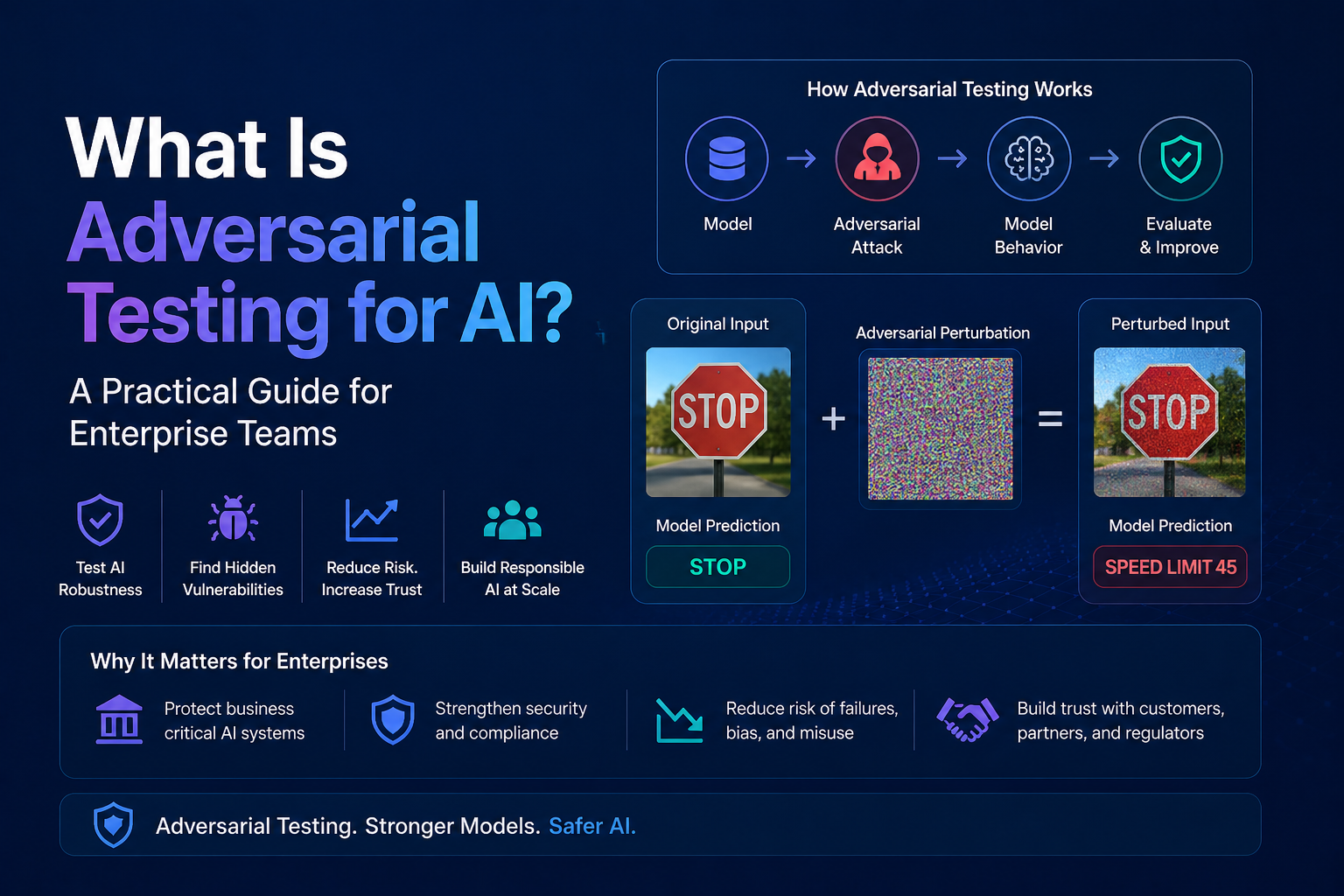
Let’s cut to the chase. Adversarial Testing for AI is a method of evaluating AI systems by exposing them to malicious or deceptive inputs designed to cause errors or unexpected behavior.
Think of it like stress-testing a bridge—but instead of heavy trucks, you’re throwing tricky, manipulated data at your AI model.
A Simple Example
Imagine an AI model that identifies images of cats and dogs. A slightly altered image—one that looks identical to a human—might cause the AI to misclassify a dog as a toaster. Sounds wild, right? That’s an adversarial attack.
Key Idea:
- The goal isn’t to break the system for fun
- It’s to find vulnerabilities before attackers exploit them
Why Adversarial Testing Matters in Enterprise AI
Here’s the thing—AI failures aren’t just technical glitches. In an enterprise setting, they can lead to:
- Financial losses
- Security breaches
- Compliance violations
- Reputational damage
Real Stakes, Real Consequences
For example:
- A fraud detection model could be bypassed
- A healthcare AI might misdiagnose due to manipulated inputs
- A chatbot could be exploited to leak sensitive data
That’s why understanding what is adversarial testing for AI isn’t just academic—it’s mission-critical.
Bottom line?
If your AI touches customers, money, or decisions, adversarial testing should be on your radar.
Common Types of Adversarial Attacks
Not all attacks are created equal. Let’s look at the usual suspects:
1. Evasion Attacks
These happen during inference (when the model is in use). Attackers tweak inputs to fool the model.
Example: Slightly modifying a transaction to bypass fraud detection.
2. Poisoning Attacks
Here, attackers mess with the training data.
Example: Injecting misleading data so the model learns the wrong patterns.
3. Model Extraction
Attackers try to reverse-engineer your model by querying it repeatedly.
4. Membership Inference
This attack determines whether a specific data point was used during training—raising privacy concerns.
How Adversarial Testing Works (Step-by-Step)
Alright, let’s get practical. Here’s how enterprise teams typically approach it:
Step 1: Define Objectives
What are you trying to protect?
- Data privacy?
- Model accuracy?
- System integrity?
Step 2: Identify Threat Models
Think like an attacker:
- What could they exploit?
- What access do they have?
Step 3: Generate Adversarial Inputs
Use tools or manual methods to create tricky inputs.
Step 4: Test the Model
Run the inputs and observe behavior:
- Does accuracy drop?
- Are outputs inconsistent?
Step 5: Analyze Weaknesses
Pinpoint where the model fails and why.
Step 6: Strengthen the Model
Apply fixes like:
- Adversarial training
- Input validation
- Model retraining
Real-World Examples of Adversarial Testing
Let’s make it real.
1. Autonomous Vehicles
Researchers have shown that small stickers on stop signs can trick AI into reading them as speed limit signs.
2. Financial Fraud Systems
Attackers tweak transaction patterns to avoid detection.
3. Facial Recognition
Minor pixel changes can fool systems into misidentifying people.
Best Practices for Enterprise Teams
Let’s not overcomplicate things. Here’s what actually works:
✔ Start Early
Don’t wait until deployment—build testing into development.
✔ Combine Human + Automated Testing
Automation is great, but human creativity catches edge cases.
✔ Continuously Monitor
Threats evolve. Your testing should too.
✔ Train Your Team
Make sure engineers understand both AI and security basics.
✔ Document Everything
From vulnerabilities to fixes—keep a clear record.
Challenges and Limitations
Now, let’s be real—this isn’t a walk in the park.
1. Complexity
AI systems are already complex. Testing them adds another layer.
2. Lack of Standardization
There’s no one-size-fits-all framework.
3. Resource Intensive
Time, tools, and talent—it all adds up.
4. Evolving Threat Landscape
Attack methods keep changing, so staying ahead is tough.
Still, the benefits far outweigh the headaches.
FAQs
1. What is adversarial testing for AI in simple terms?
It’s the process of testing AI systems with tricky or malicious inputs to uncover weaknesses.
2. Why is adversarial testing important for enterprises?
Because AI failures can lead to financial loss, security risks, and compliance issues.
3. Can all AI models be tested adversarially?
Yes, but the methods and tools may vary depending on the model type.
4. Is adversarial testing expensive?
It can be resource-intensive, but the cost of not doing it is often much higher.
5. Are there standards for adversarial testing?
Some guidelines exist (like from NIST: https://www.nist.gov), but no universal standard yet.
Wrapping It All Up: Stay Ahead of the Game
AI isn’t going anywhere—and neither are the risks that come with it. Understanding what is adversarial testing for AI gives enterprise teams a serious edge. It’s not about paranoia; it’s about preparation.
By proactively testing your systems, you’re not just fixing bugs—you’re building trust, resilience, and long-term reliability.
So, where do you go from here? Start small. Pick one model. Run a few tests. Learn from the results. Before you know it, adversarial testing will become second nature in your AI strategy.
And honestly, in today’s landscape, that’s not just smart—it’s essential.
Stop guessing.
Start measuring.
Join teams building reliable AI with TruEval. Start with a free trial, no credit card required. Get your first evaluation running in under 10 minutes.
Questions about Trusys?
Our team is here to help. Schedule a personalized demo to see how Trusys fits your specific use case.
Book a Demo

Ready to dive in?
Check out our documentation and tutorials. Get started with example datasets and evaluation templates.
Start Free Trial
Free Trial
No credit card required
10 Min
To first evaluation
24/7
Enterprise support


Benefits
Specifications
How-to
Contact Us
Learn More

What Is Adversarial Testing for AI? A Practical Guide for Enterprise Teams
2026-05-05
Introduction
AI is everywhere these days—powering recommendations, automating workflows, and even making critical business decisions. But here’s the catch: AI systems aren’t bulletproof. In fact, they can be surprisingly fragile when exposed to cleverly crafted inputs. That’s where Adversarial Testing for AI steps in.
So, what is adversarial testing for AI, really? In simple terms, it’s the process of intentionally trying to “trick” an AI system to uncover weaknesses before bad actors do. For enterprise teams relying on AI, this isn’t just a nice-to-have—it’s essential.
In this guide, we’ll break things down in plain English, explore real-world examples, and show you how to implement adversarial testing without getting lost in technical jargon.
What Is Adversarial Testing for AI?
Let’s cut to the chase. Adversarial Testing for AI is a method of evaluating AI systems by exposing them to malicious or deceptive inputs designed to cause errors or unexpected behavior.
Think of it like stress-testing a bridge—but instead of heavy trucks, you’re throwing tricky, manipulated data at your AI model.
A Simple Example
Imagine an AI model that identifies images of cats and dogs. A slightly altered image—one that looks identical to a human—might cause the AI to misclassify a dog as a toaster. Sounds wild, right? That’s an adversarial attack.
Key Idea:
- The goal isn’t to break the system for fun
- It’s to find vulnerabilities before attackers exploit them
Why Adversarial Testing Matters in Enterprise AI
Here’s the thing—AI failures aren’t just technical glitches. In an enterprise setting, they can lead to:
- Financial losses
- Security breaches
- Compliance violations
- Reputational damage
Real Stakes, Real Consequences
For example:
- A fraud detection model could be bypassed
- A healthcare AI might misdiagnose due to manipulated inputs
- A chatbot could be exploited to leak sensitive data
That’s why understanding what is adversarial testing for AI isn’t just academic—it’s mission-critical.
Bottom line?
If your AI touches customers, money, or decisions, adversarial testing should be on your radar.
Common Types of Adversarial Attacks
Not all attacks are created equal. Let’s look at the usual suspects:
1. Evasion Attacks
These happen during inference (when the model is in use). Attackers tweak inputs to fool the model.
Example: Slightly modifying a transaction to bypass fraud detection.
2. Poisoning Attacks
Here, attackers mess with the training data.
Example: Injecting misleading data so the model learns the wrong patterns.
3. Model Extraction
Attackers try to reverse-engineer your model by querying it repeatedly.
4. Membership Inference
This attack determines whether a specific data point was used during training—raising privacy concerns.
How Adversarial Testing Works (Step-by-Step)
Alright, let’s get practical. Here’s how enterprise teams typically approach it:
Step 1: Define Objectives
What are you trying to protect?
- Data privacy?
- Model accuracy?
- System integrity?
Step 2: Identify Threat Models
Think like an attacker:
- What could they exploit?
- What access do they have?
Step 3: Generate Adversarial Inputs
Use tools or manual methods to create tricky inputs.
Step 4: Test the Model
Run the inputs and observe behavior:
- Does accuracy drop?
- Are outputs inconsistent?
Step 5: Analyze Weaknesses
Pinpoint where the model fails and why.
Step 6: Strengthen the Model
Apply fixes like:
- Adversarial training
- Input validation
- Model retraining
Real-World Examples of Adversarial Testing
Let’s make it real.
1. Autonomous Vehicles
Researchers have shown that small stickers on stop signs can trick AI into reading them as speed limit signs.
2. Financial Fraud Systems
Attackers tweak transaction patterns to avoid detection.
3. Facial Recognition
Minor pixel changes can fool systems into misidentifying people.
Best Practices for Enterprise Teams
Let’s not overcomplicate things. Here’s what actually works:
✔ Start Early
Don’t wait until deployment—build testing into development.
✔ Combine Human + Automated Testing
Automation is great, but human creativity catches edge cases.
✔ Continuously Monitor
Threats evolve. Your testing should too.
✔ Train Your Team
Make sure engineers understand both AI and security basics.
✔ Document Everything
From vulnerabilities to fixes—keep a clear record.
Challenges and Limitations
Now, let’s be real—this isn’t a walk in the park.
1. Complexity
AI systems are already complex. Testing them adds another layer.
2. Lack of Standardization
There’s no one-size-fits-all framework.
3. Resource Intensive
Time, tools, and talent—it all adds up.
4. Evolving Threat Landscape
Attack methods keep changing, so staying ahead is tough.
Still, the benefits far outweigh the headaches.
FAQs
1. What is adversarial testing for AI in simple terms?
It’s the process of testing AI systems with tricky or malicious inputs to uncover weaknesses.
2. Why is adversarial testing important for enterprises?
Because AI failures can lead to financial loss, security risks, and compliance issues.
3. Can all AI models be tested adversarially?
Yes, but the methods and tools may vary depending on the model type.
4. Is adversarial testing expensive?
It can be resource-intensive, but the cost of not doing it is often much higher.
5. Are there standards for adversarial testing?
Some guidelines exist (like from NIST: https://www.nist.gov), but no universal standard yet.
Wrapping It All Up: Stay Ahead of the Game
AI isn’t going anywhere—and neither are the risks that come with it. Understanding what is adversarial testing for AI gives enterprise teams a serious edge. It’s not about paranoia; it’s about preparation.
By proactively testing your systems, you’re not just fixing bugs—you’re building trust, resilience, and long-term reliability.
So, where do you go from here? Start small. Pick one model. Run a few tests. Learn from the results. Before you know it, adversarial testing will become second nature in your AI strategy.
And honestly, in today’s landscape, that’s not just smart—it’s essential.
Stop guessing.
Start measuring.
Join teams building reliable AI with TruEval. Start with a free trial, no credit card required. Get your first evaluation running in under 10 minutes.
Questions about Trusys?
Our team is here to help. Schedule a personalized demo to see how Trusys fits your specific use case.
Book a Demo
Ready to dive in?
Check out our documentation and tutorials. Get started with example datasets and evaluation templates.
Start Free Trial
Free Trial
No credit card required
10 Min
To first evaluation
24/7
Enterprise support
What Is Adversarial Testing for AI? A Practical Guide for Enterprise Teams
2026-05-05
Introduction
AI is everywhere these days—powering recommendations, automating workflows, and even making critical business decisions. But here’s the catch: AI systems aren’t bulletproof. In fact, they can be surprisingly fragile when exposed to cleverly crafted inputs. That’s where Adversarial Testing for AI steps in.
So, what is adversarial testing for AI, really? In simple terms, it’s the process of intentionally trying to “trick” an AI system to uncover weaknesses before bad actors do. For enterprise teams relying on AI, this isn’t just a nice-to-have—it’s essential.
In this guide, we’ll break things down in plain English, explore real-world examples, and show you how to implement adversarial testing without getting lost in technical jargon.
What Is Adversarial Testing for AI?
Let’s cut to the chase. Adversarial Testing for AI is a method of evaluating AI systems by exposing them to malicious or deceptive inputs designed to cause errors or unexpected behavior.
Think of it like stress-testing a bridge—but instead of heavy trucks, you’re throwing tricky, manipulated data at your AI model.
A Simple Example
Imagine an AI model that identifies images of cats and dogs. A slightly altered image—one that looks identical to a human—might cause the AI to misclassify a dog as a toaster. Sounds wild, right? That’s an adversarial attack.
Key Idea:
- The goal isn’t to break the system for fun
- It’s to find vulnerabilities before attackers exploit them
Why Adversarial Testing Matters in Enterprise AI
Here’s the thing—AI failures aren’t just technical glitches. In an enterprise setting, they can lead to:
- Financial losses
- Security breaches
- Compliance violations
- Reputational damage
Real Stakes, Real Consequences
For example:
- A fraud detection model could be bypassed
- A healthcare AI might misdiagnose due to manipulated inputs
- A chatbot could be exploited to leak sensitive data
That’s why understanding what is adversarial testing for AI isn’t just academic—it’s mission-critical.
Bottom line?
If your AI touches customers, money, or decisions, adversarial testing should be on your radar.
Common Types of Adversarial Attacks
Not all attacks are created equal. Let’s look at the usual suspects:
1. Evasion Attacks
These happen during inference (when the model is in use). Attackers tweak inputs to fool the model.
Example: Slightly modifying a transaction to bypass fraud detection.
2. Poisoning Attacks
Here, attackers mess with the training data.
Example: Injecting misleading data so the model learns the wrong patterns.
3. Model Extraction
Attackers try to reverse-engineer your model by querying it repeatedly.
4. Membership Inference
This attack determines whether a specific data point was used during training—raising privacy concerns.
How Adversarial Testing Works (Step-by-Step)
Alright, let’s get practical. Here’s how enterprise teams typically approach it:
Step 1: Define Objectives
What are you trying to protect?
- Data privacy?
- Model accuracy?
- System integrity?
Step 2: Identify Threat Models
Think like an attacker:
- What could they exploit?
- What access do they have?
Step 3: Generate Adversarial Inputs
Use tools or manual methods to create tricky inputs.
Step 4: Test the Model
Run the inputs and observe behavior:
- Does accuracy drop?
- Are outputs inconsistent?
Step 5: Analyze Weaknesses
Pinpoint where the model fails and why.
Step 6: Strengthen the Model
Apply fixes like:
- Adversarial training
- Input validation
- Model retraining
Real-World Examples of Adversarial Testing
Let’s make it real.
1. Autonomous Vehicles
Researchers have shown that small stickers on stop signs can trick AI into reading them as speed limit signs.
2. Financial Fraud Systems
Attackers tweak transaction patterns to avoid detection.
3. Facial Recognition
Minor pixel changes can fool systems into misidentifying people.
Best Practices for Enterprise Teams
Let’s not overcomplicate things. Here’s what actually works:
✔ Start Early
Don’t wait until deployment—build testing into development.
✔ Combine Human + Automated Testing
Automation is great, but human creativity catches edge cases.
✔ Continuously Monitor
Threats evolve. Your testing should too.
✔ Train Your Team
Make sure engineers understand both AI and security basics.
✔ Document Everything
From vulnerabilities to fixes—keep a clear record.
Challenges and Limitations
Now, let’s be real—this isn’t a walk in the park.
1. Complexity
AI systems are already complex. Testing them adds another layer.
2. Lack of Standardization
There’s no one-size-fits-all framework.
3. Resource Intensive
Time, tools, and talent—it all adds up.
4. Evolving Threat Landscape
Attack methods keep changing, so staying ahead is tough.
Still, the benefits far outweigh the headaches.
FAQs
1. What is adversarial testing for AI in simple terms?
It’s the process of testing AI systems with tricky or malicious inputs to uncover weaknesses.
2. Why is adversarial testing important for enterprises?
Because AI failures can lead to financial loss, security risks, and compliance issues.
3. Can all AI models be tested adversarially?
Yes, but the methods and tools may vary depending on the model type.
4. Is adversarial testing expensive?
It can be resource-intensive, but the cost of not doing it is often much higher.
5. Are there standards for adversarial testing?
Some guidelines exist (like from NIST: https://www.nist.gov), but no universal standard yet.
Wrapping It All Up: Stay Ahead of the Game
AI isn’t going anywhere—and neither are the risks that come with it. Understanding what is adversarial testing for AI gives enterprise teams a serious edge. It’s not about paranoia; it’s about preparation.
By proactively testing your systems, you’re not just fixing bugs—you’re building trust, resilience, and long-term reliability.
So, where do you go from here? Start small. Pick one model. Run a few tests. Learn from the results. Before you know it, adversarial testing will become second nature in your AI strategy.
And honestly, in today’s landscape, that’s not just smart—it’s essential.
Stop guessing.
Start measuring.
Join teams building reliable AI with Trusys. Start with a free trial, no credit card required. Get your first evaluation running in under 10 minutes.
Questions about Trusys?
Our team is here to help. Schedule a personalized demo to see how Trusys fits your specific use case.
Book a Demo

Ready to dive in?
Check out our documentation and tutorials. Get started with example datasets and evaluation templates.
Start Free Trial
Free Trial
No credit card required
10 Min
to get started
24/7
Enterprise support