How to Build an AI Agent Audit Trail That Survives a Regulator Review
Written by

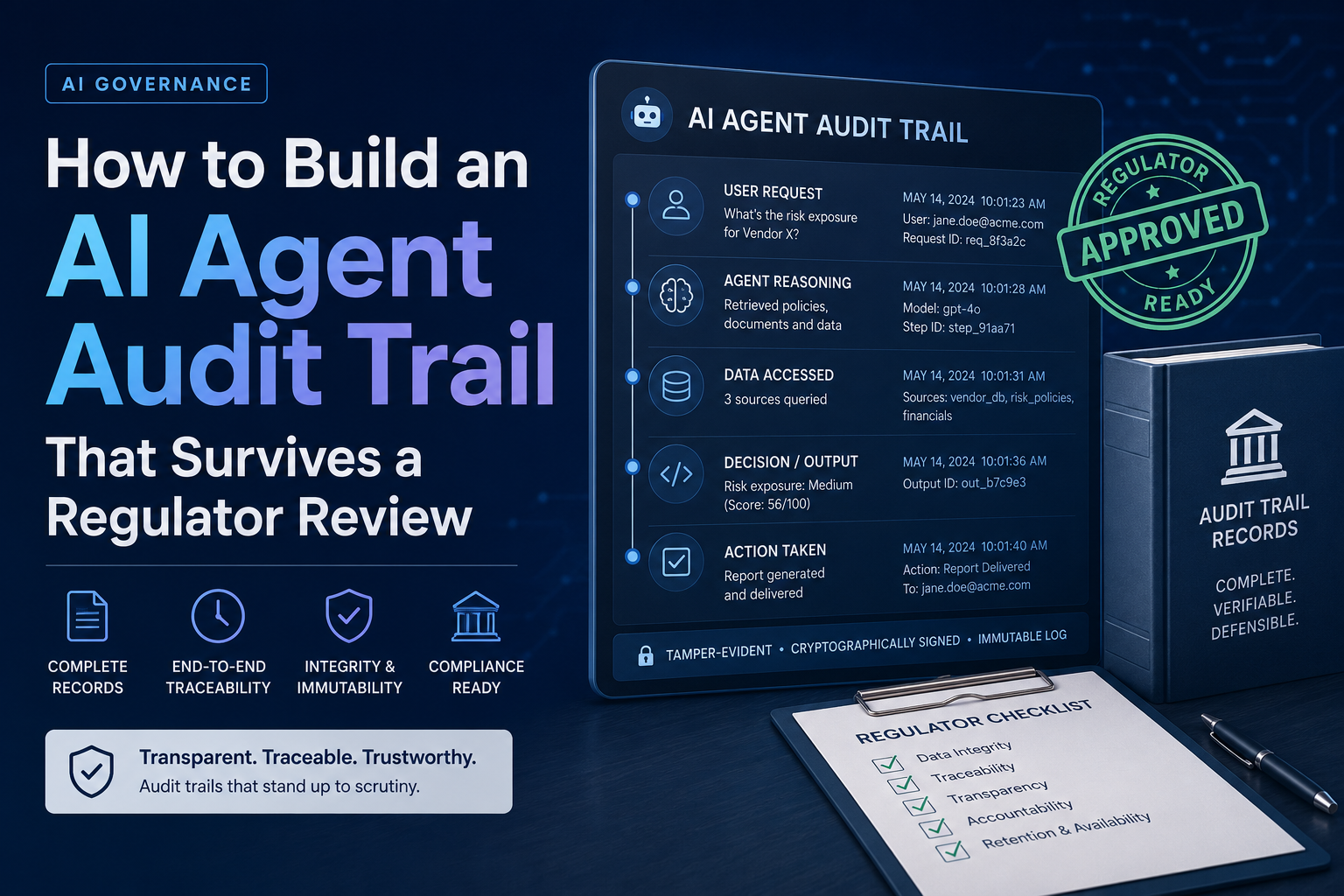
The Silent Infrastructure Crisis Behind Enterprise AI
AI agents are rapidly moving from experimentation to production. Unlike traditional AI models that simply generate predictions or content, agentic AI systems can make decisions, call tools, access enterprise data, interact with external systems, and execute multi-step workflows with minimal human intervention.
This new level of autonomy creates tremendous opportunities—but it also introduces new governance challenges.
For regulators, compliance teams, auditors, and enterprise risk managers, one question increasingly matters:
Can your organization explain exactly why an AI agent took a particular action six months ago?
If the answer is no, your organization may face significant compliance, operational, and reputational risks.
An AI Agent Audit Trail provides the evidence required to reconstruct decisions, demonstrate accountability, investigate incidents, and prove compliance with internal and external governance requirements.
This guide explains how to build an AI Agent Audit Trail that not only satisfies enterprise governance needs but can also withstand scrutiny during a regulator review.
What Is an AI Agent Audit Trail?
AI Agents Multiply Infrastructure Load
AI agents introduce an entirely new scaling challenge.
Unlike a traditional user making one request at a time, AI agents may:
- Trigger multiple chained prompts
- Query several models simultaneously
- Retry failed requests autonomously
- Launch recursive workflows
One user action can suddenly generate dozens of inference operations.
Without workload controls, traffic amplification becomes unavoidable.
Traditional Logs vs AI Agent Audit Trails
Traditional Logs
User actions
API requests
System events
Error logs
Infrastructure monitoring
Application traces
AI Agent Audit Trail
User and agent actions
Tool calls and execution records
Decision chains and reasoning steps
Risk and policy violations
Governance and compliance evidence
End-to-end accountability records
A regulator investigating an AI-driven decision typically wants more than system logs. They need evidence showing:
- What information the agent received
- Which tools it accessed
- What decisions it made
- Which policies were evaluated
- Whether human oversight occurred
- What outcome was ultimately produced
An effective AI Agent Audit Trail answers all of these questions.

Why Regulators Are Focusing on AI Agents
Regulators worldwide increasingly recognize that autonomous AI systems introduce risks beyond those posed by traditional software.
Unlike deterministic applications, AI agents can:
- Adapt behavior dynamically
- Chain multiple actions together
- Access sensitive enterprise systems
- Interact with customers independently
- Make decisions with significant business impact
As organizations deploy AI agents across customer service, healthcare, finance, cybersecurity, HR, and operations, regulators are demanding greater transparency and accountability.
Key Regulatory Concerns
AI Agents Multiply Infrastructure Load
AI agents introduce an entirely new scaling challenge.
Unlike a traditional user making one request at a time, AI agents may:
- Trigger multiple chained prompts
- Query several models simultaneously
- Retry failed requests autonomously
- Launch recursive workflows
One user action can suddenly generate dozens of inference operations.
Without workload controls, traffic amplification becomes unavoidable.
The 8 Components of a Regulator-Ready AI Agent Audit Trail

1. Agent Identity Tracking
Why Rate Limit Failures Are So Dangerous
Many organizations still treat rate limit errors as minor API inconveniences.
That assumption is becoming expensive.
In reality, rate limit failures create cascading operational disruption across the enterprise.
2. Prompt and Context Capture
Why Rate Limit Failures Are So Dangerous
Many organizations still treat rate limit errors as minor API inconveniences.
That assumption is becoming expensive.
In reality, rate limit failures create cascading operational disruption across the enterprise.
3. Tool Call Logging
Why Rate Limit Failures Are So Dangerous
Many organizations still treat rate limit errors as minor API inconveniences.
That assumption is becoming expensive.
In reality, rate limit failures create cascading operational disruption across the enterprise.
4. Decision Chain Recording
Why Rate Limit Failures Are So Dangerous
Many organizations still treat rate limit errors as minor API inconveniences.
That assumption is becoming expensive.
In reality, rate limit failures create cascading operational disruption across the enterprise.
Frequently Asked Questions
AI Agents Multiply Infrastructure Load
AI agents introduce an entirely new scaling challenge.
Unlike a traditional user making one request at a time, AI agents may:
- Trigger multiple chained prompts
- Query several models simultaneously
- Retry failed requests autonomously
- Launch recursive workflows
One user action can suddenly generate dozens of inference operations.
Without workload controls, traffic amplification becomes unavoidable.
AI Agents Multiply Infrastructure Load
AI agents introduce an entirely new scaling challenge.
Unlike a traditional user making one request at a time, AI agents may:
- Trigger multiple chained prompts
- Query several models simultaneously
- Retry failed requests autonomously
- Launch recursive workflows
One user action can suddenly generate dozens of inference operations.
Without workload controls, traffic amplification becomes unavoidable.
AI Agents Multiply Infrastructure Load
AI agents introduce an entirely new scaling challenge.
Unlike a traditional user making one request at a time, AI agents may:
- Trigger multiple chained prompts
- Query several models simultaneously
- Retry failed requests autonomously
- Launch recursive workflows
One user action can suddenly generate dozens of inference operations.
Without workload controls, traffic amplification becomes unavoidable.
AI Agents Multiply Infrastructure Load
AI agents introduce an entirely new scaling challenge.
Unlike a traditional user making one request at a time, AI agents may:
- Trigger multiple chained prompts
- Query several models simultaneously
- Retry failed requests autonomously
- Launch recursive workflows
One user action can suddenly generate dozens of inference operations.
Without workload controls, traffic amplification becomes unavoidable.
AI Agents Multiply Infrastructure Load
AI agents introduce an entirely new scaling challenge.
Unlike a traditional user making one request at a time, AI agents may:
- Trigger multiple chained prompts
- Query several models simultaneously
- Retry failed requests autonomously
- Launch recursive workflows
One user action can suddenly generate dozens of inference operations.
Without workload controls, traffic amplification becomes unavoidable.
AI Agents Multiply Infrastructure Load
AI agents introduce an entirely new scaling challenge.
Unlike a traditional user making one request at a time, AI agents may:
- Trigger multiple chained prompts
- Query several models simultaneously
- Retry failed requests autonomously
- Launch recursive workflows
One user action can suddenly generate dozens of inference operations.
Without workload controls, traffic amplification becomes unavoidable.
AI Agents Multiply Infrastructure Load
AI agents introduce an entirely new scaling challenge.
Unlike a traditional user making one request at a time, AI agents may:
- Trigger multiple chained prompts
- Query several models simultaneously
- Retry failed requests autonomously
- Launch recursive workflows
One user action can suddenly generate dozens of inference operations.
Without workload controls, traffic amplification becomes unavoidable.
AI Agents Multiply Infrastructure Load
AI agents introduce an entirely new scaling challenge.
Unlike a traditional user making one request at a time, AI agents may:
- Trigger multiple chained prompts
- Query several models simultaneously
- Retry failed requests autonomously
- Launch recursive workflows
One user action can suddenly generate dozens of inference operations.
Without workload controls, traffic amplification becomes unavoidable.
AI Agents Multiply Infrastructure Load
AI agents introduce an entirely new scaling challenge.
Unlike a traditional user making one request at a time, AI agents may:
- Trigger multiple chained prompts
- Query several models simultaneously
- Retry failed requests autonomously
- Launch recursive workflows
One user action can suddenly generate dozens of inference operations.
Without workload controls, traffic amplification becomes unavoidable.
AI Agents Multiply Infrastructure Load
AI agents introduce an entirely new scaling challenge.
Unlike a traditional user making one request at a time, AI agents may:
- Trigger multiple chained prompts
- Query several models simultaneously
- Retry failed requests autonomously
- Launch recursive workflows
One user action can suddenly generate dozens of inference operations.
Without workload controls, traffic amplification becomes unavoidable.
5. Human-in-the-Loop Oversight
Why Rate Limit Failures Are So Dangerous
Many organizations still treat rate limit errors as minor API inconveniences.
That assumption is becoming expensive.
In reality, rate limit failures create cascading operational disruption across the enterprise.
6. Policy Enforcement Events
Why Rate Limit Failures Are So Dangerous
Many organizations still treat rate limit errors as minor API inconveniences.
That assumption is becoming expensive.
In reality, rate limit failures create cascading operational disruption across the enterprise.
7. Data Lineage Tracking
Why Rate Limit Failures Are So Dangerous
Many organizations still treat rate limit errors as minor API inconveniences.
That assumption is becoming expensive.
In reality, rate limit failures create cascading operational disruption across the enterprise.
8. Immutable Audit Storage
Why Rate Limit Failures Are So Dangerous
Many organizations still treat rate limit errors as minor API inconveniences.
That assumption is becoming expensive.
In reality, rate limit failures create cascading operational disruption across the enterprise.
Common AI Agent Audit Trail Failures
Why Rate Limit Failures Are So Dangerous
Many organizations still treat rate limit errors as minor API inconveniences.
That assumption is becoming expensive.
In reality, rate limit failures create cascading operational disruption across the enterprise.
Architecture for Enterprise AI Agent Audit Trails
Why Rate Limit Failures Are So Dangerous
Many organizations still treat rate limit errors as minor API inconveniences.
That assumption is becoming expensive.
In reality, rate limit failures create cascading operational disruption across the enterprise.
AI Agent Audit Trail Checklist
Why Rate Limit Failures Are So Dangerous
Many organizations still treat rate limit errors as minor API inconveniences.
That assumption is becoming expensive.
In reality, rate limit failures create cascading operational disruption across the enterprise.
Continuous Governance vs Point-in-Time Audits
Why Rate Limit Failures Are So Dangerous
Many organizations still treat rate limit errors as minor API inconveniences.
That assumption is becoming expensive.
In reality, rate limit failures create cascading operational disruption across the enterprise.
Conclusion
Why Rate Limit Failures Are So Dangerous
Many organizations still treat rate limit errors as minor API inconveniences.
That assumption is becoming expensive.
In reality, rate limit failures create cascading operational disruption across the enterprise.
Stop guessing.
Start measuring.
Join teams building reliable AI with TruEval. Start with a free trial, no credit card required. Get your first evaluation running in under 10 minutes.
Questions about Trusys?
Our team is here to help. Schedule a personalized demo to see how Trusys fits your specific use case.
Book a Demo

Ready to dive in?
Check out our documentation and tutorials. Get started with example datasets and evaluation templates.
Start Free Trial
Free Trial
No credit card required
10 Min
To first evaluation
24/7
Enterprise support


Benefits
Specifications
How-to
Contact Us
Learn More

How to Build an AI Agent Audit Trail That Survives a Regulator Review
Written by
The Silent Infrastructure Crisis Behind Enterprise AI
AI agents are rapidly moving from experimentation to production. Unlike traditional AI models that simply generate predictions or content, agentic AI systems can make decisions, call tools, access enterprise data, interact with external systems, and execute multi-step workflows with minimal human intervention.
This new level of autonomy creates tremendous opportunities—but it also introduces new governance challenges.
For regulators, compliance teams, auditors, and enterprise risk managers, one question increasingly matters:
Can your organization explain exactly why an AI agent took a particular action six months ago?
If the answer is no, your organization may face significant compliance, operational, and reputational risks.
An AI Agent Audit Trail provides the evidence required to reconstruct decisions, demonstrate accountability, investigate incidents, and prove compliance with internal and external governance requirements.
This guide explains how to build an AI Agent Audit Trail that not only satisfies enterprise governance needs but can also withstand scrutiny during a regulator review.
What Is an AI Agent Audit Trail?
AI Agents Multiply Infrastructure Load
AI agents introduce an entirely new scaling challenge.
Unlike a traditional user making one request at a time, AI agents may:
- Trigger multiple chained prompts
- Query several models simultaneously
- Retry failed requests autonomously
- Launch recursive workflows
One user action can suddenly generate dozens of inference operations.
Without workload controls, traffic amplification becomes unavoidable.
Traditional Logs vs AI Agent Audit Trails
Traditional Logs
User actions
API requests
System events
Error logs
Infrastructure monitoring
Application traces
AI Agent Audit Trail
User and agent actions
Tool calls and execution records
Decision chains and reasoning steps
Risk and policy violations
Governance and compliance evidence
End-to-end accountability records
A regulator investigating an AI-driven decision typically wants more than system logs. They need evidence showing:
- What information the agent received
- Which tools it accessed
- What decisions it made
- Which policies were evaluated
- Whether human oversight occurred
- What outcome was ultimately produced
An effective AI Agent Audit Trail answers all of these questions.

Why Regulators Are Focusing on AI Agents
Regulators worldwide increasingly recognize that autonomous AI systems introduce risks beyond those posed by traditional software.
Unlike deterministic applications, AI agents can:
- Adapt behavior dynamically
- Chain multiple actions together
- Access sensitive enterprise systems
- Interact with customers independently
- Make decisions with significant business impact
As organizations deploy AI agents across customer service, healthcare, finance, cybersecurity, HR, and operations, regulators are demanding greater transparency and accountability.
Key Regulatory Concerns
AI Agents Multiply Infrastructure Load
AI agents introduce an entirely new scaling challenge.
Unlike a traditional user making one request at a time, AI agents may:
- Trigger multiple chained prompts
- Query several models simultaneously
- Retry failed requests autonomously
- Launch recursive workflows
One user action can suddenly generate dozens of inference operations.
Without workload controls, traffic amplification becomes unavoidable.
The 8 Components of a Regulator-Ready AI Agent Audit Trail

1. Agent Identity Tracking
Why Rate Limit Failures Are So Dangerous
Many organizations still treat rate limit errors as minor API inconveniences.
That assumption is becoming expensive.
In reality, rate limit failures create cascading operational disruption across the enterprise.
2. Prompt and Context Capture
Why Rate Limit Failures Are So Dangerous
Many organizations still treat rate limit errors as minor API inconveniences.
That assumption is becoming expensive.
In reality, rate limit failures create cascading operational disruption across the enterprise.
3. Tool Call Logging
Why Rate Limit Failures Are So Dangerous
Many organizations still treat rate limit errors as minor API inconveniences.
That assumption is becoming expensive.
In reality, rate limit failures create cascading operational disruption across the enterprise.
4. Decision Chain Recording
Why Rate Limit Failures Are So Dangerous
Many organizations still treat rate limit errors as minor API inconveniences.
That assumption is becoming expensive.
In reality, rate limit failures create cascading operational disruption across the enterprise.
Frequently Asked Questions
AI Agents Multiply Infrastructure Load
AI agents introduce an entirely new scaling challenge.
Unlike a traditional user making one request at a time, AI agents may:
- Trigger multiple chained prompts
- Query several models simultaneously
- Retry failed requests autonomously
- Launch recursive workflows
One user action can suddenly generate dozens of inference operations.
Without workload controls, traffic amplification becomes unavoidable.
AI Agents Multiply Infrastructure Load
AI agents introduce an entirely new scaling challenge.
Unlike a traditional user making one request at a time, AI agents may:
- Trigger multiple chained prompts
- Query several models simultaneously
- Retry failed requests autonomously
- Launch recursive workflows
One user action can suddenly generate dozens of inference operations.
Without workload controls, traffic amplification becomes unavoidable.
AI Agents Multiply Infrastructure Load
AI agents introduce an entirely new scaling challenge.
Unlike a traditional user making one request at a time, AI agents may:
- Trigger multiple chained prompts
- Query several models simultaneously
- Retry failed requests autonomously
- Launch recursive workflows
One user action can suddenly generate dozens of inference operations.
Without workload controls, traffic amplification becomes unavoidable.
AI Agents Multiply Infrastructure Load
AI agents introduce an entirely new scaling challenge.
Unlike a traditional user making one request at a time, AI agents may:
- Trigger multiple chained prompts
- Query several models simultaneously
- Retry failed requests autonomously
- Launch recursive workflows
One user action can suddenly generate dozens of inference operations.
Without workload controls, traffic amplification becomes unavoidable.
AI Agents Multiply Infrastructure Load
AI agents introduce an entirely new scaling challenge.
Unlike a traditional user making one request at a time, AI agents may:
- Trigger multiple chained prompts
- Query several models simultaneously
- Retry failed requests autonomously
- Launch recursive workflows
One user action can suddenly generate dozens of inference operations.
Without workload controls, traffic amplification becomes unavoidable.
AI Agents Multiply Infrastructure Load
AI agents introduce an entirely new scaling challenge.
Unlike a traditional user making one request at a time, AI agents may:
- Trigger multiple chained prompts
- Query several models simultaneously
- Retry failed requests autonomously
- Launch recursive workflows
One user action can suddenly generate dozens of inference operations.
Without workload controls, traffic amplification becomes unavoidable.
AI Agents Multiply Infrastructure Load
AI agents introduce an entirely new scaling challenge.
Unlike a traditional user making one request at a time, AI agents may:
- Trigger multiple chained prompts
- Query several models simultaneously
- Retry failed requests autonomously
- Launch recursive workflows
One user action can suddenly generate dozens of inference operations.
Without workload controls, traffic amplification becomes unavoidable.
AI Agents Multiply Infrastructure Load
AI agents introduce an entirely new scaling challenge.
Unlike a traditional user making one request at a time, AI agents may:
- Trigger multiple chained prompts
- Query several models simultaneously
- Retry failed requests autonomously
- Launch recursive workflows
One user action can suddenly generate dozens of inference operations.
Without workload controls, traffic amplification becomes unavoidable.
AI Agents Multiply Infrastructure Load
AI agents introduce an entirely new scaling challenge.
Unlike a traditional user making one request at a time, AI agents may:
- Trigger multiple chained prompts
- Query several models simultaneously
- Retry failed requests autonomously
- Launch recursive workflows
One user action can suddenly generate dozens of inference operations.
Without workload controls, traffic amplification becomes unavoidable.
AI Agents Multiply Infrastructure Load
AI agents introduce an entirely new scaling challenge.
Unlike a traditional user making one request at a time, AI agents may:
- Trigger multiple chained prompts
- Query several models simultaneously
- Retry failed requests autonomously
- Launch recursive workflows
One user action can suddenly generate dozens of inference operations.
Without workload controls, traffic amplification becomes unavoidable.
5. Human-in-the-Loop Oversight
Why Rate Limit Failures Are So Dangerous
Many organizations still treat rate limit errors as minor API inconveniences.
That assumption is becoming expensive.
In reality, rate limit failures create cascading operational disruption across the enterprise.
6. Policy Enforcement Events
Why Rate Limit Failures Are So Dangerous
Many organizations still treat rate limit errors as minor API inconveniences.
That assumption is becoming expensive.
In reality, rate limit failures create cascading operational disruption across the enterprise.
7. Data Lineage Tracking
Why Rate Limit Failures Are So Dangerous
Many organizations still treat rate limit errors as minor API inconveniences.
That assumption is becoming expensive.
In reality, rate limit failures create cascading operational disruption across the enterprise.
8. Immutable Audit Storage
Why Rate Limit Failures Are So Dangerous
Many organizations still treat rate limit errors as minor API inconveniences.
That assumption is becoming expensive.
In reality, rate limit failures create cascading operational disruption across the enterprise.
Common AI Agent Audit Trail Failures
Why Rate Limit Failures Are So Dangerous
Many organizations still treat rate limit errors as minor API inconveniences.
That assumption is becoming expensive.
In reality, rate limit failures create cascading operational disruption across the enterprise.
Architecture for Enterprise AI Agent Audit Trails
Why Rate Limit Failures Are So Dangerous
Many organizations still treat rate limit errors as minor API inconveniences.
That assumption is becoming expensive.
In reality, rate limit failures create cascading operational disruption across the enterprise.
AI Agent Audit Trail Checklist
Why Rate Limit Failures Are So Dangerous
Many organizations still treat rate limit errors as minor API inconveniences.
That assumption is becoming expensive.
In reality, rate limit failures create cascading operational disruption across the enterprise.
Continuous Governance vs Point-in-Time Audits
Why Rate Limit Failures Are So Dangerous
Many organizations still treat rate limit errors as minor API inconveniences.
That assumption is becoming expensive.
In reality, rate limit failures create cascading operational disruption across the enterprise.
Conclusion
Why Rate Limit Failures Are So Dangerous
Many organizations still treat rate limit errors as minor API inconveniences.
That assumption is becoming expensive.
In reality, rate limit failures create cascading operational disruption across the enterprise.
Stop guessing.
Start measuring.
Join teams building reliable AI with TruEval. Start with a free trial, no credit card required. Get your first evaluation running in under 10 minutes.
Questions about Trusys?
Our team is here to help. Schedule a personalized demo to see how Trusys fits your specific use case.
Book a Demo
Ready to dive in?
Check out our documentation and tutorials. Get started with example datasets and evaluation templates.
Start Free Trial
Free Trial
No credit card required
10 Min
To first evaluation
24/7
Enterprise support
How to Build an AI Agent Audit Trail That Survives a Regulator Review
Written by
Manish Tewari
Published on
June 06, 2026
The Silent Infrastructure Crisis Behind Enterprise AI
AI agents are rapidly moving from experimentation to production. Unlike traditional AI models that simply generate predictions or content, agentic AI systems can make decisions, call tools, access enterprise data, interact with external systems, and execute multi-step workflows with minimal human intervention.
This new level of autonomy creates tremendous opportunities—but it also introduces new governance challenges.
For regulators, compliance teams, auditors, and enterprise risk managers, one question increasingly matters:
Can your organization explain exactly why an AI agent took a particular action six months ago?
If the answer is no, your organization may face significant compliance, operational, and reputational risks.
An AI Agent Audit Trail provides the evidence required to reconstruct decisions, demonstrate accountability, investigate incidents, and prove compliance with internal and external governance requirements.
This guide explains how to build an AI Agent Audit Trail that not only satisfies enterprise governance needs but can also withstand scrutiny during a regulator review.


What Is an AI Agent Audit Trail?
An AI Agent Audit Trail is a comprehensive record of every significant action, decision, interaction, and policy event associated with an AI agent.
Unlike traditional application logs, an AI Agent Audit Trail captures the full context surrounding agent behavior.
Traditional Logs vs AI Agent Audit Trails
Traditional Logs
User actions
API requests
System events
Error logs
Infrastructure monitoring
Application traces
AI Agent Audit Trail
User and agent actions
Tool calls and execution records
Decision chains and reasoning steps
Risk and policy violations
Governance and compliance evidence
End-to-end accountability records
A regulator investigating an AI-driven decision typically wants more than system logs. They need evidence showing:
- What information the agent received
- Which tools it accessed
- What decisions it made
- Which policies were evaluated
- Whether human oversight occurred
- What outcome was ultimately produced
An effective AI Agent Audit Trail answers all of these questions.
Why Regulators Are Focusing on AI Agents
Regulators worldwide increasingly recognize that autonomous AI systems introduce risks beyond those posed by traditional software.
Unlike deterministic applications, AI agents can:
- Adapt behavior dynamically
- Chain multiple actions together
- Access sensitive enterprise systems
- Interact with customers independently
- Make decisions with significant business impact
As organizations deploy AI agents across customer service, healthcare, finance, cybersecurity, HR, and operations, regulators are demanding greater transparency and accountability.
Key Regulatory Concerns
Accountability
Organizations must identify who is responsible when an AI agent causes harm, makes an incorrect recommendation, or violates policy.
Traceability
Auditors need evidence showing how decisions were made.
Human Oversight
Many governance frameworks require humans to remain involved in high-risk decisions.
Risk Management
Enterprises must demonstrate ongoing monitoring and control of AI systems.
Data Governance
Regulators increasingly expect organizations to document how data is accessed, processed, and used by AI systems.
The result is clear:
If your AI agents are making decisions, you need evidence explaining those decisions.
The 8 Components of a Regulator-Ready AI Agent Audit Trail
1. Agent Identity Tracking
Every audit trail should begin by identifying the agent responsible for an action.
Record:
- Agent name
- Agent ID
- Version number
- Deployment environment
- Assigned permissions
- Owner or responsible team
Why Regulators Care
Without clear agent identification, organizations cannot establish accountability.
Common Mistake
Many organizations track user identities but fail to record which agent version performed a specific task.
Best Practice
Treat AI agents like human employees by assigning unique identities and maintaining detailed lifecycle records.
2. Prompt and Context Capture
Capturing prompts alone is insufficient.
Organizations must preserve the complete context influencing agent behavior.
This includes:
- User instructions
- System prompts
- Memory state
- Retrieved documents
- Knowledge base references
- Previous conversation history
Why Regulators Care
An agent's output can only be understood when evaluated alongside the context it received.
Common Mistake
Storing prompts while discarding retrieval results or contextual information.
Best Practice
Capture the entire decision environment, not just the final instruction.
3. Tool Call Logging
Modern AI agents frequently interact with external systems.
Examples include:
- CRM platforms
- Databases
- ERP systems
- Ticketing systems
- Financial applications
- Internal APIs
Each interaction should be logged.
Record:
- Tool name
- Access time
- Input parameters
- Output received
- Success or failure status
- User associated with the request
Why Regulators Care
External actions often carry real-world consequences.
A regulator may ask:
- Which systems were accessed?
- What information was retrieved?
- What actions were executed?
Best Practice
Log every tool invocation as a first-class audit event.
4. Decision Chain Recording
One of the defining characteristics of agentic AI is multi-step reasoning.
An AI agent may:
- Analyze a request
- Generate a plan
- Retrieve data
- Evaluate options
- Execute actions
- Deliver results
An audit trail should record each step.
Why Regulators Care
Final outputs alone rarely explain why a decision occurred.
Common Mistake
Only logging the final response.
Best Practice
Capture task decomposition, planning stages, execution paths, and intermediate decisions.
5. Human-in-the-Loop Oversight
Certain actions should require human review before execution.
Examples include:
- Financial approvals
- Medical recommendations
- Legal decisions
- Employee disciplinary actions
Audit records should include:
- Approval requests
- Reviewer identity
- Approval timestamps
- Rejections
- Overrides
- Escalations
Why Regulators Care
Human oversight is a core principle across many AI governance frameworks.
Best Practice
Create immutable records showing where human intervention occurred.
6. Policy Enforcement Events
Every governance control applied to an AI agent should generate an auditable record.
Examples include:
- Privacy policy checks
- Data classification controls
- Security guardrails
- Content moderation rules
- Risk scoring events
- Compliance evaluations
Why Regulators Care
Organizations must demonstrate that governance controls are not merely documented but actively enforced.
Common Mistake
Logging violations while ignoring successful policy evaluations.
Best Practice
Capture every policy decision, whether it passes or fails.
7. Data Lineage Tracking
AI agents increasingly rely on enterprise knowledge sources.
Organizations must understand:
- Where data originated
- Which documents influenced decisions
- What information was accessed
- How data flowed through workflows
Why Regulators Care
Data provenance is essential for accountability and compliance.
Record
- Source systems
- Retrieved documents
- Database queries
- Knowledge repositories
- Data transformation events
Best Practice
Create end-to-end visibility across the data lifecycle.
8. Immutable Audit Storage
Even the best audit trail is useless if records can be altered.
Audit evidence should be:
- Tamper resistant
- Time stamped
- Version controlled
- Access controlled
- Retained according to policy
Why Regulators Care
Integrity is fundamental to audit credibility.
Common Mistake
Storing audit records in systems where administrators can modify historical entries.
Best Practice
Implement immutable storage with cryptographic verification and retention policies.
Common AI Agent Audit Trail Failures
Organizations often discover audit deficiencies only after an incident occurs.
Missing Tool Execution Records
The agent accessed systems, but no evidence shows what actions were performed.
Lost Context Windows
Prompts were stored, but supporting context was discarded.
Missing Approval Records
Critical human review decisions cannot be verified.
Incomplete Decision Traces
Only final outcomes were logged.
Weak Retention Policies
Important evidence expired before an audit occurred.
Policy Enforcement Blind Spots
Organizations cannot prove whether governance controls were applied.
These gaps frequently turn routine reviews into costly compliance investigations.
Architecture for Enterprise AI Agent Audit Trails
A regulator-ready architecture captures evidence across every layer of the AI stack.
Agent Layer
Capture:
- Agent identity
- Instructions
- Objectives
- Session information
Orchestration Layer
Capture:
- Workflow execution
- Task planning
- Agent coordination
- Decision sequences
Tool Layer
Capture:
- API activity
- External system access
- Database queries
- Third-party interactions
Governance Layer
Capture:
- Policy checks
- Risk assessments
- Compliance evaluations
- Security controls
Monitoring Layer
Capture:
- Performance metrics
- Behavioral anomalies
- Drift indicators
- Incident alerts
Evidence Layer
Store:
- Immutable records
- Trace data
- Audit reports
- Compliance documentation
Together, these layers create a complete reconstruction capability for any AI-driven action.
AI Agent Audit Trail Checklist
Use this checklist to assess your audit readiness.
Logging
✓ Agent identities recorded
✓ Prompt history retained
✓ Context preservation enabled
✓ Tool calls tracked
✓ Decision chains logged
Governance
✓ Policy enforcement recorded
✓ Human approvals documented
✓ Risk assessments stored
✓ Security controls monitored
Compliance
✓ Retention policies defined
✓ Evidence repository established
✓ Regulatory mapping documented
✓ Audit procedures tested
Security
✓ Immutable storage implemented
✓ Access controls enforced
✓ Encryption enabled
✓ Integrity verification configured
If multiple boxes remain unchecked, your organization likely has audit gaps that regulators could identify.
Continuous Governance vs Point-in-Time Audits
Many organizations still approach AI compliance as an annual exercise.
That model no longer works for autonomous AI systems.
AI agents can make thousands of decisions daily. Risks emerge continuously, not once per year.
Continuous governance provides:
Real-Time Monitoring
Detect risky behavior as it occurs.
Automated Evidence Collection
Reduce manual audit preparation.
Continuous Policy Enforcement
Ensure governance controls remain active.
Faster Incident Investigations
Reconstruct events immediately.
Stronger Regulatory Readiness
Maintain compliance on an ongoing basis.
Organizations adopting continuous governance gain greater visibility, faster response times, and stronger audit readiness.
Platforms such as TruSys help centralize AI governance, policy monitoring, risk management, and evidence collection, enabling organizations to move from reactive compliance to continuous oversight.
Conclusion
As AI agents become more autonomous, regulators will expect greater transparency into how those systems operate.
A robust AI Agent Audit Trail is no longer optional. It is the foundation of accountability, compliance, and trust in enterprise AI deployments.
Organizations that can reconstruct every agent action, tool call, approval, policy decision, and data source will be far better positioned to withstand audits, investigations, and regulatory reviews.
The organizations that succeed in AI governance won't be the ones with the most documentation.
They'll be the ones that can explain every important AI agent decision with confidence, context, and evidence.
Frequently Asked Questions
- What is an AI Agent Audit Trail?
An AI Agent Audit Trail is a detailed record of an AI agent's actions, decisions, tool usage, policy evaluations, approvals, and data access events.
- Why do AI agents require audit trails?
AI agents operate autonomously and can affect business outcomes. Audit trails provide accountability, traceability, and compliance evidence.
- What should an AI Agent Audit Trail capture?
It should capture prompts, context, tool calls, decision chains, human approvals, policy checks, data lineage, and immutable records.
- How long should AI agent audit records be retained?
Retention periods depend on industry regulations, internal policies, and risk requirements, but organizations should align retention policies with regulatory obligations.
- How can enterprises prepare AI agents for regulator reviews?
Organizations should implement comprehensive audit logging, continuous governance monitoring, policy enforcement, evidence retention, and periodic audit readiness assessments.
Stop guessing.
Start measuring.
Join teams building reliable AI with Trusys. Start with a free trial, no credit card required. Get your first evaluation running in under 10 minutes.
Questions about Trusys?
Our team is here to help. Schedule a personalized demo to see how Trusys fits your specific use case.
Book a Demo
Ready to dive in?
Check out our documentation and tutorials. Get started with example datasets and evaluation templates.
Start Free Trial
Free Trial
No credit card required
10 Min
to get started
24/7
Enterprise support