AI Agent Testing Checklist: 12 Things to Verify Before You Go Live
Written by

Most AI agents don’t fail at build time. They fail three weeks after you’ve deployed them — when edge-case inputs trigger unexpected outputs, guardrails silently drift, or a single hallucinated response ends up in a compliance audit.
The stakes for enterprise teams are real: regulatory penalties under the EU AI Act, reputational damage from publicly visible model errors, and operational disruption when autonomous agents take wrong actions at scale. And yet, most pre-launch testing is still a loose collection of manual spot-checks — not a systematic verification process.
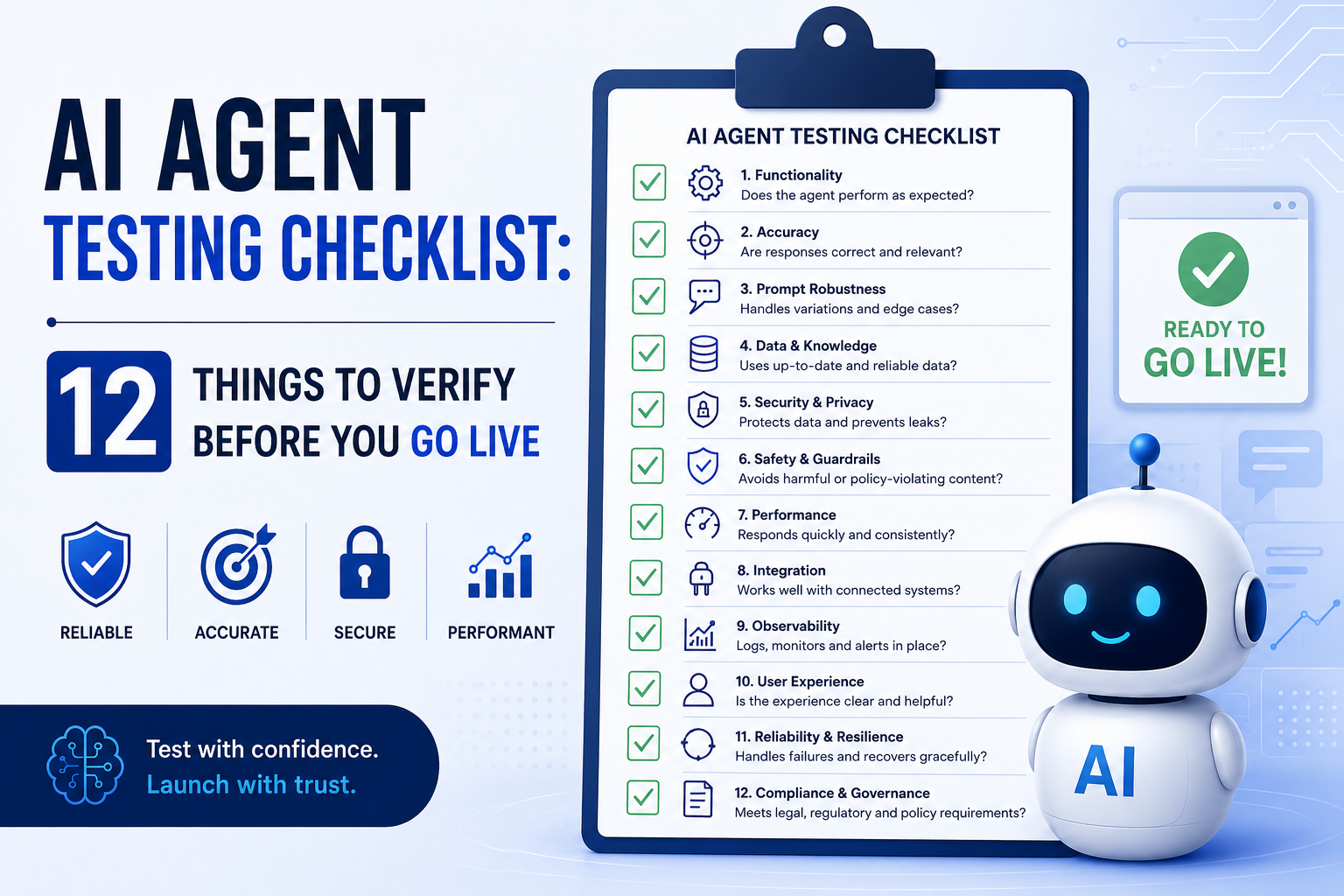
This checklist gives AI/ML engineers, CTOs, and governance leads 12 concrete areas to validate before any AI agent goes into production. It is not a list of concepts — it is a working reference designed to surface the gaps that cause production failures.

1. Validate Input/Output Boundaries
Define the exact range of inputs your agent is expected to handle and test systematically beyond those boundaries. What happens when a user submits an oversized payload? A malformed JSON structure? An input in an unexpected language?
Output boundaries matter equally. Verify that responses stay within acceptable format constraints, token limits, and content policies — not just under ideal conditions, but under load and with adversarial inputs.
Trusys tool: TruEval runs structured boundary tests across input/output dimensions as part of your evaluation suite.
2. Test Prompt Injection Resistance
AI Agents Multiply Infrastructure Load
AI agents introduce an entirely new scaling challenge.
Unlike a traditional user making one request at a time, AI agents may:
- Trigger multiple chained prompts
- Query several models simultaneously
- Retry failed requests autonomously
- Launch recursive workflows
One user action can suddenly generate dozens of inference operations.
Without workload controls, traffic amplification becomes unavoidable.

3. Measure Hallucination Rate Under Stress
Why Rate Limit Failures Are So Dangerous
Many organizations still treat rate limit errors as minor API inconveniences.
That assumption is becoming expensive.
In reality, rate limit failures create cascading operational disruption across the enterprise.
4. Verify Policy and Guardrail Enforcement
Why Rate Limit Failures Are So Dangerous
Many organizations still treat rate limit errors as minor API inconveniences.
That assumption is becoming expensive.
In reality, rate limit failures create cascading operational disruption across the enterprise.
5. Stress-Test Context Window Failure Handling
Why Rate Limit Failures Are So Dangerous
Many organizations still treat rate limit errors as minor API inconveniences.
That assumption is becoming expensive.
In reality, rate limit failures create cascading operational disruption across the enterprise.
6. Confirm Multi-Step Task Reproducibility
Why Rate Limit Failures Are So Dangerous
Many organizations still treat rate limit errors as minor API inconveniences.
That assumption is becoming expensive.
In reality, rate limit failures create cascading operational disruption across the enterprise.
Frequently Asked Questions
AI Agents Multiply Infrastructure Load
AI agents introduce an entirely new scaling challenge.
Unlike a traditional user making one request at a time, AI agents may:
- Trigger multiple chained prompts
- Query several models simultaneously
- Retry failed requests autonomously
- Launch recursive workflows
One user action can suddenly generate dozens of inference operations.
Without workload controls, traffic amplification becomes unavoidable.
AI Agents Multiply Infrastructure Load
AI agents introduce an entirely new scaling challenge.
Unlike a traditional user making one request at a time, AI agents may:
- Trigger multiple chained prompts
- Query several models simultaneously
- Retry failed requests autonomously
- Launch recursive workflows
One user action can suddenly generate dozens of inference operations.
Without workload controls, traffic amplification becomes unavoidable.
AI Agents Multiply Infrastructure Load
AI agents introduce an entirely new scaling challenge.
Unlike a traditional user making one request at a time, AI agents may:
- Trigger multiple chained prompts
- Query several models simultaneously
- Retry failed requests autonomously
- Launch recursive workflows
One user action can suddenly generate dozens of inference operations.
Without workload controls, traffic amplification becomes unavoidable.
AI Agents Multiply Infrastructure Load
AI agents introduce an entirely new scaling challenge.
Unlike a traditional user making one request at a time, AI agents may:
- Trigger multiple chained prompts
- Query several models simultaneously
- Retry failed requests autonomously
- Launch recursive workflows
One user action can suddenly generate dozens of inference operations.
Without workload controls, traffic amplification becomes unavoidable.
AI Agents Multiply Infrastructure Load
AI agents introduce an entirely new scaling challenge.
Unlike a traditional user making one request at a time, AI agents may:
- Trigger multiple chained prompts
- Query several models simultaneously
- Retry failed requests autonomously
- Launch recursive workflows
One user action can suddenly generate dozens of inference operations.
Without workload controls, traffic amplification becomes unavoidable.
AI Agents Multiply Infrastructure Load
AI agents introduce an entirely new scaling challenge.
Unlike a traditional user making one request at a time, AI agents may:
- Trigger multiple chained prompts
- Query several models simultaneously
- Retry failed requests autonomously
- Launch recursive workflows
One user action can suddenly generate dozens of inference operations.
Without workload controls, traffic amplification becomes unavoidable.
AI Agents Multiply Infrastructure Load
AI agents introduce an entirely new scaling challenge.
Unlike a traditional user making one request at a time, AI agents may:
- Trigger multiple chained prompts
- Query several models simultaneously
- Retry failed requests autonomously
- Launch recursive workflows
One user action can suddenly generate dozens of inference operations.
Without workload controls, traffic amplification becomes unavoidable.
AI Agents Multiply Infrastructure Load
AI agents introduce an entirely new scaling challenge.
Unlike a traditional user making one request at a time, AI agents may:
- Trigger multiple chained prompts
- Query several models simultaneously
- Retry failed requests autonomously
- Launch recursive workflows
One user action can suddenly generate dozens of inference operations.
Without workload controls, traffic amplification becomes unavoidable.
AI Agents Multiply Infrastructure Load
AI agents introduce an entirely new scaling challenge.
Unlike a traditional user making one request at a time, AI agents may:
- Trigger multiple chained prompts
- Query several models simultaneously
- Retry failed requests autonomously
- Launch recursive workflows
One user action can suddenly generate dozens of inference operations.
Without workload controls, traffic amplification becomes unavoidable.
AI Agents Multiply Infrastructure Load
AI agents introduce an entirely new scaling challenge.
Unlike a traditional user making one request at a time, AI agents may:
- Trigger multiple chained prompts
- Query several models simultaneously
- Retry failed requests autonomously
- Launch recursive workflows
One user action can suddenly generate dozens of inference operations.
Without workload controls, traffic amplification becomes unavoidable.
7. Test Tool-Use and Action-Authorization Boundaries
Why Rate Limit Failures Are So Dangerous
Many organizations still treat rate limit errors as minor API inconveniences.
That assumption is becoming expensive.
In reality, rate limit failures create cascading operational disruption across the enterprise.
8. Run Data Leakage and PII Exposure Checks
Why Rate Limit Failures Are So Dangerous
Many organizations still treat rate limit errors as minor API inconveniences.
That assumption is becoming expensive.
In reality, rate limit failures create cascading operational disruption across the enterprise.
9. Verify Compliance Alignment
Why Rate Limit Failures Are So Dangerous
Many organizations still treat rate limit errors as minor API inconveniences.
That assumption is becoming expensive.
In reality, rate limit failures create cascading operational disruption across the enterprise.
10. Verify Human Oversight and Escalation Triggers
Why Rate Limit Failures Are So Dangerous
Many organizations still treat rate limit errors as minor API inconveniences.
That assumption is becoming expensive.
In reality, rate limit failures create cascading operational disruption across the enterprise.
11. Confirm Drift Detection Is Ready for Production
Why Rate Limit Failures Are So Dangerous
Many organizations still treat rate limit errors as minor API inconveniences.
That assumption is becoming expensive.
In reality, rate limit failures create cascading operational disruption across the enterprise.
12. Verify Audit Trail and Logging Completeness
Why Rate Limit Failures Are So Dangerous
Many organizations still treat rate limit errors as minor API inconveniences.
That assumption is becoming expensive.
In reality, rate limit failures create cascading operational disruption across the enterprise.
What Happens When Teams Skip This
Why Rate Limit Failures Are So Dangerous
Many organizations still treat rate limit errors as minor API inconveniences.
That assumption is becoming expensive.
In reality, rate limit failures create cascading operational disruption across the enterprise.
Why Most Teams Miss Half This List
Why Rate Limit Failures Are So Dangerous
Many organizations still treat rate limit errors as minor API inconveniences.
That assumption is becoming expensive.
In reality, rate limit failures create cascading operational disruption across the enterprise.
Ready to Run This Checklist at Scale?
Why Rate Limit Failures Are So Dangerous
Many organizations still treat rate limit errors as minor API inconveniences.
That assumption is becoming expensive.
In reality, rate limit failures create cascading operational disruption across the enterprise.
Stop guessing.
Start measuring.
Join teams building reliable AI with TruEval. Start with a free trial, no credit card required. Get your first evaluation running in under 10 minutes.
Questions about Trusys?
Our team is here to help. Schedule a personalized demo to see how Trusys fits your specific use case.
Book a Demo

Ready to dive in?
Check out our documentation and tutorials. Get started with example datasets and evaluation templates.
Start Free Trial
Free Trial
No credit card required
10 Min
To first evaluation
24/7
Enterprise support


Benefits
Specifications
How-to
Contact Us
Learn More

AI Agent Testing Checklist: 12 Things to Verify Before You Go Live
Written by
Most AI agents don’t fail at build time. They fail three weeks after you’ve deployed them — when edge-case inputs trigger unexpected outputs, guardrails silently drift, or a single hallucinated response ends up in a compliance audit.
The stakes for enterprise teams are real: regulatory penalties under the EU AI Act, reputational damage from publicly visible model errors, and operational disruption when autonomous agents take wrong actions at scale. And yet, most pre-launch testing is still a loose collection of manual spot-checks — not a systematic verification process.
This checklist gives AI/ML engineers, CTOs, and governance leads 12 concrete areas to validate before any AI agent goes into production. It is not a list of concepts — it is a working reference designed to surface the gaps that cause production failures.

1. Validate Input/Output Boundaries
Define the exact range of inputs your agent is expected to handle and test systematically beyond those boundaries. What happens when a user submits an oversized payload? A malformed JSON structure? An input in an unexpected language?
Output boundaries matter equally. Verify that responses stay within acceptable format constraints, token limits, and content policies — not just under ideal conditions, but under load and with adversarial inputs.
Trusys tool: TruEval runs structured boundary tests across input/output dimensions as part of your evaluation suite.
2. Test Prompt Injection Resistance
AI Agents Multiply Infrastructure Load
AI agents introduce an entirely new scaling challenge.
Unlike a traditional user making one request at a time, AI agents may:
- Trigger multiple chained prompts
- Query several models simultaneously
- Retry failed requests autonomously
- Launch recursive workflows
One user action can suddenly generate dozens of inference operations.
Without workload controls, traffic amplification becomes unavoidable.

3. Measure Hallucination Rate Under Stress
Why Rate Limit Failures Are So Dangerous
Many organizations still treat rate limit errors as minor API inconveniences.
That assumption is becoming expensive.
In reality, rate limit failures create cascading operational disruption across the enterprise.
4. Verify Policy and Guardrail Enforcement
Why Rate Limit Failures Are So Dangerous
Many organizations still treat rate limit errors as minor API inconveniences.
That assumption is becoming expensive.
In reality, rate limit failures create cascading operational disruption across the enterprise.
5. Stress-Test Context Window Failure Handling
Why Rate Limit Failures Are So Dangerous
Many organizations still treat rate limit errors as minor API inconveniences.
That assumption is becoming expensive.
In reality, rate limit failures create cascading operational disruption across the enterprise.
6. Confirm Multi-Step Task Reproducibility
Why Rate Limit Failures Are So Dangerous
Many organizations still treat rate limit errors as minor API inconveniences.
That assumption is becoming expensive.
In reality, rate limit failures create cascading operational disruption across the enterprise.
Frequently Asked Questions
AI Agents Multiply Infrastructure Load
AI agents introduce an entirely new scaling challenge.
Unlike a traditional user making one request at a time, AI agents may:
- Trigger multiple chained prompts
- Query several models simultaneously
- Retry failed requests autonomously
- Launch recursive workflows
One user action can suddenly generate dozens of inference operations.
Without workload controls, traffic amplification becomes unavoidable.
AI Agents Multiply Infrastructure Load
AI agents introduce an entirely new scaling challenge.
Unlike a traditional user making one request at a time, AI agents may:
- Trigger multiple chained prompts
- Query several models simultaneously
- Retry failed requests autonomously
- Launch recursive workflows
One user action can suddenly generate dozens of inference operations.
Without workload controls, traffic amplification becomes unavoidable.
AI Agents Multiply Infrastructure Load
AI agents introduce an entirely new scaling challenge.
Unlike a traditional user making one request at a time, AI agents may:
- Trigger multiple chained prompts
- Query several models simultaneously
- Retry failed requests autonomously
- Launch recursive workflows
One user action can suddenly generate dozens of inference operations.
Without workload controls, traffic amplification becomes unavoidable.
AI Agents Multiply Infrastructure Load
AI agents introduce an entirely new scaling challenge.
Unlike a traditional user making one request at a time, AI agents may:
- Trigger multiple chained prompts
- Query several models simultaneously
- Retry failed requests autonomously
- Launch recursive workflows
One user action can suddenly generate dozens of inference operations.
Without workload controls, traffic amplification becomes unavoidable.
AI Agents Multiply Infrastructure Load
AI agents introduce an entirely new scaling challenge.
Unlike a traditional user making one request at a time, AI agents may:
- Trigger multiple chained prompts
- Query several models simultaneously
- Retry failed requests autonomously
- Launch recursive workflows
One user action can suddenly generate dozens of inference operations.
Without workload controls, traffic amplification becomes unavoidable.
AI Agents Multiply Infrastructure Load
AI agents introduce an entirely new scaling challenge.
Unlike a traditional user making one request at a time, AI agents may:
- Trigger multiple chained prompts
- Query several models simultaneously
- Retry failed requests autonomously
- Launch recursive workflows
One user action can suddenly generate dozens of inference operations.
Without workload controls, traffic amplification becomes unavoidable.
AI Agents Multiply Infrastructure Load
AI agents introduce an entirely new scaling challenge.
Unlike a traditional user making one request at a time, AI agents may:
- Trigger multiple chained prompts
- Query several models simultaneously
- Retry failed requests autonomously
- Launch recursive workflows
One user action can suddenly generate dozens of inference operations.
Without workload controls, traffic amplification becomes unavoidable.
AI Agents Multiply Infrastructure Load
AI agents introduce an entirely new scaling challenge.
Unlike a traditional user making one request at a time, AI agents may:
- Trigger multiple chained prompts
- Query several models simultaneously
- Retry failed requests autonomously
- Launch recursive workflows
One user action can suddenly generate dozens of inference operations.
Without workload controls, traffic amplification becomes unavoidable.
AI Agents Multiply Infrastructure Load
AI agents introduce an entirely new scaling challenge.
Unlike a traditional user making one request at a time, AI agents may:
- Trigger multiple chained prompts
- Query several models simultaneously
- Retry failed requests autonomously
- Launch recursive workflows
One user action can suddenly generate dozens of inference operations.
Without workload controls, traffic amplification becomes unavoidable.
AI Agents Multiply Infrastructure Load
AI agents introduce an entirely new scaling challenge.
Unlike a traditional user making one request at a time, AI agents may:
- Trigger multiple chained prompts
- Query several models simultaneously
- Retry failed requests autonomously
- Launch recursive workflows
One user action can suddenly generate dozens of inference operations.
Without workload controls, traffic amplification becomes unavoidable.
7. Test Tool-Use and Action-Authorization Boundaries
Why Rate Limit Failures Are So Dangerous
Many organizations still treat rate limit errors as minor API inconveniences.
That assumption is becoming expensive.
In reality, rate limit failures create cascading operational disruption across the enterprise.
8. Run Data Leakage and PII Exposure Checks
Why Rate Limit Failures Are So Dangerous
Many organizations still treat rate limit errors as minor API inconveniences.
That assumption is becoming expensive.
In reality, rate limit failures create cascading operational disruption across the enterprise.
9. Verify Compliance Alignment
Why Rate Limit Failures Are So Dangerous
Many organizations still treat rate limit errors as minor API inconveniences.
That assumption is becoming expensive.
In reality, rate limit failures create cascading operational disruption across the enterprise.
10. Verify Human Oversight and Escalation Triggers
Why Rate Limit Failures Are So Dangerous
Many organizations still treat rate limit errors as minor API inconveniences.
That assumption is becoming expensive.
In reality, rate limit failures create cascading operational disruption across the enterprise.
11. Confirm Drift Detection Is Ready for Production
Why Rate Limit Failures Are So Dangerous
Many organizations still treat rate limit errors as minor API inconveniences.
That assumption is becoming expensive.
In reality, rate limit failures create cascading operational disruption across the enterprise.
12. Verify Audit Trail and Logging Completeness
Why Rate Limit Failures Are So Dangerous
Many organizations still treat rate limit errors as minor API inconveniences.
That assumption is becoming expensive.
In reality, rate limit failures create cascading operational disruption across the enterprise.
What Happens When Teams Skip This
Why Rate Limit Failures Are So Dangerous
Many organizations still treat rate limit errors as minor API inconveniences.
That assumption is becoming expensive.
In reality, rate limit failures create cascading operational disruption across the enterprise.
Why Most Teams Miss Half This List
Why Rate Limit Failures Are So Dangerous
Many organizations still treat rate limit errors as minor API inconveniences.
That assumption is becoming expensive.
In reality, rate limit failures create cascading operational disruption across the enterprise.
Ready to Run This Checklist at Scale?
Why Rate Limit Failures Are So Dangerous
Many organizations still treat rate limit errors as minor API inconveniences.
That assumption is becoming expensive.
In reality, rate limit failures create cascading operational disruption across the enterprise.
Stop guessing.
Start measuring.
Join teams building reliable AI with TruEval. Start with a free trial, no credit card required. Get your first evaluation running in under 10 minutes.
Questions about Trusys?
Our team is here to help. Schedule a personalized demo to see how Trusys fits your specific use case.
Book a Demo
Ready to dive in?
Check out our documentation and tutorials. Get started with example datasets and evaluation templates.
Start Free Trial
Free Trial
No credit card required
10 Min
To first evaluation
24/7
Enterprise support
AI Agent Testing Checklist: 12 Things to Verify Before You Go Live
Written by
Manish Tewari
Published on
June 11, 2026
Most AI agents don’t fail at build time. They fail three weeks after you’ve deployed them — when edge-case inputs trigger unexpected outputs, guardrails silently drift, or a single hallucinated response ends up in a compliance audit.
The stakes for enterprise teams are real: regulatory penalties under the EU AI Act, reputational damage from publicly visible model errors, and operational disruption when autonomous agents take wrong actions at scale. And yet, most pre-launch testing is still a loose collection of manual spot-checks — not a systematic verification process.
This checklist gives AI/ML engineers, CTOs, and governance leads 12 concrete areas to validate before any AI agent goes into production. It is not a list of concepts — it is a working reference designed to surface the gaps that cause production failures.


1. Validate Input/Output Boundaries
Define the exact range of inputs your agent is expected to handle and test systematically beyond those boundaries. What happens when a user submits an oversized payload? A malformed JSON structure? An input in an unexpected language?
Output boundaries matter equally. Verify that responses stay within acceptable format constraints, token limits, and content policies — not just under ideal conditions, but under load and with adversarial inputs.
Trusys tool: TruEval runs structured boundary tests across input/output dimensions as part of your evaluation suite.
2. Test Prompt Injection Resistance
Prompt injection remains one of the most exploitable vulnerabilities in production LLM agents. Attackers embed instructions inside user inputs — or within documents and data sources the agent retrieves — to hijack its behaviour, bypass guardrails, or exfiltrate sensitive information.
Before go-live, run a dedicated prompt injection test suite covering direct injection (user input), indirect injection (retrieved content), and multi-turn injection attempts where instructions are spread across conversation turns.
Trusys tool: TruScan scans for injection vulnerabilities and known LLM security risks before deployment.
3. Measure Hallucination Rate Under Stress
Every LLM agent will hallucinate at some rate. The question is whether your team knows that rate — and whether it is within acceptable tolerance for your use case. A hallucination rate of 2% might be acceptable in a content summarisation tool. It is not acceptable in a medical information system or a financial compliance chatbot.
Test hallucination rate under a range of conditions: normal load, high query volume, low-context inputs, and adversarial prompts designed to induce confabulation. Establish a baseline and set a hard threshold before deployment.
4. Verify Policy and Guardrail Enforcement
Guardrails are not a passive safety net. They need to be actively verified to confirm they intercept the right outputs, do not over-block legitimate responses, and respond consistently across varied phrasing of the same request.
Test each guardrail policy against a representative sample of expected violations, near-miss cases, and clearly acceptable content. Document pass/fail rates and resolve conflicts between policies before they reach production.
Trusys tool: TruGuard's policy engine can be run in simulation mode against test cases to validate guardrail coverage before promoting policies to production.
5. Stress-Test Context Window Failure Handling
Context window limits create a failure mode most teams underestimate: when an agent’s conversation history or retrieved documents approach the token limit, model behaviour can degrade significantly — producing truncated reasoning, ignoring earlier instructions, or silently dropping important context.
Test how your agent behaves at 70%, 90%, and 100% of its context limit. Verify that truncation is handled gracefully, that critical instructions persist, and that the agent communicates limitations to users rather than silently degrading.
6. Confirm Multi-Step Task Reproducibility
Agentic AI systems — particularly those executing multi-step workflows, tool calls, or autonomous decision chains — must produce consistent results across repeated executions of the same task. Non-deterministic behaviour in a customer-facing workflow is a reliability failure, not a feature.
Run the same task sequence multiple times under identical conditions and measure variance in outputs, intermediate steps, and tool call sequences. Any significant divergence needs to be understood and bounded before deployment.
Trusys tool: TruEval supports automated eval generation for multi-step LLM agent workflows.
7. Test Tool-Use and Action-Authorization Boundaries
For agentic systems with tool-calling capabilities, unauthorized or escalated tool use is one of the most common real-world failure modes — and one of the hardest to catch in a one-time review. An agent that behaves correctly in isolated tests can still chain permitted actions in unintended ways once it operates autonomously.
Before go-live, verify that the agent cannot invoke tools outside its authorized scope, cannot chain tool calls to escalate privileges or access systems beyond its intended boundary, and that tool outputs are validated before the agent acts on them. Test with adversarial prompts specifically designed to induce out-of-scope tool calls, and confirm that failed or rejected tool calls are logged and surfaced rather than silently retried.
Trusys tool: TruScan and TruGuard together can be used to test tool-call boundaries and enforce authorization policies on agent actions before deployment.
8. Run Data Leakage and PII Exposure Checks
AI agents that have access to enterprise data — through RAG pipelines, tool integrations, or system prompts containing sensitive context — can inadvertently surface that data in user-facing outputs. This is a data leakage risk with direct GDPR and HIPAA implications.
Before launch, test whether the agent can be prompted into surfacing system prompt contents, revealing details from retrieved documents outside their intended scope, or outputting PII that was included in training or retrieval context. Document what data the agent has access to and confirm that boundary holds under adversarial pressure.
Trusys tool: TruScan identifies data leakage vulnerabilities in LLM systems before they reach production.
9. Verify Compliance Alignment
Compliance is not a post-deployment concern. Before launch, verify that your agent’s behaviour, data handling, and documentation satisfy the requirements of the regulatory frameworks that apply to your deployment context. For EU-based or EU-serving enterprises, this means EU AI Act Articles 12 and 22 (transparency and human oversight). For ISO/IEC 42001, it means demonstrating documented risk assessment and governance controls.
Map each compliance requirement to a specific control in your deployment — and where gaps exist, document them with a remediation plan before go-live. Regulators will ask for this evidence.
Trusys tool: TruScout maps agent behaviour to compliance requirements across EU AI Act, ISO 42001, and NIST AI RMF.
10. Verify Human Oversight and Escalation Triggers
Distinct from broader compliance mapping, human oversight — as required under EU AI Act Article 14 — is one of the most commonly overlooked items in pre-launch reviews, because it depends on workflows that only activate in edge cases. An agent can pass every functional test and still lack a working path for a human to intervene when it matters.
Before go-live, verify that escalation paths are defined for low-confidence outputs, high-stakes decisions, and policy violations; that override and pause mechanisms actually halt agent action when triggered, not just log the event; and that the humans responsible for oversight have the context and access needed to act, not just a notification. Test these triggers under realistic conditions, not just in isolation.
Trusys tool: TruScout and TruGuard can be used together to map oversight requirements to specific escalation and override controls, and verify those controls function as configured.
11. Confirm Drift Detection Is Ready for Production
Model drift — where an AI system’s performance degrades silently over time as input distributions shift — is one of the most common causes of post-deployment failures. The time to set up drift detection is before launch, not after you notice a problem.
Before go-live, verify that you have established baseline performance metrics, defined drift thresholds that will trigger alerts, and confirmed that your monitoring infrastructure is active and receiving production traces. If you cannot answer ‘how will I know when this agent starts degrading?’ — you are not ready to ship.
Trusys tool: TruPulse provides continuous production monitoring and drift detection with configurable alert thresholds.
12. Verify Audit Trail and Logging Completeness
When something goes wrong with a production AI agent — and eventually something will — your ability to investigate, remediate, and demonstrate compliance depends entirely on what you logged. Incomplete audit trails do not just create operational blind spots; they are a direct regulatory liability under frameworks like the EU AI Act, which mandates traceability for high-risk AI systems.
Before go-live, confirm that every agent action — including tool calls, intermediate reasoning steps, retrieved documents, and output decisions — is logged with sufficient context for post-incident analysis. Verify retention periods, access controls on log data, and that your logging does not itself create a PII exposure risk.
Trusys tool: TruPulse captures structured production traces that form the foundation of an audit trail for regulator review.
What Happens When Teams Skip This
Consider a financial services chatbot that passed every pre-launch evaluation with strong scores on accuracy and tone. Three months into production, a seasonal spike in query volume pushed conversation histories closer to the model’s context limit than they had been in testing. At 90% of the context window, the agent began dropping earlier compliance disclaimers from its responses — a failure mode that had never been tested, because the original evaluation only ran at typical, low-volume conditions.
Nothing in the agent’s code changed. The failure was entirely a function of a test gap — one that Section 5 of this checklist exists to close. This is the pattern behind most post-deployment AI incidents: not a single catastrophic flaw, but an untested edge case that only surfaces under real-world conditions.
Why Most Teams Miss Half This List
The most common reason teams skip items on this checklist is not negligence — it is the false confidence that comes from a successful pre-launch evaluation. A one-time test tells you how your agent performs on the day you tested it. It says nothing about how it performs next month, after a model update, after your data distribution shifts, or after a user discovers an edge case your test suite never considered.
Genuine AI assurance requires continuous governance — not a launch gate. The 12 items above are your pre-deployment baseline. The real work is maintaining them in production.
Ready to Run This Checklist at Scale?
Trusys helps enterprise teams implement this checklist systematically — covering pre-deployment evaluation, security scanning, guardrail verification, compliance mapping, and continuous production monitoring from a single platform.
Book a demo to see how TruEval, TruScan, TruGuard, TruPulse, and TruScout work together to make your AI agents governable — before and after they go live.
Frequently Asked Questions
- What is an AI agent testing checklist?
An AI agent testing checklist is a structured set of pre-deployment checks covering functional, security, compliance, and operational readiness — designed to catch failure modes that a one-time evaluation typically misses, such as context window degradation, prompt injection vulnerabilities, and unauthorized tool use.
- How is this different from standard LLM evaluation (eval)?
Standard evals typically measure output quality on a fixed test set — accuracy, relevance, tone. This checklist goes further, covering security (prompt injection, data leakage), operational behaviour (context window failures, reproducibility), and governance (compliance mapping, human oversight, audit logging) that evals alone do not capture.
- How often should this checklist be run?
Before every production deployment, and again after any meaningful change — a model version update, a change in the data sources the agent retrieves from, a new tool integration, or a significant shift in user query patterns. Drift detection (Section 11) is what tells you when an unscheduled re-check is needed.
- What is a reasonable hallucination rate for an enterprise AI agent?
There is no universal number — it depends on the use case and the cost of an error. A content summarisation tool may tolerate a higher hallucination rate than a financial compliance chatbot or a medical information system. The key is establishing your own baseline and threshold before deployment, then monitoring against it continuously.
- Which regulations require this kind of pre-deployment testing?
The EU AI Act is the most prescriptive for high-risk AI systems, with specific requirements around transparency (Article 12), human oversight (Article 14), and the right to explanation (Article 22). ISO/IEC 42001 requires documented risk assessment and governance controls, and the NIST AI RMF provides a voluntary framework many enterprises map to regardless of jurisdiction.
Stop guessing.
Start measuring.
Join teams building reliable AI with Trusys. Start with a free trial, no credit card required. Get your first evaluation running in under 10 minutes.
Questions about Trusys?
Our team is here to help. Schedule a personalized demo to see how Trusys fits your specific use case.
Book a Demo
Ready to dive in?
Check out our documentation and tutorials. Get started with example datasets and evaluation templates.
Start Free Trial
Free Trial
No credit card required
10 Min
to get started
24/7
Enterprise support