
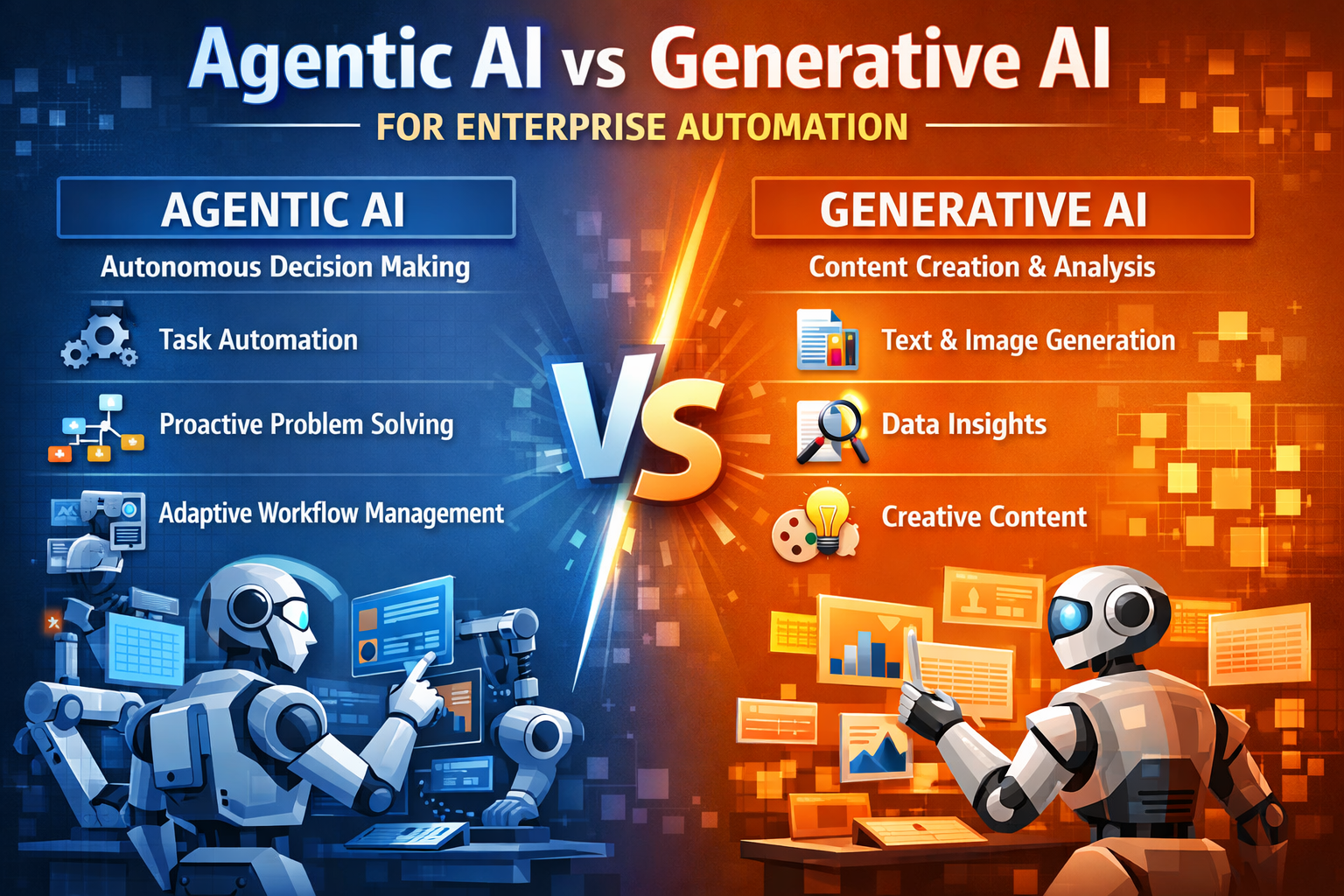
Enterprise automation has moved far beyond rule-based bots and static workflows. Today’s AI stacks are powered by transformer models, retrieval pipelines, orchestration frameworks, and increasingly — autonomous agents.
But here’s the real architectural debate: Agentic AI vs Generative AI — which paradigm can truly power the future of enterprise automation?
Generative AI excels at producing content, code, and insights. Agentic AI, on the other hand, executes goals, coordinates tools, and adapts dynamically across systems. For AI architects designing large-scale automation platforms, understanding the structural differences between these approaches isn’t optional — it’s foundational.
This technical deep dive breaks down both architectures at the system level, compares execution models, and explores how enterprises can design scalable, secure, and autonomous AI-driven automation — with insights aligned to enterprise-grade platforms like Trusys.
Before diving into architectural layers, let’s frame the evolution:
The transition from static automation to autonomous orchestration is where the discussion around Agentic AI vs Generative AI becomes architecturally significant.
Generative AI systems are built primarily on transformer architectures that rely on self-attention mechanisms to model contextual relationships across tokens.
These models function as large-scale inference engines optimized for language, code, or multimodal generation.
A typical enterprise generative architecture includes:
This pipeline is optimized for response generation, not autonomous action.
To reduce hallucination and improve factual grounding, enterprises deploy:
RAG enables LLMs to reason over enterprise data but still operates within a stateless, request-response model.
Common enterprise deployment strategies include:
While generative AI delivers tremendous productivity gains, its architecture remains fundamentally assistive.
From a systems perspective, generative AI is:
Technical constraints include:
Generative AI can recommend actions. It cannot independently execute enterprise processes without external orchestration layers.
Agentic AI introduces autonomy through structured execution frameworks layered on top of reasoning engines.
Instead of simply generating text, agentic systems:
A robust enterprise-grade agentic system includes:
Unlike generative AI’s temporary context window, agentic systems maintain:
Persistent memory enables iterative reasoning and adaptive workflows.
Agentic AI follows a cyclical process:
This loop allows dynamic adaptation within enterprise environments.
Enterprise deployment requires:
Agentic AI is not just smarter — it’s architecturally accountable.
Let’s evaluate practical enterprise scenarios.
Generative AI can:
But it cannot:
Agentic systems can orchestrate all of the above.
Generative AI:
Agentic AI:
That’s autonomous orchestration.
Generative AI:
Agentic AI:
Enterprise automation requires execution, not interpretation.
Modern enterprises rely on:
Traditional RPA layered automation externally.
Generative AI layered intelligence.
Agentic AI embeds orchestration within the enterprise fabric.
This shift moves enterprises from process automation to autonomous system management.
Agentic systems unlock:
Persistent monitoring and adaptive execution.
Objective-driven automation instead of prompt-driven responses.
Failure detection → automatic retry → dynamic rerouting → escalation if necessary.
AI-driven compute scaling and infrastructure provisioning.
Specialized agents can operate simultaneously:
Together, they create distributed enterprise intelligence.
A scalable enterprise architecture includes:
Platforms like Trusys enable scalable agentic orchestration designed for enterprise-grade performance, security, and modular deployment.
The future isn’t a binary choice between Agentic AI vs Generative AI.
It’s architectural convergence.
Generative AI provides:
Agentic AI provides:
The most powerful enterprise systems will combine:
This convergence defines the next generation of AI-native enterprises.
Generative AI focuses on producing outputs based on prompts, while agentic AI integrates planning, execution, and memory to autonomously complete multi-step tasks.
Yes. By embedding LLMs into orchestration frameworks with task planning, memory persistence, and tool execution layers, generative models can function as agentic components.
Generative AI relies on limited context windows. Agentic AI maintains structured, persistent memory across sessions and workflows.
No. While reinforcement learning enhances adaptability, many enterprise agentic systems use rule-based evaluators combined with LLM reasoning loops.
Through layered governance mechanisms including access controls, policy engines, audit logs, explainability modules, and human-in-the-loop escalation paths.
Enterprise automation is at a structural turning point.
Generative AI unlocked conversational intelligence. But autonomy requires architectural transformation — state persistence, orchestration engines, policy enforcement, and execution authority.
When evaluating Agentic AI vs Generative AI, the real question is this:
Is your AI assisting users — or operating systems?
The enterprises that invest in autonomous, governed, and scalable agentic architectures today will build self-optimizing organizations tomorrow.
The shift toward AI-native infrastructure isn’t theoretical anymore.