
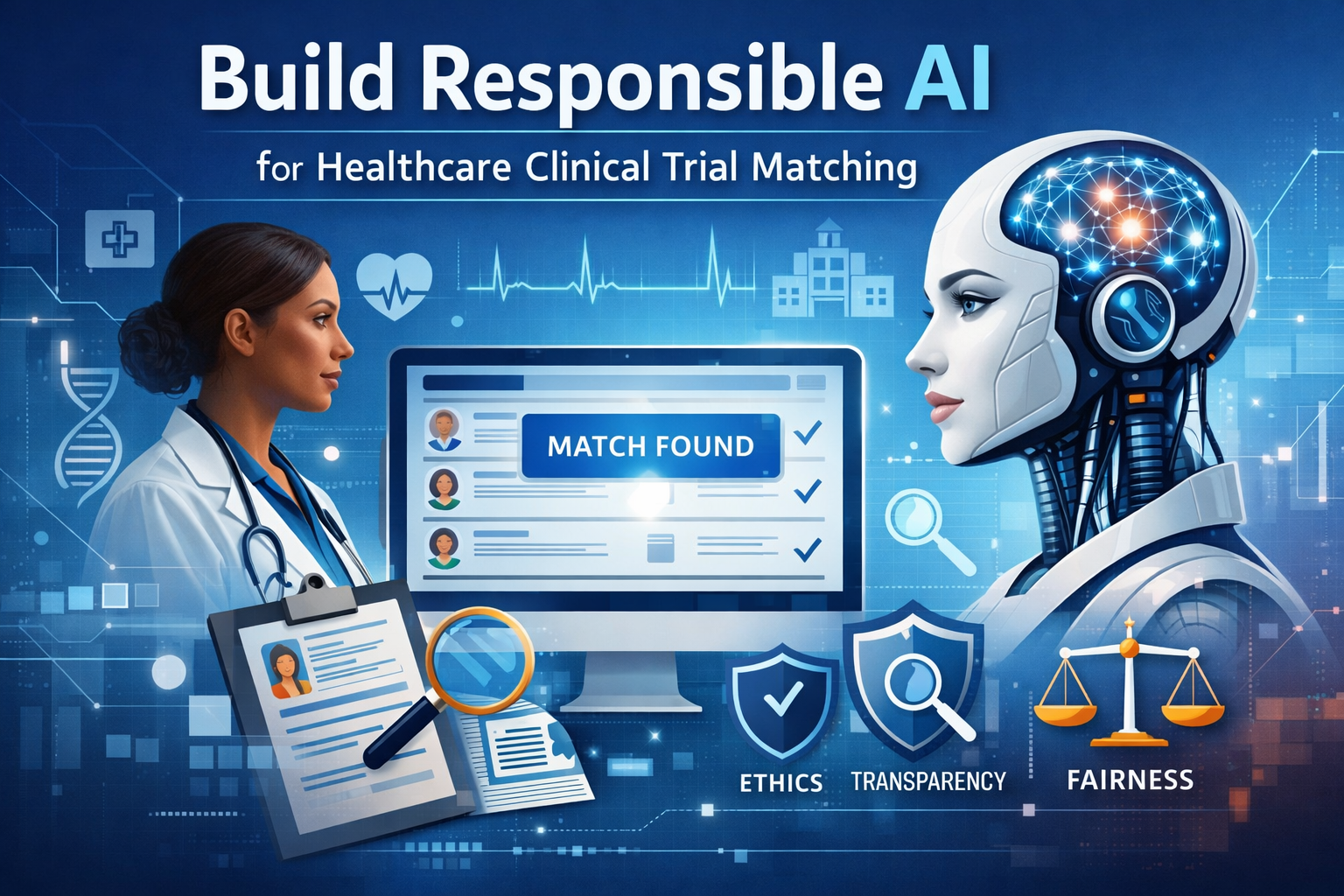
Healthcare organizations face mounting pressure to modernize clinical research without compromising ethics or patient trust. Global clinical trial spending has now exceeded $65 billion annually, while nearly 75–80% of clinical trials still miss enrollment timelines, according to updated estimates from Statista and Deloitte. Even more striking, over 45% of eligible patients remain unaware of relevant clinical trials, largely due to fragmented data and outdated matching processes.
These challenges make it essential to build Responsible AI for healthcare, particularly in clinical trial matching, where fairness, transparency, and reliability directly affect patient outcomes and research success. When designed responsibly, AI doesn’t just speed up recruitment—it restores trust in the clinical research ecosystem.
Despite technological advances, clinical trial recruitment remains one of the slowest phases of drug development. Manual screening, siloed electronic health records (EHRs), and inconsistent eligibility criteria all contribute to delays.
According to McKinsey, each day a clinical trial is delayed can cost sponsors $600,000 to $8 million, depending on the therapy area. Meanwhile, clinicians often lack the time or tools to identify suitable trials for patients.
This is where AI can help—but only if organizations build Responsible AI for healthcare rather than deploying opaque, high-risk algorithms.
Responsible AI in healthcare focuses on patient safety, ethical decision-making, and regulatory compliance. In clinical trial matching, this means AI systems must support—not replace—clinical judgment.
To build Responsible AI for healthcare clinical trial matching, systems must ensure:
A PwC healthcare AI report shows that organizations implementing Responsible AI frameworks experience 30–35% fewer compliance and ethics-related incidents.
AI excels at analyzing large volumes of structured and unstructured healthcare data, including EHRs, lab results, imaging summaries, and physician notes. When teams build Responsible AI for healthcare, these capabilities translate into tangible benefits.
Responsible AI enables:
According to Deloitte, AI-assisted clinical trial matching can reduce recruitment timelines by up to 50%, while increasing enrollment accuracy.
Bias remains one of the most serious risks in healthcare AI. Historically, many clinical trials underrepresent women, older adults, and minority populations, leading to treatments that don’t work equally well for everyone.
To build Responsible AI for healthcare clinical trial matching, organizations must actively address bias by:
The FDA and NIH continue to emphasize inclusive trial design, noting that lack of diversity can reduce treatment effectiveness and increase safety risks. Responsible AI helps ensure AI expands access instead of reinforcing existing inequities.
Healthcare professionals need to understand why an AI system recommends a trial—or excludes a patient. Black-box models undermine trust and slow adoption.
Explainable AI allows clinicians to:
According to IBM, explainable healthcare AI systems see over 35% higher clinician adoption rates, reinforcing why explainability is a cornerstone of Responsible AI.
Clinical trial matching systems handle extremely sensitive data, including diagnoses, genetic markers, and treatment histories. Regulations such as HIPAA, GDPR, and evolving AI-specific healthcare laws demand strict controls.
When organizations build Responsible AI for healthcare, they ensure:
A KPMG healthcare compliance study found that organizations using automated AI governance reduced regulatory preparation time by up to 45%, while significantly lowering privacy risk.
Clinical trial criteria change frequently, and patient conditions evolve. Responsible AI systems must adapt continuously.
Effective systems include:
According to Accenture, healthcare organizations using continuous AI monitoring reduce AI-related errors by up to 40%, ensuring long-term reliability in clinical environments.
When organizations build Responsible AI for healthcare, patients see real benefits:
NIH analysis shows that AI-assisted trial matching shortens patient placement time by 15–20%, helping patients access experimental therapies sooner.
Responsible AI-driven clinical trial matching is already delivering results across healthcare sectors:
In each case, Responsible AI ensures innovation scales without sacrificing ethics or safety.
Despite its promise, building Responsible AI for healthcare clinical trial matching comes with challenges:
However, organizations that invest early in Responsible AI frameworks are better positioned to scale safely and sustainably.
Looking ahead, Responsible AI will become the standard—not the exception. By the end of the decade, regulators are expected to require explainability, bias monitoring, and continuous oversight for AI-assisted clinical research.
Future systems will:
A McKinsey forecast suggests Responsible AI adoption could reduce global clinical trial timelines by up to 30% in the coming years.
To build Responsible AI for healthcare clinical trial matching in 2026 is to invest in trust, fairness, and long-term impact. Responsible AI accelerates recruitment, improves diversity, protects patient data, and strengthens regulatory confidence.
As clinical research becomes more data-driven, Responsible AI isn’t a constraint—it’s the foundation for ethical innovation, better outcomes, and a more inclusive future for healthcare.
To build Responsible AI for healthcare means designing AI systems that are ethical, transparent, fair, secure, and accountable. In clinical trial matching, this ensures AI supports patient safety, respects privacy, minimizes bias, and complies with healthcare regulations while assisting clinicians—not replacing them.
In 2026, clinical trials rely heavily on AI to manage complex patient data and enrollment challenges. Without Responsible AI, matching systems risk bias, lack explainability, and regulatory non-compliance. Responsible AI ensures trustworthy recommendations, inclusive recruitment, and audit-ready decision-making.
Responsible AI improves access by fairly analyzing patient data, continuously updating eligibility as conditions change, and reducing manual screening delays. Studies show AI-assisted matching can reduce placement time by 15–20%, helping patients access trials faster and more equitably.
Yes. When organizations build Responsible AI for healthcare, they actively monitor demographic outcomes, test for bias, and retrain models using diverse datasets. This approach improves trial diversity by 20–25%, addressing long-standing equity gaps in clinical research.
Explainable AI allows clinicians to understand why a patient qualifies or doesn’t qualify for a trial. This transparency increases clinician confidence, improves patient communication, and supports regulatory reviews. In 2026, explainability is a core requirement of Responsible AI in healthcare.
When built responsibly, yes. Responsible AI enforces strong data encryption, access controls, consent management, and audit trails. These measures ensure compliance with HIPAA, GDPR, and emerging AI healthcare regulations while protecting sensitive patient information.
No. Responsible AI is designed to support clinicians, not replace them. AI assists with data analysis and pre-screening, while clinicians retain final decision authority. Human-in-the-loop oversight is a foundational principle of Responsible AI for healthcare.
Continuous monitoring ensures AI systems remain accurate, fair, and compliant over time. In clinical trial matching, this includes tracking model drift, performance changes, and demographic impact. Continuous oversight reduces AI-related errors by up to 40%, according to 2026 industry reports.
Common challenges include fragmented EHR data, evolving regulations, bias mitigation, and aligning technical teams with clinical workflows. However, organizations that invest early in Responsible AI frameworks scale faster and face fewer compliance risks.
Yes. By 2026, regulators and healthcare authorities increasingly expect AI systems to demonstrate explainability, fairness, and accountability. Responsible AI is rapidly becoming a baseline requirement, not a competitive differentiator.