
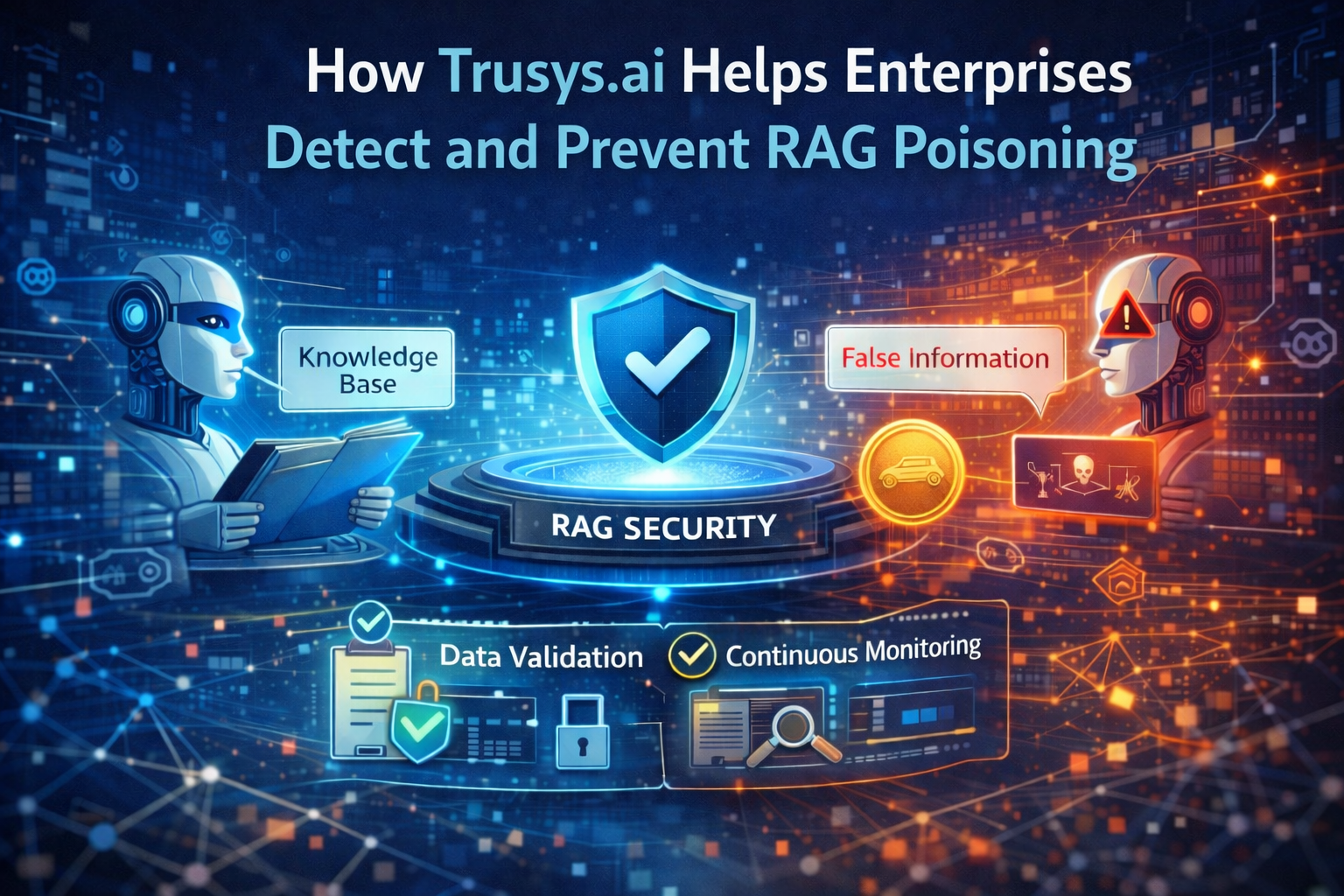
Enterprises are rapidly adopting Retrieval-Augmented Generation (RAG) to enhance large language models (LLMs) with real-time, domain-specific knowledge. From customer support and compliance research to internal copilots and decision intelligence, RAG systems promise more accurate and contextual AI outputs. However, as adoption accelerates, a critical security risk is emerging: RAG poisoning.
RAG poisoning threatens the trustworthiness of enterprise AI by corrupting the very knowledge sources these systems rely on. Unlike traditional model risks, RAG poisoning can silently manipulate outputs, trigger hallucinations, and introduce compliance and reputational damage at scale. This is where Trusys.ai, an enterprise-grade AI assurance platform, plays a vital role—helping organizations detect RAG poisoning, prevent RAG poisoning, and secure RAG systems across the AI lifecycle.
RAG poisoning refers to the deliberate or accidental manipulation of data sources used by Retrieval-Augmented Generation systems to influence AI outputs. In a RAG architecture, an LLM retrieves information from external knowledge bases—such as vector databases, document repositories, or internal wikis—before generating a response. If these sources are compromised, the model produces misleading, biased, or harmful outputs.
Unlike traditional data poisoning, which targets model training datasets, RAG data poisoning attacks the retrieval layer. This makes it particularly dangerous because poisoned content can be introduced after deployment, bypassing standard model validation and retraining workflows.
For enterprises, RAG poisoning is not just a technical issue—it is a systemic enterprise AI security risk that directly affects trust, compliance, and business outcomes.
RAG poisoning poses unique challenges that many organizations underestimate. Because RAG systems dynamically retrieve information, poisoned data can spread rapidly across applications without detection.
Key enterprise risks include:
As enterprises scale RAG deployments, the inability to detect RAG poisoning early can result in systemic failures across multiple AI-powered workflows.
Understanding how RAG poisoning occurs is essential for prevention. The most common attack vectors include:
Malicious or outdated documents are intentionally added to enterprise knowledge repositories, influencing retrieval results.
Attackers inject harmful content that is embedded and indexed, allowing it to surface during semantic search.
Retrieved content contains hidden instructions that manipulate LLM behavior when combined with user prompts.
Weak access controls or misconfigurations allow unauthorized changes to vector stores, enabling large-scale RAG poisoning.
These vectors highlight why RAG security must go beyond traditional AI testing and focus on continuous assurance.
Detecting RAG poisoning requires more than static checks. Enterprises must adopt dynamic, context-aware detection strategies, including:
Without an AI assurance platform, these capabilities are difficult to operationalize at enterprise scale.
Trusys.ai is purpose-built to address emerging AI risks like RAG poisoning through a unified AI assurance platform. It enables enterprises to proactively detect RAG poisoning before it impacts users or business decisions.
Key detection capabilities include:
Trusys.ai evaluates RAG outputs against expected behavior, identifying deviations caused by poisoned retrieval sources.
The platform monitors retrieval patterns to detect anomalies that signal RAG data poisoning or malicious embeddings.
Trusys.ai assesses generated responses for hallucinations, bias, and safety risks—early indicators of RAG poisoning.
By correlating retrieval inputs with generated outputs, Trusys.ai provides full transparency across the RAG pipeline.
This evaluation-driven approach allows enterprises to detect RAG poisoning in real time, rather than after damage occurs.
Detection alone is not enough. Enterprises must also prevent RAG poisoning through governance, controls, and continuous monitoring. Trusys.ai enables prevention at scale through:
Trusys.ai enforces policies around knowledge ingestion, retrieval behavior, and output safety to reduce exposure to poisoned data.
Real-time monitoring ensures that newly ingested content or changes to vector databases do not introduce RAG poisoning risks.
Trusys.ai embeds governance frameworks into AI operations, aligning RAG systems with enterprise risk and compliance requirements.
When suspicious behavior is detected, Trusys.ai generates alerts and audit-ready reports for security and compliance teams.
Together, these capabilities help enterprises secure RAG systems without slowing innovation.
While platforms like Trusys.ai provide foundational assurance, enterprises should also adopt best practices to reduce RAG poisoning risk:
These practices, combined with Trusys.ai, significantly strengthen enterprise AI security.
RAG poisoning is not a one-time vulnerability—it is an ongoing operational risk. Traditional security tools are not designed to evaluate AI behavior, retrieval relevance, or generation integrity. This gap is why enterprises increasingly turn to AI assurance platforms.
Trusys.ai unifies:
This holistic approach ensures that RAG systems remain trustworthy, explainable, and aligned with business objectives.
As RAG becomes foundational to enterprise AI, RAG poisoning emerges as one of the most critical threats organizations must address. Left unchecked, it undermines trust, accuracy, and compliance across AI-driven workflows.
Trusys.ai empowers enterprises to detect RAG poisoning, prevent RAG poisoning, and secure RAG systems through continuous evaluation, monitoring, and governance. By treating RAG security as an assurance challenge—not just a technical one—organizations can scale AI responsibly and confidently.
In an era where AI decisions shape business outcomes, Trusys.ai ensures that what your AI retrieves—and generates—remains trustworthy.