
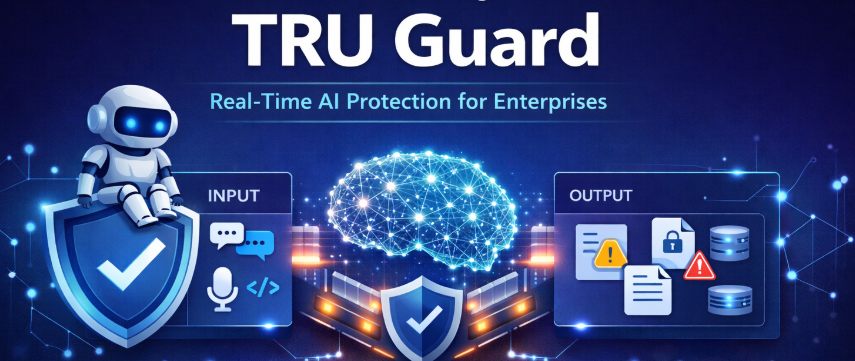
Last week, we released TRU Guard—a real-time guardrails engine built for developers and enterprises running AI in production.
If you’re building copilots, AI agents, internal assistants, or customer-facing AI apps, you already know:
shipping the model is the easy part.
Keeping it safe, compliant, and predictable in production is the hard part.
This release is about solving that gap.
Over the past year, AI has moved from experimentation to production across industries. Enterprises now run:
But many of these systems still rely on basic filters, logging, or post-processing checks.
That’s not enough.
Most teams detect issues after responses are generated.
But by then, the damage may already be done.
The core problem:
There is no centralized, real-time enforcement layer between user input → model → output → actions.
AI systems need a runtime control layer—not just testing and monitoring.
Developers today often use a mix of:
These approaches don’t scale because:
As AI systems become more autonomous, this gap becomes critical.
Enter TRU Guard.
TRU Guard is a real-time AI guardrails engine that sits between your application and your AI models.
It enforces safety, policy, and compliance checks across:
before anything reaches the user or executes in your system.
It acts as a runtime policy enforcement layer for AI.
Attackers attempt to override system instructions or extract data.
TRU Guard:
Models may reveal:
TRU Guard:
LLMs can generate:
TRU Guard:
Agents with tool access can:
TRU Guard:
TRU Guard operates as a runtime enforcement layer in your AI stack.
User sends a prompt or agent instruction.
Checks for:
If needed, input is blocked or modified.
The LLM produces output.
Checks for:
Validates:
TRU Guard decides to:
All of this happens in real time.
TRU Guard supports configurable policies such as:
Guardrails can be applied across:
Policies can be centrally managed and applied across environments.
Most teams now follow this lifecycle:
What’s been missing is a runtime protection layer.
TRU Guard sits directly in production, ensuring:
It complements:
by adding real-time enforcement.
TRU Guard is designed for practical deployment:
Instead of scattering guardrail logic across services, teams define policies once and enforce them everywhere.
Prevent exposure of internal data while maintaining usability.
Ensure safe, compliant responses across all interactions.
Block secrets, credentials, and unsafe code suggestions.
Validate tool usage and restrict risky actions.
Apply consistent policies across all AI systems.
AI adoption is accelerating, but safety infrastructure is still catching up.
Enterprises need:
without slowing down development.
TRU Guard enables teams to move fast while maintaining control.
TRU Guard is one piece of a larger AI assurance stack:
Together, these cover the full AI lifecycle.
AI systems are no longer static APIs.
They are interactive, autonomous, and connected to real systems.
That makes runtime guardrails essential.
TRU Guard provides:
so teams can deploy AI with confidence.
If you’re running AI in production, guardrails shouldn’t be optional.
They should be part of your runtime.
More updates and technical docs are available in the Trusys documentation portal.