Educational institutions are becoming prime targets for cyberattacks. According to IBM’s 2024 Cost of a Data Breach Report, the education sector faces an average breach cost of $3.65 million, while over 60% of universities globally reported at least one cyber incident in the last year. At the same time, campuses manage massive volumes of sensitive data—student records, financial information, intellectual property, and cutting-edge research. As digital transformation accelerates, schools and universities increasingly turn to the NIST Cybersecurity Framework for education to manage risk systematically and build cyber resilience.
This is where Trusys plays a critical role. By operationalizing the NIST Cybersecurity Framework, Trusys helps educational institutions protect data, secure research environments, and maintain compliance—without disrupting academic innovation.
Educational institutions operate in a uniquely complex threat landscape. They balance open access, collaboration, and innovation with the need to secure highly sensitive information. Unfortunately, this openness makes them attractive targets.
Key education cybersecurity statistics:
As a result, higher education leaders increasingly adopt the NIST Cybersecurity Framework for education as a trusted, scalable standard.
The NIST Cybersecurity Framework (NIST CSF) is a globally recognized standard developed by the U.S. National Institute of Standards and Technology. It provides a risk-based approach to managing cybersecurity across organizations of all sizes.
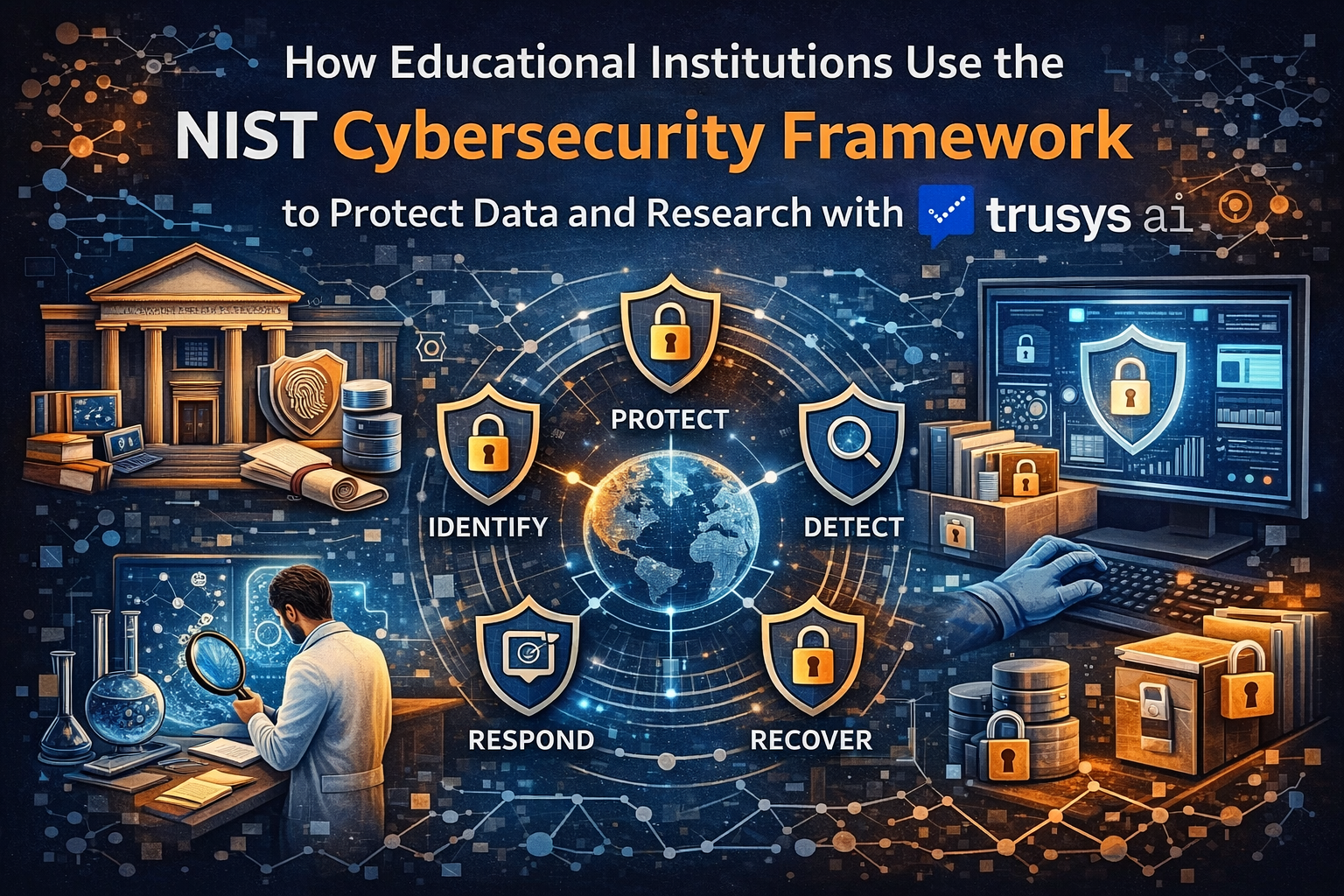
The framework is built around five core functions:
For educational institutions, the NIST Cybersecurity Framework offers a flexible structure that aligns security with academic and research missions.
Unlike rigid compliance checklists, the NIST Cybersecurity Framework for education adapts to diverse environments—public universities, private colleges, research labs, and hybrid learning platforms.
It helps institutions:
However, many institutions struggle to operationalize NIST CSF effectively. This is where Trusys adds real value.
Trusys transforms the NIST Cybersecurity Framework from a policy document into a living, actionable security program. Instead of siloed tools and manual audits, Trusys provides continuous visibility, automation, and governance.
Let’s break down how Trusys supports each NIST function in educational environments.
The first step in the NIST Cybersecurity Framework for education is knowing what you must protect. Universities often underestimate the scope of their digital assets.
With Trusys, institutions can:
According to EDUCAUSE, over 40% of institutions lack a complete asset inventory, increasing breach risk. Trusys closes this gap by providing centralized asset and risk visibility.
Once assets are identified, protection becomes the priority. Trusys strengthens protective controls without limiting academic access.
Key protection capabilities include:
This ensures that sensitive data remains protected while learning and research continue uninterrupted.
Detection is critical in education, where attacks often go unnoticed for months. IBM reports that the average breach detection time exceeds 200 days in academic environments.
Trusys enhances detection by:
By embedding NIST-aligned monitoring, Trusys reduces dwell time and limits damage.
When incidents occur, speed and coordination matter. The NIST Cybersecurity Framework for education emphasizes structured response plans—but many institutions lack automation.
With Trusys, institutions can:
Organizations with structured incident response plans reduce breach costs by up to 54% (IBM). Trusys ensures those plans are actionable when it matters most.
Recovery isn’t just about restoring systems—it’s about restoring trust with students, faculty, and funding bodies.
Trusys supports recovery by:
This continuous improvement loop aligns perfectly with the NIST CSF philosophy.
Research environments face unique risks, including nation-state attacks and intellectual property theft. Trusys helps research institutions apply the NIST Cybersecurity Framework for education specifically to high-value research.
This is especially critical as global research collaboration increases.
Educational institutions must comply with multiple regulations, including:
Trusys maps NIST CSF controls directly to these requirements, reducing audit burden and compliance risk.
While many tools address pieces of cybersecurity, Trusys delivers a unified, NIST-aligned approach tailored for education.
Institutions using structured frameworks like NIST CSF are 2x more likely to recover quickly from cyber incidents (NIST).
Cyber threats in education aren’t slowing down—but institutions don’t have to face them unprepared. By adopting the NIST Cybersecurity Framework for education and operationalizing it with Trusys, schools and universities can protect sensitive data, secure research, and maintain trust across their communities.
With Trusys, cybersecurity becomes an enabler of education—not a barrier. As digital learning and research expand, institutions that invest in structured, NIST-aligned security today will lead with confidence tomorrow.
The NIST Cybersecurity Framework for education is a risk-based security standard that helps schools and universities identify, protect, detect, respond to, and recover from cyber threats while safeguarding student data and research.
It provides a flexible and scalable approach to cybersecurity that aligns with education environments, helping institutions reduce breaches, protect intellectual property, and meet compliance requirements.
Trusys operationalizes NIST CSF by providing continuous monitoring, governance, risk assessment, and automated incident response tailored for education and research environments.
Yes. When implemented with Trusys, NIST CSF helps secure sensitive research data, prevent intellectual property theft, and monitor access to high-value research assets.
NIST CSF is not mandatory but is widely adopted as a best-practice framework, especially for institutions handling sensitive data or receiving federal funding.
Trusys maps NIST controls directly to FERPA, HIPAA, and GDPR requirements, simplifying audits and strengthening data protection across systems.
From small colleges to large research universities, Trusys scales to support diverse campus environments and multi-cloud infrastructures.