
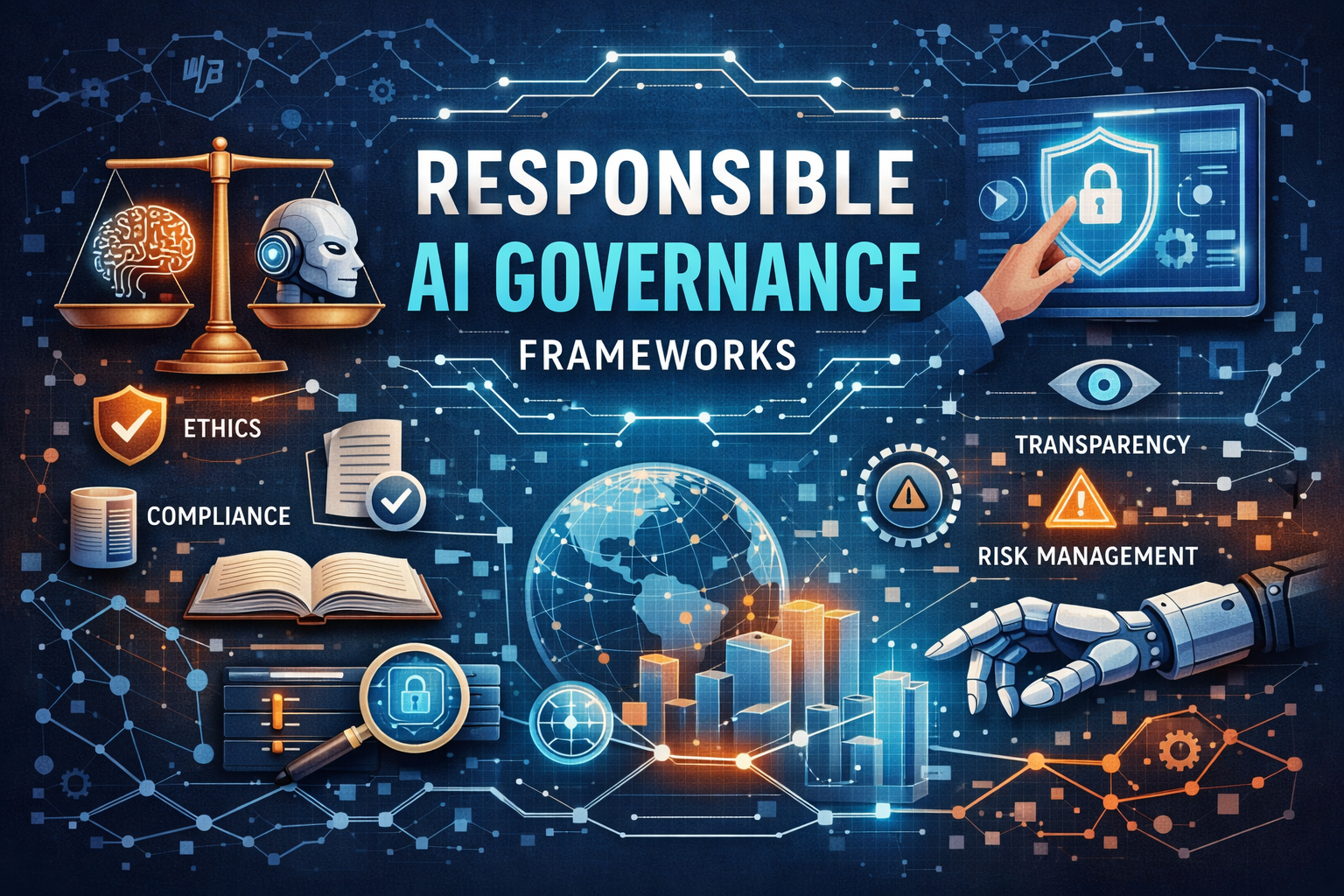
Artificial intelligence is no longer experimental—it’s enterprise-critical. According to McKinsey (2024), 65% of organizations now use generative AI regularly, yet over 60% of executives admit they lack confidence in how their AI systems are governed. At the same time, IBM reports that the average cost of an AI-related data breach exceeds $4.45 million, and Gartner predicts that by 2026, organizations without responsible AI governance will see 30% higher failure rates in AI initiatives.
These numbers tell a clear story: innovation without governance creates risk. This is why Responsible AI governance and Responsible AI frameworks have become some of the most searched and critical topics for enterprise leaders today. This guide breaks down what responsible AI governance really means, why it matters, and how leaders can implement it practically—without slowing innovation.
Responsible AI governance refers to the policies, processes, and controls that ensure AI systems are ethical, transparent, secure, compliant, and aligned with business goals. Unlike traditional IT governance, AI governance must account for:
In simple terms, responsible AI governance ensures that AI systems do what they’re supposed to do—and nothing they shouldn’t.
AI risks don’t sit only with data teams—they sit with the C-suite. Poorly governed AI can lead to regulatory fines, reputational damage, and lost customer trust.
📊 Key stats leaders should know:
As a result, responsible AI governance is no longer optional—it’s a competitive advantage.
Most successful responsible AI frameworks are built on a few foundational pillars. Let’s break them down clearly.
Every AI system must have clear human accountability. Leaders should define:
Without ownership, AI risk spreads unchecked across the organization.
Black-box AI erodes trust. Responsible AI governance frameworks require that AI decisions are understandable, auditable, and explainable—especially in regulated industries.
According to PwC, explainable AI increases stakeholder trust by up to 40% and speeds regulatory approvals.
Leaders should demand:
AI models reflect the data they’re trained on. Without governance, bias creeps in silently. Responsible AI frameworks address this by enforcing:
This isn’t just ethical—it’s commercial. Biased AI systems expose companies to legal and brand risks.
AI expands the attack surface. From data poisoning to prompt injection, AI-specific threats are rising fast. Microsoft reports that AI-related security incidents increased by 37% in 2023 alone.
Strong responsible AI governance includes:
Regulations like the EU AI Act, GDPR, HIPAA, and the NIST AI Risk Management Framework are reshaping how AI must be governed.
Responsible AI governance frameworks ensure that:
Leaders who prepare early avoid costly retrofits later.
Several global frameworks influence enterprise AI governance today. Understanding them helps leaders build robust, future-proof strategies.
Focuses on identifying, assessing, and managing AI risks across the lifecycle.
Introduces risk-based AI classification and strict obligations for high-risk systems.
Leaders often ask, "Where do we start?" The answer lies in a phased, practical approach.
Start by inventorying:
You can’t govern what you can’t see.
Create clear principles around:
These principles should align with business strategy—not just compliance.
Responsible AI governance works best when embedded into:
According to Gartner, organizations that integrate governance early reduce AI failures by up to 70%.
AI systems evolve—and so must governance. Leaders should track:
Continuous monitoring turns governance into a living system, not a static document.
When done right, responsible AI governance doesn’t slow innovation—it accelerates it safely.
Accenture reports that organizations with mature, responsible AI frameworks achieve up to 30% higher AI-driven revenue growth.
Even well-intentioned leaders fall into traps, such as:
Avoiding these pitfalls is just as important as building the framework itself.
As AI adoption grows, governance will become a board-level responsibility. By 2027, IDC predicts that 80% of enterprises will require formal AI assurance and governance frameworks to operate globally.
Leaders who invest now will not only reduce risk—they’ll position their organizations as trusted AI innovators.
Responsible AI governance frameworks are no longer theoretical—they are practical tools for modern leadership. In a world where AI decisions affect customers, employees, and society, governance is the bridge between innovation and trust.
By adopting structured, transparent, and secure Responsible AI governance and Responsible AI frameworks, leaders can move beyond fear and uncertainty—and build AI systems that are ethical, compliant, and confidently scalable.
The question isn’t whether your organization needs responsible AI governance.
It’s whether you’re ready to lead with it.