
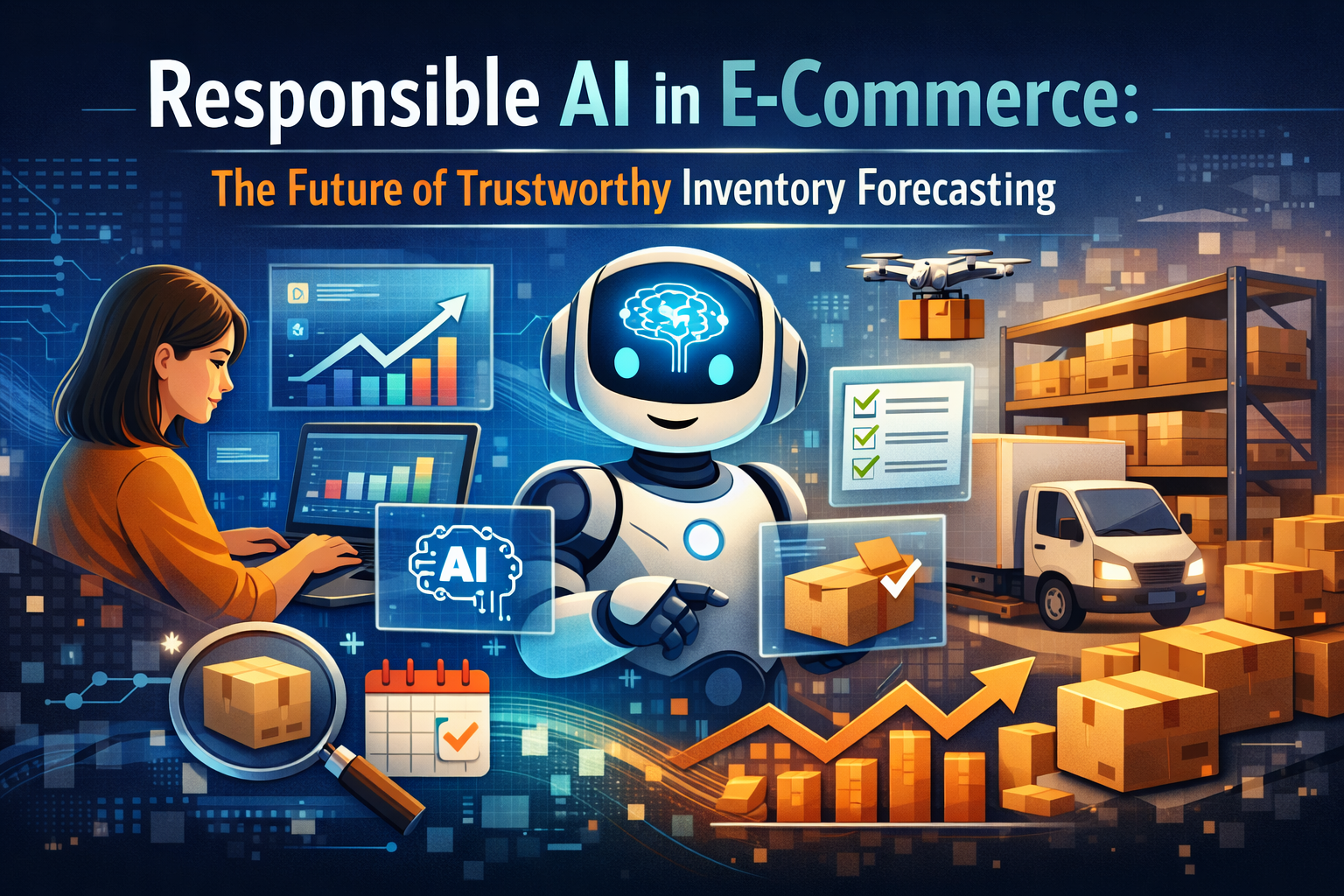
E-commerce continues to expand at an unprecedented rate. By the end of 2025, global e-commerce sales had already exceeded $7 trillion, according to updated Statista estimates, and projections show the market moving steadily toward $8.5 trillion by 2027. However, rapid growth has also magnified operational inefficiencies. Industry studies reveal that inventory mismanagement now costs retailers over $1.9 trillion each year, driven by persistent overstocking, stockouts, and inaccurate demand planning. As a result, inventory forecasting has become a mission-critical function—and this is precisely where Responsible AI in e-commerce is taking center stage.
As retailers increasingly rely on AI-driven demand prediction, trust, transparency, and accountability matter more than ever. Responsible AI ensures that inventory forecasting systems are accurate, explainable, and fair, helping businesses make smarter decisions while protecting customers and partners. In short, the future of e-commerce inventory forecasting isn’t just intelligent—it’s responsible.
Inventory forecasting directly impacts profitability, customer satisfaction, and brand loyalty. When forecasts fail, customers notice immediately. A McKinsey study found that out-of-stock products reduce customer satisfaction by up to 30%, while excess inventory increases holding costs by 20–30%.
Traditional forecasting methods struggle to keep up with modern e-commerce complexities, such as:
AI-powered forecasting addresses these challenges, but without Responsible AI in e-commerce, it can introduce bias, opacity, and operational risk.
AI adoption in retail is accelerating fast. Gartner reports that 75% of large retailers will use AI-driven forecasting tools by 2026. However, not all AI systems are created equal. Black-box models may deliver predictions, but they often lack explainability and governance.
Responsible AI focuses on building systems that are:
In e-commerce inventory forecasting, these principles ensure AI-driven decisions don’t harm suppliers, customers, or the business itself.
Accuracy is the backbone of effective inventory management. Responsible AI enhances forecasting accuracy by combining robust data governance with ethical model design.
Here’s how it works:
According to IBM, businesses that implement Responsible AI practices improve AI model reliability by up to 35%, which directly translates into better inventory planning.
Trust is everything in e-commerce. Customers expect availability, suppliers expect fairness, and stakeholders expect accountability. Responsible AI in e-commerce helps build that trust by making inventory forecasting decisions explainable.
For example, when AI predicts a demand spike, teams can trace the reasoning back to:
This level of transparency enables faster, more confident decisions. As a result, retailers can reduce stockouts while avoiding unnecessary overstock.
Inventory waste is a massive problem. The Ellen MacArthur Foundation estimates that retail waste contributes significantly to global carbon emissions, with excess inventory often ending up in landfills.
Responsible AI-driven e-commerce inventory forecasting helps retailers:
A BCG report shows that AI-driven inventory optimization can reduce waste by up to 25%, making Responsible AI not just ethical—but environmentally smart.
Inventory forecasting doesn’t just affect retailers; it impacts suppliers too. Inaccurate or biased forecasts can lead to unfair order cancellations or sudden demand spikes that suppliers can’t handle.
Responsible AI ensures:
By using Responsible AI in e-commerce, businesses create healthier, more resilient supplier ecosystems while reducing operational friction.
Regulations around AI and data usage are expanding rapidly. From GDPR to emerging AI governance frameworks, compliance is no longer optional. According to Deloitte, 60% of retail leaders worry about regulatory risks associated with AI adoption.
Responsible AI frameworks help mitigate these risks by:
When inventory forecasting models operate within clear governance boundaries, businesses can scale AI confidently and compliantly.
Responsible AI in e-commerce unlocks powerful, real-world applications, including:
Retailers using AI-driven forecasting report 10–20% lower inventory costs and 5–10% higher order fulfillment rates, according to Capgemini.
Looking ahead, the combination of Responsible AI and advanced analytics will define the next generation of e-commerce. Forecasting systems will become more adaptive, transparent, and collaborative.
Future-ready platforms will:
As competition intensifies, Responsible AI in e-commerce will separate trusted brands from the rest.
Responsible AI in e-commerce refers to using AI systems that are transparent, fair, accountable, and reliable across business operations like inventory forecasting.
It improves accuracy, reduces bias, increases explainability, and ensures forecasts align with ethical and operational standards.
Because inaccurate or opaque forecasts can cause stockouts, waste, supplier issues, and loss of customer trust.
The future of e-commerce inventory forecasting isn’t just about smarter algorithms—it’s about trustworthy ones. Responsible AI in e-commerce enables retailers to forecast demand accurately while maintaining transparency, fairness, and accountability. By embracing Responsible AI today, businesses don’t just optimize inventory—they build lasting trust, reduce waste, and create a more sustainable, resilient e-commerce ecosystem.
In a digital marketplace driven by data, Responsible AI is no longer optional. It’s the competitive edge that defines tomorrow’s e-commerce leaders.