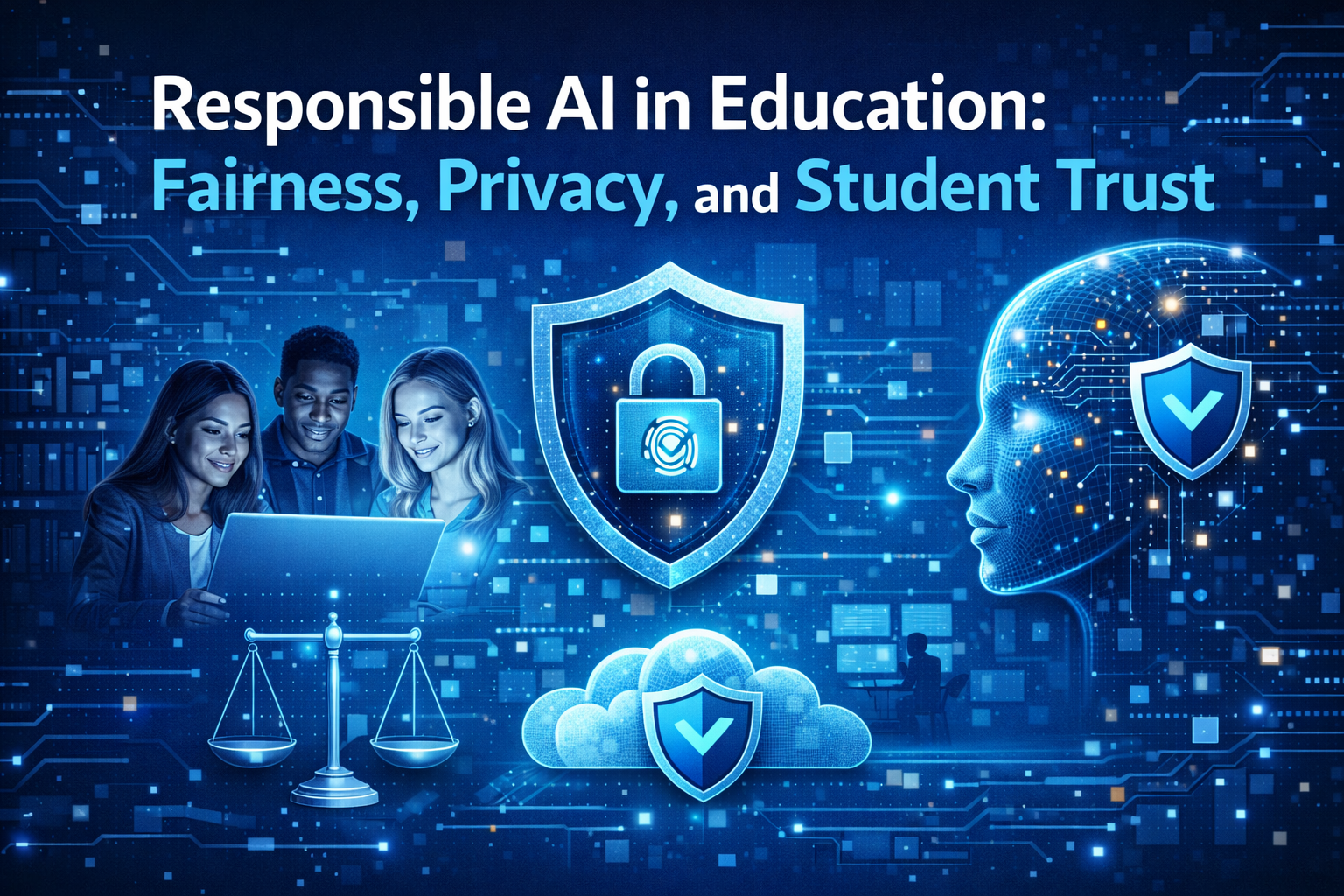
Artificial Intelligence is no longer a futuristic concept in classrooms—it’s already here. According to HolonIQ, global spending on AI in education is expected to surpass $25 billion by 2030, growing at over 45% CAGR. At the same time, a UNESCO report revealed that more than 60% of educators worry about bias, data misuse, and lack of transparency in AI-driven learning tools. These numbers make one thing crystal clear: Responsible AI in Education is not optional—it’s essential.
As schools, universities, and edtech companies rapidly adopt AI-powered systems, they must ensure fairness, protect student privacy, and maintain trust. When done right, responsible AI can personalize learning, support teachers, and improve outcomes. When done wrong, it can deepen inequalities and erode confidence in education systems.
Responsible AI in Education refers to the ethical design, deployment, and governance of AI systems used in learning environments. It ensures that AI tools operate transparently, fairly, and securely while prioritizing student well-being.
At its core, responsible AI focuses on:
By following these principles, educational institutions can harness AI’s power without compromising ethical standards.
AI already influences many aspects of education, including:
A McKinsey study found that AI-powered personalization can improve student engagement by up to 30%. However, these benefits only materialize when institutions implement Responsible AI in Education frameworks that address ethical risks proactively.
AI systems learn from data. If that data reflects historical bias, the AI may unintentionally discriminate. For example, biased training data can disadvantage students from certain socioeconomic, ethnic, or linguistic backgrounds.
A 2023 Stanford study showed that biased algorithms in education tools can reduce accuracy for underrepresented student groups by as much as 20%. That’s a gap no education system can afford.
Responsible AI in Education actively addresses bias by:
When institutions prioritize fairness, AI becomes a tool for inclusion rather than exclusion.
Students generate massive amounts of data—academic records, behavioral patterns, biometric data, and even emotional indicators. According to Common Sense Media, 70% of parents worry about how edtech platforms collect and use student data.
Without responsible practices, AI systems can expose sensitive information or violate regulations like FERPA, GDPR, and COPPA.
Responsible AI in Education ensures privacy by:
When institutions respect privacy, they protect students and strengthen institutional credibility.
Trust determines whether students and educators embrace or reject AI tools. A Pew Research Center survey found that 52% of students feel uneasy when they don’t understand how AI systems evaluate their performance.
Responsible AI in Education emphasizes transparency by:
When students understand AI decisions, they’re more likely to trust and engage with the technology.
AI should support teachers, not replace them. Responsible AI frameworks empower educators to:
According to OECD, schools that combine AI tools with human oversight see up to 25% improvement in learning outcomes compared to fully automated approaches.
To remain competitive and visible, institutions should align content and strategy with high-search-volume keywords, including:
Among these, “Responsible AI in Education” has strong and growing search demand, making it a powerful targeted keyword for thought leadership and SEO.
Despite its importance, adopting responsible AI isn’t always easy. Common challenges include:
However, institutions that invest early gain a long-term advantage by reducing risks and building sustainable AI ecosystems.
The future points toward stronger regulations, higher public awareness, and increased accountability. UNESCO’s Global AI Ethics Framework already encourages governments to embed responsible AI principles into education systems worldwide.
As AI adoption accelerates, institutions that prioritize Responsible AI in Education will stand out as leaders in innovation, ethics, and trust.
AI has the power to reshape education for the better—but only if used responsibly. By focusing on fairness, privacy, and student trust, educational institutions can unlock AI’s full potential while safeguarding human values.
Responsible AI in Education isn’t just a technical requirement; it’s a moral and strategic commitment. When ethics guide innovation, students win, educators thrive, and education systems become more resilient for the future.
Responsible AI in Education refers to the ethical use of artificial intelligence in learning environments. It ensures AI systems operate fairly, protect student data, remain transparent, and align with educational values. Schools use responsible AI to support learning while avoiding bias, privacy violations, and misuse of student information.
Responsible AI matters because AI directly influences student outcomes, assessments, and opportunities. Without ethical safeguards, AI can reinforce inequality, misuse personal data, and reduce trust. Responsible AI in Education helps institutions protect students, comply with regulations, and maintain credibility.
Responsible AI promotes fairness by using diverse datasets, monitoring algorithms for bias, and including human oversight in decision-making. These practices help ensure AI tools treat students equally regardless of background, gender, ethnicity, or socioeconomic status.
Yes, AI can become biased if it learns from incomplete or unbalanced data. Studies show biased algorithms can reduce accuracy for marginalized student groups by up to 20%. Responsible AI in Education actively audits and corrects bias to ensure equitable learning experiences.
Responsible AI protects privacy by limiting data collection, encrypting sensitive information, and complying with laws like FERPA, GDPR, and COPPA. It also ensures students and parents understand how data is collected, stored, and used.
AI systems may collect academic records, attendance data, learning behavior, assessment results, and interaction patterns. Responsible AI in Education ensures this data is used only for educational improvement and not for unauthorized purposes.
In many regions, parts of responsible AI are legally required through data protection and education laws. While full AI ethics frameworks may not yet be mandatory everywhere, global regulations like the EU AI Act indicate that responsible AI practices will soon become standard.
Responsible AI builds trust by being transparent about how decisions are made, allowing students to question outcomes, and ensuring accountability. When students understand AI decisions, they feel more confident and engaged in the learning process.
Absolutely. Teachers provide essential human oversight, interpret AI insights, and ensure ethical classroom use. Responsible AI in Education supports educators rather than replacing them, leading to better learning outcomes and stronger student relationships.
Yes. According to OECD, combining AI tools with responsible governance and human supervision can improve learning outcomes by up to 25%. Ethical AI enhances personalization while maintaining fairness and transparency.
Common challenges include limited expertise, cost concerns, lack of clear standards, and resistance to change. However, institutions that invest early reduce long-term risks and gain a competitive advantage.
The future includes stronger regulations, global ethical standards, and increased AI literacy. Organizations like UNESCO advocate embedding Responsible AI in Education policies to ensure sustainable, trustworthy innovation worldwide.