
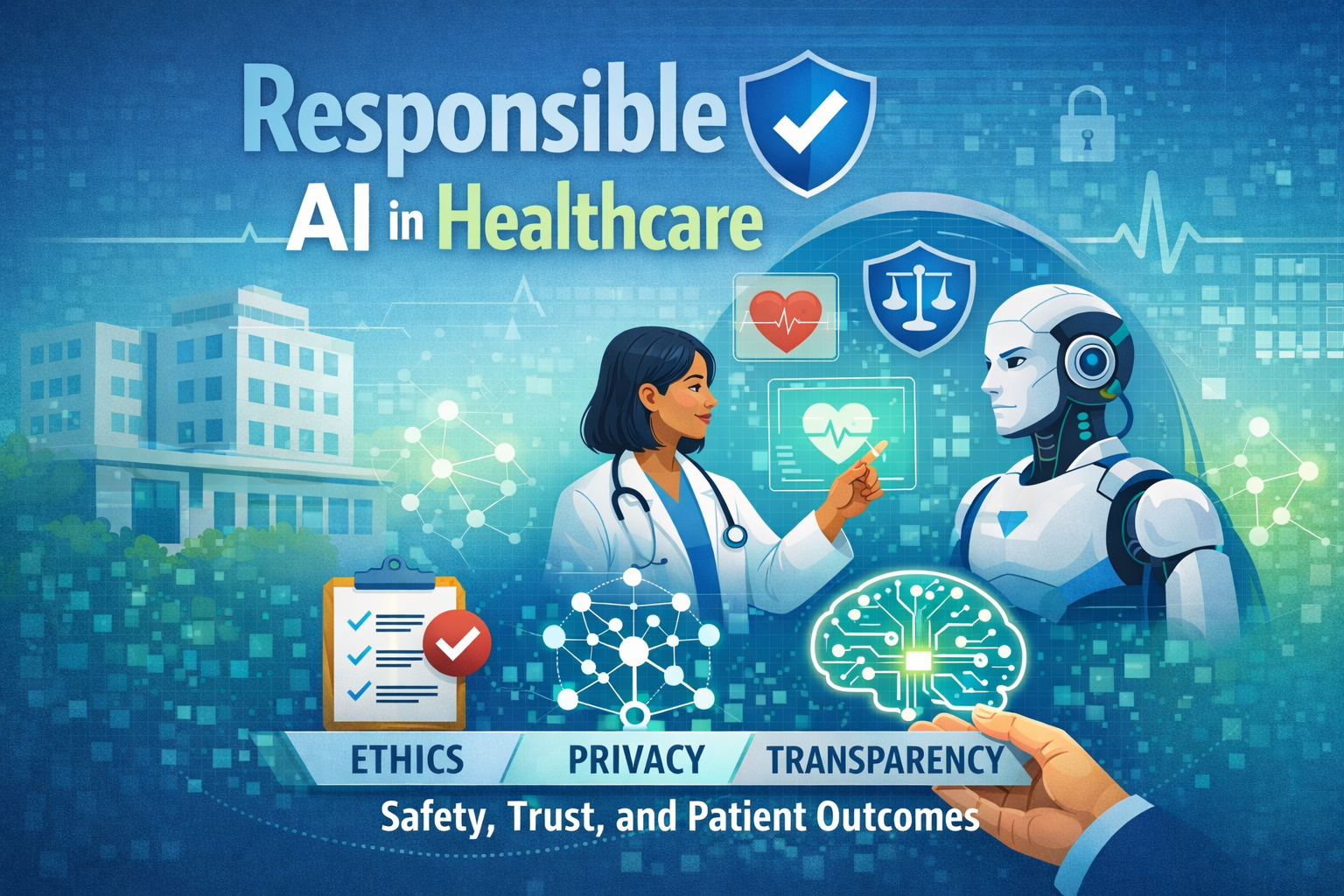
Artificial intelligence is rapidly transforming healthcare, from diagnostic imaging and clinical decision support to personalized treatment plans. According to McKinsey, AI adoption in healthcare could generate $60–110 billion annually in value, while over 70% of healthcare organizations are already piloting or deploying AI-based tools. However, this rapid growth comes with serious risks. The World Health Organization warns that poorly governed AI can increase patient harm, bias, and inequity, and IBM reports that the average cost of a healthcare data breach reached $10.93 million in 2023, the highest of any industry.
These realities explain why Responsible AI in Healthcare has become one of the most searched and competitive keywords in digital health today. Healthcare leaders now recognize that innovation must be paired with safety, trust, and accountability to truly improve patient outcomes.
Responsible AI in healthcare refers to the ethical, transparent, secure, and governed use of AI systems across clinical, operational, and research environments. Unlike other industries, healthcare AI directly affects human lives, which raises the stakes significantly.
A responsible approach ensures that AI systems are:
When healthcare organizations embed these principles, AI becomes a powerful ally rather than a source of risk.
Healthcare operates under strict regulatory, ethical, and clinical standards. A single AI error can lead to misdiagnosis, delayed treatment, or patient harm.
📊 Key healthcare AI statistics:
As a result, Responsible AI in Healthcare is no longer optional—it is essential for patient safety and institutional credibility.
Trust is the foundation of healthcare. Clinicians must trust AI recommendations, and patients must trust how their data is used.
Responsible AI builds trust by:
📈 Research from PwC shows that explainable AI increases clinician adoption by up to 40%, leading to better clinical integration and outcomes.
AI systems can process vast amounts of medical data faster than humans, but speed without safeguards is dangerous.
Responsible AI improves patient safety by:
For example, continuous monitoring of AI diagnostic tools can detect accuracy drops caused by new patient populations or changing disease patterns—preventing silent failures that could harm patients.
Healthcare data often reflects historical inequities. If left unchecked, AI can amplify disparities rather than reduce them.
Responsible AI frameworks address bias by:
📊 A Stanford study found that unmitigated bias in healthcare AI can reduce diagnostic accuracy for minority groups by up to 20%. Responsible AI practices directly protect vulnerable populations.
Healthcare data is among the most sensitive information organizations hold. AI systems increase the attack surface, making governance and security critical.
Responsible AI in healthcare emphasizes:
According to IBM, healthcare organizations with strong security and governance frameworks reduce breach costs by up to 29% compared to those without structured controls.
Regulatory scrutiny of healthcare AI is intensifying worldwide. Agencies increasingly expect organizations to demonstrate not just compliance, but accountability and transparency.
Responsible AI frameworks help healthcare organizations:
This proactive approach reduces approval delays and regulatory risk.
When healthcare organizations implement Responsible AI correctly, the benefits extend beyond compliance.
📈 Hospitals using well-governed AI tools report 10–20% improvements in clinical efficiency and measurable gains in patient satisfaction scores (McKinsey).
Search data shows growing demand for solutions centered on trust and accountability. High-volume, high-intent keywords include:
This trend reflects a shift from “Can AI work?” to “Can AI be trusted?”
Despite good intentions, many organizations struggle with Responsible AI due to:
Avoiding these pitfalls is critical to sustaining safe and effective AI programs.
The future of healthcare AI will be defined by trust and accountability. The WHO and global regulators increasingly emphasize ethical AI, while patients demand transparency and fairness.
By 2027, IDC predicts that over 80% of healthcare organizations will require formal Responsible AI governance frameworks to deploy AI at scale. Those who invest early will lead the next generation of patient-centered innovation.
Responsible AI in healthcare is not about slowing innovation—it’s about making innovation safe, fair, and effective. When healthcare organizations embed responsibility into AI design, deployment, and monitoring, they unlock better outcomes for clinicians and patients alike.
By prioritizing safety, trust, and patient outcomes, Responsible AI transforms healthcare AI from a risky experiment into a reliable clinical partner. In a field where lives are at stake, responsibility isn’t a constraint—it’s the foundation of progress.
Responsible AI in healthcare refers to the safe, ethical, transparent, and governed use of AI systems to support clinical decisions, protect patient data, and improve health outcomes.
Responsible AI reduces errors, bias, and hallucinations in AI systems, ensuring clinical recommendations remain accurate, explainable, and aligned with patient well-being.
By providing explainable insights, continuous validation, and reliable performance monitoring, Responsible AI helps clinicians understand and trust AI-driven recommendations.
Yes. Responsible AI frameworks require bias testing across diverse populations, helping prevent disparities in diagnosis, treatment, and access to care.
Responsible AI aligns AI systems with regulations such as HIPAA, GDPR, and FDA AI/ML guidelines through governance, audit trails, and risk management controls.
Without Responsible AI, healthcare organizations face higher risks of misdiagnosis, data breaches, regulatory penalties, and loss of patient trust.
No. Responsible AI benefits hospitals, clinics, health tech startups, and research institutions of all sizes by ensuring safe and scalable AI adoption.
Organizations can begin by adopting AI governance frameworks, validating AI models, monitoring performance continuously, and establishing clear accountability for AI use.