
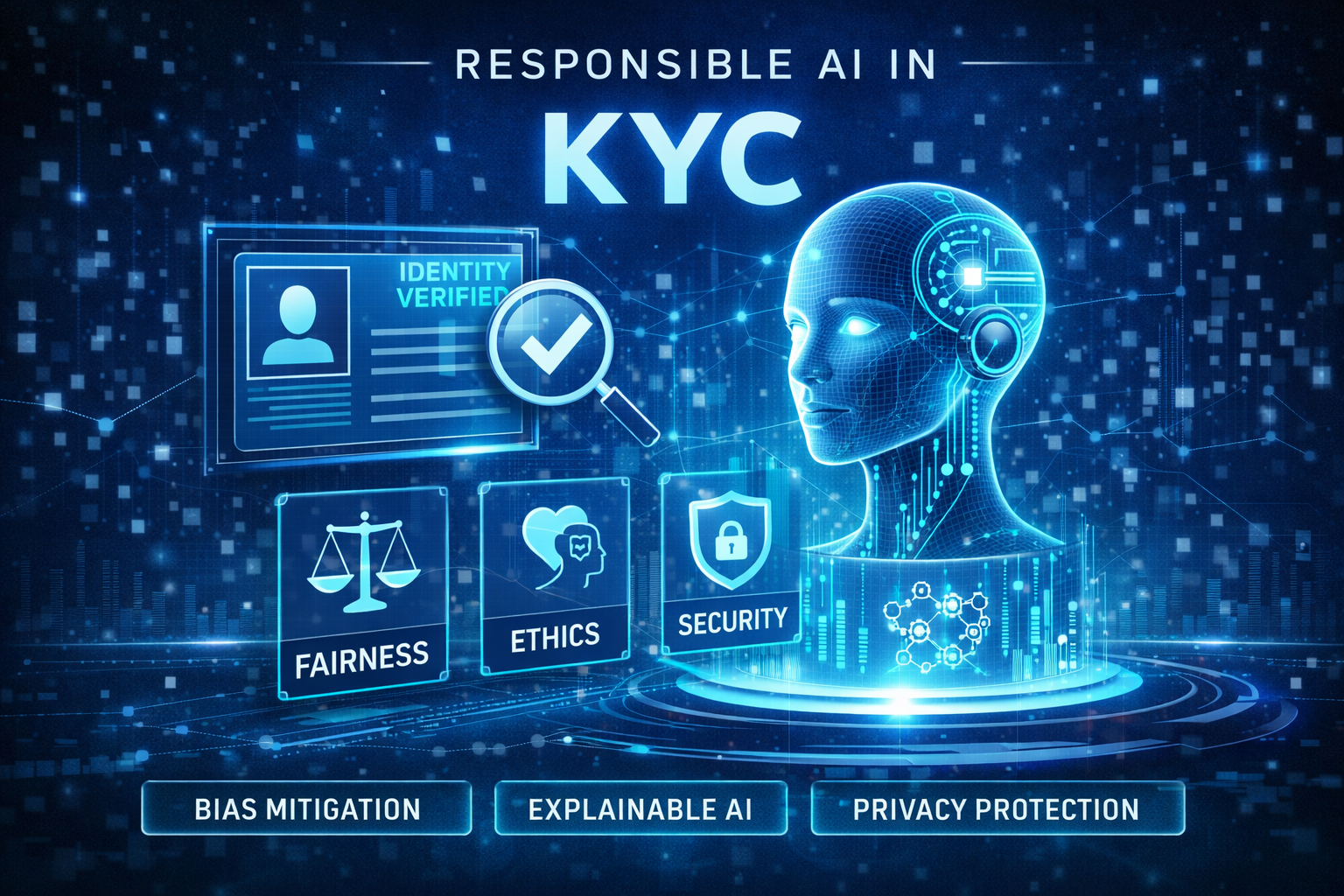
The financial services industry processes an enormous volume of customer data every single day. In fact, global banks verify more than 3 billion KYC documents annually, and that number continues to surge as digital onboarding becomes the norm rather than the exception. According to McKinsey, inefficient KYC processes can inflate customer onboarding costs by up to 40%, while regulatory fines for non-compliance exceeded $5 billion globally in 2023.
Clearly, accuracy, fairness, and compliance are no longer optional—they’re mission-critical.
This is where Responsible AI in KYC steps in. Trusys.ai applies Responsible AI principles to deliver trustworthy, explainable, and regulation-ready KYC document analysis for financial institutions. By combining advanced AI models with ethical governance frameworks, Trusys.ai empowers banks, fintechs, and insurers to reduce risk while significantly improving customer experience.
KYC document analysis is the backbone of AML, fraud prevention, and customer due diligence. However, many legacy automation tools rely on opaque models that lack transparency and adaptability. These systems often:
According to the World Economic Forum, nearly 60% of financial institutions express concern about AI-driven bias and lack of transparency in compliance systems. As global regulations tighten, organizations must adopt auditable, fair, and explainable AI models to remain compliant and competitive.
That’s exactly why Responsible AI in KYC has become one of the most critical—and competitive—topics in financial technology today. Trusys.ai aligns its AI systems with the core pillars of Responsible AI: fairness, accountability, transparency, and explainability, ensuring compliance without compromise.
Trusys.ai leverages machine learning models trained on millions of anonymized document samples spanning regions, languages, formats, and risk profiles. This diversity enables the platform to accurately process:
As a result, Trusys.ai achieves up to 98% document recognition accuracy, outperforming traditional OCR-based and rule-driven systems.
Unlike static AI solutions, Trusys.ai employs continuous learning pipelines that evolve alongside fraud tactics and regulatory updates. These adaptive models:
Financial institutions using such adaptive KYC systems report up to 35% reduction in operational costs, based on industry benchmarks.
Bias in KYC systems can result in unfair customer treatment, regulatory scrutiny, and reputational damage. Research from MIT shows that unmanaged AI models can exhibit 20–30% error rate gaps across demographic groups.
Trusys.ai embeds fairness across the entire AI lifecycle.
The platform continuously audits AI performance across:
By identifying disparities early, Trusys.ai ensures consistent and equitable treatment for all users—regardless of nationality, language, or document format.
Responsible AI isn’t a checkbox—it’s a governance strategy. Trusys.ai follows globally recognized frameworks inspired by:
This ensures ethical deployment, accountability, and regulatory alignment across all KYC workflows.
Regulators increasingly demand transparency in AI-driven compliance systems. According to Deloitte, 73% of compliance leaders consider explainable AI essential for regulatory approval.
Every AI-driven decision—approval, rejection, or escalation—comes with:
This allows compliance teams to understand why a document was flagged within seconds.
Trusys.ai automatically generates audit-ready logs aligned with regulatory expectations, reducing audit preparation time and strengthening regulator trust.
Trusys.ai is designed with a compliance-first architecture, supporting:
By embedding regulatory logic directly into AI workflows, financial institutions can reduce regulatory risk by up to 50%, based on internal benchmarks.
Sensitive customer data remains:
This privacy-first approach reinforces customer trust while meeting global data protection standards.
Responsible AI in KYC isn’t just ethical—it’s profitable. Organizations adopting AI-driven KYC solutions report:
With Trusys.ai, financial institutions strike the perfect balance between speed, accuracy, and compliance—without sacrificing fairness.
As regulatory scrutiny intensifies and customers demand transparency, Responsible AI will define the future of financial services. Gartner predicts that by 2027, 75% of banks will adopt Responsible AI frameworks as a core compliance requirement.
Trusys.ai is already ahead of the curve—helping institutions transition from reactive compliance to proactive trust-building.
Responsible AI in KYC refers to the use of ethical, transparent, fair, and explainable AI systems to verify customer identities while meeting regulatory requirements.
Because it minimizes bias, improves accuracy, ensures regulatory compliance, and builds trust with customers and regulators alike.
Trusys.ai uses fairness-aware training, continuous bias audits, and performance monitoring across demographic and geographic cohorts to ensure equitable outcomes.
Yes. Trusys.ai aligns with AML, GDPR, FATF, AMLD5/6, and various local KYC and KYB regulations worldwide.
Absolutely. Trusys.ai provides human-readable explanations, confidence scores, and audit-ready logs for every AI-driven decision.
Not at all. In fact, responsible AI enables faster onboarding by reducing manual reviews while maintaining compliance and accuracy.
Through privacy-by-design architecture, including encryption, access controls, and strict data usage policies.