
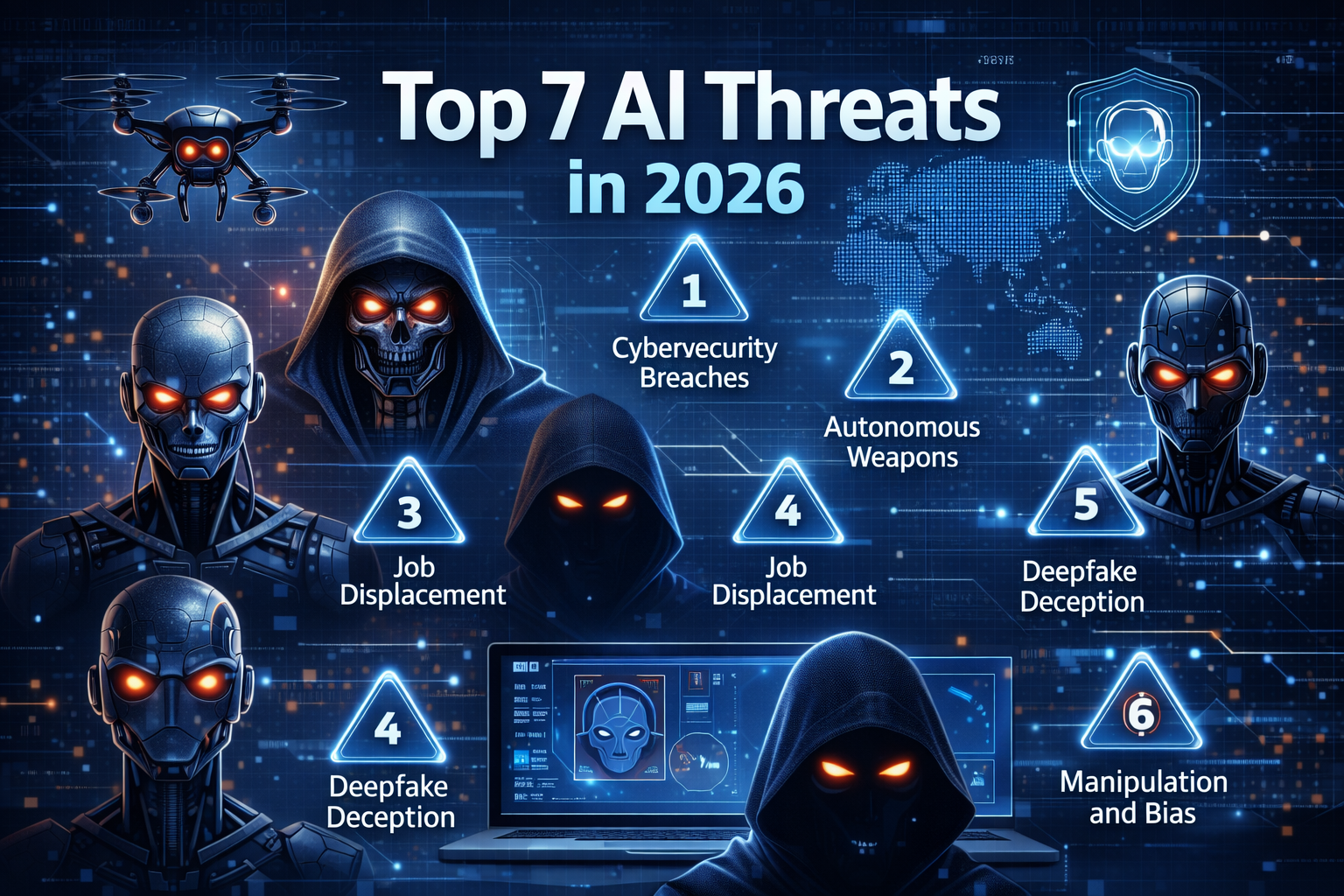
AI has moved from experimentation to execution. It now influences hiring decisions, credit approvals, medical insights, customer interactions, and internal strategy. But while adoption is accelerating, AI risk management is not keeping pace.
In 2026, the most damaging AI threats will not come from dramatic system crashes. Instead, they will emerge slowly—through subtle behavioral changes, silent bias, overconfident outputs, and governance gaps that compound over time.
Enterprises that fail to recognize these risks early will face higher costs, regulatory pressure, and declining trust. Let’s take a deeper look at the seven most critical AI threats and why strong AI risk management is the only sustainable path forward.
Enterprise AI systems are now:
This complexity means AI risk is no longer isolated. A single failure can cascade across systems, teams, and outcomes. Traditional controls—static testing, manual approvals, or occasional reviews—simply cannot manage risk at this scale.
Model drift occurs when the data or environment an AI system operates in changes over time. What makes this threat especially dangerous is that drift rarely triggers alarms.
Most enterprises validate models once and assume stability. That assumption creates blind spots.
Trusys strengthens AI risk management by continuously evaluating model behavior, allowing enterprises to detect early warning signals before drift escalates into systemic failure.
Bias is not a one-time issue—it evolves.
Even well-tested models can begin producing skewed outcomes as new data sources, user behavior, or operational contexts change.
Bias is often treated as a checkbox instead of an ongoing risk.
By enabling continuous outcome analysis, Trusys helps enterprises embed bias monitoring directly into their AI risk management processes.
Generative AI introduces a unique risk: outputs that are fluent, confident, and wrong.
Unlike traditional errors, hallucinations can easily be mistaken for reliable information.
Manual reviews and ad-hoc checks cannot scale with high-volume generation.
Trusys strengthens AI risk management by evaluating output behavior patterns, helping enterprises identify where generative AI becomes unreliable or inconsistent.
In 2026, enterprises are increasingly expected to explain AI-driven outcomes—not just accept them.
When decisions cannot be explained, accountability breaks down.
Explainability is often reactive rather than proactive.
Trusys enables enterprises to analyze decision patterns and behaviors, reinforcing AI risk management with clearer oversight and accountability.
AI regulation is expanding rapidly, and enterprises are expected to demonstrate:
Fragmented documentation and inconsistent evaluation practices.
Trusys centralizes evaluation insights, making AI risk management auditable, repeatable, and enterprise-ready.
Teams innovate quickly, often deploying AI tools outside formal oversight.
This creates shadow AI—models that operate without governance.
Governance structures lag behind decentralized AI adoption.
Trusys provides centralized visibility, helping enterprises extend AI risk management across teams and deployments.
Trust doesn’t disappear overnight—it erodes.
Repeated small failures, unexplained decisions, or inconsistent outcomes slowly undermine confidence.
Trust is rarely measured or monitored.
By making AI behavior measurable and visible, Trusys strengthens AI risk management and helps enterprises rebuild and maintain trust.
Trusys enables enterprises to move from reactive firefighting to structured control by supporting:
This approach allows AI risk management to scale alongside AI adoption—without slowing innovation.
Manage risk in credit, fraud, and compliance-focused AI systems.
Ensure AI-driven insights remain reliable, safe, and explainable.
Control unintended outcomes in recommendation and screening systems.
Across industries, AI risk management is what turns AI from a gamble into a strategic asset.
AI risk management is the continuous process of identifying, monitoring, and mitigating risks related to AI behavior, outcomes, and governance.
Because AI systems are more autonomous, regulated, and impactful than ever before.
By enabling continuous evaluation, visibility, and governance across enterprise AI systems.
Yes. Trust is built when AI behavior is transparent, measurable, and controlled.
In 2026, enterprises won’t fail because they used AI—they’ll fail because they didn’t manage its risks.
Strong AI risk management is no longer optional. It’s the foundation of scalable, trustworthy, and sustainable AI. By helping enterprises understand what AI actually does in production, Trusys transforms risk from an unknown threat into a managed capability.