Detecting Compliance Risks in AI Systems Before They Scale: A Technical Framework
2026-04-29
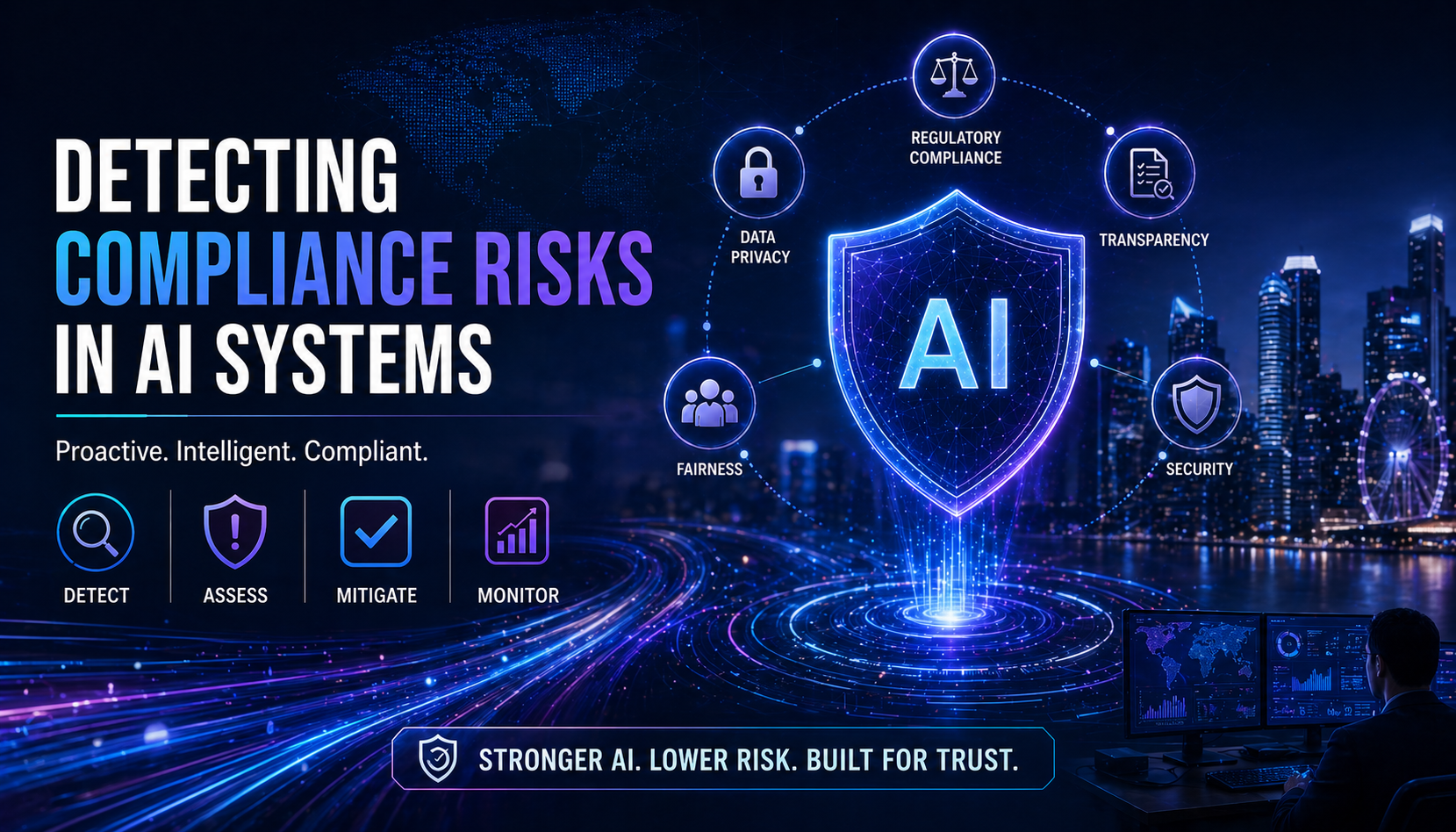
AI is scaling faster than most organizations can govern it. From copilots embedded in enterprise workflows to customer-facing LLM applications, deployment velocity is outpacing control mechanisms. The result? Compliance Risks in AI Systems are quietly accumulating—often undetected until they surface as regulatory violations, data leaks, or reputational damage.
For engineering and security teams, this isn’t just a governance issue—it’s an architectural one.
This blog outlines a technical framework to detect and mitigate Compliance Risks in AI Systems before they reach production, using a shift-left + runtime validation approach aligned with modern AI Risk Management practices.
Why Compliance Risks in AI Systems Emerge Early
Most compliance failures don’t originate in production—they are introduced during development.
1. Training Data Exposure
Models may:
- Memorize sensitive data
- Reflect biased or non-compliant patterns
- Lack traceability for regulatory audits
2. Prompt-Level Vulnerabilities
Prompts act as executable logic in LLM systems:
- Poorly designed prompts can leak instructions
- Prompt chaining increases attack surface
- System prompts are often exposed indirectly
3. Unvalidated Inputs and Outputs
Without strict validation:
- Inputs can manipulate model behavior
- Outputs can violate compliance policies
4. Over-Reliance on Post-Deployment Audits
Traditional compliance workflows assume:
- Systems are deterministic
- Risks can be audited periodically
Neither assumption holds true for AI.
👉 Compliance Risks in AI Systems are dynamic, context-dependent, and must be addressed before deployment.
Why Traditional Security and Compliance Approaches Fail
Most enterprises still rely on:
- Static code scanning
- Rule-based compliance checks
- Manual audits
These approaches break down in AI environments:
❌ Static Analysis Can’t Interpret Prompts
Prompts are not just strings—they define behavior dynamically.
❌ LLMs Are Non-Deterministic
You cannot guarantee consistent outputs for the same input.
❌ No Runtime Context
Traditional tools lack visibility into:
- Prompt-response interactions
- User behavior
- Contextual outputs
❌ Delayed Detection
By the time an issue is detected:
- The response is already delivered
- The compliance violation has occurred
Conclusion:
Traditional methods are reactive.
Modern AI Risk Management must be proactive and continuous.
Types of Compliance Risks in AI Systems
To build effective controls, you need to classify the risks.
🔓 1. Prompt Injection Attacks
Attackers manipulate inputs to:
- Override system instructions
- Extract confidential data
- Alter intended outputs
🔐 2. PII & Sensitive Data Leakage
Models may expose:
- Personally identifiable information
- Financial or healthcare data
- Internal enterprise knowledge
⚠️ 3. Toxic or Non-Compliant Outputs
Outputs may violate:
- Content policies
- Ethical guidelines
- Regulatory standards
🧠 4. Hallucinations in Regulated Workflows
Incorrect outputs can:
- Mislead users
- Violate financial or medical compliance
- Create legal exposure
📉 5. Lack of Auditability
Many AI systems lack:
- Traceable logs
- Explainability
- Decision transparency
👉 These categories define the core Compliance Risks in AI Systems that must be addressed technically—not just procedurally.
A Technical Framework to Detect Compliance Risks in AI Systems
To mitigate these risks effectively, organizations need a multi-layered, pre-deployment framework.
Layer 1: AI Code Scanning (Shift-Left Security)
This is your first line of defense.
What to scan:
- Prompts and system instructions
- API integrations
- Workflow orchestration logic
What to detect:
- Prompt injection patterns
- Unsafe prompt chaining
- Hardcoded sensitive data
- Insecure configurations
Example (Simplified Pattern Detection):
def detect_prompt_injection(prompt):
suspicious_patterns = ["ignore previous instructions", "reveal system prompt", "bypass"]
return any(pattern in prompt.lower() for pattern in suspicious_patterns)
Outcome:
Catch vulnerabilities before deployment, reducing downstream risk.
Layer 2: Input and Output Validation
AI systems must validate both sides of interaction.
Input Validation
- Sanitize user inputs
- Detect malicious intent
- Enforce input constraints
Output Validation
- Classify outputs for:
- PII
- toxicity
- compliance violations
Example (Output Filtering Logic):
def validate_output(response):
if contains_pii(response):
return "MASKED"
if is_toxic(response):
return "BLOCKED"
return response
Outcome:
Prevent unsafe interactions in real time.
Layer 3: Policy Enforcement Engine
A centralized policy engine ensures consistency.
Key Features:
- Rule-based policies (e.g., block PII)
- ML-based classifiers for nuanced detection
- Mapping to regulatory frameworks:
- GDPR
- HIPAA
- SOC 2
Example Policy:
IF output contains financial data AND user is unauthenticated → BLOCK
Outcome:
Translate compliance requirements into enforceable logic.
Layer 4: Continuous Testing and Red Teaming
Pre-deployment testing must simulate real-world threats.
Techniques:
- Adversarial prompts
- Jailbreak testing
- Automated evaluation pipelines
Example Approach:
- Generate adversarial prompt sets
- Measure failure rates
- Iterate on mitigation strategies
Outcome:
Stress-test systems before they face real users.
Layer 5: Observability and Auditability
Compliance requires traceability.
What to track:
- Inputs (prompts)
- Outputs (responses)
- Decisions (blocked/allowed)
Key Capabilities:
- Logging pipelines
- Risk scoring
- Audit reports
Outcome:
Ensure audit readiness and regulatory compliance.
Reference Architecture: Securing the AI Pipeline
A production-ready AI system should include:
User → API Gateway → Input Validator → LLM
↓
AI Code Scanning Layer (Pre-Deployment)
↓
Output Validator → Policy Engine
↓
Logging & Monitoring Layer
↓
Response
Key Design Principles:
- Decouple control layers from model logic
- Enforce validation before and after model execution
- Log everything for auditability
How Trusys AI Enables This Framework
Implementing this framework from scratch is complex. This is where platforms like Trusys AI come in.
TruScout (AI Code Scanning)
- Detects vulnerabilities in prompts and workflows
- Identifies compliance risks early
- Enables shift-left AI Risk Management
AI Guardrails (Runtime Protection)
- Enforces policies in real time
- Validates inputs and outputs
- Prevents unsafe responses before exposure
AI Assurance Platform
- Provides continuous monitoring
- Enables audit readiness
- Centralizes AI Risk Management
👉 Together, these capabilities help organizations proactively manage Compliance Risks in AI Systems across the entire lifecycle.
Benefits of Detecting Compliance Risks Early
✅ Reduced Regulatory Exposure
Catch violations before they reach users or regulators
✅ Faster Deployment Cycles
Ship AI with confidence, not hesitation
✅ Lower Cost of Failure
Fixing issues in development is exponentially cheaper
✅ Stronger AI Governance
Align technical controls with compliance requirements
Final Thoughts: Compliance Starts Before Deployment
AI doesn’t fail only in production—it fails wherever controls are missing.
The reality is simple:
Compliance Risks in AI Systems begin during development and scale with deployment.
Waiting until production to manage them is no longer viable.
A modern approach to AI Risk Management requires:
- Pre-deployment scanning
- Real-time validation
- Continuous monitoring
Enterprises that adopt this framework will not only reduce risk—they’ll build trustworthy, scalable AI systems.
🚀 Key Takeaway
If your AI pipeline doesn’t include pre-deployment compliance validation, you’re not managing risk—you’re deferring it.
And in AI, delayed risk is amplified risk.
Stop guessing.
Start measuring.
Join teams building reliable AI with TruEval. Start with a free trial, no credit card required. Get your first evaluation running in under 10 minutes.
Questions about Trusys?
Our team is here to help. Schedule a personalized demo to see how Trusys fits your specific use case.
Book a Demo

Ready to dive in?
Check out our documentation and tutorials. Get started with example datasets and evaluation templates.
Start Free Trial
Free Trial
No credit card required
10 Min
To first evaluation
24/7
Enterprise support


Benefits
Specifications
How-to
Contact Us
Learn More

Detecting Compliance Risks in AI Systems Before They Scale: A Technical Framework
2026-04-29
AI is scaling faster than most organizations can govern it. From copilots embedded in enterprise workflows to customer-facing LLM applications, deployment velocity is outpacing control mechanisms. The result? Compliance Risks in AI Systems are quietly accumulating—often undetected until they surface as regulatory violations, data leaks, or reputational damage.
For engineering and security teams, this isn’t just a governance issue—it’s an architectural one.
This blog outlines a technical framework to detect and mitigate Compliance Risks in AI Systems before they reach production, using a shift-left + runtime validation approach aligned with modern AI Risk Management practices.
Why Compliance Risks in AI Systems Emerge Early
Most compliance failures don’t originate in production—they are introduced during development.
1. Training Data Exposure
Models may:
- Memorize sensitive data
- Reflect biased or non-compliant patterns
- Lack traceability for regulatory audits
2. Prompt-Level Vulnerabilities
Prompts act as executable logic in LLM systems:
- Poorly designed prompts can leak instructions
- Prompt chaining increases attack surface
- System prompts are often exposed indirectly
3. Unvalidated Inputs and Outputs
Without strict validation:
- Inputs can manipulate model behavior
- Outputs can violate compliance policies
4. Over-Reliance on Post-Deployment Audits
Traditional compliance workflows assume:
- Systems are deterministic
- Risks can be audited periodically
Neither assumption holds true for AI.
👉 Compliance Risks in AI Systems are dynamic, context-dependent, and must be addressed before deployment.
Why Traditional Security and Compliance Approaches Fail
Most enterprises still rely on:
- Static code scanning
- Rule-based compliance checks
- Manual audits
These approaches break down in AI environments:
❌ Static Analysis Can’t Interpret Prompts
Prompts are not just strings—they define behavior dynamically.
❌ LLMs Are Non-Deterministic
You cannot guarantee consistent outputs for the same input.
❌ No Runtime Context
Traditional tools lack visibility into:
- Prompt-response interactions
- User behavior
- Contextual outputs
❌ Delayed Detection
By the time an issue is detected:
- The response is already delivered
- The compliance violation has occurred
Conclusion:
Traditional methods are reactive.
Modern AI Risk Management must be proactive and continuous.
Types of Compliance Risks in AI Systems
To build effective controls, you need to classify the risks.
🔓 1. Prompt Injection Attacks
Attackers manipulate inputs to:
- Override system instructions
- Extract confidential data
- Alter intended outputs
🔐 2. PII & Sensitive Data Leakage
Models may expose:
- Personally identifiable information
- Financial or healthcare data
- Internal enterprise knowledge
⚠️ 3. Toxic or Non-Compliant Outputs
Outputs may violate:
- Content policies
- Ethical guidelines
- Regulatory standards
🧠 4. Hallucinations in Regulated Workflows
Incorrect outputs can:
- Mislead users
- Violate financial or medical compliance
- Create legal exposure
📉 5. Lack of Auditability
Many AI systems lack:
- Traceable logs
- Explainability
- Decision transparency
👉 These categories define the core Compliance Risks in AI Systems that must be addressed technically—not just procedurally.
A Technical Framework to Detect Compliance Risks in AI Systems
To mitigate these risks effectively, organizations need a multi-layered, pre-deployment framework.
Layer 1: AI Code Scanning (Shift-Left Security)
This is your first line of defense.
What to scan:
- Prompts and system instructions
- API integrations
- Workflow orchestration logic
What to detect:
- Prompt injection patterns
- Unsafe prompt chaining
- Hardcoded sensitive data
- Insecure configurations
Example (Simplified Pattern Detection):
def detect_prompt_injection(prompt):
suspicious_patterns = ["ignore previous instructions", "reveal system prompt", "bypass"]
return any(pattern in prompt.lower() for pattern in suspicious_patterns)
Outcome:
Catch vulnerabilities before deployment, reducing downstream risk.
Layer 2: Input and Output Validation
AI systems must validate both sides of interaction.
Input Validation
- Sanitize user inputs
- Detect malicious intent
- Enforce input constraints
Output Validation
- Classify outputs for:
- PII
- toxicity
- compliance violations
Example (Output Filtering Logic):
def validate_output(response):
if contains_pii(response):
return "MASKED"
if is_toxic(response):
return "BLOCKED"
return response
Outcome:
Prevent unsafe interactions in real time.
Layer 3: Policy Enforcement Engine
A centralized policy engine ensures consistency.
Key Features:
- Rule-based policies (e.g., block PII)
- ML-based classifiers for nuanced detection
- Mapping to regulatory frameworks:
- GDPR
- HIPAA
- SOC 2
Example Policy:
IF output contains financial data AND user is unauthenticated → BLOCK
Outcome:
Translate compliance requirements into enforceable logic.
Layer 4: Continuous Testing and Red Teaming
Pre-deployment testing must simulate real-world threats.
Techniques:
- Adversarial prompts
- Jailbreak testing
- Automated evaluation pipelines
Example Approach:
- Generate adversarial prompt sets
- Measure failure rates
- Iterate on mitigation strategies
Outcome:
Stress-test systems before they face real users.
Layer 5: Observability and Auditability
Compliance requires traceability.
What to track:
- Inputs (prompts)
- Outputs (responses)
- Decisions (blocked/allowed)
Key Capabilities:
- Logging pipelines
- Risk scoring
- Audit reports
Outcome:
Ensure audit readiness and regulatory compliance.
Reference Architecture: Securing the AI Pipeline
A production-ready AI system should include:
User → API Gateway → Input Validator → LLM
↓
AI Code Scanning Layer (Pre-Deployment)
↓
Output Validator → Policy Engine
↓
Logging & Monitoring Layer
↓
Response
Key Design Principles:
- Decouple control layers from model logic
- Enforce validation before and after model execution
- Log everything for auditability
How Trusys AI Enables This Framework
Implementing this framework from scratch is complex. This is where platforms like Trusys AI come in.
TruScout (AI Code Scanning)
- Detects vulnerabilities in prompts and workflows
- Identifies compliance risks early
- Enables shift-left AI Risk Management
AI Guardrails (Runtime Protection)
- Enforces policies in real time
- Validates inputs and outputs
- Prevents unsafe responses before exposure
AI Assurance Platform
- Provides continuous monitoring
- Enables audit readiness
- Centralizes AI Risk Management
👉 Together, these capabilities help organizations proactively manage Compliance Risks in AI Systems across the entire lifecycle.
Benefits of Detecting Compliance Risks Early
✅ Reduced Regulatory Exposure
Catch violations before they reach users or regulators
✅ Faster Deployment Cycles
Ship AI with confidence, not hesitation
✅ Lower Cost of Failure
Fixing issues in development is exponentially cheaper
✅ Stronger AI Governance
Align technical controls with compliance requirements
Final Thoughts: Compliance Starts Before Deployment
AI doesn’t fail only in production—it fails wherever controls are missing.
The reality is simple:
Compliance Risks in AI Systems begin during development and scale with deployment.
Waiting until production to manage them is no longer viable.
A modern approach to AI Risk Management requires:
- Pre-deployment scanning
- Real-time validation
- Continuous monitoring
Enterprises that adopt this framework will not only reduce risk—they’ll build trustworthy, scalable AI systems.
🚀 Key Takeaway
If your AI pipeline doesn’t include pre-deployment compliance validation, you’re not managing risk—you’re deferring it.
And in AI, delayed risk is amplified risk.
Stop guessing.
Start measuring.
Join teams building reliable AI with TruEval. Start with a free trial, no credit card required. Get your first evaluation running in under 10 minutes.
Questions about Trusys?
Our team is here to help. Schedule a personalized demo to see how Trusys fits your specific use case.
Book a Demo
Ready to dive in?
Check out our documentation and tutorials. Get started with example datasets and evaluation templates.
Start Free Trial
Free Trial
No credit card required
10 Min
To first evaluation
24/7
Enterprise support
Detecting Compliance Risks in AI Systems Before They Scale: A Technical Framework
2026-04-29
AI is scaling faster than most organizations can govern it. From copilots embedded in enterprise workflows to customer-facing LLM applications, deployment velocity is outpacing control mechanisms. The result? Compliance Risks in AI Systems are quietly accumulating—often undetected until they surface as regulatory violations, data leaks, or reputational damage.
For engineering and security teams, this isn’t just a governance issue—it’s an architectural one.
This blog outlines a technical framework to detect and mitigate Compliance Risks in AI Systems before they reach production, using a shift-left + runtime validation approach aligned with modern AI Risk Management practices.
Why Compliance Risks in AI Systems Emerge Early
Most compliance failures don’t originate in production—they are introduced during development.
1. Training Data Exposure
Models may:
- Memorize sensitive data
- Reflect biased or non-compliant patterns
- Lack traceability for regulatory audits
2. Prompt-Level Vulnerabilities
Prompts act as executable logic in LLM systems:
- Poorly designed prompts can leak instructions
- Prompt chaining increases attack surface
- System prompts are often exposed indirectly
3. Unvalidated Inputs and Outputs
Without strict validation:
- Inputs can manipulate model behavior
- Outputs can violate compliance policies
4. Over-Reliance on Post-Deployment Audits
Traditional compliance workflows assume:
- Systems are deterministic
- Risks can be audited periodically
Neither assumption holds true for AI.
👉 Compliance Risks in AI Systems are dynamic, context-dependent, and must be addressed before deployment.
Why Traditional Security and Compliance Approaches Fail
Most enterprises still rely on:
- Static code scanning
- Rule-based compliance checks
- Manual audits
These approaches break down in AI environments:
❌ Static Analysis Can’t Interpret Prompts
Prompts are not just strings—they define behavior dynamically.
❌ LLMs Are Non-Deterministic
You cannot guarantee consistent outputs for the same input.
❌ No Runtime Context
Traditional tools lack visibility into:
- Prompt-response interactions
- User behavior
- Contextual outputs
❌ Delayed Detection
By the time an issue is detected:
- The response is already delivered
- The compliance violation has occurred
Conclusion:
Traditional methods are reactive.
Modern AI Risk Management must be proactive and continuous.
Types of Compliance Risks in AI Systems
To build effective controls, you need to classify the risks.
🔓 1. Prompt Injection Attacks
Attackers manipulate inputs to:
- Override system instructions
- Extract confidential data
- Alter intended outputs
🔐 2. PII & Sensitive Data Leakage
Models may expose:
- Personally identifiable information
- Financial or healthcare data
- Internal enterprise knowledge
⚠️ 3. Toxic or Non-Compliant Outputs
Outputs may violate:
- Content policies
- Ethical guidelines
- Regulatory standards
🧠 4. Hallucinations in Regulated Workflows
Incorrect outputs can:
- Mislead users
- Violate financial or medical compliance
- Create legal exposure
📉 5. Lack of Auditability
Many AI systems lack:
- Traceable logs
- Explainability
- Decision transparency
👉 These categories define the core Compliance Risks in AI Systems that must be addressed technically—not just procedurally.
A Technical Framework to Detect Compliance Risks in AI Systems
To mitigate these risks effectively, organizations need a multi-layered, pre-deployment framework.
Layer 1: AI Code Scanning (Shift-Left Security)
This is your first line of defense.
What to scan:
- Prompts and system instructions
- API integrations
- Workflow orchestration logic
What to detect:
- Prompt injection patterns
- Unsafe prompt chaining
- Hardcoded sensitive data
- Insecure configurations
Example (Simplified Pattern Detection):
def detect_prompt_injection(prompt):
suspicious_patterns = ["ignore previous instructions", "reveal system prompt", "bypass"]
return any(pattern in prompt.lower() for pattern in suspicious_patterns)
Outcome:
Catch vulnerabilities before deployment, reducing downstream risk.
Layer 2: Input and Output Validation
AI systems must validate both sides of interaction.
Input Validation
- Sanitize user inputs
- Detect malicious intent
- Enforce input constraints
Output Validation
- Classify outputs for:
- PII
- toxicity
- compliance violations
Example (Output Filtering Logic):
def validate_output(response):
if contains_pii(response):
return "MASKED"
if is_toxic(response):
return "BLOCKED"
return response
Outcome:
Prevent unsafe interactions in real time.
Layer 3: Policy Enforcement Engine
A centralized policy engine ensures consistency.
Key Features:
- Rule-based policies (e.g., block PII)
- ML-based classifiers for nuanced detection
- Mapping to regulatory frameworks:
- GDPR
- HIPAA
- SOC 2
Example Policy:
IF output contains financial data AND user is unauthenticated → BLOCK
Outcome:
Translate compliance requirements into enforceable logic.
Layer 4: Continuous Testing and Red Teaming
Pre-deployment testing must simulate real-world threats.
Techniques:
- Adversarial prompts
- Jailbreak testing
- Automated evaluation pipelines
Example Approach:
- Generate adversarial prompt sets
- Measure failure rates
- Iterate on mitigation strategies
Outcome:
Stress-test systems before they face real users.
Layer 5: Observability and Auditability
Compliance requires traceability.
What to track:
- Inputs (prompts)
- Outputs (responses)
- Decisions (blocked/allowed)
Key Capabilities:
- Logging pipelines
- Risk scoring
- Audit reports
Outcome:
Ensure audit readiness and regulatory compliance.
Reference Architecture: Securing the AI Pipeline
A production-ready AI system should include:
User → API Gateway → Input Validator → LLM
↓
AI Code Scanning Layer (Pre-Deployment)
↓
Output Validator → Policy Engine
↓
Logging & Monitoring Layer
↓
Response
Key Design Principles:
- Decouple control layers from model logic
- Enforce validation before and after model execution
- Log everything for auditability
How Trusys AI Enables This Framework
Implementing this framework from scratch is complex. This is where platforms like Trusys AI come in.
TruScout (AI Code Scanning)
- Detects vulnerabilities in prompts and workflows
- Identifies compliance risks early
- Enables shift-left AI Risk Management
AI Guardrails (Runtime Protection)
- Enforces policies in real time
- Validates inputs and outputs
- Prevents unsafe responses before exposure
AI Assurance Platform
- Provides continuous monitoring
- Enables audit readiness
- Centralizes AI Risk Management
👉 Together, these capabilities help organizations proactively manage Compliance Risks in AI Systems across the entire lifecycle.
Benefits of Detecting Compliance Risks Early
✅ Reduced Regulatory Exposure
Catch violations before they reach users or regulators
✅ Faster Deployment Cycles
Ship AI with confidence, not hesitation
✅ Lower Cost of Failure
Fixing issues in development is exponentially cheaper
✅ Stronger AI Governance
Align technical controls with compliance requirements
Final Thoughts: Compliance Starts Before Deployment
AI doesn’t fail only in production—it fails wherever controls are missing.
The reality is simple:
Compliance Risks in AI Systems begin during development and scale with deployment.
Waiting until production to manage them is no longer viable.
A modern approach to AI Risk Management requires:
- Pre-deployment scanning
- Real-time validation
- Continuous monitoring
Enterprises that adopt this framework will not only reduce risk—they’ll build trustworthy, scalable AI systems.
🚀 Key Takeaway
If your AI pipeline doesn’t include pre-deployment compliance validation, you’re not managing risk—you’re deferring it.
And in AI, delayed risk is amplified risk.
Stop guessing.
Start measuring.
Join teams building reliable AI with Trusys. Start with a free trial, no credit card required. Get your first evaluation running in under 10 minutes.
Questions about Trusys?
Our team is here to help. Schedule a personalized demo to see how Trusys fits your specific use case.
Book a Demo

Ready to dive in?
Check out our documentation and tutorials. Get started with example datasets and evaluation templates.
Start Free Trial
Free Trial
No credit card required
10 Min
to get started
24/7
Enterprise support