End-to-End AI Lifecycle Governance: Securing AI from Development to Deployment and Beyond
2026-03-20
Introduction
Artificial Intelligence is transforming how enterprises operate—from automating workflows to enabling real-time decision-making. However, as AI systems become more deeply embedded in business-critical processes, they also introduce new layers of risk, complexity, and regulatory pressure.
The biggest mistake organizations make?
Treating AI governance as a single-stage problem—often limited to post-deployment monitoring.
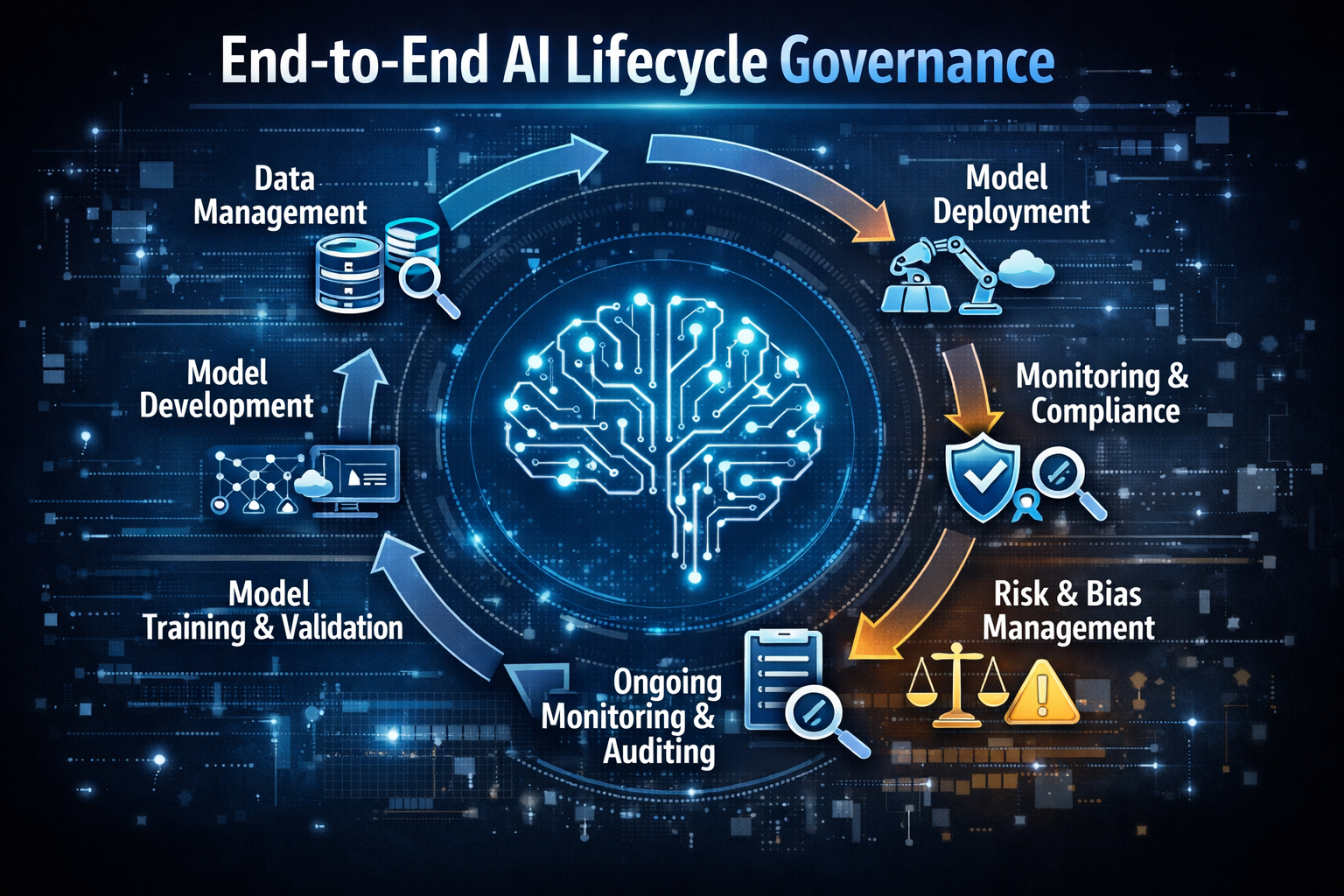
In reality, AI risk is not confined to one phase. It spans the entire lifecycle:
Development → Deployment → Monitoring → Continuous
Improvement
This is where End-to-End AI Lifecycle Governance becomes essential.
By implementing governance across every stage, organizations can ensure:
- Full visibility into AI systems
- Continuous compliance with evolving regulations
- Scalable and secure AI operations
What is AI Lifecycle Governance?
AI lifecycle governance refers to the structured management of AI systems across all stages of their lifecycle, ensuring they remain secure, compliant, transparent, and reliable.
Key Stages of the AI Lifecycle:
- Development
- Model design and training
- Data selection and preprocessing
- Prompt engineering (for LLMs)
- Deployment
- Integration into applications
- API exposure
- User interaction
- Monitoring
- Performance tracking
- Behavior analysis
- Risk detection
- Continuous Improvement
- Model updates
- Feedback loops
- Compliance updates
Without governance across each of these stages, organizations risk building AI systems that are unpredictable, non-compliant, and vulnerable to attacks.
Why AI Governance Must Be End-to-End
1. AI Risks Originate Early
Most AI vulnerabilities are introduced during development:
- Biased training data
- Weak prompt design
- Misconfigured models
If these issues are not caught early, they propagate into production.
2. Deployment Introduces New Attack Surfaces
Once deployed, AI systems interact with:
- External users
- APIs
- Third-party models
This opens the door to:
- Prompt injection attacks
- Data leakage
- Unauthorized access
3. Risks Evolve in Production
AI systems are dynamic. Over time, they can:
- Drift from original behavior
- Become less accurate
- Develop new vulnerabilities
4. Regulations Demand Continuous Compliance
Global regulations require organizations to:
- Maintain transparency
- Ensure accountability
- Continuously assess risk
Governance cannot be static—it must be ongoing.
Key Challenges in AI Lifecycle Governance
🚧 Lack of Visibility
Organizations often lack a unified view of:
- Model behavior
- Data usage
- Risk exposure
🚧 Fragmented Tools
Different teams use different tools for:
- Development
- Security
- Compliance
This creates silos and inefficiencies.
🚧 Rapid AI Adoption
AI is evolving faster than governance frameworks, making it difficult to keep up.
🚧 Complexity of AI Systems
AI systems involve:
- Data pipelines
- Models
- APIs
- Infrastructure
Managing all these components requires a holistic approach.
Core Pillars of End-to-End AI Governance
🔍 1. Visibility
Gain full insight into:
- AI models
- Data flows
- System behavior
🛡️ 2. Security
Protect AI systems from:
- Adversarial attacks
- Data leakage
- Unauthorized access
📜 3. Compliance
Ensure alignment with:
- Global regulations
- Industry standards
- Internal policies
⚖️ 4. Accountability
Track:
- Model decisions
- Data sources
- System changes
🔄 5. Continuous Monitoring
Detect:
- Anomalies
- Drift
- Emerging risks
Governance Across the AI Lifecycle
🧠 Development Stage
Focus: Prevention
Key Practices:
- AI code scanning
- Bias detection
- Secure data pipelines
- Model validation
Risks Addressed:
- Prompt injection vulnerabilities
- Data poisoning
- Misconfigurations
🚀 Deployment Stage
Focus: Secure integration
Key Practices:
- Access controls
- API security
- Guardrails for outputs
Risks Addressed:
- Unauthorized access
- Data exposure
- Unsafe responses
📊 Monitoring Stage
Focus: Continuous assurance
Key Practices:
- Real-time monitoring
- Risk scoring
- Behavior analysis
Risks Addressed:
- Model drift
- Performance degradation
- Emerging threats
🔁 Continuous Improvement
Focus: Adaptation
Key Practices:
- Feedback loops
- Model retraining
- Policy updates
Built on Trusted AI Governance Frameworks
To achieve effective lifecycle governance, organizations must align with globally recognized standards. Trusys AI integrates these frameworks directly into its platform, ensuring governance is built-in, not bolted on.
✅ OWASP Top 10 for LLMs
Focuses on critical AI vulnerabilities like:
- Prompt injection
- Data leakage
- Insecure outputs
✅ NIST AI Risk Management Framework
Provides a structured approach to:
- Risk identification
- Risk mitigation
- Continuous monitoring
✅ MITRE ATLAS
Helps organizations:
- Understand adversarial threats
- Simulate attack scenarios
- Strengthen AI resilience
✅ EU AI Act
Ensures:
- Risk-based classification
- Transparency
- Regulatory compliance
✅ ISO/IEC 42001
Supports:
- AI governance systems
- Risk management frameworks
- Responsible AI practices
Benefits of End-to-End AI Lifecycle Governance
🌐 Full AI Visibility
Understand how your AI systems behave at every stage.
🔄 Continuous Compliance
Stay aligned with evolving regulations without disruption.
📈 Scalable AI Operations
Govern AI systems efficiently as they grow.
🛡️ Reduced Risk Exposure
Identify and mitigate risks early and continuously.
🤝 Increased Trust
Build confidence among users, regulators, and stakeholders.
How Trusys AI Enables Lifecycle Governance
Trusys AI provides a unified platform to manage AI security, governance, and monitoring across the entire lifecycle.
🔍 AI Code Scanning (Development Stage)
- Detect vulnerabilities early
- Identify prompt injection risks
- Secure AI pipelines
👉 Internal Link Suggestion: Link to your blog on AI Code Scanning in Development Workflows
🛡️ AI Security & Risk Detection (Deployment Stage)
- Real-time threat detection
- Secure model integrations
- Output validation
👉 Internal Link Suggestion: Link to Top 5 Production AI Vulnerabilities
📊 AI Monitoring & Observability (Post-Deployment)
- Track model behavior
- Detect anomalies
- Ensure continuous assurance
📜 Governance & Compliance Layer
- Map risks to global frameworks
- Generate audit-ready reports
- Ensure regulatory alignment
Real-World Use Cases
🏦 Banking & Finance
- Fair credit scoring
- Fraud detection governance
- Regulatory compliance
🏥 Healthcare
- Safe AI diagnostics
- Patient data protection
- Explainable AI decisions
💻 Enterprise SaaS
- Secure AI copilots
- Safe chatbot deployment
- Continuous monitoring
Best Practices for Implementing AI Lifecycle Governance
✅ Adopt a Unified Platform
Avoid fragmented tools—use a single platform for security, monitoring, and governance.
✅ Shift Security Left
Integrate AI security early in development.
✅ Automate Governance
Use AI-driven tools to continuously monitor and enforce policies.
✅ Align with Frameworks
Adopt standards like OWASP, NIST, and ISO.
✅ Monitor Continuously
Governance doesn’t stop after deployment.
The Future of AI Governance
AI governance is moving toward:
- Continuous AI assurance
- Automated compliance systems
- AI-native security platforms
Organizations that embrace end-to-end governance will be better positioned to:
- Scale AI safely
- Meet regulatory demands
- Build trustworthy AI systems
Conclusion
AI is powerful—but without governance, it can become a significant risk.
End-to-End AI Lifecycle Governance ensures that AI systems remain secure, compliant, and reliable from development to deployment and beyond.
By adopting a lifecycle approach, organizations can:
- Gain full visibility
- Ensure continuous compliance
- Scale AI with confidence
🚀 Ready to Govern Your AI End-to-End?
Don’t let AI risks slip through the cracks.
Trusys AI empowers enterprises to secure, monitor, and govern AI systems across the entire lifecycle—ensuring safe, scalable, and compliant AI operations.
👉 Book a demo today and take control of your AI governance strategy.
Stop guessing.
Start measuring.
Join teams building reliable AI with TruEval. Start with a free trial, no credit card required. Get your first evaluation running in under 10 minutes.
Questions about Trusys?
Our team is here to help. Schedule a personalized demo to see how Trusys fits your specific use case.
Book a Demo

Ready to dive in?
Check out our documentation and tutorials. Get started with example datasets and evaluation templates.
Start Free Trial
Free Trial
No credit card required
10 Min
To first evaluation
24/7
Enterprise support


Benefits
Specifications
How-to
Contact Us
Learn More

End-to-End AI Lifecycle Governance: Securing AI from Development to Deployment and Beyond
2026-03-20
Introduction
Artificial Intelligence is transforming how enterprises operate—from automating workflows to enabling real-time decision-making. However, as AI systems become more deeply embedded in business-critical processes, they also introduce new layers of risk, complexity, and regulatory pressure.
The biggest mistake organizations make?
Treating AI governance as a single-stage problem—often limited to post-deployment monitoring.
In reality, AI risk is not confined to one phase. It spans the entire lifecycle:
Development → Deployment → Monitoring → Continuous
Improvement
This is where End-to-End AI Lifecycle Governance becomes essential.
By implementing governance across every stage, organizations can ensure:
- Full visibility into AI systems
- Continuous compliance with evolving regulations
- Scalable and secure AI operations
What is AI Lifecycle Governance?
AI lifecycle governance refers to the structured management of AI systems across all stages of their lifecycle, ensuring they remain secure, compliant, transparent, and reliable.
Key Stages of the AI Lifecycle:
- Development
- Model design and training
- Data selection and preprocessing
- Prompt engineering (for LLMs)
- Deployment
- Integration into applications
- API exposure
- User interaction
- Monitoring
- Performance tracking
- Behavior analysis
- Risk detection
- Continuous Improvement
- Model updates
- Feedback loops
- Compliance updates
Without governance across each of these stages, organizations risk building AI systems that are unpredictable, non-compliant, and vulnerable to attacks.
Why AI Governance Must Be End-to-End
1. AI Risks Originate Early
Most AI vulnerabilities are introduced during development:
- Biased training data
- Weak prompt design
- Misconfigured models
If these issues are not caught early, they propagate into production.
2. Deployment Introduces New Attack Surfaces
Once deployed, AI systems interact with:
- External users
- APIs
- Third-party models
This opens the door to:
- Prompt injection attacks
- Data leakage
- Unauthorized access
3. Risks Evolve in Production
AI systems are dynamic. Over time, they can:
- Drift from original behavior
- Become less accurate
- Develop new vulnerabilities
4. Regulations Demand Continuous Compliance
Global regulations require organizations to:
- Maintain transparency
- Ensure accountability
- Continuously assess risk
Governance cannot be static—it must be ongoing.
Key Challenges in AI Lifecycle Governance
🚧 Lack of Visibility
Organizations often lack a unified view of:
- Model behavior
- Data usage
- Risk exposure
🚧 Fragmented Tools
Different teams use different tools for:
- Development
- Security
- Compliance
This creates silos and inefficiencies.
🚧 Rapid AI Adoption
AI is evolving faster than governance frameworks, making it difficult to keep up.
🚧 Complexity of AI Systems
AI systems involve:
- Data pipelines
- Models
- APIs
- Infrastructure
Managing all these components requires a holistic approach.
Core Pillars of End-to-End AI Governance
🔍 1. Visibility
Gain full insight into:
- AI models
- Data flows
- System behavior
🛡️ 2. Security
Protect AI systems from:
- Adversarial attacks
- Data leakage
- Unauthorized access
📜 3. Compliance
Ensure alignment with:
- Global regulations
- Industry standards
- Internal policies
⚖️ 4. Accountability
Track:
- Model decisions
- Data sources
- System changes
🔄 5. Continuous Monitoring
Detect:
- Anomalies
- Drift
- Emerging risks
Governance Across the AI Lifecycle
🧠 Development Stage
Focus: Prevention
Key Practices:
- AI code scanning
- Bias detection
- Secure data pipelines
- Model validation
Risks Addressed:
- Prompt injection vulnerabilities
- Data poisoning
- Misconfigurations
🚀 Deployment Stage
Focus: Secure integration
Key Practices:
- Access controls
- API security
- Guardrails for outputs
Risks Addressed:
- Unauthorized access
- Data exposure
- Unsafe responses
📊 Monitoring Stage
Focus: Continuous assurance
Key Practices:
- Real-time monitoring
- Risk scoring
- Behavior analysis
Risks Addressed:
- Model drift
- Performance degradation
- Emerging threats
🔁 Continuous Improvement
Focus: Adaptation
Key Practices:
- Feedback loops
- Model retraining
- Policy updates
Built on Trusted AI Governance Frameworks
To achieve effective lifecycle governance, organizations must align with globally recognized standards. Trusys AI integrates these frameworks directly into its platform, ensuring governance is built-in, not bolted on.
✅ OWASP Top 10 for LLMs
Focuses on critical AI vulnerabilities like:
- Prompt injection
- Data leakage
- Insecure outputs
✅ NIST AI Risk Management Framework
Provides a structured approach to:
- Risk identification
- Risk mitigation
- Continuous monitoring
✅ MITRE ATLAS
Helps organizations:
- Understand adversarial threats
- Simulate attack scenarios
- Strengthen AI resilience
✅ EU AI Act
Ensures:
- Risk-based classification
- Transparency
- Regulatory compliance
✅ ISO/IEC 42001
Supports:
- AI governance systems
- Risk management frameworks
- Responsible AI practices
Benefits of End-to-End AI Lifecycle Governance
🌐 Full AI Visibility
Understand how your AI systems behave at every stage.
🔄 Continuous Compliance
Stay aligned with evolving regulations without disruption.
📈 Scalable AI Operations
Govern AI systems efficiently as they grow.
🛡️ Reduced Risk Exposure
Identify and mitigate risks early and continuously.
🤝 Increased Trust
Build confidence among users, regulators, and stakeholders.
How Trusys AI Enables Lifecycle Governance
Trusys AI provides a unified platform to manage AI security, governance, and monitoring across the entire lifecycle.
🔍 AI Code Scanning (Development Stage)
- Detect vulnerabilities early
- Identify prompt injection risks
- Secure AI pipelines
👉 Internal Link Suggestion: Link to your blog on AI Code Scanning in Development Workflows
🛡️ AI Security & Risk Detection (Deployment Stage)
- Real-time threat detection
- Secure model integrations
- Output validation
👉 Internal Link Suggestion: Link to Top 5 Production AI Vulnerabilities
📊 AI Monitoring & Observability (Post-Deployment)
- Track model behavior
- Detect anomalies
- Ensure continuous assurance
📜 Governance & Compliance Layer
- Map risks to global frameworks
- Generate audit-ready reports
- Ensure regulatory alignment
Real-World Use Cases
🏦 Banking & Finance
- Fair credit scoring
- Fraud detection governance
- Regulatory compliance
🏥 Healthcare
- Safe AI diagnostics
- Patient data protection
- Explainable AI decisions
💻 Enterprise SaaS
- Secure AI copilots
- Safe chatbot deployment
- Continuous monitoring
Best Practices for Implementing AI Lifecycle Governance
✅ Adopt a Unified Platform
Avoid fragmented tools—use a single platform for security, monitoring, and governance.
✅ Shift Security Left
Integrate AI security early in development.
✅ Automate Governance
Use AI-driven tools to continuously monitor and enforce policies.
✅ Align with Frameworks
Adopt standards like OWASP, NIST, and ISO.
✅ Monitor Continuously
Governance doesn’t stop after deployment.
The Future of AI Governance
AI governance is moving toward:
- Continuous AI assurance
- Automated compliance systems
- AI-native security platforms
Organizations that embrace end-to-end governance will be better positioned to:
- Scale AI safely
- Meet regulatory demands
- Build trustworthy AI systems
Conclusion
AI is powerful—but without governance, it can become a significant risk.
End-to-End AI Lifecycle Governance ensures that AI systems remain secure, compliant, and reliable from development to deployment and beyond.
By adopting a lifecycle approach, organizations can:
- Gain full visibility
- Ensure continuous compliance
- Scale AI with confidence
🚀 Ready to Govern Your AI End-to-End?
Don’t let AI risks slip through the cracks.
Trusys AI empowers enterprises to secure, monitor, and govern AI systems across the entire lifecycle—ensuring safe, scalable, and compliant AI operations.
👉 Book a demo today and take control of your AI governance strategy.
Stop guessing.
Start measuring.
Join teams building reliable AI with TruEval. Start with a free trial, no credit card required. Get your first evaluation running in under 10 minutes.
Questions about Trusys?
Our team is here to help. Schedule a personalized demo to see how Trusys fits your specific use case.
Book a Demo
Ready to dive in?
Check out our documentation and tutorials. Get started with example datasets and evaluation templates.
Start Free Trial
Free Trial
No credit card required
10 Min
To first evaluation
24/7
Enterprise support
End-to-End AI Lifecycle Governance: Securing AI from Development to Deployment and Beyond
2026-03-20
Introduction
Artificial Intelligence is transforming how enterprises operate—from automating workflows to enabling real-time decision-making. However, as AI systems become more deeply embedded in business-critical processes, they also introduce new layers of risk, complexity, and regulatory pressure.
The biggest mistake organizations make?
Treating AI governance as a single-stage problem—often limited to post-deployment monitoring.
In reality, AI risk is not confined to one phase. It spans the entire lifecycle:
Development → Deployment → Monitoring → Continuous
Improvement
This is where End-to-End AI Lifecycle Governance becomes essential.
By implementing governance across every stage, organizations can ensure:
- Full visibility into AI systems
- Continuous compliance with evolving regulations
- Scalable and secure AI operations
What is AI Lifecycle Governance?
AI lifecycle governance refers to the structured management of AI systems across all stages of their lifecycle, ensuring they remain secure, compliant, transparent, and reliable.
Key Stages of the AI Lifecycle:
- Development
- Model design and training
- Data selection and preprocessing
- Prompt engineering (for LLMs)
- Deployment
- Integration into applications
- API exposure
- User interaction
- Monitoring
- Performance tracking
- Behavior analysis
- Risk detection
- Continuous Improvement
- Model updates
- Feedback loops
- Compliance updates
Without governance across each of these stages, organizations risk building AI systems that are unpredictable, non-compliant, and vulnerable to attacks.
Why AI Governance Must Be End-to-End
1. AI Risks Originate Early
Most AI vulnerabilities are introduced during development:
- Biased training data
- Weak prompt design
- Misconfigured models
If these issues are not caught early, they propagate into production.
2. Deployment Introduces New Attack Surfaces
Once deployed, AI systems interact with:
- External users
- APIs
- Third-party models
This opens the door to:
- Prompt injection attacks
- Data leakage
- Unauthorized access
3. Risks Evolve in Production
AI systems are dynamic. Over time, they can:
- Drift from original behavior
- Become less accurate
- Develop new vulnerabilities
4. Regulations Demand Continuous Compliance
Global regulations require organizations to:
- Maintain transparency
- Ensure accountability
- Continuously assess risk
Governance cannot be static—it must be ongoing.
Key Challenges in AI Lifecycle Governance
🚧 Lack of Visibility
Organizations often lack a unified view of:
- Model behavior
- Data usage
- Risk exposure
🚧 Fragmented Tools
Different teams use different tools for:
- Development
- Security
- Compliance
This creates silos and inefficiencies.
🚧 Rapid AI Adoption
AI is evolving faster than governance frameworks, making it difficult to keep up.
🚧 Complexity of AI Systems
AI systems involve:
- Data pipelines
- Models
- APIs
- Infrastructure
Managing all these components requires a holistic approach.
Core Pillars of End-to-End AI Governance
🔍 1. Visibility
Gain full insight into:
- AI models
- Data flows
- System behavior
🛡️ 2. Security
Protect AI systems from:
- Adversarial attacks
- Data leakage
- Unauthorized access
📜 3. Compliance
Ensure alignment with:
- Global regulations
- Industry standards
- Internal policies
⚖️ 4. Accountability
Track:
- Model decisions
- Data sources
- System changes
🔄 5. Continuous Monitoring
Detect:
- Anomalies
- Drift
- Emerging risks
Governance Across the AI Lifecycle
🧠 Development Stage
Focus: Prevention
Key Practices:
- AI code scanning
- Bias detection
- Secure data pipelines
- Model validation
Risks Addressed:
- Prompt injection vulnerabilities
- Data poisoning
- Misconfigurations
🚀 Deployment Stage
Focus: Secure integration
Key Practices:
- Access controls
- API security
- Guardrails for outputs
Risks Addressed:
- Unauthorized access
- Data exposure
- Unsafe responses
📊 Monitoring Stage
Focus: Continuous assurance
Key Practices:
- Real-time monitoring
- Risk scoring
- Behavior analysis
Risks Addressed:
- Model drift
- Performance degradation
- Emerging threats
🔁 Continuous Improvement
Focus: Adaptation
Key Practices:
- Feedback loops
- Model retraining
- Policy updates
Built on Trusted AI Governance Frameworks
To achieve effective lifecycle governance, organizations must align with globally recognized standards. Trusys AI integrates these frameworks directly into its platform, ensuring governance is built-in, not bolted on.
✅ OWASP Top 10 for LLMs
Focuses on critical AI vulnerabilities like:
- Prompt injection
- Data leakage
- Insecure outputs
✅ NIST AI Risk Management Framework
Provides a structured approach to:
- Risk identification
- Risk mitigation
- Continuous monitoring
✅ MITRE ATLAS
Helps organizations:
- Understand adversarial threats
- Simulate attack scenarios
- Strengthen AI resilience
✅ EU AI Act
Ensures:
- Risk-based classification
- Transparency
- Regulatory compliance
✅ ISO/IEC 42001
Supports:
- AI governance systems
- Risk management frameworks
- Responsible AI practices
Benefits of End-to-End AI Lifecycle Governance
🌐 Full AI Visibility
Understand how your AI systems behave at every stage.
🔄 Continuous Compliance
Stay aligned with evolving regulations without disruption.
📈 Scalable AI Operations
Govern AI systems efficiently as they grow.
🛡️ Reduced Risk Exposure
Identify and mitigate risks early and continuously.
🤝 Increased Trust
Build confidence among users, regulators, and stakeholders.
How Trusys AI Enables Lifecycle Governance
Trusys AI provides a unified platform to manage AI security, governance, and monitoring across the entire lifecycle.
🔍 AI Code Scanning (Development Stage)
- Detect vulnerabilities early
- Identify prompt injection risks
- Secure AI pipelines
👉 Internal Link Suggestion: Link to your blog on AI Code Scanning in Development Workflows
🛡️ AI Security & Risk Detection (Deployment Stage)
- Real-time threat detection
- Secure model integrations
- Output validation
👉 Internal Link Suggestion: Link to Top 5 Production AI Vulnerabilities
📊 AI Monitoring & Observability (Post-Deployment)
- Track model behavior
- Detect anomalies
- Ensure continuous assurance
📜 Governance & Compliance Layer
- Map risks to global frameworks
- Generate audit-ready reports
- Ensure regulatory alignment
Real-World Use Cases
🏦 Banking & Finance
- Fair credit scoring
- Fraud detection governance
- Regulatory compliance
🏥 Healthcare
- Safe AI diagnostics
- Patient data protection
- Explainable AI decisions
💻 Enterprise SaaS
- Secure AI copilots
- Safe chatbot deployment
- Continuous monitoring
Best Practices for Implementing AI Lifecycle Governance
✅ Adopt a Unified Platform
Avoid fragmented tools—use a single platform for security, monitoring, and governance.
✅ Shift Security Left
Integrate AI security early in development.
✅ Automate Governance
Use AI-driven tools to continuously monitor and enforce policies.
✅ Align with Frameworks
Adopt standards like OWASP, NIST, and ISO.
✅ Monitor Continuously
Governance doesn’t stop after deployment.
The Future of AI Governance
AI governance is moving toward:
- Continuous AI assurance
- Automated compliance systems
- AI-native security platforms
Organizations that embrace end-to-end governance will be better positioned to:
- Scale AI safely
- Meet regulatory demands
- Build trustworthy AI systems
Conclusion
AI is powerful—but without governance, it can become a significant risk.
End-to-End AI Lifecycle Governance ensures that AI systems remain secure, compliant, and reliable from development to deployment and beyond.
By adopting a lifecycle approach, organizations can:
- Gain full visibility
- Ensure continuous compliance
- Scale AI with confidence
🚀 Ready to Govern Your AI End-to-End?
Don’t let AI risks slip through the cracks.
Trusys AI empowers enterprises to secure, monitor, and govern AI systems across the entire lifecycle—ensuring safe, scalable, and compliant AI operations.
👉 Book a demo today and take control of your AI governance strategy.
Stop guessing.
Start measuring.
Join teams building reliable AI with Trusys. Start with a free trial, no credit card required. Get your first evaluation running in under 10 minutes.
Questions about Trusys?
Our team is here to help. Schedule a personalized demo to see how Trusys fits your specific use case.
Book a Demo

Ready to dive in?
Check out our documentation and tutorials. Get started with example datasets and evaluation templates.
Start Free Trial
Free Trial
No credit card required
10 Min
to get started
24/7
Enterprise support