One AI Response Can Cost You $4.5M—The Missing Layer in AI Risk Management
2026-04-25
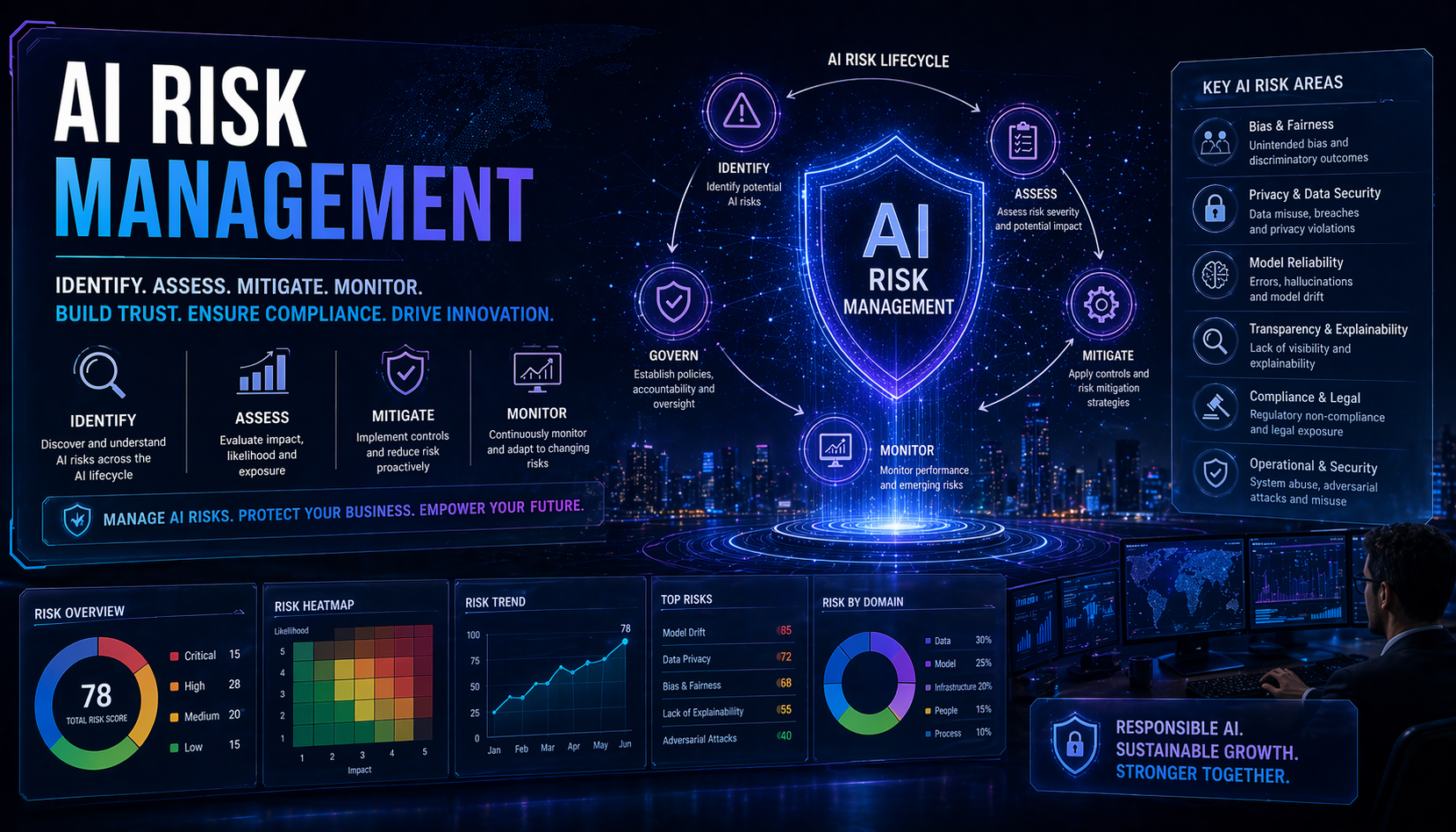
AI is no longer experimental—it’s operational. Enterprises are deploying large language models (LLMs), copilots, and AI agents across customer support, finance, healthcare, and internal workflows. But as adoption accelerates, so does a critical realization:
AI Risk Management is not keeping up with AI deployment.
And the consequences are no longer theoretical.
A single unsafe AI response—whether it’s a data leak, hallucination, or manipulated output—can trigger regulatory fines, legal exposure, and reputational damage that easily crosses $4.5 million or more. The question is no longer if something will go wrong, but when.
So what’s missing?
The $4.5M Reality: Why AI Risk Management Is Now a Boardroom Issue
Traditional enterprise risks were predictable. Systems behaved deterministically. Security vulnerabilities could be patched. Compliance could be audited periodically.
AI breaks all of that.
Here’s how one AI failure escalates into millions:
- Data Breaches: An AI assistant exposes sensitive customer or internal data
- Compliance Violations: Non-compliant outputs violate GDPR, HIPAA, or financial regulations
- Reputational Damage: Toxic or biased responses go viral
- Operational Losses: Hallucinated insights lead to poor decisions
According to multiple industry reports, the average cost of a data breach alone is already in the millions. When AI is involved, the blast radius expands because the failure happens in real time, often at scale.
This is why AI Risk Management has shifted from a technical concern to a strategic priority—one that boards and executives can no longer ignore.
Why Traditional Risk Management Fails AI
Most enterprises are still applying legacy risk management frameworks to AI systems. That’s a fundamental mismatch.
Here’s why:
1. AI Is Non-Deterministic
The same input can produce different outputs. This unpredictability makes traditional testing insufficient.
2. Static Testing ≠ Runtime Behavior
Point-in-time evaluations don’t reflect how models behave in production under real-world conditions.
3. Threats Evolve Dynamically
Attack vectors like prompt injection are not static vulnerabilities—they adapt in real time.
4. No Real-Time Enforcement
Most systems detect issues after they occur. By then, the damage is already done.
Bottom line: Traditional approaches focus on detection. AI demands prevention.
Where AI Systems Are Most Vulnerable
To understand effective AI Risk Management, you need to know where failures originate.
1. Input Layer (Prompt Injection)
Attackers manipulate inputs to override system instructions, extract data, or alter outputs.
2. Output Layer (Data Leakage & Toxicity)
Models may unintentionally:
- Expose sensitive information
- Generate harmful or biased content
- Provide non-compliant responses
3. Lack of Validation
Most AI systems:
- Don’t validate inputs rigorously
- Don’t enforce output policies
- Rely heavily on model “good behavior”
4. Gaps in AI Risk Management Frameworks
Existing frameworks often:
- Stop at model evaluation
- Ignore runtime risks
- Lack enforcement mechanisms
This creates a dangerous gap between AI deployment and AI control.
The Missing Layer in AI Risk Management: AI Guardrails
If testing and monitoring aren’t enough, what is?
AI Guardrails.
AI Guardrails act as a real-time control layer that sits between users and AI systems—ensuring every interaction is safe, compliant, and aligned with enterprise policies.
What AI Guardrails Do:
Input Validation
- Detect and block malicious prompts
- Prevent prompt injection attacks
Output Filtering
- Remove or mask sensitive data (PII, financial info, etc.)
- Block toxic, biased, or non-compliant responses
Policy Enforcement
- Ensure every response adheres to business and regulatory rules
Real-Time Action
- Block
- Mask
- Modify
- Allow
This is the shift from reactive AI Risk Management → proactive AI control.
Real-World Scenarios: How AI Failures Happen
Let’s make this concrete.
Scenario 1: Sensitive Data Exposure
A customer support chatbot accidentally reveals another user’s personal data.
Impact: Legal penalties + loss of trust
Scenario 2: Prompt Injection Attack
An attacker manipulates the AI to ignore its safeguards and disclose internal system prompts.
Impact: Security breach + system compromise
Scenario 3: Toxic Output
An AI-generated response includes biased or offensive language.
Impact: Brand damage + public backlash
Scenario 4: Hallucinated Decision Support
An AI tool provides incorrect financial or medical advice.
Impact: Operational and legal consequences
Every one of these scenarios is a failure of AI Risk Management—and all are preventable with the right guardrails in place.
From Detection to Prevention: Rethinking AI Risk Management
Most enterprises today rely on:
- Model testing
- Periodic audits
- Post-incident monitoring
But here’s the problem:
👉 You can’t monitor your way out of a real-time failure.
By the time monitoring detects an issue:
- The response is already delivered
- The user has already seen it
- The damage has already started
AI Risk Management must evolve into a real-time discipline.
Strengthening AI Risk Management with a Layered Approach
The most effective strategy isn’t one tool—it’s a layered defense model:
1. Pre-Deployment: AI Code Scanning
- Identify vulnerabilities early
- Detect prompt injection risks
- Secure AI workflows before launch
2. Runtime: AI Guardrails
- Enforce policies in real time
- Validate every input and output
- Prevent incidents before they occur
3. Continuous Monitoring
- Track model behavior over time
- Detect drift and anomalies
Together, these layers create a complete AI Risk Management lifecycle:
Build securely → Deploy safely → Operate confidently
Why AI Guardrails Are No Longer Optional
There’s a growing misconception that guardrails are “nice-to-have.”
They’re not.
They are the only layer that actively prevents AI failures in real time.
Without them:
- You’re trusting probabilistic systems blindly
- You’re exposing your organization to unpredictable risks
- You’re relying on detection instead of control
With them:
- Every AI interaction is governed
- Every response is validated
- Every risk is mitigated before impact
The Future of AI Risk Management
AI adoption will only accelerate. So will:
- Regulatory scrutiny
- Security threats
- User expectations
In this environment, AI Risk Management must become continuous, adaptive, and real-time.
The enterprises that succeed will be the ones that:
- Treat AI as a dynamic risk surface
- Invest in prevention, not just detection
- Embed control layers directly into AI systems
Final Thoughts: Risk Is Inevitable—Damage Is Not
AI systems will fail. That’s the nature of probabilistic technology.
But uncontrolled failure is a choice.
A single AI response can cost millions—but it doesn’t have to.
With the right approach to AI Risk Management, and by implementing real-time protection layers like AI Guardrails, enterprises can move from:
❌ Reactive firefighting
➡️
✅ Proactive risk prevention
🚀 The Bottom Line
If your AI strategy doesn’t include real-time enforcement, it’s incomplete.
Because in the age of AI:
It’s not the model that defines your risk—
It’s the controls around it.
Stop guessing.
Start measuring.
Join teams building reliable AI with TruEval. Start with a free trial, no credit card required. Get your first evaluation running in under 10 minutes.
Questions about Trusys?
Our team is here to help. Schedule a personalized demo to see how Trusys fits your specific use case.
Book a Demo

Ready to dive in?
Check out our documentation and tutorials. Get started with example datasets and evaluation templates.
Start Free Trial
Free Trial
No credit card required
10 Min
To first evaluation
24/7
Enterprise support


Benefits
Specifications
How-to
Contact Us
Learn More

One AI Response Can Cost You $4.5M—The Missing Layer in AI Risk Management
2026-04-25
AI is no longer experimental—it’s operational. Enterprises are deploying large language models (LLMs), copilots, and AI agents across customer support, finance, healthcare, and internal workflows. But as adoption accelerates, so does a critical realization:
AI Risk Management is not keeping up with AI deployment.
And the consequences are no longer theoretical.
A single unsafe AI response—whether it’s a data leak, hallucination, or manipulated output—can trigger regulatory fines, legal exposure, and reputational damage that easily crosses $4.5 million or more. The question is no longer if something will go wrong, but when.
So what’s missing?
The $4.5M Reality: Why AI Risk Management Is Now a Boardroom Issue
Traditional enterprise risks were predictable. Systems behaved deterministically. Security vulnerabilities could be patched. Compliance could be audited periodically.
AI breaks all of that.
Here’s how one AI failure escalates into millions:
- Data Breaches: An AI assistant exposes sensitive customer or internal data
- Compliance Violations: Non-compliant outputs violate GDPR, HIPAA, or financial regulations
- Reputational Damage: Toxic or biased responses go viral
- Operational Losses: Hallucinated insights lead to poor decisions
According to multiple industry reports, the average cost of a data breach alone is already in the millions. When AI is involved, the blast radius expands because the failure happens in real time, often at scale.
This is why AI Risk Management has shifted from a technical concern to a strategic priority—one that boards and executives can no longer ignore.
Why Traditional Risk Management Fails AI
Most enterprises are still applying legacy risk management frameworks to AI systems. That’s a fundamental mismatch.
Here’s why:
1. AI Is Non-Deterministic
The same input can produce different outputs. This unpredictability makes traditional testing insufficient.
2. Static Testing ≠ Runtime Behavior
Point-in-time evaluations don’t reflect how models behave in production under real-world conditions.
3. Threats Evolve Dynamically
Attack vectors like prompt injection are not static vulnerabilities—they adapt in real time.
4. No Real-Time Enforcement
Most systems detect issues after they occur. By then, the damage is already done.
Bottom line: Traditional approaches focus on detection. AI demands prevention.
Where AI Systems Are Most Vulnerable
To understand effective AI Risk Management, you need to know where failures originate.
1. Input Layer (Prompt Injection)
Attackers manipulate inputs to override system instructions, extract data, or alter outputs.
2. Output Layer (Data Leakage & Toxicity)
Models may unintentionally:
- Expose sensitive information
- Generate harmful or biased content
- Provide non-compliant responses
3. Lack of Validation
Most AI systems:
- Don’t validate inputs rigorously
- Don’t enforce output policies
- Rely heavily on model “good behavior”
4. Gaps in AI Risk Management Frameworks
Existing frameworks often:
- Stop at model evaluation
- Ignore runtime risks
- Lack enforcement mechanisms
This creates a dangerous gap between AI deployment and AI control.
The Missing Layer in AI Risk Management: AI Guardrails
If testing and monitoring aren’t enough, what is?
AI Guardrails.
AI Guardrails act as a real-time control layer that sits between users and AI systems—ensuring every interaction is safe, compliant, and aligned with enterprise policies.
What AI Guardrails Do:
Input Validation
- Detect and block malicious prompts
- Prevent prompt injection attacks
Output Filtering
- Remove or mask sensitive data (PII, financial info, etc.)
- Block toxic, biased, or non-compliant responses
Policy Enforcement
- Ensure every response adheres to business and regulatory rules
Real-Time Action
- Block
- Mask
- Modify
- Allow
This is the shift from reactive AI Risk Management → proactive AI control.
Real-World Scenarios: How AI Failures Happen
Let’s make this concrete.
Scenario 1: Sensitive Data Exposure
A customer support chatbot accidentally reveals another user’s personal data.
Impact: Legal penalties + loss of trust
Scenario 2: Prompt Injection Attack
An attacker manipulates the AI to ignore its safeguards and disclose internal system prompts.
Impact: Security breach + system compromise
Scenario 3: Toxic Output
An AI-generated response includes biased or offensive language.
Impact: Brand damage + public backlash
Scenario 4: Hallucinated Decision Support
An AI tool provides incorrect financial or medical advice.
Impact: Operational and legal consequences
Every one of these scenarios is a failure of AI Risk Management—and all are preventable with the right guardrails in place.
From Detection to Prevention: Rethinking AI Risk Management
Most enterprises today rely on:
- Model testing
- Periodic audits
- Post-incident monitoring
But here’s the problem:
👉 You can’t monitor your way out of a real-time failure.
By the time monitoring detects an issue:
- The response is already delivered
- The user has already seen it
- The damage has already started
AI Risk Management must evolve into a real-time discipline.
Strengthening AI Risk Management with a Layered Approach
The most effective strategy isn’t one tool—it’s a layered defense model:
1. Pre-Deployment: AI Code Scanning
- Identify vulnerabilities early
- Detect prompt injection risks
- Secure AI workflows before launch
2. Runtime: AI Guardrails
- Enforce policies in real time
- Validate every input and output
- Prevent incidents before they occur
3. Continuous Monitoring
- Track model behavior over time
- Detect drift and anomalies
Together, these layers create a complete AI Risk Management lifecycle:
Build securely → Deploy safely → Operate confidently
Why AI Guardrails Are No Longer Optional
There’s a growing misconception that guardrails are “nice-to-have.”
They’re not.
They are the only layer that actively prevents AI failures in real time.
Without them:
- You’re trusting probabilistic systems blindly
- You’re exposing your organization to unpredictable risks
- You’re relying on detection instead of control
With them:
- Every AI interaction is governed
- Every response is validated
- Every risk is mitigated before impact
The Future of AI Risk Management
AI adoption will only accelerate. So will:
- Regulatory scrutiny
- Security threats
- User expectations
In this environment, AI Risk Management must become continuous, adaptive, and real-time.
The enterprises that succeed will be the ones that:
- Treat AI as a dynamic risk surface
- Invest in prevention, not just detection
- Embed control layers directly into AI systems
Final Thoughts: Risk Is Inevitable—Damage Is Not
AI systems will fail. That’s the nature of probabilistic technology.
But uncontrolled failure is a choice.
A single AI response can cost millions—but it doesn’t have to.
With the right approach to AI Risk Management, and by implementing real-time protection layers like AI Guardrails, enterprises can move from:
❌ Reactive firefighting
➡️
✅ Proactive risk prevention
🚀 The Bottom Line
If your AI strategy doesn’t include real-time enforcement, it’s incomplete.
Because in the age of AI:
It’s not the model that defines your risk—
It’s the controls around it.
Stop guessing.
Start measuring.
Join teams building reliable AI with TruEval. Start with a free trial, no credit card required. Get your first evaluation running in under 10 minutes.
Questions about Trusys?
Our team is here to help. Schedule a personalized demo to see how Trusys fits your specific use case.
Book a Demo
Ready to dive in?
Check out our documentation and tutorials. Get started with example datasets and evaluation templates.
Start Free Trial
Free Trial
No credit card required
10 Min
To first evaluation
24/7
Enterprise support
One AI Response Can Cost You $4.5M—The Missing Layer in AI Risk Management
2026-04-25
AI is no longer experimental—it’s operational. Enterprises are deploying large language models (LLMs), copilots, and AI agents across customer support, finance, healthcare, and internal workflows. But as adoption accelerates, so does a critical realization:
AI Risk Management is not keeping up with AI deployment.
And the consequences are no longer theoretical.
A single unsafe AI response—whether it’s a data leak, hallucination, or manipulated output—can trigger regulatory fines, legal exposure, and reputational damage that easily crosses $4.5 million or more. The question is no longer if something will go wrong, but when.
So what’s missing?
The $4.5M Reality: Why AI Risk Management Is Now a Boardroom Issue
Traditional enterprise risks were predictable. Systems behaved deterministically. Security vulnerabilities could be patched. Compliance could be audited periodically.
AI breaks all of that.
Here’s how one AI failure escalates into millions:
- Data Breaches: An AI assistant exposes sensitive customer or internal data
- Compliance Violations: Non-compliant outputs violate GDPR, HIPAA, or financial regulations
- Reputational Damage: Toxic or biased responses go viral
- Operational Losses: Hallucinated insights lead to poor decisions
According to multiple industry reports, the average cost of a data breach alone is already in the millions. When AI is involved, the blast radius expands because the failure happens in real time, often at scale.
This is why AI Risk Management has shifted from a technical concern to a strategic priority—one that boards and executives can no longer ignore.
Why Traditional Risk Management Fails AI
Most enterprises are still applying legacy risk management frameworks to AI systems. That’s a fundamental mismatch.
Here’s why:
1. AI Is Non-Deterministic
The same input can produce different outputs. This unpredictability makes traditional testing insufficient.
2. Static Testing ≠ Runtime Behavior
Point-in-time evaluations don’t reflect how models behave in production under real-world conditions.
3. Threats Evolve Dynamically
Attack vectors like prompt injection are not static vulnerabilities—they adapt in real time.
4. No Real-Time Enforcement
Most systems detect issues after they occur. By then, the damage is already done.
Bottom line: Traditional approaches focus on detection. AI demands prevention.
Where AI Systems Are Most Vulnerable
To understand effective AI Risk Management, you need to know where failures originate.
1. Input Layer (Prompt Injection)
Attackers manipulate inputs to override system instructions, extract data, or alter outputs.
2. Output Layer (Data Leakage & Toxicity)
Models may unintentionally:
- Expose sensitive information
- Generate harmful or biased content
- Provide non-compliant responses
3. Lack of Validation
Most AI systems:
- Don’t validate inputs rigorously
- Don’t enforce output policies
- Rely heavily on model “good behavior”
4. Gaps in AI Risk Management Frameworks
Existing frameworks often:
- Stop at model evaluation
- Ignore runtime risks
- Lack enforcement mechanisms
This creates a dangerous gap between AI deployment and AI control.
The Missing Layer in AI Risk Management: AI Guardrails
If testing and monitoring aren’t enough, what is?
AI Guardrails.
AI Guardrails act as a real-time control layer that sits between users and AI systems—ensuring every interaction is safe, compliant, and aligned with enterprise policies.
What AI Guardrails Do:
Input Validation
- Detect and block malicious prompts
- Prevent prompt injection attacks
Output Filtering
- Remove or mask sensitive data (PII, financial info, etc.)
- Block toxic, biased, or non-compliant responses
Policy Enforcement
- Ensure every response adheres to business and regulatory rules
Real-Time Action
- Block
- Mask
- Modify
- Allow
This is the shift from reactive AI Risk Management → proactive AI control.
Real-World Scenarios: How AI Failures Happen
Let’s make this concrete.
Scenario 1: Sensitive Data Exposure
A customer support chatbot accidentally reveals another user’s personal data.
Impact: Legal penalties + loss of trust
Scenario 2: Prompt Injection Attack
An attacker manipulates the AI to ignore its safeguards and disclose internal system prompts.
Impact: Security breach + system compromise
Scenario 3: Toxic Output
An AI-generated response includes biased or offensive language.
Impact: Brand damage + public backlash
Scenario 4: Hallucinated Decision Support
An AI tool provides incorrect financial or medical advice.
Impact: Operational and legal consequences
Every one of these scenarios is a failure of AI Risk Management—and all are preventable with the right guardrails in place.
From Detection to Prevention: Rethinking AI Risk Management
Most enterprises today rely on:
- Model testing
- Periodic audits
- Post-incident monitoring
But here’s the problem:
👉 You can’t monitor your way out of a real-time failure.
By the time monitoring detects an issue:
- The response is already delivered
- The user has already seen it
- The damage has already started
AI Risk Management must evolve into a real-time discipline.
Strengthening AI Risk Management with a Layered Approach
The most effective strategy isn’t one tool—it’s a layered defense model:
1. Pre-Deployment: AI Code Scanning
- Identify vulnerabilities early
- Detect prompt injection risks
- Secure AI workflows before launch
2. Runtime: AI Guardrails
- Enforce policies in real time
- Validate every input and output
- Prevent incidents before they occur
3. Continuous Monitoring
- Track model behavior over time
- Detect drift and anomalies
Together, these layers create a complete AI Risk Management lifecycle:
Build securely → Deploy safely → Operate confidently
Why AI Guardrails Are No Longer Optional
There’s a growing misconception that guardrails are “nice-to-have.”
They’re not.
They are the only layer that actively prevents AI failures in real time.
Without them:
- You’re trusting probabilistic systems blindly
- You’re exposing your organization to unpredictable risks
- You’re relying on detection instead of control
With them:
- Every AI interaction is governed
- Every response is validated
- Every risk is mitigated before impact
The Future of AI Risk Management
AI adoption will only accelerate. So will:
- Regulatory scrutiny
- Security threats
- User expectations
In this environment, AI Risk Management must become continuous, adaptive, and real-time.
The enterprises that succeed will be the ones that:
- Treat AI as a dynamic risk surface
- Invest in prevention, not just detection
- Embed control layers directly into AI systems
Final Thoughts: Risk Is Inevitable—Damage Is Not
AI systems will fail. That’s the nature of probabilistic technology.
But uncontrolled failure is a choice.
A single AI response can cost millions—but it doesn’t have to.
With the right approach to AI Risk Management, and by implementing real-time protection layers like AI Guardrails, enterprises can move from:
❌ Reactive firefighting
➡️
✅ Proactive risk prevention
🚀 The Bottom Line
If your AI strategy doesn’t include real-time enforcement, it’s incomplete.
Because in the age of AI:
It’s not the model that defines your risk—
It’s the controls around it.
Stop guessing.
Start measuring.
Join teams building reliable AI with Trusys. Start with a free trial, no credit card required. Get your first evaluation running in under 10 minutes.
Questions about Trusys?
Our team is here to help. Schedule a personalized demo to see how Trusys fits your specific use case.
Book a Demo

Ready to dive in?
Check out our documentation and tutorials. Get started with example datasets and evaluation templates.
Start Free Trial
Free Trial
No credit card required
10 Min
to get started
24/7
Enterprise support