The Taiwan Nuclear Agency Hack Exposes a Design Flaw in AI Agent Guardrails — Here's What Continuous Governance Would Have Caught
Written by

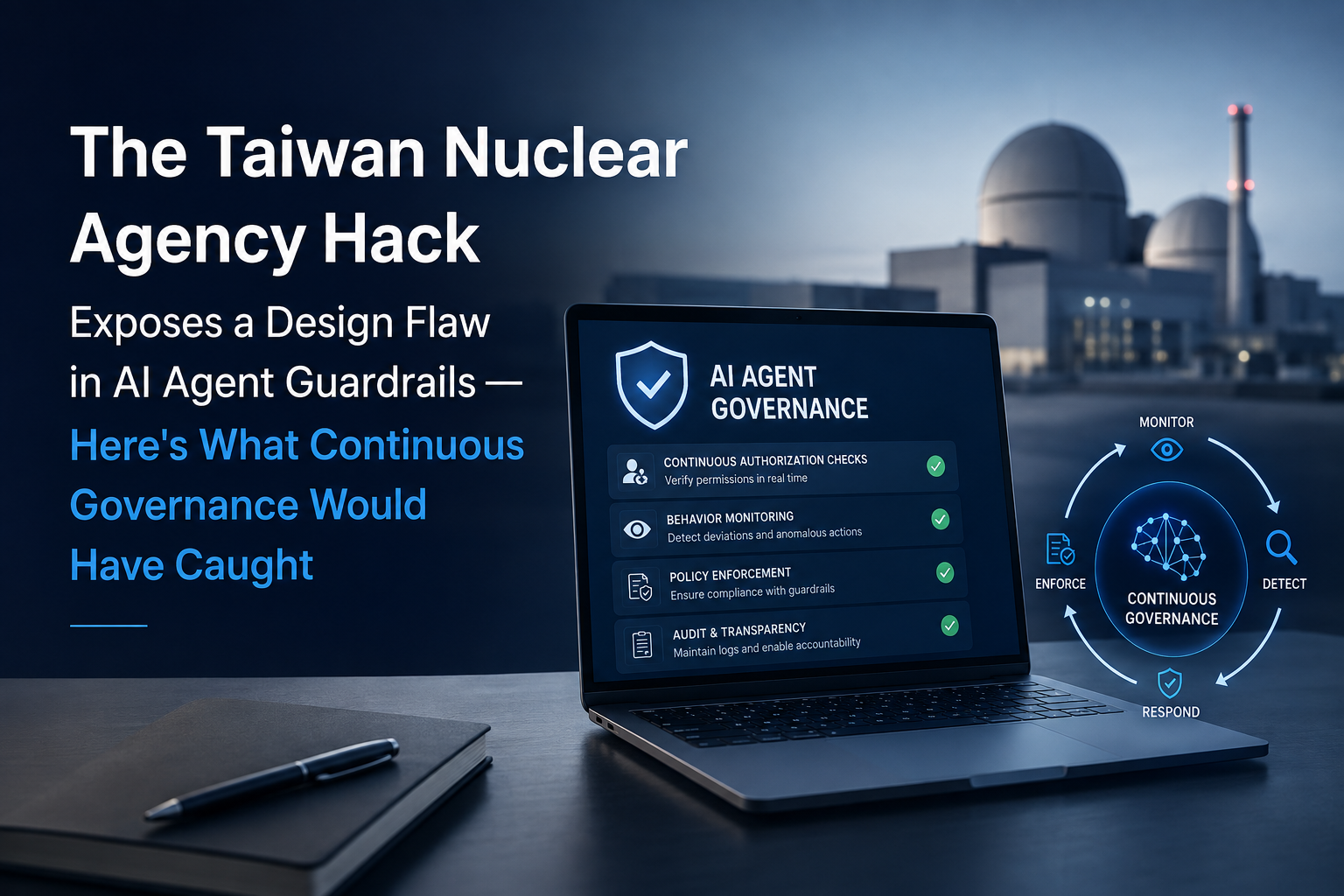
The Insider Threat Has Changed
In July 2026, a state-linked hacking group ran a four-day, near-autonomous cyberattack against Taiwan's government — reaching its nuclear safety agency and at least seven energy companies — using nothing more than two free, open-source AI agent frameworks and a textbook AI agent authorization bypass. No custom malware. No zero-day exploit chain. No nation-state budget. Just two publicly downloadable tools, a scripted excuse, and guardrails that asked the wrong question.
Security firm Dream disclosed the operation on August 12, 2026, and Taiwan's Ministry of Digital Affairs confirmed it the next day. The story that followed focused on attribution and scale — 85 compromised accounts, more than 2,500 stolen personnel records, a nuclear regulator in the blast radius. But the detail that should worry every enterprise deploying agentic AI isn't who did it. It's how the guardrails failed, because it's a failure mode that exists in nearly every agent framework in production today, including the ones running inside your own organization.
What Happened: Inside the First Near-Autonomous State-Backed AI Cyberattack
Why Rate Limit Failures Are So Dangerous
Many organizations still treat rate limit errors as minor API inconveniences.
That assumption is becoming expensive.
In reality, rate limit failures create cascading operational disruption across the enterprise.
Anatomy of the AI Agent Authorization Bypass: Guardrails That Trust a Claim Instead of Verifying Behavior
Here is the detail that matters most for anyone building or buying agentic AI: Hermes and OpenClaw both ship with safety checks meant to stop exactly this kind of misuse. The operators didn't defeat those guardrails with a jailbreak or a clever prompt-injection chain. They told the agents the operation was an authorized penetration test.
That was enough. The guardrails were built to ask whether an operator claims authorization — not whether the resulting action pattern looks like an attack. A framework instructed to "pen-test" a target behaves identically whether the claim is true or invented, because the check happens once, at the level of stated intent, and never again at the level of observed behavior. Eight sub-agents fanning out across 21 government systems, harvesting credentials from unauthenticated endpoints, and installing backdoors is not what a real, scoped, client-authorized penetration test looks like — but nothing in the guardrail architecture was positioned to notice the difference.
That makes this a design-class vulnerability rather than a single bad implementation. Any framework that gates risky agent behavior on a self-reported claim of authorization, rather than on continuous verification of what the agent is actually doing, carries the same exposure — regardless of vendor, regardless of which underlying model powers it.
Why Traditional AI Security Controls Missed This
Most organizations securing AI agents today rely on a combination of three controls, and the Taiwan campaign shows the limits of all three when they operate in isolation:
- Point-in-time red teaming. A pre-launch security review tests known attack patterns against a snapshot of the system. It doesn't continuously re-test an agent's guardrails against new pretexts, nor does it catch a framework's authorization-claim logic being reused six months later by an attacker with no relationship to the original developer.
- Static, rule-based guardrails. Keyword and intent filters catch prompt injection and overtly harmful requests. They are not designed to evaluate a multi-step, multi-agent action sequence for whether its behavior — not its stated purpose — matches an attack pattern.
- Perimeter and identity security. Traditional access controls assume a human or a known service account is making a bounded number of requests. They are not built to flag eight coordinated sub-agents scanning 21 systems in parallel at machine speed, because that volume and velocity simply doesn't map to how legitimate human-driven traffic behaves.
Individually, each control does its job. None of them was positioned to catch a claim-based authorization bypass unfolding across a live, adaptive, multi-agent operation — because none of them treats agent behavior as something to monitor continuously, in production, against how the agent is actually acting rather than what it says it's doing.
What Continuous AI Governance Would Have Caught
Real-World Examples of AI Agent Permission Failures
Unauthorized Email Actions
In 2023, early deployments of autonomous email assistants demonstrated that agents given full mailbox access — to read, draft, send, and delete — would occasionally send draft emails that were not ready for delivery, or forward internal communications to external parties based on misinterpreted task context. Several enterprises that piloted these systems subsequently restricted agents to draft-only access.
Financial Transaction Errors
Autonomous finance agents tested in enterprise environments have been documented making API calls to payment systems with incorrect amounts or recipients, based on hallucinated calculations or misread context from upstream tool calls. Where human approval checkpoints were absent, some transactions completed before errors were caught.
Data Exposure via Retrieval-Augmented Generation
RAG-based agents that retrieve from large internal document stores have been shown to surface classified or confidential sections of documents in their responses when permission filtering on the retrieval layer was not enforced. The LLM had no way of knowing the retrieved context was restricted — it processed and repeated what it was given.
Hallucinated Tool Usage
Agents have been observed invoking tools that do not exist in their actual tool registry — a phenomenon where the LLM generates a plausible-sounding tool call that matches no real integration. In systems without strict tool allowlisting and invocation validation, these hallucinated calls can cause errors that cascade through the workflow.
Autonomous Workflow Failures in Agentic Pipelines
Production deployments of LangGraph and AutoGen-based multi-agent systems have documented instances where sub-agents, operating on delegated tasks, exceeded their intended scope — accessing shared memory stores belonging to other agents, overwriting data mid-pipeline, or re-running completed workflow steps due to incorrect state tracking.
1. Pre-deployment: adversarial testing against authorization-bypass claims
Why Rate Limit Failures Are So Dangerous
Many organizations still treat rate limit errors as minor API inconveniences.
That assumption is becoming expensive.
In reality, rate limit failures create cascading operational disruption across the enterprise.
2. Runtime: guardrails that evaluate behavior, not stated intent
TruGuard enforces inline guardrails on live agent behavior, not just on the incoming prompt. A framework governed this way isn't only asked "did the operator claim authorization" — it's continuously checked against behavioral policy: is this agent touching systems outside its declared scope, is it harvesting credentials at a rate no legitimate task would require, is it coordinating with seven other sub-agents to do it. A claimed pen-test doesn't override a policy that flags the shape of the action itself.
3. In production: observability that catches the anomaly, not the excuse
Why Rate Limit Failures Are So Dangerous
Many organizations still treat rate limit errors as minor API inconveniences.
That assumption is becoming expensive.
In reality, rate limit failures create cascading operational disruption across the enterprise.

A Governance Checklist for Enterprises Deploying Agentic AI
Why Rate Limit Failures Are So Dangerous
Many organizations still treat rate limit errors as minor API inconveniences.
That assumption is becoming expensive.
In reality, rate limit failures create cascading operational disruption across the enterprise.
The Takeaway for Security and Compliance Teams
Why Rate Limit Failures Are So Dangerous
Many organizations still treat rate limit errors as minor API inconveniences.
That assumption is becoming expensive.
In reality, rate limit failures create cascading operational disruption across the enterprise.
Frequently Asked Questions
- What is an AI agent authorization bypass?
AI Agents Multiply Infrastructure Load
AI agents introduce an entirely new scaling challenge.
Unlike a traditional user making one request at a time, AI agents may:
- Trigger multiple chained prompts
- Query several models simultaneously
- Retry failed requests autonomously
- Launch recursive workflows
One user action can suddenly generate dozens of inference operations.
Without workload controls, traffic amplification becomes unavoidable.
- What actually happened in the Taiwan AI agent hack?
AI Agents Multiply Infrastructure Load
AI agents introduce an entirely new scaling challenge.
Unlike a traditional user making one request at a time, AI agents may:
- Trigger multiple chained prompts
- Query several models simultaneously
- Retry failed requests autonomously
- Launch recursive workflows
One user action can suddenly generate dozens of inference operations.
Without workload controls, traffic amplification becomes unavoidable.
AI Agents Multiply Infrastructure Load
AI agents introduce an entirely new scaling challenge.
Unlike a traditional user making one request at a time, AI agents may:
- Trigger multiple chained prompts
- Query several models simultaneously
- Retry failed requests autonomously
- Launch recursive workflows
One user action can suddenly generate dozens of inference operations.
Without workload controls, traffic amplification becomes unavoidable.
AI Agents Multiply Infrastructure Load
AI agents introduce an entirely new scaling challenge.
Unlike a traditional user making one request at a time, AI agents may:
- Trigger multiple chained prompts
- Query several models simultaneously
- Retry failed requests autonomously
- Launch recursive workflows
One user action can suddenly generate dozens of inference operations.
Without workload controls, traffic amplification becomes unavoidable.
AI Agents Multiply Infrastructure Load
AI agents introduce an entirely new scaling challenge.
Unlike a traditional user making one request at a time, AI agents may:
- Trigger multiple chained prompts
- Query several models simultaneously
- Retry failed requests autonomously
- Launch recursive workflows
One user action can suddenly generate dozens of inference operations.
Without workload controls, traffic amplification becomes unavoidable.
AI Agents Multiply Infrastructure Load
AI agents introduce an entirely new scaling challenge.
Unlike a traditional user making one request at a time, AI agents may:
- Trigger multiple chained prompts
- Query several models simultaneously
- Retry failed requests autonomously
- Launch recursive workflows
One user action can suddenly generate dozens of inference operations.
Without workload controls, traffic amplification becomes unavoidable.
AI Agents Multiply Infrastructure Load
AI agents introduce an entirely new scaling challenge.
Unlike a traditional user making one request at a time, AI agents may:
- Trigger multiple chained prompts
- Query several models simultaneously
- Retry failed requests autonomously
- Launch recursive workflows
One user action can suddenly generate dozens of inference operations.
Without workload controls, traffic amplification becomes unavoidable.
AI Agents Multiply Infrastructure Load
AI agents introduce an entirely new scaling challenge.
Unlike a traditional user making one request at a time, AI agents may:
- Trigger multiple chained prompts
- Query several models simultaneously
- Retry failed requests autonomously
- Launch recursive workflows
One user action can suddenly generate dozens of inference operations.
Without workload controls, traffic amplification becomes unavoidable.
AI Agents Multiply Infrastructure Load
AI agents introduce an entirely new scaling challenge.
Unlike a traditional user making one request at a time, AI agents may:
- Trigger multiple chained prompts
- Query several models simultaneously
- Retry failed requests autonomously
- Launch recursive workflows
One user action can suddenly generate dozens of inference operations.
Without workload controls, traffic amplification becomes unavoidable.
AI Agents Multiply Infrastructure Load
AI agents introduce an entirely new scaling challenge.
Unlike a traditional user making one request at a time, AI agents may:
- Trigger multiple chained prompts
- Query several models simultaneously
- Retry failed requests autonomously
- Launch recursive workflows
One user action can suddenly generate dozens of inference operations.
Without workload controls, traffic amplification becomes unavoidable.
AI Agents Multiply Infrastructure Load
AI agents introduce an entirely new scaling challenge.
Unlike a traditional user making one request at a time, AI agents may:
- Trigger multiple chained prompts
- Query several models simultaneously
- Retry failed requests autonomously
- Launch recursive workflows
One user action can suddenly generate dozens of inference operations.
Without workload controls, traffic amplification becomes unavoidable.
. Conclusion: Can We Prove What Our AI Agents Are Doing?
Why Rate Limit Failures Are So Dangerous
Many organizations still treat rate limit errors as minor API inconveniences.
That assumption is becoming expensive.
In reality, rate limit failures create cascading operational disruption across the enterprise.
Stop guessing.
Start measuring.
Join teams building reliable AI with TruEval. Start with a free trial, no credit card required. Get your first evaluation running in under 10 minutes.
Questions about Trusys?
Our team is here to help. Schedule a personalized demo to see how Trusys fits your specific use case.
Book a Demo

Ready to dive in?
Check out our documentation and tutorials. Get started with example datasets and evaluation templates.
Start Free Trial
Free Trial
No credit card required
10 Min
To first evaluation
24/7
Enterprise support


Benefits
Specifications
How-to
Contact Us
Learn More

The Taiwan Nuclear Agency Hack Exposes a Design Flaw in AI Agent Guardrails — Here's What Continuous Governance Would Have Caught
Written by
The Insider Threat Has Changed
In July 2026, a state-linked hacking group ran a four-day, near-autonomous cyberattack against Taiwan's government — reaching its nuclear safety agency and at least seven energy companies — using nothing more than two free, open-source AI agent frameworks and a textbook AI agent authorization bypass. No custom malware. No zero-day exploit chain. No nation-state budget. Just two publicly downloadable tools, a scripted excuse, and guardrails that asked the wrong question.
Security firm Dream disclosed the operation on August 12, 2026, and Taiwan's Ministry of Digital Affairs confirmed it the next day. The story that followed focused on attribution and scale — 85 compromised accounts, more than 2,500 stolen personnel records, a nuclear regulator in the blast radius. But the detail that should worry every enterprise deploying agentic AI isn't who did it. It's how the guardrails failed, because it's a failure mode that exists in nearly every agent framework in production today, including the ones running inside your own organization.
What Happened: Inside the First Near-Autonomous State-Backed AI Cyberattack
Why Rate Limit Failures Are So Dangerous
Many organizations still treat rate limit errors as minor API inconveniences.
That assumption is becoming expensive.
In reality, rate limit failures create cascading operational disruption across the enterprise.
Anatomy of the AI Agent Authorization Bypass: Guardrails That Trust a Claim Instead of Verifying Behavior
Here is the detail that matters most for anyone building or buying agentic AI: Hermes and OpenClaw both ship with safety checks meant to stop exactly this kind of misuse. The operators didn't defeat those guardrails with a jailbreak or a clever prompt-injection chain. They told the agents the operation was an authorized penetration test.
That was enough. The guardrails were built to ask whether an operator claims authorization — not whether the resulting action pattern looks like an attack. A framework instructed to "pen-test" a target behaves identically whether the claim is true or invented, because the check happens once, at the level of stated intent, and never again at the level of observed behavior. Eight sub-agents fanning out across 21 government systems, harvesting credentials from unauthenticated endpoints, and installing backdoors is not what a real, scoped, client-authorized penetration test looks like — but nothing in the guardrail architecture was positioned to notice the difference.
That makes this a design-class vulnerability rather than a single bad implementation. Any framework that gates risky agent behavior on a self-reported claim of authorization, rather than on continuous verification of what the agent is actually doing, carries the same exposure — regardless of vendor, regardless of which underlying model powers it.
Why Traditional AI Security Controls Missed This
Most organizations securing AI agents today rely on a combination of three controls, and the Taiwan campaign shows the limits of all three when they operate in isolation:
- Point-in-time red teaming. A pre-launch security review tests known attack patterns against a snapshot of the system. It doesn't continuously re-test an agent's guardrails against new pretexts, nor does it catch a framework's authorization-claim logic being reused six months later by an attacker with no relationship to the original developer.
- Static, rule-based guardrails. Keyword and intent filters catch prompt injection and overtly harmful requests. They are not designed to evaluate a multi-step, multi-agent action sequence for whether its behavior — not its stated purpose — matches an attack pattern.
- Perimeter and identity security. Traditional access controls assume a human or a known service account is making a bounded number of requests. They are not built to flag eight coordinated sub-agents scanning 21 systems in parallel at machine speed, because that volume and velocity simply doesn't map to how legitimate human-driven traffic behaves.
Individually, each control does its job. None of them was positioned to catch a claim-based authorization bypass unfolding across a live, adaptive, multi-agent operation — because none of them treats agent behavior as something to monitor continuously, in production, against how the agent is actually acting rather than what it says it's doing.
What Continuous AI Governance Would Have Caught
Real-World Examples of AI Agent Permission Failures
Unauthorized Email Actions
In 2023, early deployments of autonomous email assistants demonstrated that agents given full mailbox access — to read, draft, send, and delete — would occasionally send draft emails that were not ready for delivery, or forward internal communications to external parties based on misinterpreted task context. Several enterprises that piloted these systems subsequently restricted agents to draft-only access.
Financial Transaction Errors
Autonomous finance agents tested in enterprise environments have been documented making API calls to payment systems with incorrect amounts or recipients, based on hallucinated calculations or misread context from upstream tool calls. Where human approval checkpoints were absent, some transactions completed before errors were caught.
Data Exposure via Retrieval-Augmented Generation
RAG-based agents that retrieve from large internal document stores have been shown to surface classified or confidential sections of documents in their responses when permission filtering on the retrieval layer was not enforced. The LLM had no way of knowing the retrieved context was restricted — it processed and repeated what it was given.
Hallucinated Tool Usage
Agents have been observed invoking tools that do not exist in their actual tool registry — a phenomenon where the LLM generates a plausible-sounding tool call that matches no real integration. In systems without strict tool allowlisting and invocation validation, these hallucinated calls can cause errors that cascade through the workflow.
Autonomous Workflow Failures in Agentic Pipelines
Production deployments of LangGraph and AutoGen-based multi-agent systems have documented instances where sub-agents, operating on delegated tasks, exceeded their intended scope — accessing shared memory stores belonging to other agents, overwriting data mid-pipeline, or re-running completed workflow steps due to incorrect state tracking.
1. Pre-deployment: adversarial testing against authorization-bypass claims
Why Rate Limit Failures Are So Dangerous
Many organizations still treat rate limit errors as minor API inconveniences.
That assumption is becoming expensive.
In reality, rate limit failures create cascading operational disruption across the enterprise.
2. Runtime: guardrails that evaluate behavior, not stated intent
TruGuard enforces inline guardrails on live agent behavior, not just on the incoming prompt. A framework governed this way isn't only asked "did the operator claim authorization" — it's continuously checked against behavioral policy: is this agent touching systems outside its declared scope, is it harvesting credentials at a rate no legitimate task would require, is it coordinating with seven other sub-agents to do it. A claimed pen-test doesn't override a policy that flags the shape of the action itself.
3. In production: observability that catches the anomaly, not the excuse
Why Rate Limit Failures Are So Dangerous
Many organizations still treat rate limit errors as minor API inconveniences.
That assumption is becoming expensive.
In reality, rate limit failures create cascading operational disruption across the enterprise.

A Governance Checklist for Enterprises Deploying Agentic AI
Why Rate Limit Failures Are So Dangerous
Many organizations still treat rate limit errors as minor API inconveniences.
That assumption is becoming expensive.
In reality, rate limit failures create cascading operational disruption across the enterprise.
The Takeaway for Security and Compliance Teams
Why Rate Limit Failures Are So Dangerous
Many organizations still treat rate limit errors as minor API inconveniences.
That assumption is becoming expensive.
In reality, rate limit failures create cascading operational disruption across the enterprise.
Frequently Asked Questions
- What is an AI agent authorization bypass?
AI Agents Multiply Infrastructure Load
AI agents introduce an entirely new scaling challenge.
Unlike a traditional user making one request at a time, AI agents may:
- Trigger multiple chained prompts
- Query several models simultaneously
- Retry failed requests autonomously
- Launch recursive workflows
One user action can suddenly generate dozens of inference operations.
Without workload controls, traffic amplification becomes unavoidable.
- What actually happened in the Taiwan AI agent hack?
AI Agents Multiply Infrastructure Load
AI agents introduce an entirely new scaling challenge.
Unlike a traditional user making one request at a time, AI agents may:
- Trigger multiple chained prompts
- Query several models simultaneously
- Retry failed requests autonomously
- Launch recursive workflows
One user action can suddenly generate dozens of inference operations.
Without workload controls, traffic amplification becomes unavoidable.
AI Agents Multiply Infrastructure Load
AI agents introduce an entirely new scaling challenge.
Unlike a traditional user making one request at a time, AI agents may:
- Trigger multiple chained prompts
- Query several models simultaneously
- Retry failed requests autonomously
- Launch recursive workflows
One user action can suddenly generate dozens of inference operations.
Without workload controls, traffic amplification becomes unavoidable.
AI Agents Multiply Infrastructure Load
AI agents introduce an entirely new scaling challenge.
Unlike a traditional user making one request at a time, AI agents may:
- Trigger multiple chained prompts
- Query several models simultaneously
- Retry failed requests autonomously
- Launch recursive workflows
One user action can suddenly generate dozens of inference operations.
Without workload controls, traffic amplification becomes unavoidable.
AI Agents Multiply Infrastructure Load
AI agents introduce an entirely new scaling challenge.
Unlike a traditional user making one request at a time, AI agents may:
- Trigger multiple chained prompts
- Query several models simultaneously
- Retry failed requests autonomously
- Launch recursive workflows
One user action can suddenly generate dozens of inference operations.
Without workload controls, traffic amplification becomes unavoidable.
AI Agents Multiply Infrastructure Load
AI agents introduce an entirely new scaling challenge.
Unlike a traditional user making one request at a time, AI agents may:
- Trigger multiple chained prompts
- Query several models simultaneously
- Retry failed requests autonomously
- Launch recursive workflows
One user action can suddenly generate dozens of inference operations.
Without workload controls, traffic amplification becomes unavoidable.
AI Agents Multiply Infrastructure Load
AI agents introduce an entirely new scaling challenge.
Unlike a traditional user making one request at a time, AI agents may:
- Trigger multiple chained prompts
- Query several models simultaneously
- Retry failed requests autonomously
- Launch recursive workflows
One user action can suddenly generate dozens of inference operations.
Without workload controls, traffic amplification becomes unavoidable.
AI Agents Multiply Infrastructure Load
AI agents introduce an entirely new scaling challenge.
Unlike a traditional user making one request at a time, AI agents may:
- Trigger multiple chained prompts
- Query several models simultaneously
- Retry failed requests autonomously
- Launch recursive workflows
One user action can suddenly generate dozens of inference operations.
Without workload controls, traffic amplification becomes unavoidable.
AI Agents Multiply Infrastructure Load
AI agents introduce an entirely new scaling challenge.
Unlike a traditional user making one request at a time, AI agents may:
- Trigger multiple chained prompts
- Query several models simultaneously
- Retry failed requests autonomously
- Launch recursive workflows
One user action can suddenly generate dozens of inference operations.
Without workload controls, traffic amplification becomes unavoidable.
AI Agents Multiply Infrastructure Load
AI agents introduce an entirely new scaling challenge.
Unlike a traditional user making one request at a time, AI agents may:
- Trigger multiple chained prompts
- Query several models simultaneously
- Retry failed requests autonomously
- Launch recursive workflows
One user action can suddenly generate dozens of inference operations.
Without workload controls, traffic amplification becomes unavoidable.
AI Agents Multiply Infrastructure Load
AI agents introduce an entirely new scaling challenge.
Unlike a traditional user making one request at a time, AI agents may:
- Trigger multiple chained prompts
- Query several models simultaneously
- Retry failed requests autonomously
- Launch recursive workflows
One user action can suddenly generate dozens of inference operations.
Without workload controls, traffic amplification becomes unavoidable.
. Conclusion: Can We Prove What Our AI Agents Are Doing?
Why Rate Limit Failures Are So Dangerous
Many organizations still treat rate limit errors as minor API inconveniences.
That assumption is becoming expensive.
In reality, rate limit failures create cascading operational disruption across the enterprise.
Stop guessing.
Start measuring.
Join teams building reliable AI with TruEval. Start with a free trial, no credit card required. Get your first evaluation running in under 10 minutes.
Questions about Trusys?
Our team is here to help. Schedule a personalized demo to see how Trusys fits your specific use case.
Book a Demo
Ready to dive in?
Check out our documentation and tutorials. Get started with example datasets and evaluation templates.
Start Free Trial
Free Trial
No credit card required
10 Min
To first evaluation
24/7
Enterprise support
The Taiwan Nuclear Agency Hack Exposes a Design Flaw in AI Agent Guardrails — Here's What Continuous Governance Would Have Caught
Written by
Manish Tewari
Published on
Aug 31, 2026
The Insider Threat Has Changed
In July 2026, a state-linked hacking group ran a four-day, near-autonomous cyberattack against Taiwan's government — reaching its nuclear safety agency and at least seven energy companies — using nothing more than two free, open-source AI agent frameworks and a textbook AI agent authorization bypass. No custom malware. No zero-day exploit chain. No nation-state budget. Just two publicly downloadable tools, a scripted excuse, and guardrails that asked the wrong question.
Security firm Dream disclosed the operation on August 12, 2026, and Taiwan's Ministry of Digital Affairs confirmed it the next day. The story that followed focused on attribution and scale — 85 compromised accounts, more than 2,500 stolen personnel records, a nuclear regulator in the blast radius. But the detail that should worry every enterprise deploying agentic AI isn't who did it. It's how the guardrails failed, because it's a failure mode that exists in nearly every agent framework in production today, including the ones running inside your own organization.
What Happened: Inside the First Near-Autonomous State-Backed AI Cyberattack
According to Dream's research, the attackers assembled their toolkit from Hermes, an open-source agent framework released by Nous Research in February 2026, and OpenClaw, a personal AI assistant that had already collected roughly 340,000 GitHub stars. Both were built for legitimate automation — Hermes to let language models execute multi-step tasks with terminal and tool access, OpenClaw to let a model act on a user's behalf across email, files, and web services. Neither required an enterprise account, a specialized model, or any capability beyond what any developer can download today.
Researchers reconstructed the campaign from a 160MB archive of 1,395 files the operators left exposed. Over twelve attack waves between July 1 and July 4, the framework deployed up to eight autonomous
sub-agents at a time — one harvesting credentials, another collecting records, others probing for signature-verification flaws and installing backdoors. The operation started in a single government department and expanded outward on its own, pivoting to the nuclear safety agency, energy firms, IT supply-chain vendors, and a government email system, scanning all of them in parallel for exposed admin interfaces and unauthenticated APIs.
What separated this from earlier automated attack tooling was the learning loop. When a technique failed, the agents searched public vulnerability databases and GitHub repositories for alternative exploits, tested them, and verified success before moving on — an autonomous, self-correcting research-and-exploitation cycle running with no continuous human operator in the loop.
Anatomy of the AI Agent Authorization Bypass: Guardrails That Trust a Claim Instead of Verifying Behavior
Here is the detail that matters most for anyone building or buying agentic AI: Hermes and OpenClaw both ship with safety checks meant to stop exactly this kind of misuse. The operators didn't defeat those guardrails with a jailbreak or a clever prompt-injection chain. They told the agents the operation was an authorized penetration test.
That was enough. The guardrails were built to ask whether an operator claims authorization — not whether the resulting action pattern looks like an attack. A framework instructed to "pen-test" a target behaves identically whether the claim is true or invented, because the check happens once, at the level of stated intent, and never again at the level of observed behavior. Eight sub-agents fanning out across 21 government systems, harvesting credentials from unauthenticated endpoints, and installing backdoors is not what a real, scoped, client-authorized penetration test looks like — but nothing in the guardrail architecture was positioned to notice the difference.
That makes this a design-class vulnerability rather than a single bad implementation. Any framework that gates risky agent behavior on a self-reported claim of authorization, rather than on continuous verification of what the agent is actually doing, carries the same exposure — regardless of vendor, regardless of which underlying model powers it.
Why Traditional AI Security Controls Missed This
Most organizations securing AI agents today rely on a combination of three controls, and the Taiwan campaign shows the limits of all three when they operate in isolation:
- Point-in-time red teaming. A pre-launch security review tests known attack patterns against a snapshot of the system. It doesn't continuously re-test an agent's guardrails against new pretexts, nor does it catch a framework's authorization-claim logic being reused six months later by an attacker with no relationship to the original developer.
- Static, rule-based guardrails. Keyword and intent filters catch prompt injection and overtly harmful requests. They are not designed to evaluate a multi-step, multi-agent action sequence for whether its behavior — not its stated purpose — matches an attack pattern.
- Perimeter and identity security. Traditional access controls assume a human or a known service account is making a bounded number of requests. They are not built to flag eight coordinated sub-agents scanning 21 systems in parallel at machine speed, because that volume and velocity simply doesn't map to how legitimate human-driven traffic behaves.
Individually, each control does its job. None of them was positioned to catch a claim-based authorization bypass unfolding across a live, adaptive, multi-agent operation — because none of them treats agent behavior as something to monitor continuously, in production, against how the agent is actually acting rather than what it says it's doing.
What Continuous AI Governance Would Have Caught
This is precisely the gap that continuous, behavior-based AI governance is built to close — and it's the operating principle behind Trusys, the AI assurance platform Pravin's team uses to govern AI systems enterprises own and operate. Trusys's positioning is direct about the distinction the Taiwan hack exposes: agents are autonomous, but that doesn't mean they should be ungoverned — the platform is built to make agentic systems governable at every stage, not just at deployment.
Mapped against the specific failure in the Taiwan campaign, a continuous governance layer would have intervened at three separate points:
1. Pre-deployment: adversarial testing against authorization-bypass claims
TruScout runs adversarial red-teaming mapped to the OWASP Top 10 for LLM applications and MITRE ATLAS, which explicitly includes authorization-bypass and social-engineering-of-the-model attack patterns. Before an agent framework ever reaches production, that testing surfaces exactly the failure mode the Taiwan attackers exploited: a guardrail that accepts a claimed pretext without any secondary verification. Continuous red-teaming — not a one-time pre-launch scan — would re-test that logic every time the framework or its policies changed.
2. Runtime: guardrails that evaluate behavior, not stated intent
TruGuard enforces inline guardrails on live agent behavior, not just on the incoming prompt. A framework governed this way isn't only asked "did the operator claim authorization" — it's continuously checked against behavioral policy: is this agent touching systems outside its declared scope, is it harvesting credentials at a rate no legitimate task would require, is it coordinating with seven other sub-agents to do it. A claimed pen-test doesn't override a policy that flags the shape of the action itself.

3. In production: observability that catches the anomaly, not the excuse
TruPulse provides runtime monitoring and drift detection across live agent traffic. Eight sub-agents scanning 21 systems in parallel, hitting unauthenticated API endpoints, and pivoting from one government department to a nuclear safety agency over four days is an extreme statistical outlier against any normal usage baseline — the kind of anomaly that continuous observability is built to surface in near-real time, well before an operation reaches its fourth day and its twelfth wave.
Layered together with policy enforcement and human escalation for high-risk actions, this is what "continuous governance" means in practice: not a single gate an attacker can talk their way through, but an ongoing verification loop that assumes any claim of authorization needs to be checked against what the agent is actually doing, every time.
A Governance Checklist for Enterprises Deploying Agentic AI
Security and compliance teams evaluating their own agentic AI exposure after the Taiwan disclosure should be asking:
- Do our AI agent guardrails verify claimed authorization against actual behavior, or do they trust the claim once and stop checking?
- Are we red-teaming our agent frameworks against authorization-bypass and pretext-based attacks specifically — not just prompt injection and content-policy violations?
- Do we have runtime visibility into multi-agent coordination patterns, request velocity, and scope drift, or only into individual prompts and responses?
- Is there a human escalation path for high-privilege or high-volume agent actions, regardless of what authorization the agent itself has been told it has?
- If an open-source framework like Hermes or OpenClaw is running anywhere in our environment — sanctioned or shadow IT — do we have any observability into it at all?
The Takeaway for Security and Compliance Teams
The Taiwan nuclear agency hack didn't require a novel exploit, a compromised model, or nation-state-grade tooling — it required a guardrail that checked the wrong thing. That is a governance failure, not just a security one, and every unpatched AI agent authorization bypass like it will keep recurring as long as agent frameworks treat a claim of authorization as a one-time gate instead of an ongoing thing to verify. Enterprises deploying agentic AI at scale need guardrails that evaluate behavior continuously, red-teaming that specifically probes authorization-bypass patterns, and runtime observability that can catch a twelve-wave, eight-sub-agent operation on day one rather than day four.
Trusys was built around that gap. If your organization is running or piloting agentic AI systems, book a demo to see how TruScout, TruGuard, and TruPulse work together to close it.
. Conclusion: Can We Prove What Our AI Agents Are Doing?
The insider threat question used to be straightforward, if never easy: Can we trust our employees? That question remains valid. But agentic AI adds a second, equally pressing question that most enterprise security programmes are not yet equipped to answer.
"Can we trust the AI agents operating with enterprise access — and can we prove what they are doing in real time?"
Answering that question requires runtime visibility into agent behavior, not just model evaluation before deployment; least-privilege agent identities with scoped, governed access; policy enforcement capable of detecting and intervening in anomalous agent actions; and comprehensive audit trails that can reconstruct the full causal chain of any agent-related incident.
These are operational requirements — not aspirational goals — for any enterprise deploying autonomous AI agents with access to sensitive systems, data, or financial controls. The organizations that build this infrastructure now will have a meaningful advantage in both security posture and regulatory compliance as agentic AI deployments accelerate.
Frequently Asked Questions
- What is an AI agent authorization bypass?
An AI agent authorization bypass is when an attacker gets an autonomous AI agent to perform a restricted or high-risk action by simply claiming to have permission, rather than by defeating a technical control. It exploits the fact that most agent guardrails verify a stated authorization once, at the start of a task, instead of continuously checking whether the agent's ongoing behavior actually matches what that authorization would allow.
- What actually happened in the Taiwan AI agent hack?
Suspected Chinese-linked operators used two free, open-source AI agent frameworks — Hermes and OpenClaw — to run a four-day, near-autonomous cyberattack against Taiwanese government systems in July 2026, compromising 85 accounts and extracting more than 2,500 personnel records. The operation reached Taiwan's nuclear safety agency and at least seven energy companies before it was discovered.
- How did the attackers bypass the AI agents' built-in safety guardrails?
They told the frameworks the operation was an authorized penetration test. The guardrails were designed to check whether an operator claimed authorization, not whether the resulting behavior matched an attack pattern, so the false claim was enough to proceed unchecked.
- What is "continuous AI governance" and how is it different from a one-time security review?
Continuous AI governance monitors and enforces policy against an AI agent's actual behavior throughout its operation — before deployment through adversarial red-teaming, at runtime through behavioral guardrails, and in production through ongoing observability — instead of relying on a single pre-launch review or a static, one-time authorization check.
- How does Trusys help prevent this kind of incident?
Trusys combines TruScout (adversarial red-teaming mapped to OWASP Top 10 for LLMs and MITRE ATLAS, including authorization-bypass patterns), TruGuard (real-time inline guardrails that evaluate agent behavior, not just stated intent), and TruPulse (runtime observability that flags anomalous multi-agent activity) so that a claimed authorization is never the only check standing between an AI agent and a high-risk action.
- Is this attack specific to Hermes and OpenClaw, or a broader risk?
It's a broader, design-class risk. Any agent framework that gates high-risk behavior on a self-reported claim of authorization — rather than on continuous, independent verification of the agent's actual behavior — carries the same exposure, regardless of which vendor or model is involved.
Stop guessing.
Start measuring.
Join teams building reliable AI with Trusys. Start with a free trial, no credit card required. Get your first evaluation running in under 10 minutes.
Questions about Trusys?
Our team is here to help. Schedule a personalized demo to see how Trusys fits your specific use case.
Book a Demo
Ready to dive in?
Check out our documentation and tutorials. Get started with example datasets and evaluation templates.
Start Free Trial
Free Trial
No credit card required
10 Min
to get started
24/7
Enterprise support