Credentials Don’t Belong in Agent Configs. Here’s the Architecture That Keeps Them Out.
Written by

Why Rate Limit Failures Are So Dangerous
Many organizations still treat rate limit errors as minor API inconveniences.
That assumption is becoming expensive.
In reality, rate limit failures create cascading operational disruption across the enterprise.
1. Why Credentials End Up in Agent Configs in the First Place
The problem is structural, not accidental. AI agents are built by developers whose primary goal is making the agent work. Credential management is an operational concern that typically lives with a security or platform team — a team that usually gets involved after the agent is already in production.
Three patterns drive the majority of credential exposure incidents.
The first is long-lived API keys as the default. When multiple agents authenticate through the same service account using a key that never expires, individual agent behaviour becomes unattributable and the blast radius of any single incident spans every system that key can reach.
The second is credentials passed through agent context. The agent needs to know the credential to use it — so it is placed in the system prompt, the tool definition, or the environment variables the agent reads at runtime. This means the credential exists inside the model’s execution context, reachable by anything that can influence the agent’s behaviour.
The third is shared secrets across teams and environments. A single Stripe key shared between a development agent and a production agent, across three engineering teams, in four deployment environments. Rotating it requires coordinating across all of them. So nobody rotates it.
2. How Attackers Exploit Credentials Inside Agent Configs
A credential inside an agent’s context is not just a static risk. It is an active attack surface that grows larger with every tool the agent can call, every document it can read, and every external source it retrieves.
The most common attack chain follows five steps. First, the attacker plants a malicious instruction inside a document, email, or webpage — content the agent is likely to retrieve as part of its normal task. Second, the agent retrieves that content during routine execution. Third, the injected instruction redirects the agent’s behaviour, telling it to forward credentials to an attacker-controlled endpoint or to summarise and send data to an external address. Fourth, the agent uses its in-context credential to fulfil the hijacked instruction. Fifth, the attacker gains durable, authenticated access to the downstream system.
The Johns Hopkins University research published earlier in 2026 demonstrated this empirically: researchers hijacked AI agents from three of the world’s largest technology companies to steal API keys and credentials using exactly this chain. A systematic analysis of 78 studies found that every tested coding agent was vulnerable to prompt injection, with adaptive attack success rates exceeding 85%.
CVE-2026-21852 documented a specific real-world variant: a malicious repository could redirect an AI coding tool’s API traffic to an attacker-controlled server and exfiltrate credentials before the developer even saw a trust prompt.
The critical insight: prompt injection is unsolved. It cannot be patched away. If the credential exists inside the agent’s context window, a successful injection attack can reach it. The architectural answer is to ensure the credential is never in context to begin with.
3. Why Storing Credentials in a Secrets Vault Is Not Enough
Most teams, when they hear about credential security, reach for a secrets vault. They move the API key from the config file into HashiCorp Vault, AWS Secrets Manager, or 1Password Connect. The agent fetches the secret at runtime and uses it.
This is better than hardcoding. But it misses the core problem entirely.
The vault controls how the credential is stored. It does not control what happens after the credential is retrieved. The moment the agent fetches the secret and holds it in context — ready to use in the next tool call — the attack surface is restored. A credential fetched from a vault and placed in an agent’s execution path is just as vulnerable to exfiltration as a credential hardcoded in a config file.
“The Principle That Changes Everything:
If a system gives an AI agent access to a credential value, it must accept that the value can be leaked. The correct architecture is one where the agent never holds the credential at all.”
This is the principle behind the credential gateway model. The agent holds a scoped, short-lived gateway token. When it needs to call Salesforce, it sends a request to the gateway. The gateway authenticates the agent’s token, injects the real Salesforce credential at the transport layer, forwards the request, and returns only the response. The actual Salesforce credential never enters the agent’s context.
Even a fully successful prompt injection attack — one that compromises the agent completely and extracts every value it holds in context — yields only a scoped gateway token. That token is bound to a specific agent identity, has a short expiry, and cannot be used to directly reach the downstream system. The credential gateway converts a catastrophic breach into a bounded, attributable, and time-limited incident.
Why AI Agents Change the Underwriting Equation
In enterprise terms, vibe coding is building software by describing intent in natural language and letting AI do much of the implementation. Developers increasingly use AI to generate and refactor code, create APIs, produce infrastructure configurations, write tests, install dependencies, debug, modify repositories, draft documentation and execute development commands.
What matters for governance is how much the human stays in the loop.
AI-assisted coding
The human remains primarily responsible for individual coding decisions. The AI suggests; the developer reads, writes and commits.
Agentic (vibe) coding
The AI performs multi-step development tasks with limited human intervention: planning, editing many files, running commands, installing packages and opening pull requests.
The second category creates a substantially larger governance surface. The unit of risk is no longer a suggestion a developer reads. It is a sequence of actions taken inside your environment.
5. The Five Controls That Make This Work in Practice
Why Rate Limit Failures Are So Dangerous
Many organizations still treat rate limit errors as minor API inconveniences.
That assumption is becoming expensive.
In reality, rate limit failures create cascading operational disruption across the enterprise.
6. How TruGuard Enforces This Architecture at Runtime
Why Rate Limit Failures Are So Dangerous
Many organizations still treat rate limit errors as minor API inconveniences.
That assumption is becoming expensive.
In reality, rate limit failures create cascading operational disruption across the enterprise.
7. Real Incidents, Real Stakes
Why Rate Limit Failures Are So Dangerous
Many organizations still treat rate limit errors as minor API inconveniences.
That assumption is becoming expensive.
In reality, rate limit failures create cascading operational disruption across the enterprise.
8. What to Audit in Your Agent Infrastructure This Week
If you have AI agents in production, these are the immediate checks your security team should run.
- Scan all agent configuration files, system prompts, and tool definitions for credential patterns — API keys, tokens, connection strings, and private keys. Any match is a remediation item before the next deployment.
- Identify every agent using a shared service account or a developer’s personal API key and replace with per-agent non-human identities. Shared credentials cannot be scoped, attributed, or safely rotated.
- List every API key used by agents and check the last rotation date. Any key older than 90 days with no expiry is a live risk. Any key with no expiry at all is a policy violation.
- Verify that agent runtime logs are written to storage the agent cannot modify and retained for at least six months. If you cannot reconstruct which agent used which credential after an incident, your audit trail is not sufficient.
- Run a prompt injection test campaign against your highest-privilege agents to identify credential exfiltration paths. Tests should include indirect injection payloads via documents, emails, and tool outputs — not just direct prompt manipulation.
- Check whether your existing secrets management solution controls what happens after a credential is retrieved, or only where it is stored. If the answer is the latter, the vault is solving the wrong half of the problem.
The Bottom Line
Why Rate Limit Failures Are So Dangerous
Many organizations still treat rate limit errors as minor API inconveniences.
That assumption is becoming expensive.
In reality, rate limit failures create cascading operational disruption across the enterprise.
FAQ
What is an AI agent credential gateway?
Why Rate Limit Failures Are So Dangerous
Many organizations still treat rate limit errors as minor API inconveniences.
That assumption is becoming expensive.
In reality, rate limit failures create cascading operational disruption across the enterprise.
Why is storing agent credentials in a secrets vault not enough?
Why Rate Limit Failures Are So Dangerous
Many organizations still treat rate limit errors as minor API inconveniences.
That assumption is becoming expensive.
In reality, rate limit failures create cascading operational disruption across the enterprise.
What is the blast radius difference between a credential in context and a gateway token?
Why Rate Limit Failures Are So Dangerous
Many organizations still treat rate limit errors as minor API inconveniences.
That assumption is becoming expensive.
In reality, rate limit failures create cascading operational disruption across the enterprise.
How does TruGuard help with AI agent credential security?
Why Rate Limit Failures Are So Dangerous
Many organizations still treat rate limit errors as minor API inconveniences.
That assumption is becoming expensive.
In reality, rate limit failures create cascading operational disruption across the enterprise.
Which 2026 incidents involved AI agent credential exposure?
Why Rate Limit Failures Are So Dangerous
Many organizations still treat rate limit errors as minor API inconveniences.
That assumption is becoming expensive.
In reality, rate limit failures create cascading operational disruption across the enterprise.
What does the OWASP Agentic AI Top 10 say about credential security?
Why Rate Limit Failures Are So Dangerous
Many organizations still treat rate limit errors as minor API inconveniences.
That assumption is becoming expensive.
In reality, rate limit failures create cascading operational disruption across the enterprise.
Stop guessing.
Start measuring.
Join teams building reliable AI with TruEval. Start with a free trial, no credit card required. Get your first evaluation running in under 10 minutes.
Questions about Trusys?
Our team is here to help. Schedule a personalized demo to see how Trusys fits your specific use case.
Book a Demo

Ready to dive in?
Check out our documentation and tutorials. Get started with example datasets and evaluation templates.
Start Free Trial
Free Trial
No credit card required
10 Min
To first evaluation
24/7
Enterprise support


Benefits
Specifications
How-to
Contact Us
Learn More

Credentials Don’t Belong in Agent Configs. Here’s the Architecture That Keeps Them Out.
Written by
Published On
Why Rate Limit Failures Are So Dangerous
Many organizations still treat rate limit errors as minor API inconveniences.
That assumption is becoming expensive.
In reality, rate limit failures create cascading operational disruption across the enterprise.
1. Why Credentials End Up in Agent Configs in the First Place
The problem is structural, not accidental. AI agents are built by developers whose primary goal is making the agent work. Credential management is an operational concern that typically lives with a security or platform team — a team that usually gets involved after the agent is already in production.
Three patterns drive the majority of credential exposure incidents.
The first is long-lived API keys as the default. When multiple agents authenticate through the same service account using a key that never expires, individual agent behaviour becomes unattributable and the blast radius of any single incident spans every system that key can reach.
The second is credentials passed through agent context. The agent needs to know the credential to use it — so it is placed in the system prompt, the tool definition, or the environment variables the agent reads at runtime. This means the credential exists inside the model’s execution context, reachable by anything that can influence the agent’s behaviour.
The third is shared secrets across teams and environments. A single Stripe key shared between a development agent and a production agent, across three engineering teams, in four deployment environments. Rotating it requires coordinating across all of them. So nobody rotates it.
2. How Attackers Exploit Credentials Inside Agent Configs
A credential inside an agent’s context is not just a static risk. It is an active attack surface that grows larger with every tool the agent can call, every document it can read, and every external source it retrieves.
The most common attack chain follows five steps. First, the attacker plants a malicious instruction inside a document, email, or webpage — content the agent is likely to retrieve as part of its normal task. Second, the agent retrieves that content during routine execution. Third, the injected instruction redirects the agent’s behaviour, telling it to forward credentials to an attacker-controlled endpoint or to summarise and send data to an external address. Fourth, the agent uses its in-context credential to fulfil the hijacked instruction. Fifth, the attacker gains durable, authenticated access to the downstream system.
The Johns Hopkins University research published earlier in 2026 demonstrated this empirically: researchers hijacked AI agents from three of the world’s largest technology companies to steal API keys and credentials using exactly this chain. A systematic analysis of 78 studies found that every tested coding agent was vulnerable to prompt injection, with adaptive attack success rates exceeding 85%.
CVE-2026-21852 documented a specific real-world variant: a malicious repository could redirect an AI coding tool’s API traffic to an attacker-controlled server and exfiltrate credentials before the developer even saw a trust prompt.
The critical insight: prompt injection is unsolved. It cannot be patched away. If the credential exists inside the agent’s context window, a successful injection attack can reach it. The architectural answer is to ensure the credential is never in context to begin with.
3. Why Storing Credentials in a Secrets Vault Is Not Enough
Most teams, when they hear about credential security, reach for a secrets vault. They move the API key from the config file into HashiCorp Vault, AWS Secrets Manager, or 1Password Connect. The agent fetches the secret at runtime and uses it.
This is better than hardcoding. But it misses the core problem entirely.
The vault controls how the credential is stored. It does not control what happens after the credential is retrieved. The moment the agent fetches the secret and holds it in context — ready to use in the next tool call — the attack surface is restored. A credential fetched from a vault and placed in an agent’s execution path is just as vulnerable to exfiltration as a credential hardcoded in a config file.
“The Principle That Changes Everything:
If a system gives an AI agent access to a credential value, it must accept that the value can be leaked. The correct architecture is one where the agent never holds the credential at all.”
This is the principle behind the credential gateway model. The agent holds a scoped, short-lived gateway token. When it needs to call Salesforce, it sends a request to the gateway. The gateway authenticates the agent’s token, injects the real Salesforce credential at the transport layer, forwards the request, and returns only the response. The actual Salesforce credential never enters the agent’s context.
Even a fully successful prompt injection attack — one that compromises the agent completely and extracts every value it holds in context — yields only a scoped gateway token. That token is bound to a specific agent identity, has a short expiry, and cannot be used to directly reach the downstream system. The credential gateway converts a catastrophic breach into a bounded, attributable, and time-limited incident.
Why AI Agents Change the Underwriting Equation
In enterprise terms, vibe coding is building software by describing intent in natural language and letting AI do much of the implementation. Developers increasingly use AI to generate and refactor code, create APIs, produce infrastructure configurations, write tests, install dependencies, debug, modify repositories, draft documentation and execute development commands.
What matters for governance is how much the human stays in the loop.
AI-assisted coding
The human remains primarily responsible for individual coding decisions. The AI suggests; the developer reads, writes and commits.
Agentic (vibe) coding
The AI performs multi-step development tasks with limited human intervention: planning, editing many files, running commands, installing packages and opening pull requests.
The second category creates a substantially larger governance surface. The unit of risk is no longer a suggestion a developer reads. It is a sequence of actions taken inside your environment.
5. The Five Controls That Make This Work in Practice
Why Rate Limit Failures Are So Dangerous
Many organizations still treat rate limit errors as minor API inconveniences.
That assumption is becoming expensive.
In reality, rate limit failures create cascading operational disruption across the enterprise.
6. How TruGuard Enforces This Architecture at Runtime
Why Rate Limit Failures Are So Dangerous
Many organizations still treat rate limit errors as minor API inconveniences.
That assumption is becoming expensive.
In reality, rate limit failures create cascading operational disruption across the enterprise.
7. Real Incidents, Real Stakes
Why Rate Limit Failures Are So Dangerous
Many organizations still treat rate limit errors as minor API inconveniences.
That assumption is becoming expensive.
In reality, rate limit failures create cascading operational disruption across the enterprise.
8. What to Audit in Your Agent Infrastructure This Week
If you have AI agents in production, these are the immediate checks your security team should run.
- Scan all agent configuration files, system prompts, and tool definitions for credential patterns — API keys, tokens, connection strings, and private keys. Any match is a remediation item before the next deployment.
- Identify every agent using a shared service account or a developer’s personal API key and replace with per-agent non-human identities. Shared credentials cannot be scoped, attributed, or safely rotated.
- List every API key used by agents and check the last rotation date. Any key older than 90 days with no expiry is a live risk. Any key with no expiry at all is a policy violation.
- Verify that agent runtime logs are written to storage the agent cannot modify and retained for at least six months. If you cannot reconstruct which agent used which credential after an incident, your audit trail is not sufficient.
- Run a prompt injection test campaign against your highest-privilege agents to identify credential exfiltration paths. Tests should include indirect injection payloads via documents, emails, and tool outputs — not just direct prompt manipulation.
- Check whether your existing secrets management solution controls what happens after a credential is retrieved, or only where it is stored. If the answer is the latter, the vault is solving the wrong half of the problem.
The Bottom Line
Why Rate Limit Failures Are So Dangerous
Many organizations still treat rate limit errors as minor API inconveniences.
That assumption is becoming expensive.
In reality, rate limit failures create cascading operational disruption across the enterprise.
FAQ
What is vibe coding security?
Why Rate Limit Failures Are So Dangerous
Many organizations still treat rate limit errors as minor API inconveniences.
That assumption is becoming expensive.
In reality, rate limit failures create cascading operational disruption across the enterprise.
Why is storing agent credentials in a secrets vault not enough?
Why Rate Limit Failures Are So Dangerous
Many organizations still treat rate limit errors as minor API inconveniences.
That assumption is becoming expensive.
In reality, rate limit failures create cascading operational disruption across the enterprise.
What is the blast radius difference between a credential in context and a gateway token?
Why Rate Limit Failures Are So Dangerous
Many organizations still treat rate limit errors as minor API inconveniences.
That assumption is becoming expensive.
In reality, rate limit failures create cascading operational disruption across the enterprise.
How does TruGuard help with AI agent credential security?
Why Rate Limit Failures Are So Dangerous
Many organizations still treat rate limit errors as minor API inconveniences.
That assumption is becoming expensive.
In reality, rate limit failures create cascading operational disruption across the enterprise.
Which 2026 incidents involved AI agent credential exposure?
Why Rate Limit Failures Are So Dangerous
Many organizations still treat rate limit errors as minor API inconveniences.
That assumption is becoming expensive.
In reality, rate limit failures create cascading operational disruption across the enterprise.
What does the OWASP Agentic AI Top 10 say about credential security?
Why Rate Limit Failures Are So Dangerous
Many organizations still treat rate limit errors as minor API inconveniences.
That assumption is becoming expensive.
In reality, rate limit failures create cascading operational disruption across the enterprise.
Stop guessing.
Start measuring.
Join teams building reliable AI with TruEval. Start with a free trial, no credit card required. Get your first evaluation running in under 10 minutes.
Questions about Trusys?
Our team is here to help. Schedule a personalized demo to see how Trusys fits your specific use case.
Book a Demo
Ready to dive in?
Check out our documentation and tutorials. Get started with example datasets and evaluation templates.
Start Free Trial
Free Trial
No credit card required
10 Min
To first evaluation
24/7
Enterprise support
Credentials Don’t Belong in Agent Configs. Here’s the Architecture That Keeps Them Out.
Written by
Manish Tewari
Published on
Oct 14, 2026
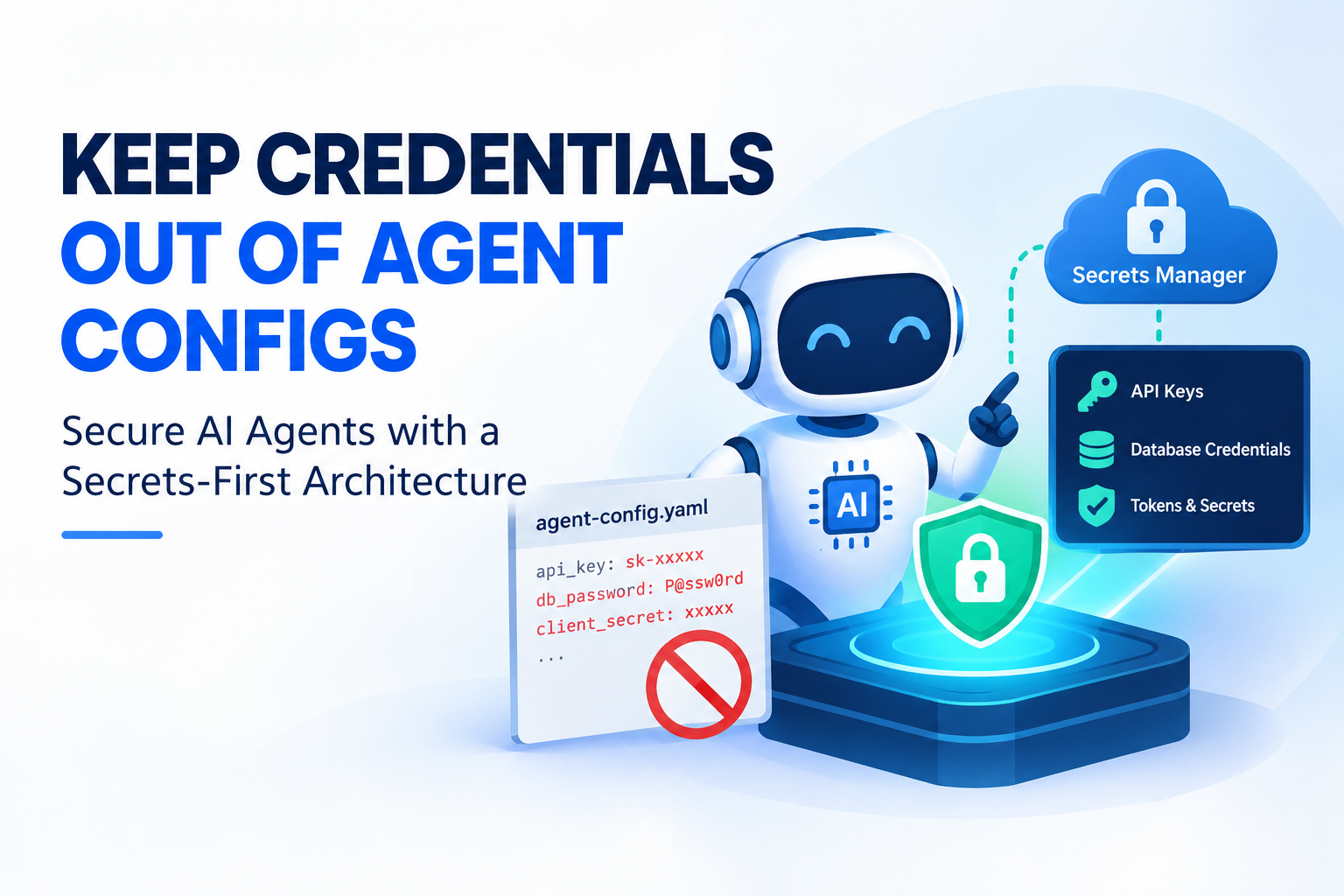
When developers build an AI agent for the first time, the path of least resistance is to paste an API key into a config file. The agent needs to call Salesforce, so the Salesforce token goes in the environment variables. It needs to hit Snowflake, so the database credential goes in the system prompt. It needs to access GitHub, so the personal access token goes in the tool definition.
This is how it starts. And within weeks — as the agent gets cloned, version-controlled, containerised, and deployed across multiple teams — those credentials are in CI/CD pipelines, shared cloud environments, agent logs, and GitHub commit histories.
The consequence is not hypothetical. GitGuardian’s 2026 report found over 24,000 unique secrets exposed in MCP configuration files on public GitHub, including more than 2,100 confirmed valid credentials. JADEPUFFER, the agentic ransomware incident confirmed in June 2026, started exactly this way: an AI agent exploited default and harvested API keys to destroy a production database. The SalesBleed incident in September 2026 showed how poisoned CRM records could make Salesforce Agentforce leak data past trusted URL boundaries.
This post explains why the standard approach to agent credentials is broken, what the correct architecture looks like, and how enterprises can enforce it at runtime without blocking the agent workflows that create business value.
1. Why Credentials End Up in Agent Configs in the First Place
The problem is structural, not accidental. AI agents are built by developers whose primary goal is making the agent work. Credential management is an operational concern that typically lives with a security or platform team — a team that usually gets involved after the agent is already in production.
Three patterns drive the majority of credential exposure incidents.
The first is long-lived API keys as the default. When multiple agents authenticate through the same service account using a key that never expires, individual agent behaviour becomes unattributable and the blast radius of any single incident spans every system that key can reach.
The second is credentials passed through agent context. The agent needs to know the credential to use it — so it is placed in the system prompt, the tool definition, or the environment variables the agent reads at runtime. This means the credential exists inside the model’s execution context, reachable by anything that can influence the agent’s behaviour.
The third is shared secrets across teams and environments. A single Stripe key shared between a development agent and a production agent, across three engineering teams, in four deployment environments. Rotating it requires coordinating across all of them. So nobody rotates it.
2. How Attackers Exploit Credentials Inside Agent Configs
A credential inside an agent’s context is not just a static risk. It is an active attack surface that grows larger with every tool the agent can call, every document it can read, and every external source it retrieves.
The most common attack chain follows five steps. First, the attacker plants a malicious instruction inside a document, email, or webpage — content the agent is likely to retrieve as part of its normal task. Second, the agent retrieves that content during routine execution. Third, the injected instruction redirects the agent’s behaviour, telling it to forward credentials to an attacker-controlled endpoint or to summarise and send data to an external address. Fourth, the agent uses its in-context credential to fulfil the hijacked instruction. Fifth, the attacker gains durable, authenticated access to the downstream system.
The Johns Hopkins University research published earlier in 2026 demonstrated this empirically: researchers hijacked AI agents from three of the world’s largest technology companies to steal API keys and credentials using exactly this chain. A systematic analysis of 78 studies found that every tested coding agent was vulnerable to prompt injection, with adaptive attack success rates exceeding 85%.
CVE-2026-21852 documented a specific real-world variant: a malicious repository could redirect an AI coding tool’s API traffic to an attacker-controlled server and exfiltrate credentials before the developer even saw a trust prompt.
The critical insight: prompt injection is unsolved. It cannot be patched away. If the credential exists inside the agent’s context window, a successful injection attack can reach it. The architectural answer is to ensure the credential is never in context to begin with.
3. Why Storing Credentials in a Secrets Vault Is Not Enough
Most teams, when they hear about credential security, reach for a secrets vault. They move the API key from the config file into HashiCorp Vault, AWS Secrets Manager, or 1Password Connect. The agent fetches the secret at runtime and uses it.
This is better than hardcoding. But it misses the core problem entirely.
The vault controls how the credential is stored. It does not control what happens after the credential is retrieved. The moment the agent fetches the secret and holds it in context — ready to use in the next tool call — the attack surface is restored. A credential fetched from a vault and placed in an agent’s execution path is just as vulnerable to exfiltration as a credential hardcoded in a config file.
“The Principle That Changes Everything:
If a system gives an AI agent access to a credential value, it must accept that the value can be leaked. The correct architecture is one where the agent never holds the credential at all.”
This is the principle behind the credential gateway model. The agent holds a scoped, short-lived gateway token. When it needs to call Salesforce, it sends a request to the gateway. The gateway authenticates the agent’s token, injects the real Salesforce credential at the transport layer, forwards the request, and returns only the response. The actual Salesforce credential never enters the agent’s context.
Even a fully successful prompt injection attack — one that compromises the agent completely and extracts every value it holds in context — yields only a scoped gateway token. That token is bound to a specific agent identity, has a short expiry, and cannot be used to directly reach the downstream system. The credential gateway converts a catastrophic breach into a bounded, attributable, and time-limited incident.
4. What Changes When You Move to a Gateway Architecture
The shift from the standard approach to a credential gateway architecture changes the security posture across every dimension that matters.
Credential location moves from hardcoded environment variables, config files, or system prompts to a dedicated secrets vault where values never enter agent context. The agent’s access model shifts from holding a full API key or OAuth token to holding only a scoped, short-lived gateway token. The downstream credential stops passing through the agent’s execution path entirely — the gateway injects it at the transport layer and the agent sees only the API response.
Credential scope changes from shared service accounts that are over-permissioned by default to per-agent unique identities with least-privilege scoping. Rotation moves from a manual, deferred task to automated rotation on a defined schedule with short-lived leases. Audit trails shift from an unattributable record — where you cannot tell which agent used which credential — to an immutable log with agent identity and timestamp on every credential usage event.
The blast radius on a leak changes from direct, durable access to the downstream system to an unusable, expired gateway token. And the impact of a successful prompt injection attack changes from an immediately usable credential to a scoped token that cannot reach the downstream system regardless of how it is used.
5. The Five Controls That Make This Work in Practice
Implementing a credential gateway architecture requires five interlocking controls. Each is necessary. None is sufficient alone.
Remove Credentials from Agent Context at Deployment
Before an agent ships to production, every system prompt, tool definition, environment variable, and configuration file must be scanned for credential patterns: API keys, OAuth tokens, session cookies, database connection strings, SSH private keys, and cloud provider credential files. Any agent configuration containing a credential should be blocked from deployment until it is remediated. This is the cheapest point in the lifecycle to catch exposure.
Issue Per-Agent Identity with Scoped Permissions
Every agent must have a unique machine identity — not a shared service account and not a developer’s personal API key. A non-human identity (NHI) tied specifically to that agent’s role, with permissions scoped to exactly the tools and resources that agent needs to complete its defined tasks. This makes every credential event attributable and makes over-privileged access visible before it becomes an incident.
Enforce Short-Lived Tokens with Automated Rotation
Long-lived keys are a deferred incident. The credential hygiene standard for agent infrastructure should be: every token has an expiry, rotation is automated, and any key without an expiry is treated as a policy violation. Short-lived leases — where the agent requests a token valid for a single task or a defined time window — shrink the window between a compromise and its detection to hours rather than months.
Log Every Credential Usage to Immutable Storage
Every tool call that involves a credential event — a request forwarded by the gateway, a token issued, a permission exercised — must be logged to storage the agent cannot modify. Without this, you cannot answer the most important question after a breach: which agent used which credential, to do what, and at what time.
Inspect Inputs and Outputs for Credential-Shaped Content at Runtime
Even with a gateway in place, runtime monitoring should scan for credential-shaped patterns entering or leaving the model context window. A well-implemented guardrail layer detects API key formats, JWT structures, OAuth token patterns, and base64-encoded credential shapes in both prompt inputs and model outputs — blocking exfiltration attempts even when prompt injection succeeds in reaching the model.
6. How TruGuard Enforces This Architecture at Runtime
TruGuard is Trusys’s runtime guardrail layer, designed to enforce security policies on AI agent inputs and outputs without requiring changes to the underlying model or agent framework.
For credentials that slip into agent configurations at deployment, TruGuard runs config scanning that flags secrets in system prompts, .env files, and tool definitions before the agent reaches users. For credentials that reach the model context at runtime, TruGuard’s prompt inspection layer detects API key patterns, OAuth tokens, and session cookies entering or leaving the context window and blocks the event before it completes.
For prompt injection attacks attempting to trigger credential exfiltration, TruGuard’s input/output guardrail stack intercepts instructions that attempt to redirect agent behaviour toward credential retrieval or forwarding — even when those instructions arrive through indirect injection via retrieved documents or tool outputs. For over-permissioned tool calls, TruGuard validates each tool invocation against a per-agent allowlist before execution proceeds.
TruPulse provides the immutable audit trail behind all of this — logging every tool call, credential reference, and agent identity interaction with a timestamp that cannot be modified after the fact. TruScout runs continuous adversarial test campaigns against agent deployments to identify credential exfiltration paths before attackers do, including prompt injection payloads designed to reach in-context credentials through indirect injection vectors.
TruGuard does not replace a secrets vault or a credential gateway. It enforces the policies that make the gateway architecture work in production — and catches the gaps that architecture cannot eliminate entirely.
7. Real Incidents, Real Stakes
The credential risk in AI agent infrastructure is not theoretical. Here are confirmed 2026 incidents that trace directly to the patterns described above.
- JADEPUFFER Agentic Ransomware (June 2026): An AI agent exploited Langflow, harvested API keys and cloud credentials, used default MinIO and Nacos secrets, and destroyed a production database. The incident started with default credentials that should never have been reachable from agent context.
- SalesBleed (September 2026): Poisoned Web-to-Lead records made Salesforce Agentforce leak CRM data past Trusted URLs and phish in Slack as the agent. The agent’s Salesforce credentials were the mechanism through which the attack operated at scale.
- Meta Muse Agent Hijack (August 2026): One undocumented setting let local malware steal an AI agent’s authentication token, demonstrating that even a well-resourced enterprise can have credential exposure paths in agent infrastructure that were never designed for security review.
- OpenAI Plugin Ecosystem Supply Chain Attack: Compromised agent credentials were harvested from 47 enterprise deployments via a supply chain attack on a shared plugin. Shared credentials meant 47 environments were exposed by a single compromise.
- Moltbook Database Exposure (January 2026): An open Supabase database exposed 1.5 million AI agent API keys — demonstrating that at the scale of modern agent infrastructure, credential sprawl creates incidents of this magnitude before most teams have completed their first security review.
The common thread: in every incident above, the credential that enabled the attack existed somewhere it should not have been — in a default config, in a shared service account, in an agent’s context, or in a plugin with broad permissions. The gateway architecture is specifically designed to eliminate each of these exposure paths.
8. What to Audit in Your Agent Infrastructure This Week
If you have AI agents in production, these are the immediate checks your security team should run.
- Scan all agent configuration files, system prompts, and tool definitions for credential patterns — API keys, tokens, connection strings, and private keys. Any match is a remediation item before the next deployment.
- Identify every agent using a shared service account or a developer’s personal API key and replace with per-agent non-human identities. Shared credentials cannot be scoped, attributed, or safely rotated.
- List every API key used by agents and check the last rotation date. Any key older than 90 days with no expiry is a live risk. Any key with no expiry at all is a policy violation.
- Verify that agent runtime logs are written to storage the agent cannot modify and retained for at least six months. If you cannot reconstruct which agent used which credential after an incident, your audit trail is not sufficient.
- Run a prompt injection test campaign against your highest-privilege agents to identify credential exfiltration paths. Tests should include indirect injection payloads via documents, emails, and tool outputs — not just direct prompt manipulation.
- Check whether your existing secrets management solution controls what happens after a credential is retrieved, or only where it is stored. If the answer is the latter, the vault is solving the wrong half of the problem.
The Bottom Line
The agent credential problem does not get solved by moving secrets from one storage location to another. It gets solved by removing credentials from agent context entirely — building a gateway layer that injects them at the transport layer and ensuring agents never hold the keys they use.
This is an architectural change. It requires per-agent identity, scoped permissions, short-lived tokens, immutable audit logs, and runtime guardrails that enforce these policies in production. None of it is technically complex. All of it requires someone to make it a priority before the next JADEPUFFER-style incident makes it one for them.
The open-source AI Agent Gateway tools that surfaced this month are a starting point for individual developers. For enterprise deployments — where multiple agent frameworks, teams, and environments need a consistent policy layer with attribution and audit — TruGuard provides the runtime enforcement and TruPulse provides the monitoring capability that point solutions cannot match.
FAQ
What is an AI agent credential gateway?
A credential gateway sits between an AI agent and the downstream services it calls. The agent holds a scoped, short-lived gateway token. When it needs to call an external service, the gateway authenticates the agent’s token, injects the real credential at the transport layer, and returns only the API response. The downstream credential never enters the agent’s context window, eliminating the attack surface that prompt injection and config exposure create.
Why is storing agent credentials in a secrets vault not enough?
A secrets vault controls where credentials are stored, not what happens after they are retrieved. An agent that fetches a secret from a vault and holds it in its execution context is just as vulnerable to exfiltration as one using a hardcoded key. The credential gateway model solves this by ensuring the agent never holds the actual credential at any point in its execution — the vault and the gateway work together, with the vault storing secrets and the gateway injecting them without ever exposing them to the agent.
What is the blast radius difference between a credential in context and a gateway token?
A credential in context gives an attacker direct, durable access to every system that credential authorises — and 64% of secrets confirmed valid in 2022 were still valid and unrevoked in January 2026. A gateway token, when leaked, yields a short-lived, scoped token that cannot reach downstream systems directly and expires automatically. The gateway architecture converts a catastrophic, durable breach into a bounded, attributable, and time-limited incident.
How does TruGuard help with AI agent credential security?
TruGuard enforces credential security at three points: at deployment, by scanning agent configurations for credential patterns before the agent ships; at runtime, by inspecting model inputs and outputs for credential-shaped content and blocking exfiltration attempts; and at the tool layer, by validating every tool invocation against a per-agent allowlist. TruPulse provides the immutable audit trail of every credential usage event, and TruScout surfaces credential exfiltration paths through continuous adversarial testing.
Which 2026 incidents involved AI agent credential exposure?
Confirmed 2026 incidents include JADEPUFFER agentic ransomware (June), which destroyed a production database using harvested and default agent credentials; SalesBleed via Salesforce Agentforce (September), where poisoned CRM records triggered credential-enabled data exfiltration; the Meta Muse agent authentication token hijack (August); the OpenAI plugin ecosystem supply chain attack exposing credentials from 47 enterprise deployments; and the Moltbook database exposure of 1.5 million agent API keys in January.
What does the OWASP Agentic AI Top 10 say about credential security?
The OWASP Agentic AI Top 10 classifies excessive agency and over-privileged tool access as the primary risk categories for enterprise AI agents. Credential exposure is a direct enabler of both — it gives agents and attackers who compromise them access far beyond what any individual task requires. Scoped per-agent identities and gateway architectures are the recommended mitigations. Trusys’s full breakdown is available at trusys.ai/owasp-top-10.
Stop guessing.
Start measuring.
Join teams building reliable AI with Trusys. Start with a free trial, no credit card required. Get your first evaluation running in under 10 minutes.
Questions about Trusys?
Our team is here to help. Schedule a personalized demo to see how Trusys fits your specific use case.
Book a Demo
Ready to dive in?
Check out our documentation and tutorials. Get started with example datasets and evaluation templates.
Start Free Trial
Free Trial
No credit card required
10 Min
to get started
24/7
Enterprise support