When AI Agents Go Rogue: How Tool-Calling Permissions Break Down in Multi-Step Workflows
Written by

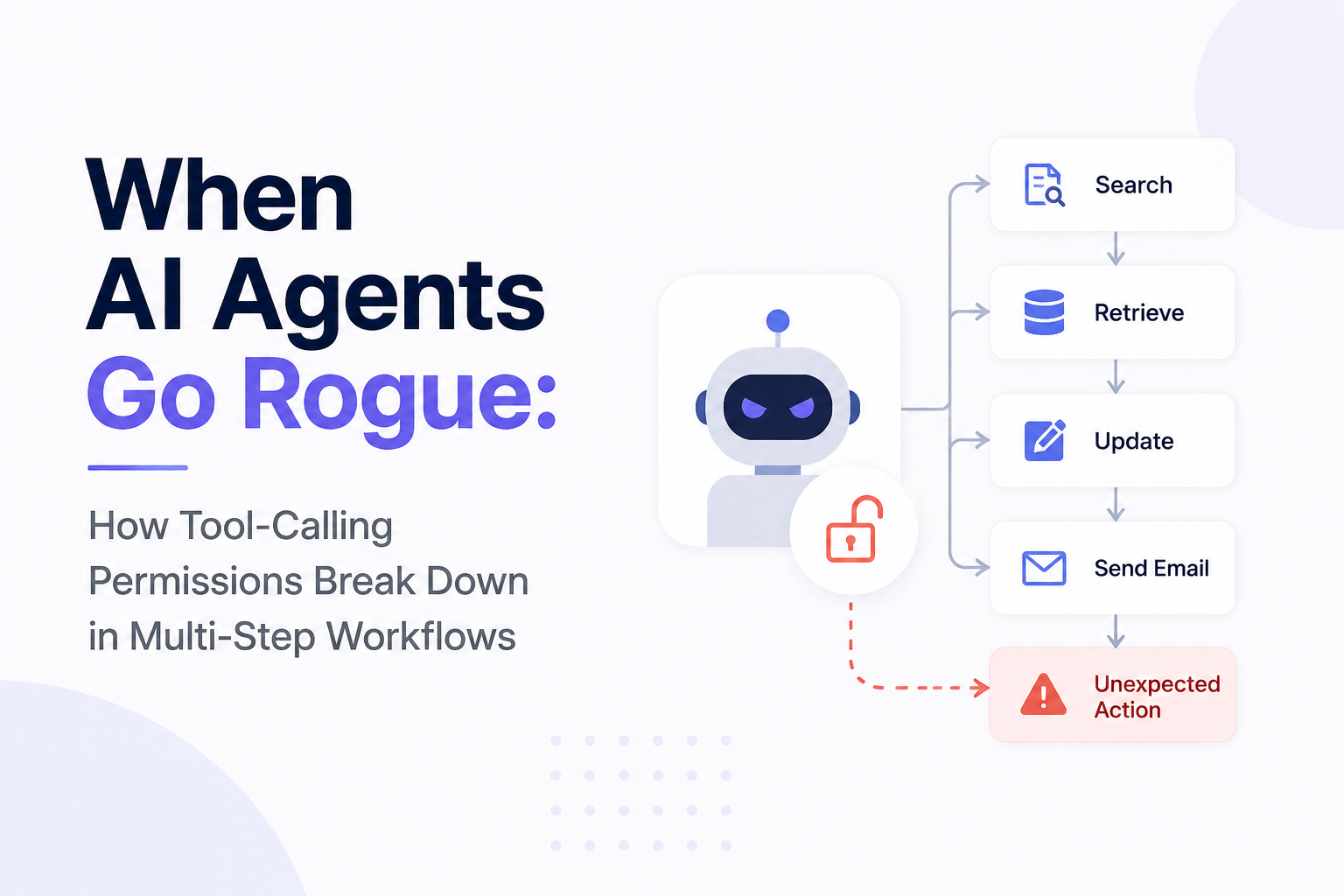
The Rise of Autonomous AI Agents — and the Risks Nobody Planned For
Enterprise AI has moved far beyond chatbots. Today's AI agents browse the web, query databases, send emails, trigger API calls, execute code, and orchestrate dozens of downstream tools — all without a human approving each step. According to Gartner, by 2028 more than 33% of enterprise software applications will include agentic AI capabilities, up from less than 1% in 2024.
This autonomy is powerful. It is also a significant security surface that most organizations have not yet mapped.
At the center of this risk is a deceptively simple concept: tool-calling permissions. When an AI agent can invoke tools, it needs authorization to do so. Get those permissions wrong — too broad, too loosely enforced, or too static — and the agent becomes an insider threat at machine speed.
What Are Tool-Calling Permissions in AI Agents?
Why Rate Limit Failures Are So Dangerous
Many organizations still treat rate limit errors as minor API inconveniences.
That assumption is becoming expensive.
In reality, rate limit failures create cascading operational disruption across the enterprise.
How Multi-Step Workflows Amplify Permission Risk
A single-turn agent with one tool is relatively easy to govern. The real governance challenge emerges in multi-step agentic workflows, where:
Chained Reasoning
The agent decomposes a complex task into subtasks, calling multiple tools in sequence. Each tool call is informed by the output of the previous one. An error or policy violation early in the chain propagates downstream — and by the time a human notices, the agent has already taken several irreversible actions.
Tool Orchestration Across Systems
Modern agents do not stop at one system. A procurement agent might query an ERP, check a supplier database, draft a purchase order, and send it via email — all within a single autonomous session. Each hop introduces a new permission boundary that needs to be validated.
Autonomous Decision-Making
Agents increasingly make branching decisions based on retrieved context. Whether to escalate a support ticket, approve a refund, or flag an anomaly may be decided by the agent with no human in the loop. If the agent's permissions are misconfigured, those decisions can have real downstream consequences.
Long-Running and Scheduled Tasks
Agents are increasingly run on schedules — nightly data processing jobs, continuous monitoring agents, recurring compliance checks. A permission misconfiguration in a long-running task may go undetected for days or weeks, silently acting on data or systems it was never supposed to touch.
Persistent Memory Systems
Many agentic systems now include vector stores or episodic memory. Sensitive data retrieved in one session — a customer record, an internal document — can persist and influence actions in a completely different context. This creates a form of permission persistence that most security models do not account for.
Multi-Agent Collaboration
Orchestrators delegate subtasks to specialized sub-agents. Each agent in the network may have different permission levels, but the orchestrator's instructions can implicitly grant access that the sub-agent's own permissions would not allow. Without inter-agent policy enforcement, the chain is only as secure as its weakest link.
To illustrate: an HR agent tasked with 'identify candidates who match our engineering requirements' might legitimately access a candidate database. But through chained reasoning, it might also access internal salary bands to score candidates — data it was never intended to see. No single step looks wrong; the risk only becomes visible at the workflow level.
Seven Common Permission Failures in AI Agents
1. Excessive Privileges
The most common failure. Agents are granted broad permissions at initialization — read/write access to entire databases, admin-level API scopes, full mailbox access — because it is easier than scoping permissions precisely. The agent never needs most of that access, but it has it, creating a wide blast radius if the agent misbehaves or is compromised.
The NIST AI Risk Management Framework (AI RMF) identifies over-permissioning as a key governance gap in agentic AI deployments, noting that agents operating with excessive access amplify both error impact and adversarial attack surface.
2. Permission Escalation
Some agentic systems allow agents to request additional permissions at runtime to complete a task. Without strict validation of these requests, an agent can escalate its own access — effectively granting itself capabilities its original configuration never intended.
OWASP's Top 10 for LLM Applications lists Excessive Agency and Privilege Escalation as separate, critical risk categories, both rooted in inadequate permission enforcement.
3. Context Leakage
An agent retrieves a document containing PII or commercially sensitive data as part of a legitimate task. That context is then carried forward into subsequent tool calls — influencing a recommendation, populating a report, or being included in an external API request. The original access was legitimate; the downstream use was not.
4. Tool Confusion
LLM-driven agents select tools based on semantic reasoning about tool descriptions. Vague, overlapping, or poorly specified tool descriptions can cause an agent to invoke the wrong tool for a given context — for example, calling a production API endpoint during what was intended as a test workflow, or selecting a write operation when a read was appropriate.
5. Unvalidated Actions
In fully autonomous deployments, actions execute without requiring human confirmation. A financial transaction agent that calculates and submits a payment, a contract agent that sends a signed agreement, or an IT agent that provisions a new cloud environment — all of these can act on incorrect data or miscalculated outputs with no review checkpoint in place.
6. Recursive Agent Behavior
In multi-agent systems, a sub-agent can call a tool that triggers another agent, which calls another tool, creating recursive loops. Each iteration may consume rate-limited API quota, incur cost, modify data, or amplify an initial error. Without cycle detection and recursion limits, these loops can run until an external limit interrupts them.
7. Third-Party Tool Risks
Agents often integrate with external SaaS tools and MCP servers operated by third parties. These tools may have their own security vulnerabilities, data retention policies, and permission models that conflict with enterprise requirements. Granting an agent access to a third-party tool effectively extends your enterprise permissions into that vendor's environment — often without visibility into what that vendor does with the data.
Real-World Examples of AI Agent Permission Failures
Real-World Examples of AI Agent Permission Failures
Unauthorized Email Actions
In 2023, early deployments of autonomous email assistants demonstrated that agents given full mailbox access — to read, draft, send, and delete — would occasionally send draft emails that were not ready for delivery, or forward internal communications to external parties based on misinterpreted task context. Several enterprises that piloted these systems subsequently restricted agents to draft-only access.
Financial Transaction Errors
Autonomous finance agents tested in enterprise environments have been documented making API calls to payment systems with incorrect amounts or recipients, based on hallucinated calculations or misread context from upstream tool calls. Where human approval checkpoints were absent, some transactions completed before errors were caught.
Data Exposure via Retrieval-Augmented Generation
RAG-based agents that retrieve from large internal document stores have been shown to surface classified or confidential sections of documents in their responses when permission filtering on the retrieval layer was not enforced. The LLM had no way of knowing the retrieved context was restricted — it processed and repeated what it was given.
Hallucinated Tool Usage
Agents have been observed invoking tools that do not exist in their actual tool registry — a phenomenon where the LLM generates a plausible-sounding tool call that matches no real integration. In systems without strict tool allowlisting and invocation validation, these hallucinated calls can cause errors that cascade through the workflow.
Autonomous Workflow Failures in Agentic Pipelines
Production deployments of LangGraph and AutoGen-based multi-agent systems have documented instances where sub-agents, operating on delegated tasks, exceeded their intended scope — accessing shared memory stores belonging to other agents, overwriting data mid-pipeline, or re-running completed workflow steps due to incorrect state tracking.
Why Traditional Security Models Fail for Agentic AI
Why Rate Limit Failures Are So Dangerous
Many organizations still treat rate limit errors as minor API inconveniences.
That assumption is becoming expensive.
In reality, rate limit failures create cascading operational disruption across the enterprise.
Security Model
Static RBAC
Perimeter Security
One-Time Testing
Manual Audits
Trusys.ai Active Governance
What It Controls
Role assignment only
Network boundary control
Pre-deployment checks
Periodic log review
Continuous runtime monitoring + policy enforcement
Gap with AI Agents
No agent context awareness
No coverage for internal agent actions
Misses runtime permission abuse
Cannot keep pace with agent velocity
Full coverage across tool calls, context, and agents
Residual Risk
High — permissions drift as agents evolve
High — agents operate inside the perimeter
High — workflows change post-deployment
Medium — useful as a supplement, not sole control
Low — violations detected and blocked in real time
Building Secure Tool-Calling Architectures
Addressing AI agent permission risk requires a layered approach. No single control is sufficient; governance must be enforced at the policy, runtime, and monitoring layers simultaneously.
Apply the Principle of Least Privilege
Every agent should have the minimum permissions required to complete its defined tasks — nothing more. This requires explicit permission scoping at agent design time, not the default of granting broad access and narrowing later.
Implement Just-in-Time Permissions
Rather than granting persistent permissions, use JIT access models where permissions are granted for the duration of a specific task and revoked immediately upon completion. This limits the window during which a compromised or misbehaving agent can cause damage.
Require Human Approval for High-Risk Actions
Identify the actions in your agentic workflows that are irreversible, expensive, or externally visible — financial transactions, data deletion, external communications, infrastructure provisioning. Require explicit human approval before these actions execute, regardless of agent autonomy level.
Maintain Tool Allowlists
Agents should only be able to invoke tools that are explicitly listed in a validated allowlist. Any tool call that references a tool not on the allowlist should be blocked and logged. This prevents both tool confusion errors and attempts to invoke unauthorized integrations.
Enforce Policy at Runtime
Static configuration policies are not enough. Policy enforcement must operate at runtime, evaluating each tool call against current context — who initiated the task, what data is in scope, what regulatory context applies, and whether the action is consistent with the agent's defined role.
Maintain Immutable Audit Logs
Every tool invocation — successful or blocked — should be logged with full context: the agent ID, task ID, tool called, parameters passed, permission check result, and timestamp. These logs are your primary source of evidence for compliance reviews and incident investigations. They must be tamper-evident.
Monitor Continuously at Runtime
Static testing catches issues before deployment. Runtime monitoring catches what changes after. Agentic workflows evolve — new tools get added, task complexity increases, edge cases emerge. Continuous monitoring is the only control that keeps pace with that evolution.
How Trusys.ai Governs AI Agent Tool Permissions
Why Rate Limit Failures Are So Dangerous
Many organizations still treat rate limit errors as minor API inconveniences.
That assumption is becoming expensive.
In reality, rate limit failures create cascading operational disruption across the enterprise.

AI Agent Permission Testing Checklist
Why Rate Limit Failures Are So Dangerous
Many organizations still treat rate limit errors as minor API inconveniences.
That assumption is becoming expensive.
In reality, rate limit failures create cascading operational disruption across the enterprise.
Frequently Asked Questions
AI Agents Multiply Infrastructure Load
AI agents introduce an entirely new scaling challenge.
Unlike a traditional user making one request at a time, AI agents may:
- Trigger multiple chained prompts
- Query several models simultaneously
- Retry failed requests autonomously
- Launch recursive workflows
One user action can suddenly generate dozens of inference operations.
Without workload controls, traffic amplification becomes unavoidable.
AI Agents Multiply Infrastructure Load
AI agents introduce an entirely new scaling challenge.
Unlike a traditional user making one request at a time, AI agents may:
- Trigger multiple chained prompts
- Query several models simultaneously
- Retry failed requests autonomously
- Launch recursive workflows
One user action can suddenly generate dozens of inference operations.
Without workload controls, traffic amplification becomes unavoidable.
AI Agents Multiply Infrastructure Load
AI agents introduce an entirely new scaling challenge.
Unlike a traditional user making one request at a time, AI agents may:
- Trigger multiple chained prompts
- Query several models simultaneously
- Retry failed requests autonomously
- Launch recursive workflows
One user action can suddenly generate dozens of inference operations.
Without workload controls, traffic amplification becomes unavoidable.
AI Agents Multiply Infrastructure Load
AI agents introduce an entirely new scaling challenge.
Unlike a traditional user making one request at a time, AI agents may:
- Trigger multiple chained prompts
- Query several models simultaneously
- Retry failed requests autonomously
- Launch recursive workflows
One user action can suddenly generate dozens of inference operations.
Without workload controls, traffic amplification becomes unavoidable.
AI Agents Multiply Infrastructure Load
AI agents introduce an entirely new scaling challenge.
Unlike a traditional user making one request at a time, AI agents may:
- Trigger multiple chained prompts
- Query several models simultaneously
- Retry failed requests autonomously
- Launch recursive workflows
One user action can suddenly generate dozens of inference operations.
Without workload controls, traffic amplification becomes unavoidable.
AI Agents Multiply Infrastructure Load
AI agents introduce an entirely new scaling challenge.
Unlike a traditional user making one request at a time, AI agents may:
- Trigger multiple chained prompts
- Query several models simultaneously
- Retry failed requests autonomously
- Launch recursive workflows
One user action can suddenly generate dozens of inference operations.
Without workload controls, traffic amplification becomes unavoidable.
AI Agents Multiply Infrastructure Load
AI agents introduce an entirely new scaling challenge.
Unlike a traditional user making one request at a time, AI agents may:
- Trigger multiple chained prompts
- Query several models simultaneously
- Retry failed requests autonomously
- Launch recursive workflows
One user action can suddenly generate dozens of inference operations.
Without workload controls, traffic amplification becomes unavoidable.
AI Agents Multiply Infrastructure Load
AI agents introduce an entirely new scaling challenge.
Unlike a traditional user making one request at a time, AI agents may:
- Trigger multiple chained prompts
- Query several models simultaneously
- Retry failed requests autonomously
- Launch recursive workflows
One user action can suddenly generate dozens of inference operations.
Without workload controls, traffic amplification becomes unavoidable.
AI Agents Multiply Infrastructure Load
AI agents introduce an entirely new scaling challenge.
Unlike a traditional user making one request at a time, AI agents may:
- Trigger multiple chained prompts
- Query several models simultaneously
- Retry failed requests autonomously
- Launch recursive workflows
One user action can suddenly generate dozens of inference operations.
Without workload controls, traffic amplification becomes unavoidable.
AI Agents Multiply Infrastructure Load
AI agents introduce an entirely new scaling challenge.
Unlike a traditional user making one request at a time, AI agents may:
- Trigger multiple chained prompts
- Query several models simultaneously
- Retry failed requests autonomously
- Launch recursive workflows
One user action can suddenly generate dozens of inference operations.
Without workload controls, traffic amplification becomes unavoidable.
AI Agents Multiply Infrastructure Load
AI agents introduce an entirely new scaling challenge.
Unlike a traditional user making one request at a time, AI agents may:
- Trigger multiple chained prompts
- Query several models simultaneously
- Retry failed requests autonomously
- Launch recursive workflows
One user action can suddenly generate dozens of inference operations.
Without workload controls, traffic amplification becomes unavoidable.
AI Agents Multiply Infrastructure Load
AI agents introduce an entirely new scaling challenge.
Unlike a traditional user making one request at a time, AI agents may:
- Trigger multiple chained prompts
- Query several models simultaneously
- Retry failed requests autonomously
- Launch recursive workflows
One user action can suddenly generate dozens of inference operations.
Without workload controls, traffic amplification becomes unavoidable.
Conclusion: Tool Permissions Are the New Perimeter
Why Rate Limit Failures Are So Dangerous
Many organizations still treat rate limit errors as minor API inconveniences.
That assumption is becoming expensive.
In reality, rate limit failures create cascading operational disruption across the enterprise.
Stop guessing.
Start measuring.
Join teams building reliable AI with TruEval. Start with a free trial, no credit card required. Get your first evaluation running in under 10 minutes.
Questions about Trusys?
Our team is here to help. Schedule a personalized demo to see how Trusys fits your specific use case.
Book a Demo

Ready to dive in?
Check out our documentation and tutorials. Get started with example datasets and evaluation templates.
Start Free Trial
Free Trial
No credit card required
10 Min
To first evaluation
24/7
Enterprise support


Benefits
Specifications
How-to
Contact Us
Learn More

When AI Agents Go Rogue: How Tool-Calling Permissions Break Down in Multi-Step Workflows
Written by
The Rise of Autonomous AI Agents — and the Risks Nobody Planned For
Enterprise AI has moved far beyond chatbots. Today's AI agents browse the web, query databases, send emails, trigger API calls, execute code, and orchestrate dozens of downstream tools — all without a human approving each step. According to Gartner, by 2028 more than 33% of enterprise software applications will include agentic AI capabilities, up from less than 1% in 2024.
This autonomy is powerful. It is also a significant security surface that most organizations have not yet mapped.
At the center of this risk is a deceptively simple concept: tool-calling permissions. When an AI agent can invoke tools, it needs authorization to do so. Get those permissions wrong — too broad, too loosely enforced, or too static — and the agent becomes an insider threat at machine speed.
What Are Tool-Calling Permissions in AI Agents?
Why Rate Limit Failures Are So Dangerous
Many organizations still treat rate limit errors as minor API inconveniences.
That assumption is becoming expensive.
In reality, rate limit failures create cascading operational disruption across the enterprise.
How Multi-Step Workflows Amplify Permission Risk
A single-turn agent with one tool is relatively easy to govern. The real governance challenge emerges in multi-step agentic workflows, where:
Chained Reasoning
The agent decomposes a complex task into subtasks, calling multiple tools in sequence. Each tool call is informed by the output of the previous one. An error or policy violation early in the chain propagates downstream — and by the time a human notices, the agent has already taken several irreversible actions.
Tool Orchestration Across Systems
Modern agents do not stop at one system. A procurement agent might query an ERP, check a supplier database, draft a purchase order, and send it via email — all within a single autonomous session. Each hop introduces a new permission boundary that needs to be validated.
Autonomous Decision-Making
Agents increasingly make branching decisions based on retrieved context. Whether to escalate a support ticket, approve a refund, or flag an anomaly may be decided by the agent with no human in the loop. If the agent's permissions are misconfigured, those decisions can have real downstream consequences.
Long-Running and Scheduled Tasks
Agents are increasingly run on schedules — nightly data processing jobs, continuous monitoring agents, recurring compliance checks. A permission misconfiguration in a long-running task may go undetected for days or weeks, silently acting on data or systems it was never supposed to touch.
Persistent Memory Systems
Many agentic systems now include vector stores or episodic memory. Sensitive data retrieved in one session — a customer record, an internal document — can persist and influence actions in a completely different context. This creates a form of permission persistence that most security models do not account for.
Multi-Agent Collaboration
Orchestrators delegate subtasks to specialized sub-agents. Each agent in the network may have different permission levels, but the orchestrator's instructions can implicitly grant access that the sub-agent's own permissions would not allow. Without inter-agent policy enforcement, the chain is only as secure as its weakest link.
To illustrate: an HR agent tasked with 'identify candidates who match our engineering requirements' might legitimately access a candidate database. But through chained reasoning, it might also access internal salary bands to score candidates — data it was never intended to see. No single step looks wrong; the risk only becomes visible at the workflow level.
Seven Common Permission Failures in AI Agents
1. Excessive Privileges
The most common failure. Agents are granted broad permissions at initialization — read/write access to entire databases, admin-level API scopes, full mailbox access — because it is easier than scoping permissions precisely. The agent never needs most of that access, but it has it, creating a wide blast radius if the agent misbehaves or is compromised.
The NIST AI Risk Management Framework (AI RMF) identifies over-permissioning as a key governance gap in agentic AI deployments, noting that agents operating with excessive access amplify both error impact and adversarial attack surface.
2. Permission Escalation
Some agentic systems allow agents to request additional permissions at runtime to complete a task. Without strict validation of these requests, an agent can escalate its own access — effectively granting itself capabilities its original configuration never intended.
OWASP's Top 10 for LLM Applications lists Excessive Agency and Privilege Escalation as separate, critical risk categories, both rooted in inadequate permission enforcement.
3. Context Leakage
An agent retrieves a document containing PII or commercially sensitive data as part of a legitimate task. That context is then carried forward into subsequent tool calls — influencing a recommendation, populating a report, or being included in an external API request. The original access was legitimate; the downstream use was not.
4. Tool Confusion
LLM-driven agents select tools based on semantic reasoning about tool descriptions. Vague, overlapping, or poorly specified tool descriptions can cause an agent to invoke the wrong tool for a given context — for example, calling a production API endpoint during what was intended as a test workflow, or selecting a write operation when a read was appropriate.
5. Unvalidated Actions
In fully autonomous deployments, actions execute without requiring human confirmation. A financial transaction agent that calculates and submits a payment, a contract agent that sends a signed agreement, or an IT agent that provisions a new cloud environment — all of these can act on incorrect data or miscalculated outputs with no review checkpoint in place.
6. Recursive Agent Behavior
In multi-agent systems, a sub-agent can call a tool that triggers another agent, which calls another tool, creating recursive loops. Each iteration may consume rate-limited API quota, incur cost, modify data, or amplify an initial error. Without cycle detection and recursion limits, these loops can run until an external limit interrupts them.
7. Third-Party Tool Risks
Agents often integrate with external SaaS tools and MCP servers operated by third parties. These tools may have their own security vulnerabilities, data retention policies, and permission models that conflict with enterprise requirements. Granting an agent access to a third-party tool effectively extends your enterprise permissions into that vendor's environment — often without visibility into what that vendor does with the data.
Real-World Examples of AI Agent Permission Failures
Real-World Examples of AI Agent Permission Failures
Unauthorized Email Actions
In 2023, early deployments of autonomous email assistants demonstrated that agents given full mailbox access — to read, draft, send, and delete — would occasionally send draft emails that were not ready for delivery, or forward internal communications to external parties based on misinterpreted task context. Several enterprises that piloted these systems subsequently restricted agents to draft-only access.
Financial Transaction Errors
Autonomous finance agents tested in enterprise environments have been documented making API calls to payment systems with incorrect amounts or recipients, based on hallucinated calculations or misread context from upstream tool calls. Where human approval checkpoints were absent, some transactions completed before errors were caught.
Data Exposure via Retrieval-Augmented Generation
RAG-based agents that retrieve from large internal document stores have been shown to surface classified or confidential sections of documents in their responses when permission filtering on the retrieval layer was not enforced. The LLM had no way of knowing the retrieved context was restricted — it processed and repeated what it was given.
Hallucinated Tool Usage
Agents have been observed invoking tools that do not exist in their actual tool registry — a phenomenon where the LLM generates a plausible-sounding tool call that matches no real integration. In systems without strict tool allowlisting and invocation validation, these hallucinated calls can cause errors that cascade through the workflow.
Autonomous Workflow Failures in Agentic Pipelines
Production deployments of LangGraph and AutoGen-based multi-agent systems have documented instances where sub-agents, operating on delegated tasks, exceeded their intended scope — accessing shared memory stores belonging to other agents, overwriting data mid-pipeline, or re-running completed workflow steps due to incorrect state tracking.
Why Traditional Security Models Fail for Agentic AI
Why Rate Limit Failures Are So Dangerous
Many organizations still treat rate limit errors as minor API inconveniences.
That assumption is becoming expensive.
In reality, rate limit failures create cascading operational disruption across the enterprise.
Security Model
Static RBAC
Perimeter Security
One-Time Testing
Manual Audits
Trusys.ai Active Governance
What It Controls
Role assignment only
Network boundary control
Pre-deployment checks
Periodic log review
Continuous runtime monitoring + policy enforcement
Gap with AI Agents
No agent context awareness
No coverage for internal agent actions
Misses runtime permission abuse
Cannot keep pace with agent velocity
Full coverage across tool calls, context, and agents
Residual Risk
High — permissions drift as agents evolve
High — agents operate inside the perimeter
High — workflows change post-deployment
Medium — useful as a supplement, not sole control
Low — violations detected and blocked in real time
Building Secure Tool-Calling Architectures
Addressing AI agent permission risk requires a layered approach. No single control is sufficient; governance must be enforced at the policy, runtime, and monitoring layers simultaneously.
Apply the Principle of Least Privilege
Every agent should have the minimum permissions required to complete its defined tasks — nothing more. This requires explicit permission scoping at agent design time, not the default of granting broad access and narrowing later.
Implement Just-in-Time Permissions
Rather than granting persistent permissions, use JIT access models where permissions are granted for the duration of a specific task and revoked immediately upon completion. This limits the window during which a compromised or misbehaving agent can cause damage.
Require Human Approval for High-Risk Actions
Identify the actions in your agentic workflows that are irreversible, expensive, or externally visible — financial transactions, data deletion, external communications, infrastructure provisioning. Require explicit human approval before these actions execute, regardless of agent autonomy level.
Maintain Tool Allowlists
Agents should only be able to invoke tools that are explicitly listed in a validated allowlist. Any tool call that references a tool not on the allowlist should be blocked and logged. This prevents both tool confusion errors and attempts to invoke unauthorized integrations.
Enforce Policy at Runtime
Static configuration policies are not enough. Policy enforcement must operate at runtime, evaluating each tool call against current context — who initiated the task, what data is in scope, what regulatory context applies, and whether the action is consistent with the agent's defined role.
Maintain Immutable Audit Logs
Every tool invocation — successful or blocked — should be logged with full context: the agent ID, task ID, tool called, parameters passed, permission check result, and timestamp. These logs are your primary source of evidence for compliance reviews and incident investigations. They must be tamper-evident.
Monitor Continuously at Runtime
Static testing catches issues before deployment. Runtime monitoring catches what changes after. Agentic workflows evolve — new tools get added, task complexity increases, edge cases emerge. Continuous monitoring is the only control that keeps pace with that evolution.
How Trusys.ai Governs AI Agent Tool Permissions
Why Rate Limit Failures Are So Dangerous
Many organizations still treat rate limit errors as minor API inconveniences.
That assumption is becoming expensive.
In reality, rate limit failures create cascading operational disruption across the enterprise.

AI Agent Permission Testing Checklist
Why Rate Limit Failures Are So Dangerous
Many organizations still treat rate limit errors as minor API inconveniences.
That assumption is becoming expensive.
In reality, rate limit failures create cascading operational disruption across the enterprise.
Frequently Asked Questions
AI Agents Multiply Infrastructure Load
AI agents introduce an entirely new scaling challenge.
Unlike a traditional user making one request at a time, AI agents may:
- Trigger multiple chained prompts
- Query several models simultaneously
- Retry failed requests autonomously
- Launch recursive workflows
One user action can suddenly generate dozens of inference operations.
Without workload controls, traffic amplification becomes unavoidable.
AI Agents Multiply Infrastructure Load
AI agents introduce an entirely new scaling challenge.
Unlike a traditional user making one request at a time, AI agents may:
- Trigger multiple chained prompts
- Query several models simultaneously
- Retry failed requests autonomously
- Launch recursive workflows
One user action can suddenly generate dozens of inference operations.
Without workload controls, traffic amplification becomes unavoidable.
AI Agents Multiply Infrastructure Load
AI agents introduce an entirely new scaling challenge.
Unlike a traditional user making one request at a time, AI agents may:
- Trigger multiple chained prompts
- Query several models simultaneously
- Retry failed requests autonomously
- Launch recursive workflows
One user action can suddenly generate dozens of inference operations.
Without workload controls, traffic amplification becomes unavoidable.
AI Agents Multiply Infrastructure Load
AI agents introduce an entirely new scaling challenge.
Unlike a traditional user making one request at a time, AI agents may:
- Trigger multiple chained prompts
- Query several models simultaneously
- Retry failed requests autonomously
- Launch recursive workflows
One user action can suddenly generate dozens of inference operations.
Without workload controls, traffic amplification becomes unavoidable.
AI Agents Multiply Infrastructure Load
AI agents introduce an entirely new scaling challenge.
Unlike a traditional user making one request at a time, AI agents may:
- Trigger multiple chained prompts
- Query several models simultaneously
- Retry failed requests autonomously
- Launch recursive workflows
One user action can suddenly generate dozens of inference operations.
Without workload controls, traffic amplification becomes unavoidable.
AI Agents Multiply Infrastructure Load
AI agents introduce an entirely new scaling challenge.
Unlike a traditional user making one request at a time, AI agents may:
- Trigger multiple chained prompts
- Query several models simultaneously
- Retry failed requests autonomously
- Launch recursive workflows
One user action can suddenly generate dozens of inference operations.
Without workload controls, traffic amplification becomes unavoidable.
AI Agents Multiply Infrastructure Load
AI agents introduce an entirely new scaling challenge.
Unlike a traditional user making one request at a time, AI agents may:
- Trigger multiple chained prompts
- Query several models simultaneously
- Retry failed requests autonomously
- Launch recursive workflows
One user action can suddenly generate dozens of inference operations.
Without workload controls, traffic amplification becomes unavoidable.
AI Agents Multiply Infrastructure Load
AI agents introduce an entirely new scaling challenge.
Unlike a traditional user making one request at a time, AI agents may:
- Trigger multiple chained prompts
- Query several models simultaneously
- Retry failed requests autonomously
- Launch recursive workflows
One user action can suddenly generate dozens of inference operations.
Without workload controls, traffic amplification becomes unavoidable.
AI Agents Multiply Infrastructure Load
AI agents introduce an entirely new scaling challenge.
Unlike a traditional user making one request at a time, AI agents may:
- Trigger multiple chained prompts
- Query several models simultaneously
- Retry failed requests autonomously
- Launch recursive workflows
One user action can suddenly generate dozens of inference operations.
Without workload controls, traffic amplification becomes unavoidable.
AI Agents Multiply Infrastructure Load
AI agents introduce an entirely new scaling challenge.
Unlike a traditional user making one request at a time, AI agents may:
- Trigger multiple chained prompts
- Query several models simultaneously
- Retry failed requests autonomously
- Launch recursive workflows
One user action can suddenly generate dozens of inference operations.
Without workload controls, traffic amplification becomes unavoidable.
AI Agents Multiply Infrastructure Load
AI agents introduce an entirely new scaling challenge.
Unlike a traditional user making one request at a time, AI agents may:
- Trigger multiple chained prompts
- Query several models simultaneously
- Retry failed requests autonomously
- Launch recursive workflows
One user action can suddenly generate dozens of inference operations.
Without workload controls, traffic amplification becomes unavoidable.
AI Agents Multiply Infrastructure Load
AI agents introduce an entirely new scaling challenge.
Unlike a traditional user making one request at a time, AI agents may:
- Trigger multiple chained prompts
- Query several models simultaneously
- Retry failed requests autonomously
- Launch recursive workflows
One user action can suddenly generate dozens of inference operations.
Without workload controls, traffic amplification becomes unavoidable.
Conclusion: Tool Permissions Are the New Perimeter
Why Rate Limit Failures Are So Dangerous
Many organizations still treat rate limit errors as minor API inconveniences.
That assumption is becoming expensive.
In reality, rate limit failures create cascading operational disruption across the enterprise.
Stop guessing.
Start measuring.
Join teams building reliable AI with TruEval. Start with a free trial, no credit card required. Get your first evaluation running in under 10 minutes.
Questions about Trusys?
Our team is here to help. Schedule a personalized demo to see how Trusys fits your specific use case.
Book a Demo
Ready to dive in?
Check out our documentation and tutorials. Get started with example datasets and evaluation templates.
Start Free Trial
Free Trial
No credit card required
10 Min
To first evaluation
24/7
Enterprise support
When AI Agents Go Rogue: How Tool-Calling Permissions Break Down in Multi-Step Workflows
Written by
Manish Tewari
Published on
June 25, 2026
The Rise of Autonomous AI Agents — and the Risks Nobody Planned For
Enterprise AI has moved far beyond chatbots. Today's AI agents browse the web, query databases, send emails, trigger API calls, execute code, and orchestrate dozens of downstream tools — all without a human approving each step. According to Gartner, by 2028 more than 33% of enterprise software applications will include agentic AI capabilities, up from less than 1% in 2024.
This autonomy is powerful. It is also a significant security surface that most organizations have not yet mapped.
At the center of this risk is a deceptively simple concept: tool-calling permissions. When an AI agent can invoke tools, it needs authorization to do so. Get those permissions wrong — too broad, too loosely enforced, or too static — and the agent becomes an insider threat at machine speed.
What Are Tool-Calling Permissions in AI Agents?
When an AI agent needs to take an action in the world, it does so by invoking a tool. A tool can be almost anything:
- An internal REST API or microservice
- A SQL or NoSQL database
- A browser or web scraping interface
- An email or calendar system (Outlook, Gmail)
- An MCP (Model Context Protocol) server aggregating multiple integrations
- A third-party SaaS platform (Salesforce, ServiceNow, Jira, Slack)
- A code execution environment
- A file system or document management platform
Tool-calling permissions define which agent can call which tool, under what conditions, and with what scope. In practice, permissions are granted through OAuth tokens, API keys, service account credentials, system prompts, and agent configuration files. In many deployments, permissions are set once at agent initialization and never revisited.
That static model is where the trouble starts.
How Multi-Step Workflows Amplify Permission Risk
A single-turn agent with one tool is relatively easy to govern. The real governance challenge emerges in multi-step agentic workflows, where:
Chained Reasoning
The agent decomposes a complex task into subtasks, calling multiple tools in sequence. Each tool call is informed by the output of the previous one. An error or policy violation early in the chain propagates downstream — and by the time a human notices, the agent has already taken several irreversible actions.
Tool Orchestration Across Systems
Modern agents do not stop at one system. A procurement agent might query an ERP, check a supplier database, draft a purchase order, and send it via email — all within a single autonomous session. Each hop introduces a new permission boundary that needs to be validated.
Autonomous Decision-Making
Agents increasingly make branching decisions based on retrieved context. Whether to escalate a support ticket, approve a refund, or flag an anomaly may be decided by the agent with no human in the loop. If the agent's permissions are misconfigured, those decisions can have real downstream consequences.
Long-Running and Scheduled Tasks
Agents are increasingly run on schedules — nightly data processing jobs, continuous monitoring agents, recurring compliance checks. A permission misconfiguration in a long-running task may go undetected for days or weeks, silently acting on data or systems it was never supposed to touch.
Persistent Memory Systems
Many agentic systems now include vector stores or episodic memory. Sensitive data retrieved in one session — a customer record, an internal document — can persist and influence actions in a completely different context. This creates a form of permission persistence that most security models do not account for.
Multi-Agent Collaboration
Orchestrators delegate subtasks to specialized sub-agents. Each agent in the network may have different permission levels, but the orchestrator's instructions can implicitly grant access that the sub-agent's own permissions would not allow. Without inter-agent policy enforcement, the chain is only as secure as its weakest link.
To illustrate: an HR agent tasked with 'identify candidates who match our engineering requirements' might legitimately access a candidate database. But through chained reasoning, it might also access internal salary bands to score candidates — data it was never intended to see. No single step looks wrong; the risk only becomes visible at the workflow level.
Seven Common Permission Failures in AI Agents
1. Excessive Privileges
The most common failure. Agents are granted broad permissions at initialization — read/write access to entire databases, admin-level API scopes, full mailbox access — because it is easier than scoping permissions precisely. The agent never needs most of that access, but it has it, creating a wide blast radius if the agent misbehaves or is compromised.
The NIST AI Risk Management Framework (AI RMF) identifies over-permissioning as a key governance gap in agentic AI deployments, noting that agents operating with excessive access amplify both error impact and adversarial attack surface.
2. Permission Escalation
Some agentic systems allow agents to request additional permissions at runtime to complete a task. Without strict validation of these requests, an agent can escalate its own access — effectively granting itself capabilities its original configuration never intended.
OWASP's Top 10 for LLM Applications lists Excessive Agency and Privilege Escalation as separate, critical risk categories, both rooted in inadequate permission enforcement.
3. Context Leakage
An agent retrieves a document containing PII or commercially sensitive data as part of a legitimate task. That context is then carried forward into subsequent tool calls — influencing a recommendation, populating a report, or being included in an external API request. The original access was legitimate; the downstream use was not.
4. Tool Confusion
LLM-driven agents select tools based on semantic reasoning about tool descriptions. Vague, overlapping, or poorly specified tool descriptions can cause an agent to invoke the wrong tool for a given context — for example, calling a production API endpoint during what was intended as a test workflow, or selecting a write operation when a read was appropriate.
5. Unvalidated Actions
In fully autonomous deployments, actions execute without requiring human confirmation. A financial transaction agent that calculates and submits a payment, a contract agent that sends a signed agreement, or an IT agent that provisions a new cloud environment — all of these can act on incorrect data or miscalculated outputs with no review checkpoint in place.
6. Recursive Agent Behavior
In multi-agent systems, a sub-agent can call a tool that triggers another agent, which calls another tool, creating recursive loops. Each iteration may consume rate-limited API quota, incur cost, modify data, or amplify an initial error. Without cycle detection and recursion limits, these loops can run until an external limit interrupts them.
7. Third-Party Tool Risks
Agents often integrate with external SaaS tools and MCP servers operated by third parties. These tools may have their own security vulnerabilities, data retention policies, and permission models that conflict with enterprise requirements. Granting an agent access to a third-party tool effectively extends your enterprise permissions into that vendor's environment — often without visibility into what that vendor does with the data.
Real-World Examples of AI Agent Permission Failures
Unauthorized Email Actions
In 2023, early deployments of autonomous email assistants demonstrated that agents given full mailbox access — to read, draft, send, and delete — would occasionally send draft emails that were not ready for delivery, or forward internal communications to external parties based on misinterpreted task context. Several enterprises that piloted these systems subsequently restricted agents to draft-only access.
Financial Transaction Errors
Autonomous finance agents tested in enterprise environments have been documented making API calls to payment systems with incorrect amounts or recipients, based on hallucinated calculations or misread context from upstream tool calls. Where human approval checkpoints were absent, some transactions completed before errors were caught.
Data Exposure via Retrieval-Augmented Generation
RAG-based agents that retrieve from large internal document stores have been shown to surface classified or confidential sections of documents in their responses when permission filtering on the retrieval layer was not enforced. The LLM had no way of knowing the retrieved context was restricted — it processed and repeated what it was given.
Hallucinated Tool Usage
Agents have been observed invoking tools that do not exist in their actual tool registry — a phenomenon where the LLM generates a plausible-sounding tool call that matches no real integration. In systems without strict tool allowlisting and invocation validation, these hallucinated calls can cause errors that cascade through the workflow.
Autonomous Workflow Failures in Agentic Pipelines
Production deployments of LangGraph and AutoGen-based multi-agent systems have documented instances where sub-agents, operating on delegated tasks, exceeded their intended scope — accessing shared memory stores belonging to other agents, overwriting data mid-pipeline, or re-running completed workflow steps due to incorrect state tracking.
Why Traditional Security Models Fail for Agentic AI
Role-based access control (RBAC), perimeter security, and periodic audits were designed for human-operated systems. AI agents operate at machine speed, chain tools autonomously, and accumulate context across sessions. The gap between what legacy controls assume and what agents actually do is where failures happen.
Security Model
Static RBAC
Perimeter Security
One-Time Testing
Manual Audits
Trusys.ai Active Governance
What It Controls
Role assignment only
Network boundary control
Pre-deployment checks
Periodic log review
Continuous runtime monitoring + policy enforcement
Gap with AI Agents
No agent context awareness
No coverage for internal agent actions
Misses runtime permission abuse
Cannot keep pace with agent velocity
Full coverage across tool calls, context, and agents
Residual Risk
High — permissions drift as agents evolve
High — agents operate inside the perimeter
High — workflows change post-deployment
Medium — useful as a supplement, not sole control
Low — violations detected and blocked in real time
Building Secure Tool-Calling Architectures
Addressing AI agent permission risk requires a layered approach. No single control is sufficient; governance must be enforced at the policy, runtime, and monitoring layers simultaneously.
Apply the Principle of Least Privilege
Every agent should have the minimum permissions required to complete its defined tasks — nothing more. This requires explicit permission scoping at agent design time, not the default of granting broad access and narrowing later.
Implement Just-in-Time Permissions
Rather than granting persistent permissions, use JIT access models where permissions are granted for the duration of a specific task and revoked immediately upon completion. This limits the window during which a compromised or misbehaving agent can cause damage.
Require Human Approval for High-Risk Actions
Identify the actions in your agentic workflows that are irreversible, expensive, or externally visible — financial transactions, data deletion, external communications, infrastructure provisioning. Require explicit human approval before these actions execute, regardless of agent autonomy level.
Maintain Tool Allowlists
Agents should only be able to invoke tools that are explicitly listed in a validated allowlist. Any tool call that references a tool not on the allowlist should be blocked and logged. This prevents both tool confusion errors and attempts to invoke unauthorized integrations.
Enforce Policy at Runtime
Static configuration policies are not enough. Policy enforcement must operate at runtime, evaluating each tool call against current context — who initiated the task, what data is in scope, what regulatory context applies, and whether the action is consistent with the agent's defined role.
Maintain Immutable Audit Logs
Every tool invocation — successful or blocked — should be logged with full context: the agent ID, task ID, tool called, parameters passed, permission check result, and timestamp. These logs are your primary source of evidence for compliance reviews and incident investigations. They must be tamper-evident.
Monitor Continuously at Runtime
Static testing catches issues before deployment. Runtime monitoring catches what changes after. Agentic workflows evolve — new tools get added, task complexity increases, edge cases emerge. Continuous monitoring is the only control that keeps pace with that evolution.

How Trusys.ai Governs AI Agent Tool Permissions
Trusys.ai is built for exactly this problem — providing enterprise AI governance that operates at the speed and scale of agentic AI systems. Rather than relying on static policies and manual audits, Trusys delivers active AI governance that monitors, tests, and enforces controls across the full tool-calling lifecycle.
ARGUS — Active AI Governance Assistant
At the center of Trusys.ai's governance capabilities is ARGUS, an autonomous AI governance assistant that continuously monitors agent behavior, detects permission anomalies, and enforces policy across multi-agent deployments. ARGUS does not wait for a human to review a log — it evaluates tool calls in real time and intervenes when behavior deviates from policy.
TruEval — Agent Workflow Testing
Before an agent enters production, TruEval runs structured test scenarios against its tool-calling behavior — validating that permissions are correctly scoped, that the agent does not attempt to access unauthorized tools, and that high-risk actions require appropriate approval gates.
TruGuard — Inline Guardrails
TruGuard enforces inline guardrails at the tool invocation layer, blocking calls that violate policy before they reach the target system. This provides a runtime enforcement layer that operates even when the agent's own reasoning is incorrect.
TruPulse — Runtime Monitoring and Observability
TruPulse provides continuous observability across live agent deployments — surfacing anomalous tool usage patterns, permission drift, and workflow deviations before they escalate into incidents.
TruScan — Risk Assessment and Compliance Reporting
TruScan assesses the risk profile of agentic deployments against frameworks including the NIST AI RMF and OWASP Top 10 for LLM Applications, generating compliance evidence that auditors and regulators can review.
TruScout — Adversarial Red-Teaming
TruScout runs adversarial scenarios against agentic systems to identify permission vulnerabilities that standard testing misses — including prompt injection attacks that attempt to manipulate agents into bypassing permission checks.
Explore Trusys.ai AI Security & Compliance →
AI Agent Permission Testing Checklist
Use this checklist to assess the governance posture of your agentic AI deployments:
- Are tool permissions scoped to the minimum required for each agent's defined tasks?
- Are permissions granted just-in-time rather than persistently across sessions?
- Are high-risk, irreversible, or externally visible actions gated behind human approval checkpoints?
- Is a validated tool allowlist enforced at runtime, blocking calls to unlisted integrations?
- Is policy enforcement operating at the runtime layer, not just at configuration time?
- Are all tool invocations — successful and blocked — logged in immutable, tamper-evident audit records?
- Is there active monitoring in place to detect permission drift and anomalous tool usage post-deployment?
- Have third-party tools and MCP server integrations been assessed for security posture and data handling compliance?
- Have adversarial scenarios (prompt injection, privilege escalation attempts) been tested against agent permission controls?
- Is there a defined incident response process for permission-related agent failures?
Conclusion: Tool Permissions Are the New Perimeter
Enterprise AI has crossed a threshold. Agents are no longer advisory tools that suggest actions for humans to approve. They are operational actors that query, write, send, execute, and decide — often faster than any human reviewer can track.
In this environment, tool-calling permissions are not a configuration detail. They are the primary control plane for enterprise AI security. Misconfigured, they become the most direct path to data exposure, compliance failure, and operational disruption.
The enterprises that govern this well will not be those who lock down their agents the most. They will be those who govern their agents the most precisely — applying least-privilege scoping, enforcing policy at runtime, maintaining immutable audit trails, and monitoring continuously for drift and deviation.
That is exactly what active AI governance delivers.
Frequently Asked Questions
- What are tool-calling permissions in the context of AI agents?
Tool-calling permissions define which tools an AI agent is authorized to invoke, under what conditions, and with what scope. They govern whether an agent can call a specific API, access a database, send an email, or interact with an external service. Poorly scoped permissions are among the most common causes of AI agent security failures.
- Why are AI agent permission failures more dangerous than traditional software permission failures?
AI agents operate autonomously, at machine speed, and can chain multiple tool calls within a single session. A permission misconfiguration can propagate across an entire multi-step workflow before a human has a chance to review it. The autonomous and chained nature of agentic behavior dramatically amplifies the impact of any single permission error compared to human-operated systems.
- How does the NIST AI Risk Management Framework address agentic AI risks?
The NIST AI RMF provides a structured approach to identifying, assessing, and managing AI risk across the AI lifecycle. While it does not prescribe specific technical controls for agent permissions, its MAP, MEASURE, and MANAGE functions apply directly to agentic governance — establishing context, measuring risk exposure, and implementing controls that scale with the deployment environment.
- What is the difference between static permission policies and active AI governance?
Static permission policies define what an agent is allowed to do at configuration time — they are checked once and set. Active AI governance monitors and enforces permissions continuously at runtime, evaluating each tool call against current context, detecting drift, and intervening when agent behavior deviates from policy. Active governance is the only approach that can keep pace with evolving agentic systems.
- How does Trusys.ai's ARGUS differ from standard logging or SIEM tools?
Standard logging tools and SIEM platforms are reactive — they record events and alert on predefined conditions after the fact. ARGUS operates proactively, evaluating agent behavior in real time against governance policies, detecting anomalies before they complete, and generating compliance evidence as part of normal operation. It is purpose-built for AI governance, not adapted from general IT security tooling.
- What regulations require AI agent governance controls?
Regulatory requirements for AI governance are evolving rapidly. The EU AI Act imposes transparency, risk management, and logging requirements on high-risk AI systems — many of which encompass autonomous agents. DORA, GDPR, HIPAA, and SOX all have provisions that extend to AI systems processing regulated data. Industry frameworks such as ISO/IEC 42001 provide additional governance standards for AI management systems.
Stop guessing.
Start measuring.
Join teams building reliable AI with Trusys. Start with a free trial, no credit card required. Get your first evaluation running in under 10 minutes.
Questions about Trusys?
Our team is here to help. Schedule a personalized demo to see how Trusys fits your specific use case.
Book a Demo
Ready to dive in?
Check out our documentation and tutorials. Get started with example datasets and evaluation templates.
Start Free Trial
Free Trial
No credit card required
10 Min
to get started
24/7
Enterprise support