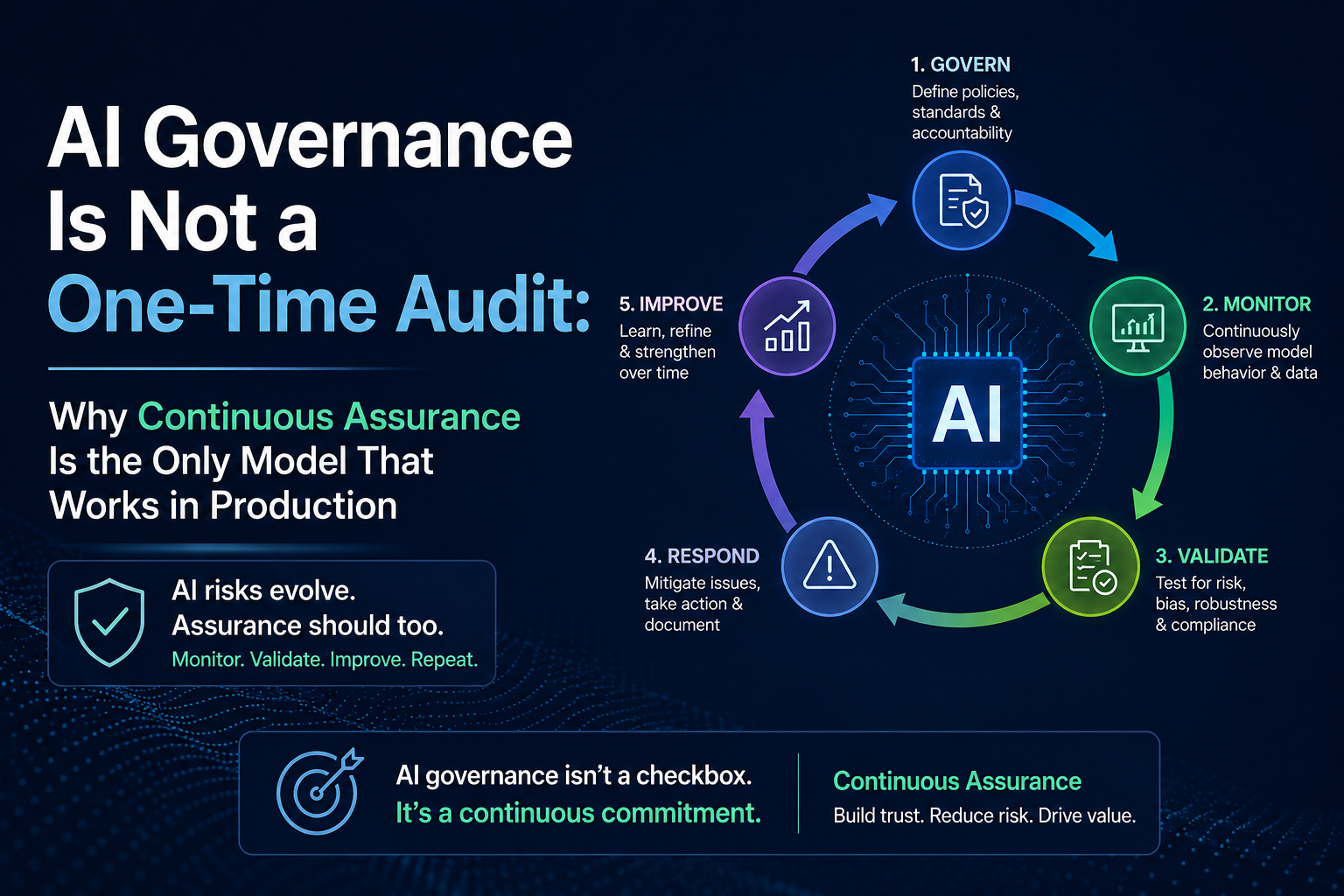
There is a dangerous assumption quietly spreading across boardrooms and AI teams alike: that once an AI system passes its governance review, the hard work is done.
It isn't.
Treating AI governance as a point-in-time checkpoint — a box to tick before deployment — is one of the most costly mistakes an enterprise can make. As AI systems grow more embedded in critical business decisions, from credit approvals and medical triage to customer service and fraud detection, the consequences of that assumption are becoming impossible to ignore.
The organizations winning with AI in 2026 are not the ones that deployed fastest. They are the ones that built governance capable of keeping pace with the systems they govern. And that governance is not an audit. It is a continuous, operational capability.
The Audit Mentality and Why It Falls Short
Most organizations approach AI governance the way they approach financial audits: schedule a review, pass the review, file the paperwork, and move on.
The logic seems reasonable. You evaluate the model before launch. You check for bias. You test for harmful outputs. Everything looks acceptable. You ship.
But here is what that approach fundamentally misses: AI systems do not stay static after deployment.
Models drift as real-world input distributions shift away from training data. User behavior evolves in ways no pre-deployment test suite can fully anticipate. Edge cases that never surfaced during evaluation begin appearing in production at scale. Regulatory requirements tighten. New adversarial inputs emerge as bad actors probe for weaknesses.
What was a compliant, safe system at the moment of launch can quietly become a liability within weeks — and without continuous monitoring, no one notices until it has already caused harm.
A one-time audit captures a photograph of your AI at a single moment in time. It tells you nothing about how that system behaves tomorrow, next quarter, or after your next model update. Governance built on photographs cannot protect a system that is constantly in motion.

What Actually Goes Wrong After Deployment
AI Agents Multiply Infrastructure Load
AI agents introduce an entirely new scaling challenge.
Unlike a traditional user making one request at a time, AI agents may:
- Trigger multiple chained prompts
- Query several models simultaneously
- Retry failed requests autonomously
- Launch recursive workflows
One user action can suddenly generate dozens of inference operations.
Without workload controls, traffic amplification becomes unavoidable.
What Continuous Assurance Actually Means
AI Agents Multiply Infrastructure Load
AI agents introduce an entirely new scaling challenge.
Unlike a traditional user making one request at a time, AI agents may:
- Trigger multiple chained prompts
- Query several models simultaneously
- Retry failed requests autonomously
- Launch recursive workflows
One user action can suddenly generate dozens of inference operations.
Without workload controls, traffic amplification becomes unavoidable.

The Three Pillars of Governance That Scales
AI Agents Multiply Infrastructure Load
AI agents introduce an entirely new scaling challenge.
Unlike a traditional user making one request at a time, AI agents may:
- Trigger multiple chained prompts
- Query several models simultaneously
- Retry failed requests autonomously
- Launch recursive workflows
One user action can suddenly generate dozens of inference operations.
Without workload controls, traffic amplification becomes unavoidable.
The True Cost of Point-in-Time Governance
Why Rate Limit Failures Are So Dangerous
Many organizations still treat rate limit errors as minor API inconveniences.
That assumption is becoming expensive.
In reality, rate limit failures create cascading operational disruption across the enterprise.

Governance as Competitive Advantage
Why Rate Limit Failures Are So Dangerous
Many organizations still treat rate limit errors as minor API inconveniences.
That assumption is becoming expensive.
In reality, rate limit failures create cascading operational disruption across the enterprise.
FAQs
AI Agents Multiply Infrastructure Load
AI agents introduce an entirely new scaling challenge.
Unlike a traditional user making one request at a time, AI agents may:
- Trigger multiple chained prompts
- Query several models simultaneously
- Retry failed requests autonomously
- Launch recursive workflows
One user action can suddenly generate dozens of inference operations.
Without workload controls, traffic amplification becomes unavoidable.
AI Agents Multiply Infrastructure Load
AI agents introduce an entirely new scaling challenge.
Unlike a traditional user making one request at a time, AI agents may:
- Trigger multiple chained prompts
- Query several models simultaneously
- Retry failed requests autonomously
- Launch recursive workflows
One user action can suddenly generate dozens of inference operations.
Without workload controls, traffic amplification becomes unavoidable.
AI Agents Multiply Infrastructure Load
AI agents introduce an entirely new scaling challenge.
Unlike a traditional user making one request at a time, AI agents may:
- Trigger multiple chained prompts
- Query several models simultaneously
- Retry failed requests autonomously
- Launch recursive workflows
One user action can suddenly generate dozens of inference operations.
Without workload controls, traffic amplification becomes unavoidable.
AI Agents Multiply Infrastructure Load
AI agents introduce an entirely new scaling challenge.
Unlike a traditional user making one request at a time, AI agents may:
- Trigger multiple chained prompts
- Query several models simultaneously
- Retry failed requests autonomously
- Launch recursive workflows
One user action can suddenly generate dozens of inference operations.
Without workload controls, traffic amplification becomes unavoidable.
AI Agents Multiply Infrastructure Load
AI agents introduce an entirely new scaling challenge.
Unlike a traditional user making one request at a time, AI agents may:
- Trigger multiple chained prompts
- Query several models simultaneously
- Retry failed requests autonomously
- Launch recursive workflows
One user action can suddenly generate dozens of inference operations.
Without workload controls, traffic amplification becomes unavoidable.
AI Agents Multiply Infrastructure Load
AI agents introduce an entirely new scaling challenge.
Unlike a traditional user making one request at a time, AI agents may:
- Trigger multiple chained prompts
- Query several models simultaneously
- Retry failed requests autonomously
- Launch recursive workflows
One user action can suddenly generate dozens of inference operations.
Without workload controls, traffic amplification becomes unavoidable.
AI Agents Multiply Infrastructure Load
AI agents introduce an entirely new scaling challenge.
Unlike a traditional user making one request at a time, AI agents may:
- Trigger multiple chained prompts
- Query several models simultaneously
- Retry failed requests autonomously
- Launch recursive workflows
One user action can suddenly generate dozens of inference operations.
Without workload controls, traffic amplification becomes unavoidable.
AI Agents Multiply Infrastructure Load
AI agents introduce an entirely new scaling challenge.
Unlike a traditional user making one request at a time, AI agents may:
- Trigger multiple chained prompts
- Query several models simultaneously
- Retry failed requests autonomously
- Launch recursive workflows
One user action can suddenly generate dozens of inference operations.
Without workload controls, traffic amplification becomes unavoidable.
AI Agents Multiply Infrastructure Load
AI agents introduce an entirely new scaling challenge.
Unlike a traditional user making one request at a time, AI agents may:
- Trigger multiple chained prompts
- Query several models simultaneously
- Retry failed requests autonomously
- Launch recursive workflows
One user action can suddenly generate dozens of inference operations.
Without workload controls, traffic amplification becomes unavoidable.
AI Agents Multiply Infrastructure Load
AI agents introduce an entirely new scaling challenge.
Unlike a traditional user making one request at a time, AI agents may:
- Trigger multiple chained prompts
- Query several models simultaneously
- Retry failed requests autonomously
- Launch recursive workflows
One user action can suddenly generate dozens of inference operations.
Without workload controls, traffic amplification becomes unavoidable.
Stop guessing.
Start measuring.
Join teams building reliable AI with TruEval. Start with a free trial, no credit card required. Get your first evaluation running in under 10 minutes.
Questions about Trusys?
Our team is here to help. Schedule a personalized demo to see how Trusys fits your specific use case.
Book a Demo

Ready to dive in?
Check out our documentation and tutorials. Get started with example datasets and evaluation templates.
Start Free Trial
Free Trial
No credit card required
10 Min
To first evaluation
24/7
Enterprise support


Benefits
Specifications
How-to
Contact Us
Learn More

There is a dangerous assumption quietly spreading across boardrooms and AI teams alike: that once an AI system passes its governance review, the hard work is done.
It isn't.
Treating AI governance as a point-in-time checkpoint — a box to tick before deployment — is one of the most costly mistakes an enterprise can make. As AI systems grow more embedded in critical business decisions, from credit approvals and medical triage to customer service and fraud detection, the consequences of that assumption are becoming impossible to ignore.
The organizations winning with AI in 2026 are not the ones that deployed fastest. They are the ones that built governance capable of keeping pace with the systems they govern. And that governance is not an audit. It is a continuous, operational capability.
The Audit Mentality and Why It Falls Short
Most organizations approach AI governance the way they approach financial audits: schedule a review, pass the review, file the paperwork, and move on.
The logic seems reasonable. You evaluate the model before launch. You check for bias. You test for harmful outputs. Everything looks acceptable. You ship.
But here is what that approach fundamentally misses: AI systems do not stay static after deployment.
Models drift as real-world input distributions shift away from training data. User behavior evolves in ways no pre-deployment test suite can fully anticipate. Edge cases that never surfaced during evaluation begin appearing in production at scale. Regulatory requirements tighten. New adversarial inputs emerge as bad actors probe for weaknesses.
What was a compliant, safe system at the moment of launch can quietly become a liability within weeks — and without continuous monitoring, no one notices until it has already caused harm.
A one-time audit captures a photograph of your AI at a single moment in time. It tells you nothing about how that system behaves tomorrow, next quarter, or after your next model update. Governance built on photographs cannot protect a system that is constantly in motion.
What Actually Goes Wrong After Deployment
AI Agents Multiply Infrastructure Load
AI agents introduce an entirely new scaling challenge.
Unlike a traditional user making one request at a time, AI agents may:
- Trigger multiple chained prompts
- Query several models simultaneously
- Retry failed requests autonomously
- Launch recursive workflows
One user action can suddenly generate dozens of inference operations.
Without workload controls, traffic amplification becomes unavoidable.
What Continuous Assurance Actually Means
AI Agents Multiply Infrastructure Load
AI agents introduce an entirely new scaling challenge.
Unlike a traditional user making one request at a time, AI agents may:
- Trigger multiple chained prompts
- Query several models simultaneously
- Retry failed requests autonomously
- Launch recursive workflows
One user action can suddenly generate dozens of inference operations.
Without workload controls, traffic amplification becomes unavoidable.

The Three Pillars of Governance That Scales
AI Agents Multiply Infrastructure Load
AI agents introduce an entirely new scaling challenge.
Unlike a traditional user making one request at a time, AI agents may:
- Trigger multiple chained prompts
- Query several models simultaneously
- Retry failed requests autonomously
- Launch recursive workflows
One user action can suddenly generate dozens of inference operations.
Without workload controls, traffic amplification becomes unavoidable.
The True Cost of Point-in-Time Governance
Why Rate Limit Failures Are So Dangerous
Many organizations still treat rate limit errors as minor API inconveniences.
That assumption is becoming expensive.
In reality, rate limit failures create cascading operational disruption across the enterprise.

Governance as Competitive Advantage
Why Rate Limit Failures Are So Dangerous
Many organizations still treat rate limit errors as minor API inconveniences.
That assumption is becoming expensive.
In reality, rate limit failures create cascading operational disruption across the enterprise.
FAQs
AI Agents Multiply Infrastructure Load
AI agents introduce an entirely new scaling challenge.
Unlike a traditional user making one request at a time, AI agents may:
- Trigger multiple chained prompts
- Query several models simultaneously
- Retry failed requests autonomously
- Launch recursive workflows
One user action can suddenly generate dozens of inference operations.
Without workload controls, traffic amplification becomes unavoidable.
AI Agents Multiply Infrastructure Load
AI agents introduce an entirely new scaling challenge.
Unlike a traditional user making one request at a time, AI agents may:
- Trigger multiple chained prompts
- Query several models simultaneously
- Retry failed requests autonomously
- Launch recursive workflows
One user action can suddenly generate dozens of inference operations.
Without workload controls, traffic amplification becomes unavoidable.
AI Agents Multiply Infrastructure Load
AI agents introduce an entirely new scaling challenge.
Unlike a traditional user making one request at a time, AI agents may:
- Trigger multiple chained prompts
- Query several models simultaneously
- Retry failed requests autonomously
- Launch recursive workflows
One user action can suddenly generate dozens of inference operations.
Without workload controls, traffic amplification becomes unavoidable.
AI Agents Multiply Infrastructure Load
AI agents introduce an entirely new scaling challenge.
Unlike a traditional user making one request at a time, AI agents may:
- Trigger multiple chained prompts
- Query several models simultaneously
- Retry failed requests autonomously
- Launch recursive workflows
One user action can suddenly generate dozens of inference operations.
Without workload controls, traffic amplification becomes unavoidable.
AI Agents Multiply Infrastructure Load
AI agents introduce an entirely new scaling challenge.
Unlike a traditional user making one request at a time, AI agents may:
- Trigger multiple chained prompts
- Query several models simultaneously
- Retry failed requests autonomously
- Launch recursive workflows
One user action can suddenly generate dozens of inference operations.
Without workload controls, traffic amplification becomes unavoidable.
AI Agents Multiply Infrastructure Load
AI agents introduce an entirely new scaling challenge.
Unlike a traditional user making one request at a time, AI agents may:
- Trigger multiple chained prompts
- Query several models simultaneously
- Retry failed requests autonomously
- Launch recursive workflows
One user action can suddenly generate dozens of inference operations.
Without workload controls, traffic amplification becomes unavoidable.
AI Agents Multiply Infrastructure Load
AI agents introduce an entirely new scaling challenge.
Unlike a traditional user making one request at a time, AI agents may:
- Trigger multiple chained prompts
- Query several models simultaneously
- Retry failed requests autonomously
- Launch recursive workflows
One user action can suddenly generate dozens of inference operations.
Without workload controls, traffic amplification becomes unavoidable.
AI Agents Multiply Infrastructure Load
AI agents introduce an entirely new scaling challenge.
Unlike a traditional user making one request at a time, AI agents may:
- Trigger multiple chained prompts
- Query several models simultaneously
- Retry failed requests autonomously
- Launch recursive workflows
One user action can suddenly generate dozens of inference operations.
Without workload controls, traffic amplification becomes unavoidable.
AI Agents Multiply Infrastructure Load
AI agents introduce an entirely new scaling challenge.
Unlike a traditional user making one request at a time, AI agents may:
- Trigger multiple chained prompts
- Query several models simultaneously
- Retry failed requests autonomously
- Launch recursive workflows
One user action can suddenly generate dozens of inference operations.
Without workload controls, traffic amplification becomes unavoidable.
AI Agents Multiply Infrastructure Load
AI agents introduce an entirely new scaling challenge.
Unlike a traditional user making one request at a time, AI agents may:
- Trigger multiple chained prompts
- Query several models simultaneously
- Retry failed requests autonomously
- Launch recursive workflows
One user action can suddenly generate dozens of inference operations.
Without workload controls, traffic amplification becomes unavoidable.
Stop guessing.
Start measuring.
Join teams building reliable AI with TruEval. Start with a free trial, no credit card required. Get your first evaluation running in under 10 minutes.
Questions about Trusys?
Our team is here to help. Schedule a personalized demo to see how Trusys fits your specific use case.
Book a Demo
Ready to dive in?
Check out our documentation and tutorials. Get started with example datasets and evaluation templates.
Start Free Trial
Free Trial
No credit card required
10 Min
To first evaluation
24/7
Enterprise support
AI Governance Is Not a One-Time Audit: Why Continuous Assurance Is the Only Model That Works in Production
There is a dangerous assumption quietly spreading across boardrooms and AI teams alike: that once an AI system passes its governance review, the hard work is done.
It isn't.
Treating AI governance as a point-in-time checkpoint — a box to tick before deployment — is one of the most costly mistakes an enterprise can make. As AI systems grow more embedded in critical business decisions, from credit approvals and medical triage to customer service and fraud detection, the consequences of that assumption are becoming impossible to ignore.
The organizations winning with AI in 2026 are not the ones that deployed fastest. They are the ones that built governance capable of keeping pace with the systems they govern. And that governance is not an audit. It is a continuous, operational capability.

The Audit Mentality and Why It Falls Short

Most organizations approach AI governance the way they approach financial audits: schedule a review, pass the review, file the paperwork, and move on.
The logic seems reasonable. You evaluate the model before launch. You check for bias. You test for harmful outputs. Everything looks acceptable. You ship.
But here is what that approach fundamentally misses: AI systems do not stay static after deployment.
Models drift as real-world input distributions shift away from training data. User behavior evolves in ways no pre-deployment test suite can fully anticipate. Edge cases that never surfaced during evaluation begin appearing in production at scale. Regulatory requirements tighten. New adversarial inputs emerge as bad actors probe for weaknesses.
What was a compliant, safe system at the moment of launch can quietly become a liability within weeks — and without continuous monitoring, no one notices until it has already caused harm.
A one-time audit captures a photograph of your AI at a single moment in time. It tells you nothing about how that system behaves tomorrow, next quarter, or after your next model update. Governance built on photographs cannot protect a system that is constantly in motion.
What Actually Goes Wrong After Deployment
The risks that emerge post-deployment are not theoretical. They are operational, legal, and reputational — and they compound the longer they go undetected.
Hallucinations multiply at production scale. Large language models can produce confident, plausible-sounding outputs that are factually incorrect. In a controlled evaluation environment, teams may catch most of these. In production, handling thousands of real-world queries daily across diverse user contexts, the failure modes multiply in ways pre-deployment testing cannot predict. A customer-facing AI that hallucinates contract terms, investment guidance, or medical information does not just create a bad user experience — it creates direct liability for the organization that deployed it.
Model drift is invisible without monitoring. As the distribution of real-world inputs shifts away from the data the model was trained and evaluated on, performance degrades — often gradually, often silently. There is no visible error. No crash. No alert. The model simply becomes less accurate, less safe, and less aligned with its intended behavior over time. Without continuous observability, organizations learn about drift only after it has already caused damage.
Policy violations surface under pressure. The guardrails built into a model during development are stress-tested by edge cases, adversarial prompts, and unexpected user inputs that only emerge at production scale. Those guardrails need active monitoring and continuous adjustment — not one-time configuration before launch.
Regulatory requirements evolve. The EU AI Act, NIST AI RMF, GDPR, and a growing body of sector-specific AI regulations are living frameworks that continue to develop. Compliance achieved at a point in time does not guarantee compliance as these frameworks mature. Organizations that treat governance as a static checklist will find themselves perpetually behind, reacting to regulatory changes rather than anticipating them.
The compounding effect is what makes this dangerous. Each of these risks is manageable in isolation. Together, and left unmonitored, they create systemic failure — the kind that surfaces as a headline, a regulatory investigation, or a catastrophic loss of user trust.
What Continuous Assurance Actually Means
The shift that leading AI teams are making — and that every enterprise deploying AI at scale needs to make — is reframing governance not as a compliance event, but as an ongoing operational capability.
Continuous assurance means embedding governance into every stage of the AI lifecycle: from data preparation and model training, through structured evaluation and staged deployment, to real-time monitoring in production. It means every layer of the AI stack — data pipelines, prompts, models, and outputs — operates under consistent policy enforcement with full audit-ready traceability.
It means moving from reactive to proactive risk management. Rather than investigating failures after they occur, mature AI governance surfaces early warning signals before they escalate: anomalies in performance metrics, emerging safety violations, drift indicators, and policy boundary breaches. Teams that can detect and act on these signals early are teams that can scale AI with genuine confidence.
Critically, continuous assurance is not just a monitoring dashboard. It requires organizational infrastructure: defined accountability across teams, clear escalation paths when risks are detected, and leadership that treats AI risk with the same seriousness applied to financial or operational risk. The technology enables the process. The process requires organizational commitment.
The True Cost of Point-in-Time Governance
Organizations that treat AI governance as a periodic audit are not just accepting regulatory risk. They are accepting trust risk — and in an environment where enterprise AI deployments are under increasing scrutiny, trust is the most valuable and most fragile asset an organization holds.
A single high-profile AI failure — a biased outcome in lending decisions, a hallucinated recommendation in a healthcare application, a safety violation in a consumer-facing product — can undo years of brand equity. Regulators are paying closer attention. Enterprise customers are asking harder due diligence questions. Boards are beginning to hold leadership accountable for AI risk in ways that were unthinkable three years ago.
The financial cost is significant. The reputational cost is harder to quantify and harder to recover from.
The organizations that will lead the next wave of enterprise AI adoption are those that have built governance systems sophisticated enough to keep pace with the systems they govern. That is not a point-in-time achievement. It is a continuous operational commitment.
The Three Pillars of Governance That Scales
Effective continuous AI governance does not require slowing down innovation. It requires building the right foundation — one that makes rigorous governance a natural, automated output of how your AI systems operate, rather than a disruptive intervention layered on top.
That foundation rests on three pillars:
1. Continuous Evaluation Move beyond pre-deployment testing to structured, repeatable evaluation infrastructure that runs automatically with every model update, prompt modification, or pipeline change. Real metrics — accuracy, hallucination rate, safety scores, robustness, fairness indicators — tracked over time and across model versions, not just at launch. When every change triggers a full evaluation cycle, teams catch regressions before they reach users.
2. Real-Time Production Observability Monitoring that surfaces failures, drift, and policy violations as they occur in production — not in the next quarterly governance review. Intelligent alerting calibrated to meaningful thresholds, with enough context to distinguish signal from noise and enable fast, targeted intervention. The goal is not to generate more alerts. It is to surface the right information at the right time so teams can act before issues escalate.
3. Unified Policy Enforcement and Audit Traceability Consistent governance applied across the entire AI stack — data, prompts, models, and pipelines — with every decision logged, versioned, and traceable. Audit-ready records that make compliance a natural output of normal operations, not a reactive scramble before an external review. When governance is embedded in the system rather than imposed on top of it, compliance becomes operationally sustainable.
Governance as Competitive Advantage
There is a persistent narrative that governance slows AI teams down. The evidence from organizations that have built continuous assurance capabilities tells a different story.
Teams with systematic governance infrastructure ship with more confidence, because they have the metrics to know what they are shipping. They resolve incidents faster, because they detect them earlier and with more context. They build products that earn deeper user and regulatory trust, because that trust is grounded in demonstrated operational rigor — not just policy commitments.
They do not fear the next regulatory update because they are already operating ahead of it.
AI governance is not a one-time audit. It is not a checkbox, a quarterly review, or a pre-deployment evaluation. It is an ongoing operational commitment — to the safety, reliability, and integrity of the AI systems your organization builds and deploys.
The organizations that internalize this soonest will be the ones best positioned to lead.
FAQs
- What is continuous AI assurance and how is it different from a one-time audit?
A one-time audit evaluates an AI system at a fixed point before deployment. Continuous AI assurance is an ongoing operational capability that monitors, evaluates, and enforces governance across the full AI lifecycle — from training through production. It detects model drift, hallucinations, and policy violations in real time, not just during a scheduled review.
- Why do LLMs need governance beyond the initial deployment review?
LLMs are not static. Their behavior shifts as real-world inputs evolve, model updates are applied, and edge cases emerge that pre-deployment testing never covered. Without continuous monitoring, risks like hallucinations, bias, and safety violations can compound silently in production — often going undetected until they cause real harm.
- What is model drift and why is it a governance risk?
Model drift occurs when the distribution of real-world inputs shifts away from the data a model was trained on, causing its outputs to degrade in accuracy, safety, or fairness over time. It happens gradually and without visible errors, making it invisible without dedicated observability tooling. Left undetected, drift can turn a compliant AI system into a liability.
- How does Trusys AI help enterprises implement continuous AI governance?
Trusys AI provides an enterprise-grade AI Assurance Platform built around three core capabilities: continuous evaluation (TruEval) for structured, repeatable model assessments; real-time production monitoring (TruPulse) for detecting drift, failures, and policy violations as they occur; and automated security and compliance testing (TruScout) mapped to global standards including EU AI Act and NIST AI RMF — all within a unified governance layer.
- What regulations require continuous AI governance for LLM applications?
Several major frameworks now demand ongoing governance. The EU AI Act (with high-risk AI obligations applying from August 2026) requires continuous risk management, logging, and human oversight. NIST AI RMF defines governance as a living process across four functions — Govern, Map, Measure, and Manage. GDPR and sector-specific regulations in finance and healthcare further require traceable, auditable AI decision-making.
Stop guessing.
Start measuring.
Join teams building reliable AI with Trusys. Start with a free trial, no credit card required. Get your first evaluation running in under 10 minutes.
Questions about Trusys?
Our team is here to help. Schedule a personalized demo to see how Trusys fits your specific use case.
Book a Demo
Ready to dive in?
Check out our documentation and tutorials. Get started with example datasets and evaluation templates.
Start Free Trial
Free Trial
No credit card required
10 Min
to get started
24/7
Enterprise support