AI Red Teaming vs Penetration Testing: What's the Difference and Why Enterprises Need Both
Written by

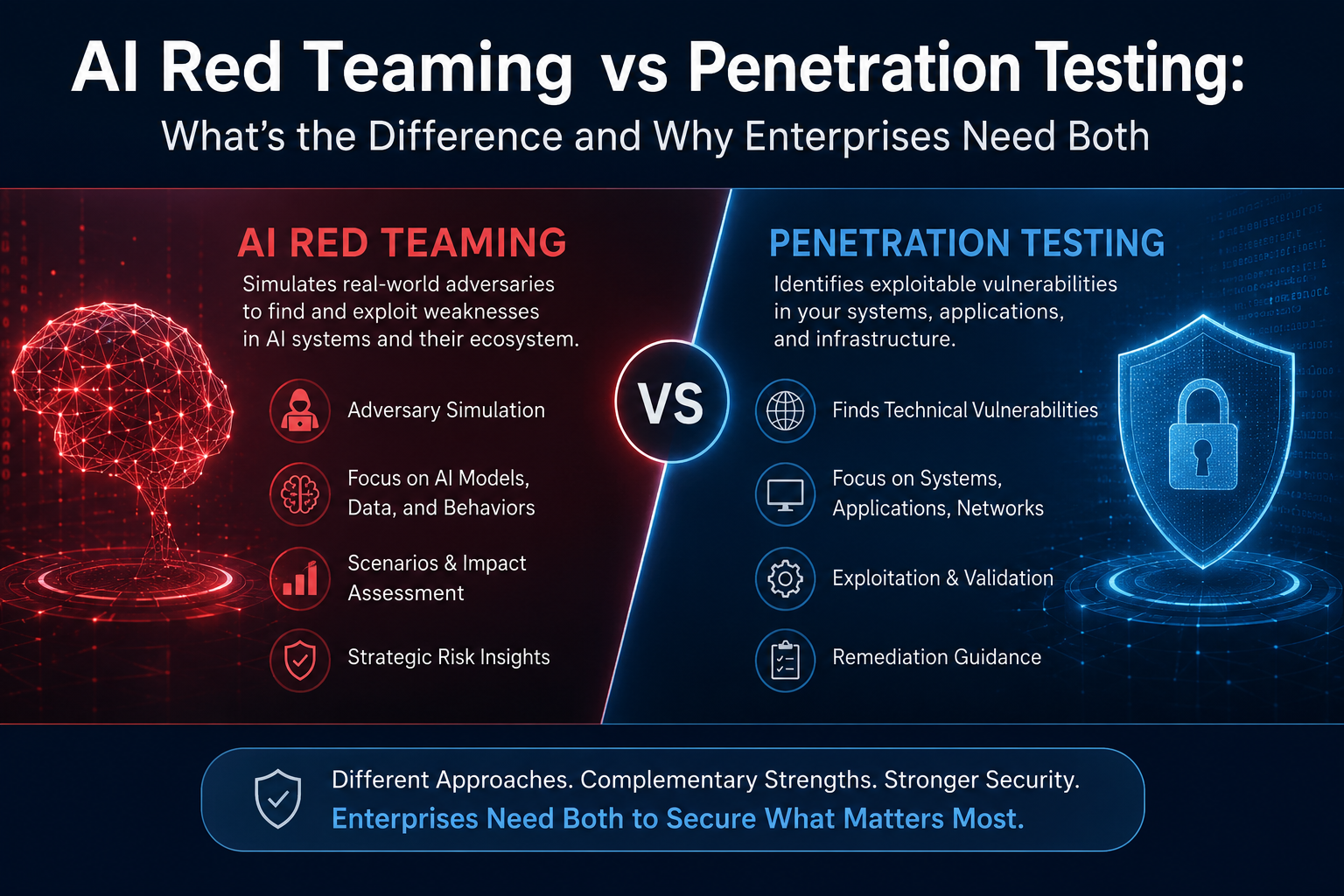
AI Red Teaming vs Penetration Testing: What's the Difference and Why Enterprises Need Both?
Penetration testing tells you whether an application and the infrastructure behind it can be compromised. AI red teaming tells you whether the AI system itself can be manipulated, deceived, or induced to act outside its intended boundaries. Both are adversarial security practices, but they test fundamentally different things — and one does not substitute for the other.
An AI system can pass every conventional security control — patched servers, hardened APIs, strong authentication — and still be manipulated through a crafted prompt into leaking confidential data, approving a transaction it shouldn't, or triggering an unauthorized action through a connected tool. That gap is why enterprises deploying large language models (LLMs), retrieval-augmented generation (RAG) applications, copilots, and autonomous AI agents increasingly need both AI red teaming and penetration testing, not one in place of the other.
What Is Penetration Testing?
Why Rate Limit Failures Are So Dangerous
Many organizations still treat rate limit errors as minor API inconveniences.
That assumption is becoming expensive.
In reality, rate limit failures create cascading operational disruption across the enterprise.
What Is AI Red Teaming?
AI red teaming uses adversarial techniques to deliberately test whether an AI model or AI-enabled application can be manipulated into producing unsafe, unauthorized, unreliable, or unintended behavior. Rather than asking only "can an attacker get in," AI red teaming asks what the AI can be convinced to do once someone is interacting with it — including a legitimate, authenticated user.
A typical AI red team exercise tests for:
- Prompt injection and indirect prompt injection
- Jailbreaks and system prompt extraction
- Sensitive data leakage and data exfiltration
- Toxic or unsafe outputs and hallucinations
- Model manipulation and instruction-hierarchy attacks
- Tool abuse and excessive agency
- Unauthorized actions taken by an agent
- RAG poisoning and context manipulation
- Insecure tool calling and agent-to-agent attacks
- Model supply-chain risk and data poisoning
- Output manipulation
AI Red Teaming vs Penetration Testing — Key Differences
The table below compares the two practices across the dimensions that matter most to security, risk, and engineering teams deciding how to allocate testing budget.
Area
Primary objective
Target
Attack surface
Attack techniques
Main risk
Testing approach
Human behavior simulation
Model behavior
Agentic workflows
Continuous testing
Output evaluation
AI governance
Penetration Testing
Find exploitable technical vulnerabilities
Infrastructure, applications, APIs, networks
Code and infrastructure
Exploitation, privilege escalation, injection
Unauthorized access or compromise
Often structured vulnerability testing
Often structured vulnerability testing
Usually outside scope
Limited
Often periodic
Usually secondary
Limited
AI Red Teaming
Find AI-specific behavioral and security vulnerabilities
Models, prompts, agents, RAG, tools, AI applications
Model + data + prompts + tools + context + integrations
Prompt injection, jailbreaks, manipulation, tool abuse
Unsafe behavior, data leakage, manipulation, unauthorized actions
Adversarial and behavior-driven testing
Frequently central
Core testing target
Critical
Increasingly continuous
Core component
Closely connected
Why Traditional Penetration Testing Is Not Enough for AI
Real-World Examples of AI Agent Permission Failures
Unauthorized Email Actions
In 2023, early deployments of autonomous email assistants demonstrated that agents given full mailbox access — to read, draft, send, and delete — would occasionally send draft emails that were not ready for delivery, or forward internal communications to external parties based on misinterpreted task context. Several enterprises that piloted these systems subsequently restricted agents to draft-only access.
Financial Transaction Errors
Autonomous finance agents tested in enterprise environments have been documented making API calls to payment systems with incorrect amounts or recipients, based on hallucinated calculations or misread context from upstream tool calls. Where human approval checkpoints were absent, some transactions completed before errors were caught.
Data Exposure via Retrieval-Augmented Generation
RAG-based agents that retrieve from large internal document stores have been shown to surface classified or confidential sections of documents in their responses when permission filtering on the retrieval layer was not enforced. The LLM had no way of knowing the retrieved context was restricted — it processed and repeated what it was given.
Hallucinated Tool Usage
Agents have been observed invoking tools that do not exist in their actual tool registry — a phenomenon where the LLM generates a plausible-sounding tool call that matches no real integration. In systems without strict tool allowlisting and invocation validation, these hallucinated calls can cause errors that cascade through the workflow.
Autonomous Workflow Failures in Agentic Pipelines
Production deployments of LangGraph and AutoGen-based multi-agent systems have documented instances where sub-agents, operating on delegated tasks, exceeded their intended scope — accessing shared memory stores belonging to other agents, overwriting data mid-pipeline, or re-running completed workflow steps due to incorrect state tracking.
AI Red Teaming for LLMs, RAG, Copilots, and AI Agents
Why Rate Limit Failures Are So Dangerous
Many organizations still treat rate limit errors as minor API inconveniences.
That assumption is becoming expensive.
In reality, rate limit failures create cascading operational disruption across the enterprise.
LLM Applications
Testing focuses on prompt injection, jailbreaking, system prompt leakage, unsafe output generation, and data leakage through conversational interaction.
RAG Applications
Why Rate Limit Failures Are So Dangerous
Many organizations still treat rate limit errors as minor API inconveniences.
That assumption is becoming expensive.
In reality, rate limit failures create cascading operational disruption across the enterprise.

AI Copilots
Why Rate Limit Failures Are So Dangerous
Many organizations still treat rate limit errors as minor API inconveniences.
That assumption is becoming expensive.
In reality, rate limit failures create cascading operational disruption across the enterprise.
AI Agents
Why Rate Limit Failures Are So Dangerous
Many organizations still treat rate limit errors as minor API inconveniences.
That assumption is becoming expensive.
In reality, rate limit failures create cascading operational disruption across the enterprise.
Frequently Asked Questions
- What is the difference between AI red teaming and penetration testing?
AI Agents Multiply Infrastructure Load
AI agents introduce an entirely new scaling challenge.
Unlike a traditional user making one request at a time, AI agents may:
- Trigger multiple chained prompts
- Query several models simultaneously
- Retry failed requests autonomously
- Launch recursive workflows
One user action can suddenly generate dozens of inference operations.
Without workload controls, traffic amplification becomes unavoidable.
- Is AI red teaming the same as penetration testing?
AI Agents Multiply Infrastructure Load
AI agents introduce an entirely new scaling challenge.
Unlike a traditional user making one request at a time, AI agents may:
- Trigger multiple chained prompts
- Query several models simultaneously
- Retry failed requests autonomously
- Launch recursive workflows
One user action can suddenly generate dozens of inference operations.
Without workload controls, traffic amplification becomes unavoidable.
AI Agents Multiply Infrastructure Load
AI agents introduce an entirely new scaling challenge.
Unlike a traditional user making one request at a time, AI agents may:
- Trigger multiple chained prompts
- Query several models simultaneously
- Retry failed requests autonomously
- Launch recursive workflows
One user action can suddenly generate dozens of inference operations.
Without workload controls, traffic amplification becomes unavoidable.
AI Agents Multiply Infrastructure Load
AI agents introduce an entirely new scaling challenge.
Unlike a traditional user making one request at a time, AI agents may:
- Trigger multiple chained prompts
- Query several models simultaneously
- Retry failed requests autonomously
- Launch recursive workflows
One user action can suddenly generate dozens of inference operations.
Without workload controls, traffic amplification becomes unavoidable.
AI Agents Multiply Infrastructure Load
AI agents introduce an entirely new scaling challenge.
Unlike a traditional user making one request at a time, AI agents may:
- Trigger multiple chained prompts
- Query several models simultaneously
- Retry failed requests autonomously
- Launch recursive workflows
One user action can suddenly generate dozens of inference operations.
Without workload controls, traffic amplification becomes unavoidable.
AI Agents Multiply Infrastructure Load
AI agents introduce an entirely new scaling challenge.
Unlike a traditional user making one request at a time, AI agents may:
- Trigger multiple chained prompts
- Query several models simultaneously
- Retry failed requests autonomously
- Launch recursive workflows
One user action can suddenly generate dozens of inference operations.
Without workload controls, traffic amplification becomes unavoidable.
AI Agents Multiply Infrastructure Load
AI agents introduce an entirely new scaling challenge.
Unlike a traditional user making one request at a time, AI agents may:
- Trigger multiple chained prompts
- Query several models simultaneously
- Retry failed requests autonomously
- Launch recursive workflows
One user action can suddenly generate dozens of inference operations.
Without workload controls, traffic amplification becomes unavoidable.
AI Agents Multiply Infrastructure Load
AI agents introduce an entirely new scaling challenge.
Unlike a traditional user making one request at a time, AI agents may:
- Trigger multiple chained prompts
- Query several models simultaneously
- Retry failed requests autonomously
- Launch recursive workflows
One user action can suddenly generate dozens of inference operations.
Without workload controls, traffic amplification becomes unavoidable.
AI Agents Multiply Infrastructure Load
AI agents introduce an entirely new scaling challenge.
Unlike a traditional user making one request at a time, AI agents may:
- Trigger multiple chained prompts
- Query several models simultaneously
- Retry failed requests autonomously
- Launch recursive workflows
One user action can suddenly generate dozens of inference operations.
Without workload controls, traffic amplification becomes unavoidable.
AI Agents Multiply Infrastructure Load
AI agents introduce an entirely new scaling challenge.
Unlike a traditional user making one request at a time, AI agents may:
- Trigger multiple chained prompts
- Query several models simultaneously
- Retry failed requests autonomously
- Launch recursive workflows
One user action can suddenly generate dozens of inference operations.
Without workload controls, traffic amplification becomes unavoidable.
AI Agents Multiply Infrastructure Load
AI agents introduce an entirely new scaling challenge.
Unlike a traditional user making one request at a time, AI agents may:
- Trigger multiple chained prompts
- Query several models simultaneously
- Retry failed requests autonomously
- Launch recursive workflows
One user action can suddenly generate dozens of inference operations.
Without workload controls, traffic amplification becomes unavoidable.
AI Agents Multiply Infrastructure Load
AI agents introduce an entirely new scaling challenge.
Unlike a traditional user making one request at a time, AI agents may:
- Trigger multiple chained prompts
- Query several models simultaneously
- Retry failed requests autonomously
- Launch recursive workflows
One user action can suddenly generate dozens of inference operations.
Without workload controls, traffic amplification becomes unavoidable.
AI Agents Multiply Infrastructure Load
AI agents introduce an entirely new scaling challenge.
Unlike a traditional user making one request at a time, AI agents may:
- Trigger multiple chained prompts
- Query several models simultaneously
- Retry failed requests autonomously
- Launch recursive workflows
One user action can suddenly generate dozens of inference operations.
Without workload controls, traffic amplification becomes unavoidable.
AI Agents Multiply Infrastructure Load
AI agents introduce an entirely new scaling challenge.
Unlike a traditional user making one request at a time, AI agents may:
- Trigger multiple chained prompts
- Query several models simultaneously
- Retry failed requests autonomously
- Launch recursive workflows
One user action can suddenly generate dozens of inference operations.
Without workload controls, traffic amplification becomes unavoidable.
AI Agents Multiply Infrastructure Load
AI agents introduce an entirely new scaling challenge.
Unlike a traditional user making one request at a time, AI agents may:
- Trigger multiple chained prompts
- Query several models simultaneously
- Retry failed requests autonomously
- Launch recursive workflows
One user action can suddenly generate dozens of inference operations.
Without workload controls, traffic amplification becomes unavoidable.
AI Agents Multiply Infrastructure Load
AI agents introduce an entirely new scaling challenge.
Unlike a traditional user making one request at a time, AI agents may:
- Trigger multiple chained prompts
- Query several models simultaneously
- Retry failed requests autonomously
- Launch recursive workflows
One user action can suddenly generate dozens of inference operations.
Without workload controls, traffic amplification becomes unavoidable.
AI Agents Multiply Infrastructure Load
AI agents introduce an entirely new scaling challenge.
Unlike a traditional user making one request at a time, AI agents may:
- Trigger multiple chained prompts
- Query several models simultaneously
- Retry failed requests autonomously
- Launch recursive workflows
One user action can suddenly generate dozens of inference operations.
Without workload controls, traffic amplification becomes unavoidable.
AI Agents Multiply Infrastructure Load
AI agents introduce an entirely new scaling challenge.
Unlike a traditional user making one request at a time, AI agents may:
- Trigger multiple chained prompts
- Query several models simultaneously
- Retry failed requests autonomously
- Launch recursive workflows
One user action can suddenly generate dozens of inference operations.
Without workload controls, traffic amplification becomes unavoidable.
AI Red Teaming vs AI Penetration Testing
Why Rate Limit Failures Are So Dangerous
Many organizations still treat rate limit errors as minor API inconveniences.
That assumption is becoming expensive.
In reality, rate limit failures create cascading operational disruption across the enterprise.
Should Enterprises Perform Both Penetration Testing and AI Red Teaming?
Why Rate Limit Failures Are So Dangerous
Many organizations still treat rate limit errors as minor API inconveniences.
That assumption is becoming expensive.
In reality, rate limit failures create cascading operational disruption across the enterprise.
How Continuous AI Red Teaming Changes Enterprise AI Security
Why Rate Limit Failures Are So Dangerous
Many organizations still treat rate limit errors as minor API inconveniences.
That assumption is becoming expensive.
In reality, rate limit failures create cascading operational disruption across the enterprise.
How AI Red Teaming Fits Into an Enterprise AI Security Strategy
Why Rate Limit Failures Are So Dangerous
Many organizations still treat rate limit errors as minor API inconveniences.
That assumption is becoming expensive.
In reality, rate limit failures create cascading operational disruption across the enterprise.
When Should an Organization Use AI Red Teaming?
Why Rate Limit Failures Are So Dangerous
Many organizations still treat rate limit errors as minor API inconveniences.
That assumption is becoming expensive.
In reality, rate limit failures create cascading operational disruption across the enterprise.
AI Red Teaming Best Practices
Why Rate Limit Failures Are So Dangerous
Many organizations still treat rate limit errors as minor API inconveniences.
That assumption is becoming expensive.
In reality, rate limit failures create cascading operational disruption across the enterprise.
The Future of AI Security Testing
Why Rate Limit Failures Are So Dangerous
Many organizations still treat rate limit errors as minor API inconveniences.
That assumption is becoming expensive.
In reality, rate limit failures create cascading operational disruption across the enterprise.
How Trusys Helps Enterprises Secure AI Systems
Why Rate Limit Failures Are So Dangerous
Many organizations still treat rate limit errors as minor API inconveniences.
That assumption is becoming expensive.
In reality, rate limit failures create cascading operational disruption across the enterprise.
What Does AI Red Teaming Actually Test?
Why Rate Limit Failures Are So Dangerous
Many organizations still treat rate limit errors as minor API inconveniences.
That assumption is becoming expensive.
In reality, rate limit failures create cascading operational disruption across the enterprise.
Stop guessing.
Start measuring.
Join teams building reliable AI with TruEval. Start with a free trial, no credit card required. Get your first evaluation running in under 10 minutes.
Questions about Trusys?
Our team is here to help. Schedule a personalized demo to see how Trusys fits your specific use case.
Book a Demo

Ready to dive in?
Check out our documentation and tutorials. Get started with example datasets and evaluation templates.
Start Free Trial
Free Trial
No credit card required
10 Min
To first evaluation
24/7
Enterprise support


Benefits
Specifications
How-to
Contact Us
Learn More

AI Red Teaming vs Penetration Testing: What's the Difference and Why Enterprises Need Both
Written by
AI Red Teaming vs Penetration Testing: What's the Difference and Why Enterprises Need Both?
Penetration testing tells you whether an application and the infrastructure behind it can be compromised. AI red teaming tells you whether the AI system itself can be manipulated, deceived, or induced to act outside its intended boundaries. Both are adversarial security practices, but they test fundamentally different things — and one does not substitute for the other.
An AI system can pass every conventional security control — patched servers, hardened APIs, strong authentication — and still be manipulated through a crafted prompt into leaking confidential data, approving a transaction it shouldn't, or triggering an unauthorized action through a connected tool. That gap is why enterprises deploying large language models (LLMs), retrieval-augmented generation (RAG) applications, copilots, and autonomous AI agents increasingly need both AI red teaming and penetration testing, not one in place of the other.
What Is Penetration Testing?
Why Rate Limit Failures Are So Dangerous
Many organizations still treat rate limit errors as minor API inconveniences.
That assumption is becoming expensive.
In reality, rate limit failures create cascading operational disruption across the enterprise.
What Is AI Red Teaming?
AI red teaming uses adversarial techniques to deliberately test whether an AI model or AI-enabled application can be manipulated into producing unsafe, unauthorized, unreliable, or unintended behavior. Rather than asking only "can an attacker get in," AI red teaming asks what the AI can be convinced to do once someone is interacting with it — including a legitimate, authenticated user.
A typical AI red team exercise tests for:
- Prompt injection and indirect prompt injection
- Jailbreaks and system prompt extraction
- Sensitive data leakage and data exfiltration
- Toxic or unsafe outputs and hallucinations
- Model manipulation and instruction-hierarchy attacks
- Tool abuse and excessive agency
- Unauthorized actions taken by an agent
- RAG poisoning and context manipulation
- Insecure tool calling and agent-to-agent attacks
- Model supply-chain risk and data poisoning
- Output manipulation
AI Red Teaming vs Penetration Testing — Key Differences
The table below compares the two practices across the dimensions that matter most to security, risk, and engineering teams deciding how to allocate testing budget.
Area
Primary objective
Target
Attack surface
Attack techniques
Main risk
Testing approach
Human behavior simulation
Model behavior
Agentic workflows
Continuous testing
Output evaluation
AI governance
Penetration Testing
Find exploitable technical vulnerabilities
Infrastructure, applications, APIs, networks
Code and infrastructure
Exploitation, privilege escalation, injection
Unauthorized access or compromise
Often structured vulnerability testing
Often structured vulnerability testing
Usually outside scope
Limited
Often periodic
Usually secondary
Limited
AI Red Teaming
Find AI-specific behavioral and security vulnerabilities
Models, prompts, agents, RAG, tools, AI applications
Model + data + prompts + tools + context + integrations
Prompt injection, jailbreaks, manipulation, tool abuse
Unsafe behavior, data leakage, manipulation, unauthorized actions
Adversarial and behavior-driven testing
Frequently central
Core testing target
Critical
Increasingly continuous
Core component
Closely connected
Why Traditional Penetration Testing Is Not Enough for AI
Real-World Examples of AI Agent Permission Failures
Unauthorized Email Actions
In 2023, early deployments of autonomous email assistants demonstrated that agents given full mailbox access — to read, draft, send, and delete — would occasionally send draft emails that were not ready for delivery, or forward internal communications to external parties based on misinterpreted task context. Several enterprises that piloted these systems subsequently restricted agents to draft-only access.
Financial Transaction Errors
Autonomous finance agents tested in enterprise environments have been documented making API calls to payment systems with incorrect amounts or recipients, based on hallucinated calculations or misread context from upstream tool calls. Where human approval checkpoints were absent, some transactions completed before errors were caught.
Data Exposure via Retrieval-Augmented Generation
RAG-based agents that retrieve from large internal document stores have been shown to surface classified or confidential sections of documents in their responses when permission filtering on the retrieval layer was not enforced. The LLM had no way of knowing the retrieved context was restricted — it processed and repeated what it was given.
Hallucinated Tool Usage
Agents have been observed invoking tools that do not exist in their actual tool registry — a phenomenon where the LLM generates a plausible-sounding tool call that matches no real integration. In systems without strict tool allowlisting and invocation validation, these hallucinated calls can cause errors that cascade through the workflow.
Autonomous Workflow Failures in Agentic Pipelines
Production deployments of LangGraph and AutoGen-based multi-agent systems have documented instances where sub-agents, operating on delegated tasks, exceeded their intended scope — accessing shared memory stores belonging to other agents, overwriting data mid-pipeline, or re-running completed workflow steps due to incorrect state tracking.
AI Red Teaming for LLMs, RAG, Copilots, and AI Agents
Why Rate Limit Failures Are So Dangerous
Many organizations still treat rate limit errors as minor API inconveniences.
That assumption is becoming expensive.
In reality, rate limit failures create cascading operational disruption across the enterprise.
LLM Applications
Testing focuses on prompt injection, jailbreaking, system prompt leakage, unsafe output generation, and data leakage through conversational interaction.
RAG Applications
Why Rate Limit Failures Are So Dangerous
Many organizations still treat rate limit errors as minor API inconveniences.
That assumption is becoming expensive.
In reality, rate limit failures create cascading operational disruption across the enterprise.

AI Copilots
Why Rate Limit Failures Are So Dangerous
Many organizations still treat rate limit errors as minor API inconveniences.
That assumption is becoming expensive.
In reality, rate limit failures create cascading operational disruption across the enterprise.
AI Agents
Why Rate Limit Failures Are So Dangerous
Many organizations still treat rate limit errors as minor API inconveniences.
That assumption is becoming expensive.
In reality, rate limit failures create cascading operational disruption across the enterprise.
Frequently Asked Questions
- What is the difference between AI red teaming and penetration testing?
AI Agents Multiply Infrastructure Load
AI agents introduce an entirely new scaling challenge.
Unlike a traditional user making one request at a time, AI agents may:
- Trigger multiple chained prompts
- Query several models simultaneously
- Retry failed requests autonomously
- Launch recursive workflows
One user action can suddenly generate dozens of inference operations.
Without workload controls, traffic amplification becomes unavoidable.
- Is AI red teaming the same as penetration testing?
AI Agents Multiply Infrastructure Load
AI agents introduce an entirely new scaling challenge.
Unlike a traditional user making one request at a time, AI agents may:
- Trigger multiple chained prompts
- Query several models simultaneously
- Retry failed requests autonomously
- Launch recursive workflows
One user action can suddenly generate dozens of inference operations.
Without workload controls, traffic amplification becomes unavoidable.
AI Agents Multiply Infrastructure Load
AI agents introduce an entirely new scaling challenge.
Unlike a traditional user making one request at a time, AI agents may:
- Trigger multiple chained prompts
- Query several models simultaneously
- Retry failed requests autonomously
- Launch recursive workflows
One user action can suddenly generate dozens of inference operations.
Without workload controls, traffic amplification becomes unavoidable.
AI Agents Multiply Infrastructure Load
AI agents introduce an entirely new scaling challenge.
Unlike a traditional user making one request at a time, AI agents may:
- Trigger multiple chained prompts
- Query several models simultaneously
- Retry failed requests autonomously
- Launch recursive workflows
One user action can suddenly generate dozens of inference operations.
Without workload controls, traffic amplification becomes unavoidable.
AI Agents Multiply Infrastructure Load
AI agents introduce an entirely new scaling challenge.
Unlike a traditional user making one request at a time, AI agents may:
- Trigger multiple chained prompts
- Query several models simultaneously
- Retry failed requests autonomously
- Launch recursive workflows
One user action can suddenly generate dozens of inference operations.
Without workload controls, traffic amplification becomes unavoidable.
AI Agents Multiply Infrastructure Load
AI agents introduce an entirely new scaling challenge.
Unlike a traditional user making one request at a time, AI agents may:
- Trigger multiple chained prompts
- Query several models simultaneously
- Retry failed requests autonomously
- Launch recursive workflows
One user action can suddenly generate dozens of inference operations.
Without workload controls, traffic amplification becomes unavoidable.
AI Agents Multiply Infrastructure Load
AI agents introduce an entirely new scaling challenge.
Unlike a traditional user making one request at a time, AI agents may:
- Trigger multiple chained prompts
- Query several models simultaneously
- Retry failed requests autonomously
- Launch recursive workflows
One user action can suddenly generate dozens of inference operations.
Without workload controls, traffic amplification becomes unavoidable.
AI Agents Multiply Infrastructure Load
AI agents introduce an entirely new scaling challenge.
Unlike a traditional user making one request at a time, AI agents may:
- Trigger multiple chained prompts
- Query several models simultaneously
- Retry failed requests autonomously
- Launch recursive workflows
One user action can suddenly generate dozens of inference operations.
Without workload controls, traffic amplification becomes unavoidable.
AI Agents Multiply Infrastructure Load
AI agents introduce an entirely new scaling challenge.
Unlike a traditional user making one request at a time, AI agents may:
- Trigger multiple chained prompts
- Query several models simultaneously
- Retry failed requests autonomously
- Launch recursive workflows
One user action can suddenly generate dozens of inference operations.
Without workload controls, traffic amplification becomes unavoidable.
AI Agents Multiply Infrastructure Load
AI agents introduce an entirely new scaling challenge.
Unlike a traditional user making one request at a time, AI agents may:
- Trigger multiple chained prompts
- Query several models simultaneously
- Retry failed requests autonomously
- Launch recursive workflows
One user action can suddenly generate dozens of inference operations.
Without workload controls, traffic amplification becomes unavoidable.
AI Agents Multiply Infrastructure Load
AI agents introduce an entirely new scaling challenge.
Unlike a traditional user making one request at a time, AI agents may:
- Trigger multiple chained prompts
- Query several models simultaneously
- Retry failed requests autonomously
- Launch recursive workflows
One user action can suddenly generate dozens of inference operations.
Without workload controls, traffic amplification becomes unavoidable.
AI Agents Multiply Infrastructure Load
AI agents introduce an entirely new scaling challenge.
Unlike a traditional user making one request at a time, AI agents may:
- Trigger multiple chained prompts
- Query several models simultaneously
- Retry failed requests autonomously
- Launch recursive workflows
One user action can suddenly generate dozens of inference operations.
Without workload controls, traffic amplification becomes unavoidable.
AI Agents Multiply Infrastructure Load
AI agents introduce an entirely new scaling challenge.
Unlike a traditional user making one request at a time, AI agents may:
- Trigger multiple chained prompts
- Query several models simultaneously
- Retry failed requests autonomously
- Launch recursive workflows
One user action can suddenly generate dozens of inference operations.
Without workload controls, traffic amplification becomes unavoidable.
AI Agents Multiply Infrastructure Load
AI agents introduce an entirely new scaling challenge.
Unlike a traditional user making one request at a time, AI agents may:
- Trigger multiple chained prompts
- Query several models simultaneously
- Retry failed requests autonomously
- Launch recursive workflows
One user action can suddenly generate dozens of inference operations.
Without workload controls, traffic amplification becomes unavoidable.
AI Agents Multiply Infrastructure Load
AI agents introduce an entirely new scaling challenge.
Unlike a traditional user making one request at a time, AI agents may:
- Trigger multiple chained prompts
- Query several models simultaneously
- Retry failed requests autonomously
- Launch recursive workflows
One user action can suddenly generate dozens of inference operations.
Without workload controls, traffic amplification becomes unavoidable.
AI Agents Multiply Infrastructure Load
AI agents introduce an entirely new scaling challenge.
Unlike a traditional user making one request at a time, AI agents may:
- Trigger multiple chained prompts
- Query several models simultaneously
- Retry failed requests autonomously
- Launch recursive workflows
One user action can suddenly generate dozens of inference operations.
Without workload controls, traffic amplification becomes unavoidable.
AI Agents Multiply Infrastructure Load
AI agents introduce an entirely new scaling challenge.
Unlike a traditional user making one request at a time, AI agents may:
- Trigger multiple chained prompts
- Query several models simultaneously
- Retry failed requests autonomously
- Launch recursive workflows
One user action can suddenly generate dozens of inference operations.
Without workload controls, traffic amplification becomes unavoidable.
AI Agents Multiply Infrastructure Load
AI agents introduce an entirely new scaling challenge.
Unlike a traditional user making one request at a time, AI agents may:
- Trigger multiple chained prompts
- Query several models simultaneously
- Retry failed requests autonomously
- Launch recursive workflows
One user action can suddenly generate dozens of inference operations.
Without workload controls, traffic amplification becomes unavoidable.
AI Red Teaming vs AI Penetration Testing
Why Rate Limit Failures Are So Dangerous
Many organizations still treat rate limit errors as minor API inconveniences.
That assumption is becoming expensive.
In reality, rate limit failures create cascading operational disruption across the enterprise.
Should Enterprises Perform Both Penetration Testing and AI Red Teaming?
Why Rate Limit Failures Are So Dangerous
Many organizations still treat rate limit errors as minor API inconveniences.
That assumption is becoming expensive.
In reality, rate limit failures create cascading operational disruption across the enterprise.
How Continuous AI Red Teaming Changes Enterprise AI Security
Why Rate Limit Failures Are So Dangerous
Many organizations still treat rate limit errors as minor API inconveniences.
That assumption is becoming expensive.
In reality, rate limit failures create cascading operational disruption across the enterprise.
How AI Red Teaming Fits Into an Enterprise AI Security Strategy
Why Rate Limit Failures Are So Dangerous
Many organizations still treat rate limit errors as minor API inconveniences.
That assumption is becoming expensive.
In reality, rate limit failures create cascading operational disruption across the enterprise.
When Should an Organization Use AI Red Teaming?
Why Rate Limit Failures Are So Dangerous
Many organizations still treat rate limit errors as minor API inconveniences.
That assumption is becoming expensive.
In reality, rate limit failures create cascading operational disruption across the enterprise.
AI Red Teaming Best Practices
Why Rate Limit Failures Are So Dangerous
Many organizations still treat rate limit errors as minor API inconveniences.
That assumption is becoming expensive.
In reality, rate limit failures create cascading operational disruption across the enterprise.
The Future of AI Security Testing
Why Rate Limit Failures Are So Dangerous
Many organizations still treat rate limit errors as minor API inconveniences.
That assumption is becoming expensive.
In reality, rate limit failures create cascading operational disruption across the enterprise.
How Trusys Helps Enterprises Secure AI Systems
Why Rate Limit Failures Are So Dangerous
Many organizations still treat rate limit errors as minor API inconveniences.
That assumption is becoming expensive.
In reality, rate limit failures create cascading operational disruption across the enterprise.
What Does AI Red Teaming Actually Test?
Why Rate Limit Failures Are So Dangerous
Many organizations still treat rate limit errors as minor API inconveniences.
That assumption is becoming expensive.
In reality, rate limit failures create cascading operational disruption across the enterprise.
Stop guessing.
Start measuring.
Join teams building reliable AI with TruEval. Start with a free trial, no credit card required. Get your first evaluation running in under 10 minutes.
Questions about Trusys?
Our team is here to help. Schedule a personalized demo to see how Trusys fits your specific use case.
Book a Demo
Ready to dive in?
Check out our documentation and tutorials. Get started with example datasets and evaluation templates.
Start Free Trial
Free Trial
No credit card required
10 Min
To first evaluation
24/7
Enterprise support
AI Red Teaming vs Penetration Testing: What's the Difference and Why Enterprises Need Both
Written by
Manish Tewari
Published on
Aug 11, 2026
AI Red Teaming vs Penetration Testing: What's the Difference and Why Enterprises Need Both?
Penetration testing tells you whether an application and the infrastructure behind it can be compromised. AI red teaming tells you whether the AI system itself can be manipulated, deceived, or induced to act outside its intended boundaries. Both are adversarial security practices, but they test fundamentally different things — and one does not substitute for the other.
An AI system can pass every conventional security control — patched servers, hardened APIs, strong authentication — and still be manipulated through a crafted prompt into leaking confidential data, approving a transaction it shouldn't, or triggering an unauthorized action through a connected tool. That gap is why enterprises deploying large language models (LLMs), retrieval-augmented generation (RAG) applications, copilots, and autonomous AI agents increasingly need both AI red teaming and penetration testing, not one in place of the other.
What Is Penetration Testing?
Penetration testing (pentesting) is a structured security assessment in which testers attempt to find and exploit vulnerabilities in an organization's systems before real attackers do. A typical engagement covers:
- Network penetration testing — probing firewalls, VPNs, and internal network segmentation
- Web application penetration testing — testing for injection flaws, broken access control, and insecure session handling
- API penetration testing — checking authentication, authorization, rate limiting, and input validation on API endpoints
- Cloud infrastructure testing — misconfigured storage, overly permissive IAM roles, exposed management interfaces
- Authentication and authorization testing — weak credentials, session fixation, privilege boundaries
- Vulnerability exploitation and privilege escalation — proving that a discovered flaw can actually be leveraged
- Lateral movement and data exposure — how far an attacker could move once inside, and what they could reach
The objective is consistent across all of these: identify exploitable technical vulnerabilities before attackers do.
This remains essential for AI applications too — the APIs, cloud infrastructure, authentication layers, databases, identity systems, network controls, application logic, and third-party integrations that sit around an AI model still need conventional testing. AI red teaming does not replace this layer of security work; it adds a layer conventional pentesting was never designed to cover.
What Is AI Red Teaming?
AI red teaming uses adversarial techniques to deliberately test whether an AI model or AI-enabled application can be manipulated into producing unsafe, unauthorized, unreliable, or unintended behavior. Rather than asking only "can an attacker get in," AI red teaming asks what the AI can be convinced to do once someone is interacting with it — including a legitimate, authenticated user.
A typical AI red team exercise tests for:
- Prompt injection and indirect prompt injection
- Jailbreaks and system prompt extraction
- Sensitive data leakage and data exfiltration
- Toxic or unsafe outputs and hallucinations
- Model manipulation and instruction-hierarchy attacks
- Tool abuse and excessive agency
- Unauthorized actions taken by an agent
- RAG poisoning and context manipulation
- Insecure tool calling and agent-to-agent attacks
- Model supply-chain risk and data poisoning
- Output manipulation
AI Red Teaming vs Penetration Testing — Key Differences
The table below compares the two practices across the dimensions that matter most to security, risk, and engineering teams deciding how to allocate testing budget.
Area
Primary objective
Target
Attack surface
Attack techniques
Main risk
Testing approach
Human behavior simulation
Model behavior
Agentic workflows
Continuous testing
Output evaluation
AI governance
Penetration Testing
Find exploitable technical vulnerabilities
Infrastructure, applications, APIs, networks
Code and infrastructure
Exploitation, privilege escalation, injection
Unauthorized access or compromise
Often structured vulnerability testing
Often structured vulnerability testing
Usually outside scope
Limited
Often periodic
Usually secondary
Limited
AI Red Teaming
Find AI-specific behavioral and security vulnerabilities
Models, prompts, agents, RAG, tools, AI applications
Model + data + prompts + tools + context + integrations
Prompt injection, jailbreaks, manipulation, tool abuse
Unsafe behavior, data leakage, manipulation, unauthorized actions
Adversarial and behavior-driven testing
Frequently central
Core testing target
Critical
Increasingly continuous
Core component
Closely connected
Why Traditional Penetration Testing Is Not Enough for AI
Penetration testing is not obsolete for AI applications — but it is incomplete on its own. An AI application can pass conventional security testing and still be vulnerable to prompt injection, jailbreaks, hallucination-driven decisions, data leakage through natural-language interaction, malicious documents in a RAG pipeline, manipulation of an AI agent, unsafe tool execution, excessive permissions, and context poisoning.
Consider a practical example: a conventional penetration test may confirm that an API requires authentication and that the underlying database is properly protected. An AI red team exercise on the same system may separately discover that an authenticated, legitimate user can manipulate the AI assistant into revealing information from restricted context, bypassing intended business rules, or triggering an unauthorized tool action — none of which shows up as a broken authentication check or an unpatched server.
AI Red Teaming for LLMs, RAG, Copilots, and AI Agents
The right red teaming methodology depends on the AI system's architecture — the more autonomous the system, the larger the adversarial surface.
LLM Applications
Testing focuses on prompt injection, jailbreaking, system prompt leakage, unsafe output generation, and data leakage through conversational interaction.

RAG Applications
Testing focuses on malicious documents entering the knowledge base, retrieval manipulation, context poisoning, data leakage across the retrieval layer, and cross-user data exposure when a shared knowledge base serves multiple tenants or roles.
AI Copilots
Testing focuses on sensitive data exposure through assistant responses, excessive permissions granted to the copilot, instruction manipulation, and unauthorized recommendations or actions surfaced to the end user.
AI Agents
Testing focuses on tool abuse, excessive agency, privilege escalation, unauthorized transactions, multi-step attack chains, and agent-to-agent manipulation in multi-agent workflows. Agents don't fail the way static models do — they hold memory, call tools, and take actions semi-autonomously, which is exactly why adversarial testing matters more as autonomy increases.
What Does AI Red Teaming Actually Test?
Model Security
- Jailbreak resistance
- Prompt injection resistance
- Instruction-following boundaries
- Model behavior under adversarial prompts
Data Security
- PII leakage
- Confidential information exposure
- Cross-context leakage
- Training and data extraction risks
Application Security
- API abuse
- Authentication and authorization
- Business logic manipulation
Agent Security
- Tool permissions
- Unauthorized actions
- Excessive agency
- Malicious tool inputs and tool poisoning
Reliability
- Hallucination
- Factual inconsistency
- Unsafe recommendations
- Failure under adversarial conditions
Governance
- Policy violations
- Auditability
- Risk classification
- Regulatory controls and monitoring
AI Red Teaming vs AI Penetration Testing
These two terms are often used interchangeably, which adds to the confusion. AI penetration testing typically focuses on technical vulnerabilities within an AI-enabled application — treating it like any other piece of software built from familiar components (APIs, auth, databases) that happen to sit in front of a model. AI red teaming takes a broader adversarial perspective that includes model behavior, human-AI interaction, application controls, AI agents, business workflows, governance controls, and abuse scenarios. Different organizations use the terms differently, but the broader concept — testing how the AI actually behaves under adversarial pressure — is what matters most for real-world risk.
Should Enterprises Perform Both Penetration Testing and AI Red Teaming?
Yes.
The two practices address complementary risks, and a simple framework makes the reasoning clear:
- Penetration Testing — Can attackers compromise the technology?
- AI Red Teaming — Can attackers manipulate the intelligence?
- Runtime AI Security — Can the organization detect and control attacks while the AI is operating?
Mature enterprise AI security programs combine all three: technical security testing, adversarial AI testing, and continuous runtime monitoring once systems are in production.
How Continuous AI Red Teaming Changes Enterprise AI Security
Point-in-time security assessments have a natural limitation: AI systems change continuously, through model updates, prompt changes, new tools, new data sources, RAG updates, new integrations, agent workflows, and policy changes. A red team exercise run once before launch cannot account for vulnerabilities introduced six weeks later by a model swap or a newly connected tool.
Continuous or automated AI red teaming addresses this by running structured adversarial testing repeatedly rather than once, using capabilities such as automated adversarial testing, attack libraries, continuous vulnerability discovery, regression testing after changes, AI behavior monitoring, risk scoring, automated reporting, compliance mapping, and integration with CI/CD pipelines. This is the role an AI red teaming platform plays: it operationalizes adversarial testing so it can run as often as the AI system itself changes, rather than as a periodic, manual exercise.
How AI Red Teaming Fits Into an Enterprise AI Security Strategy
A practical lifecycle for embedding AI red teaming into a broader AI security strategy:
Discover → Assess → Red Team → Monitor → Remediate → Retest → Govern
- Discover — inventory the AI systems, models, agents, and data sources in use across the organization
- Assess — map the intended behavior, permissions, and risk classification of each system
- Red Team — run adversarial testing against the defined attack surface
- Monitor — observe production behavior for drift, new failure modes, and emerging attack patterns
- Remediate — fix identified vulnerabilities in prompts, guardrails, tool permissions, or model configuration
- Retest — confirm the fix holds under the same and evolved attack strategies
- Govern — map findings to security and compliance frameworks and maintain auditable evidence
This lifecycle works alongside AI governance, application security, model risk management, runtime monitoring, compliance, and incident response — AI red teaming is one stage in a continuous loop, not a standalone checkbox.
When Should an Organization Use AI Red Teaming?
AI red teaming is most valuable before:
- Launching a customer-facing AI application
- Deploying an enterprise copilot
- Giving an AI agent access to tools
- Connecting an LLM to sensitive enterprise data
- Deploying RAG against confidential knowledge bases
- Automating high-impact decisions
- Updating models or prompts
- Adding new AI integrations
Periodic exercises validate specific launches; continuous testing catches the vulnerabilities introduced afterward by ordinary, ongoing change. Enterprises with actively evolving AI systems generally benefit from both.
AI Red Teaming Best Practices
- Define the AI system's intended behavior
- Map the complete AI attack surface
- Test the model and the surrounding application together
- Include realistic adversarial scenarios
- Test indirect prompt injection specifically
- Test for data leakage across contexts
- Test agent permissions and tool access
- Test business-logic abuse
- Automate regression testing after changes
- Continuously monitor production behavior
- Map findings to security and governance frameworks
- Retest after remediation
The Future of AI Security Testing
AI security testing is moving from periodic, point-in-time assessments toward continuous security validation. Several trends are shaping that shift: the growth of autonomous AI agents and agentic workflows, increasing AI-to-AI interaction, expanding tool ecosystems connected through protocols like the Model Context Protocol (MCP), growing attention to AI supply-chain security, and the pairing of red teaming with runtime AI security once systems are in production. These are established directions in current practice — how far and how fast each one develops is still an open question, and claims beyond current capability should be treated as exactly that: emerging, not settled.
How Trusys Helps Enterprises Secure AI Systems
Trusys is an AI assurance platform built for the full AI lifecycle, and its red teaming module, TruScout, is purpose-built for the gap this article describes. TruScout runs automated adversarial testing against AI systems — including prompt injection, jailbreak attempts, and manipulation tactics — across more than 50 AI vulnerability categories spanning safety, privacy, manipulation, and reliability risk. Testing is framework-driven, mapped to OWASP Top 10 for LLM Applications and MITRE ATLAS, with predefined attack strategies (including multi-turn, tree-based, and iterative jailbreak techniques) that can be tailored to an application's threat model and compliance requirements.
Because AI systems change continuously, TruScout is designed to run as continuous red teaming rather than a one-time checklist, retesting as models, prompts, and tools evolve. It sits alongside the rest of the Trusys suite — TruEval for evaluation, TruPulse for runtime observability, TruGuard for inline guardrails, TruScan for AI code scanning, and Argus for governance orchestration — so adversarial testing findings feed directly into monitoring, remediation, and audit-ready compliance reporting.
None of this replaces conventional penetration testing of the APIs, cloud infrastructure, and authentication layers around an AI system — that testing is still necessary. An AI red teaming platform like TruScout is built to close the adjacent gap: whether the AI itself can be manipulated once an attacker, or an ordinary user, starts interacting with it.
Enterprises evaluating their AI security posture should assess both dimensions: run conventional penetration testing against the infrastructure, and run AI red teaming against the model and application behavior. Book a demo to see how continuous AI red teaming fits into your existing AI security strategy.
Frequently Asked Questions
- What is the difference between AI red teaming and penetration testing?
Penetration testing looks for exploitable technical vulnerabilities in infrastructure, applications, and APIs. AI red teaming tests whether the AI model or AI-enabled application itself can be manipulated into unsafe, unauthorized, or unintended behavior through techniques like prompt injection, jailbreaks, and tool abuse. They test different layers of the same system.
- Is AI red teaming the same as penetration testing?
AI agents operate autonomously, at machine speed, and can chain multiple tool calls within a single session. A permission misconfiguration can propagate across an entire multi-step workflow before a human has a chance to review it. The autonomous and chained nature of agentic behavior dramatically amplifies the impact of any single permission error compared to human-operated systems.
- Why is penetration testing not enough for AI applications?
An AI application can pass a conventional penetration test — authenticated APIs, patched servers, protected databases — and still be manipulated through natural-language interaction. Prompt injection, jailbreaks, and context poisoning don't show up as broken authentication or unpatched software, so they fall outside standard pentest scope.
- What vulnerabilities does AI red teaming identify?
AI red teaming identifies prompt injection, jailbreaks, system prompt extraction, sensitive data leakage, hallucination-driven errors, RAG and context poisoning, insecure tool calling, excessive agent agency, unauthorized actions, and agent-to-agent manipulation — risks specific to how AI models and AI-enabled applications process and act on inputs.
- What is tested during an AI red team exercise?
A red team exercise typically tests model security (jailbreak and prompt-injection resistance), data security (PII and confidential-data leakage), application security around the model, agent security (tool permissions and excessive agency), reliability (hallucination and factual consistency), and governance controls such as auditability and policy mapping.
- Do AI agents need red teaming?
Yes, and arguably more urgently than single-turn LLM applications. Agents hold memory, call tools, and take multi-step actions semi-autonomously, which creates risks — like tool abuse, privilege escalation, and unauthorized transactions — that don't exist in a simple prompt-response model.
- How often should enterprises perform AI red teaming?
AI red teaming should happen before launch and continuously afterward. Models, prompts, tools, and data sources change frequently, and each change can introduce new vulnerabilities. Point-in-time testing alone misses issues introduced after the initial assessment, so many organizations pair periodic exercises with continuous automated testing.
- Can AI red teaming be automated?
Large parts of it can. Automated adversarial testing tools can run libraries of jailbreak and prompt-injection attack strategies, score outputs against vulnerability categories, and retest after model or prompt changes. Automation extends coverage and frequency, though complex or novel attack scenarios still benefit from human-led exercises.
- What is an AI red teaming platform?
An AI red teaming platform is software that automates adversarial testing of AI models and applications — running structured attack strategies against defined vulnerability categories, mapping findings to frameworks like OWASP and MITRE ATLAS, and supporting continuous retesting as the underlying AI system changes.
- Should organizations use penetration testing and AI red teaming together?
Yes. Penetration testing and AI red teaming address complementary risks: one asks whether the technology can be compromised, the other asks whether the intelligence can be manipulated. Enterprises deploying LLMs, RAG systems, copilots, or AI agents generally need both, alongside runtime monitoring once systems are in production.
Stop guessing.
Start measuring.
Join teams building reliable AI with Trusys. Start with a free trial, no credit card required. Get your first evaluation running in under 10 minutes.
Questions about Trusys?
Our team is here to help. Schedule a personalized demo to see how Trusys fits your specific use case.
Book a Demo
Ready to dive in?
Check out our documentation and tutorials. Get started with example datasets and evaluation templates.
Start Free Trial
Free Trial
No credit card required
10 Min
to get started
24/7
Enterprise support