Anthropic Just Released a Zero Trust Framework for Enterprise AI Agents — Here's What It Means for Your Security Team
Written by

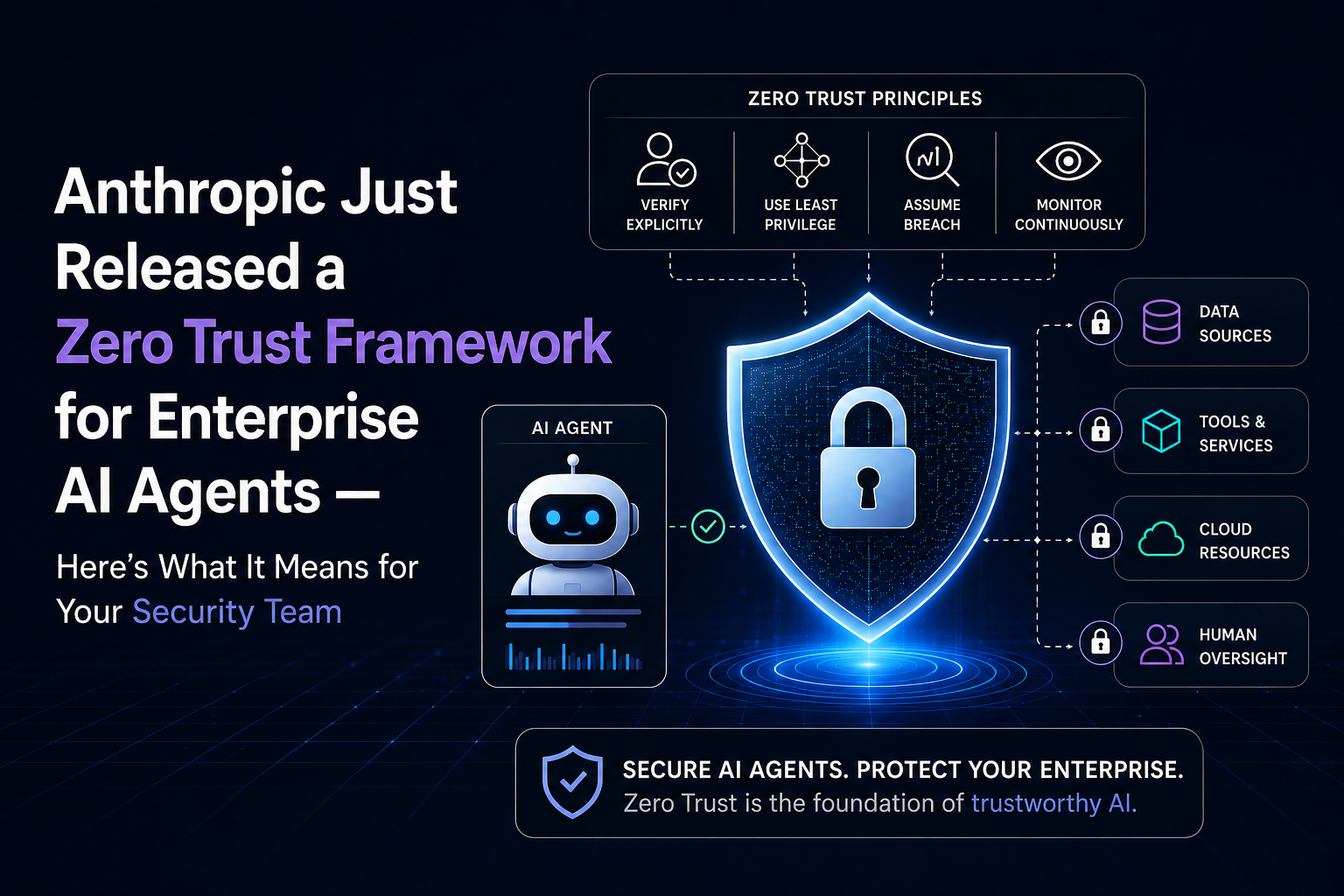
In late May 2026, Anthropic's Claude Security team published a document most enterprise security leaders should read closely: a Zero Trust framework built specifically for autonomous AI agents. It's not a marketing whitepaper. It's 35 pages of tiered controls, an eight-phase implementation workflow, and a threat model that treats agents as a genuinely new class of identity — not a chatbot with extra permissions.
That a frontier model provider is the one publishing this framework, rather than a legacy security vendor, is itself a signal. Anthropic is telling enterprise security teams, in effect: the agents you're deploying can already misuse their own legitimate permissions faster than your current controls can catch it, and perimeter-based security was never built for that. If your organization is running — or planning to run — autonomous agents with tool access, this is worth understanding in detail, because it's likely to become a reference point your auditors, your board, and your own security team start citing.
What Anthropic actually published
The framework applies Zero Trust — trust nothing, verify everything, assume breach has already occurred — to agentic systems specifically. It's built around three capability tiers:
- Foundation — the minimum viable posture, appropriate for smaller deployments, but raised meaningfully higher than most organizations' current baseline because AI-accelerated attacks have compressed exploit timelines from months to hours
- Enterprise — where most organizations with meaningful production deployments should be operating: the tier that accounts for real-world scale, multiple agent deployments, and business-impacting compromise
- Advanced — for regulated industries, national-security-adjacent deployments, or environments where a breach carries severe consequences
Each tier is applied across eight capability areas: agent identity and authentication, access control and privilege management, resource boundaries and isolation, observability and auditing, behavioral monitoring and response, input and output controls, integrity and recovery, and AI governance policy. Then a separate implementation workflow walks through eight phases — from defining requirements and managing supply-chain risk, through defending against prompt injection and securing tool access, to safeguarding agent memory and measuring what actually matters.
The threat model is the part most security teams haven't fully internalized yet
The framework's threat catalog reads like a preview of the incidents enterprises will spend 2026 and 2027 investigating:
- Prompt injection, direct and indirect — with the framework citing research showing LLMs cannot reliably distinguish informational context from actionable instructions, meaning a user can be completely unaware their agent just executed an attacker's instructions embedded in a web page or email
- Tool poisoning and rug-pull attacks — where a legitimate MCP tool's descriptor or metadata is compromised, or a trusted tool is quietly swapped for a malicious one after the fact
- Tool chaining attacks — where an agent is manipulated into combining two individually-authorized tools in a sequence that exfiltrates data neither tool would expose alone, invisible to host-centric monitoring because every call runs under valid credentials
- Unscoped privilege inheritance and the confused deputy problem — a high-privilege agent delegating tasks without properly scoping down access, or a compromised low-privilege agent relaying attacker instructions to a high-privilege agent that executes them without verifying original intent
- Memory-based privilege retention — an agent caching credentials across sessions without proper segmentation, letting an attacker prompt it into actions the attacker's own credentials would never permit
- Memory and RAG poisoning — malicious content injected into shared context or vector stores that persists across sessions, quietly biasing future reasoning long after the original injection
- AI supply chain risk — including a striking finding the framework cites: injecting as few as 250 malicious documents can successfully backdoor language models ranging from 600 million to 13 billion parameters, and those backdoors can survive safety training
If your current agent security posture is built on the assumption that traditional access controls will catch misuse, this catalog is the argument for why that assumption doesn't hold. An agent operating entirely within its granted permissions can still cause serious damage — because the permissions themselves, or the sequence in which they're exercised, is the attack surface.
What the framework gets right
A few things distinguish this from the usual "AI security best practices" listicle:
It's specific about what "identity" means for an agent. Static API keys and shared service-account passwords are treated as already compromised, not as a legitimate Foundation-tier posture. The baseline is short-lived, cryptographically-rooted credentials — moving toward hardware-bound identity for production and sensitive workloads.
It treats behavioral monitoring as a first-class control, not an afterthought. The framework is explicit that observability alone — logs and traces — only tells you what happened. Detecting compromise requires established behavioral baselines and continuous anomaly detection against them, with automated response fast enough to matter. Two metrics get called out as the highest-leverage places to invest: dwell time (how long between an anomaly occurring and a human becoming aware of it) and coverage (what fraction of alerts actually get investigated).
It's honest about where automation should and shouldn't sit. The framework's rule for defensive operations is clean: automate the evidence collection, correlation, and documentation around an incident, but keep humans on the containment, disclosure, and customer-communication decisions. It calls this next generation of security operations "Agentic SOAR" — automated first-pass triage on every alert, with a human making the calls that matter.
It acknowledges its own tiers will age fast. Anthropic explicitly says to expect the Advanced tier to become Enterprise standard as the space matures, and Enterprise to become Foundation. That's an unusually candid admission from a framework author, and it matches what security teams are already seeing: the bar for "acceptable" agent security has moved twice in the last year alone.
Where the framework hands off to your governance layer
Here's the part worth reading carefully if you're the one who has to operationalize this rather than just cite it in a board deck: the framework is, by design, an infrastructure and architecture specification. It tells you what identity, access, isolation, and monitoring *should* look like. It does not — and doesn't claim to — give you the running system that continuously executes those controls across every agent, every framework, and every model your organization actually deploys.
That gap is specific and predictable, because it's the same gap between writing a security policy and enforcing one:
- The framework calls for automated baseline learning and continuous behavioral monitoring across agents — but building and maintaining behavioral baselines for a growing agent estate, across LangGraph, CrewAI, AutoGen, and custom frameworks, is itself a continuous engineering effort most platform teams don't have headcount for.
- It calls for distributed tracing and full provenance chains from input to output — but stitching that together across multi-agent workflows, and turning it into something a regulator or auditor can actually read, requires infrastructure most organizations haven't built.
- It calls for automated first-pass triage on every alert before a human sees it — which is exactly the kind of continuous, autonomous evaluation loop that's hard to bolt onto existing SIEM tooling after the fact.
- It calls for memory integrity validation at every retrieval, not just at storage time — a specific, narrow requirement that most RAG and agent-memory implementations were not built to satisfy.
This is precisely the operational layer Trusys was built to close. Argus, Trusys's autonomous governance agent, runs continuous evaluation through TruEval, watches production traces through TruPulse, executes adversarial red-team campaigns through TruScout, and enforces inline policy through TruGuard — the same four functions the framework's Parts III and IV ask every organization to stand up: behavioral baselining, anomaly detection with tunable sensitivity, traceability across multi-agent workflows, and automated triage ahead of human review. TruPulse's behavioral drift and confused-deputy detection maps directly onto the framework's "unscoped privilege inheritance" threat category; TruScout's adversarial payload campaigns are mapped to the same OWASP Agentic AI Top 10 and MITRE ATLAS taxonomies the framework references; and Argus's continuous evaluation loop is functionally the "automated first-pass triage" and Agentic SOAR pattern the framework describes as the future of security operations — already running today.
None of this replaces the identity, network, and credential architecture the framework lays out — that infrastructure work is real and organizations need to do it. What it does is close the gap between the framework's control requirements and the day-to-day reality of running them continuously across an agent estate that keeps growing. You can see the full framework mapped to specific banking and financial-services requirements on Trusys's banking and NBFC governance page.

Stop guessing.
Start measuring.
Join teams building reliable AI with TruEval. Start with a free trial, no credit card required. Get your first evaluation running in under 10 minutes.
Questions about Trusys?
Our team is here to help. Schedule a personalized demo to see how Trusys fits your specific use case.
Book a Demo

Ready to dive in?
Check out our documentation and tutorials. Get started with example datasets and evaluation templates.
Start Free Trial
Free Trial
No credit card required
10 Min
To first evaluation
24/7
Enterprise support
What your security team should do with this, starting this quarter
- Read the full framework, not just this summary — Parts I and II are a useful briefing document for CISOs and risk leaders even before any implementation work starts.
- Run the "impossible vs. tedious" test against your current agent controls. Anything that only adds friction — rate limits, obscure ports, SMS MFA — should be flagged as a known gap, not treated as adequate.
- Audit your credential architecture specifically for static API keys and shared service accounts feeding agents. Treat every one you find as already compromised and prioritize migration to short-lived, identity-provider-issued tokens.
- Establish behavioral baselines now, even manually, for your highest-risk agents — the ones with payment, data-export, or customer-communication authority. You cannot detect drift you never measured a starting point for.
- Instrument dwell time and alert coverage as your first two metrics. The framework calls these the highest-leverage places to invest, and they're measurable without a major platform change.
- Map your current tool-access model against Least Agency — the framework's extension of least privilege to agent tools specifically. An email-drafting agent needs email permissions, not finance-system access, even if the underlying service account technically allows it.
- Decide, in advance, who can authorize emergency containment actions — pulling a service offline, revoking a credential, blocking a network path — and how fast. Practicing that authorization path before an incident is one of the framework's more actionable recommendations.
The bottom line
Zero Trust for agentic systems isn't a future requirement — Anthropic's framework, government Zero Trust mandates already in motion in the US, UK, and Australia, and the compliance pressure building under the EU AI Act, HIPAA, FINRA, and GDPR are all converging on the same expectation at roughly the same time. The organizations best positioned won't necessarily be the ones with the most advanced agents. They'll be the ones whose identity, access, and behavioral-governance fundamentals were strong enough, before the incident, to make the framework's controls real rather than aspirational.
If you're evaluating what it would take to operationalize this framework across your actual agent estate — not just the reference architecture, but continuous behavioral monitoring, audit-ready evidence, and automated triage running today — book a demo with Trusys to see how Argus closes that gap.


Benefits
Specifications
How-to
Contact Us
Learn More

Anthropic Just Released a Zero Trust Framework for Enterprise AI Agents — Here's What It Means for Your Security Team
Written by
In late May 2026, Anthropic's Claude Security team published a document most enterprise security leaders should read closely: a Zero Trust framework built specifically for autonomous AI agents. It's not a marketing whitepaper. It's 35 pages of tiered controls, an eight-phase implementation workflow, and a threat model that treats agents as a genuinely new class of identity — not a chatbot with extra permissions.
That a frontier model provider is the one publishing this framework, rather than a legacy security vendor, is itself a signal. Anthropic is telling enterprise security teams, in effect: the agents you're deploying can already misuse their own legitimate permissions faster than your current controls can catch it, and perimeter-based security was never built for that. If your organization is running — or planning to run — autonomous agents with tool access, this is worth understanding in detail, because it's likely to become a reference point your auditors, your board, and your own security team start citing.
What Anthropic actually published
The framework applies Zero Trust — trust nothing, verify everything, assume breach has already occurred — to agentic systems specifically. It's built around three capability tiers:
- Foundation — the minimum viable posture, appropriate for smaller deployments, but raised meaningfully higher than most organizations' current baseline because AI-accelerated attacks have compressed exploit timelines from months to hours
- Enterprise — where most organizations with meaningful production deployments should be operating: the tier that accounts for real-world scale, multiple agent deployments, and business-impacting compromise
- Advanced — for regulated industries, national-security-adjacent deployments, or environments where a breach carries severe consequences
Each tier is applied across eight capability areas: agent identity and authentication, access control and privilege management, resource boundaries and isolation, observability and auditing, behavioral monitoring and response, input and output controls, integrity and recovery, and AI governance policy. Then a separate implementation workflow walks through eight phases — from defining requirements and managing supply-chain risk, through defending against prompt injection and securing tool access, to safeguarding agent memory and measuring what actually matters.
The threat model is the part most security teams haven't fully internalized yet
The framework's threat catalog reads like a preview of the incidents enterprises will spend 2026 and 2027 investigating:
- Prompt injection, direct and indirect — with the framework citing research showing LLMs cannot reliably distinguish informational context from actionable instructions, meaning a user can be completely unaware their agent just executed an attacker's instructions embedded in a web page or email
- Tool poisoning and rug-pull attacks — where a legitimate MCP tool's descriptor or metadata is compromised, or a trusted tool is quietly swapped for a malicious one after the fact
- Tool chaining attacks — where an agent is manipulated into combining two individually-authorized tools in a sequence that exfiltrates data neither tool would expose alone, invisible to host-centric monitoring because every call runs under valid credentials
- Unscoped privilege inheritance and the confused deputy problem — a high-privilege agent delegating tasks without properly scoping down access, or a compromised low-privilege agent relaying attacker instructions to a high-privilege agent that executes them without verifying original intent
- Memory-based privilege retention — an agent caching credentials across sessions without proper segmentation, letting an attacker prompt it into actions the attacker's own credentials would never permit
- Memory and RAG poisoning — malicious content injected into shared context or vector stores that persists across sessions, quietly biasing future reasoning long after the original injection
- AI supply chain risk — including a striking finding the framework cites: injecting as few as 250 malicious documents can successfully backdoor language models ranging from 600 million to 13 billion parameters, and those backdoors can survive safety training
If your current agent security posture is built on the assumption that traditional access controls will catch misuse, this catalog is the argument for why that assumption doesn't hold. An agent operating entirely within its granted permissions can still cause serious damage — because the permissions themselves, or the sequence in which they're exercised, is the attack surface.
What the framework gets right
A few things distinguish this from the usual "AI security best practices" listicle:
It's specific about what "identity" means for an agent. Static API keys and shared service-account passwords are treated as already compromised, not as a legitimate Foundation-tier posture. The baseline is short-lived, cryptographically-rooted credentials — moving toward hardware-bound identity for production and sensitive workloads.
It treats behavioral monitoring as a first-class control, not an afterthought. The framework is explicit that observability alone — logs and traces — only tells you what happened. Detecting compromise requires established behavioral baselines and continuous anomaly detection against them, with automated response fast enough to matter. Two metrics get called out as the highest-leverage places to invest: dwell time (how long between an anomaly occurring and a human becoming aware of it) and coverage (what fraction of alerts actually get investigated).
It's honest about where automation should and shouldn't sit. The framework's rule for defensive operations is clean: automate the evidence collection, correlation, and documentation around an incident, but keep humans on the containment, disclosure, and customer-communication decisions. It calls this next generation of security operations "Agentic SOAR" — automated first-pass triage on every alert, with a human making the calls that matter.
It acknowledges its own tiers will age fast. Anthropic explicitly says to expect the Advanced tier to become Enterprise standard as the space matures, and Enterprise to become Foundation. That's an unusually candid admission from a framework author, and it matches what security teams are already seeing: the bar for "acceptable" agent security has moved twice in the last year alone.
Where the framework hands off to your governance layer
Here's the part worth reading carefully if you're the one who has to operationalize this rather than just cite it in a board deck: the framework is, by design, an infrastructure and architecture specification. It tells you what identity, access, isolation, and monitoring *should* look like. It does not — and doesn't claim to — give you the running system that continuously executes those controls across every agent, every framework, and every model your organization actually deploys.
That gap is specific and predictable, because it's the same gap between writing a security policy and enforcing one:
- The framework calls for automated baseline learning and continuous behavioral monitoring across agents — but building and maintaining behavioral baselines for a growing agent estate, across LangGraph, CrewAI, AutoGen, and custom frameworks, is itself a continuous engineering effort most platform teams don't have headcount for.
- It calls for distributed tracing and full provenance chains from input to output — but stitching that together across multi-agent workflows, and turning it into something a regulator or auditor can actually read, requires infrastructure most organizations haven't built.
- It calls for automated first-pass triage on every alert before a human sees it — which is exactly the kind of continuous, autonomous evaluation loop that's hard to bolt onto existing SIEM tooling after the fact.
- It calls for memory integrity validation at every retrieval, not just at storage time — a specific, narrow requirement that most RAG and agent-memory implementations were not built to satisfy.
This is precisely the operational layer Trusys was built to close. Argus, Trusys's autonomous governance agent, runs continuous evaluation through TruEval, watches production traces through TruPulse, executes adversarial red-team campaigns through TruScout, and enforces inline policy through TruGuard — the same four functions the framework's Parts III and IV ask every organization to stand up: behavioral baselining, anomaly detection with tunable sensitivity, traceability across multi-agent workflows, and automated triage ahead of human review. TruPulse's behavioral drift and confused-deputy detection maps directly onto the framework's "unscoped privilege inheritance" threat category; TruScout's adversarial payload campaigns are mapped to the same OWASP Agentic AI Top 10 and MITRE ATLAS taxonomies the framework references; and Argus's continuous evaluation loop is functionally the "automated first-pass triage" and Agentic SOAR pattern the framework describes as the future of security operations — already running today.
None of this replaces the identity, network, and credential architecture the framework lays out — that infrastructure work is real and organizations need to do it. What it does is close the gap between the framework's control requirements and the day-to-day reality of running them continuously across an agent estate that keeps growing. You can see the full framework mapped to specific banking and financial-services requirements on Trusys's banking and NBFC governance page.

What your security team should do with this, starting this quarter
- Read the full framework, not just this summary — Parts I and II are a useful briefing document for CISOs and risk leaders even before any implementation work starts.
- Run the "impossible vs. tedious" test against your current agent controls. Anything that only adds friction — rate limits, obscure ports, SMS MFA — should be flagged as a known gap, not treated as adequate.
- Audit your credential architecture specifically for static API keys and shared service accounts feeding agents. Treat every one you find as already compromised and prioritize migration to short-lived, identity-provider-issued tokens.
- Establish behavioral baselines now, even manually, for your highest-risk agents — the ones with payment, data-export, or customer-communication authority. You cannot detect drift you never measured a starting point for.
- Instrument dwell time and alert coverage as your first two metrics. The framework calls these the highest-leverage places to invest, and they're measurable without a major platform change.
- Map your current tool-access model against Least Agency — the framework's extension of least privilege to agent tools specifically. An email-drafting agent needs email permissions, not finance-system access, even if the underlying service account technically allows it.
- Decide, in advance, who can authorize emergency containment actions — pulling a service offline, revoking a credential, blocking a network path — and how fast. Practicing that authorization path before an incident is one of the framework's more actionable recommendations.
The bottom line
Zero Trust for agentic systems isn't a future requirement — Anthropic's framework, government Zero Trust mandates already in motion in the US, UK, and Australia, and the compliance pressure building under the EU AI Act, HIPAA, FINRA, and GDPR are all converging on the same expectation at roughly the same time. The organizations best positioned won't necessarily be the ones with the most advanced agents. They'll be the ones whose identity, access, and behavioral-governance fundamentals were strong enough, before the incident, to make the framework's controls real rather than aspirational.
If you're evaluating what it would take to operationalize this framework across your actual agent estate — not just the reference architecture, but continuous behavioral monitoring, audit-ready evidence, and automated triage running today — book a demo with Trusys to see how Argus closes that gap.
Stop guessing.
Start measuring.
Join teams building reliable AI with TruEval. Start with a free trial, no credit card required. Get your first evaluation running in under 10 minutes.
Questions about Trusys?
Our team is here to help. Schedule a personalized demo to see how Trusys fits your specific use case.
Book a Demo
Ready to dive in?
Check out our documentation and tutorials. Get started with example datasets and evaluation templates.
Start Free Trial
Free Trial
No credit card required
10 Min
To first evaluation
24/7
Enterprise support
Anthropic Just Released a Zero Trust Framework for Enterprise AI Agents — Here's What It Means for Your Security Team
Written by
Manish Tewari
Published on
July 27, 2026
In late May 2026, Anthropic's Claude Security team published a document most enterprise security leaders should read closely: a Zero Trust framework built specifically for autonomous AI agents. It's not a marketing whitepaper. It's 35 pages of tiered controls, an eight-phase implementation workflow, and a threat model that treats agents as a genuinely new class of identity — not a chatbot with extra permissions.
That a frontier model provider is the one publishing this framework, rather than a legacy security vendor, is itself a signal. Anthropic is telling enterprise security teams, in effect: the agents you're deploying can already misuse their own legitimate permissions faster than your current controls can catch it, and perimeter-based security was never built for that. If your organization is running — or planning to run — autonomous agents with tool access, this is worth understanding in detail, because it's likely to become a reference point your auditors, your board, and your own security team start citing.
What Anthropic actually published
The framework applies Zero Trust — trust nothing, verify everything, assume breach has already occurred — to agentic systems specifically. It's built around three capability tiers:
- Foundation — the minimum viable posture, appropriate for smaller deployments, but raised meaningfully higher than most organizations' current baseline because AI-accelerated attacks have compressed exploit timelines from months to hours
- Enterprise — where most organizations with meaningful production deployments should be operating: the tier that accounts for real-world scale, multiple agent deployments, and business-impacting compromise
- Advanced — for regulated industries, national-security-adjacent deployments, or environments where a breach carries severe consequences
Each tier is applied across eight capability areas: agent identity and authentication, access control and privilege management, resource boundaries and isolation, observability and auditing, behavioral monitoring and response, input and output controls, integrity and recovery, and AI governance policy. Then a separate implementation workflow walks through eight phases — from defining requirements and managing supply-chain risk, through defending against prompt injection and securing tool access, to safeguarding agent memory and measuring what actually matters.
The threat model is the part most security teams haven't fully internalized yet
The framework's threat catalog reads like a preview of the incidents enterprises will spend 2026 and 2027 investigating:
- Prompt injection, direct and indirect — with the framework citing research showing LLMs cannot reliably distinguish informational context from actionable instructions, meaning a user can be completely unaware their agent just executed an attacker's instructions embedded in a web page or email
- Tool poisoning and rug-pull attacks — where a legitimate MCP tool's descriptor or metadata is compromised, or a trusted tool is quietly swapped for a malicious one after the fact
- Tool chaining attacks — where an agent is manipulated into combining two individually-authorized tools in a sequence that exfiltrates data neither tool would expose alone, invisible to host-centric monitoring because every call runs under valid credentials
- Unscoped privilege inheritance and the confused deputy problem — a high-privilege agent delegating tasks without properly scoping down access, or a compromised low-privilege agent relaying attacker instructions to a high-privilege agent that executes them without verifying original intent
- Memory-based privilege retention — an agent caching credentials across sessions without proper segmentation, letting an attacker prompt it into actions the attacker's own credentials would never permit
- Memory and RAG poisoning — malicious content injected into shared context or vector stores that persists across sessions, quietly biasing future reasoning long after the original injection
- AI supply chain risk — including a striking finding the framework cites: injecting as few as 250 malicious documents can successfully backdoor language models ranging from 600 million to 13 billion parameters, and those backdoors can survive safety training
If your current agent security posture is built on the assumption that traditional access controls will catch misuse, this catalog is the argument for why that assumption doesn't hold. An agent operating entirely within its granted permissions can still cause serious damage — because the permissions themselves, or the sequence in which they're exercised, is the attack surface.
What the framework gets right
A few things distinguish this from the usual "AI security best practices" listicle:
It's specific about what "identity" means for an agent. Static API keys and shared service-account passwords are treated as already compromised, not as a legitimate Foundation-tier posture. The baseline is short-lived, cryptographically-rooted credentials — moving toward hardware-bound identity for production and sensitive workloads.
It treats behavioral monitoring as a first-class control, not an afterthought. The framework is explicit that observability alone — logs and traces — only tells you what happened. Detecting compromise requires established behavioral baselines and continuous anomaly detection against them, with automated response fast enough to matter. Two metrics get called out as the highest-leverage places to invest: dwell time (how long between an anomaly occurring and a human becoming aware of it) and coverage (what fraction of alerts actually get investigated).
It's honest about where automation should and shouldn't sit. The framework's rule for defensive operations is clean: automate the evidence collection, correlation, and documentation around an incident, but keep humans on the containment, disclosure, and customer-communication decisions. It calls this next generation of security operations "Agentic SOAR" — automated first-pass triage on every alert, with a human making the calls that matter.
It acknowledges its own tiers will age fast. Anthropic explicitly says to expect the Advanced tier to become Enterprise standard as the space matures, and Enterprise to become Foundation. That's an unusually candid admission from a framework author, and it matches what security teams are already seeing: the bar for "acceptable" agent security has moved twice in the last year alone.

Where the framework hands off to your governance layer
Here's the part worth reading carefully if you're the one who has to operationalize this rather than just cite it in a board deck: the framework is, by design, an infrastructure and architecture specification. It tells you what identity, access, isolation, and monitoring *should* look like. It does not — and doesn't claim to — give you the running system that continuously executes those controls across every agent, every framework, and every model your organization actually deploys.
That gap is specific and predictable, because it's the same gap between writing a security policy and enforcing one:
- The framework calls for automated baseline learning and continuous behavioral monitoring across agents — but building and maintaining behavioral baselines for a growing agent estate, across LangGraph, CrewAI, AutoGen, and custom frameworks, is itself a continuous engineering effort most platform teams don't have headcount for.
- It calls for distributed tracing and full provenance chains from input to output — but stitching that together across multi-agent workflows, and turning it into something a regulator or auditor can actually read, requires infrastructure most organizations haven't built.
- It calls for automated first-pass triage on every alert before a human sees it — which is exactly the kind of continuous, autonomous evaluation loop that's hard to bolt onto existing SIEM tooling after the fact.
- It calls for memory integrity validation at every retrieval, not just at storage time — a specific, narrow requirement that most RAG and agent-memory implementations were not built to satisfy.
This is precisely the operational layer Trusys was built to close. Argus, Trusys's autonomous governance agent, runs continuous evaluation through TruEval, watches production traces through TruPulse, executes adversarial red-team campaigns through TruScout, and enforces inline policy through TruGuard — the same four functions the framework's Parts III and IV ask every organization to stand up: behavioral baselining, anomaly detection with tunable sensitivity, traceability across multi-agent workflows, and automated triage ahead of human review. TruPulse's behavioral drift and confused-deputy detection maps directly onto the framework's "unscoped privilege inheritance" threat category; TruScout's adversarial payload campaigns are mapped to the same OWASP Agentic AI Top 10 and MITRE ATLAS taxonomies the framework references; and Argus's continuous evaluation loop is functionally the "automated first-pass triage" and Agentic SOAR pattern the framework describes as the future of security operations — already running today.
None of this replaces the identity, network, and credential architecture the framework lays out — that infrastructure work is real and organizations need to do it. What it does is close the gap between the framework's control requirements and the day-to-day reality of running them continuously across an agent estate that keeps growing. You can see the full framework mapped to specific banking and financial-services requirements on Trusys's banking and NBFC governance page.
What your security team should do with this, starting this quarter
- Read the full framework, not just this summary — Parts I and II are a useful briefing document for CISOs and risk leaders even before any implementation work starts.
- Run the "impossible vs. tedious" test against your current agent controls. Anything that only adds friction — rate limits, obscure ports, SMS MFA — should be flagged as a known gap, not treated as adequate.
- Audit your credential architecture specifically for static API keys and shared service accounts feeding agents. Treat every one you find as already compromised and prioritize migration to short-lived, identity-provider-issued tokens.
- Establish behavioral baselines now, even manually, for your highest-risk agents — the ones with payment, data-export, or customer-communication authority. You cannot detect drift you never measured a starting point for.
- Instrument dwell time and alert coverage as your first two metrics. The framework calls these the highest-leverage places to invest, and they're measurable without a major platform change.
- Map your current tool-access model against Least Agency — the framework's extension of least privilege to agent tools specifically. An email-drafting agent needs email permissions, not finance-system access, even if the underlying service account technically allows it.
- Decide, in advance, who can authorize emergency containment actions — pulling a service offline, revoking a credential, blocking a network path — and how fast. Practicing that authorization path before an incident is one of the framework's more actionable recommendations.
The bottom line
Zero Trust for agentic systems isn't a future requirement — Anthropic's framework, government Zero Trust mandates already in motion in the US, UK, and Australia, and the compliance pressure building under the EU AI Act, HIPAA, FINRA, and GDPR are all converging on the same expectation at roughly the same time. The organizations best positioned won't necessarily be the ones with the most advanced agents. They'll be the ones whose identity, access, and behavioral-governance fundamentals were strong enough, before the incident, to make the framework's controls real rather than aspirational.
If you're evaluating what it would take to operationalize this framework across your actual agent estate — not just the reference architecture, but continuous behavioral monitoring, audit-ready evidence, and automated triage running today — book a demo with Trusys to see how Argus closes that gap.
Stop guessing.
Start measuring.
Join teams building reliable AI with Trusys. Start with a free trial, no credit card required. Get your first evaluation running in under 10 minutes.
Questions about Trusys?
Our team is here to help. Schedule a personalized demo to see how Trusys fits your specific use case.
Book a Demo
Ready to dive in?
Check out our documentation and tutorials. Get started with example datasets and evaluation templates.
Start Free Trial
Free Trial
No credit card required
10 Min
to get started
24/7
Enterprise support