Agentic AI in Action: Use Cases, Risks, and Governance Strategies
2026-05-01
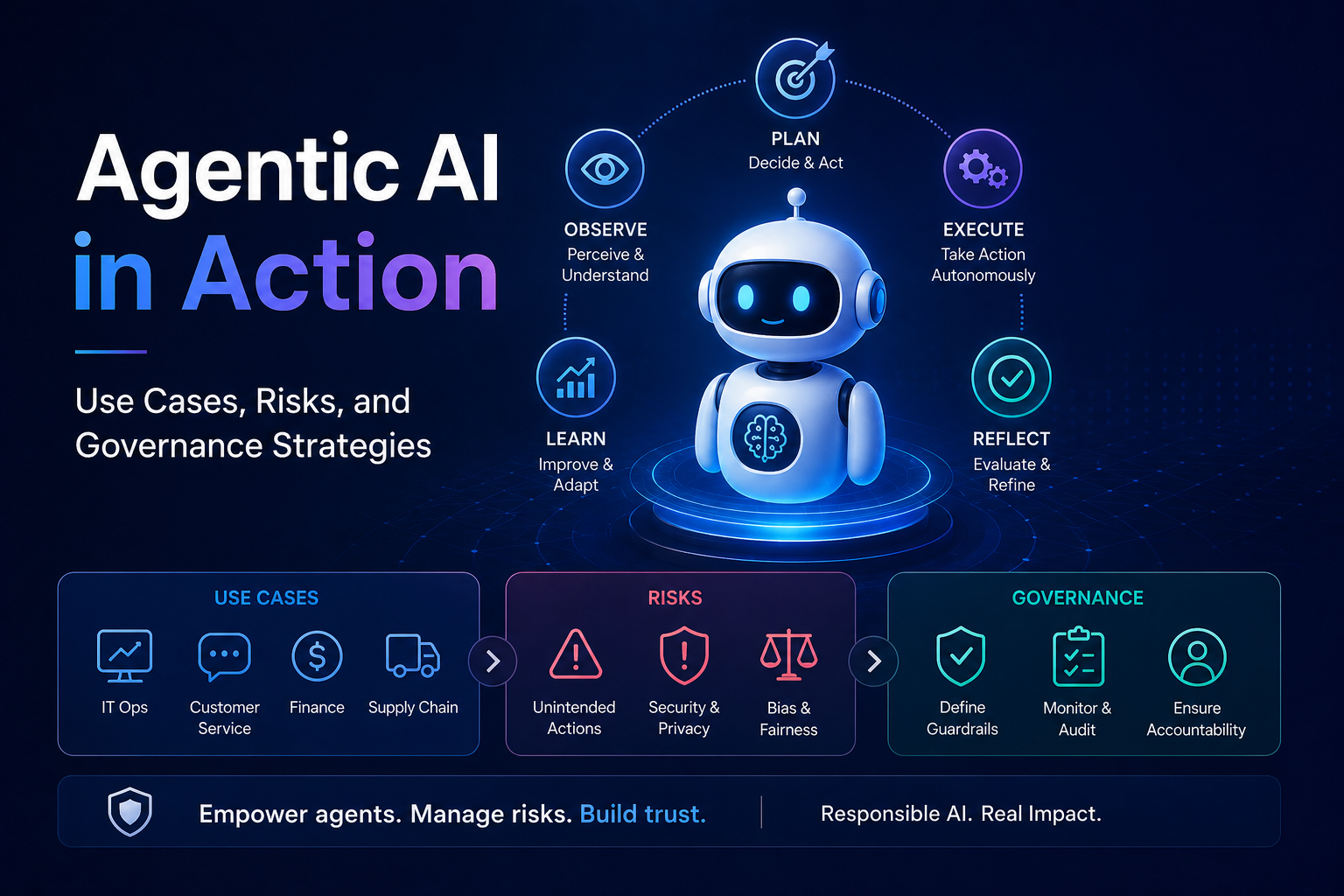
Agentic AI is no longer a concept confined to research labs—it is actively reshaping how enterprises operate. From autonomous customer service agents to self-optimizing workflows, organizations are deploying AI systems that don’t just respond to prompts but make decisions, take actions, and iterate toward goals.
But this shift introduces a fundamental challenge:
The more autonomous AI becomes, the harder it is to control.
While enterprises are racing to adopt Agentic AI for speed and efficiency, many are overlooking the governance layer required to manage its behavior in real-world environments. The result is a growing gap between AI capability and AI control.
To bridge this gap, organizations must rethink how they design, evaluate, and govern AI systems—bringing AI Evaluation and AI Assurance Platforms into the core of their strategy.
What Is Agentic AI?
Agentic AI refers to systems that can act independently to achieve defined objectives, often across multi-step workflows. Unlike traditional Generative AI, which produces outputs based on a single prompt, Agentic AI:
- Breaks down goals into sub-tasks
- Makes decisions dynamically
- Interacts with external tools and systems
- Learns from feedback and iterates
How Agentic AI Works
At a high level, agentic systems operate in a loop:
Input → Reasoning → Action → Feedback → Adjustment
This continuous cycle enables adaptability—but also introduces unpredictability. Every additional step increases the surface area for errors, bias, or security vulnerabilities.
Agentic AI : Enterprise Use Cases
Agentic AI is already delivering measurable value across industries. However, each use case comes with hidden complexities.
1. Autonomous Customer Support
AI agents can resolve tickets, escalate issues, and even trigger backend workflows without human intervention.
Value:
- Reduced response times
- 24/7 scalability
- Lower operational costs
Hidden Risks:
- Incorrect or hallucinated responses
- Escalation failures
- Exposure of sensitive customer data
2. Financial Decisioning and Underwriting
Agentic AI systems can analyze applications, assess risk, and approve or reject transactions.
Value:
- Faster decision-making
- Improved efficiency
- Data-driven insights
Hidden Risks:
- Bias in decision logic
- Lack of explainability
- Regulatory non-compliance
3. AI-Assisted Engineering and DevOps
AI agents are increasingly used to write code, deploy systems, and manage infrastructure.
Value:
- Accelerated development cycles
- Automated debugging and optimization
Hidden Risks:
- Insecure or vulnerable code
- Misconfigured environments
- Propagation of errors at scale
4. Security Automation
Agentic AI can detect threats, respond to incidents, and enforce policies in real time.
Value:
- Faster threat detection
- Reduced manual workload
Hidden Risks:
- False positives or negatives
- Over-automation without oversight
- Exploitable decision pathways
The Hidden Risks of Agentic AI
As autonomy increases, so does risk. Agentic systems introduce challenges that traditional AI models do not.
1. Lack of Predictability
Multi-step reasoning can produce unexpected outcomes, even with well-defined inputs.
2. Hallucinations at Scale
Errors are amplified across workflows, making them harder to detect and correct.
3. Prompt Injection and Adversarial Attacks
Malicious inputs can manipulate agent behavior, leading to unintended actions.
4. Data Leakage
Interactions with external tools increase the risk of exposing sensitive information.
5. Compliance and Audit Gaps
Tracking decision pathways becomes difficult, complicating regulatory reporting.
Agentic AI doesn’t just fail—it fails in ways that are harder to trace and control.
Why Traditional AI Governance Fails
Most governance frameworks were designed for static systems. Agentic AI is anything but static.
Key Limitations:
- Point-in-time testing: Fails to capture dynamic behavior
- Limited observability: No visibility into decision chains
- Manual oversight: Cannot scale with autonomous systems
As a result, enterprises often discover issues only after deployment—when the impact is already significant.
The Role of AI Evaluation in Agentic Systems
To manage autonomous AI effectively, organizations must adopt continuous AI Evaluation.
Unlike traditional testing, AI Evaluation focuses on:
- Behavior under diverse scenarios
- Performance across multi-step workflows
- Risk detection before and after deployment
Key Evaluation Metrics:
- Accuracy and reliability
- Bias and fairness
- Safety and robustness
- Hallucination rates
- Policy compliance
By implementing structured evaluation frameworks, enterprises can move from assumptions to measurable assurance.
AI Assurance Platform: The Control Layer for Agentic AI
An AI Assurance Platform acts as the missing control layer in enterprise AI strategy—bringing together evaluation, monitoring, and governance into a unified system.
Core Capabilities:
- End-to-end visibility across AI workflows
- Real-time monitoring of agent behavior
- Continuous AI Evaluation pipelines
- Policy enforcement and guardrails
- Audit-ready reporting and traceability
Instead of relying on fragmented tools, enterprises gain a centralized system to manage AI risk proactively.
If Agentic AI is the engine, the AI Assurance Platform is the control system.
Governance Strategies for Agentic AI
To safely scale Agentic AI, organizations must embed governance into every stage of the lifecycle.
1. Human-in-the-Loop Controls
Ensure critical decisions require human validation, especially in high-risk scenarios.
2. AI Guardrails and Policy Enforcement
Define clear boundaries for AI behavior and enforce them programmatically.
3. Continuous Monitoring
Track system performance, detect anomalies, and respond in real time.
4. Explainability and Audit Trails
Maintain detailed logs of decisions and actions for transparency and compliance.
5. Cross-Functional Governance
Align AI initiatives across engineering, security, compliance, and business teams.
Future Outlook: From Autonomous to Accountable AI
Agentic AI adoption will accelerate rapidly in the coming years. As systems become more capable, they will also become more scrutinized.
We can expect:
- Stricter regulatory frameworks
- Increased demand for transparency
- Greater emphasis on AI risk management
Enterprises that invest early in AI Evaluation and AI Assurance Platforms will be better positioned to scale responsibly.
Those that don’t risk falling behind—not just technologically, but operationally and reputationally.
Conclusion: Control Is the New Competitive Advantage
Agentic AI represents a major leap forward in enterprise capability. It enables systems that don’t just assist—but act.
But with autonomy comes responsibility.
The question is no longer whether you can deploy Agentic AI.
The real question is:
Can you control it once it’s deployed?
By integrating AI Evaluation and an AI Assurance Platform, organizations can transform Agentic AI from a source of risk into a source of trust.
Because in the era of autonomous systems:
Control isn’t optional—it’s the foundation of scale.
🔍 SEO Meta (Optional)
Meta Description:
Agentic AI is transforming enterprises. Explore real-world use cases, risks, and governance strategies using AI Evaluation and AI Assurance Platforms.
Stop guessing.
Start measuring.
Join teams building reliable AI with TruEval. Start with a free trial, no credit card required. Get your first evaluation running in under 10 minutes.
Questions about Trusys?
Our team is here to help. Schedule a personalized demo to see how Trusys fits your specific use case.
Book a Demo

Ready to dive in?
Check out our documentation and tutorials. Get started with example datasets and evaluation templates.
Start Free Trial
Free Trial
No credit card required
10 Min
To first evaluation
24/7
Enterprise support


Benefits
Specifications
How-to
Contact Us
Learn More

Agentic AI in Action: Use Cases, Risks, and Governance Strategies
2026-05-01
Agentic AI is no longer a concept confined to research labs—it is actively reshaping how enterprises operate. From autonomous customer service agents to self-optimizing workflows, organizations are deploying AI systems that don’t just respond to prompts but make decisions, take actions, and iterate toward goals.
But this shift introduces a fundamental challenge:
The more autonomous AI becomes, the harder it is to control.
While enterprises are racing to adopt Agentic AI for speed and efficiency, many are overlooking the governance layer required to manage its behavior in real-world environments. The result is a growing gap between AI capability and AI control.
To bridge this gap, organizations must rethink how they design, evaluate, and govern AI systems—bringing AI Evaluation and AI Assurance Platforms into the core of their strategy.
What Is Agentic AI?
Agentic AI refers to systems that can act independently to achieve defined objectives, often across multi-step workflows. Unlike traditional Generative AI, which produces outputs based on a single prompt, Agentic AI:
- Breaks down goals into sub-tasks
- Makes decisions dynamically
- Interacts with external tools and systems
- Learns from feedback and iterates
How Agentic AI Works
At a high level, agentic systems operate in a loop:
Input → Reasoning → Action → Feedback → Adjustment
This continuous cycle enables adaptability—but also introduces unpredictability. Every additional step increases the surface area for errors, bias, or security vulnerabilities.
Agentic AI : Enterprise Use Cases
Agentic AI is already delivering measurable value across industries. However, each use case comes with hidden complexities.
1. Autonomous Customer Support
AI agents can resolve tickets, escalate issues, and even trigger backend workflows without human intervention.
Value:
- Reduced response times
- 24/7 scalability
- Lower operational costs
Hidden Risks:
- Incorrect or hallucinated responses
- Escalation failures
- Exposure of sensitive customer data
2. Financial Decisioning and Underwriting
Agentic AI systems can analyze applications, assess risk, and approve or reject transactions.
Value:
- Faster decision-making
- Improved efficiency
- Data-driven insights
Hidden Risks:
- Bias in decision logic
- Lack of explainability
- Regulatory non-compliance
3. AI-Assisted Engineering and DevOps
AI agents are increasingly used to write code, deploy systems, and manage infrastructure.
Value:
- Accelerated development cycles
- Automated debugging and optimization
Hidden Risks:
- Insecure or vulnerable code
- Misconfigured environments
- Propagation of errors at scale
4. Security Automation
Agentic AI can detect threats, respond to incidents, and enforce policies in real time.
Value:
- Faster threat detection
- Reduced manual workload
Hidden Risks:
- False positives or negatives
- Over-automation without oversight
- Exploitable decision pathways
The Hidden Risks of Agentic AI
As autonomy increases, so does risk. Agentic systems introduce challenges that traditional AI models do not.
1. Lack of Predictability
Multi-step reasoning can produce unexpected outcomes, even with well-defined inputs.
2. Hallucinations at Scale
Errors are amplified across workflows, making them harder to detect and correct.
3. Prompt Injection and Adversarial Attacks
Malicious inputs can manipulate agent behavior, leading to unintended actions.
4. Data Leakage
Interactions with external tools increase the risk of exposing sensitive information.
5. Compliance and Audit Gaps
Tracking decision pathways becomes difficult, complicating regulatory reporting.
Agentic AI doesn’t just fail—it fails in ways that are harder to trace and control.
Why Traditional AI Governance Fails
Most governance frameworks were designed for static systems. Agentic AI is anything but static.
Key Limitations:
- Point-in-time testing: Fails to capture dynamic behavior
- Limited observability: No visibility into decision chains
- Manual oversight: Cannot scale with autonomous systems
As a result, enterprises often discover issues only after deployment—when the impact is already significant.
The Role of AI Evaluation in Agentic Systems
To manage autonomous AI effectively, organizations must adopt continuous AI Evaluation.
Unlike traditional testing, AI Evaluation focuses on:
- Behavior under diverse scenarios
- Performance across multi-step workflows
- Risk detection before and after deployment
Key Evaluation Metrics:
- Accuracy and reliability
- Bias and fairness
- Safety and robustness
- Hallucination rates
- Policy compliance
By implementing structured evaluation frameworks, enterprises can move from assumptions to measurable assurance.
AI Assurance Platform: The Control Layer for Agentic AI
An AI Assurance Platform acts as the missing control layer in enterprise AI strategy—bringing together evaluation, monitoring, and governance into a unified system.
Core Capabilities:
- End-to-end visibility across AI workflows
- Real-time monitoring of agent behavior
- Continuous AI Evaluation pipelines
- Policy enforcement and guardrails
- Audit-ready reporting and traceability
Instead of relying on fragmented tools, enterprises gain a centralized system to manage AI risk proactively.
If Agentic AI is the engine, the AI Assurance Platform is the control system.
Governance Strategies for Agentic AI
To safely scale Agentic AI, organizations must embed governance into every stage of the lifecycle.
1. Human-in-the-Loop Controls
Ensure critical decisions require human validation, especially in high-risk scenarios.
2. AI Guardrails and Policy Enforcement
Define clear boundaries for AI behavior and enforce them programmatically.
3. Continuous Monitoring
Track system performance, detect anomalies, and respond in real time.
4. Explainability and Audit Trails
Maintain detailed logs of decisions and actions for transparency and compliance.
5. Cross-Functional Governance
Align AI initiatives across engineering, security, compliance, and business teams.
Future Outlook: From Autonomous to Accountable AI
Agentic AI adoption will accelerate rapidly in the coming years. As systems become more capable, they will also become more scrutinized.
We can expect:
- Stricter regulatory frameworks
- Increased demand for transparency
- Greater emphasis on AI risk management
Enterprises that invest early in AI Evaluation and AI Assurance Platforms will be better positioned to scale responsibly.
Those that don’t risk falling behind—not just technologically, but operationally and reputationally.
Conclusion: Control Is the New Competitive Advantage
Agentic AI represents a major leap forward in enterprise capability. It enables systems that don’t just assist—but act.
But with autonomy comes responsibility.
The question is no longer whether you can deploy Agentic AI.
The real question is:
Can you control it once it’s deployed?
By integrating AI Evaluation and an AI Assurance Platform, organizations can transform Agentic AI from a source of risk into a source of trust.
Because in the era of autonomous systems:
Control isn’t optional—it’s the foundation of scale.
🔍 SEO Meta (Optional)
Meta Description:
Agentic AI is transforming enterprises. Explore real-world use cases, risks, and governance strategies using AI Evaluation and AI Assurance Platforms.
Stop guessing.
Start measuring.
Join teams building reliable AI with TruEval. Start with a free trial, no credit card required. Get your first evaluation running in under 10 minutes.
Questions about Trusys?
Our team is here to help. Schedule a personalized demo to see how Trusys fits your specific use case.
Book a Demo
Ready to dive in?
Check out our documentation and tutorials. Get started with example datasets and evaluation templates.
Start Free Trial
Free Trial
No credit card required
10 Min
To first evaluation
24/7
Enterprise support
Agentic AI in Action: Use Cases, Risks, and Governance Strategies
2026-05-01
Agentic AI is no longer a concept confined to research labs—it is actively reshaping how enterprises operate. From autonomous customer service agents to self-optimizing workflows, organizations are deploying AI systems that don’t just respond to prompts but make decisions, take actions, and iterate toward goals.
But this shift introduces a fundamental challenge:
The more autonomous AI becomes, the harder it is to control.
While enterprises are racing to adopt Agentic AI for speed and efficiency, many are overlooking the governance layer required to manage its behavior in real-world environments. The result is a growing gap between AI capability and AI control.
To bridge this gap, organizations must rethink how they design, evaluate, and govern AI systems—bringing AI Evaluation and AI Assurance Platforms into the core of their strategy.
What Is Agentic AI?
Agentic AI refers to systems that can act independently to achieve defined objectives, often across multi-step workflows. Unlike traditional Generative AI, which produces outputs based on a single prompt, Agentic AI:
- Breaks down goals into sub-tasks
- Makes decisions dynamically
- Interacts with external tools and systems
- Learns from feedback and iterates
How Agentic AI Works
At a high level, agentic systems operate in a loop:
Input → Reasoning → Action → Feedback → Adjustment
This continuous cycle enables adaptability—but also introduces unpredictability. Every additional step increases the surface area for errors, bias, or security vulnerabilities.
Agentic AI : Enterprise Use Cases
Agentic AI is already delivering measurable value across industries. However, each use case comes with hidden complexities.
1. Autonomous Customer Support
AI agents can resolve tickets, escalate issues, and even trigger backend workflows without human intervention.
Value:
- Reduced response times
- 24/7 scalability
- Lower operational costs
Hidden Risks:
- Incorrect or hallucinated responses
- Escalation failures
- Exposure of sensitive customer data
2. Financial Decisioning and Underwriting
Agentic AI systems can analyze applications, assess risk, and approve or reject transactions.
Value:
- Faster decision-making
- Improved efficiency
- Data-driven insights
Hidden Risks:
- Bias in decision logic
- Lack of explainability
- Regulatory non-compliance
3. AI-Assisted Engineering and DevOps
AI agents are increasingly used to write code, deploy systems, and manage infrastructure.
Value:
- Accelerated development cycles
- Automated debugging and optimization
Hidden Risks:
- Insecure or vulnerable code
- Misconfigured environments
- Propagation of errors at scale
4. Security Automation
Agentic AI can detect threats, respond to incidents, and enforce policies in real time.
Value:
- Faster threat detection
- Reduced manual workload
Hidden Risks:
- False positives or negatives
- Over-automation without oversight
- Exploitable decision pathways
The Hidden Risks of Agentic AI
As autonomy increases, so does risk. Agentic systems introduce challenges that traditional AI models do not.
1. Lack of Predictability
Multi-step reasoning can produce unexpected outcomes, even with well-defined inputs.
2. Hallucinations at Scale
Errors are amplified across workflows, making them harder to detect and correct.
3. Prompt Injection and Adversarial Attacks
Malicious inputs can manipulate agent behavior, leading to unintended actions.
4. Data Leakage
Interactions with external tools increase the risk of exposing sensitive information.
5. Compliance and Audit Gaps
Tracking decision pathways becomes difficult, complicating regulatory reporting.
Agentic AI doesn’t just fail—it fails in ways that are harder to trace and control.
Why Traditional AI Governance Fails
Most governance frameworks were designed for static systems. Agentic AI is anything but static.
Key Limitations:
- Point-in-time testing: Fails to capture dynamic behavior
- Limited observability: No visibility into decision chains
- Manual oversight: Cannot scale with autonomous systems
As a result, enterprises often discover issues only after deployment—when the impact is already significant.
The Role of AI Evaluation in Agentic Systems
To manage autonomous AI effectively, organizations must adopt continuous AI Evaluation.
Unlike traditional testing, AI Evaluation focuses on:
- Behavior under diverse scenarios
- Performance across multi-step workflows
- Risk detection before and after deployment
Key Evaluation Metrics:
- Accuracy and reliability
- Bias and fairness
- Safety and robustness
- Hallucination rates
- Policy compliance
By implementing structured evaluation frameworks, enterprises can move from assumptions to measurable assurance.
AI Assurance Platform: The Control Layer for Agentic AI
An AI Assurance Platform acts as the missing control layer in enterprise AI strategy—bringing together evaluation, monitoring, and governance into a unified system.
Core Capabilities:
- End-to-end visibility across AI workflows
- Real-time monitoring of agent behavior
- Continuous AI Evaluation pipelines
- Policy enforcement and guardrails
- Audit-ready reporting and traceability
Instead of relying on fragmented tools, enterprises gain a centralized system to manage AI risk proactively.
If Agentic AI is the engine, the AI Assurance Platform is the control system.
Governance Strategies for Agentic AI
To safely scale Agentic AI, organizations must embed governance into every stage of the lifecycle.
1. Human-in-the-Loop Controls
Ensure critical decisions require human validation, especially in high-risk scenarios.
2. AI Guardrails and Policy Enforcement
Define clear boundaries for AI behavior and enforce them programmatically.
3. Continuous Monitoring
Track system performance, detect anomalies, and respond in real time.
4. Explainability and Audit Trails
Maintain detailed logs of decisions and actions for transparency and compliance.
5. Cross-Functional Governance
Align AI initiatives across engineering, security, compliance, and business teams.
Future Outlook: From Autonomous to Accountable AI
Agentic AI adoption will accelerate rapidly in the coming years. As systems become more capable, they will also become more scrutinized.
We can expect:
- Stricter regulatory frameworks
- Increased demand for transparency
- Greater emphasis on AI risk management
Enterprises that invest early in AI Evaluation and AI Assurance Platforms will be better positioned to scale responsibly.
Those that don’t risk falling behind—not just technologically, but operationally and reputationally.
Conclusion: Control Is the New Competitive Advantage
Agentic AI represents a major leap forward in enterprise capability. It enables systems that don’t just assist—but act.
But with autonomy comes responsibility.
The question is no longer whether you can deploy Agentic AI.
The real question is:
Can you control it once it’s deployed?
By integrating AI Evaluation and an AI Assurance Platform, organizations can transform Agentic AI from a source of risk into a source of trust.
Because in the era of autonomous systems:
Control isn’t optional—it’s the foundation of scale.
🔍 SEO Meta (Optional)
Meta Description:
Agentic AI is transforming enterprises. Explore real-world use cases, risks, and governance strategies using AI Evaluation and AI Assurance Platforms.
Stop guessing.
Start measuring.
Join teams building reliable AI with Trusys. Start with a free trial, no credit card required. Get your first evaluation running in under 10 minutes.
Questions about Trusys?
Our team is here to help. Schedule a personalized demo to see how Trusys fits your specific use case.
Book a Demo

Ready to dive in?
Check out our documentation and tutorials. Get started with example datasets and evaluation templates.
Start Free Trial
Free Trial
No credit card required
10 Min
to get started
24/7
Enterprise support