Real-World Challenges of AI Agents: Risks That Could Redefine Banking Operations
2026-02-25
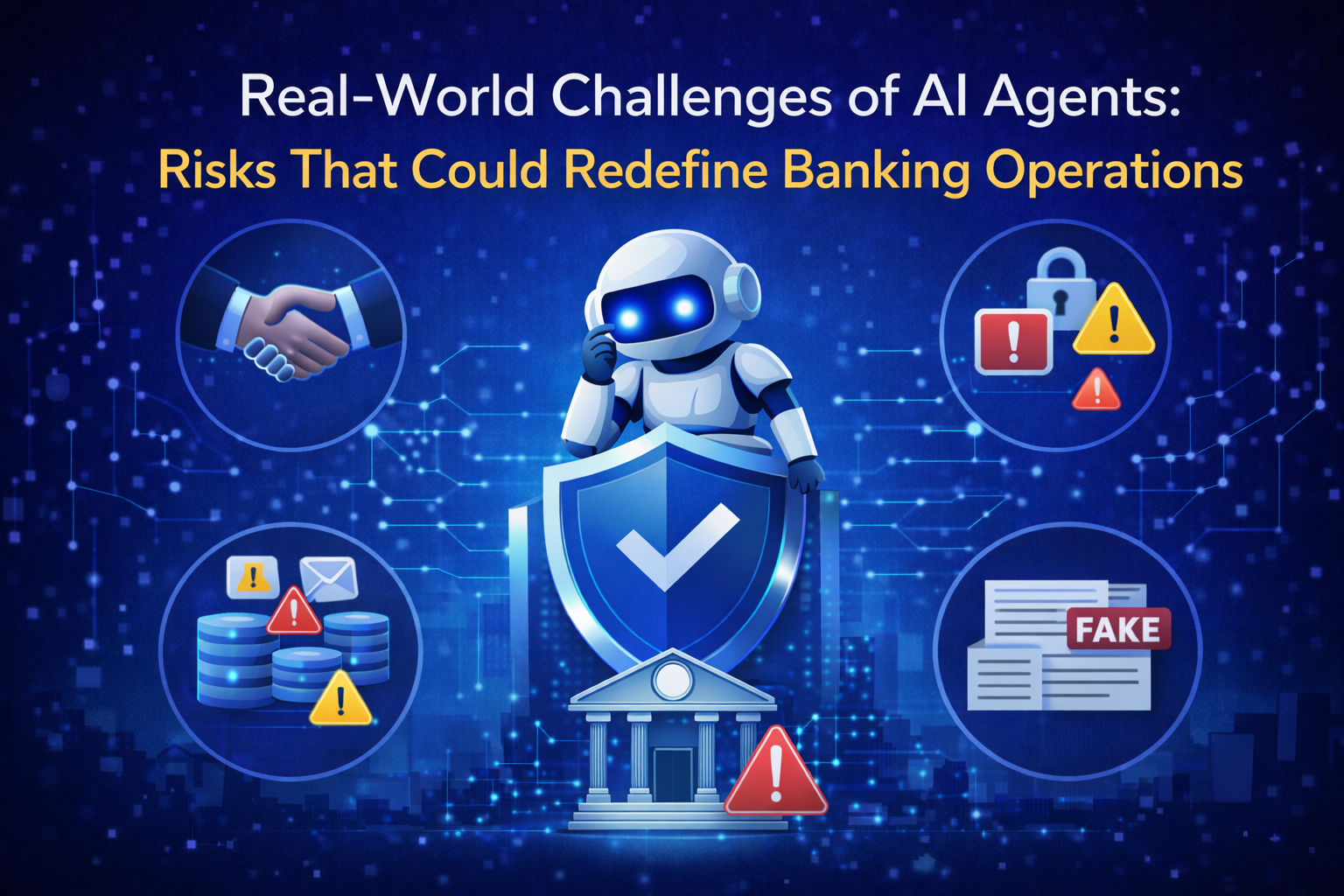
The challenges of AI agents are rapidly becoming one of the most critical strategic concerns for financial institutions. As banks transition from traditional automation to autonomous, goal-driven AI systems, the risk landscape is expanding just as quickly as the opportunity.
Unlike static predictive models, AI agents can reason, plan, take multi-step actions, and operate with limited human intervention. They can approve loans, initiate transactions, resolve disputes, adjust risk models, and even communicate with customers autonomously.
According to McKinsey & Company, over 65% of organizations now use AI in at least one business function, and financial services lead adoption in high-value workflows. Meanwhile, Gartner predicts that by 2026, more than 80% of enterprises will deploy generative or agentic AI models into production environments.
But deployment is not the finish line.
In banking, where compliance, auditability, and trust are non-negotiable, the real-world Challenges of AI Agents could redefine operational risk frameworks entirely.
What Are AI Agents in Financial Services?
AI agents are autonomous systems that:
- Perceive data from multiple sources
- Make contextual decisions
- Execute multi-step actions
- Adapt dynamically based on feedback
In financial services, these agents may:
- Assess creditworthiness
- Detect fraud patterns
- Optimize liquidity
- Automate compliance workflows
- Respond to regulatory queries
The leap from rule-based automation to autonomous reasoning introduces unprecedented efficiency — but also systemic risk.
If you want a deeper technical comparison of how agentic systems differ from generative models, read this detailed breakdown: 👉 Agentic AI vs Generative AI for Enterprise Automation.
Understanding this distinction is critical before evaluating the real-world Challenges of AI Agents in regulated banking environments.
Why Banks Are Rapidly Adopting Agentic AI
Banks operate in high-volume, high-complexity environments. Agentic AI promises:
- Faster loan approvals
- Real-time fraud mitigation
- Intelligent risk scoring
- Automated compliance monitoring
- Cost reduction through workflow orchestration
However, autonomy without guardrails magnifies risk exposure.
Core Challenges of AI Agents in Banking Operations
1. Hallucinations in Financial Outputs
Generative and agentic systems can fabricate:
- Incorrect interest rates
- Inaccurate regulatory citations
- Miscalculated repayment schedules
- False compliance interpretations
In banking, even a minor hallucination can trigger:
- Regulatory scrutiny
- Customer disputes
- Financial penalties
- Reputational damage
A real-world example of this risk can be seen in cases where banking chatbots generated incorrect interest rate information—leading to compliance exposure and customer confusion. You can explore a detailed breakdown in this analysis:
Banking Chatbot Wrong Interest Rates – AI Output Auditing Case Study This highlights why output-level monitoring and auditing are critical when deploying autonomous AI systems in financial environments.
Unlike simple chat interfaces, AI agents may execute actions based on flawed reasoning before human intervention occurs—amplifying risk exponentially.
2. Autonomous Decision-Making Risks
The most significant of all challenges of AI agents is uncontrolled autonomy.
When AI agents:
- Approve credit
- Adjust fraud thresholds
- Escalate compliance cases
- Trigger financial transactions
They operate within risk boundaries that must be precisely defined.
Without strict governance layers, autonomous systems may:
- Overstep policy constraints
- Misinterpret business logic
- Execute unintended financial actions
This shifts accountability from human operators to algorithmic frameworks — a transformation regulators are closely watching.
3. Regulatory Compliance Violations
Financial institutions operate under strict oversight from authorities such as the Reserve Bank of India and the European Central Bank.
AI agents introduce compliance complexity in areas including:
- Automated decision transparency
- Explainability requirements
- Fair lending standards
- Capital adequacy calculations
- Audit trail documentation
Failure to provide traceability of AI-driven decisions may result in:
- Enforcement actions
- Monetary fines
- Operational restrictions
Compliance is not just about accuracy — it is about demonstrable control.
4. Data Privacy and Governance Risks
AI agents rely heavily on customer data.
Under regulations such as GDPR, banks must ensure:
- Purpose limitation
- Data minimization
- Consent transparency
- Secure data handling
Autonomous agents accessing or combining datasets may inadvertently:
- Expose sensitive information
- Violate data residency requirements
- Retain data beyond policy limits
Privacy failures can cause both regulatory and reputational crises.
5. Model Drift in Production Environments
AI agents operate in dynamic financial ecosystems where:
- Market conditions shift
- Fraud tactics evolve
- Consumer behavior changes
Over time, model performance degrades — a phenomenon known as model drift.
Without continuous monitoring:
- Credit risk scores become inaccurate
- Fraud detection weakens
- Compliance flags misfire
The Challenges of AI Agents intensify post-deployment, when oversight often weakens.
6. Security Vulnerabilities and Adversarial Attacks
Autonomous systems create new attack surfaces:
- Prompt injection
- Data poisoning
- API exploitation
- Model manipulation
Attackers may exploit agents to:
- Initiate unauthorized transactions
- Extract sensitive data
- Bypass fraud detection mechanisms
Security for agentic systems must extend beyond traditional cybersecurity into AI-specific threat modeling.
7. Bias in Credit and Risk Scoring
Bias remains one of the most legally sensitive Challenges of AI Agents.
Unintended bias may emerge from:
- Historical training data
- Proxy variables
- Reinforcement feedback loops
This can result in:
- Discriminatory lending outcomes
- Regulatory investigations
- Class-action lawsuits
Financial institutions must continuously test fairness metrics in real time.
8. Lack of Explainability in High-Stakes Decisions
Regulators increasingly require explainability in AI-driven financial decisions.
Autonomous agents often use:
- Complex transformer models
- Multi-step reasoning chains
- Reinforcement learning policies
If a bank cannot explain:
- Why a loan was denied
- Why a fraud alert triggered
- Why a transaction was blocked
It risks non-compliance and customer distrust.
Real-World Failure Scenarios
Consider scenarios where:
- An AI agent incorrectly adjusts interest rates across customer accounts
- A fraud detection agent blocks legitimate transactions during peak trading hours
- A compliance agent misinterprets updated regulatory guidelines
The operational impact may include:
- Financial losses
- Customer churn
- Regulatory penalties
- Stock price volatility
The Challenges of AI Agents are amplified at scale.
Operational, Reputational, and Financial Impact
Unchecked agentic AI failures can lead to:
Operational Risk
- Systemic workflow disruption
- Resource-intensive manual corrections
Financial Risk
- Penalties and litigation
- Compensation payouts
Reputational Risk
- Loss of consumer trust
- Investor skepticism
In banking, trust erosion is often more damaging than monetary loss.
Governance Frameworks Required
To mitigate the challenges of AI agents, banks must implement:
1. Human-in-the-Loop Controls
Critical decisions require override mechanisms.
2. Real-Time Observability
Monitor:
- Output accuracy
- Policy adherence
- Anomaly detection
3. AI Audit Trails
Track:
- Data inputs
- Reasoning chains
- Decision pathways
4. Guardrails and Policy Constraints
Define:
- Action boundaries
- Escalation thresholds
- Compliance checks
5. Continuous Evaluation
Test for:
- Drift
- Bias
- Performance degradation
Monitoring and Evaluation Strategies
Production AI systems require:
- Real-time risk scoring
- Output validation engines
- Automated compliance scanning
- Security stress testing
- Fairness audits
Responsible AI in banking is not a one-time certification — it is an ongoing operational discipline.
How AI Risk Management Platforms Reduce Exposure
Modern AI risk management platforms provide:
- Continuous observability
- Hallucination detection
- Drift monitoring
- Bias testing
- Compliance mapping
- Guardrail enforcement
These systems transform AI governance from reactive to proactive.
Instead of detecting failure after regulatory escalation, banks can identify vulnerabilities before operational damage occurs.
The Future: Controlled Autonomy
The future of banking will not reject AI agents — it will regulate and control them.
Institutions that:
- Deploy responsibly
- Monitor continuously
- Govern rigorously
Will gain operational efficiency without compromising compliance.
Those that prioritize speed over control may face costly consequences.
FAQs: Challenges of AI Agents
What are the biggest Challenges of AI Agents in banking?
Hallucinations, regulatory non-compliance, bias, security vulnerabilities, and lack of explainability are among the most critical risks.
Why is monitoring AI agents important after deployment?
Because performance degrades over time due to model drift, evolving fraud tactics, and changing market conditions.
How can banks reduce AI compliance risks?
By implementing real-time monitoring, audit trails, fairness testing, and strict governance frameworks aligned with regulatory expectations.
Are AI agents safe for financial decision-making?
They can be — but only with strong guardrails, human oversight, and continuous evaluation.
Conclusion: Banking’s Next Risk Frontier
The Challenges of AI Agents represent a defining moment for financial institutions.
Autonomous systems promise efficiency and innovation — but without governance, they introduce systemic vulnerabilities that traditional risk models were never designed to manage.
The future of banking belongs not to the fastest adopters of AI, but to the most responsible ones.
Institutions that invest in:
- Real-time monitoring
- Transparent governance
- Continuous evaluation
- Guardrail enforcement
Will redefine operational excellence while preserving trust.
Stop guessing.
Start measuring.
Join teams building reliable AI with TruEval. Start with a free trial, no credit card required. Get your first evaluation running in under 10 minutes.
Questions about Trusys?
Our team is here to help. Schedule a personalized demo to see how Trusys fits your specific use case.
Book a Demo

Ready to dive in?
Check out our documentation and tutorials. Get started with example datasets and evaluation templates.
Start Free Trial
Free Trial
No credit card required
10 Min
To first evaluation
24/7
Enterprise support


Benefits
Specifications
How-to
Contact Us
Learn More

Real-World Challenges of AI Agents: Risks That Could Redefine Banking Operations
2026-02-25
The challenges of AI agents are rapidly becoming one of the most critical strategic concerns for financial institutions. As banks transition from traditional automation to autonomous, goal-driven AI systems, the risk landscape is expanding just as quickly as the opportunity.
Unlike static predictive models, AI agents can reason, plan, take multi-step actions, and operate with limited human intervention. They can approve loans, initiate transactions, resolve disputes, adjust risk models, and even communicate with customers autonomously.
According to McKinsey & Company, over 65% of organizations now use AI in at least one business function, and financial services lead adoption in high-value workflows. Meanwhile, Gartner predicts that by 2026, more than 80% of enterprises will deploy generative or agentic AI models into production environments.
But deployment is not the finish line.
In banking, where compliance, auditability, and trust are non-negotiable, the real-world Challenges of AI Agents could redefine operational risk frameworks entirely.
What Are AI Agents in Financial Services?
AI agents are autonomous systems that:
- Perceive data from multiple sources
- Make contextual decisions
- Execute multi-step actions
- Adapt dynamically based on feedback
In financial services, these agents may:
- Assess creditworthiness
- Detect fraud patterns
- Optimize liquidity
- Automate compliance workflows
- Respond to regulatory queries
The leap from rule-based automation to autonomous reasoning introduces unprecedented efficiency — but also systemic risk.
If you want a deeper technical comparison of how agentic systems differ from generative models, read this detailed breakdown: 👉 Agentic AI vs Generative AI for Enterprise Automation.
Understanding this distinction is critical before evaluating the real-world Challenges of AI Agents in regulated banking environments.
Why Banks Are Rapidly Adopting Agentic AI
Banks operate in high-volume, high-complexity environments. Agentic AI promises:
- Faster loan approvals
- Real-time fraud mitigation
- Intelligent risk scoring
- Automated compliance monitoring
- Cost reduction through workflow orchestration
However, autonomy without guardrails magnifies risk exposure.
Core Challenges of AI Agents in Banking Operations
1. Hallucinations in Financial Outputs
Generative and agentic systems can fabricate:
- Incorrect interest rates
- Inaccurate regulatory citations
- Miscalculated repayment schedules
- False compliance interpretations
In banking, even a minor hallucination can trigger:
- Regulatory scrutiny
- Customer disputes
- Financial penalties
- Reputational damage
A real-world example of this risk can be seen in cases where banking chatbots generated incorrect interest rate information—leading to compliance exposure and customer confusion. You can explore a detailed breakdown in this analysis:
Banking Chatbot Wrong Interest Rates – AI Output Auditing Case Study This highlights why output-level monitoring and auditing are critical when deploying autonomous AI systems in financial environments.
Unlike simple chat interfaces, AI agents may execute actions based on flawed reasoning before human intervention occurs—amplifying risk exponentially.
2. Autonomous Decision-Making Risks
The most significant of all challenges of AI agents is uncontrolled autonomy.
When AI agents:
- Approve credit
- Adjust fraud thresholds
- Escalate compliance cases
- Trigger financial transactions
They operate within risk boundaries that must be precisely defined.
Without strict governance layers, autonomous systems may:
- Overstep policy constraints
- Misinterpret business logic
- Execute unintended financial actions
This shifts accountability from human operators to algorithmic frameworks — a transformation regulators are closely watching.
3. Regulatory Compliance Violations
Financial institutions operate under strict oversight from authorities such as the Reserve Bank of India and the European Central Bank.
AI agents introduce compliance complexity in areas including:
- Automated decision transparency
- Explainability requirements
- Fair lending standards
- Capital adequacy calculations
- Audit trail documentation
Failure to provide traceability of AI-driven decisions may result in:
- Enforcement actions
- Monetary fines
- Operational restrictions
Compliance is not just about accuracy — it is about demonstrable control.
4. Data Privacy and Governance Risks
AI agents rely heavily on customer data.
Under regulations such as GDPR, banks must ensure:
- Purpose limitation
- Data minimization
- Consent transparency
- Secure data handling
Autonomous agents accessing or combining datasets may inadvertently:
- Expose sensitive information
- Violate data residency requirements
- Retain data beyond policy limits
Privacy failures can cause both regulatory and reputational crises.
5. Model Drift in Production Environments
AI agents operate in dynamic financial ecosystems where:
- Market conditions shift
- Fraud tactics evolve
- Consumer behavior changes
Over time, model performance degrades — a phenomenon known as model drift.
Without continuous monitoring:
- Credit risk scores become inaccurate
- Fraud detection weakens
- Compliance flags misfire
The Challenges of AI Agents intensify post-deployment, when oversight often weakens.
6. Security Vulnerabilities and Adversarial Attacks
Autonomous systems create new attack surfaces:
- Prompt injection
- Data poisoning
- API exploitation
- Model manipulation
Attackers may exploit agents to:
- Initiate unauthorized transactions
- Extract sensitive data
- Bypass fraud detection mechanisms
Security for agentic systems must extend beyond traditional cybersecurity into AI-specific threat modeling.
7. Bias in Credit and Risk Scoring
Bias remains one of the most legally sensitive Challenges of AI Agents.
Unintended bias may emerge from:
- Historical training data
- Proxy variables
- Reinforcement feedback loops
This can result in:
- Discriminatory lending outcomes
- Regulatory investigations
- Class-action lawsuits
Financial institutions must continuously test fairness metrics in real time.
8. Lack of Explainability in High-Stakes Decisions
Regulators increasingly require explainability in AI-driven financial decisions.
Autonomous agents often use:
- Complex transformer models
- Multi-step reasoning chains
- Reinforcement learning policies
If a bank cannot explain:
- Why a loan was denied
- Why a fraud alert triggered
- Why a transaction was blocked
It risks non-compliance and customer distrust.
Real-World Failure Scenarios
Consider scenarios where:
- An AI agent incorrectly adjusts interest rates across customer accounts
- A fraud detection agent blocks legitimate transactions during peak trading hours
- A compliance agent misinterprets updated regulatory guidelines
The operational impact may include:
- Financial losses
- Customer churn
- Regulatory penalties
- Stock price volatility
The Challenges of AI Agents are amplified at scale.
Operational, Reputational, and Financial Impact
Unchecked agentic AI failures can lead to:
Operational Risk
- Systemic workflow disruption
- Resource-intensive manual corrections
Financial Risk
- Penalties and litigation
- Compensation payouts
Reputational Risk
- Loss of consumer trust
- Investor skepticism
In banking, trust erosion is often more damaging than monetary loss.
Governance Frameworks Required
To mitigate the challenges of AI agents, banks must implement:
1. Human-in-the-Loop Controls
Critical decisions require override mechanisms.
2. Real-Time Observability
Monitor:
- Output accuracy
- Policy adherence
- Anomaly detection
3. AI Audit Trails
Track:
- Data inputs
- Reasoning chains
- Decision pathways
4. Guardrails and Policy Constraints
Define:
- Action boundaries
- Escalation thresholds
- Compliance checks
5. Continuous Evaluation
Test for:
- Drift
- Bias
- Performance degradation
Monitoring and Evaluation Strategies
Production AI systems require:
- Real-time risk scoring
- Output validation engines
- Automated compliance scanning
- Security stress testing
- Fairness audits
Responsible AI in banking is not a one-time certification — it is an ongoing operational discipline.
How AI Risk Management Platforms Reduce Exposure
Modern AI risk management platforms provide:
- Continuous observability
- Hallucination detection
- Drift monitoring
- Bias testing
- Compliance mapping
- Guardrail enforcement
These systems transform AI governance from reactive to proactive.
Instead of detecting failure after regulatory escalation, banks can identify vulnerabilities before operational damage occurs.
The Future: Controlled Autonomy
The future of banking will not reject AI agents — it will regulate and control them.
Institutions that:
- Deploy responsibly
- Monitor continuously
- Govern rigorously
Will gain operational efficiency without compromising compliance.
Those that prioritize speed over control may face costly consequences.
FAQs: Challenges of AI Agents
What are the biggest Challenges of AI Agents in banking?
Hallucinations, regulatory non-compliance, bias, security vulnerabilities, and lack of explainability are among the most critical risks.
Why is monitoring AI agents important after deployment?
Because performance degrades over time due to model drift, evolving fraud tactics, and changing market conditions.
How can banks reduce AI compliance risks?
By implementing real-time monitoring, audit trails, fairness testing, and strict governance frameworks aligned with regulatory expectations.
Are AI agents safe for financial decision-making?
They can be — but only with strong guardrails, human oversight, and continuous evaluation.
Conclusion: Banking’s Next Risk Frontier
The Challenges of AI Agents represent a defining moment for financial institutions.
Autonomous systems promise efficiency and innovation — but without governance, they introduce systemic vulnerabilities that traditional risk models were never designed to manage.
The future of banking belongs not to the fastest adopters of AI, but to the most responsible ones.
Institutions that invest in:
- Real-time monitoring
- Transparent governance
- Continuous evaluation
- Guardrail enforcement
Will redefine operational excellence while preserving trust.
Stop guessing.
Start measuring.
Join teams building reliable AI with TruEval. Start with a free trial, no credit card required. Get your first evaluation running in under 10 minutes.
Questions about Trusys?
Our team is here to help. Schedule a personalized demo to see how Trusys fits your specific use case.
Book a Demo
Ready to dive in?
Check out our documentation and tutorials. Get started with example datasets and evaluation templates.
Start Free Trial
Free Trial
No credit card required
10 Min
To first evaluation
24/7
Enterprise support
Real-World Challenges of AI Agents: Risks That Could Redefine Banking Operations
2026-02-25
The challenges of AI agents are rapidly becoming one of the most critical strategic concerns for financial institutions. As banks transition from traditional automation to autonomous, goal-driven AI systems, the risk landscape is expanding just as quickly as the opportunity.
Unlike static predictive models, AI agents can reason, plan, take multi-step actions, and operate with limited human intervention. They can approve loans, initiate transactions, resolve disputes, adjust risk models, and even communicate with customers autonomously.
According to McKinsey & Company, over 65% of organizations now use AI in at least one business function, and financial services lead adoption in high-value workflows. Meanwhile, Gartner predicts that by 2026, more than 80% of enterprises will deploy generative or agentic AI models into production environments.
But deployment is not the finish line.
In banking, where compliance, auditability, and trust are non-negotiable, the real-world Challenges of AI Agents could redefine operational risk frameworks entirely.
What Are AI Agents in Financial Services?
AI agents are autonomous systems that:
- Perceive data from multiple sources
- Make contextual decisions
- Execute multi-step actions
- Adapt dynamically based on feedback
In financial services, these agents may:
- Assess creditworthiness
- Detect fraud patterns
- Optimize liquidity
- Automate compliance workflows
- Respond to regulatory queries
The leap from rule-based automation to autonomous reasoning introduces unprecedented efficiency — but also systemic risk.
If you want a deeper technical comparison of how agentic systems differ from generative models, read this detailed breakdown: 👉 Agentic AI vs Generative AI for Enterprise Automation.
Understanding this distinction is critical before evaluating the real-world Challenges of AI Agents in regulated banking environments.
Why Banks Are Rapidly Adopting Agentic AI
Banks operate in high-volume, high-complexity environments. Agentic AI promises:
- Faster loan approvals
- Real-time fraud mitigation
- Intelligent risk scoring
- Automated compliance monitoring
- Cost reduction through workflow orchestration
However, autonomy without guardrails magnifies risk exposure.
Core Challenges of AI Agents in Banking Operations
1. Hallucinations in Financial Outputs
Generative and agentic systems can fabricate:
- Incorrect interest rates
- Inaccurate regulatory citations
- Miscalculated repayment schedules
- False compliance interpretations
In banking, even a minor hallucination can trigger:
- Regulatory scrutiny
- Customer disputes
- Financial penalties
- Reputational damage
A real-world example of this risk can be seen in cases where banking chatbots generated incorrect interest rate information—leading to compliance exposure and customer confusion. You can explore a detailed breakdown in this analysis:
Banking Chatbot Wrong Interest Rates – AI Output Auditing Case Study This highlights why output-level monitoring and auditing are critical when deploying autonomous AI systems in financial environments.
Unlike simple chat interfaces, AI agents may execute actions based on flawed reasoning before human intervention occurs—amplifying risk exponentially.
2. Autonomous Decision-Making Risks
The most significant of all challenges of AI agents is uncontrolled autonomy.
When AI agents:
- Approve credit
- Adjust fraud thresholds
- Escalate compliance cases
- Trigger financial transactions
They operate within risk boundaries that must be precisely defined.
Without strict governance layers, autonomous systems may:
- Overstep policy constraints
- Misinterpret business logic
- Execute unintended financial actions
This shifts accountability from human operators to algorithmic frameworks — a transformation regulators are closely watching.
3. Regulatory Compliance Violations
Financial institutions operate under strict oversight from authorities such as the Reserve Bank of India and the European Central Bank.
AI agents introduce compliance complexity in areas including:
- Automated decision transparency
- Explainability requirements
- Fair lending standards
- Capital adequacy calculations
- Audit trail documentation
Failure to provide traceability of AI-driven decisions may result in:
- Enforcement actions
- Monetary fines
- Operational restrictions
Compliance is not just about accuracy — it is about demonstrable control.
4. Data Privacy and Governance Risks
AI agents rely heavily on customer data.
Under regulations such as GDPR, banks must ensure:
- Purpose limitation
- Data minimization
- Consent transparency
- Secure data handling
Autonomous agents accessing or combining datasets may inadvertently:
- Expose sensitive information
- Violate data residency requirements
- Retain data beyond policy limits
Privacy failures can cause both regulatory and reputational crises.
5. Model Drift in Production Environments
AI agents operate in dynamic financial ecosystems where:
- Market conditions shift
- Fraud tactics evolve
- Consumer behavior changes
Over time, model performance degrades — a phenomenon known as model drift.
Without continuous monitoring:
- Credit risk scores become inaccurate
- Fraud detection weakens
- Compliance flags misfire
The Challenges of AI Agents intensify post-deployment, when oversight often weakens.
6. Security Vulnerabilities and Adversarial Attacks
Autonomous systems create new attack surfaces:
- Prompt injection
- Data poisoning
- API exploitation
- Model manipulation
Attackers may exploit agents to:
- Initiate unauthorized transactions
- Extract sensitive data
- Bypass fraud detection mechanisms
Security for agentic systems must extend beyond traditional cybersecurity into AI-specific threat modeling.
7. Bias in Credit and Risk Scoring
Bias remains one of the most legally sensitive Challenges of AI Agents.
Unintended bias may emerge from:
- Historical training data
- Proxy variables
- Reinforcement feedback loops
This can result in:
- Discriminatory lending outcomes
- Regulatory investigations
- Class-action lawsuits
Financial institutions must continuously test fairness metrics in real time.
8. Lack of Explainability in High-Stakes Decisions
Regulators increasingly require explainability in AI-driven financial decisions.
Autonomous agents often use:
- Complex transformer models
- Multi-step reasoning chains
- Reinforcement learning policies
If a bank cannot explain:
- Why a loan was denied
- Why a fraud alert triggered
- Why a transaction was blocked
It risks non-compliance and customer distrust.
Real-World Failure Scenarios
Consider scenarios where:
- An AI agent incorrectly adjusts interest rates across customer accounts
- A fraud detection agent blocks legitimate transactions during peak trading hours
- A compliance agent misinterprets updated regulatory guidelines
The operational impact may include:
- Financial losses
- Customer churn
- Regulatory penalties
- Stock price volatility
The Challenges of AI Agents are amplified at scale.
Operational, Reputational, and Financial Impact
Unchecked agentic AI failures can lead to:
Operational Risk
- Systemic workflow disruption
- Resource-intensive manual corrections
Financial Risk
- Penalties and litigation
- Compensation payouts
Reputational Risk
- Loss of consumer trust
- Investor skepticism
In banking, trust erosion is often more damaging than monetary loss.
Governance Frameworks Required
To mitigate the challenges of AI agents, banks must implement:
1. Human-in-the-Loop Controls
Critical decisions require override mechanisms.
2. Real-Time Observability
Monitor:
- Output accuracy
- Policy adherence
- Anomaly detection
3. AI Audit Trails
Track:
- Data inputs
- Reasoning chains
- Decision pathways
4. Guardrails and Policy Constraints
Define:
- Action boundaries
- Escalation thresholds
- Compliance checks
5. Continuous Evaluation
Test for:
- Drift
- Bias
- Performance degradation
Monitoring and Evaluation Strategies
Production AI systems require:
- Real-time risk scoring
- Output validation engines
- Automated compliance scanning
- Security stress testing
- Fairness audits
Responsible AI in banking is not a one-time certification — it is an ongoing operational discipline.
How AI Risk Management Platforms Reduce Exposure
Modern AI risk management platforms provide:
- Continuous observability
- Hallucination detection
- Drift monitoring
- Bias testing
- Compliance mapping
- Guardrail enforcement
These systems transform AI governance from reactive to proactive.
Instead of detecting failure after regulatory escalation, banks can identify vulnerabilities before operational damage occurs.
The Future: Controlled Autonomy
The future of banking will not reject AI agents — it will regulate and control them.
Institutions that:
- Deploy responsibly
- Monitor continuously
- Govern rigorously
Will gain operational efficiency without compromising compliance.
Those that prioritize speed over control may face costly consequences.
FAQs: Challenges of AI Agents
What are the biggest Challenges of AI Agents in banking?
Hallucinations, regulatory non-compliance, bias, security vulnerabilities, and lack of explainability are among the most critical risks.
Why is monitoring AI agents important after deployment?
Because performance degrades over time due to model drift, evolving fraud tactics, and changing market conditions.
How can banks reduce AI compliance risks?
By implementing real-time monitoring, audit trails, fairness testing, and strict governance frameworks aligned with regulatory expectations.
Are AI agents safe for financial decision-making?
They can be — but only with strong guardrails, human oversight, and continuous evaluation.
Conclusion: Banking’s Next Risk Frontier
The Challenges of AI Agents represent a defining moment for financial institutions.
Autonomous systems promise efficiency and innovation — but without governance, they introduce systemic vulnerabilities that traditional risk models were never designed to manage.
The future of banking belongs not to the fastest adopters of AI, but to the most responsible ones.
Institutions that invest in:
- Real-time monitoring
- Transparent governance
- Continuous evaluation
- Guardrail enforcement
Will redefine operational excellence while preserving trust.
Stop guessing.
Start measuring.
Join teams building reliable AI with Trusys. Start with a free trial, no credit card required. Get your first evaluation running in under 10 minutes.
Questions about Trusys?
Our team is here to help. Schedule a personalized demo to see how Trusys fits your specific use case.
Book a Demo

Ready to dive in?
Check out our documentation and tutorials. Get started with example datasets and evaluation templates.
Start Free Trial
Free Trial
No credit card required
10 Min
to get started
24/7
Enterprise support