Shadow AI: The Governance Risk Hiding in Your Sanctioned Tools
Written by

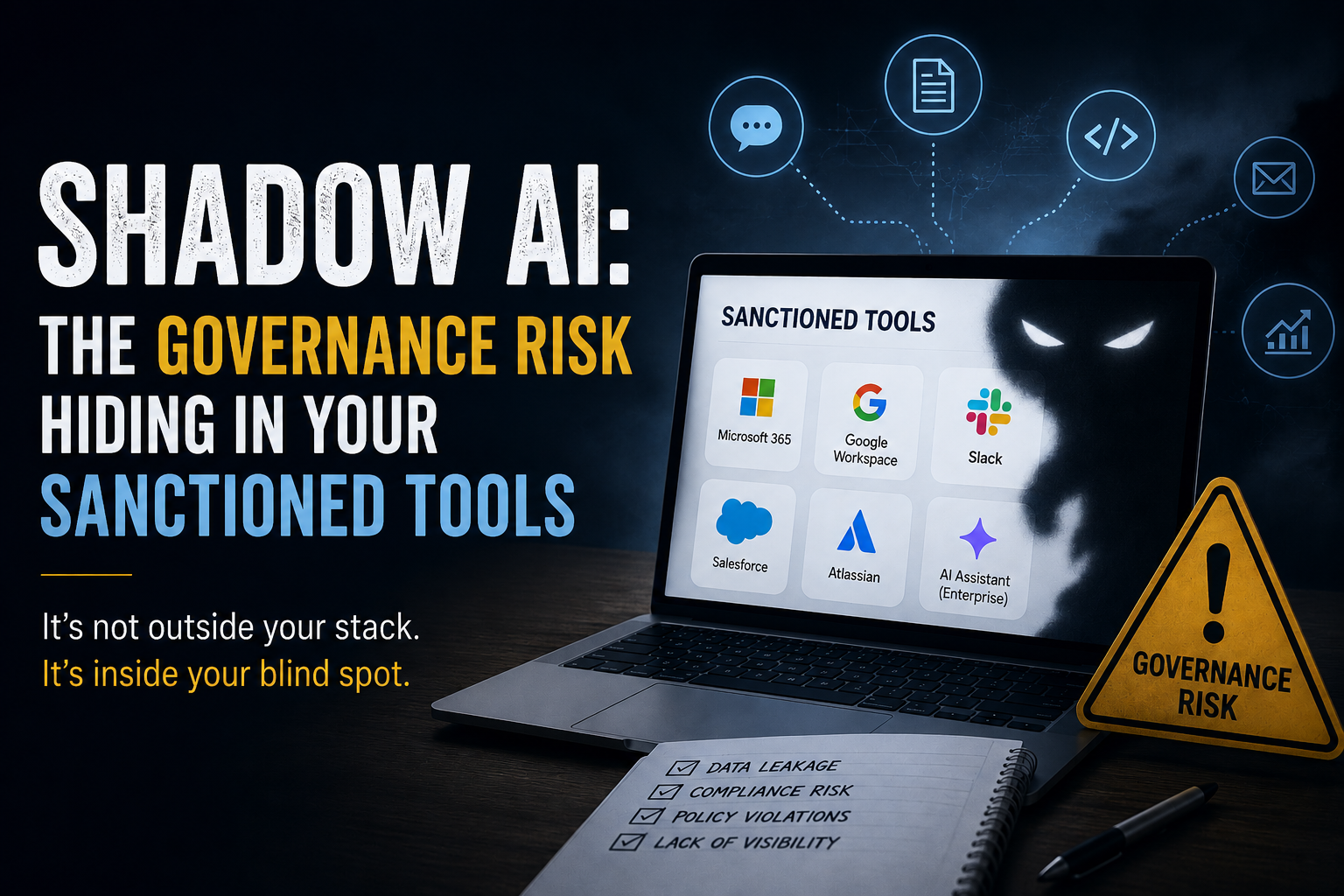
Here is a scenario that is playing out in enterprise security and legal teams right now. A company spends six months building an AI governance programme. They audit third-party AI tools, require vendor disclosures, add AI usage clauses to procurement contracts, and block a list of unapproved consumer AI services at the network level. The CISO presents the board with a clean slide: AI risk: managed
Three months later, a data subject access request reveals that customer PII has been processed by an AI model embedded in a CRM the company uses daily. The CRM vendor updated its terms of service to include AI training on user data six months ago. Nobody noticed. The AI was there the whole time — sanctioned, trusted, and completely ungoverned.
This is the real shadow AI problem. Not the ChatGPT tabs your employees open in Chrome. The AI behaviour embedded in your approved enterprise stack — and silently operating outside every governance control you've built.
Key Statistics
- 73% of enterprise SaaS tools now embed AI features by default, often without prominent disclosure.
- 61% of security leaders say they cannot fully inventory all AI running in their organisation.
- 4.2x more likely: a governance incident originates from a sanctioned tool vs. a blocked consumer service.
What Shadow AI Actually Is (and Isn't)
The term shadow AI entered mainstream enterprise vocabulary alongside the explosion of consumer generative AI in 2023. Originally it referred to employees using unapproved tools — running sensitive documents through ChatGPT, pasting customer data into Midjourney prompts, asking Claude to summarise confidential M&A briefings on a personal device.
That definition is real, and that risk is real. But it has also caused a dangerous blind spot: it led organisations to frame shadow AI as a people problem — something solved by policy enforcement, training, and blocking consumer endpoints.
The more dangerous and rapidly growing category is what we call embedded shadow AI: AI capabilities that are shipped, activated, or silently enabled inside enterprise tools you've already approved, paid for, and integrated into critical business processes.
The key distinction: Traditional shadow AI is unsanctioned usage of AI. Embedded shadow AI is ungoverned AI usage inside sanctioned systems. The first is a policy gap. The second is a governance architecture gap — and it's substantially harder to close.

The key distinction: Traditional shadow AI is unsanctioned usage of AI. Embedded shadow AI is ungoverned AI usage inside sanctioned systems. The first is a policy gap. The second is a governance architecture gap — and it's substantially harder to close.
Where Embedded Shadow AI Hides
AI Agents Multiply Infrastructure Load
AI agents introduce an entirely new scaling challenge.
Unlike a traditional user making one request at a time, AI agents may:
- Trigger multiple chained prompts
- Query several models simultaneously
- Retry failed requests autonomously
- Launch recursive workflows
One user action can suddenly generate dozens of inference operations.
Without workload controls, traffic amplification becomes unavoidable.
Developer and Code Platforms
GitHub Copilot, JetBrains AI Assistant, and similar coding tools are now pervasive in enterprise engineering teams. These tools process proprietary codebases to generate suggestions — and in many configurations, code snippets are transmitted to third-party model providers for inference. Code that contains authentication logic, cryptographic implementations, or business-critical algorithms may be processed by models your security team has never evaluated.
Pull quote: The governance gap isn't at the edge of your network. It's at the heart of your approved software stack.

There are three additional failure modes worth naming explicitly:
AI Agents Multiply Infrastructure Load
AI agents introduce an entirely new scaling challenge.
Unlike a traditional user making one request at a time, AI agents may:
- Trigger multiple chained prompts
- Query several models simultaneously
- Retry failed requests autonomously
- Launch recursive workflows
One user action can suddenly generate dozens of inference operations.
Without workload controls, traffic amplification becomes unavoidable.
Why Existing Governance Frameworks Miss This
Why Rate Limit Failures Are So Dangerous
Many organizations still treat rate limit errors as minor API inconveniences.
That assumption is becoming expensive.
In reality, rate limit failures create cascading operational disruption across the enterprise.
The Risk Landscape: What Embedded Shadow AI Exposes You To
Why Rate Limit Failures Are So Dangerous
Many organizations still treat rate limit errors as minor API inconveniences.
That assumption is becoming expensive.
In reality, rate limit failures create cascading operational disruption across the enterprise.
Step One: You Cannot Govern What You Cannot See
AI Agents Multiply Infrastructure Load
AI agents introduce an entirely new scaling challenge.
Unlike a traditional user making one request at a time, AI agents may:
- Trigger multiple chained prompts
- Query several models simultaneously
- Retry failed requests autonomously
- Launch recursive workflows
One user action can suddenly generate dozens of inference operations.
Without workload controls, traffic amplification becomes unavoidable.
Building a Governance Framework That Catches Embedded Shadow AI
AI Agents Multiply Infrastructure Load
AI agents introduce an entirely new scaling challenge.
Unlike a traditional user making one request at a time, AI agents may:
- Trigger multiple chained prompts
- Query several models simultaneously
- Retry failed requests autonomously
- Launch recursive workflows
One user action can suddenly generate dozens of inference operations.
Without workload controls, traffic amplification becomes unavoidable.
The Agentic AI Dimension
AI Agents Multiply Infrastructure Load
AI agents introduce an entirely new scaling challenge.
Unlike a traditional user making one request at a time, AI agents may:
- Trigger multiple chained prompts
- Query several models simultaneously
- Retry failed requests autonomously
- Launch recursive workflows
One user action can suddenly generate dozens of inference operations.
Without workload controls, traffic amplification becomes unavoidable.
Shadow AI Governance: An Immediate Action Checklist
If you are an AI governance lead, CISO, or legal counsel and you want to start closing the embedded shadow AI gap today, here is where to begin:
- Audit your top 20 SaaS platforms for AI features that are currently active, regardless of whether they were part of your original procurement scope.
- Review the DPAs and ToS of your highest-data-density platforms for AI training, retention, and data sharing clauses updated in the last 18 months.
- Map AI use cases to EU AI Act risk categories. Any platform making or supporting employment, credit, or service access decisions requires an AI impact assessment.
- Check your AI governance framework for procurement-only triggers and extend review requirements to cover software updates, tier changes, and vendor notifications.
- Assess your runtime visibility. Can you actually see what AI systems are doing in production in real time? If the answer is no — or 'we rely on vendor reporting' — you have a material governance gap.
- Begin vendor engagement on AI notification obligations. Push for contractual commitments that require advance notice of model changes, new AI feature activations, and data policy updates.
For a structured approach to enterprise AI risk management: Automating AI Risk Management with Trusys.ai — https://www.trusys.ai/blog-details/automating-ai-risk-management-with-trusys-ai-a-step-by-step-guide
Conclusion: The Perimeter Has Moved
The enterprise AI governance challenge in 2026 is not primarily about employees using rogue tools. It's about the AI that your organisation is already running — at scale, against sensitive data, inside trusted systems — with no governance controls applied to it because nobody classified it as 'AI' when it arrived.
The perimeter of AI governance has moved. It is no longer at the boundary of approved versus unapproved tools. It is inside every approved tool in your stack — in the AI features, agents, and model calls that your vendors shipped while your governance programme was looking elsewhere.
Closing this gap requires a fundamental shift in how enterprises think about AI governance: from a procurement-time activity to a continuous operational discipline. From a policy document to a runtime control. From trusting vendor assurances to independently verifying AI behaviour in production.
That shift is what Trusys was built to enable. And in a world where your biggest AI governance risk is hiding in the tools you already trust, continuous assurance isn't optional — it's the only model that works.
See: AI Governance Is Not a One-Time Audit — https://www.trusys.ai/ai-governance-not-a-one-time-audit
FAQs
AI Agents Multiply Infrastructure Load
AI agents introduce an entirely new scaling challenge.
Unlike a traditional user making one request at a time, AI agents may:
- Trigger multiple chained prompts
- Query several models simultaneously
- Retry failed requests autonomously
- Launch recursive workflows
One user action can suddenly generate dozens of inference operations.
Without workload controls, traffic amplification becomes unavoidable.
AI Agents Multiply Infrastructure Load
AI agents introduce an entirely new scaling challenge.
Unlike a traditional user making one request at a time, AI agents may:
- Trigger multiple chained prompts
- Query several models simultaneously
- Retry failed requests autonomously
- Launch recursive workflows
One user action can suddenly generate dozens of inference operations.
Without workload controls, traffic amplification becomes unavoidable.
AI Agents Multiply Infrastructure Load
AI agents introduce an entirely new scaling challenge.
Unlike a traditional user making one request at a time, AI agents may:
- Trigger multiple chained prompts
- Query several models simultaneously
- Retry failed requests autonomously
- Launch recursive workflows
One user action can suddenly generate dozens of inference operations.
Without workload controls, traffic amplification becomes unavoidable.
AI Agents Multiply Infrastructure Load
AI agents introduce an entirely new scaling challenge.
Unlike a traditional user making one request at a time, AI agents may:
- Trigger multiple chained prompts
- Query several models simultaneously
- Retry failed requests autonomously
- Launch recursive workflows
One user action can suddenly generate dozens of inference operations.
Without workload controls, traffic amplification becomes unavoidable.
AI Agents Multiply Infrastructure Load
AI agents introduce an entirely new scaling challenge.
Unlike a traditional user making one request at a time, AI agents may:
- Trigger multiple chained prompts
- Query several models simultaneously
- Retry failed requests autonomously
- Launch recursive workflows
One user action can suddenly generate dozens of inference operations.
Without workload controls, traffic amplification becomes unavoidable.
AI Agents Multiply Infrastructure Load
AI agents introduce an entirely new scaling challenge.
Unlike a traditional user making one request at a time, AI agents may:
- Trigger multiple chained prompts
- Query several models simultaneously
- Retry failed requests autonomously
- Launch recursive workflows
One user action can suddenly generate dozens of inference operations.
Without workload controls, traffic amplification becomes unavoidable.
AI Agents Multiply Infrastructure Load
AI agents introduce an entirely new scaling challenge.
Unlike a traditional user making one request at a time, AI agents may:
- Trigger multiple chained prompts
- Query several models simultaneously
- Retry failed requests autonomously
- Launch recursive workflows
One user action can suddenly generate dozens of inference operations.
Without workload controls, traffic amplification becomes unavoidable.
AI Agents Multiply Infrastructure Load
AI agents introduce an entirely new scaling challenge.
Unlike a traditional user making one request at a time, AI agents may:
- Trigger multiple chained prompts
- Query several models simultaneously
- Retry failed requests autonomously
- Launch recursive workflows
One user action can suddenly generate dozens of inference operations.
Without workload controls, traffic amplification becomes unavoidable.
AI Agents Multiply Infrastructure Load
AI agents introduce an entirely new scaling challenge.
Unlike a traditional user making one request at a time, AI agents may:
- Trigger multiple chained prompts
- Query several models simultaneously
- Retry failed requests autonomously
- Launch recursive workflows
One user action can suddenly generate dozens of inference operations.
Without workload controls, traffic amplification becomes unavoidable.
AI Agents Multiply Infrastructure Load
AI agents introduce an entirely new scaling challenge.
Unlike a traditional user making one request at a time, AI agents may:
- Trigger multiple chained prompts
- Query several models simultaneously
- Retry failed requests autonomously
- Launch recursive workflows
One user action can suddenly generate dozens of inference operations.
Without workload controls, traffic amplification becomes unavoidable.
AI Agents Multiply Infrastructure Load
AI agents introduce an entirely new scaling challenge.
Unlike a traditional user making one request at a time, AI agents may:
- Trigger multiple chained prompts
- Query several models simultaneously
- Retry failed requests autonomously
- Launch recursive workflows
One user action can suddenly generate dozens of inference operations.
Without workload controls, traffic amplification becomes unavoidable.
AI Agents Multiply Infrastructure Load
AI agents introduce an entirely new scaling challenge.
Unlike a traditional user making one request at a time, AI agents may:
- Trigger multiple chained prompts
- Query several models simultaneously
- Retry failed requests autonomously
- Launch recursive workflows
One user action can suddenly generate dozens of inference operations.
Without workload controls, traffic amplification becomes unavoidable.
AI Agents Multiply Infrastructure Load
AI agents introduce an entirely new scaling challenge.
Unlike a traditional user making one request at a time, AI agents may:
- Trigger multiple chained prompts
- Query several models simultaneously
- Retry failed requests autonomously
- Launch recursive workflows
One user action can suddenly generate dozens of inference operations.
Without workload controls, traffic amplification becomes unavoidable.
AI Agents Multiply Infrastructure Load
AI agents introduce an entirely new scaling challenge.
Unlike a traditional user making one request at a time, AI agents may:
- Trigger multiple chained prompts
- Query several models simultaneously
- Retry failed requests autonomously
- Launch recursive workflows
One user action can suddenly generate dozens of inference operations.
Without workload controls, traffic amplification becomes unavoidable.
AI Agents Multiply Infrastructure Load
AI agents introduce an entirely new scaling challenge.
Unlike a traditional user making one request at a time, AI agents may:
- Trigger multiple chained prompts
- Query several models simultaneously
- Retry failed requests autonomously
- Launch recursive workflows
One user action can suddenly generate dozens of inference operations.
Without workload controls, traffic amplification becomes unavoidable.
AI Agents Multiply Infrastructure Load
AI agents introduce an entirely new scaling challenge.
Unlike a traditional user making one request at a time, AI agents may:
- Trigger multiple chained prompts
- Query several models simultaneously
- Retry failed requests autonomously
- Launch recursive workflows
One user action can suddenly generate dozens of inference operations.
Without workload controls, traffic amplification becomes unavoidable.
AI Agents Multiply Infrastructure Load
AI agents introduce an entirely new scaling challenge.
Unlike a traditional user making one request at a time, AI agents may:
- Trigger multiple chained prompts
- Query several models simultaneously
- Retry failed requests autonomously
- Launch recursive workflows
One user action can suddenly generate dozens of inference operations.
Without workload controls, traffic amplification becomes unavoidable.
AI Agents Multiply Infrastructure Load
AI agents introduce an entirely new scaling challenge.
Unlike a traditional user making one request at a time, AI agents may:
- Trigger multiple chained prompts
- Query several models simultaneously
- Retry failed requests autonomously
- Launch recursive workflows
One user action can suddenly generate dozens of inference operations.
Without workload controls, traffic amplification becomes unavoidable.
AI Agents Multiply Infrastructure Load
AI agents introduce an entirely new scaling challenge.
Unlike a traditional user making one request at a time, AI agents may:
- Trigger multiple chained prompts
- Query several models simultaneously
- Retry failed requests autonomously
- Launch recursive workflows
One user action can suddenly generate dozens of inference operations.
Without workload controls, traffic amplification becomes unavoidable.
AI Agents Multiply Infrastructure Load
AI agents introduce an entirely new scaling challenge.
Unlike a traditional user making one request at a time, AI agents may:
- Trigger multiple chained prompts
- Query several models simultaneously
- Retry failed requests autonomously
- Launch recursive workflows
One user action can suddenly generate dozens of inference operations.
Without workload controls, traffic amplification becomes unavoidable.
Stop guessing.
Start measuring.
Join teams building reliable AI with TruEval. Start with a free trial, no credit card required. Get your first evaluation running in under 10 minutes.
Questions about Trusys?
Our team is here to help. Schedule a personalized demo to see how Trusys fits your specific use case.
Book a Demo

Ready to dive in?
Check out our documentation and tutorials. Get started with example datasets and evaluation templates.
Start Free Trial
Free Trial
No credit card required
10 Min
To first evaluation
24/7
Enterprise support


Benefits
Specifications
How-to
Contact Us
Learn More

Shadow AI: The Governance Risk Hiding in Your Sanctioned Tools
Written by
Here is a scenario that is playing out in enterprise security and legal teams right now. A company spends six months building an AI governance programme. They audit third-party AI tools, require vendor disclosures, add AI usage clauses to procurement contracts, and block a list of unapproved consumer AI services at the network level. The CISO presents the board with a clean slide: AI risk: managed
Three months later, a data subject access request reveals that customer PII has been processed by an AI model embedded in a CRM the company uses daily. The CRM vendor updated its terms of service to include AI training on user data six months ago. Nobody noticed. The AI was there the whole time — sanctioned, trusted, and completely ungoverned.
This is the real shadow AI problem. Not the ChatGPT tabs your employees open in Chrome. The AI behaviour embedded in your approved enterprise stack — and silently operating outside every governance control you've built.
Key Statistics
- 73% of enterprise SaaS tools now embed AI features by default, often without prominent disclosure.
- 61% of security leaders say they cannot fully inventory all AI running in their organisation.
- 4.2x more likely: a governance incident originates from a sanctioned tool vs. a blocked consumer service.
What Shadow AI Actually Is (and Isn't)
The term shadow AI entered mainstream enterprise vocabulary alongside the explosion of consumer generative AI in 2023. Originally it referred to employees using unapproved tools — running sensitive documents through ChatGPT, pasting customer data into Midjourney prompts, asking Claude to summarise confidential M&A briefings on a personal device.
That definition is real, and that risk is real. But it has also caused a dangerous blind spot: it led organisations to frame shadow AI as a people problem — something solved by policy enforcement, training, and blocking consumer endpoints.
The more dangerous and rapidly growing category is what we call embedded shadow AI: AI capabilities that are shipped, activated, or silently enabled inside enterprise tools you've already approved, paid for, and integrated into critical business processes.
The key distinction: Traditional shadow AI is unsanctioned usage of AI. Embedded shadow AI is ungoverned AI usage inside sanctioned systems. The first is a policy gap. The second is a governance architecture gap — and it's substantially harder to close.

The key distinction: Traditional shadow AI is unsanctioned usage of AI. Embedded shadow AI is ungoverned AI usage inside sanctioned systems. The first is a policy gap. The second is a governance architecture gap — and it's substantially harder to close.
Where Embedded Shadow AI Hides
AI Agents Multiply Infrastructure Load
AI agents introduce an entirely new scaling challenge.
Unlike a traditional user making one request at a time, AI agents may:
- Trigger multiple chained prompts
- Query several models simultaneously
- Retry failed requests autonomously
- Launch recursive workflows
One user action can suddenly generate dozens of inference operations.
Without workload controls, traffic amplification becomes unavoidable.
Developer and Code Platforms
GitHub Copilot, JetBrains AI Assistant, and similar coding tools are now pervasive in enterprise engineering teams. These tools process proprietary codebases to generate suggestions — and in many configurations, code snippets are transmitted to third-party model providers for inference. Code that contains authentication logic, cryptographic implementations, or business-critical algorithms may be processed by models your security team has never evaluated.
Pull quote: The governance gap isn't at the edge of your network. It's at the heart of your approved software stack.

There are three additional failure modes worth naming explicitly:
AI Agents Multiply Infrastructure Load
AI agents introduce an entirely new scaling challenge.
Unlike a traditional user making one request at a time, AI agents may:
- Trigger multiple chained prompts
- Query several models simultaneously
- Retry failed requests autonomously
- Launch recursive workflows
One user action can suddenly generate dozens of inference operations.
Without workload controls, traffic amplification becomes unavoidable.
Why Existing Governance Frameworks Miss This
Why Rate Limit Failures Are So Dangerous
Many organizations still treat rate limit errors as minor API inconveniences.
That assumption is becoming expensive.
In reality, rate limit failures create cascading operational disruption across the enterprise.
The Risk Landscape: What Embedded Shadow AI Exposes You To
Why Rate Limit Failures Are So Dangerous
Many organizations still treat rate limit errors as minor API inconveniences.
That assumption is becoming expensive.
In reality, rate limit failures create cascading operational disruption across the enterprise.
Step One: You Cannot Govern What You Cannot See
AI Agents Multiply Infrastructure Load
AI agents introduce an entirely new scaling challenge.
Unlike a traditional user making one request at a time, AI agents may:
- Trigger multiple chained prompts
- Query several models simultaneously
- Retry failed requests autonomously
- Launch recursive workflows
One user action can suddenly generate dozens of inference operations.
Without workload controls, traffic amplification becomes unavoidable.
Building a Governance Framework That Catches Embedded Shadow AI
AI Agents Multiply Infrastructure Load
AI agents introduce an entirely new scaling challenge.
Unlike a traditional user making one request at a time, AI agents may:
- Trigger multiple chained prompts
- Query several models simultaneously
- Retry failed requests autonomously
- Launch recursive workflows
One user action can suddenly generate dozens of inference operations.
Without workload controls, traffic amplification becomes unavoidable.
The Agentic AI Dimension
AI Agents Multiply Infrastructure Load
AI agents introduce an entirely new scaling challenge.
Unlike a traditional user making one request at a time, AI agents may:
- Trigger multiple chained prompts
- Query several models simultaneously
- Retry failed requests autonomously
- Launch recursive workflows
One user action can suddenly generate dozens of inference operations.
Without workload controls, traffic amplification becomes unavoidable.
Shadow AI Governance: An Immediate Action Checklist
If you are an AI governance lead, CISO, or legal counsel and you want to start closing the embedded shadow AI gap today, here is where to begin:
- Audit your top 20 SaaS platforms for AI features that are currently active, regardless of whether they were part of your original procurement scope.
- Review the DPAs and ToS of your highest-data-density platforms for AI training, retention, and data sharing clauses updated in the last 18 months.
- Map AI use cases to EU AI Act risk categories. Any platform making or supporting employment, credit, or service access decisions requires an AI impact assessment.
- Check your AI governance framework for procurement-only triggers and extend review requirements to cover software updates, tier changes, and vendor notifications.
- Assess your runtime visibility. Can you actually see what AI systems are doing in production in real time? If the answer is no — or 'we rely on vendor reporting' — you have a material governance gap.
- Begin vendor engagement on AI notification obligations. Push for contractual commitments that require advance notice of model changes, new AI feature activations, and data policy updates.
For a structured approach to enterprise AI risk management: Automating AI Risk Management with Trusys.ai — https://www.trusys.ai/blog-details/automating-ai-risk-management-with-trusys-ai-a-step-by-step-guide
Conclusion: The Perimeter Has Moved
The enterprise AI governance challenge in 2026 is not primarily about employees using rogue tools. It's about the AI that your organisation is already running — at scale, against sensitive data, inside trusted systems — with no governance controls applied to it because nobody classified it as 'AI' when it arrived.
The perimeter of AI governance has moved. It is no longer at the boundary of approved versus unapproved tools. It is inside every approved tool in your stack — in the AI features, agents, and model calls that your vendors shipped while your governance programme was looking elsewhere.
Closing this gap requires a fundamental shift in how enterprises think about AI governance: from a procurement-time activity to a continuous operational discipline. From a policy document to a runtime control. From trusting vendor assurances to independently verifying AI behaviour in production.
That shift is what Trusys was built to enable. And in a world where your biggest AI governance risk is hiding in the tools you already trust, continuous assurance isn't optional — it's the only model that works.
See: AI Governance Is Not a One-Time Audit — https://www.trusys.ai/ai-governance-not-a-one-time-audit
FAQs
AI Agents Multiply Infrastructure Load
AI agents introduce an entirely new scaling challenge.
Unlike a traditional user making one request at a time, AI agents may:
- Trigger multiple chained prompts
- Query several models simultaneously
- Retry failed requests autonomously
- Launch recursive workflows
One user action can suddenly generate dozens of inference operations.
Without workload controls, traffic amplification becomes unavoidable.
AI Agents Multiply Infrastructure Load
AI agents introduce an entirely new scaling challenge.
Unlike a traditional user making one request at a time, AI agents may:
- Trigger multiple chained prompts
- Query several models simultaneously
- Retry failed requests autonomously
- Launch recursive workflows
One user action can suddenly generate dozens of inference operations.
Without workload controls, traffic amplification becomes unavoidable.
AI Agents Multiply Infrastructure Load
AI agents introduce an entirely new scaling challenge.
Unlike a traditional user making one request at a time, AI agents may:
- Trigger multiple chained prompts
- Query several models simultaneously
- Retry failed requests autonomously
- Launch recursive workflows
One user action can suddenly generate dozens of inference operations.
Without workload controls, traffic amplification becomes unavoidable.
AI Agents Multiply Infrastructure Load
AI agents introduce an entirely new scaling challenge.
Unlike a traditional user making one request at a time, AI agents may:
- Trigger multiple chained prompts
- Query several models simultaneously
- Retry failed requests autonomously
- Launch recursive workflows
One user action can suddenly generate dozens of inference operations.
Without workload controls, traffic amplification becomes unavoidable.
AI Agents Multiply Infrastructure Load
AI agents introduce an entirely new scaling challenge.
Unlike a traditional user making one request at a time, AI agents may:
- Trigger multiple chained prompts
- Query several models simultaneously
- Retry failed requests autonomously
- Launch recursive workflows
One user action can suddenly generate dozens of inference operations.
Without workload controls, traffic amplification becomes unavoidable.
AI Agents Multiply Infrastructure Load
AI agents introduce an entirely new scaling challenge.
Unlike a traditional user making one request at a time, AI agents may:
- Trigger multiple chained prompts
- Query several models simultaneously
- Retry failed requests autonomously
- Launch recursive workflows
One user action can suddenly generate dozens of inference operations.
Without workload controls, traffic amplification becomes unavoidable.
AI Agents Multiply Infrastructure Load
AI agents introduce an entirely new scaling challenge.
Unlike a traditional user making one request at a time, AI agents may:
- Trigger multiple chained prompts
- Query several models simultaneously
- Retry failed requests autonomously
- Launch recursive workflows
One user action can suddenly generate dozens of inference operations.
Without workload controls, traffic amplification becomes unavoidable.
AI Agents Multiply Infrastructure Load
AI agents introduce an entirely new scaling challenge.
Unlike a traditional user making one request at a time, AI agents may:
- Trigger multiple chained prompts
- Query several models simultaneously
- Retry failed requests autonomously
- Launch recursive workflows
One user action can suddenly generate dozens of inference operations.
Without workload controls, traffic amplification becomes unavoidable.
AI Agents Multiply Infrastructure Load
AI agents introduce an entirely new scaling challenge.
Unlike a traditional user making one request at a time, AI agents may:
- Trigger multiple chained prompts
- Query several models simultaneously
- Retry failed requests autonomously
- Launch recursive workflows
One user action can suddenly generate dozens of inference operations.
Without workload controls, traffic amplification becomes unavoidable.
AI Agents Multiply Infrastructure Load
AI agents introduce an entirely new scaling challenge.
Unlike a traditional user making one request at a time, AI agents may:
- Trigger multiple chained prompts
- Query several models simultaneously
- Retry failed requests autonomously
- Launch recursive workflows
One user action can suddenly generate dozens of inference operations.
Without workload controls, traffic amplification becomes unavoidable.
AI Agents Multiply Infrastructure Load
AI agents introduce an entirely new scaling challenge.
Unlike a traditional user making one request at a time, AI agents may:
- Trigger multiple chained prompts
- Query several models simultaneously
- Retry failed requests autonomously
- Launch recursive workflows
One user action can suddenly generate dozens of inference operations.
Without workload controls, traffic amplification becomes unavoidable.
AI Agents Multiply Infrastructure Load
AI agents introduce an entirely new scaling challenge.
Unlike a traditional user making one request at a time, AI agents may:
- Trigger multiple chained prompts
- Query several models simultaneously
- Retry failed requests autonomously
- Launch recursive workflows
One user action can suddenly generate dozens of inference operations.
Without workload controls, traffic amplification becomes unavoidable.
AI Agents Multiply Infrastructure Load
AI agents introduce an entirely new scaling challenge.
Unlike a traditional user making one request at a time, AI agents may:
- Trigger multiple chained prompts
- Query several models simultaneously
- Retry failed requests autonomously
- Launch recursive workflows
One user action can suddenly generate dozens of inference operations.
Without workload controls, traffic amplification becomes unavoidable.
AI Agents Multiply Infrastructure Load
AI agents introduce an entirely new scaling challenge.
Unlike a traditional user making one request at a time, AI agents may:
- Trigger multiple chained prompts
- Query several models simultaneously
- Retry failed requests autonomously
- Launch recursive workflows
One user action can suddenly generate dozens of inference operations.
Without workload controls, traffic amplification becomes unavoidable.
AI Agents Multiply Infrastructure Load
AI agents introduce an entirely new scaling challenge.
Unlike a traditional user making one request at a time, AI agents may:
- Trigger multiple chained prompts
- Query several models simultaneously
- Retry failed requests autonomously
- Launch recursive workflows
One user action can suddenly generate dozens of inference operations.
Without workload controls, traffic amplification becomes unavoidable.
AI Agents Multiply Infrastructure Load
AI agents introduce an entirely new scaling challenge.
Unlike a traditional user making one request at a time, AI agents may:
- Trigger multiple chained prompts
- Query several models simultaneously
- Retry failed requests autonomously
- Launch recursive workflows
One user action can suddenly generate dozens of inference operations.
Without workload controls, traffic amplification becomes unavoidable.
AI Agents Multiply Infrastructure Load
AI agents introduce an entirely new scaling challenge.
Unlike a traditional user making one request at a time, AI agents may:
- Trigger multiple chained prompts
- Query several models simultaneously
- Retry failed requests autonomously
- Launch recursive workflows
One user action can suddenly generate dozens of inference operations.
Without workload controls, traffic amplification becomes unavoidable.
AI Agents Multiply Infrastructure Load
AI agents introduce an entirely new scaling challenge.
Unlike a traditional user making one request at a time, AI agents may:
- Trigger multiple chained prompts
- Query several models simultaneously
- Retry failed requests autonomously
- Launch recursive workflows
One user action can suddenly generate dozens of inference operations.
Without workload controls, traffic amplification becomes unavoidable.
AI Agents Multiply Infrastructure Load
AI agents introduce an entirely new scaling challenge.
Unlike a traditional user making one request at a time, AI agents may:
- Trigger multiple chained prompts
- Query several models simultaneously
- Retry failed requests autonomously
- Launch recursive workflows
One user action can suddenly generate dozens of inference operations.
Without workload controls, traffic amplification becomes unavoidable.
AI Agents Multiply Infrastructure Load
AI agents introduce an entirely new scaling challenge.
Unlike a traditional user making one request at a time, AI agents may:
- Trigger multiple chained prompts
- Query several models simultaneously
- Retry failed requests autonomously
- Launch recursive workflows
One user action can suddenly generate dozens of inference operations.
Without workload controls, traffic amplification becomes unavoidable.
Stop guessing.
Start measuring.
Join teams building reliable AI with TruEval. Start with a free trial, no credit card required. Get your first evaluation running in under 10 minutes.
Questions about Trusys?
Our team is here to help. Schedule a personalized demo to see how Trusys fits your specific use case.
Book a Demo
Ready to dive in?
Check out our documentation and tutorials. Get started with example datasets and evaluation templates.
Start Free Trial
Free Trial
No credit card required
10 Min
To first evaluation
24/7
Enterprise support
Shadow AI: The Governance Risk Hiding in Your Sanctioned Tools
Written by
Manish Tewari
Published on
May 31, 2026
Here is a scenario that is playing out in enterprise security and legal teams right now. A company spends six months building an AI governance programme. They audit third-party AI tools, require vendor disclosures, add AI usage clauses to procurement contracts, and block a list of unapproved consumer AI services at the network level. The CISO presents the board with a clean slide: AI risk: managed
Three months later, a data subject access request reveals that customer PII has been processed by an AI model embedded in a CRM the company uses daily. The CRM vendor updated its terms of service to include AI training on user data six months ago. Nobody noticed. The AI was there the whole time — sanctioned, trusted, and completely ungoverned.
This is the real shadow AI problem. Not the ChatGPT tabs your employees open in Chrome. The AI behaviour embedded in your approved enterprise stack — and silently operating outside every governance control you've built.

Key Statistics
- 73% of enterprise SaaS tools now embed AI features by default, often without prominent disclosure.
- 61% of security leaders say they cannot fully inventory all AI running in their organisation.
- 4.2x more likely: a governance incident originates from a sanctioned tool vs. a blocked consumer service.

What Shadow AI Actually Is (and Isn't)
The term shadow AI entered mainstream enterprise vocabulary alongside the explosion of consumer generative AI in 2023. Originally it referred to employees using unapproved tools — running sensitive documents through ChatGPT, pasting customer data into Midjourney prompts, asking Claude to summarise confidential M&A briefings on a personal device.
That definition is real, and that risk is real. But it has also caused a dangerous blind spot: it led organisations to frame shadow AI as a people problem — something solved by policy enforcement, training, and blocking consumer endpoints.
The more dangerous and rapidly growing category is what we call embedded shadow AI: AI capabilities that are shipped, activated, or silently enabled inside enterprise tools you've already approved, paid for, and integrated into critical business processes.
The key distinction: Traditional shadow AI is unsanctioned usage of AI. Embedded shadow AI is ungoverned AI usage inside sanctioned systems. The first is a policy gap. The second is a governance architecture gap — and it's substantially harder to close.
Where Embedded Shadow AI Hides
To understand the scope of this problem, consider how AI is now embedded in the average enterprise software stack. It is no longer a feature toggle or an add-on purchase. It is the default operating mode of modern SaaS.
Productivity and Collaboration Suites
Microsoft 365 Copilot, Google Workspace AI, and Notion AI are now activated at the tenant level for millions of users. These tools process emails, documents, meeting recordings, and internal communications through foundation models. In many deployments, the data processed by these models is subject to different retention, training, and access policies than the underlying platform — often buried in updated DPA addenda.
CRM and Customer Data Platforms
Salesforce Einstein, HubSpot AI, and similar platforms actively process customer data to generate summaries, predictions, and recommendations. When organisations upgrade or renew these platforms, AI features are often enabled by default. Sales data, customer communications, and deal history are being fed to models that may operate under different data sovereignty rules than the CRM contract specifies.
HR and Talent Management Platforms
AI-assisted screening, performance summary generation, and employee sentiment analysis are now standard features in platforms like Workday, SAP SuccessFactors, and Greenhouse. The EU AI Act classifies AI-driven employment decisions as high-risk. Many organisations deploying these platforms have not completed an AI impact assessment because they don't classify HR software as an 'AI system' — they classify it as HR software.
Security and Observability Tooling
SIEM platforms, endpoint detection tools, and cloud security posture management systems now use AI models to detect anomalies, prioritise alerts, and generate incident summaries. These models process security telemetry that may include sensitive system architecture details, user behaviour, and credential patterns. The irony is significant: the tools companies use to monitor risk may themselves be ungoverned AI systems.
Developer and Code Platforms
GitHub Copilot, JetBrains AI Assistant, and similar coding tools are now pervasive in enterprise engineering teams. These tools process proprietary codebases to generate suggestions — and in many configurations, code snippets are transmitted to third-party model providers for inference. Code that contains authentication logic, cryptographic implementations, or business-critical algorithms may be processed by models your security team has never evaluated.
Pull quote: The governance gap isn't at the edge of your network. It's at the heart of your approved software stack.
Why Existing Governance Frameworks Miss This
Traditional enterprise AI governance was designed for a world where AI was a discrete, procured capability — a model you trained, a vendor whose contract you negotiated, a system whose data flows you designed. That world no longer exists at scale.
The current reality is that AI is a layer that gets added to software you already have, often through software updates, pricing tier changes, or default feature activations. Your existing governance frameworks weren't built to catch this, because they assume a procurement trigger — a decision point where AI governance review can be applied.
When AI is added post-procurement, that trigger never fires. The governance review never happens. The system is already in production, processing data, and making decisions before anyone in your AI governance function is aware it exists.
The procurement trigger problem: Most enterprise AI governance frameworks attach to procurement. They require AI disclosure in RFPs, include AI clauses in vendor contracts, and mandate risk assessments for new AI tools. None of these controls apply when an existing vendor adds AI features to a product you already own.
There are three additional failure modes worth naming explicitly:
- AI by update: Vendors ship AI features as part of routine software updates. These don't trigger procurement review, security assessment, or AI risk evaluation. They are processed through the same change management pipeline as a UI improvement.
- AI by pricing tier: When an enterprise upgrades to a premium tier of a SaaS platform, AI features are often included as a bundle. The commercial decision is made by finance or IT ops. The governance assessment that would apply to a new AI procurement never occurs.
AI by contract update: Vendors update their terms of service to permit AI training on user data or to change data retention policies for AI workloads. If your legal team doesn't read every ToS update — and no enterprise legal team realistically can — this change goes unnoticed.
The Risk Landscape: What Embedded Shadow AI Exposes You To
The risks created by ungoverned embedded AI are not hypothetical. They are emerging as live regulatory and legal exposure for enterprises across every sector.
Data Privacy and GDPR / EU AI Act [Critical]
Ungoverned AI processing of personal data may lack a lawful basis, violate data minimisation principles, or trigger high-risk processing obligations under the EU AI Act without a completed DPIA.
IP and Trade Secret Leakage [Critical]
Proprietary code, customer data, strategic documents, and competitive intelligence processed by third-party AI models may be retained, used for training, or accessible to model providers under their data policies.
Discriminatory Outcomes [High]
AI-assisted hiring, credit, or service decisions made by embedded AI that has never been tested for fairness or bias can create material discrimination liability — especially under the EU AI Act's high-risk AI classification.
AI-Generated Content Liability [High]
Embedded AI generating customer communications, support responses, or public-facing content may produce inaccurate, harmful, or legally problematic outputs that are attributed to your organization, not the vendor.
Model Drift in Embedded AI [Medium]
Vendor-managed AI models are updated by the vendor. When they retrain or replace underlying models, your system's behaviour can change without warning. You have no visibility into this drift — and no mechanism to detect it.
Supply Chain AI Risk [Medium]
If your embedded AI vendor is compromised, their model is poisoned, or their infrastructure is breached, adversarial content can enter your workflows through a trusted channel you've never treated as an AI risk surface.
Step One: You Cannot Govern What You Cannot See
The foundational requirement for addressing shadow AI in sanctioned tools is comprehensive AI inventory — an ongoing, continuously updated catalogue of every AI system operating in your environment, including AI embedded in third-party SaaS.
This is harder than it sounds. Traditional software asset management tools don't track AI features within applications — they track applications. Your organisation may have a complete inventory of the 300 SaaS tools in your stack while having zero visibility into the 800+ AI models those tools are running against your data.
Trusys's approach to this problem is covered in depth in How Trusys Enables Scalable AI Governance Across Enterprises but the core principle is that inventory must be continuous, not periodic. AI features are added, updated, and removed in production on the vendor's schedule. A quarterly audit is always behind the current state.
Starting point for AI inventory: Begin with your highest-data-density platforms — the tools that process the most sensitive data at the highest volume. CRM, HRIS, cloud storage, email, and code repositories should be your first focus. For each platform, identify: what AI features are active, what data they process, what the vendor's data retention and training policy is, and what the lawful basis for AI processing is.
Building a Governance Framework That Catches Embedded Shadow AI
Closing the embedded shadow AI governance gap requires extending your framework beyond the procurement trigger. Here is a structured six-step approach:
Step 1 — Extend vendor due diligence to include AI disclosure
Add AI feature disclosure requirements to vendor questionnaires, security assessments, and contract renewals. Require vendors to notify you before activating new AI features, changing underlying models, or updating data retention policies for AI workloads. This gives you a contractual trigger where no procurement trigger exists.
Step 2 — Implement continuous ToS and DPA change monitoring
Automate monitoring of terms of service and data processing agreement changes for your critical vendors. Several specialist legal intelligence tools now track these changes. When an AI-relevant clause changes, it should trigger an immediate governance review — not wait for the next contract renewal cycle.
Step 3 — Create AI-specific data classification controls
Not all data should be available to all AI features. Implement data classification policies that restrict which categories of data — personal data, IP-sensitive content, regulated information — can be processed by AI systems, including embedded AI. Apply these controls at the platform configuration level, not just the policy level.
Step 4 — Build AI governance into your software update review process
Establish a flag for software updates that include AI feature changes — new capabilities, changes to AI data processing, activation of previously dormant AI features. These should route through AI governance review, not just standard change management. The overhead is low; the risk reduction is significant.
Step 5 — Deploy runtime AI observability across your stack
Policy and process controls are necessary but not sufficient. You need runtime observability — the ability to see what AI systems are actually doing in production, not just what vendor documentation says they do. This is the capability gap that Trusys TruPulse is built to close: continuous tracing of AI behavior across your environment, with policy enforcement that fires in real time, not in the next audit cycle.
Step 6 — Apply EU AI Act classification to all AI, including embedded AI
The EU AI Act's risk classification requirements apply to AI systems based on their function and use case, not their form factor. An AI-assisted hiring decision made by an HR platform is a high-risk AI use regardless of whether it's a purpose-built AI tool or an embedded feature of an HRIS. Your impact assessments, transparency obligations, and monitoring requirements need to apply accordingly.
The Agentic AI Dimension
- The embedded shadow AI problem is about to become substantially more complex. The next wave of enterprise software will not just embed AI features — it will embed AI agents: autonomous systems that take multi-step actions, make sequential decisions, and operate with persistent memory across sessions.
- Microsoft's Copilot Agents, Salesforce Agentforce, and ServiceNow's agentic automation platform are already shipping in enterprise environments. These agents don't just summarise content — they send emails, update records, trigger workflows, and interact with external systems on behalf of your organisation.
- The governance implications are qualitatively different from embedded feature AI. An agent operating on behalf of your organisation can create contractual obligations, transmit sensitive data to third parties, make decisions that affect regulated processes, and generate outputs that carry legal and reputational weight — all without a human in the loop.
- Governing agentic AI requires what Trusys calls full action lineage: the ability to trace every decision an agent makes, every tool it calls, every piece of data it accesses, back to an auditable record. Without this, you cannot meet regulatory accountability requirements, you cannot investigate incidents, and you cannot detect behavioural drift as agents operate in production.
- See: The Agentic AI Pyramid — https://www.trusys.ai/blog-details/the-agentic-ai-pyramid-a-blueprint-for-safe-trustworthy-and-autonomous-artificial-intelligence
- The agentic threshold: When an AI system can take actions with real-world consequences — sending communications, modifying records, triggering financial transactions — the governance requirements shift from observability to active control. You need not just the ability to see what agents are doing, but the ability to enforce policies in real time and intervene before consequential actions are executed.
- See: TruGuard Real-Time Guardrails — https://www.trusys.ai/blog-details/introducing-tru-guard-real-time-guardrails-for-production-ai
Shadow AI Governance: An Immediate Action Checklist
If you are an AI governance lead, CISO, or legal counsel and you want to start closing the embedded shadow AI gap today, here is where to begin:
- Audit your top 20 SaaS platforms for AI features that are currently active, regardless of whether they were part of your original procurement scope.
- Review the DPAs and ToS of your highest-data-density platforms for AI training, retention, and data sharing clauses updated in the last 18 months.
- Map AI use cases to EU AI Act risk categories. Any platform making or supporting employment, credit, or service access decisions requires an AI impact assessment.
- Check your AI governance framework for procurement-only triggers and extend review requirements to cover software updates, tier changes, and vendor notifications.
- Assess your runtime visibility. Can you actually see what AI systems are doing in production in real time? If the answer is no — or 'we rely on vendor reporting' — you have a material governance gap.
- Begin vendor engagement on AI notification obligations. Push for contractual commitments that require advance notice of model changes, new AI feature activations, and data policy updates.
For a structured approach to enterprise AI risk management: Automating AI Risk Management with Trusys.ai — https://www.trusys.ai/blog-details/automating-ai-risk-management-with-trusys-ai-a-step-by-step-guide
Conclusion: The Perimeter Has Moved
The enterprise AI governance challenge in 2026 is not primarily about employees using rogue tools. It's about the AI that your organisation is already running — at scale, against sensitive data, inside trusted systems — with no governance controls applied to it because nobody classified it as 'AI' when it arrived.
The perimeter of AI governance has moved. It is no longer at the boundary of approved versus unapproved tools. It is inside every approved tool in your stack — in the AI features, agents, and model calls that your vendors shipped while your governance programme was looking elsewhere.
Closing this gap requires a fundamental shift in how enterprises think about AI governance: from a procurement-time activity to a continuous operational discipline. From a policy document to a runtime control. From trusting vendor assurances to independently verifying AI behaviour in production.
That shift is what Trusys was built to enable. And in a world where your biggest AI governance risk is hiding in the tools you already trust, continuous assurance isn't optional — it's the only model that works.
See: AI Governance Is Not a One-Time Audit — https://www.trusys.ai/ai-governance-not-a-one-time-audit
FAQs
1. What is shadow AI in enterprise environments?
Shadow AI refers to AI systems or capabilities operating without formal governance oversight. In 2026, this increasingly includes AI features embedded within approved enterprise software, not just employees using unauthorized AI tools.
2. How is embedded shadow AI different from traditional shadow AI?
Traditional shadow AI involves employees using unapproved AI applications. Embedded shadow AI refers to AI capabilities that are built into sanctioned enterprise platforms such as CRM, HR, collaboration, and security tools, often without triggering governance reviews.
- Why is embedded shadow AI a governance risk?
Embedded AI can process sensitive data, influence business decisions, and generate content without being assessed for compliance, privacy, security, or regulatory risks. This creates governance blind spots across the enterprise.
- Which enterprise applications commonly contain embedded AI?
AI is increasingly embedded in productivity suites, CRM platforms, HR systems, security tools, customer service platforms, developer tools, and business intelligence software. Many AI features are enabled automatically through software updates or subscription upgrades.
- Can embedded AI create GDPR and EU AI Act compliance risks?
Yes. Embedded AI may process personal data, perform profiling, or support high-risk decision-making activities. Organizations must assess whether these capabilities require data protection impact assessments, transparency measures, or EU AI Act compliance controls.
- How can organizations identify shadow AI within approved software?
Organizations should maintain a continuous AI inventory, review vendor AI disclosures, monitor changes to terms of service and data processing agreements, and assess AI functionality across their SaaS ecosystem on an ongoing basis.
- What are the biggest risks associated with embedded AI?
Common risks include unauthorized data processing, intellectual property leakage, bias and discrimination, AI-generated content liability, model drift, regulatory non-compliance, and third-party AI supply chain vulnerabilities.
- Why do traditional AI governance programs often miss embedded AI?
Most governance frameworks rely on procurement reviews as the trigger for risk assessments. When vendors add AI capabilities after procurement through updates, feature activations, or contract changes, those governance processes are often bypassed.
- What role does AI observability play in managing shadow AI?
AI observability provides visibility into how AI systems behave in production. Combined with policy enforcement and runtime monitoring, it helps organizations detect governance violations, data misuse, and risky AI behaviors across sanctioned tools.
10. How can enterprises reduce shadow AI risk in 2026?
Organizations should implement continuous AI discovery, vendor AI monitoring, runtime AI observability, policy enforcement, AI risk assessments, and governance controls that extend beyond procurement to cover software updates and embedded AI features.
Stop guessing.
Start measuring.
Join teams building reliable AI with Trusys. Start with a free trial, no credit card required. Get your first evaluation running in under 10 minutes.
Questions about Trusys?
Our team is here to help. Schedule a personalized demo to see how Trusys fits your specific use case.
Book a Demo
Ready to dive in?
Check out our documentation and tutorials. Get started with example datasets and evaluation templates.
Start Free Trial
Free Trial
No credit card required
10 Min
to get started
24/7
Enterprise support