ISO 42001 Implementation Guide
Written by

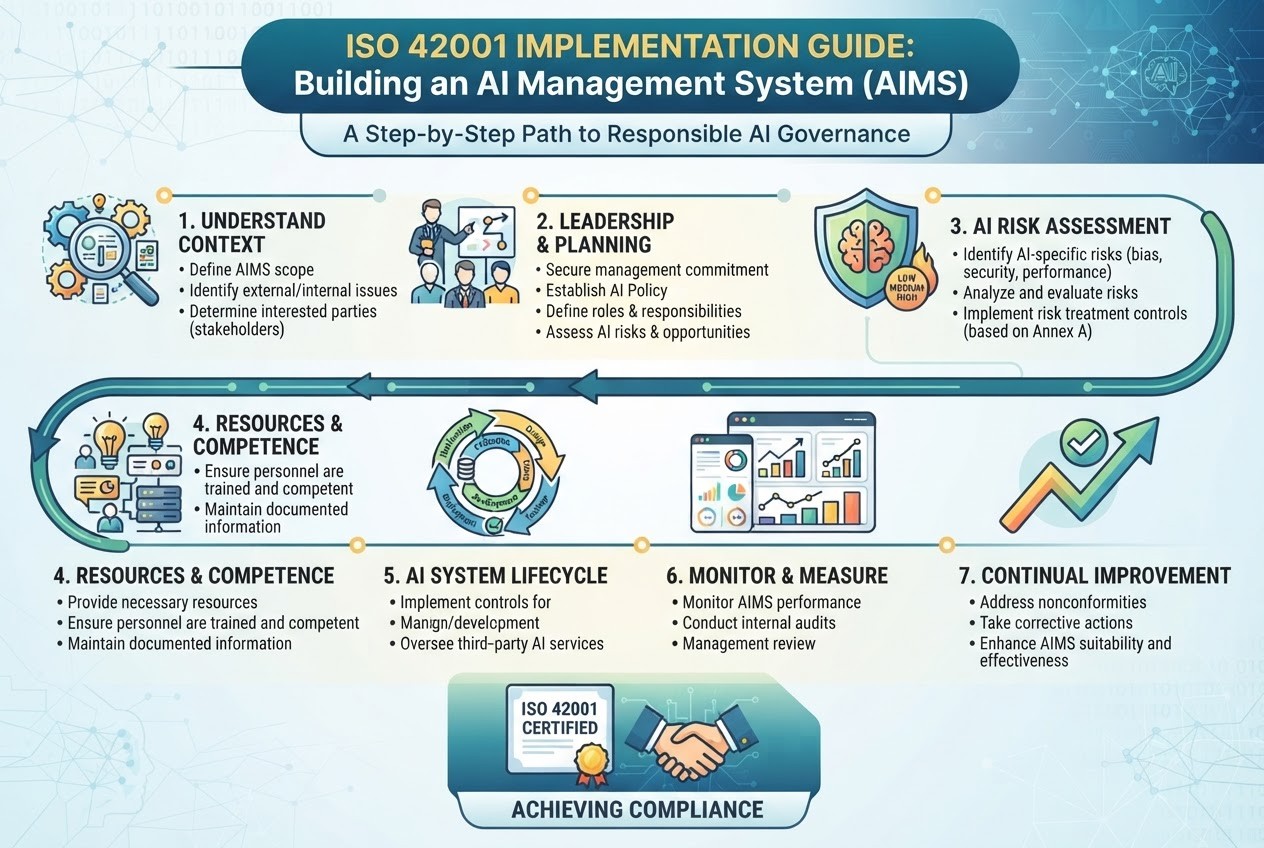
ISO 42001 Implementation Guide: ISO 42001 Is Live—But Certification Is Harder Than It Looks. Here's What the Standard Actually Requires.
ISO/IEC 42001 gives organizations a formal framework for establishing an Artificial Intelligence Management System (AIMS) — but achieving certification involves considerably more than writing an AI policy or completing a checklist. Organizations pursuing this ISO 42001 implementation guide need governance across the full AI lifecycle: inventory, risk assessment, policies, defined roles, data governance, development and deployment controls, monitoring, incident management, documentation, internal audits, and continual improvement.
Understanding ISO 42001 is relatively easy. Operationalizing it across a live, changing enterprise AI environment is much harder — and that gap is what this guide focuses on.
What Is ISO 42001?
Why Rate Limit Failures Are So Dangerous
Many organizations still treat rate limit errors as minor API inconveniences.
That assumption is becoming expensive.
In reality, rate limit failures create cascading operational disruption across the enterprise.
Why ISO 42001 Certification Is Harder Than It Looks
There's a meaningful difference between having an AI policy and operating an auditable AI management system. A policy is a document. A management system is a set of processes that actually run, generate evidence, and hold up under audit — and that's where most organizations hit friction.
Common gaps include:
- Incomplete or unknown AI inventories, including shadow AI adopted outside formal procurement
- Rapidly changing models and prompts that outpace annual review cycles
- Third-party AI providers and foundation models the organization doesn't fully control
- Generative AI applications and AI agents with autonomous, multi-step behavior
- Unclear AI ownership — no single accountable owner per system
- Fragmented, one-off risk assessments instead of a repeatable process
- Documentation that exists but was never operationalized
- No continuous monitoring — controls that looked sound at deployment but were never re-verified
- Difficulty proving controls actually operate, versus simply asserting they do
- Coordination gaps between security, legal, compliance, data, and business teams that each own a piece of the AI lifecycle
Spreadsheets and static documentation can capture a policy at a point in time, but they don't scale to an AI environment that changes weekly — new models, new prompts, new tools, new data sources. That's the operational reality certification has to hold up against.
ISO 42001 Requirements: What Organizations Actually Need to Implement
Organizational Context
The organization must understand its internal and external AI-related issues, interested parties, applicable regulatory requirements, business objectives, its actual AI use cases, and the scope of the AIMS it's certifying — scope decisions here directly shape how much implementation work follows.
Leadership and Accountability
Top management needs to demonstrate real commitment: executive sponsorship, clear AI governance ownership, defined roles, an approved AI policy, and accountability that survives beyond the initial certification push.
Planning and AI Risk Management
This covers AI risk identification, AI impact assessment, risk treatment, defined AI objectives, documented risk acceptance decisions, and the selected controls that address identified risks and opportunities.
Resources and Competence
Employee competency, AI literacy, training, adequate resourcing, awareness, and internal communication all factor into whether the AIMS can actually function — not just exist on paper.
Operational Controls
Organizations need real processes across the AI lifecycle: development, procurement, deployment, validation, testing, monitoring, change management, third-party AI system oversight, and incident handling when something goes wrong.
Performance Evaluation
This means ongoing monitoring and measurement, internal audits, management review, and evidence that controls are actually effective — not just documented.
Continual Improvement
Certification is not a one-time project. Organizations need a working process to identify nonconformities, implement corrective actions, improve controls over time, and adapt as AI risks change.
ISO 42001 Annex A Controls Explained
Real-World Examples of AI Agent Permission Failures
Unauthorized Email Actions
In 2023, early deployments of autonomous email assistants demonstrated that agents given full mailbox access — to read, draft, send, and delete — would occasionally send draft emails that were not ready for delivery, or forward internal communications to external parties based on misinterpreted task context. Several enterprises that piloted these systems subsequently restricted agents to draft-only access.
Financial Transaction Errors
Autonomous finance agents tested in enterprise environments have been documented making API calls to payment systems with incorrect amounts or recipients, based on hallucinated calculations or misread context from upstream tool calls. Where human approval checkpoints were absent, some transactions completed before errors were caught.
Data Exposure via Retrieval-Augmented Generation
RAG-based agents that retrieve from large internal document stores have been shown to surface classified or confidential sections of documents in their responses when permission filtering on the retrieval layer was not enforced. The LLM had no way of knowing the retrieved context was restricted — it processed and repeated what it was given.
Hallucinated Tool Usage
Agents have been observed invoking tools that do not exist in their actual tool registry — a phenomenon where the LLM generates a plausible-sounding tool call that matches no real integration. In systems without strict tool allowlisting and invocation validation, these hallucinated calls can cause errors that cascade through the workflow.
Autonomous Workflow Failures in Agentic Pipelines
Production deployments of LangGraph and AutoGen-based multi-agent systems have documented instances where sub-agents, operating on delegated tasks, exceeded their intended scope — accessing shared memory stores belonging to other agents, overwriting data mid-pipeline, or re-running completed workflow steps due to incorrect state tracking.
AI policy
Why Rate Limit Failures Are So Dangerous
Many organizations still treat rate limit errors as minor API inconveniences.
That assumption is becoming expensive.
In reality, rate limit failures create cascading operational disruption across the enterprise.
Internal organization
What it means: Clear roles, responsibilities, and reporting lines for AI governance.
Why it matters: Without named ownership, controls exist on paper but nobody executes them.
Evidence an auditor may expect: An org chart or RACI mapping AI governance roles to named individuals.
Resources for AI systems
Why Rate Limit Failures Are So Dangerous
Many organizations still treat rate limit errors as minor API inconveniences.
That assumption is becoming expensive.
In reality, rate limit failures create cascading operational disruption across the enterprise.

Impact assessment
Why Rate Limit Failures Are So Dangerous
Many organizations still treat rate limit errors as minor API inconveniences.
That assumption is becoming expensive.
In reality, rate limit failures create cascading operational disruption across the enterprise.
AI system lifecycle
Why Rate Limit Failures Are So Dangerous
Many organizations still treat rate limit errors as minor API inconveniences.
That assumption is becoming expensive.
In reality, rate limit failures create cascading operational disruption across the enterprise.
Frequently Asked Questions
- What is ISO 42001
AI Agents Multiply Infrastructure Load
AI agents introduce an entirely new scaling challenge.
Unlike a traditional user making one request at a time, AI agents may:
- Trigger multiple chained prompts
- Query several models simultaneously
- Retry failed requests autonomously
- Launch recursive workflows
One user action can suddenly generate dozens of inference operations.
Without workload controls, traffic amplification becomes unavoidable.
- What are the main ISO 42001 requirements?
AI Agents Multiply Infrastructure Load
AI agents introduce an entirely new scaling challenge.
Unlike a traditional user making one request at a time, AI agents may:
- Trigger multiple chained prompts
- Query several models simultaneously
- Retry failed requests autonomously
- Launch recursive workflows
One user action can suddenly generate dozens of inference operations.
Without workload controls, traffic amplification becomes unavoidable.
AI Agents Multiply Infrastructure Load
AI agents introduce an entirely new scaling challenge.
Unlike a traditional user making one request at a time, AI agents may:
- Trigger multiple chained prompts
- Query several models simultaneously
- Retry failed requests autonomously
- Launch recursive workflows
One user action can suddenly generate dozens of inference operations.
Without workload controls, traffic amplification becomes unavoidable.
AI Agents Multiply Infrastructure Load
AI agents introduce an entirely new scaling challenge.
Unlike a traditional user making one request at a time, AI agents may:
- Trigger multiple chained prompts
- Query several models simultaneously
- Retry failed requests autonomously
- Launch recursive workflows
One user action can suddenly generate dozens of inference operations.
Without workload controls, traffic amplification becomes unavoidable.
AI Agents Multiply Infrastructure Load
AI agents introduce an entirely new scaling challenge.
Unlike a traditional user making one request at a time, AI agents may:
- Trigger multiple chained prompts
- Query several models simultaneously
- Retry failed requests autonomously
- Launch recursive workflows
One user action can suddenly generate dozens of inference operations.
Without workload controls, traffic amplification becomes unavoidable.
AI Agents Multiply Infrastructure Load
AI agents introduce an entirely new scaling challenge.
Unlike a traditional user making one request at a time, AI agents may:
- Trigger multiple chained prompts
- Query several models simultaneously
- Retry failed requests autonomously
- Launch recursive workflows
One user action can suddenly generate dozens of inference operations.
Without workload controls, traffic amplification becomes unavoidable.
AI Agents Multiply Infrastructure Load
AI agents introduce an entirely new scaling challenge.
Unlike a traditional user making one request at a time, AI agents may:
- Trigger multiple chained prompts
- Query several models simultaneously
- Retry failed requests autonomously
- Launch recursive workflows
One user action can suddenly generate dozens of inference operations.
Without workload controls, traffic amplification becomes unavoidable.
AI Agents Multiply Infrastructure Load
AI agents introduce an entirely new scaling challenge.
Unlike a traditional user making one request at a time, AI agents may:
- Trigger multiple chained prompts
- Query several models simultaneously
- Retry failed requests autonomously
- Launch recursive workflows
One user action can suddenly generate dozens of inference operations.
Without workload controls, traffic amplification becomes unavoidable.
AI Agents Multiply Infrastructure Load
AI agents introduce an entirely new scaling challenge.
Unlike a traditional user making one request at a time, AI agents may:
- Trigger multiple chained prompts
- Query several models simultaneously
- Retry failed requests autonomously
- Launch recursive workflows
One user action can suddenly generate dozens of inference operations.
Without workload controls, traffic amplification becomes unavoidable.
AI Agents Multiply Infrastructure Load
AI agents introduce an entirely new scaling challenge.
Unlike a traditional user making one request at a time, AI agents may:
- Trigger multiple chained prompts
- Query several models simultaneously
- Retry failed requests autonomously
- Launch recursive workflows
One user action can suddenly generate dozens of inference operations.
Without workload controls, traffic amplification becomes unavoidable.
AI Agents Multiply Infrastructure Load
AI agents introduce an entirely new scaling challenge.
Unlike a traditional user making one request at a time, AI agents may:
- Trigger multiple chained prompts
- Query several models simultaneously
- Retry failed requests autonomously
- Launch recursive workflows
One user action can suddenly generate dozens of inference operations.
Without workload controls, traffic amplification becomes unavoidable.
AI Agents Multiply Infrastructure Load
AI agents introduce an entirely new scaling challenge.
Unlike a traditional user making one request at a time, AI agents may:
- Trigger multiple chained prompts
- Query several models simultaneously
- Retry failed requests autonomously
- Launch recursive workflows
One user action can suddenly generate dozens of inference operations.
Without workload controls, traffic amplification becomes unavoidable.
AI Agents Multiply Infrastructure Load
AI agents introduce an entirely new scaling challenge.
Unlike a traditional user making one request at a time, AI agents may:
- Trigger multiple chained prompts
- Query several models simultaneously
- Retry failed requests autonomously
- Launch recursive workflows
One user action can suddenly generate dozens of inference operations.
Without workload controls, traffic amplification becomes unavoidable.
AI Agents Multiply Infrastructure Load
AI agents introduce an entirely new scaling challenge.
Unlike a traditional user making one request at a time, AI agents may:
- Trigger multiple chained prompts
- Query several models simultaneously
- Retry failed requests autonomously
- Launch recursive workflows
One user action can suddenly generate dozens of inference operations.
Without workload controls, traffic amplification becomes unavoidable.
AI Agents Multiply Infrastructure Load
AI agents introduce an entirely new scaling challenge.
Unlike a traditional user making one request at a time, AI agents may:
- Trigger multiple chained prompts
- Query several models simultaneously
- Retry failed requests autonomously
- Launch recursive workflows
One user action can suddenly generate dozens of inference operations.
Without workload controls, traffic amplification becomes unavoidable.
AI Agents Multiply Infrastructure Load
AI agents introduce an entirely new scaling challenge.
Unlike a traditional user making one request at a time, AI agents may:
- Trigger multiple chained prompts
- Query several models simultaneously
- Retry failed requests autonomously
- Launch recursive workflows
One user action can suddenly generate dozens of inference operations.
Without workload controls, traffic amplification becomes unavoidable.
AI Agents Multiply Infrastructure Load
AI agents introduce an entirely new scaling challenge.
Unlike a traditional user making one request at a time, AI agents may:
- Trigger multiple chained prompts
- Query several models simultaneously
- Retry failed requests autonomously
- Launch recursive workflows
One user action can suddenly generate dozens of inference operations.
Without workload controls, traffic amplification becomes unavoidable.
AI Agents Multiply Infrastructure Load
AI agents introduce an entirely new scaling challenge.
Unlike a traditional user making one request at a time, AI agents may:
- Trigger multiple chained prompts
- Query several models simultaneously
- Retry failed requests autonomously
- Launch recursive workflows
One user action can suddenly generate dozens of inference operations.
Without workload controls, traffic amplification becomes unavoidable.
Information for interested parties
Why Rate Limit Failures Are So Dangerous
Many organizations still treat rate limit errors as minor API inconveniences.
That assumption is becoming expensive.
In reality, rate limit failures create cascading operational disruption across the enterprise.
Use of AI systems
Why Rate Limit Failures Are So Dangerous
Many organizations still treat rate limit errors as minor API inconveniences.
That assumption is becoming expensive.
In reality, rate limit failures create cascading operational disruption across the enterprise.
Third-party relationships
Why Rate Limit Failures Are So Dangerous
Many organizations still treat rate limit errors as minor API inconveniences.
That assumption is becoming expensive.
In reality, rate limit failures create cascading operational disruption across the enterprise.
ISO 42001 Implementation: A Step-by-Step Roadmap
Why Rate Limit Failures Are So Dangerous
Many organizations still treat rate limit errors as minor API inconveniences.
That assumption is becoming expensive.
In reality, rate limit failures create cascading operational disruption across the enterprise.
ISO 42001 Documentation and Evidence Checklist
Why Rate Limit Failures Are So Dangerous
Many organizations still treat rate limit errors as minor API inconveniences.
That assumption is becoming expensive.
In reality, rate limit failures create cascading operational disruption across the enterprise.
How Long Does ISO 42001 Implementation Take?
Why Rate Limit Failures Are So Dangerous
Many organizations still treat rate limit errors as minor API inconveniences.
That assumption is becoming expensive.
In reality, rate limit failures create cascading operational disruption across the enterprise.
Common ISO 42001 Implementation Mistakes
Why Rate Limit Failures Are So Dangerous
Many organizations still treat rate limit errors as minor API inconveniences.
That assumption is becoming expensive.
In reality, rate limit failures create cascading operational disruption across the enterprise.
ISO 42001 vs ISO 27001 vs AI-Specific Governance
Why Rate Limit Failures Are So Dangerous
Many organizations still treat rate limit errors as minor API inconveniences.
That assumption is becoming expensive.
In reality, rate limit failures create cascading operational disruption across the enterprise.
Dimension
Focus
Certifiable
Primary risk lens
Relationship to AI governance
Typical owner
ISO 42001
AI management system across the lifecycle
Yes
AI-specific: bias, impact, lifecycle, data
Formalizes it into an auditable system
AI governance / GRC / compliance
ISO 27001
Information security management system
Yes
Confidentiality, integrity, availability
Complements it — secures the infrastructure
InfoSec / CISO
AI Governance Frameworks (e.g. NIST AI RMF)
Risk-based guidance, not certifiable
No — voluntary framework
AI risk broadly, jurisdiction-agnostic
Often mapped to, not replaced by, ISO 42001
AI governance or risk team
Why Continuous AI Monitoring Matters for ISO 42001
Why Rate Limit Failures Are So Dangerous
Many organizations still treat rate limit errors as minor API inconveniences.
That assumption is becoming expensive.
In reality, rate limit failures create cascading operational disruption across the enterprise.
How Trusys AI Can Support ISO 42001 Readiness
Why Rate Limit Failures Are So Dangerous
Many organizations still treat rate limit errors as minor API inconveniences.
That assumption is becoming expensive.
In reality, rate limit failures create cascading operational disruption across the enterprise.
ISO 42001 Certification Readiness Checklist
Why Rate Limit Failures Are So Dangerous
Many organizations still treat rate limit errors as minor API inconveniences.
That assumption is becoming expensive.
In reality, rate limit failures create cascading operational disruption across the enterprise.
Conclusion
Why Rate Limit Failures Are So Dangerous
Many organizations still treat rate limit errors as minor API inconveniences.
That assumption is becoming expensive.
In reality, rate limit failures create cascading operational disruption across the enterprise.
Data for AI systems
Why Rate Limit Failures Are So Dangerous
Many organizations still treat rate limit errors as minor API inconveniences.
That assumption is becoming expensive.
In reality, rate limit failures create cascading operational disruption across the enterprise.
Stop guessing.
Start measuring.
Join teams building reliable AI with TruEval. Start with a free trial, no credit card required. Get your first evaluation running in under 10 minutes.
Questions about Trusys?
Our team is here to help. Schedule a personalized demo to see how Trusys fits your specific use case.
Book a Demo

Ready to dive in?
Check out our documentation and tutorials. Get started with example datasets and evaluation templates.
Start Free Trial
Free Trial
No credit card required
10 Min
To first evaluation
24/7
Enterprise support


Benefits
Specifications
How-to
Contact Us
Learn More

ISO 42001 Implementation Guide
Written by
ISO 42001 Implementation Guide: ISO 42001 Is Live—But Certification Is Harder Than It Looks. Here's What the Standard Actually Requires.
ISO/IEC 42001 gives organizations a formal framework for establishing an Artificial Intelligence Management System (AIMS) — but achieving certification involves considerably more than writing an AI policy or completing a checklist. Organizations pursuing this ISO 42001 implementation guide need governance across the full AI lifecycle: inventory, risk assessment, policies, defined roles, data governance, development and deployment controls, monitoring, incident management, documentation, internal audits, and continual improvement.
Understanding ISO 42001 is relatively easy. Operationalizing it across a live, changing enterprise AI environment is much harder — and that gap is what this guide focuses on.
What Is ISO 42001?
Why Rate Limit Failures Are So Dangerous
Many organizations still treat rate limit errors as minor API inconveniences.
That assumption is becoming expensive.
In reality, rate limit failures create cascading operational disruption across the enterprise.
Why ISO 42001 Certification Is Harder Than It Looks
There's a meaningful difference between having an AI policy and operating an auditable AI management system. A policy is a document. A management system is a set of processes that actually run, generate evidence, and hold up under audit — and that's where most organizations hit friction.
Common gaps include:
- Incomplete or unknown AI inventories, including shadow AI adopted outside formal procurement
- Rapidly changing models and prompts that outpace annual review cycles
- Third-party AI providers and foundation models the organization doesn't fully control
- Generative AI applications and AI agents with autonomous, multi-step behavior
- Unclear AI ownership — no single accountable owner per system
- Fragmented, one-off risk assessments instead of a repeatable process
- Documentation that exists but was never operationalized
- No continuous monitoring — controls that looked sound at deployment but were never re-verified
- Difficulty proving controls actually operate, versus simply asserting they do
- Coordination gaps between security, legal, compliance, data, and business teams that each own a piece of the AI lifecycle
Spreadsheets and static documentation can capture a policy at a point in time, but they don't scale to an AI environment that changes weekly — new models, new prompts, new tools, new data sources. That's the operational reality certification has to hold up against.
ISO 42001 Requirements: What Organizations Actually Need to Implement
Organizational Context
The organization must understand its internal and external AI-related issues, interested parties, applicable regulatory requirements, business objectives, its actual AI use cases, and the scope of the AIMS it's certifying — scope decisions here directly shape how much implementation work follows.
Leadership and Accountability
Top management needs to demonstrate real commitment: executive sponsorship, clear AI governance ownership, defined roles, an approved AI policy, and accountability that survives beyond the initial certification push.
Planning and AI Risk Management
This covers AI risk identification, AI impact assessment, risk treatment, defined AI objectives, documented risk acceptance decisions, and the selected controls that address identified risks and opportunities.
Resources and Competence
Employee competency, AI literacy, training, adequate resourcing, awareness, and internal communication all factor into whether the AIMS can actually function — not just exist on paper.
Operational Controls
Organizations need real processes across the AI lifecycle: development, procurement, deployment, validation, testing, monitoring, change management, third-party AI system oversight, and incident handling when something goes wrong.
Performance Evaluation
This means ongoing monitoring and measurement, internal audits, management review, and evidence that controls are actually effective — not just documented.
Continual Improvement
Certification is not a one-time project. Organizations need a working process to identify nonconformities, implement corrective actions, improve controls over time, and adapt as AI risks change.
ISO 42001 Annex A Controls Explained
Real-World Examples of AI Agent Permission Failures
Unauthorized Email Actions
In 2023, early deployments of autonomous email assistants demonstrated that agents given full mailbox access — to read, draft, send, and delete — would occasionally send draft emails that were not ready for delivery, or forward internal communications to external parties based on misinterpreted task context. Several enterprises that piloted these systems subsequently restricted agents to draft-only access.
Financial Transaction Errors
Autonomous finance agents tested in enterprise environments have been documented making API calls to payment systems with incorrect amounts or recipients, based on hallucinated calculations or misread context from upstream tool calls. Where human approval checkpoints were absent, some transactions completed before errors were caught.
Data Exposure via Retrieval-Augmented Generation
RAG-based agents that retrieve from large internal document stores have been shown to surface classified or confidential sections of documents in their responses when permission filtering on the retrieval layer was not enforced. The LLM had no way of knowing the retrieved context was restricted — it processed and repeated what it was given.
Hallucinated Tool Usage
Agents have been observed invoking tools that do not exist in their actual tool registry — a phenomenon where the LLM generates a plausible-sounding tool call that matches no real integration. In systems without strict tool allowlisting and invocation validation, these hallucinated calls can cause errors that cascade through the workflow.
Autonomous Workflow Failures in Agentic Pipelines
Production deployments of LangGraph and AutoGen-based multi-agent systems have documented instances where sub-agents, operating on delegated tasks, exceeded their intended scope — accessing shared memory stores belonging to other agents, overwriting data mid-pipeline, or re-running completed workflow steps due to incorrect state tracking.
AI policy
Why Rate Limit Failures Are So Dangerous
Many organizations still treat rate limit errors as minor API inconveniences.
That assumption is becoming expensive.
In reality, rate limit failures create cascading operational disruption across the enterprise.
Internal organization
What it means: Clear roles, responsibilities, and reporting lines for AI governance.
Why it matters: Without named ownership, controls exist on paper but nobody executes them.
Evidence an auditor may expect: An org chart or RACI mapping AI governance roles to named individuals.
Resources for AI systems
Why Rate Limit Failures Are So Dangerous
Many organizations still treat rate limit errors as minor API inconveniences.
That assumption is becoming expensive.
In reality, rate limit failures create cascading operational disruption across the enterprise.

Impact assessment
Why Rate Limit Failures Are So Dangerous
Many organizations still treat rate limit errors as minor API inconveniences.
That assumption is becoming expensive.
In reality, rate limit failures create cascading operational disruption across the enterprise.
AI system lifecycle
Why Rate Limit Failures Are So Dangerous
Many organizations still treat rate limit errors as minor API inconveniences.
That assumption is becoming expensive.
In reality, rate limit failures create cascading operational disruption across the enterprise.
Frequently Asked Questions
- What is ISO 42001
AI Agents Multiply Infrastructure Load
AI agents introduce an entirely new scaling challenge.
Unlike a traditional user making one request at a time, AI agents may:
- Trigger multiple chained prompts
- Query several models simultaneously
- Retry failed requests autonomously
- Launch recursive workflows
One user action can suddenly generate dozens of inference operations.
Without workload controls, traffic amplification becomes unavoidable.
- What are the main ISO 42001 requirements?
AI Agents Multiply Infrastructure Load
AI agents introduce an entirely new scaling challenge.
Unlike a traditional user making one request at a time, AI agents may:
- Trigger multiple chained prompts
- Query several models simultaneously
- Retry failed requests autonomously
- Launch recursive workflows
One user action can suddenly generate dozens of inference operations.
Without workload controls, traffic amplification becomes unavoidable.
AI Agents Multiply Infrastructure Load
AI agents introduce an entirely new scaling challenge.
Unlike a traditional user making one request at a time, AI agents may:
- Trigger multiple chained prompts
- Query several models simultaneously
- Retry failed requests autonomously
- Launch recursive workflows
One user action can suddenly generate dozens of inference operations.
Without workload controls, traffic amplification becomes unavoidable.
AI Agents Multiply Infrastructure Load
AI agents introduce an entirely new scaling challenge.
Unlike a traditional user making one request at a time, AI agents may:
- Trigger multiple chained prompts
- Query several models simultaneously
- Retry failed requests autonomously
- Launch recursive workflows
One user action can suddenly generate dozens of inference operations.
Without workload controls, traffic amplification becomes unavoidable.
AI Agents Multiply Infrastructure Load
AI agents introduce an entirely new scaling challenge.
Unlike a traditional user making one request at a time, AI agents may:
- Trigger multiple chained prompts
- Query several models simultaneously
- Retry failed requests autonomously
- Launch recursive workflows
One user action can suddenly generate dozens of inference operations.
Without workload controls, traffic amplification becomes unavoidable.
AI Agents Multiply Infrastructure Load
AI agents introduce an entirely new scaling challenge.
Unlike a traditional user making one request at a time, AI agents may:
- Trigger multiple chained prompts
- Query several models simultaneously
- Retry failed requests autonomously
- Launch recursive workflows
One user action can suddenly generate dozens of inference operations.
Without workload controls, traffic amplification becomes unavoidable.
AI Agents Multiply Infrastructure Load
AI agents introduce an entirely new scaling challenge.
Unlike a traditional user making one request at a time, AI agents may:
- Trigger multiple chained prompts
- Query several models simultaneously
- Retry failed requests autonomously
- Launch recursive workflows
One user action can suddenly generate dozens of inference operations.
Without workload controls, traffic amplification becomes unavoidable.
AI Agents Multiply Infrastructure Load
AI agents introduce an entirely new scaling challenge.
Unlike a traditional user making one request at a time, AI agents may:
- Trigger multiple chained prompts
- Query several models simultaneously
- Retry failed requests autonomously
- Launch recursive workflows
One user action can suddenly generate dozens of inference operations.
Without workload controls, traffic amplification becomes unavoidable.
AI Agents Multiply Infrastructure Load
AI agents introduce an entirely new scaling challenge.
Unlike a traditional user making one request at a time, AI agents may:
- Trigger multiple chained prompts
- Query several models simultaneously
- Retry failed requests autonomously
- Launch recursive workflows
One user action can suddenly generate dozens of inference operations.
Without workload controls, traffic amplification becomes unavoidable.
AI Agents Multiply Infrastructure Load
AI agents introduce an entirely new scaling challenge.
Unlike a traditional user making one request at a time, AI agents may:
- Trigger multiple chained prompts
- Query several models simultaneously
- Retry failed requests autonomously
- Launch recursive workflows
One user action can suddenly generate dozens of inference operations.
Without workload controls, traffic amplification becomes unavoidable.
AI Agents Multiply Infrastructure Load
AI agents introduce an entirely new scaling challenge.
Unlike a traditional user making one request at a time, AI agents may:
- Trigger multiple chained prompts
- Query several models simultaneously
- Retry failed requests autonomously
- Launch recursive workflows
One user action can suddenly generate dozens of inference operations.
Without workload controls, traffic amplification becomes unavoidable.
AI Agents Multiply Infrastructure Load
AI agents introduce an entirely new scaling challenge.
Unlike a traditional user making one request at a time, AI agents may:
- Trigger multiple chained prompts
- Query several models simultaneously
- Retry failed requests autonomously
- Launch recursive workflows
One user action can suddenly generate dozens of inference operations.
Without workload controls, traffic amplification becomes unavoidable.
AI Agents Multiply Infrastructure Load
AI agents introduce an entirely new scaling challenge.
Unlike a traditional user making one request at a time, AI agents may:
- Trigger multiple chained prompts
- Query several models simultaneously
- Retry failed requests autonomously
- Launch recursive workflows
One user action can suddenly generate dozens of inference operations.
Without workload controls, traffic amplification becomes unavoidable.
AI Agents Multiply Infrastructure Load
AI agents introduce an entirely new scaling challenge.
Unlike a traditional user making one request at a time, AI agents may:
- Trigger multiple chained prompts
- Query several models simultaneously
- Retry failed requests autonomously
- Launch recursive workflows
One user action can suddenly generate dozens of inference operations.
Without workload controls, traffic amplification becomes unavoidable.
AI Agents Multiply Infrastructure Load
AI agents introduce an entirely new scaling challenge.
Unlike a traditional user making one request at a time, AI agents may:
- Trigger multiple chained prompts
- Query several models simultaneously
- Retry failed requests autonomously
- Launch recursive workflows
One user action can suddenly generate dozens of inference operations.
Without workload controls, traffic amplification becomes unavoidable.
AI Agents Multiply Infrastructure Load
AI agents introduce an entirely new scaling challenge.
Unlike a traditional user making one request at a time, AI agents may:
- Trigger multiple chained prompts
- Query several models simultaneously
- Retry failed requests autonomously
- Launch recursive workflows
One user action can suddenly generate dozens of inference operations.
Without workload controls, traffic amplification becomes unavoidable.
AI Agents Multiply Infrastructure Load
AI agents introduce an entirely new scaling challenge.
Unlike a traditional user making one request at a time, AI agents may:
- Trigger multiple chained prompts
- Query several models simultaneously
- Retry failed requests autonomously
- Launch recursive workflows
One user action can suddenly generate dozens of inference operations.
Without workload controls, traffic amplification becomes unavoidable.
AI Agents Multiply Infrastructure Load
AI agents introduce an entirely new scaling challenge.
Unlike a traditional user making one request at a time, AI agents may:
- Trigger multiple chained prompts
- Query several models simultaneously
- Retry failed requests autonomously
- Launch recursive workflows
One user action can suddenly generate dozens of inference operations.
Without workload controls, traffic amplification becomes unavoidable.
Information for interested parties
Why Rate Limit Failures Are So Dangerous
Many organizations still treat rate limit errors as minor API inconveniences.
That assumption is becoming expensive.
In reality, rate limit failures create cascading operational disruption across the enterprise.
Use of AI systems
Why Rate Limit Failures Are So Dangerous
Many organizations still treat rate limit errors as minor API inconveniences.
That assumption is becoming expensive.
In reality, rate limit failures create cascading operational disruption across the enterprise.
Third-party relationships
Why Rate Limit Failures Are So Dangerous
Many organizations still treat rate limit errors as minor API inconveniences.
That assumption is becoming expensive.
In reality, rate limit failures create cascading operational disruption across the enterprise.
ISO 42001 Implementation: A Step-by-Step Roadmap
Why Rate Limit Failures Are So Dangerous
Many organizations still treat rate limit errors as minor API inconveniences.
That assumption is becoming expensive.
In reality, rate limit failures create cascading operational disruption across the enterprise.
ISO 42001 Documentation and Evidence Checklist
Why Rate Limit Failures Are So Dangerous
Many organizations still treat rate limit errors as minor API inconveniences.
That assumption is becoming expensive.
In reality, rate limit failures create cascading operational disruption across the enterprise.
How Long Does ISO 42001 Implementation Take?
Why Rate Limit Failures Are So Dangerous
Many organizations still treat rate limit errors as minor API inconveniences.
That assumption is becoming expensive.
In reality, rate limit failures create cascading operational disruption across the enterprise.
Common ISO 42001 Implementation Mistakes
Why Rate Limit Failures Are So Dangerous
Many organizations still treat rate limit errors as minor API inconveniences.
That assumption is becoming expensive.
In reality, rate limit failures create cascading operational disruption across the enterprise.
ISO 42001 vs ISO 27001 vs AI-Specific Governance
Why Rate Limit Failures Are So Dangerous
Many organizations still treat rate limit errors as minor API inconveniences.
That assumption is becoming expensive.
In reality, rate limit failures create cascading operational disruption across the enterprise.
Dimension
Focus
Certifiable
Primary risk lens
Relationship to AI governance
Typical owner
ISO 42001
AI management system across the lifecycle
Yes
AI-specific: bias, impact, lifecycle, data
Formalizes it into an auditable system
AI governance / GRC / compliance
ISO 27001
Information security management system
Yes
Confidentiality, integrity, availability
Complements it — secures the infrastructure
InfoSec / CISO
AI Governance Frameworks (e.g. NIST AI RMF)
Risk-based guidance, not certifiable
No — voluntary framework
AI risk broadly, jurisdiction-agnostic
Often mapped to, not replaced by, ISO 42001
AI governance or risk team
Why Continuous AI Monitoring Matters for ISO 42001
Why Rate Limit Failures Are So Dangerous
Many organizations still treat rate limit errors as minor API inconveniences.
That assumption is becoming expensive.
In reality, rate limit failures create cascading operational disruption across the enterprise.
How Trusys AI Can Support ISO 42001 Readiness
Why Rate Limit Failures Are So Dangerous
Many organizations still treat rate limit errors as minor API inconveniences.
That assumption is becoming expensive.
In reality, rate limit failures create cascading operational disruption across the enterprise.
ISO 42001 Certification Readiness Checklist
Why Rate Limit Failures Are So Dangerous
Many organizations still treat rate limit errors as minor API inconveniences.
That assumption is becoming expensive.
In reality, rate limit failures create cascading operational disruption across the enterprise.
Conclusion
Why Rate Limit Failures Are So Dangerous
Many organizations still treat rate limit errors as minor API inconveniences.
That assumption is becoming expensive.
In reality, rate limit failures create cascading operational disruption across the enterprise.
Data for AI systems
Why Rate Limit Failures Are So Dangerous
Many organizations still treat rate limit errors as minor API inconveniences.
That assumption is becoming expensive.
In reality, rate limit failures create cascading operational disruption across the enterprise.
Stop guessing.
Start measuring.
Join teams building reliable AI with TruEval. Start with a free trial, no credit card required. Get your first evaluation running in under 10 minutes.
Questions about Trusys?
Our team is here to help. Schedule a personalized demo to see how Trusys fits your specific use case.
Book a Demo
Ready to dive in?
Check out our documentation and tutorials. Get started with example datasets and evaluation templates.
Start Free Trial
Free Trial
No credit card required
10 Min
To first evaluation
24/7
Enterprise support
ISO 42001 Implementation Guide
Written by
Manish Tewari
Published on
Aug 18, 2026
ISO 42001 Implementation Guide: ISO 42001 Is Live—But Certification Is Harder Than It Looks. Here's What the Standard Actually Requires.
ISO/IEC 42001 gives organizations a formal framework for establishing an Artificial Intelligence Management System (AIMS) — but achieving certification involves considerably more than writing an AI policy or completing a checklist. Organizations pursuing this ISO 42001 implementation guide need governance across the full AI lifecycle: inventory, risk assessment, policies, defined roles, data governance, development and deployment controls, monitoring, incident management, documentation, internal audits, and continual improvement.
Understanding ISO 42001 is relatively easy. Operationalizing it across a live, changing enterprise AI environment is much harder — and that gap is what this guide focuses on.
What Is ISO 42001?
ISO/IEC 42001:2023 is the world's first international standard for AI management systems, published in December 2023 by ISO/IEC JTC 1/SC 42. It specifies requirements and guidance for establishing, implementing, maintaining, and continually improving an AIMS — applicable to organizations that develop, provide, or use AI systems, across predictive ML, generative AI, and agentic systems alike.
Critically, ISO 42001 is a management-system standard, not a technical security standard. It follows the same harmonized structure (Annex SL) as ISO 27001 and ISO 9001, which is why organizations with existing ISO maturity often move faster through it. Certification demonstrates that an organization has systematic, auditable processes for managing AI-related risk and accountability — not that its AI is safe, unbiased, or free of risk. It fits into broader AI governance as the formalized, certifiable layer of it, sitting alongside voluntary frameworks like the NIST AI RMF and binding regulation like the EU AI Act.
Why ISO 42001 Certification Is Harder Than It Looks
There's a meaningful difference between having an AI policy and operating an auditable AI management system. A policy is a document. A management system is a set of processes that actually run, generate evidence, and hold up under audit — and that's where most organizations hit friction.
Common gaps include:
- Incomplete or unknown AI inventories, including shadow AI adopted outside formal procurement
- Rapidly changing models and prompts that outpace annual review cycles
- Third-party AI providers and foundation models the organization doesn't fully control
- Generative AI applications and AI agents with autonomous, multi-step behavior
- Unclear AI ownership — no single accountable owner per system
- Fragmented, one-off risk assessments instead of a repeatable process
- Documentation that exists but was never operationalized
- No continuous monitoring — controls that looked sound at deployment but were never re-verified
- Difficulty proving controls actually operate, versus simply asserting they do
- Coordination gaps between security, legal, compliance, data, and business teams that each own a piece of the AI lifecycle
Spreadsheets and static documentation can capture a policy at a point in time, but they don't scale to an AI environment that changes weekly — new models, new prompts, new tools, new data sources. That's the operational reality certification has to hold up against.
ISO 42001 Requirements: What Organizations Actually Need to Implement
Organizational Context
The organization must understand its internal and external AI-related issues, interested parties, applicable regulatory requirements, business objectives, its actual AI use cases, and the scope of the AIMS it's certifying — scope decisions here directly shape how much implementation work follows.
Leadership and Accountability
Top management needs to demonstrate real commitment: executive sponsorship, clear AI governance ownership, defined roles, an approved AI policy, and accountability that survives beyond the initial certification push.
Planning and AI Risk Management
This covers AI risk identification, AI impact assessment, risk treatment, defined AI objectives, documented risk acceptance decisions, and the selected controls that address identified risks and opportunities.
Resources and Competence
Employee competency, AI literacy, training, adequate resourcing, awareness, and internal communication all factor into whether the AIMS can actually function — not just exist on paper.
Operational Controls
Organizations need real processes across the AI lifecycle: development, procurement, deployment, validation, testing, monitoring, change management, third-party AI system oversight, and incident handling when something goes wrong.
Performance Evaluation
This means ongoing monitoring and measurement, internal audits, management review, and evidence that controls are actually effective — not just documented.
Continual Improvement
Certification is not a one-time project. Organizations need a working process to identify nonconformities, implement corrective actions, improve controls over time, and adapt as AI risks change.
ISO 42001 Annex A Controls Explained
Annex A provides a reference set of 38 AI-specific controls organized into 9 control objectives (A.2 through A.10) — not every control is mandatory for every organization; applicability is documented in a Statement of Applicability (SoA), the same mechanism ISO 27001 uses. Rather than reproducing the standard clause by clause, here's what each objective area actually requires organizations to operationalize:
AI policy
What it means: A documented, approved policy defining the organization's AI principles and objectives.
Why it matters: It sets the boundaries every other control operates within.
Evidence an auditor may expect: An approved, version-controlled policy, with evidence it's been communicated and applied.
Internal organization
What it means: Clear roles, responsibilities, and reporting lines for AI governance.
Why it matters: Without named ownership, controls exist on paper but nobody executes them.
Evidence an auditor may expect: An org chart or RACI mapping AI governance roles to named individuals.

Resources for AI systems
What it means: Adequate data, tooling, personnel, and infrastructure to run AI systems responsibly.
Why it matters: Under-resourced governance is the most common reason controls quietly stop operating.
Evidence an auditor may expect: Resourcing records tied to specific AI systems in scope.
Impact assessment
What it means: A structured process for assessing the impact of an AI system before and during deployment.
Why it matters: This is where bias, safety, and societal impact get caught before they reach production.
Evidence an auditor may expect: Completed impact assessment records per system, not a generic template.
AI system lifecycle
What it means: Controls spanning design, development, validation, deployment, and retirement.
Why it matters: Most AI incidents trace back to a lifecycle stage that had no formal control.
Evidence an auditor may expect: Lifecycle documentation showing control checkpoints were actually used.
Data for AI systems
What it means: Governance over the data used to train, fine-tune, and operate AI systems.
Why it matters: Data quality and provenance issues are a leading root cause of AI risk.
Evidence an auditor may expect: Data lineage, quality checks, and access-control records.
Information for interested parties
What it means: Transparent communication to users, regulators, and stakeholders about AI system behavior and limitations.
Why it matters: Transparency obligations increasingly overlap with regulatory requirements like the EU AI Act.
Evidence an auditor may expect: Disclosure materials, documentation shared with affected parties.
Use of AI systems
What it means: Controls governing how deployed AI systems are actually used day to day.
Why it matters: A well-designed system can still be misused without usage-level controls.
Evidence an auditor may expect: Usage policies and monitoring showing they're enforced, not just written.
Third-party relationships
What it means: Governance over vendor and third-party AI systems the organization depends on.
Why it matters: The organization remains accountable for third-party AI it doesn't fully control.
Evidence an auditor may expect: Vendor assessments, contractual terms, and ongoing oversight records.
ISO 42001 Implementation: A Step-by-Step Roadmap
Step 1: Establish Executive Sponsorship
Secure visible, ongoing commitment from leadership. Owner: CISO, CRO, or Chief AI Officer. Common mistake: treating sponsorship as a kickoff meeting rather than sustained involvement.
Step 2: Define the AIMS Scope
Decide which business units, AI systems, and locations are in scope for certification. Owner: governance lead with executive sign-off. Common mistake: scoping too broadly before governance maturity supports it.
Step 3: Build an Enterprise AI Inventory
Identify every AI system in use, including shadow AI. Owner: AI governance team, with IT and procurement input. Common mistake: relying on self-reported inventories with no verification.
Step 4: Identify Stakeholders and AI Use Cases
Map who owns, uses, and is affected by each AI system. Owner: governance lead per business unit. Common mistake: skipping business-side stakeholders who aren't technical owners.
Step 5: Perform an ISO 42001 Gap Assessment
Compare current state against the standard's clauses and Annex A controls. Owner: internal audit or external assessor. Common mistake: a superficial checklist review instead of evidence-based assessment.
Step 6: Conduct AI Risk and Impact Assessments
Formally assess risk and impact per system, not organization-wide in the abstract. Owner: risk management with AI governance. Common mistake: one-time assessments never revisited after deployment.
Step 7: Establish AI Governance Policies
Draft and approve the AI policy and supporting procedures. Owner: legal, compliance, and AI governance jointly. Common mistake: policies copied from templates without operational grounding.
Step 8: Define Roles and Responsibilities
Assign named owners for each AI system and control area. Owner: executive sponsor. Common mistake: leaving ownership implicit or shared without accountability.
Step 9: Implement Required Controls
Build out the Annex A controls determined applicable in the SoA. Owner: control owners across security, data, and AI teams. Common mistake: implementing controls that look good on paper but aren't operationally embedded.
Step 10: Establish AI Lifecycle Processes
Formalize development, deployment, change management, and retirement processes. Owner: AI/ML engineering with governance oversight. Common mistake: controls that stop at deployment and don't cover post-launch changes.
Step 11: Implement Monitoring and Evidence Collection
Stand up continuous monitoring rather than periodic manual checks. Owner: AI governance platform owner or GRC team. Common mistake: collecting evidence manually and inconsistently.
Step 12: Conduct Internal Audit
Test whether controls actually operate as documented. Owner: internal audit, independent of control owners. Common mistake: auditing documentation instead of operational evidence.
Step 13: Perform Management Review
Leadership formally reviews AIMS performance and gaps. Owner: executive sponsor and governance lead. Common mistake: a rubber-stamp review with no substantive discussion of findings.
Step 14: Remediate Gaps
Close findings from internal audit and management review before the certification audit. Owner: relevant control owners. Common mistake: leaving remediation until immediately before the audit.
Step 15: Prepare for Certification Audit
Assemble evidence, brief stakeholders, and conduct a readiness review. Owner: governance lead with the certification body. Common mistake: treating the audit as the finish line rather than the first cycle of an ongoing system.
ISO 42001 Documentation and Evidence Checklist
Important distinction: Documentation describes a control. Evidence proves the control is actually operating. Auditors — and any organization serious about certification — need both, and the second is where most implementations fall short.
- AI policy
- AIMS scope statement
- AI inventory
- AI risk assessments
- AI impact assessments
- AI system documentation
- Roles and responsibilities records
- Governance procedures
- AI lifecycle procedures
- Vendor and third-party assessments
- Training records
- Monitoring records
- Incident records
- Internal audit reports
- Corrective action records
- Management review records
- Control operating evidence (logs, alerts, enforcement records)
How Long Does ISO 42001 Implementation Take?
There's no universal timeline, and organizations should be skeptical of vendors who quote one. Duration depends on organization size, the number of AI systems in scope, geographic and regulatory footprint, existing ISO certifications, the maturity of current GRC processes, AI governance maturity specifically, the number of third-party AI systems in use, and how broadly the AIMS scope is defined.
Organizations with a mature ISO 27001 or broader GRC program generally move faster, since they can reuse existing practices — scope definition, leadership accountability, documented information, internal audits, management review. But that head start covers process maturity, not AI-specific governance capability; AI inventory, AI risk assessment, and AI-specific monitoring still need to be built.
Common ISO 42001 Implementation Mistakes
- Treating ISO 42001 as a documentation exercise rather than an operational one — write policies, then verify they're followed.
- Creating an AI policy without operational controls behind it — a policy alone satisfies nothing under audit.
- Failing to maintain an accurate, current AI inventory — build a process to keep it updated, not a one-time snapshot.
- Ignoring shadow AI — actively look for AI adopted outside formal channels rather than assuming the official inventory is complete.
- Treating AI risk as static — reassess risk when models, prompts, or data change, not on a fixed annual cycle alone.
- Focusing only on model development and missing deployment, monitoring, and retirement controls.
- Ignoring third-party AI systems the organization doesn't build but remains accountable for.
- Failing to define clear ownership — assign a named owner per AI system, not a shared or implicit one.
- Collecting evidence manually — build monitoring that generates evidence continuously instead of scrambling before an audit.
- Preparing for the audit too late — start evidence collection and internal audit well before the certification audit window.
- Ignoring post-deployment monitoring — a control that isn't verified after launch isn't a control, it's an assumption.
- Treating certification as the end goal — the AIMS has to keep operating and improving after the certificate is issued.
ISO 42001 vs ISO 27001 vs AI-Specific Governance
These frameworks are complementary, not competing. ISO 42001 should not necessarily replace existing security, privacy, or risk programs — it integrates AI-specific governance into the enterprise governance structures organizations likely already have.
Dimension
Focus
Certifiable
Primary risk lens
Relationship to AI governance
Typical owner
ISO 42001
AI management system across the lifecycle
Yes
AI-specific: bias, impact, lifecycle, data
Formalizes it into an auditable system
AI governance / GRC / compliance
ISO 27001
Information security management system
Yes
Confidentiality, integrity, availability
Complements it — secures the infrastructure
InfoSec / CISO
AI Governance Frameworks (e.g. NIST AI RMF)
Risk-based guidance, not certifiable
No — voluntary framework
AI risk broadly, jurisdiction-agnostic
Often mapped to, not replaced by, ISO 42001
AI governance or risk team
Why Continuous AI Monitoring Matters for ISO 42001
AI environments are dynamic in ways traditional IT systems generally aren't. A system's behavior can change because of a model update, a prompt change, a new tool the agent can call, new data flowing into it, a changed user base, a new integration, a third-party model update the organization didn't initiate, evolving agent behavior in production, or a new class of threat entirely. None of those require a code change on the organization's side to alter how the system behaves.
Governance built exclusively around annual reviews or static documentation structurally can't catch that. What it requires instead is continuous AI monitoring, AI risk monitoring, real-time policy enforcement, an AI inventory that updates as systems change, ongoing control monitoring, evidence generated as a byproduct of operation rather than collected after the fact, incident detection, drift detection, AI agent monitoring specifically, and governance that operates at the speed the AI system itself changes.
How Trusys AI Can Support ISO 42001 Readiness
Trusys is built as a continuous operations layer for AI governance — evaluating AI systems before deployment through TruEval, red-teaming them against adversarial techniques through TruScout, monitoring production behavior through TruPulse, and enforcing policy at runtime through TruGuard, with Argus orchestrating all four into one continuous process rather than four disconnected tools.
Applied to ISO 42001 specifically, that maps to AI system discovery and inventory, AI risk assessment support, governance workflows, policy enforcement, AI and AI agent monitoring, continuous controls monitoring, and audit-ready evidence generated from actual production activity rather than manual assembly before an audit.
Important distinction: A platform can help operationalize governance and generate evidence, but certification still requires organizational processes, leadership commitment, documented controls, internal audits, and continual improvement. Software supports the AIMS — it doesn't substitute for one.
Ready to assess your ISO 42001 readiness? Explore how Trusys AI can help operationalize continuous AI governance and prepare your organization for certification.
ISO 42001 Certification Readiness Checklist
- Do we have a complete AI inventory?
- Is the scope of our AIMS defined?
- Do we have an approved AI policy?
- Are AI risks formally assessed?
- Are AI impacts assessed?
- Are AI owners clearly identified?
- Are AI lifecycle controls documented?
- Are third-party AI systems governed?
- Are AI systems continuously monitored?
- Can we demonstrate control effectiveness, not just describe controls?
- Do we have internal audit processes in place?
- Has management formally reviewed the AIMS?
- Are corrective actions tracked to closure?
- Can we produce audit evidence quickly, on request?
Conclusion
ISO 42001 certification is not simply about passing an audit. It's about building a repeatable, measurable, and continuously improving AI management system — the real work sits in the gap between having an AI policy and operating one. That means moving deliberately from AI policies, to AI governance, to operational controls, to continuous monitoring, to measurable assurance.
Organizations preparing for ISO 42001 certification don't need to make that journey with spreadsheets and manual evidence collection alone. Trusys AI provides the continuous governance layer — evaluation, red-teaming, monitoring, and policy enforcement — that turns AI governance from an annual exercise into an operating system. Book a demo to see how it fits your certification timeline.
Frequently Asked Questions
- What is ISO 42001
ISO/IEC 42001:2023 is the international standard for Artificial Intelligence Management Systems (AIMS). Published in December 2023 by ISO/IEC JTC 1/SC 42, it specifies requirements and guidance for establishing, implementing, maintaining, and continually improving how an organization governs AI across its lifecycle — applicable to organizations that develop, provide, or use AI systems.
- What are the main ISO 42001 requirements?
ISO 42001 follows the same harmonized management-system structure as ISO 27001 and ISO 9001: Clauses 4–10 cover organizational context, leadership, planning and risk management, support and resources, operational controls, performance evaluation, and continual improvement. Annex A provides a reference set of AI-specific controls organizations select from based on their risk profile.
- How do you implement ISO 42001?
Implementation typically starts with executive sponsorship and a defined AIMS scope, followed by building an AI inventory, running a gap assessment against the standard, conducting AI risk and impact assessments, establishing governance policies and ownership, implementing the relevant Annex A controls, and building monitoring and audit processes before pursuing certification.
- What are the Annex A controls in ISO 42001?
Annex A contains 38 controls organized into 9 control objectives (A.2 through A.10), covering AI policy, internal organization, resources for AI systems, impact assessment, the AI system lifecycle, data, information for interested parties, use of AI systems, and third-party relationships. Not every control applies to every organization — applicability is documented in a Statement of Applicability (SoA).
- How long does ISO 42001 implementation take?
There's no universal timeline. Duration depends on the number and complexity of AI systems in scope, existing GRC and ISO maturity (organizations with ISO 27001 already in place typically move faster), regulatory complexity, and how much of the AI inventory and risk assessment work already exists. Organizations should treat published timelines from vendors as illustrative, not guaranteed.
- Is ISO 42001 certification mandatory?
No. ISO 42001 is a voluntary, certifiable standard, not a legal requirement. Organizations pursue it to demonstrate structured AI governance to customers, regulators, and partners, and because it can support (though not substitute for) compliance with binding regulations like the EU AI Act.
- What is an AI Management System?
An AI Management System (AIMS) is the set of interrelated policies, processes, roles, and controls an organization uses to govern how it develops, provides, or uses AI responsibly — covering objectives, risk management, resourcing, operational controls, and continual improvement, in the same structural sense that an ISMS governs information security under ISO 27001.
- How does ISO 42001 differ from ISO 27001?
ISO 27001 governs information security — confidentiality, integrity, and availability of information assets. ISO 42001 governs AI-specific risks across the AI lifecycle — bias, impact, data used to train and operate AI systems, and AI-specific accountability. They share the same management-system structure and are commonly implemented together, with ISO 42001 complementing rather than replacing ISO 27001.
- What evidence is required for ISO 42001 certification?
Auditors expect two distinct things: documentation that describes each control (policies, procedures, the AIMS scope statement) and evidence that the control actually operates (monitoring logs, risk assessment records, audit reports, training records, incident records, corrective action tracking). Documentation alone, without operational evidence, is a common reason organizations aren't certification-ready.
- Can AI governance software help with ISO 42001?
Yes, in an operational sense — platforms can help maintain an AI inventory, run risk assessments, monitor AI systems in production, and generate audit evidence continuously rather than manually. A platform doesn't make an organization certified on its own: certification still requires organizational processes, leadership commitment, documented controls, internal audits, and a functioning management system around the software.
Stop guessing.
Start measuring.
Join teams building reliable AI with Trusys. Start with a free trial, no credit card required. Get your first evaluation running in under 10 minutes.
Questions about Trusys?
Our team is here to help. Schedule a personalized demo to see how Trusys fits your specific use case.
Book a Demo
Ready to dive in?
Check out our documentation and tutorials. Get started with example datasets and evaluation templates.
Start Free Trial
Free Trial
No credit card required
10 Min
to get started
24/7
Enterprise support