NBFC Co-Lending and AI Credit Models: The Governance Blind Spot RBI Is Watching
Written by

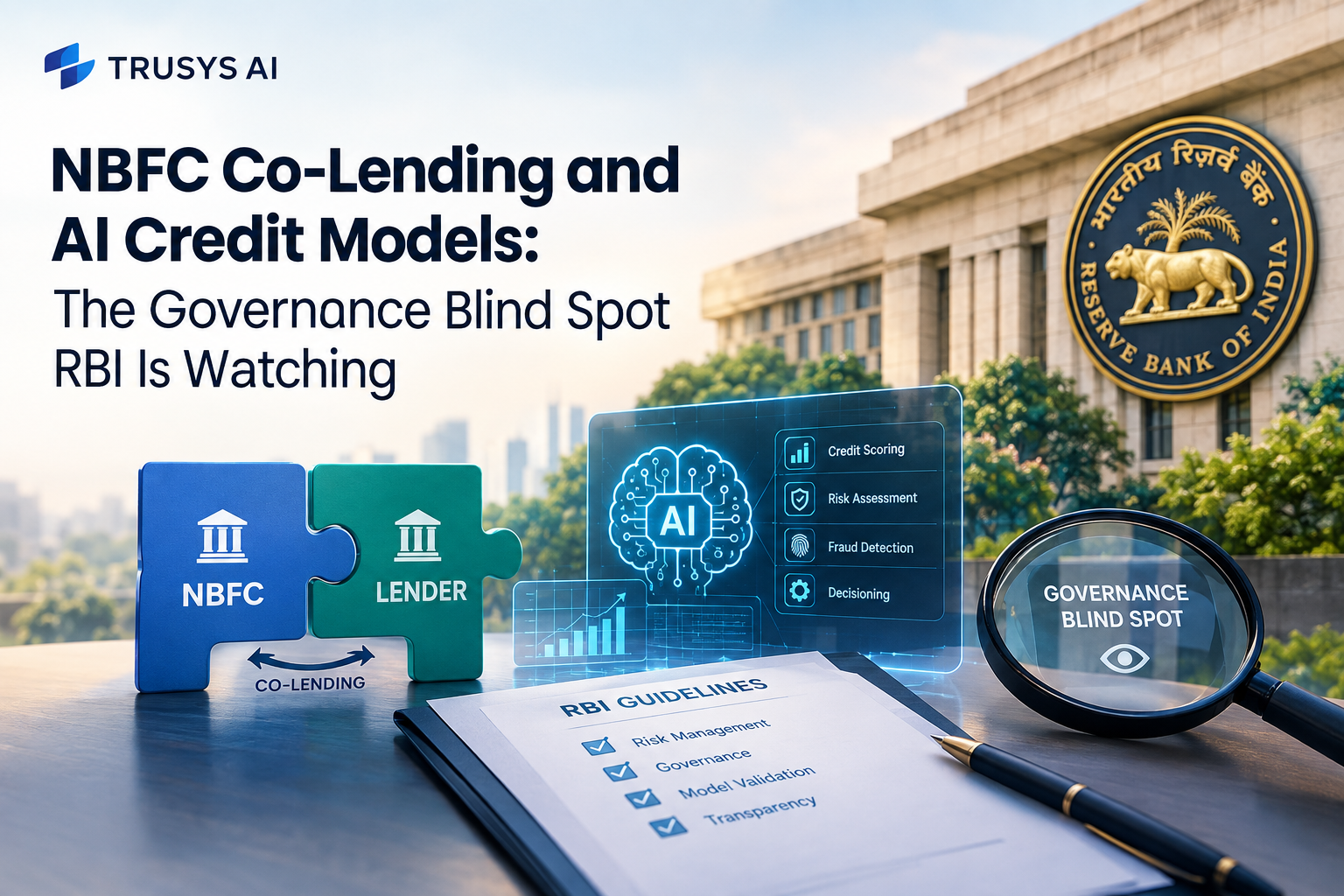
Imagine a high-volume retail lending program in full swing. An Indian Non-Banking Financial Company (NBFC) partners with a commercial bank to extend two-wheeler and micro-MSME loans under a 20:80 co-lending arrangement. To process tens of thousands of applications daily, the NBFC integrates an algorithmic credit scoring tool provided by a third-party fintech.
The machine learning (ML) model ingests thousands of alternative data signals—from digital payment velocity and device metadata to geo-spatial income proxies. Within milliseconds, the model evaluates applicant eligibility, assigns a risk score, determines the risk-based pricing, sets credit limits, and flags potential fraud. To the bank, the pipeline looks seamless, hyper-efficient, and low-friction.
Then comes the audit.
When internal auditors and regulators ask a simple question—“Why was an eligible applicant in a specific demographic rejected, while a higher-risk applicant was approved at a lower interest rate?”—the answers begin to blur. The NBFC points to the fintech's proprietary model; the fintech claims its proprietary neural network is an intellectual property black box; and the bank asserts that it relied on the NBFC's primary origination checks.
This scenario exposes a growing structural issue in Indian retail finance: while co-lending spreads risk and expands distribution, AI-driven credit decisions can fragment operational accountability.
The fundamental issue facing Chief Risk Officers (CROs) and Chief Compliance Officers (CCOs) is not merely whether an AI model predicts defaults accurately. It is whether the institution can prove that the model is governed, monitored, explainable, auditable, and operating within approved credit risk policies.
Co-Lending Already Creates a Governance Challenge
Why Rate Limit Failures Are So Dangerous
Many organizations still treat rate limit errors as minor API inconveniences.
That assumption is becoming expensive.
In reality, rate limit failures create cascading operational disruption across the enterprise.
When an institution layers an AI credit underwriting model onto this structure, the decision chain expands rapidly:
- Data Ingestion: Alternative and traditional data are pulled via APIs.
- Feature Engineering: Machine learning algorithms convert raw data into predictive features.
- Automated Recommendation: The model outputs a probability of default, custom score, and suggested loan terms.
- Decision Execution: An automated rules engine approves, rejects, or routes the loan for human exception handling.
- Loan Origination: Funds flow through defined escrow accounts, allocating debt across both balance sheets.
- Continuous Monitoring: Ongoing performance logs feed back into future model iterations.
When a decision fails—whether through systemic mispricing, subtle algorithmic bias, or elevated defaults—determining where the breakdown occurred requires unspooling this entire chain.
Where AI Changes the Credit-Risk Equation
Traditional credit scorecards rely on static, rule-based logic such as fixed debt-to-income caps, rigid credit bureau score cutoffs, and minimum employment tenure thresholds. These traditional systems update infrequently, are straightforward for human risk teams to inspect, and offer clear linear reasoning for every credit outcome.
In contrast, machine learning underwriting models introduce a fundamentally different risk dynamic through complex feature interactions. Neural networks and decision trees evaluate thousands of non-linear data points simultaneously, meaning two variables that appear harmless independently may trigger an unexpected risk score when evaluated together.
Furthermore, while traditional underwriting sticks to verified financial statements and credit bureau histories, AI models frequently pull in alternative data signals like device telemetry, e-commerce behavior, and utility payment patterns. These non-traditional inputs can accidentally capture proxy variables for protected demographics, leading to indirect bias.
Finally, traditional scorecards remain identical until a risk committee explicitly updates the policy rules. Machine learning models, however, are built to adapt. Continuous retraining pipelines mean an algorithm operating in December may evaluate a borrower using entirely different mathematical weights than it did in January, creating moving targets for validation teams and compliance officers.
The 8 Governance Blind Spots in AI-Driven Co-Lending
In an AI-powered co-lending ecosystem, governance gaps rarely stem from outright model failure. Instead, they emerge in the spaces between third-party vendors, NBFC origination desks, and bank risk committees.
Why AI Agents Change the Underwriting Equation
When an NBFC uses a third-party fintech’s proprietary credit scoring engine, accountability can become unclear. The vendor treats the code as proprietary intellectual property, while the lenders treat the output as a turnkey decision. Under RBI principles, regulated entities cannot outsource risk accountability—a bank or NBFC cannot point to a third-party vendor to excuse underwriting or compliance failures. Institutions must formally designate an internal Model Owner within the regulated entity who bears primary responsibility for the model's outputs.
6. The Regulatory and Framework Dimension
Lenders often rely on vendor-supplied validation reports ("vendor self-certification") rather than testing the algorithm on their own portfolio metrics. A model calibrated on urban retail borrowers may fail when applied to semi-urban micro-entrepreneurs, causing unexpected default spikes. Lenders must mandate independent model validation by an internal or external unit separate from the development team to stress-test extreme economic scenarios and audit the underlying logic.
3. Explainability and Adverse Action Transparency
Why Rate Limit Failures Are So Dangerous
Many organizations still treat rate limit errors as minor API inconveniences.
That assumption is becoming expensive.
In reality, rate limit failures create cascading operational disruption across the enterprise.

4. Data Lineage and Consent Integrity
Why Rate Limit Failures Are So Dangerous
Many organizations still treat rate limit errors as minor API inconveniences.
That assumption is becoming expensive.
In reality, rate limit failures create cascading operational disruption across the enterprise.
5. Unmonitored Model Drift
Why Rate Limit Failures Are So Dangerous
Many organizations still treat rate limit errors as minor API inconveniences.
That assumption is becoming expensive.
In reality, rate limit failures create cascading operational disruption across the enterprise.
6. Version Control and Reconstruction
Why Rate Limit Failures Are So Dangerous
Many organizations still treat rate limit errors as minor API inconveniences.
That assumption is becoming expensive.
In reality, rate limit failures create cascading operational disruption across the enterprise.
7. Proxy Bias and Fairness
Why Rate Limit Failures Are So Dangerous
Many organizations still treat rate limit errors as minor API inconveniences.
That assumption is becoming expensive.
In reality, rate limit failures create cascading operational disruption across the enterprise.
8. Third-Party Vendor and Concentration Risk
Why Rate Limit Failures Are So Dangerous
Many organizations still treat rate limit errors as minor API inconveniences.
That assumption is becoming expensive.
In reality, rate limit failures create cascading operational disruption across the enterprise.
The "Can You Prove It?" Test
Why Rate Limit Failures Are So Dangerous
Many organizations still treat rate limit errors as minor API inconveniences.
That assumption is becoming expensive.
In reality, rate limit failures create cascading operational disruption across the enterprise.
Allocating Governance Responsibilities in a Co-Lending Ecosystem
Why Rate Limit Failures Are So Dangerous
Many organizations still treat rate limit errors as minor API inconveniences.
That assumption is becoming expensive.
In reality, rate limit failures create cascading operational disruption across the enterprise.
What an AI Credit Model Governance Framework Should Include
A robust Model Risk Management Framework covers three distinct phases of the model lifecycle:
Pre-Deployment
- Model Inventory: Maintain a centralized register listing all active, historical, and pipeline models, complete with business use cases, owners, and risk classifications.
- Independent Pre-Testing: Conduct back-testing and out-of-sample testing using historical loan performance data before granting deployment sign-off.
- Fairness Baseline: Establish pre-deployment baselines for demographic parity and feature impact.
- Risk Appetite Mapping: Set quantitative limits for acceptable probability-of-default variance, override volumes, and concentration limits.
During Deployment
- Immutable Decision Logging: Record every score, output decision, input feature payload, and active model version ID in a secure storage environment.
- Human-in-the-Loop Thresholds: Establish clear operational boundaries where low-risk decisions are automated, borderline decisions route to human underwriters, and high-value exceptions require manual sign-off.
- Circuit Breakers: Build automated kill-switches capable of isolating a malfunctioning model and reverting traffic to traditional underwriting rules.
After Deployment
- Periodic Re-Validation: Conduct comprehensive annual re-validations of production models.
- Decommissioning Protocols: Maintain formal procedures to retire outdated models securely, ensuring historical decision logs remain accessible for audit purposes.
Questions NBFCs Should Ask Their AI/Fintech Partners
Before incorporating a third-party AI underwriting tool into a co-lending workflow, risk teams should evaluate these core questions with their vendor:
- Does the lender retain unrestricted rights to independently audit the model and source code?
- How does the system handle black-box neural logic to generate adverse-action explanation codes?
- What specific data sources are used, and how is explicit borrower consent logged and verified?
- What is the precise retraining schedule, and how are logic changes approved prior to deployment?
- Can the platform re-simulate a historic credit decision using the exact original model state?
- How are proxy variables for restricted demographic traits identified and removed from training datasets?
- What automated thresholds trigger alerts for model performance or data drift?
- What is the operational protocol if the primary API endpoint fails or experiences latency spikes?
- Does the system support automated human-in-the-loop routing for borderline applications?
- How does the platform isolate data environments across different co-lending partner programs?
- What failsafe mechanisms exist to prevent automated limit increases without explicit consent?
- Does the model operate strictly within the bank's board-approved credit policy guidelines?
From Model Governance to AI Control Governance
Focusing exclusively on the machine learning model can lead to missing broader operational risks. Modern lending environments rely on integrated software stacks: automated APIs, identity verification modules, agentic decision frameworks, and robotic process automation tools that process decisions end-to-end.
An upstream API integration bug that feeds malformed income data into an accurately calibrated model will still yield flawed credit decisions. Similarly, an automated software agent programmed to trigger recovery actions that bypasses standard cooling-off periods violates regulatory rules, regardless of the underlying credit model's accuracy.
Financial institutions must move from simple model governance to comprehensive AI Control Governance. This requires maintaining security, logging, identity management, and compliance controls across the entire lending pipeline—from customer identity verification and data pulls to model evaluation, decision routing, disbursal actions, and ongoing audit logging.
Conclusion
As regulatory standards evolve, institutions that treat AI governance merely as a compliance exercise risk falling behind. Opaque algorithms, untraceable data pipelines, and ambiguous partner responsibilities leave lenders vulnerable to unexpected losses and regulatory scrutiny.
Conversely, institutions that build robust governance frameworks—featuring clear model ownership, independent validation, Explainable AI, continuous drift monitoring, and transparent audit trails—gain a distinct advantage. They can deploy new algorithms faster, integrate smoothly with co-lending partners, and scale their credit portfolios with confidence.
The future of co-lending belongs to institutions that recognize a simple truth: innovation expands market reach, but control protects the balance sheet.
Frequently Asked Questions
- Does the RBI explicitly prohibit the use of AI in credit underwriting?
AI Agents Multiply Infrastructure Load
AI agents introduce an entirely new scaling challenge.
Unlike a traditional user making one request at a time, AI agents may:
- Trigger multiple chained prompts
- Query several models simultaneously
- Retry failed requests autonomously
- Launch recursive workflows
One user action can suddenly generate dozens of inference operations.
Without workload controls, traffic amplification becomes unavoidable.
- Can an NBFC or bank blame a third-party fintech for an AI model error?
AI Agents Multiply Infrastructure Load
AI agents introduce an entirely new scaling challenge.
Unlike a traditional user making one request at a time, AI agents may:
- Trigger multiple chained prompts
- Query several models simultaneously
- Retry failed requests autonomously
- Launch recursive workflows
One user action can suddenly generate dozens of inference operations.
Without workload controls, traffic amplification becomes unavoidable.
Stop guessing.
Start measuring.
Join teams building reliable AI with TruEval. Start with a free trial, no credit card required. Get your first evaluation running in under 10 minutes.
Questions about Trusys?
Our team is here to help. Schedule a personalized demo to see how Trusys fits your specific use case.
Book a Demo

Ready to dive in?
Check out our documentation and tutorials. Get started with example datasets and evaluation templates.
Start Free Trial
Free Trial
No credit card required
10 Min
To first evaluation
24/7
Enterprise support


Benefits
Specifications
How-to
Contact Us
Learn More

NBFC Co-Lending and AI Credit Models: The Governance Blind Spot RBI Is Watching
Written by
Imagine a high-volume retail lending program in full swing. An Indian Non-Banking Financial Company (NBFC) partners with a commercial bank to extend two-wheeler and micro-MSME loans under a 20:80 co-lending arrangement. To process tens of thousands of applications daily, the NBFC integrates an algorithmic credit scoring tool provided by a third-party fintech.
The machine learning (ML) model ingests thousands of alternative data signals—from digital payment velocity and device metadata to geo-spatial income proxies. Within milliseconds, the model evaluates applicant eligibility, assigns a risk score, determines the risk-based pricing, sets credit limits, and flags potential fraud. To the bank, the pipeline looks seamless, hyper-efficient, and low-friction.
Then comes the audit.
When internal auditors and regulators ask a simple question—“Why was an eligible applicant in a specific demographic rejected, while a higher-risk applicant was approved at a lower interest rate?”—the answers begin to blur. The NBFC points to the fintech's proprietary model; the fintech claims its proprietary neural network is an intellectual property black box; and the bank asserts that it relied on the NBFC's primary origination checks.
This scenario exposes a growing structural issue in Indian retail finance: while co-lending spreads risk and expands distribution, AI-driven credit decisions can fragment operational accountability.
The fundamental issue facing Chief Risk Officers (CROs) and Chief Compliance Officers (CCOs) is not merely whether an AI model predicts defaults accurately. It is whether the institution can prove that the model is governed, monitored, explainable, auditable, and operating within approved credit risk policies.
Co-Lending Already Creates a Governance Challenge
Why Rate Limit Failures Are So Dangerous
Many organizations still treat rate limit errors as minor API inconveniences.
That assumption is becoming expensive.
In reality, rate limit failures create cascading operational disruption across the enterprise.
When an institution layers an AI credit underwriting model onto this structure, the decision chain expands rapidly:
- Data Ingestion: Alternative and traditional data are pulled via APIs.
- Feature Engineering: Machine learning algorithms convert raw data into predictive features.
- Automated Recommendation: The model outputs a probability of default, custom score, and suggested loan terms.
- Decision Execution: An automated rules engine approves, rejects, or routes the loan for human exception handling.
- Loan Origination: Funds flow through defined escrow accounts, allocating debt across both balance sheets.
- Continuous Monitoring: Ongoing performance logs feed back into future model iterations.
When a decision fails—whether through systemic mispricing, subtle algorithmic bias, or elevated defaults—determining where the breakdown occurred requires unspooling this entire chain.
Where AI Changes the Credit-Risk Equation
Traditional credit scorecards rely on static, rule-based logic such as fixed debt-to-income caps, rigid credit bureau score cutoffs, and minimum employment tenure thresholds. These traditional systems update infrequently, are straightforward for human risk teams to inspect, and offer clear linear reasoning for every credit outcome.
In contrast, machine learning underwriting models introduce a fundamentally different risk dynamic through complex feature interactions. Neural networks and decision trees evaluate thousands of non-linear data points simultaneously, meaning two variables that appear harmless independently may trigger an unexpected risk score when evaluated together.
Furthermore, while traditional underwriting sticks to verified financial statements and credit bureau histories, AI models frequently pull in alternative data signals like device telemetry, e-commerce behavior, and utility payment patterns. These non-traditional inputs can accidentally capture proxy variables for protected demographics, leading to indirect bias.
Finally, traditional scorecards remain identical until a risk committee explicitly updates the policy rules. Machine learning models, however, are built to adapt. Continuous retraining pipelines mean an algorithm operating in December may evaluate a borrower using entirely different mathematical weights than it did in January, creating moving targets for validation teams and compliance officers.
The 8 Governance Blind Spots in AI-Driven Co-Lending
In an AI-powered co-lending ecosystem, governance gaps rarely stem from outright model failure. Instead, they emerge in the spaces between third-party vendors, NBFC origination desks, and bank risk committees.
Why AI Agents Change the Underwriting Equation
When an NBFC uses a third-party fintech’s proprietary credit scoring engine, accountability can become unclear. The vendor treats the code as proprietary intellectual property, while the lenders treat the output as a turnkey decision. Under RBI principles, regulated entities cannot outsource risk accountability—a bank or NBFC cannot point to a third-party vendor to excuse underwriting or compliance failures. Institutions must formally designate an internal Model Owner within the regulated entity who bears primary responsibility for the model's outputs.
6. The Regulatory and Framework Dimension
Lenders often rely on vendor-supplied validation reports ("vendor self-certification") rather than testing the algorithm on their own portfolio metrics. A model calibrated on urban retail borrowers may fail when applied to semi-urban micro-entrepreneurs, causing unexpected default spikes. Lenders must mandate independent model validation by an internal or external unit separate from the development team to stress-test extreme economic scenarios and audit the underlying logic.
3. Explainability and Adverse Action Transparency
Why Rate Limit Failures Are So Dangerous
Many organizations still treat rate limit errors as minor API inconveniences.
That assumption is becoming expensive.
In reality, rate limit failures create cascading operational disruption across the enterprise.

4. Data Lineage and Consent Integrity
Why Rate Limit Failures Are So Dangerous
Many organizations still treat rate limit errors as minor API inconveniences.
That assumption is becoming expensive.
In reality, rate limit failures create cascading operational disruption across the enterprise.
5. Unmonitored Model Drift
Why Rate Limit Failures Are So Dangerous
Many organizations still treat rate limit errors as minor API inconveniences.
That assumption is becoming expensive.
In reality, rate limit failures create cascading operational disruption across the enterprise.
6. Version Control and Reconstruction
Why Rate Limit Failures Are So Dangerous
Many organizations still treat rate limit errors as minor API inconveniences.
That assumption is becoming expensive.
In reality, rate limit failures create cascading operational disruption across the enterprise.
7. Proxy Bias and Fairness
Why Rate Limit Failures Are So Dangerous
Many organizations still treat rate limit errors as minor API inconveniences.
That assumption is becoming expensive.
In reality, rate limit failures create cascading operational disruption across the enterprise.
8. Third-Party Vendor and Concentration Risk
Why Rate Limit Failures Are So Dangerous
Many organizations still treat rate limit errors as minor API inconveniences.
That assumption is becoming expensive.
In reality, rate limit failures create cascading operational disruption across the enterprise.
The "Can You Prove It?" Test
Why Rate Limit Failures Are So Dangerous
Many organizations still treat rate limit errors as minor API inconveniences.
That assumption is becoming expensive.
In reality, rate limit failures create cascading operational disruption across the enterprise.
Allocating Governance Responsibilities in a Co-Lending Ecosystem
Why Rate Limit Failures Are So Dangerous
Many organizations still treat rate limit errors as minor API inconveniences.
That assumption is becoming expensive.
In reality, rate limit failures create cascading operational disruption across the enterprise.
What an AI Credit Model Governance Framework Should Include
A robust Model Risk Management Framework covers three distinct phases of the model lifecycle:
Pre-Deployment
- Model Inventory: Maintain a centralized register listing all active, historical, and pipeline models, complete with business use cases, owners, and risk classifications.
- Independent Pre-Testing: Conduct back-testing and out-of-sample testing using historical loan performance data before granting deployment sign-off.
- Fairness Baseline: Establish pre-deployment baselines for demographic parity and feature impact.
- Risk Appetite Mapping: Set quantitative limits for acceptable probability-of-default variance, override volumes, and concentration limits.
During Deployment
- Immutable Decision Logging: Record every score, output decision, input feature payload, and active model version ID in a secure storage environment.
- Human-in-the-Loop Thresholds: Establish clear operational boundaries where low-risk decisions are automated, borderline decisions route to human underwriters, and high-value exceptions require manual sign-off.
- Circuit Breakers: Build automated kill-switches capable of isolating a malfunctioning model and reverting traffic to traditional underwriting rules.
After Deployment
- Periodic Re-Validation: Conduct comprehensive annual re-validations of production models.
- Decommissioning Protocols: Maintain formal procedures to retire outdated models securely, ensuring historical decision logs remain accessible for audit purposes.
Questions NBFCs Should Ask Their AI/Fintech Partners
Before incorporating a third-party AI underwriting tool into a co-lending workflow, risk teams should evaluate these core questions with their vendor:
- Does the lender retain unrestricted rights to independently audit the model and source code?
- How does the system handle black-box neural logic to generate adverse-action explanation codes?
- What specific data sources are used, and how is explicit borrower consent logged and verified?
- What is the precise retraining schedule, and how are logic changes approved prior to deployment?
- Can the platform re-simulate a historic credit decision using the exact original model state?
- How are proxy variables for restricted demographic traits identified and removed from training datasets?
- What automated thresholds trigger alerts for model performance or data drift?
- What is the operational protocol if the primary API endpoint fails or experiences latency spikes?
- Does the system support automated human-in-the-loop routing for borderline applications?
- How does the platform isolate data environments across different co-lending partner programs?
- What failsafe mechanisms exist to prevent automated limit increases without explicit consent?
- Does the model operate strictly within the bank's board-approved credit policy guidelines?
From Model Governance to AI Control Governance
Focusing exclusively on the machine learning model can lead to missing broader operational risks. Modern lending environments rely on integrated software stacks: automated APIs, identity verification modules, agentic decision frameworks, and robotic process automation tools that process decisions end-to-end.
An upstream API integration bug that feeds malformed income data into an accurately calibrated model will still yield flawed credit decisions. Similarly, an automated software agent programmed to trigger recovery actions that bypasses standard cooling-off periods violates regulatory rules, regardless of the underlying credit model's accuracy.
Financial institutions must move from simple model governance to comprehensive AI Control Governance. This requires maintaining security, logging, identity management, and compliance controls across the entire lending pipeline—from customer identity verification and data pulls to model evaluation, decision routing, disbursal actions, and ongoing audit logging.
Conclusion
As regulatory standards evolve, institutions that treat AI governance merely as a compliance exercise risk falling behind. Opaque algorithms, untraceable data pipelines, and ambiguous partner responsibilities leave lenders vulnerable to unexpected losses and regulatory scrutiny.
Conversely, institutions that build robust governance frameworks—featuring clear model ownership, independent validation, Explainable AI, continuous drift monitoring, and transparent audit trails—gain a distinct advantage. They can deploy new algorithms faster, integrate smoothly with co-lending partners, and scale their credit portfolios with confidence.
The future of co-lending belongs to institutions that recognize a simple truth: innovation expands market reach, but control protects the balance sheet.
Frequently Asked Questions
- Does the RBI explicitly prohibit the use of AI in credit underwriting?
AI Agents Multiply Infrastructure Load
AI agents introduce an entirely new scaling challenge.
Unlike a traditional user making one request at a time, AI agents may:
- Trigger multiple chained prompts
- Query several models simultaneously
- Retry failed requests autonomously
- Launch recursive workflows
One user action can suddenly generate dozens of inference operations.
Without workload controls, traffic amplification becomes unavoidable.
- Can an NBFC or bank blame a third-party fintech for an AI model error?
AI Agents Multiply Infrastructure Load
AI agents introduce an entirely new scaling challenge.
Unlike a traditional user making one request at a time, AI agents may:
- Trigger multiple chained prompts
- Query several models simultaneously
- Retry failed requests autonomously
- Launch recursive workflows
One user action can suddenly generate dozens of inference operations.
Without workload controls, traffic amplification becomes unavoidable.
AI Agents Multiply Infrastructure Load
AI agents introduce an entirely new scaling challenge.
Unlike a traditional user making one request at a time, AI agents may:
- Trigger multiple chained prompts
- Query several models simultaneously
- Retry failed requests autonomously
- Launch recursive workflows
One user action can suddenly generate dozens of inference operations.
Without workload controls, traffic amplification becomes unavoidable.
AI Agents Multiply Infrastructure Load
AI agents introduce an entirely new scaling challenge.
Unlike a traditional user making one request at a time, AI agents may:
- Trigger multiple chained prompts
- Query several models simultaneously
- Retry failed requests autonomously
- Launch recursive workflows
One user action can suddenly generate dozens of inference operations.
Without workload controls, traffic amplification becomes unavoidable.
AI Agents Multiply Infrastructure Load
AI agents introduce an entirely new scaling challenge.
Unlike a traditional user making one request at a time, AI agents may:
- Trigger multiple chained prompts
- Query several models simultaneously
- Retry failed requests autonomously
- Launch recursive workflows
One user action can suddenly generate dozens of inference operations.
Without workload controls, traffic amplification becomes unavoidable.
AI Agents Multiply Infrastructure Load
AI agents introduce an entirely new scaling challenge.
Unlike a traditional user making one request at a time, AI agents may:
- Trigger multiple chained prompts
- Query several models simultaneously
- Retry failed requests autonomously
- Launch recursive workflows
One user action can suddenly generate dozens of inference operations.
Without workload controls, traffic amplification becomes unavoidable.
AI Agents Multiply Infrastructure Load
AI agents introduce an entirely new scaling challenge.
Unlike a traditional user making one request at a time, AI agents may:
- Trigger multiple chained prompts
- Query several models simultaneously
- Retry failed requests autonomously
- Launch recursive workflows
One user action can suddenly generate dozens of inference operations.
Without workload controls, traffic amplification becomes unavoidable.
AI Agents Multiply Infrastructure Load
AI agents introduce an entirely new scaling challenge.
Unlike a traditional user making one request at a time, AI agents may:
- Trigger multiple chained prompts
- Query several models simultaneously
- Retry failed requests autonomously
- Launch recursive workflows
One user action can suddenly generate dozens of inference operations.
Without workload controls, traffic amplification becomes unavoidable.
Stop guessing.
Start measuring.
Join teams building reliable AI with TruEval. Start with a free trial, no credit card required. Get your first evaluation running in under 10 minutes.
Questions about Trusys?
Our team is here to help. Schedule a personalized demo to see how Trusys fits your specific use case.
Book a Demo
Ready to dive in?
Check out our documentation and tutorials. Get started with example datasets and evaluation templates.
Start Free Trial
Free Trial
No credit card required
10 Min
To first evaluation
24/7
Enterprise support
NBFC Co-Lending and AI Credit Models: The Governance Blind Spot RBI Is Watching
Written by
Manish Tewari
Published on
Sep 16, 2026
Imagine a high-volume retail lending program in full swing. An Indian Non-Banking Financial Company (NBFC) partners with a commercial bank to extend two-wheeler and micro-MSME loans under a 20:80 co-lending arrangement. To process tens of thousands of applications daily, the NBFC integrates an algorithmic credit scoring tool provided by a third-party fintech.
The machine learning (ML) model ingests thousands of alternative data signals—from digital payment velocity and device metadata to geo-spatial income proxies. Within milliseconds, the model evaluates applicant eligibility, assigns a risk score, determines the risk-based pricing, sets credit limits, and flags potential fraud. To the bank, the pipeline looks seamless, hyper-efficient, and low-friction.
Then comes the audit.
When internal auditors and regulators ask a simple question—“Why was an eligible applicant in a specific demographic rejected, while a higher-risk applicant was approved at a lower interest rate?”—the answers begin to blur. The NBFC points to the fintech's proprietary model; the fintech claims its proprietary neural network is an intellectual property black box; and the bank asserts that it relied on the NBFC's primary origination checks.
This scenario exposes a growing structural issue in Indian retail finance: while co-lending spreads risk and expands distribution, AI-driven credit decisions can fragment operational accountability.
The fundamental issue facing Chief Risk Officers (CROs) and Chief Compliance Officers (CCOs) is not merely whether an AI model predicts defaults accurately. It is whether the institution can prove that the model is governed, monitored, explainable, auditable, and operating within approved credit risk policies.
Co-Lending Already Creates a Governance Challenge
Under the Reserve Bank of India (RBI) framework, the Co-Lending Model (CLM) requires a tight operational alignment between regulated institutions. The originating NBFC retains a minimum of 20% of the loan risk on its balance sheet, while the partner bank absorbs up to 80%. On paper, this risk-sharing arrangement aligns incentives. In practice, coordinating credit policies, operational workflows, fund flows, and recovery mechanisms across two distinct corporate balance sheets is a complex undertaking.
When an institution layers an AI credit underwriting model onto this structure, the decision chain expands rapidly:
- Data Ingestion: Alternative and traditional data are pulled via APIs.
- Feature Engineering: Machine learning algorithms convert raw data into predictive features.
- Automated Recommendation: The model outputs a probability of default, custom score, and suggested loan terms.
- Decision Execution: An automated rules engine approves, rejects, or routes the loan for human exception handling.
- Loan Origination: Funds flow through defined escrow accounts, allocating debt across both balance sheets.
- Continuous Monitoring: Ongoing performance logs feed back into future model iterations.
When a decision fails—whether through systemic mispricing, subtle algorithmic bias, or elevated defaults—determining where the breakdown occurred requires unspooling this entire chain.
Where AI Changes the Credit-Risk Equation
Traditional credit scorecards rely on static, rule-based logic such as fixed debt-to-income caps, rigid credit bureau score cutoffs, and minimum employment tenure thresholds. These traditional systems update infrequently, are straightforward for human risk teams to inspect, and offer clear linear reasoning for every credit outcome.
In contrast, machine learning underwriting models introduce a fundamentally different risk dynamic through complex feature interactions. Neural networks and decision trees evaluate thousands of non-linear data points simultaneously, meaning two variables that appear harmless independently may trigger an unexpected risk score when evaluated together.
Furthermore, while traditional underwriting sticks to verified financial statements and credit bureau histories, AI models frequently pull in alternative data signals like device telemetry, e-commerce behavior, and utility payment patterns. These non-traditional inputs can accidentally capture proxy variables for protected demographics, leading to indirect bias.
Finally, traditional scorecards remain identical until a risk committee explicitly updates the policy rules. Machine learning models, however, are built to adapt. Continuous retraining pipelines mean an algorithm operating in December may evaluate a borrower using entirely different mathematical weights than it did in January, creating moving targets for validation teams and compliance officers.
The 8 Governance Blind Spots in AI-Driven Co-Lending
In an AI-powered co-lending ecosystem, governance gaps rarely stem from outright model failure. Instead, they emerge in the spaces between third-party vendors, NBFC origination desks, and bank risk committees.
1. Model Ownership and Accountability
When an NBFC uses a third-party fintech’s proprietary credit scoring engine, accountability can become unclear. The vendor treats the code as proprietary intellectual property, while the lenders treat the output as a turnkey decision. Under RBI principles, regulated entities cannot outsource risk accountability—a bank or NBFC cannot point to a third-party vendor to excuse underwriting or compliance failures. Institutions must formally designate an internal Model Owner within the regulated entity who bears primary responsibility for the model's outputs.
2. Independent Model Validation
Lenders often rely on vendor-supplied validation reports ("vendor self-certification") rather than testing the algorithm on their own portfolio metrics. A model calibrated on urban retail borrowers may fail when applied to semi-urban micro-entrepreneurs, causing unexpected default spikes. Lenders must mandate independent model validation by an internal or external unit separate from the development team to stress-test extreme economic scenarios and audit the underlying logic.

3. Explainability and Adverse Action Transparency
Deep learning models can operate as "black boxes," delivering risk scores without generating human-understandable explanations for credit decisions. Under the RBI Digital Lending framework, borrowers are entitled to clear disclosures regarding loan decisions, pricing, and terms. If an auditor asks why a loan was rejected, an opaque numeric score is not a compliant response. Institutions need Explainable AI (XAI) frameworks—such as SHAP or LIME—to extract the top driver variables for every individual credit outcome.
4. Data Lineage and Consent Integrity
AI models consume diverse datasets. In fast-paced co-lending setups, data provenance and consent trails can easily degrade. The RBI Digital Lending framework requires explicit, need-based borrower consent with verifiable audit trails, banning indiscriminate access to mobile contacts, media, and call logs. Feeding non-compliant or unconsented data into an AI model invalidates the underlying credit decision process.
5. Unmonitored Model Drift
A credit model trained on historical data can experience concept drift or data drift as macro-economic conditions, interest rates, or consumer habits change. An AI model trained during an economic expansion phase may misread rising early-stage delinquencies as normal friction, leading to sustained under-provisioning. Risk teams must implement continuous monitoring dashboards that track changes in feature distribution and performance metrics in real time.
6. Version Control and Reconstruction
Continuous integration pipelines update ML models regularly, often replacing algorithms in production without strict version logging. If a regulatory inspection or litigation request seeks to examine a loan two years after origination, the lender faces an audit failure if it cannot reconstruct the exact model version, weights, and inputs active on that specific date. Immutable model versioning protocols are necessary to retain precise records of code, parameters, and deployment dates.
7. Proxy Bias and Fairness
While AI models omit explicit demographic inputs, machine learning algorithms can uncover proxy variables—such as location data, device models, or merchant types—that correlate with sensitive traits. The algorithm can unwittingly introduce systemic bias, systematically penalizing specific groups and violating fair-lending expectations. Institutions must conduct regular algorithmic fairness audits to test feature selections for hidden proxies.
8. Third-Party Vendor and Concentration Risk
Multiple NBFCs and banks often plug into the same white-label AI underwriting engine provided by a dominant fintech platform. An unmitigated bug, flawed assumption, or cyber incident at the fintech level can create systemic, multi-institution defaults, catching partner banks off guard. Lenders need contractual audit rights over vendor algorithms and operational kill-switches to fallback to conservative traditional underwriting if vendor pipelines fail.
The "Can You Prove It?" Test
To verify whether an AI credit governance model is mature, senior leadership should evaluate its ability to answer ten audit questions for any loan originated through a co-lending program:
- Which exact model version made this specific credit decision?
- What were the primary top-five variables driving the score?
- Can you produce the time-stamped borrower consent log for all inputs?
- Which credit policy version was the model executing against?
- Who independently validated this model prior to deployment?
- Was a human override applied, who authorized it, and why?
- What was the model's stability index at decision time?
- Did the decision fall within the bank and NBFC's joint risk limits?
- Was the applicant treated consistently with similarly situated peers?
- Can you rerun the exact decision offline using the historic inputs?
If answering these questions requires weeks of technical investigation across multiple systems, the institution is operating with a governance gap.
Allocating Governance Responsibilities in a Co-Lending Ecosystem
A fundamental principle of financial regulation is that operational functions can be outsourced, but risk responsibility cannot. In an AI-assisted co-lending arrangement, responsibilities must be explicitly split across all participating entities:
- Originating NBFC: Focuses on front-line data consent compliance, enforcing eligibility rules, maintaining customer grievance channels, and keeping time-stamped consent and KYC audit trails.
- Partner Bank: Owns the independent validation of the model, verifies joint credit policy alignment, conducts portfolio-level reviews, and maintains Board-approved risk committee records.
- Fintech / LSP: Responsible for technical model documentation, supporting explainability APIs, notifying lenders of model updates, and providing system security logs.
- AI / Model Provider: Delivers transparent model architecture details, exposes feature importance metrics, and facilitates third-party code audits.
- Internal Risk & Audit: Executes independent periodic reviews of performance, tracks override frequencies, and reports directly to the Board.
Contracts and Service Level Agreements alone are insufficient. Regulators expect lenders to maintain active, technical oversight over their third-party networks.
What an AI Credit Model Governance Framework Should Include
A robust Model Risk Management Framework covers three distinct phases of the model lifecycle:
Pre-Deployment
- Model Inventory: Maintain a centralized register listing all active, historical, and pipeline models, complete with business use cases, owners, and risk classifications.
- Independent Pre-Testing: Conduct back-testing and out-of-sample testing using historical loan performance data before granting deployment sign-off.
- Fairness Baseline: Establish pre-deployment baselines for demographic parity and feature impact.
- Risk Appetite Mapping: Set quantitative limits for acceptable probability-of-default variance, override volumes, and concentration limits.
During Deployment
- Immutable Decision Logging: Record every score, output decision, input feature payload, and active model version ID in a secure storage environment.
- Human-in-the-Loop Thresholds: Establish clear operational boundaries where low-risk decisions are automated, borderline decisions route to human underwriters, and high-value exceptions require manual sign-off.
- Circuit Breakers: Build automated kill-switches capable of isolating a malfunctioning model and reverting traffic to traditional underwriting rules.
After Deployment
- Periodic Re-Validation: Conduct comprehensive annual re-validations of production models.
- Decommissioning Protocols: Maintain formal procedures to retire outdated models securely, ensuring historical decision logs remain accessible for audit purposes.
Questions NBFCs Should Ask Their AI/Fintech Partners
Before incorporating a third-party AI underwriting tool into a co-lending workflow, risk teams should evaluate these core questions with their vendor:
- Does the lender retain unrestricted rights to independently audit the model and source code?
- How does the system handle black-box neural logic to generate adverse-action explanation codes?
- What specific data sources are used, and how is explicit borrower consent logged and verified?
- What is the precise retraining schedule, and how are logic changes approved prior to deployment?
- Can the platform re-simulate a historic credit decision using the exact original model state?
- How are proxy variables for restricted demographic traits identified and removed from training datasets?
- What automated thresholds trigger alerts for model performance or data drift?
- What is the operational protocol if the primary API endpoint fails or experiences latency spikes?
- Does the system support automated human-in-the-loop routing for borderline applications?
- How does the platform isolate data environments across different co-lending partner programs?
- What failsafe mechanisms exist to prevent automated limit increases without explicit consent?
- Does the model operate strictly within the bank's board-approved credit policy guidelines?
From Model Governance to AI Control Governance
Focusing exclusively on the machine learning model can lead to missing broader operational risks. Modern lending environments rely on integrated software stacks: automated APIs, identity verification modules, agentic decision frameworks, and robotic process automation tools that process decisions end-to-end.
An upstream API integration bug that feeds malformed income data into an accurately calibrated model will still yield flawed credit decisions. Similarly, an automated software agent programmed to trigger recovery actions that bypasses standard cooling-off periods violates regulatory rules, regardless of the underlying credit model's accuracy.
Financial institutions must move from simple model governance to comprehensive AI Control Governance. This requires maintaining security, logging, identity management, and compliance controls across the entire lending pipeline—from customer identity verification and data pulls to model evaluation, decision routing, disbursal actions, and ongoing audit logging.
Conclusion
As regulatory standards evolve, institutions that treat AI governance merely as a compliance exercise risk falling behind. Opaque algorithms, untraceable data pipelines, and ambiguous partner responsibilities leave lenders vulnerable to unexpected losses and regulatory scrutiny.
Conversely, institutions that build robust governance frameworks—featuring clear model ownership, independent validation, Explainable AI, continuous drift monitoring, and transparent audit trails—gain a distinct advantage. They can deploy new algorithms faster, integrate smoothly with co-lending partners, and scale their credit portfolios with confidence.
The future of co-lending belongs to institutions that recognize a simple truth: innovation expands market reach, but control protects the balance sheet.
Frequently Asked Questions
- Does the RBI explicitly prohibit the use of AI in credit underwriting?
No. The RBI encourages technological innovation that expands access to credit and improves operational efficiency. However, the regulator emphasizes that technology adoption must not compromise risk management standards, customer protection, or transparency. Institutions must ensure all AI-assisted credit decisions comply with existing credit policies, digital lending directions, and model risk management principles.
- Can an NBFC or bank blame a third-party fintech for an AI model error?
No. Regulated entities maintain ultimate responsibility for their credit decisions, data governance, and regulatory compliance. Outsourcing underwriting technology or sourcing to an LSP/fintech does not transfer regulatory accountability away from the lender.
- How do explainability requirements apply to black-box machine learning models?
Lenders must be able to explain the rationale behind adverse credit decisions to regulators, auditors, and borrowers. For complex models like gradient-boosted trees or deep neural networks, institutions use Explainability techniques (such as SHAP or LIME) to translate complex feature interactions into clear, factor-based explanations.
- What is the difference between model drift and concept drift?
Data drift occurs when the distribution of incoming input data changes over time, such as average borrower income metrics shifting due to macro-economic trends. Concept drift occurs when the statistical relationship between input features and the target variable changes, such as a feature that previously signaled low default risk beginning to correlate with higher defaults. Both require continuous monitoring to maintain underwriting accuracy.
- What are the key regulatory pillars for digital co-lending in India?
Key components include the RBI Digital Lending Directions, the Co-Lending Model circulars, Outsourcing of Financial Services guidelines, IT Governance and Cybersecurity frameworks, and guidance on Model Risk Management. Together, these require transparent fund flows via escrow, direct loan disbursal, explicit data consent trails, capped default guarantees, and independent model risk oversight.
Stop guessing.
Start measuring.
Join teams building reliable AI with Trusys. Start with a free trial, no credit card required. Get your first evaluation running in under 10 minutes.
Questions about Trusys?
Our team is here to help. Schedule a personalized demo to see how Trusys fits your specific use case.
Book a Demo
Ready to dive in?
Check out our documentation and tutorials. Get started with example datasets and evaluation templates.
Start Free Trial
Free Trial
No credit card required
10 Min
to get started
24/7
Enterprise support