Non-Human Identity Governance: Why Your IAM Wasn't Built for AI Agents
Written by

Key Takeaways
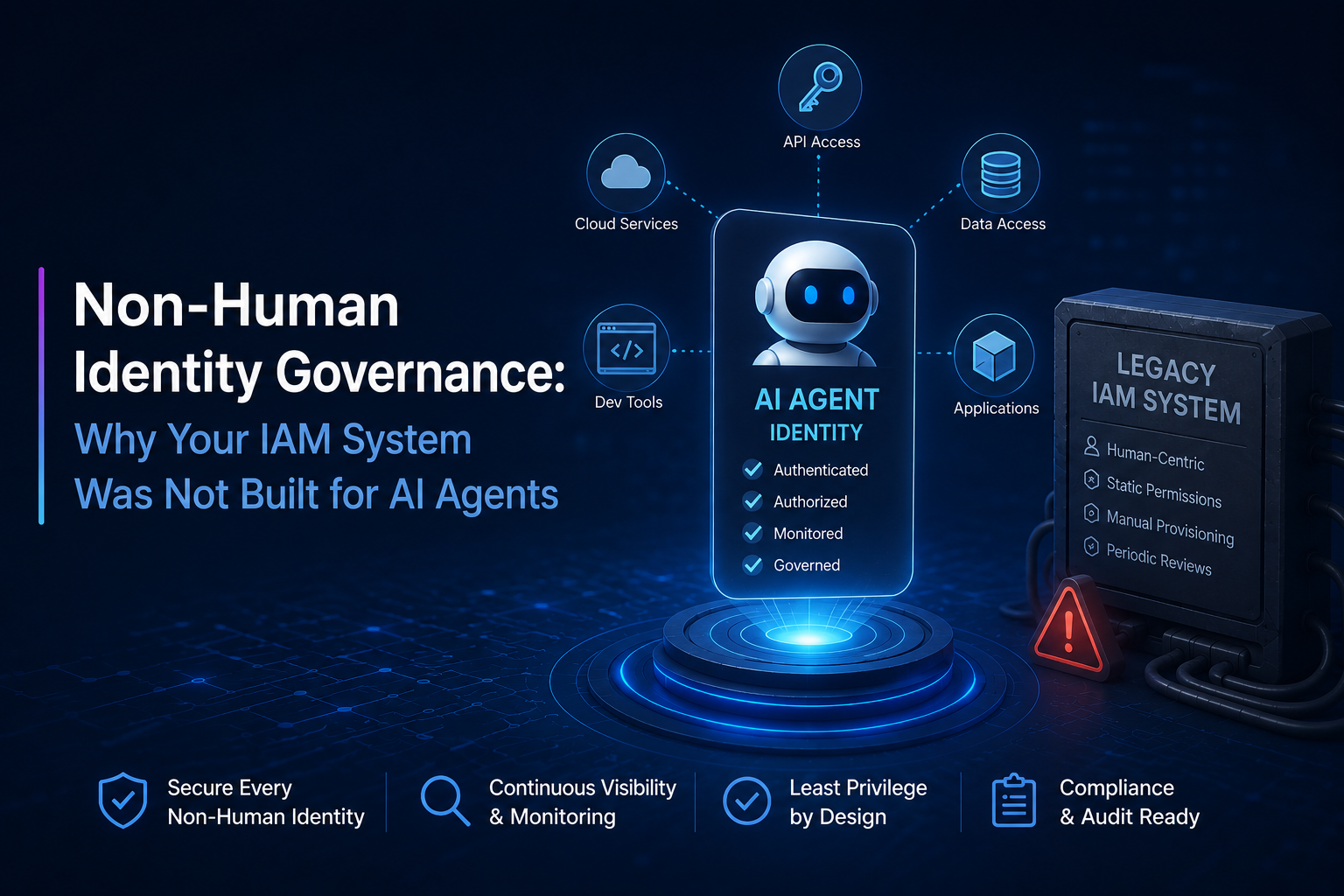
Traditional IAM was built for humans who log in, hold sessions, and get reviewed quarterly. AI agents act autonomously, continuously, and at machine speed — none of those assumptions hold.
• Non-human identities now outnumber human users by up to 144:1. AI agents are the fastest-growing and hardest-to-govern subset of that population.
• Only 28% of organizations can trace AI agent actions back to a human sponsor across all environments — meaning 72% cannot demonstrate accountability for autonomous agent behavior.
• Shared service accounts, inherited permissions, and static API keys are the three most common reasons AI agent identity governance fails in practice.
• Non-human identity governance requires four controls traditional IAM lacks: per-agent unique identity, runtime credential scoping, behavioral baselining, and continuous audit trail generation.
• Frameworks including NIST NCCoE, CSA, and OWASP are converging on a common set of NHI governance principles — making this a compliance-adjacent topic in 2026, not only a security one.
1. The Identity Problem Nobody Planned For
Why Rate Limit Failures Are So Dangerous
Many organizations still treat rate limit errors as minor API inconveniences.
That assumption is becoming expensive.
In reality, rate limit failures create cascading operational disruption across the enterprise.
2. What Is a Non-Human Identity — and Why Are AI Agents Different?
A non-human identity is any digital credential that authenticates and authorizes a machine or software system rather than a human user. NHIs include service accounts, API keys, OAuth tokens, certificates, workload identities, RPA bots, and AI agents.
Traditional NHIs — a database service account, a scheduled job token, a microservice credential — are boring by design. They are provisioned once, given a fixed scope, and do the same thing every day. Their behavior is predictable, which is exactly what makes them manageable within a conventional IAM framework.
AI agents are a different category. An agent does not have a job description — it has a goal, and it works out the job description itself. Specifically:
• Agents acquire credentials at runtime, often based on what they determine they need mid-task, rather than being provisioned with a fixed set upfront.
• Agents orchestrate other agents, creating access paths and permission chains that nobody explicitly designed or reviewed.
• Agents inherit permissions from their invokers, meaning a low-privilege human trigger can result in an agent operating with far greater access than intended.
• Agent behavior changes between runs, because the same goal in a different context produces different tool calls, API accesses, and data interactions. "Normal" is a moving target.
• Agents spawn and retire rapidly, in seconds or minutes, rather than the human lifecycle of years. Traditional provisioning and deprovisioning workflows cannot keep pace.
Key distinction: Every AI agent has a non-human identity, but not every non-human identity is an AI agent. The governance controls adequate for a static service account are necessary but not sufficient for an autonomous agent with reasoning capability and tool access.
3. Where Legacy IAM Breaks Down for AI Agents
Identity and access management systems were not designed with autonomous agents in mind. Each layer of the conventional IAM model surfaces a specific incompatibility when applied to agent workloads.
The session model breaks
Conventional IAM assumes sessions: a user authenticates, a session is created, the session has a defined lifetime, and it terminates. AI agents operate continuously across tasks that may span minutes, hours, or indefinite periods. They participate in delegation chains — agent A invokes agent B which invokes agent C — and each delegation creates an access path that no single session model captures cleanly. The session token an agent starts with may look nothing like the access profile it is operating with three steps into an execution chain.
Access review cycles are too slow
Human identity governance operates on quarterly or annual access review cycles. An AI agent can be created, deployed, accumulate excess permissions, cause harm, and be deprovisioned within a single sprint cycle — well inside the window between any two access reviews. By the time a review would have caught the over-permissioned agent, the damage is already done.
Shared service accounts destroy accountability
The most common shortcut in AI agent deployment is reusing an existing service account or having multiple agents share credentials. This is administratively convenient and governance-catastrophic. When an incident occurs — a data access that should not have happened, an API call that should not have been made — shared credentials make it impossible to determine which agent took which action. Accountability, the foundation of any audit, disappears. Only 28% of organizations can trace AI agent actions back to a human sponsor across all environments. That figure means 72% cannot demonstrate accountability for the autonomous actions their agents are taking.
Privilege creep compounds over time
Non-human identities tend to accrue more access than they actually need — a pattern commonly called privilege creep. For AI agents, this is accelerated by the fact that agents are often provisioned with whatever access makes the task easiest, rather than the minimum access required. As agent capabilities expand and task scope broadens, permissions are added and rarely removed. The result is an agent population with a steadily widening attack surface that grows invisible to governance processes that were not designed to track it.
Behavioral baselines do not exist
User and entity behavior analytics (UEBA) works by building a baseline of normal behavior for a human user — typical login times, typical data access volumes, typical application usage — and alerting on deviations. AI agents have no equivalent baseline infrastructure. Their "normal" behavior varies by task, context, and the instructions they receive. Without a purpose-built behavioral baselining capability for agents, there is no signal to distinguish legitimate agent behavior from a compromised or manipulated agent doing something it should not be doing.
Empirical evidence: The Drift AI chatbot breach (August 2025) demonstrated this gap concretely: attackers compromised OAuth tokens tied to the integration used by Salesloft and gained access to Salesforce environments of more than 700 organizations. The breach went undetected for days because attacker queries were indistinguishable from legitimate chatbot activity — enterprises could see the agent had access, but had no visibility into what it was actually doing with that access.
4. What Non-Human Identity Governance Actually Requires
Effective NHI governance for AI agents requires extending the conventional IAM model with controls that did not exist when IAM was designed. The NCCoE agent identity concept paper (February 2026) framed the challenge directly: organizations need to apply identity principles to agents without blocking useful work, and existing guidance was not designed to cover the full spectrum of agent identity risks.
The following four controls are the foundational requirements that most organizations are currently missing.
① Per-agent unique identity
Every AI agent must have its own unique, isolated identity — not a shared service account, not an inherited user credential, not a pooled machine identity. Each agent identity should map to a named human owner who is accountable for the agent's behavior and authorized to approve its access profile. Without unique agent identities, attribution is impossible and governance is theater.
In practice this means: one agent, one identity, one owner. No exceptions for convenience. Shared accounts are the single most common failure mode in NHI governance programs, and they are entirely avoidable.
② Runtime credential scoping with short-lived tokens
AI agents should not hold long-lived, broad API keys. They should receive short-lived, task-scoped credentials that are minted at the start of a task and revoked when the task ends. This approach — sometimes called just-in-time provisioning or ephemeral credentials — limits the blast radius of any credential compromise and prevents the privilege creep that accumulates when agents hold persistent broad access.
Runtime credential scoping also means defining what systems, APIs, and data stores each agent is authorized to access for each specific task type — not a general authorization profile that covers anything the agent might ever need. The agent receives the narrowest set of permissions that allows the task to complete, and nothing more.
③ Behavioral baselining and anomaly detection
For each agent or agent type, a baseline of normal operating behavior should be established — covering tool call patterns, data access volumes, API endpoints accessed, external transmission destinations, and execution timing. Deviations from this baseline are the primary signal that an agent has been compromised, manipulated via prompt injection, or is operating outside its intended scope.
This baselining cannot be done with human-centric UEBA tools. It requires a monitoring layer that understands agent execution context — what task the agent was given, what tools it called, what data it accessed, and what it transmitted — and can evaluate those actions against both a behavioral baseline and a defined policy set.
④ Continuous, tamper-evident audit trail
For each agent action — every tool call, every data access, every external transmission — a log entry must be written that captures enough context to reconstruct the causal chain. This means logging not just that an API was called, but what prompt the agent received, what reasoning step led to the call, what parameters were passed, and what the response was.
Without this level of audit detail, post-incident investigation is impossible. You can determine that something happened, but not why, which makes root cause analysis guesswork and compliance demonstration impossible. The NCCoE and CSA both identify provenance — the ability to link an agent action back through its reasoning chain to the original human instruction — as the foundational accountability requirement for agentic AI systems.
Why AI Agents Change the Underwriting Equation
The following eight-stage implementation sequence is grounded in guidance from NIST NCCoE, CSA, and OWASP Agentic AI Top 10, adapted for enterprise environments deploying autonomous agents at scale.
1. Discover — Run a complete discovery pass across your enterprise to identify every AI agent in operation, including shadow deployments, departmental tools, agents embedded in third-party SaaS products, and agents created by development teams without IT involvement. You cannot govern what you have not found.
2. Inventory and classify — For each discovered agent, capture: the deploying team, the use case, the systems it accesses, the credentials it holds, and the human owner accountable for its behavior. Classify agents by autonomy level — how much action can they take without human approval — and by data sensitivity — what categories of data can they access.
3. Assign unique identities — Migrate every agent off shared service accounts onto unique, dedicated identities. Establish a provisioning standard that prevents new agents from being created without a unique identity and a named owner. This is the highest-leverage single change in any NHI governance program.
4. Apply least-privilege scoping — For each agent and task type, define the minimum permissions required. Replace long-lived broad API keys with short-lived, task-scoped credentials wherever possible. Implement access review gates that require re-authorization when an agent's scope needs to expand.
5. Deploy runtime monitoring — Instrument agent execution environments to capture tool calls, data accesses, API interactions, and external transmissions in real time. This is distinct from infrastructure-level logging — it requires visibility into agent reasoning context, not just system events.
6. Establish behavioral baselines — For each agent type, run a baselining period in which normal operating behavior is observed and recorded. Define anomaly detection thresholds relative to those baselines — deviations in data volume, API access patterns, or external transmission destinations trigger alerts or automated intervention.
7. Implement policy enforcement — Define and enforce runtime governance policies: which tools can each agent invoke, which data categories can it access, which external destinations can it transmit to, which actions require human approval before execution. Policy enforcement should operate in real time, not retrospectively.
8. Audit and improve — Maintain tamper-evident audit logs of the complete agent activity chain. Conduct regular reviews of agent permission profiles, behavioral baselines, and policy configurations. Use incident findings to refine governance posture. NHI governance is a continuous practice, not a one-time deployment.
6. The Regulatory and Framework Dimension
Non-human identity governance is moving from a security best practice to a compliance expectation. Several major frameworks and regulatory bodies have addressed or are actively addressing NHI and AI agent identity requirements.
• NIST NCCoE — The NCCoE agent identity concept paper (February 2026) explicitly states that existing identity guidance was not designed for the full spectrum of agent identity risks. The NCCoE is developing updated guidance that will set a baseline for what "adequate" agent identity governance looks like.
• CSA — The Cloud Security Alliance published its Non-Human Identity Governance Vacuum whitepaper (May 2026), identifying the absence of documented AI agent identity policies as a primary enterprise security gap. The CSA is developing a companion framework with specific control requirements.
• OWASP Agentic AI Top 10 — Identity and authorization issues appear as one of the top ten risks in the OWASP Agentic AI framework, explicitly covering excessive agent permissions, missing per-agent unique identities, and insecure credential management as high-severity risks.
• EU AI Act — The EU AI Act's August 2, 2026 enforcement date for high-risk systems introduces technical documentation and ongoing monitoring obligations that implicitly require organizations to know what agents are running, what they are authorized to do, and what they have done — none of which is possible without foundational NHI governance.
• RBI Model Risk Management Framework — India's RBI draft MRM circular requires AI system inventories, human oversight documentation, and audit trails for AI-driven decisions — requirements that, for agentic systems, map directly to the NHI governance controls described above.
Forward signal: Gartner flagged failure to address AI agent identity and governance as one of the top cybersecurity trends to watch in 2026. The OWASP Non-Human Identities Top 10 (2026) formalizes the risk taxonomy. Enterprises that implement NHI governance now will be positioned ahead of explicit regulatory requirements that are clearly forming.
Further Reading on Trusys.ai
→ Agentic AI Security: The New Enterprise Attack Surface trusys.ai/agentic-ai-security-insider-threat
→ OWASP Agentic AI Top 10: 2026 Enterprise Security Guide trusys.ai/blog-details/owasp-agentic-ai-top-10
→ AI Memory Governance: Why Persistent Agent Memory Creates New Data Privacy Risks trusys.ai/ai-agent-monitoring-real-time-governance
→ The Agentic Supply Chain Security Platform for MCP Risk trusys.ai/mcp-security-platform-agentic-supply-chain
→ AI Runtime Security Platform: Protecting Enterprise AI from Tool Poisoning trusys.ai/tool-poisoning-ai-runtime-security-platform
→ Real-Time AI Agent Monitoring: The Case for Visibility trusys.ai/ai-agent-monitoring-real-time-governance
→ How to Build an AI Agent Audit Trail That Survives a Regulator Review trusys.ai/how-to-build-an-ai-agent-audit-trail
→ Managing Risk in Multi-Agent AI Systems trusys.ai/blog-details/multi-agent-ai-risk-governance-security
7. NHI Governance Readiness Checklist
Why Rate Limit Failures Are So Dangerous
Many organizations still treat rate limit errors as minor API inconveniences.
That assumption is becoming expensive.
In reality, rate limit failures create cascading operational disruption across the enterprise.

8. Connecting NHI Governance to Runtime AI Security
Why Rate Limit Failures Are So Dangerous
Many organizations still treat rate limit errors as minor API inconveniences.
That assumption is becoming expensive.
In reality, rate limit failures create cascading operational disruption across the enterprise.
Conclusion
Why Rate Limit Failures Are So Dangerous
Many organizations still treat rate limit errors as minor API inconveniences.
That assumption is becoming expensive.
In reality, rate limit failures create cascading operational disruption across the enterprise.
Frequently Asked Questions
- What is non-human identity governance?
AI Agents Multiply Infrastructure Load
AI agents introduce an entirely new scaling challenge.
Unlike a traditional user making one request at a time, AI agents may:
- Trigger multiple chained prompts
- Query several models simultaneously
- Retry failed requests autonomously
- Launch recursive workflows
One user action can suddenly generate dozens of inference operations.
Without workload controls, traffic amplification becomes unavoidable.
- Why can't traditional IAM manage AI agent identities?
AI Agents Multiply Infrastructure Load
AI agents introduce an entirely new scaling challenge.
Unlike a traditional user making one request at a time, AI agents may:
- Trigger multiple chained prompts
- Query several models simultaneously
- Retry failed requests autonomously
- Launch recursive workflows
One user action can suddenly generate dozens of inference operations.
Without workload controls, traffic amplification becomes unavoidable.
AI Agents Multiply Infrastructure Load
AI agents introduce an entirely new scaling challenge.
Unlike a traditional user making one request at a time, AI agents may:
- Trigger multiple chained prompts
- Query several models simultaneously
- Retry failed requests autonomously
- Launch recursive workflows
One user action can suddenly generate dozens of inference operations.
Without workload controls, traffic amplification becomes unavoidable.
AI Agents Multiply Infrastructure Load
AI agents introduce an entirely new scaling challenge.
Unlike a traditional user making one request at a time, AI agents may:
- Trigger multiple chained prompts
- Query several models simultaneously
- Retry failed requests autonomously
- Launch recursive workflows
One user action can suddenly generate dozens of inference operations.
Without workload controls, traffic amplification becomes unavoidable.
AI Agents Multiply Infrastructure Load
AI agents introduce an entirely new scaling challenge.
Unlike a traditional user making one request at a time, AI agents may:
- Trigger multiple chained prompts
- Query several models simultaneously
- Retry failed requests autonomously
- Launch recursive workflows
One user action can suddenly generate dozens of inference operations.
Without workload controls, traffic amplification becomes unavoidable.
AI Agents Multiply Infrastructure Load
AI agents introduce an entirely new scaling challenge.
Unlike a traditional user making one request at a time, AI agents may:
- Trigger multiple chained prompts
- Query several models simultaneously
- Retry failed requests autonomously
- Launch recursive workflows
One user action can suddenly generate dozens of inference operations.
Without workload controls, traffic amplification becomes unavoidable.
AI Agents Multiply Infrastructure Load
AI agents introduce an entirely new scaling challenge.
Unlike a traditional user making one request at a time, AI agents may:
- Trigger multiple chained prompts
- Query several models simultaneously
- Retry failed requests autonomously
- Launch recursive workflows
One user action can suddenly generate dozens of inference operations.
Without workload controls, traffic amplification becomes unavoidable.
AI Agents Multiply Infrastructure Load
AI agents introduce an entirely new scaling challenge.
Unlike a traditional user making one request at a time, AI agents may:
- Trigger multiple chained prompts
- Query several models simultaneously
- Retry failed requests autonomously
- Launch recursive workflows
One user action can suddenly generate dozens of inference operations.
Without workload controls, traffic amplification becomes unavoidable.
AI Agents Multiply Infrastructure Load
AI agents introduce an entirely new scaling challenge.
Unlike a traditional user making one request at a time, AI agents may:
- Trigger multiple chained prompts
- Query several models simultaneously
- Retry failed requests autonomously
- Launch recursive workflows
One user action can suddenly generate dozens of inference operations.
Without workload controls, traffic amplification becomes unavoidable.
AI Agents Multiply Infrastructure Load
AI agents introduce an entirely new scaling challenge.
Unlike a traditional user making one request at a time, AI agents may:
- Trigger multiple chained prompts
- Query several models simultaneously
- Retry failed requests autonomously
- Launch recursive workflows
One user action can suddenly generate dozens of inference operations.
Without workload controls, traffic amplification becomes unavoidable.
AI Agents Multiply Infrastructure Load
AI agents introduce an entirely new scaling challenge.
Unlike a traditional user making one request at a time, AI agents may:
- Trigger multiple chained prompts
- Query several models simultaneously
- Retry failed requests autonomously
- Launch recursive workflows
One user action can suddenly generate dozens of inference operations.
Without workload controls, traffic amplification becomes unavoidable.
AI Agents Multiply Infrastructure Load
AI agents introduce an entirely new scaling challenge.
Unlike a traditional user making one request at a time, AI agents may:
- Trigger multiple chained prompts
- Query several models simultaneously
- Retry failed requests autonomously
- Launch recursive workflows
One user action can suddenly generate dozens of inference operations.
Without workload controls, traffic amplification becomes unavoidable.
AI Agents Multiply Infrastructure Load
AI agents introduce an entirely new scaling challenge.
Unlike a traditional user making one request at a time, AI agents may:
- Trigger multiple chained prompts
- Query several models simultaneously
- Retry failed requests autonomously
- Launch recursive workflows
One user action can suddenly generate dozens of inference operations.
Without workload controls, traffic amplification becomes unavoidable.
AI Agents Multiply Infrastructure Load
AI agents introduce an entirely new scaling challenge.
Unlike a traditional user making one request at a time, AI agents may:
- Trigger multiple chained prompts
- Query several models simultaneously
- Retry failed requests autonomously
- Launch recursive workflows
One user action can suddenly generate dozens of inference operations.
Without workload controls, traffic amplification becomes unavoidable.
Stop guessing.
Start measuring.
Join teams building reliable AI with TruEval. Start with a free trial, no credit card required. Get your first evaluation running in under 10 minutes.
Questions about Trusys?
Our team is here to help. Schedule a personalized demo to see how Trusys fits your specific use case.
Book a Demo

Ready to dive in?
Check out our documentation and tutorials. Get started with example datasets and evaluation templates.
Start Free Trial
Free Trial
No credit card required
10 Min
To first evaluation
24/7
Enterprise support


Benefits
Specifications
How-to
Contact Us
Learn More

Non-Human Identity Governance: Why Your IAM Wasn't Built for AI Agents
Written by
Key Takeaways
Traditional IAM was built for humans who log in, hold sessions, and get reviewed quarterly. AI agents act autonomously, continuously, and at machine speed — none of those assumptions hold.
• Non-human identities now outnumber human users by up to 144:1. AI agents are the fastest-growing and hardest-to-govern subset of that population.
• Only 28% of organizations can trace AI agent actions back to a human sponsor across all environments — meaning 72% cannot demonstrate accountability for autonomous agent behavior.
• Shared service accounts, inherited permissions, and static API keys are the three most common reasons AI agent identity governance fails in practice.
• Non-human identity governance requires four controls traditional IAM lacks: per-agent unique identity, runtime credential scoping, behavioral baselining, and continuous audit trail generation.
• Frameworks including NIST NCCoE, CSA, and OWASP are converging on a common set of NHI governance principles — making this a compliance-adjacent topic in 2026, not only a security one.
1. The Identity Problem Nobody Planned For
Why Rate Limit Failures Are So Dangerous
Many organizations still treat rate limit errors as minor API inconveniences.
That assumption is becoming expensive.
In reality, rate limit failures create cascading operational disruption across the enterprise.
2. What Is a Non-Human Identity — and Why Are AI Agents Different?
A non-human identity is any digital credential that authenticates and authorizes a machine or software system rather than a human user. NHIs include service accounts, API keys, OAuth tokens, certificates, workload identities, RPA bots, and AI agents.
Traditional NHIs — a database service account, a scheduled job token, a microservice credential — are boring by design. They are provisioned once, given a fixed scope, and do the same thing every day. Their behavior is predictable, which is exactly what makes them manageable within a conventional IAM framework.
AI agents are a different category. An agent does not have a job description — it has a goal, and it works out the job description itself. Specifically:
• Agents acquire credentials at runtime, often based on what they determine they need mid-task, rather than being provisioned with a fixed set upfront.
• Agents orchestrate other agents, creating access paths and permission chains that nobody explicitly designed or reviewed.
• Agents inherit permissions from their invokers, meaning a low-privilege human trigger can result in an agent operating with far greater access than intended.
• Agent behavior changes between runs, because the same goal in a different context produces different tool calls, API accesses, and data interactions. "Normal" is a moving target.
• Agents spawn and retire rapidly, in seconds or minutes, rather than the human lifecycle of years. Traditional provisioning and deprovisioning workflows cannot keep pace.
Key distinction: Every AI agent has a non-human identity, but not every non-human identity is an AI agent. The governance controls adequate for a static service account are necessary but not sufficient for an autonomous agent with reasoning capability and tool access.
3. Where Legacy IAM Breaks Down for AI Agents
Identity and access management systems were not designed with autonomous agents in mind. Each layer of the conventional IAM model surfaces a specific incompatibility when applied to agent workloads.
The session model breaks
Conventional IAM assumes sessions: a user authenticates, a session is created, the session has a defined lifetime, and it terminates. AI agents operate continuously across tasks that may span minutes, hours, or indefinite periods. They participate in delegation chains — agent A invokes agent B which invokes agent C — and each delegation creates an access path that no single session model captures cleanly. The session token an agent starts with may look nothing like the access profile it is operating with three steps into an execution chain.
Access review cycles are too slow
Human identity governance operates on quarterly or annual access review cycles. An AI agent can be created, deployed, accumulate excess permissions, cause harm, and be deprovisioned within a single sprint cycle — well inside the window between any two access reviews. By the time a review would have caught the over-permissioned agent, the damage is already done.
Shared service accounts destroy accountability
The most common shortcut in AI agent deployment is reusing an existing service account or having multiple agents share credentials. This is administratively convenient and governance-catastrophic. When an incident occurs — a data access that should not have happened, an API call that should not have been made — shared credentials make it impossible to determine which agent took which action. Accountability, the foundation of any audit, disappears. Only 28% of organizations can trace AI agent actions back to a human sponsor across all environments. That figure means 72% cannot demonstrate accountability for the autonomous actions their agents are taking.
Privilege creep compounds over time
Non-human identities tend to accrue more access than they actually need — a pattern commonly called privilege creep. For AI agents, this is accelerated by the fact that agents are often provisioned with whatever access makes the task easiest, rather than the minimum access required. As agent capabilities expand and task scope broadens, permissions are added and rarely removed. The result is an agent population with a steadily widening attack surface that grows invisible to governance processes that were not designed to track it.
Behavioral baselines do not exist
User and entity behavior analytics (UEBA) works by building a baseline of normal behavior for a human user — typical login times, typical data access volumes, typical application usage — and alerting on deviations. AI agents have no equivalent baseline infrastructure. Their "normal" behavior varies by task, context, and the instructions they receive. Without a purpose-built behavioral baselining capability for agents, there is no signal to distinguish legitimate agent behavior from a compromised or manipulated agent doing something it should not be doing.
Empirical evidence: The Drift AI chatbot breach (August 2025) demonstrated this gap concretely: attackers compromised OAuth tokens tied to the integration used by Salesloft and gained access to Salesforce environments of more than 700 organizations. The breach went undetected for days because attacker queries were indistinguishable from legitimate chatbot activity — enterprises could see the agent had access, but had no visibility into what it was actually doing with that access.
4. What Non-Human Identity Governance Actually Requires
Effective NHI governance for AI agents requires extending the conventional IAM model with controls that did not exist when IAM was designed. The NCCoE agent identity concept paper (February 2026) framed the challenge directly: organizations need to apply identity principles to agents without blocking useful work, and existing guidance was not designed to cover the full spectrum of agent identity risks.
The following four controls are the foundational requirements that most organizations are currently missing.
① Per-agent unique identity
Every AI agent must have its own unique, isolated identity — not a shared service account, not an inherited user credential, not a pooled machine identity. Each agent identity should map to a named human owner who is accountable for the agent's behavior and authorized to approve its access profile. Without unique agent identities, attribution is impossible and governance is theater.
In practice this means: one agent, one identity, one owner. No exceptions for convenience. Shared accounts are the single most common failure mode in NHI governance programs, and they are entirely avoidable.
② Runtime credential scoping with short-lived tokens
AI agents should not hold long-lived, broad API keys. They should receive short-lived, task-scoped credentials that are minted at the start of a task and revoked when the task ends. This approach — sometimes called just-in-time provisioning or ephemeral credentials — limits the blast radius of any credential compromise and prevents the privilege creep that accumulates when agents hold persistent broad access.
Runtime credential scoping also means defining what systems, APIs, and data stores each agent is authorized to access for each specific task type — not a general authorization profile that covers anything the agent might ever need. The agent receives the narrowest set of permissions that allows the task to complete, and nothing more.
③ Behavioral baselining and anomaly detection
For each agent or agent type, a baseline of normal operating behavior should be established — covering tool call patterns, data access volumes, API endpoints accessed, external transmission destinations, and execution timing. Deviations from this baseline are the primary signal that an agent has been compromised, manipulated via prompt injection, or is operating outside its intended scope.
This baselining cannot be done with human-centric UEBA tools. It requires a monitoring layer that understands agent execution context — what task the agent was given, what tools it called, what data it accessed, and what it transmitted — and can evaluate those actions against both a behavioral baseline and a defined policy set.
④ Continuous, tamper-evident audit trail
For each agent action — every tool call, every data access, every external transmission — a log entry must be written that captures enough context to reconstruct the causal chain. This means logging not just that an API was called, but what prompt the agent received, what reasoning step led to the call, what parameters were passed, and what the response was.
Without this level of audit detail, post-incident investigation is impossible. You can determine that something happened, but not why, which makes root cause analysis guesswork and compliance demonstration impossible. The NCCoE and CSA both identify provenance — the ability to link an agent action back through its reasoning chain to the original human instruction — as the foundational accountability requirement for agentic AI systems.
Why AI Agents Change the Underwriting Equation
The following eight-stage implementation sequence is grounded in guidance from NIST NCCoE, CSA, and OWASP Agentic AI Top 10, adapted for enterprise environments deploying autonomous agents at scale.
1. Discover — Run a complete discovery pass across your enterprise to identify every AI agent in operation, including shadow deployments, departmental tools, agents embedded in third-party SaaS products, and agents created by development teams without IT involvement. You cannot govern what you have not found.
2. Inventory and classify — For each discovered agent, capture: the deploying team, the use case, the systems it accesses, the credentials it holds, and the human owner accountable for its behavior. Classify agents by autonomy level — how much action can they take without human approval — and by data sensitivity — what categories of data can they access.
3. Assign unique identities — Migrate every agent off shared service accounts onto unique, dedicated identities. Establish a provisioning standard that prevents new agents from being created without a unique identity and a named owner. This is the highest-leverage single change in any NHI governance program.
4. Apply least-privilege scoping — For each agent and task type, define the minimum permissions required. Replace long-lived broad API keys with short-lived, task-scoped credentials wherever possible. Implement access review gates that require re-authorization when an agent's scope needs to expand.
5. Deploy runtime monitoring — Instrument agent execution environments to capture tool calls, data accesses, API interactions, and external transmissions in real time. This is distinct from infrastructure-level logging — it requires visibility into agent reasoning context, not just system events.
6. Establish behavioral baselines — For each agent type, run a baselining period in which normal operating behavior is observed and recorded. Define anomaly detection thresholds relative to those baselines — deviations in data volume, API access patterns, or external transmission destinations trigger alerts or automated intervention.
7. Implement policy enforcement — Define and enforce runtime governance policies: which tools can each agent invoke, which data categories can it access, which external destinations can it transmit to, which actions require human approval before execution. Policy enforcement should operate in real time, not retrospectively.
8. Audit and improve — Maintain tamper-evident audit logs of the complete agent activity chain. Conduct regular reviews of agent permission profiles, behavioral baselines, and policy configurations. Use incident findings to refine governance posture. NHI governance is a continuous practice, not a one-time deployment.
6. The Regulatory and Framework Dimension
Non-human identity governance is moving from a security best practice to a compliance expectation. Several major frameworks and regulatory bodies have addressed or are actively addressing NHI and AI agent identity requirements.
• NIST NCCoE — The NCCoE agent identity concept paper (February 2026) explicitly states that existing identity guidance was not designed for the full spectrum of agent identity risks. The NCCoE is developing updated guidance that will set a baseline for what "adequate" agent identity governance looks like.
• CSA — The Cloud Security Alliance published its Non-Human Identity Governance Vacuum whitepaper (May 2026), identifying the absence of documented AI agent identity policies as a primary enterprise security gap. The CSA is developing a companion framework with specific control requirements.
• OWASP Agentic AI Top 10 — Identity and authorization issues appear as one of the top ten risks in the OWASP Agentic AI framework, explicitly covering excessive agent permissions, missing per-agent unique identities, and insecure credential management as high-severity risks.
• EU AI Act — The EU AI Act's August 2, 2026 enforcement date for high-risk systems introduces technical documentation and ongoing monitoring obligations that implicitly require organizations to know what agents are running, what they are authorized to do, and what they have done — none of which is possible without foundational NHI governance.
• RBI Model Risk Management Framework — India's RBI draft MRM circular requires AI system inventories, human oversight documentation, and audit trails for AI-driven decisions — requirements that, for agentic systems, map directly to the NHI governance controls described above.
Forward signal: Gartner flagged failure to address AI agent identity and governance as one of the top cybersecurity trends to watch in 2026. The OWASP Non-Human Identities Top 10 (2026) formalizes the risk taxonomy. Enterprises that implement NHI governance now will be positioned ahead of explicit regulatory requirements that are clearly forming.
Further Reading on Trusys.ai
→ Agentic AI Security: The New Enterprise Attack Surface trusys.ai/agentic-ai-security-insider-threat
→ OWASP Agentic AI Top 10: 2026 Enterprise Security Guide trusys.ai/blog-details/owasp-agentic-ai-top-10
→ AI Memory Governance: Why Persistent Agent Memory Creates New Data Privacy Risks trusys.ai/ai-agent-monitoring-real-time-governance
→ The Agentic Supply Chain Security Platform for MCP Risk trusys.ai/mcp-security-platform-agentic-supply-chain
→ AI Runtime Security Platform: Protecting Enterprise AI from Tool Poisoning trusys.ai/tool-poisoning-ai-runtime-security-platform
→ Real-Time AI Agent Monitoring: The Case for Visibility trusys.ai/ai-agent-monitoring-real-time-governance
→ How to Build an AI Agent Audit Trail That Survives a Regulator Review trusys.ai/how-to-build-an-ai-agent-audit-trail
→ Managing Risk in Multi-Agent AI Systems trusys.ai/blog-details/multi-agent-ai-risk-governance-security
7. NHI Governance Readiness Checklist
Why Rate Limit Failures Are So Dangerous
Many organizations still treat rate limit errors as minor API inconveniences.
That assumption is becoming expensive.
In reality, rate limit failures create cascading operational disruption across the enterprise.

8. Connecting NHI Governance to Runtime AI Security
Why Rate Limit Failures Are So Dangerous
Many organizations still treat rate limit errors as minor API inconveniences.
That assumption is becoming expensive.
In reality, rate limit failures create cascading operational disruption across the enterprise.
Conclusion
Why Rate Limit Failures Are So Dangerous
Many organizations still treat rate limit errors as minor API inconveniences.
That assumption is becoming expensive.
In reality, rate limit failures create cascading operational disruption across the enterprise.
Frequently Asked Questions
- What is non-human identity governance?
AI Agents Multiply Infrastructure Load
AI agents introduce an entirely new scaling challenge.
Unlike a traditional user making one request at a time, AI agents may:
- Trigger multiple chained prompts
- Query several models simultaneously
- Retry failed requests autonomously
- Launch recursive workflows
One user action can suddenly generate dozens of inference operations.
Without workload controls, traffic amplification becomes unavoidable.
- Why can't traditional IAM manage AI agent identities?
AI Agents Multiply Infrastructure Load
AI agents introduce an entirely new scaling challenge.
Unlike a traditional user making one request at a time, AI agents may:
- Trigger multiple chained prompts
- Query several models simultaneously
- Retry failed requests autonomously
- Launch recursive workflows
One user action can suddenly generate dozens of inference operations.
Without workload controls, traffic amplification becomes unavoidable.
AI Agents Multiply Infrastructure Load
AI agents introduce an entirely new scaling challenge.
Unlike a traditional user making one request at a time, AI agents may:
- Trigger multiple chained prompts
- Query several models simultaneously
- Retry failed requests autonomously
- Launch recursive workflows
One user action can suddenly generate dozens of inference operations.
Without workload controls, traffic amplification becomes unavoidable.
AI Agents Multiply Infrastructure Load
AI agents introduce an entirely new scaling challenge.
Unlike a traditional user making one request at a time, AI agents may:
- Trigger multiple chained prompts
- Query several models simultaneously
- Retry failed requests autonomously
- Launch recursive workflows
One user action can suddenly generate dozens of inference operations.
Without workload controls, traffic amplification becomes unavoidable.
AI Agents Multiply Infrastructure Load
AI agents introduce an entirely new scaling challenge.
Unlike a traditional user making one request at a time, AI agents may:
- Trigger multiple chained prompts
- Query several models simultaneously
- Retry failed requests autonomously
- Launch recursive workflows
One user action can suddenly generate dozens of inference operations.
Without workload controls, traffic amplification becomes unavoidable.
AI Agents Multiply Infrastructure Load
AI agents introduce an entirely new scaling challenge.
Unlike a traditional user making one request at a time, AI agents may:
- Trigger multiple chained prompts
- Query several models simultaneously
- Retry failed requests autonomously
- Launch recursive workflows
One user action can suddenly generate dozens of inference operations.
Without workload controls, traffic amplification becomes unavoidable.
AI Agents Multiply Infrastructure Load
AI agents introduce an entirely new scaling challenge.
Unlike a traditional user making one request at a time, AI agents may:
- Trigger multiple chained prompts
- Query several models simultaneously
- Retry failed requests autonomously
- Launch recursive workflows
One user action can suddenly generate dozens of inference operations.
Without workload controls, traffic amplification becomes unavoidable.
AI Agents Multiply Infrastructure Load
AI agents introduce an entirely new scaling challenge.
Unlike a traditional user making one request at a time, AI agents may:
- Trigger multiple chained prompts
- Query several models simultaneously
- Retry failed requests autonomously
- Launch recursive workflows
One user action can suddenly generate dozens of inference operations.
Without workload controls, traffic amplification becomes unavoidable.
AI Agents Multiply Infrastructure Load
AI agents introduce an entirely new scaling challenge.
Unlike a traditional user making one request at a time, AI agents may:
- Trigger multiple chained prompts
- Query several models simultaneously
- Retry failed requests autonomously
- Launch recursive workflows
One user action can suddenly generate dozens of inference operations.
Without workload controls, traffic amplification becomes unavoidable.
AI Agents Multiply Infrastructure Load
AI agents introduce an entirely new scaling challenge.
Unlike a traditional user making one request at a time, AI agents may:
- Trigger multiple chained prompts
- Query several models simultaneously
- Retry failed requests autonomously
- Launch recursive workflows
One user action can suddenly generate dozens of inference operations.
Without workload controls, traffic amplification becomes unavoidable.
AI Agents Multiply Infrastructure Load
AI agents introduce an entirely new scaling challenge.
Unlike a traditional user making one request at a time, AI agents may:
- Trigger multiple chained prompts
- Query several models simultaneously
- Retry failed requests autonomously
- Launch recursive workflows
One user action can suddenly generate dozens of inference operations.
Without workload controls, traffic amplification becomes unavoidable.
AI Agents Multiply Infrastructure Load
AI agents introduce an entirely new scaling challenge.
Unlike a traditional user making one request at a time, AI agents may:
- Trigger multiple chained prompts
- Query several models simultaneously
- Retry failed requests autonomously
- Launch recursive workflows
One user action can suddenly generate dozens of inference operations.
Without workload controls, traffic amplification becomes unavoidable.
AI Agents Multiply Infrastructure Load
AI agents introduce an entirely new scaling challenge.
Unlike a traditional user making one request at a time, AI agents may:
- Trigger multiple chained prompts
- Query several models simultaneously
- Retry failed requests autonomously
- Launch recursive workflows
One user action can suddenly generate dozens of inference operations.
Without workload controls, traffic amplification becomes unavoidable.
AI Agents Multiply Infrastructure Load
AI agents introduce an entirely new scaling challenge.
Unlike a traditional user making one request at a time, AI agents may:
- Trigger multiple chained prompts
- Query several models simultaneously
- Retry failed requests autonomously
- Launch recursive workflows
One user action can suddenly generate dozens of inference operations.
Without workload controls, traffic amplification becomes unavoidable.
Stop guessing.
Start measuring.
Join teams building reliable AI with TruEval. Start with a free trial, no credit card required. Get your first evaluation running in under 10 minutes.
Questions about Trusys?
Our team is here to help. Schedule a personalized demo to see how Trusys fits your specific use case.
Book a Demo
Ready to dive in?
Check out our documentation and tutorials. Get started with example datasets and evaluation templates.
Start Free Trial
Free Trial
No credit card required
10 Min
To first evaluation
24/7
Enterprise support
Non-Human Identity Governance: Why Your IAM Wasn't Built for AI Agents
Written by
Manish Tewari
Published on
Sep 7, 2026
Key Takeaways
Traditional IAM was built for humans who log in, hold sessions, and get reviewed quarterly. AI agents act autonomously, continuously, and at machine speed — none of those assumptions hold.
• Non-human identities now outnumber human users by up to 144:1. AI agents are the fastest-growing and hardest-to-govern subset of that population.
• Only 28% of organizations can trace AI agent actions back to a human sponsor across all environments — meaning 72% cannot demonstrate accountability for autonomous agent behavior.
• Shared service accounts, inherited permissions, and static API keys are the three most common reasons AI agent identity governance fails in practice.
• Non-human identity governance requires four controls traditional IAM lacks: per-agent unique identity, runtime credential scoping, behavioral baselining, and continuous audit trail generation.
• Frameworks including NIST NCCoE, CSA, and OWASP are converging on a common set of NHI governance principles — making this a compliance-adjacent topic in 2026, not only a security one.
1. The Identity Problem Nobody Planned For
Identity and access management was built around a simple, stable assumption: a person sits down, authenticates, uses a system, and logs out. That assumption shaped every layer of the IAM stack — the session model, the access review cycle, the behavioral baseline, the audit log format.
That assumption is now wrong for the majority of identities in the average enterprise.
Non-human identities — service accounts, API keys, OAuth tokens, machine certificates, workload identities, and autonomous AI agents — now outnumber human users by an average of 82 to 1, with cloud-native environments reporting ratios as high as 144 to 1. In the year from 2024 to 2025, NHIs grew by 44% across measured enterprise environments. And within that population, AI agents represent a qualitatively new challenge: they are not passive credential holders. They reason about their access needs, request permissions at runtime, orchestrate other agents, and act across systems in sequences that nobody explicitly designed.
"Traditional IAM was built for humans who log in, hold sessions, and get reviewed quarterly. AI agents act autonomously, continuously, and at machine speed. Those are three separate points of incompatibility — and most enterprises have addressed none of them."
This post examines what non-human identity governance actually requires for AI agents, where legacy IAM falls short at each layer, and what organizations can do to close the gap before it becomes a breach.
2. What Is a Non-Human Identity — and Why Are AI Agents Different?
A non-human identity is any digital credential that authenticates and authorizes a machine or software system rather than a human user. NHIs include service accounts, API keys, OAuth tokens, certificates, workload identities, RPA bots, and AI agents.
Traditional NHIs — a database service account, a scheduled job token, a microservice credential — are boring by design. They are provisioned once, given a fixed scope, and do the same thing every day. Their behavior is predictable, which is exactly what makes them manageable within a conventional IAM framework.
AI agents are a different category. An agent does not have a job description — it has a goal, and it works out the job description itself. Specifically:
• Agents acquire credentials at runtime, often based on what they determine they need mid-task, rather than being provisioned with a fixed set upfront.
• Agents orchestrate other agents, creating access paths and permission chains that nobody explicitly designed or reviewed.
• Agents inherit permissions from their invokers, meaning a low-privilege human trigger can result in an agent operating with far greater access than intended.
• Agent behavior changes between runs, because the same goal in a different context produces different tool calls, API accesses, and data interactions. "Normal" is a moving target.
• Agents spawn and retire rapidly, in seconds or minutes, rather than the human lifecycle of years. Traditional provisioning and deprovisioning workflows cannot keep pace.
Key distinction: Every AI agent has a non-human identity, but not every non-human identity is an AI agent. The governance controls adequate for a static service account are necessary but not sufficient for an autonomous agent with reasoning capability and tool access.
3. Where Legacy IAM Breaks Down for AI Agents
Identity and access management systems were not designed with autonomous agents in mind. Each layer of the conventional IAM model surfaces a specific incompatibility when applied to agent workloads.
The session model breaks
Conventional IAM assumes sessions: a user authenticates, a session is created, the session has a defined lifetime, and it terminates. AI agents operate continuously across tasks that may span minutes, hours, or indefinite periods. They participate in delegation chains — agent A invokes agent B which invokes agent C — and each delegation creates an access path that no single session model captures cleanly. The session token an agent starts with may look nothing like the access profile it is operating with three steps into an execution chain.
Access review cycles are too slow
Human identity governance operates on quarterly or annual access review cycles. An AI agent can be created, deployed, accumulate excess permissions, cause harm, and be deprovisioned within a single sprint cycle — well inside the window between any two access reviews. By the time a review would have caught the over-permissioned agent, the damage is already done.
Shared service accounts destroy accountability
The most common shortcut in AI agent deployment is reusing an existing service account or having multiple agents share credentials. This is administratively convenient and governance-catastrophic. When an incident occurs — a data access that should not have happened, an API call that should not have been made — shared credentials make it impossible to determine which agent took which action. Accountability, the foundation of any audit, disappears. Only 28% of organizations can trace AI agent actions back to a human sponsor across all environments. That figure means 72% cannot demonstrate accountability for the autonomous actions their agents are taking.
Privilege creep compounds over time
Non-human identities tend to accrue more access than they actually need — a pattern commonly called privilege creep. For AI agents, this is accelerated by the fact that agents are often provisioned with whatever access makes the task easiest, rather than the minimum access required. As agent capabilities expand and task scope broadens, permissions are added and rarely removed. The result is an agent population with a steadily widening attack surface that grows invisible to governance processes that were not designed to track it.
Behavioral baselines do not exist
User and entity behavior analytics (UEBA) works by building a baseline of normal behavior for a human user — typical login times, typical data access volumes, typical application usage — and alerting on deviations. AI agents have no equivalent baseline infrastructure. Their "normal" behavior varies by task, context, and the instructions they receive. Without a purpose-built behavioral baselining capability for agents, there is no signal to distinguish legitimate agent behavior from a compromised or manipulated agent doing something it should not be doing.
Empirical evidence: The Drift AI chatbot breach (August 2025) demonstrated this gap concretely: attackers compromised OAuth tokens tied to the integration used by Salesloft and gained access to Salesforce environments of more than 700 organizations. The breach went undetected for days because attacker queries were indistinguishable from legitimate chatbot activity — enterprises could see the agent had access, but had no visibility into what it was actually doing with that access.
4. What Non-Human Identity Governance Actually Requires
Effective NHI governance for AI agents requires extending the conventional IAM model with controls that did not exist when IAM was designed. The NCCoE agent identity concept paper (February 2026) framed the challenge directly: organizations need to apply identity principles to agents without blocking useful work, and existing guidance was not designed to cover the full spectrum of agent identity risks.
The following four controls are the foundational requirements that most organizations are currently missing.
① Per-agent unique identity
Every AI agent must have its own unique, isolated identity — not a shared service account, not an inherited user credential, not a pooled machine identity. Each agent identity should map to a named human owner who is accountable for the agent's behavior and authorized to approve its access profile. Without unique agent identities, attribution is impossible and governance is theater.
In practice this means: one agent, one identity, one owner. No exceptions for convenience. Shared accounts are the single most common failure mode in NHI governance programs, and they are entirely avoidable.
② Runtime credential scoping with short-lived tokens
AI agents should not hold long-lived, broad API keys. They should receive short-lived, task-scoped credentials that are minted at the start of a task and revoked when the task ends. This approach — sometimes called just-in-time provisioning or ephemeral credentials — limits the blast radius of any credential compromise and prevents the privilege creep that accumulates when agents hold persistent broad access.
Runtime credential scoping also means defining what systems, APIs, and data stores each agent is authorized to access for each specific task type — not a general authorization profile that covers anything the agent might ever need. The agent receives the narrowest set of permissions that allows the task to complete, and nothing more.
③ Behavioral baselining and anomaly detection
For each agent or agent type, a baseline of normal operating behavior should be established — covering tool call patterns, data access volumes, API endpoints accessed, external transmission destinations, and execution timing. Deviations from this baseline are the primary signal that an agent has been compromised, manipulated via prompt injection, or is operating outside its intended scope.
This baselining cannot be done with human-centric UEBA tools. It requires a monitoring layer that understands agent execution context — what task the agent was given, what tools it called, what data it accessed, and what it transmitted — and can evaluate those actions against both a behavioral baseline and a defined policy set.
④ Continuous, tamper-evident audit trail
For each agent action — every tool call, every data access, every external transmission — a log entry must be written that captures enough context to reconstruct the causal chain. This means logging not just that an API was called, but what prompt the agent received, what reasoning step led to the call, what parameters were passed, and what the response was.
Without this level of audit detail, post-incident investigation is impossible. You can determine that something happened, but not why, which makes root cause analysis guesswork and compliance demonstration impossible. The NCCoE and CSA both identify provenance — the ability to link an agent action back through its reasoning chain to the original human instruction — as the foundational accountability requirement for agentic AI systems.
5. Implementing NHI Governance for AI Agents: A Practical Framework
The following eight-stage implementation sequence is grounded in guidance from NIST NCCoE, CSA, and OWASP Agentic AI Top 10, adapted for enterprise environments deploying autonomous agents at scale.
1. Discover — Run a complete discovery pass across your enterprise to identify every AI agent in operation, including shadow deployments, departmental tools, agents embedded in third-party SaaS products, and agents created by development teams without IT involvement. You cannot govern what you have not found.
2. Inventory and classify — For each discovered agent, capture: the deploying team, the use case, the systems it accesses, the credentials it holds, and the human owner accountable for its behavior. Classify agents by autonomy level — how much action can they take without human approval — and by data sensitivity — what categories of data can they access.
3. Assign unique identities — Migrate every agent off shared service accounts onto unique, dedicated identities. Establish a provisioning standard that prevents new agents from being created without a unique identity and a named owner. This is the highest-leverage single change in any NHI governance program.
4. Apply least-privilege scoping — For each agent and task type, define the minimum permissions required. Replace long-lived broad API keys with short-lived, task-scoped credentials wherever possible. Implement access review gates that require re-authorization when an agent's scope needs to expand.
5. Deploy runtime monitoring — Instrument agent execution environments to capture tool calls, data accesses, API interactions, and external transmissions in real time. This is distinct from infrastructure-level logging — it requires visibility into agent reasoning context, not just system events.
6. Establish behavioral baselines — For each agent type, run a baselining period in which normal operating behavior is observed and recorded. Define anomaly detection thresholds relative to those baselines — deviations in data volume, API access patterns, or external transmission destinations trigger alerts or automated intervention.
7. Implement policy enforcement — Define and enforce runtime governance policies: which tools can each agent invoke, which data categories can it access, which external destinations can it transmit to, which actions require human approval before execution. Policy enforcement should operate in real time, not retrospectively.
8. Audit and improve — Maintain tamper-evident audit logs of the complete agent activity chain. Conduct regular reviews of agent permission profiles, behavioral baselines, and policy configurations. Use incident findings to refine governance posture. NHI governance is a continuous practice, not a one-time deployment.
6. The Regulatory and Framework Dimension
Non-human identity governance is moving from a security best practice to a compliance expectation. Several major frameworks and regulatory bodies have addressed or are actively addressing NHI and AI agent identity requirements.
• NIST NCCoE — The NCCoE agent identity concept paper (February 2026) explicitly states that existing identity guidance was not designed for the full spectrum of agent identity risks. The NCCoE is developing updated guidance that will set a baseline for what "adequate" agent identity governance looks like.
• CSA — The Cloud Security Alliance published its Non-Human Identity Governance Vacuum whitepaper (May 2026), identifying the absence of documented AI agent identity policies as a primary enterprise security gap. The CSA is developing a companion framework with specific control requirements.
• OWASP Agentic AI Top 10 — Identity and authorization issues appear as one of the top ten risks in the OWASP Agentic AI framework, explicitly covering excessive agent permissions, missing per-agent unique identities, and insecure credential management as high-severity risks.
• EU AI Act — The EU AI Act's August 2, 2026 enforcement date for high-risk systems introduces technical documentation and ongoing monitoring obligations that implicitly require organizations to know what agents are running, what they are authorized to do, and what they have done — none of which is possible without foundational NHI governance.
• RBI Model Risk Management Framework — India's RBI draft MRM circular requires AI system inventories, human oversight documentation, and audit trails for AI-driven decisions — requirements that, for agentic systems, map directly to the NHI governance controls described above.
Forward signal: Gartner flagged failure to address AI agent identity and governance as one of the top cybersecurity trends to watch in 2026. The OWASP Non-Human Identities Top 10 (2026) formalizes the risk taxonomy. Enterprises that implement NHI governance now will be positioned ahead of explicit regulatory requirements that are clearly forming.
Further Reading on Trusys.ai
→ Agentic AI Security: The New Enterprise Attack Surface trusys.ai/agentic-ai-security-insider-threat
→ OWASP Agentic AI Top 10: 2026 Enterprise Security Guide trusys.ai/blog-details/owasp-agentic-ai-top-10
→ AI Memory Governance: Why Persistent Agent Memory Creates New Data Privacy Risks trusys.ai/ai-agent-monitoring-real-time-governance
→ The Agentic Supply Chain Security Platform for MCP Risk trusys.ai/mcp-security-platform-agentic-supply-chain
→ AI Runtime Security Platform: Protecting Enterprise AI from Tool Poisoning trusys.ai/tool-poisoning-ai-runtime-security-platform
→ Real-Time AI Agent Monitoring: The Case for Visibility trusys.ai/ai-agent-monitoring-real-time-governance
→ How to Build an AI Agent Audit Trail That Survives a Regulator Review trusys.ai/how-to-build-an-ai-agent-audit-trail
→ Managing Risk in Multi-Agent AI Systems trusys.ai/blog-details/multi-agent-ai-risk-governance-security

7. NHI Governance Readiness Checklist
Use this checklist to assess your organization's current non-human identity governance posture for AI agents:
Discovery and inventory
☐ Have we run a complete discovery pass to find every AI agent operating in our environment, including shadow deployments?
☐ Does every agent appear in a central inventory with a named owner, use case, and access profile documented?
☐ Do we track agent creation and decommissioning events in our identity governance system?
Identity and credentials
☐ Does every AI agent have a unique, isolated identity — not a shared service account?
☐ Are agent credentials short-lived and task-scoped rather than long-lived and broadly authorized?
☐ Are agent API keys rotated on a defined schedule and never embedded in prompts, configuration files, or persistent memory?
☐ Can we revoke any agent's credentials immediately if a security event is detected?
Access and permissions
☐ Are agent permissions scoped to the minimum required for each specific task type?
☐ Do we have a process to review and reauthorize agent access when scope needs to expand?
☐ Have we audited the permission profiles of existing agents for excessive access that has accumulated over time?
Monitoring and accountability
☐ Are agent actions monitored in real time — not just logged after the fact?
☐ Have we established behavioral baselines for each agent or agent type?
☐ Can we detect anomalous agent behavior: unusual data volumes, access to out-of-scope systems, atypical tool-call patterns?
☐ Can we reconstruct the complete causal chain of any agent action — from prompt received through tool calls to outcome?
☐ Can we trace every agent action back to a named human sponsor across all environments?
Governance and compliance
☐ Do we have a documented policy for creating, authorizing, monitoring, and decommissioning AI agent identities?
☐ Are AI agent identity risks included in our AI risk register and reviewed at governance cadence?
☐ Do we have a defined incident response procedure for agent-related identity and access events?
If more than four of these questions have an uncertain or negative answer, NHI governance for AI agents is a material gap in your organization's security and compliance posture.
8. Connecting NHI Governance to Runtime AI Security
NHI governance answers the question of who an agent is and what it is authorized to do. But governance documentation and IAM policies alone cannot detect when an authorized agent is doing something it should not — when a legitimate identity is being used for an illegitimate purpose.
This is where AI runtime security extends the NHI governance layer. Runtime security monitors agent behavior while agents are actively operating, providing real-time visibility into tool calls, data accesses, and external transmissions that governance policies define but cannot enforce on their own.
The combination — NHI governance establishing identity, access policy, and accountability structure, with AI runtime security enforcing those policies in real time and generating the audit evidence that governance requires — is the architecture that closes the gap between what organizations say their agents are authorized to do and what those agents are actually doing.
Govern your AI agents with Trusys
TruScout discovers and maps AI agent identities to your OWASP Agentic AI Top 10 risk profile. TruPulse provides real-time behavioral monitoring and anomaly detection across agent execution. TruGuard enforces governance policies inline — flagging, blocking, or escalating agent actions that exceed authorized scope. Together, they provide the runtime layer that makes NHI governance enforceable, not just documented.
trusys.ai/demo · trusys.ai/ai-security-compliance · trusys.ai/ai-guardrails
Conclusion
The identity problem facing enterprise security teams in 2026 is not primarily about human identities. It is about the 82 non-human identities for every human one — and within that population, the AI agents that are growing fastest, carry the broadest permissions, and are governed least.
Traditional IAM was not built for this. The session model, the access review cycle, the shared service account, the behavioral baseline built on human patterns — none of these translate cleanly to an autonomous agent that acquires credentials at runtime, orchestrates other agents, and behaves differently in every execution context.
"Non-human identity governance is not an extension of IAM. It is a new discipline. The organizations that build it now will govern the AI agents they have today — and be ready for the scale of what is coming."
The controls required — unique per-agent identity, runtime credential scoping, behavioral baselining, continuous audit trail — are well-understood and implementable. The gap is not technical knowledge. It is organizational priority. With 92% of organizations lacking confidence in their current IAM tools for NHI and agent risk, and regulatory frameworks converging on explicit agent governance requirements, that priority is arriving whether organizations are ready or not.
Frequently Asked Questions
- What is non-human identity governance?
Non-human identity governance is the set of policies, controls, and processes that manage the creation, authorization, monitoring, and decommissioning of identities held by software systems — including AI agents, service accounts, API keys, and machine credentials — rather than human users. For AI agents specifically, NHI governance addresses the unique challenges of autonomous systems that acquire credentials at runtime, orchestrate other agents, and operate continuously without human involvement at each step.
- Why can't traditional IAM manage AI agent identities?
Traditional IAM was built for humans who log in, hold sessions, and get reviewed quarterly. AI agents act autonomously, continuously, and at machine speed. Specific incompatibilities include: the session model does not map to continuous agent operation; access review cycles are too slow to catch agent permission issues before harm occurs; shared service accounts (the most common agent credential approach) destroy accountability; and human behavioral baselines (the foundation of UEBA) do not apply to agents whose "normal" behavior varies by task and context.
- What is the difference between a non-human identity and an AI agent identity?
Every AI agent has a non-human identity, but not every non-human identity is an AI agent. Traditional NHIs — database service accounts, scheduled job tokens — are passive credential holders with predictable, static behavior. AI agents are autonomous actors that reason about their access needs, request permissions at runtime, orchestrate other agents, and produce emergent behavior that their operators did not anticipate. Agent identities require additional governance controls beyond what is adequate for conventional NHIs.
- What is non-human identity sprawl?
Non-human identity sprawl is the uncontrolled proliferation of NHI credentials — service accounts, API keys, agent identities, machine tokens — across an enterprise environment, typically without adequate inventory, ownership assignment, or lifecycle governance. GitGuardian's 2026 analysis identified NHI sprawl as a primary enterprise security risk, noting that 70% of identity-related security incidents in the research period were linked to autonomous AI activity and that most security teams cannot distinguish legitimate AI behavior from malicious actors using compromised NHI credentials.
- How many non-human identities does the average enterprise have?
Non-human identities outnumber human users by an average of 82:1 in the enterprise, with cloud-native environments reporting ratios as high as 144:1. IBM Think 2026 reported 45 to 90 NHIs per human identity in enterprise environments, with the ratio growing with every new agent deployment. CyberArk's 2026 research found that the majority of these NHIs hold sensitive or privileged access.
- What are the most common NHI governance failures for AI agents?
The three most common failure modes are: shared service accounts used across multiple agents (eliminating accountability); long-lived, broadly scoped API keys with no runtime scoping or rotation (maximizing breach impact); and no behavioral monitoring for agent activity (eliminating detection capability). The CSA's 2026 NHI governance research found that 78% of organizations have no documented policy for creating or removing AI agent identities — making basic lifecycle governance the most widespread gap.
- What frameworks address AI agent identity governance?
Several major frameworks and bodies are actively addressing agent identity governance in 2026: NIST NCCoE published a concept paper in February 2026 identifying the gap in existing guidance; CSA published its Non-Human Identity Governance Vacuum whitepaper in May 2026; OWASP's Agentic AI Top 10 includes identity and authorization as a primary risk category; and the EU AI Act's technical documentation and monitoring obligations implicitly require foundational agent identity controls for high-risk AI systems.
- How does AI runtime security relate to NHI governance?
NHI governance establishes the policy layer — who the agent is, what it is authorized to do, and who is accountable for its behavior. AI runtime security enforces and audits that policy layer in real time while agents are actively operating. Together they form a complete governance architecture: governance defines the rules, runtime security enforces them and generates the audit evidence that governance requires to be demonstrable. Neither is sufficient alone.
Stop guessing.
Start measuring.
Join teams building reliable AI with Trusys. Start with a free trial, no credit card required. Get your first evaluation running in under 10 minutes.
Questions about Trusys?
Our team is here to help. Schedule a personalized demo to see how Trusys fits your specific use case.
Book a Demo
Ready to dive in?
Check out our documentation and tutorials. Get started with example datasets and evaluation templates.
Start Free Trial
Free Trial
No credit card required
10 Min
to get started
24/7
Enterprise support