The OWASP Agentic AI Top 10: What Every Enterprise Security Team Needs to Know in 2026
Written by

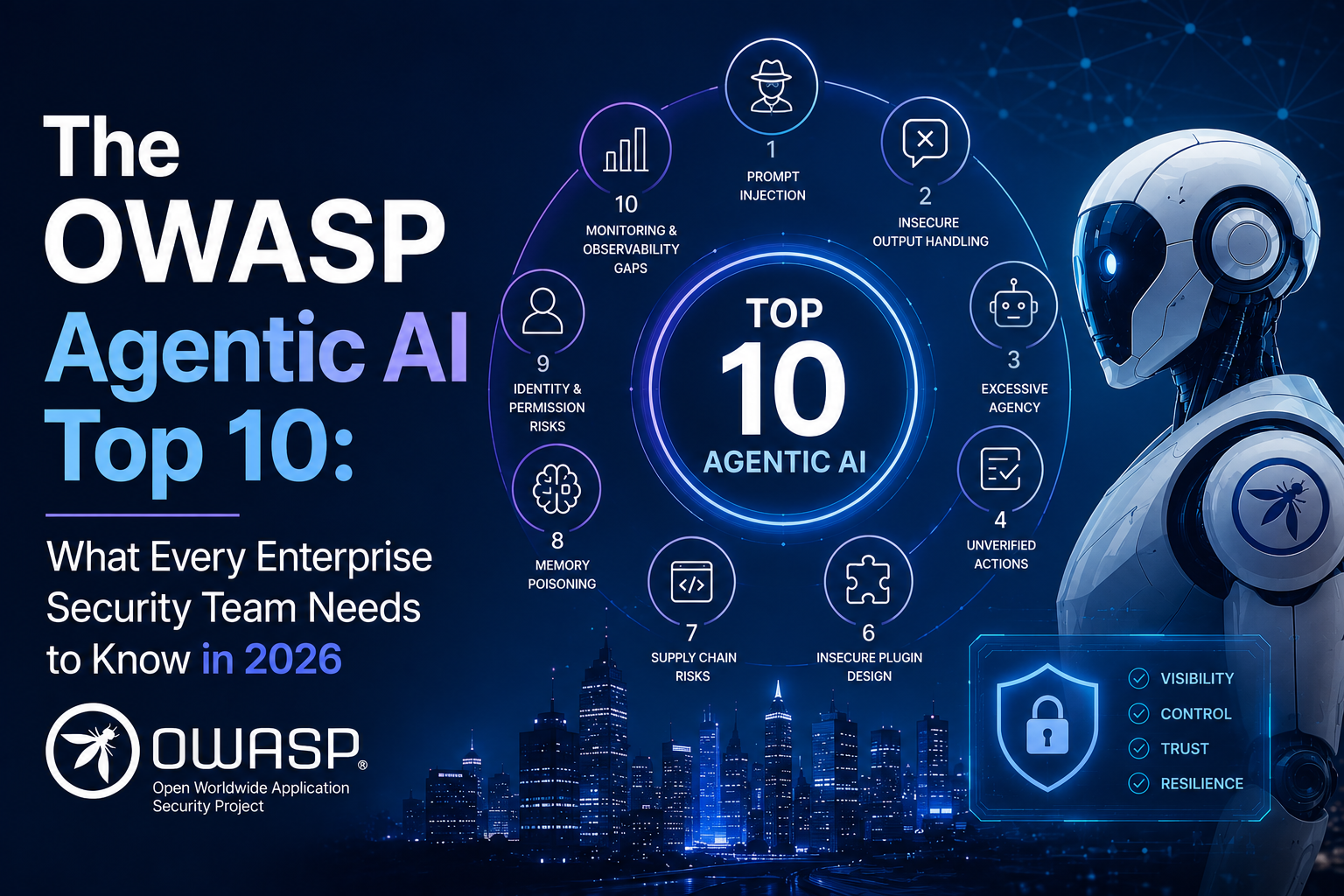
For roughly two decades, enterprise security teams have operated on a dependable assumption: software does what it's told. A web application follows its code paths. A database enforces its access rules. When something breaks, you can trace the exact line of logic responsible. AI agents break that assumption.
An agent doesn't just generate text — it reasons over a goal, plans a sequence of steps, calls external tools and APIs, reads and writes to live systems, and decides what to do next based on what it observes along the way. Run the same prompt twice and an agent can take two different paths to get there. The "code" is a probability distribution, not a fixed set of instructions. Traditional application security — built around deterministic execution, permissions granted at deployment time, and code review — was never designed to reason about a system that plans its own actions in real time.
This shift stopped being theoretical some time ago. By mid-2026, agentic AI had moved from pilot projects to operational deployment across banking, insurance, healthcare, and contact centres, with autonomous systems routinely summarizing documents, executing code, calling APIs, and triggering downstream workflows — often with limited human review of any single step.
In response, OWASP — the organization behind the long-standing OWASP Top 10 for web applications — convened a global community of over 100 security practitioners, researchers, and industry contributors to build a dedicated framework for this new class of risk: the OWASP Top 10 for Agentic Applications 2026, published in December 2025. It is the first vendor-neutral, peer-reviewed catalog of what actually goes wrong when AI agents are given autonomy, tools, memory, and the ability to act on their own.
This guide walks through what agentic AI is, why conventional security models fall short, each of the ten OWASP risks in detail, and the governance, monitoring, and evaluation practices enterprise security teams need in place before scaling agent deployments further.
What Is Agentic AI?
"Agentic AI" describes systems that go beyond single-turn question answering to plan, decide, and act across multiple steps toward a goal — frequently without a human approving every intermediate action. Where a chatbot receives a prompt and returns text, an agent receives an objective and works toward it: breaking the goal into subtasks, choosing which tools to call, observing the results, and adjusting its plan accordingly.
Several capabilities distinguish agentic systems from earlier generative AI deployments:
- Autonomous planning — the agent decomposes a high-level goal ("reconcile this quarter's expense report") into a sequence of steps without being told each one explicitly.
- Tool calling — the agent invokes external functions, APIs, or software (querying a database, sending an email, executing code, updating a CRM record) based on its own judgment about what the task requires.
- Model Context Protocol (MCP) — an open standard that lets AI assistants connect to external tools and data sources through a common interface. MCP has quickly become the default way enterprise agents discover and call tools, which also makes it a concentrated point of risk, a theme explored further in Your IDE Is Becoming the AI Control Plane.
- Memory — agents increasingly retain context across sessions: conversation history, vector-store retrievals, cached credentials, scratchpad notes — so past interactions shape future decisions.
- Multi-agent systems — complex workflows are often split across specialized agents (a planning agent, a research agent, an execution agent) that communicate and delegate tasks to one another.
- Workflow orchestration — a controller process sequences agent and tool calls, manages shared state, and enforces (or fails to enforce) human approval checkpoints.
In practice, this looks like: a finance copilot that reads an invoice, judges whether it looks legitimate, and initiates payment; a coding agent that diagnoses a failing build, writes a patch, and pushes it; a support agent that reads a ticket, queries the order database, and issues a refund — often without a human reviewing each individual step. Each of these is a genuine productivity gain. Each is also, as the OWASP framework documents in detail, a new place for something to go wrong. Trusys has covered this shift in more depth in AI Agents Don't Just Answer Questions Anymore — They Take Actions.
Why Traditional Security Doesn't Work for AI Agents
Traditional application security assumes a closed, predictable system: fixed code paths, static permissions granted at deployment, and a clear boundary between trusted code and untrusted input. Agentic AI complicates all three assumptions.
- Deterministic vs. probabilistic behavior — the same input to conventional software produces the same output every time. The same prompt to an agent, run twice, can produce two different tool-call sequences. Exhaustively testing "all the paths" isn't feasible the way it is for conventional code.
- Dynamic permissions — agents often need broad access to be useful: read order history, write to a ticketing system, execute shell commands. That access is frequently granted once, broadly, and rarely re-evaluated per action.
- Runtime decision-making — an agent decides, at the moment of execution, which tool to call and what to pass it. Static code review can inspect the tools available to an agent; it cannot fully predict which combination the agent will select under adversarial input.
- External tools as new attack surface — every tool, API, and MCP server an agent can reach becomes part of its trust boundary, whether or not your security team ever vetted it.
Dimension
Execution logic
Permissions
Input handling
Testing
Attack surface
Failure mode
§54(2)
§54(3)
§55
§56
§58–59
§60
Ch. V.A
Traditional Application
Fixed code paths, fully reviewable
Static, role-based, set at deployment
Data and instructions kept separate
Unit and integration tests cover known paths
Defined API endpoints
Crash, error, exception
Access controls, API safeguards, prompt-injection and anomaly defences
Human-in-command: override, suspension and kill-switch
Independent validation of third-party models regardless of vendor assurance
AI Agent
Probabilistic; plan generated at runtime
Dynamic, often broad, rarely re-scoped per action
Data and instructions share the same context window
Behavior varies run to run; needs continuous red-teaming
Silent goal drift; plausible-looking wrong actions
Silent goal drift; plausible-looking wrong actions
TruScout + TruEval
The last row matters most to security leaders. A traditional application usually fails loudly. A compromised or misaligned agent often fails quietly and convincingly — producing an action that looks reasonable, gets logged as "successful," and only reveals itself as wrong in hindsight.
The OWASP Agentic AI Top 10 Explained
ASI01: Agent Goal Hijack
What it is: Attackers manipulate an agent's objectives or decision pathway indirectly, through content the agent processes — documents, emails, calendar invites — rather than a direct prompt to the agent itself.
Real-world example: A publicized email-based attack against a Microsoft 365 Copilot deployment ("EchoLeak") embedded a hidden payload that caused the agent to silently exfiltrate confidential emails and chat logs without the user clicking anything. A related pattern, sometimes called "calendar drift," uses a malicious calendar invite to subtly reweight an agent's objectives toward low-friction approval that technically stays within policy but violates the business's actual intent.
Business impact: Data exfiltration, unauthorized approvals, and regulatory exposure — made worse by the fact that the resulting action often looks compliant on paper.
Detection challenges: The agent's output can look legitimate at every individual step; there's no single malicious command to flag, only a gradual reweighting of priorities across a session.
Recommended mitigations: Strictly separate trusted instructions from untrusted content the agent processes, tag content by provenance, sandbox the processing of external documents, and continuously evaluate agent decisions against the originally stated goal rather than just the final output.
ASI02: Tool Misuse and Exploitation
What it is: An agent uses a legitimate tool unsafely, often because of ambiguous instructions, over-privileged access, or attacker-crafted inputs that trick tool selection.
Real-world example: In a typosquatting-style attack, an agent attempting to call a finance tool is tricked into calling a maliciously named lookalike instead, causing unintended data disclosure. In another pattern, a coding agent permitted to use a basic "ping" utility is manipulated into repeatedly pinging an attacker-controlled server, exfiltrating data via DNS queries.
Business impact: Unauthorized data access or disclosure, unexpected financial or infrastructure cost, and compliance violations tied to unapproved data movement.
Detection challenges: Tool calls look routine in logs; distinguishing legitimate automation from abuse requires understanding intent behind the call, not just the call itself.
Recommended mitigations: Apply least-privilege scoping to every tool, validate tool names strictly against an approved catalog, enforce rate limits and cost ceilings on sensitive tools, and enforce policy at the point of tool invocation rather than only at deployment time.

ASI03: Identity and Privilege Abuse
What it is: Agents frequently operate in an "attribution gap" — acting without a distinct, governed identity of their own, instead borrowing, caching, or dynamically escalating a human's permissions.
Real-world example: In the "confused deputy" pattern, a low-privilege agent relays a valid-looking instruction to a high-privilege agent (a finance bot, say), which trusts the internal request and executes a transfer without re-verifying the original user's intent. In another case, an IT agent caches administrator credentials during a routine patch cycle, and a later, unrelated request reuses that open session to create an unauthorized account.
Business impact: Privilege escalation, unauthorized transactions, and difficulty attributing actions to a specific human or system during an audit.
Detection challenges: Without a dedicated agent identity, standard access logs often show the human's identity even when the agent acted autonomously, obscuring what actually happened.
Recommended mitigations: Give every agent its own scoped, managed identity rather than letting it borrow a user's session, apply least privilege at the agent level rather than the application level, and require step-up authentication for high-impact or irreversible actions.
ASI04: Agentic Supply Chain Vulnerabilities
What it is: Agents assemble capabilities at runtime from third-party tools, MCP servers, prompt templates, and packaged "skills" — any of which may be compromised, poisoned, or outright malicious.
Real-world example: A fake MCP server impersonates a legitimate service (an email provider, for instance) and silently BCCs every outgoing message to an attacker once the agent connects. In a related pattern, an agent pulls prompt templates from an external, unvetted source that contains hidden instructions to perform destructive actions, which the agent then executes without question.
Business impact: Data exfiltration, unauthorized actions carried out under the guise of a trusted integration, and a compromise that's difficult to trace back to its actual source.
Detection challenges: Most organizations have no inventory of every tool, skill, and MCP server their agents can reach, let alone a way to verify each one's provenance before it's used.
Recommended mitigations: Maintain a governed registry of approved tools and MCP servers, verify provenance before connecting any new integration, and apply the same supply-chain scrutiny to agent tooling that already applies to open-source software dependencies. Trusys MCP addresses this directly: it gives security and platform teams a single, governed connection point for exposing TruEval, TruScout, TruPulse, and TruGuard to an IDE assistant, rather than leaving individual developers to wire up ad hoc, unvetted integrations. See also Build AI Faster Without Leaving Your IDE.
Stop guessing.
Start measuring.
Join teams building reliable AI with TruEval. Start with a free trial, no credit card required. Get your first evaluation running in under 10 minutes.
Questions about Trusys?
Our team is here to help. Schedule a personalized demo to see how Trusys fits your specific use case.
Book a Demo

Ready to dive in?
Check out our documentation and tutorials. Get started with example datasets and evaluation templates.
Start Free Trial
Free Trial
No credit card required
10 Min
To first evaluation
24/7
Enterprise support
ASI05: Unexpected Code Execution (RCE)
What it is: Agents increasingly generate and execute code to solve problems, creating a direct path from a manipulated prompt to arbitrary command execution on the underlying system.
Real-world example: A self-repairing coding agent generates unreviewed shell commands to fix a broken build and, through manipulation or plain error, deletes production data. In a more direct attack, an adversary embeds shell syntax inside a file the agent is asked to process, and the agent executes it as if it were a legitimate part of the task.
Business impact: Data loss, service outages, and in the worst case, full compromise of the execution environment.
Detection challenges: Code-generation agents produce plausible, syntactically correct commands constantly, which makes it hard to distinguish a legitimate fix from a malicious one without execution-time review.
Recommended mitigations: Sandbox all agent-generated code execution, require human approval before any destructive or irreversible command runs, and log every generated command together with the agent's stated rationale for post-hoc review.
ASI06: Memory & Context Poisoning
What it is: Attackers corrupt an agent's long-term memory or retrieval (RAG) data so that false information persists and biases every future decision built on top of it.
Real-world example: An attacker repeatedly reinforces fake pricing information in a travel-booking agent's memory until the agent treats it as ground truth and approves bookings at inflated rates. In another pattern, an attacker splits a malicious request across multiple sessions so that an earlier rejection ages out of the agent's context window before the final step is executed, effectively laundering the request past its original refusal.
Business impact: Financial loss, compounding bad decisions across sessions, and a corrupted knowledge base that's difficult to fully clean once poisoned.
Detection challenges: Unlike a single-prompt injection, memory poisoning persists and accumulates — the "attack" is often complete long before its effects become visible.
Recommended mitigations: Validate and version every memory write, apply provenance checks to RAG data sources, periodically audit stored memory against ground truth, and treat persistent agent memory as a data store requiring the same integrity controls as a production database.
ASI07: Insecure Inter-Agent Communication
What it is: In multi-agent systems, messages passed between agents can be intercepted, spoofed, or replayed if the communication channel and agent discovery process aren't properly secured.
Real-world example: An attacker forces agent-to-agent traffic onto an unencrypted channel and injects hidden instructions from a man-in-the-middle position. In another pattern, an attacker registers a fake peer agent in a discovery service using a cloned schema, intercepting privileged coordination traffic intended for a legitimate agent.
Business impact: Compromised coordination logic, unauthorized data sharing between agents, and cascading effects when a spoofed agent feeds bad data into an otherwise trusted workflow.
Detection challenges: Multi-agent protocols are new enough that few organizations have established a baseline for "normal" inter-agent traffic, which makes anomalies hard to spot.
Recommended mitigations: Encrypt and authenticate all inter-agent communication, use signed agent identities for discovery and registration, and log inter-agent messages with the same rigor already applied to external API calls.
ASI08: Cascading Failures
What it is: A single fault in one agent — whether from compromise, poisoned data, or plain error — can propagate across a network of dependent agents, amplifying a small problem into a system-wide incident.
Real-world example: A market-analysis agent is fed poisoned data that inflates risk limits; downstream position and execution agents automatically trade larger positions based on that bad data, and compliance checks pass because each individual trade looks "valid" in isolation. A similar pattern shows up in cloud operations, where a poisoned resource-planning agent authorizes extra permissions and a deployment agent then provisions costly, backdoored infrastructure automatically.
Business impact: Losses that are disproportionate to the size of the original fault, and incidents that are difficult to root-cause because no single agent's logs show an obvious error.
Detection challenges: Each agent in the chain may be behaving exactly as designed given its inputs — the failure is systemic, not local to any one component.
Recommended mitigations: Treat autonomy as a privilege earned incrementally rather than granted by default ("least agency"), continuously monitor agent behavior for deviation from its intended purpose, and maintain a kill-switch capability to halt an agent's authority immediately when anomalous behavior is detected.
Common Enterprise Mistakes
Across the incidents the OWASP framework catalogs, the same handful of organizational gaps show up repeatedly:
- Static permissions — agent access is scoped once at setup and never re-evaluated as the agent's role or the data it touches changes.
- No runtime monitoring — teams evaluate an agent before launch and then stop watching, even though agent behavior can drift after deployment.
- No policy enforcement at execution time — governance policies exist as documents, not as controls actually enforced at the moment a tool is called.
- Trusting third-party tools and MCP servers by default — connecting a new integration because it's convenient, without verifying its provenance or behavior.
- Excessive autonomy granted by default — agents are given broad authority "to be useful," rather than earning wider scope incrementally as trust is established.
- Lack of explainability — when an agent takes an action, no one can easily reconstruct why, which slows incident response and audits alike.
- No continuous evaluation — quality and safety testing happens once, pre-launch, instead of running continuously against production traffic.
How Enterprises Should Secure AI Agents
Defending against the OWASP Agentic AI Top 10 isn't a single control — it's a set of interlocking pillars that need to work together.
Governance
Formal policies that define what agents are allowed to do, which data they can touch, and what requires human sign-off — enforced, not just documented.
Runtime Monitoring
Continuous observability into what agents are actually doing in production: which tools they call, what data they touch, and how their behavior changes over time.
Identity
A distinct, scoped identity for every agent, so permissions can be granted, audited, and revoked at the agent level rather than inherited from a human's session.
Tool Security
Least-privilege access to every tool an agent can call, validated tool names, and rate limits or cost ceilings on anything sensitive or expensive.
Prompt Security
Controls that separate trusted instructions from untrusted content the agent processes, reducing the surface for goal hijacking and injection.
Evaluation
Ongoing, structured testing of agent outputs for accuracy, safety, and robustness — not a one-time pre-launch checklist.
Human Oversight
Meaningful checkpoints for high-impact or irreversible actions, designed to resist automation bias rather than rubber-stamp agent recommendations.
Continuous Assurance
A standing program that ties governance, monitoring, identity, tool security, evaluation, and oversight together, so gaps in one layer are caught by another.
How Trusys.ai Helps
The pillars above are easier to state than to operationalize, especially across many agents, tools, and teams. This is where a dedicated AI governance and assurance platform earns its place alongside conventional security tooling.
Trusys MCP: Governance Where Developers Already Work
A large share of the risks above — supply chain compromise, tool misuse, unreviewed code execution — trace back to agent tooling that was connected quickly and never governed. Trusys MCP exposes the full Trusys platform (TruEval, TruScout, TruPulse, and TruGuard) as governed, natural-language tools inside Cursor, Claude Code, or Google Antigravity, so developers can run evaluations, red-team an application, enable production monitoring, and configure guardrails without leaving their IDE or standing up unvetted integrations of their own. Because the connection point itself is governed and SOC 2 Type II certified, it gives security teams a single place to enforce policy on secure AI agent tool access, rather than trying to audit dozens of ad hoc integrations after the fact. For more on this shift, see Your IDE Is Becoming the AI Control Plane.
Argus: Continuous Assurance and Runtime Visibility
Several of the risks in the OWASP list — cascading failures, memory poisoning, rogue agents — only become visible when someone is actually watching production behavior over time. Argus is Trusys's AI governance assistant: it lets teams ask plain-language questions about their AI systems — why a trace failed a hallucination check, what caused a latency spike, which traces show the highest error rates — and get instant root-cause analysis instead of manually sifting through thousands of logs. That combination of continuous AI assurance and proactive anomaly detection is what turns runtime monitoring from a dashboard people glance at occasionally into an active governance layer that surfaces problems before they escalate.
BinEval: Evaluation You Can Actually Audit
Human-agent trust exploitation and goal hijacking both thrive on evaluation that returns a single opaque score without explaining why. Trusys's BinEval assertion, described in Ask, Don't Judge: Interpretable LLM Evaluation Comes to Trusys, decomposes evaluation criteria into individual binary questions, so every score comes with a specific, named reason rather than a black-box verdict. That matters directly for agentic security: interpretable AI model evaluation makes it possible to catch hallucinations, prompt-robustness failures, and instruction-following gaps with an audit trail that holds up under regulator review, rather than a number a security team has to take on faith.
Together, these three capabilities map onto the governance, tool security, runtime monitoring, and continuous evaluation pillars above — not as a replacement for enterprise security fundamentals, but as the operational layer that makes those fundamentals achievable at the pace agentic AI is being deployed.
Building an AI Governance Program
A durable AI governance program treats agent security as a lifecycle, not a launch gate:
- Policies — written, specific rules about what agents may access, what actions require approval, and how exceptions are handled.
- Approvals — a defined process for reviewing and sanctioning new agents, tools, and MCP integrations before they reach production.
- Testing — pre-launch evaluation against the OWASP Agentic AI Top 10 and relevant frameworks like MITRE ATLAS, not just functional QA.
- Deployment — staged rollouts with the least privilege necessary, expanding agent autonomy only as trust is established.
- Monitoring — continuous, runtime visibility into agent behavior, tool calls, and outcomes in production.
- Incident response — a defined playbook for agent-specific incidents (goal hijack, memory poisoning, rogue behavior), since conventional application incident response often assumes the wrong failure modes.
- Auditing — regular review of agent identity, permissions, and decision logs against policy.
- Compliance — mapping controls to relevant regulatory frameworks, including the EU AI Act, NIST AI RMF, and ISO 42001, so governance work also satisfies audit and reporting obligations.
Conclusion
The OWASP Agentic AI Top 10 should be treated as a living security framework, not merely a compliance checklist. Agents will keep gaining autonomy, tools, and memory, and the risks in this list will keep evolving alongside them. Organizations that build continuous evaluation, governance, and runtime monitoring into how they deploy agents — rather than treating security as a one-time pre-launch review — will be better positioned to scale enterprise AI safely while maintaining regulatory and operational trust.
If you're assessing how your organization stacks up against these ten risks, Trusys.ai brings governance, continuous assurance, and developer-integrated security together in one platform built for exactly this shift.
Frequently Asked Questions
What is the OWASP Agentic AI Top 10?
It's a framework published by OWASP in December 2025 that identifies the ten most critical security risks facing autonomous AI agents — systems that plan, decide, and act across tools and multi-step workflows, as distinct from single-turn LLM applications.
How is the OWASP Agentic AI Top 10 different from the OWASP LLM Top 10?
The LLM Top 10 addresses risks in single-turn, prompt-and-response LLM applications. The Agentic AI Top 10 extends that work to cover risks specific to autonomous, tool-using, multi-step agents — goal hijacking, tool misuse, identity abuse, and inter-agent communication among them. Programs evaluating agentic applications should use both lists together.
What is the biggest security risk in agentic AI?
There's no single biggest risk — the ten categories interact. That said, agent goal hijack and tool misuse are the most commonly reported in production incidents so far, since they exploit the most basic agent capability (following an objective and calling tools) rather than requiring a sophisticated multi-agent setup.
What is agent goal hijacking?
It's when an attacker manipulates an agent's objectives or decision pathway indirectly, typically through content the agent processes (a document, email, or calendar invite) rather than a direct prompt, causing the agent to act against the user's actual intent while appearing to stay within policy.
How does MCP relate to agentic AI security?
The Model Context Protocol has become the standard way agents discover and call external tools, which makes it a concentrated point of risk for several OWASP categories, particularly agentic supply chain vulnerabilities and tool misuse. Governing MCP connections is now a core part of securing agentic deployments.
Does the EU AI Act require compliance with the OWASP Agentic AI Top 10?
The EU AI Act doesn't name OWASP's framework specifically, but its requirements around risk management, technical robustness, and human oversight for high-risk AI systems align closely with the controls the OWASP Top 10 recommends, making it a practical reference point for compliance work.
How often should enterprises re-evaluate AI agents for these risks?
Continuously, not just pre-launch. Because agent behavior can drift after deployment and new tools or integrations get added over time, ongoing runtime monitoring and periodic red-teaming are necessary, not optional.
What's the first step for a security team just starting to address agentic AI risk?
Start with an inventory: which agents exist, what tools and MCP servers each one can reach, and what permissions each holds. Most of the OWASP Top 10 risks are easier to address once that baseline visibility exists.


Benefits
Specifications
How-to
Contact Us
Learn More

The OWASP Agentic AI Top 10: What Every Enterprise Security Team Needs to Know in 2026
Written by
For roughly two decades, enterprise security teams have operated on a dependable assumption: software does what it's told. A web application follows its code paths. A database enforces its access rules. When something breaks, you can trace the exact line of logic responsible. AI agents break that assumption.
An agent doesn't just generate text — it reasons over a goal, plans a sequence of steps, calls external tools and APIs, reads and writes to live systems, and decides what to do next based on what it observes along the way. Run the same prompt twice and an agent can take two different paths to get there. The "code" is a probability distribution, not a fixed set of instructions. Traditional application security — built around deterministic execution, permissions granted at deployment time, and code review — was never designed to reason about a system that plans its own actions in real time.
This shift stopped being theoretical some time ago. By mid-2026, agentic AI had moved from pilot projects to operational deployment across banking, insurance, healthcare, and contact centres, with autonomous systems routinely summarizing documents, executing code, calling APIs, and triggering downstream workflows — often with limited human review of any single step.
In response, OWASP — the organization behind the long-standing OWASP Top 10 for web applications — convened a global community of over 100 security practitioners, researchers, and industry contributors to build a dedicated framework for this new class of risk: the OWASP Top 10 for Agentic Applications 2026, published in December 2025. It is the first vendor-neutral, peer-reviewed catalog of what actually goes wrong when AI agents are given autonomy, tools, memory, and the ability to act on their own.
This guide walks through what agentic AI is, why conventional security models fall short, each of the ten OWASP risks in detail, and the governance, monitoring, and evaluation practices enterprise security teams need in place before scaling agent deployments further.
What Is Agentic AI?
"Agentic AI" describes systems that go beyond single-turn question answering to plan, decide, and act across multiple steps toward a goal — frequently without a human approving every intermediate action. Where a chatbot receives a prompt and returns text, an agent receives an objective and works toward it: breaking the goal into subtasks, choosing which tools to call, observing the results, and adjusting its plan accordingly.
Several capabilities distinguish agentic systems from earlier generative AI deployments:
- Autonomous planning — the agent decomposes a high-level goal ("reconcile this quarter's expense report") into a sequence of steps without being told each one explicitly.
- Tool calling — the agent invokes external functions, APIs, or software (querying a database, sending an email, executing code, updating a CRM record) based on its own judgment about what the task requires.
- Model Context Protocol (MCP) — an open standard that lets AI assistants connect to external tools and data sources through a common interface. MCP has quickly become the default way enterprise agents discover and call tools, which also makes it a concentrated point of risk, a theme explored further in Your IDE Is Becoming the AI Control Plane.
- Memory — agents increasingly retain context across sessions: conversation history, vector-store retrievals, cached credentials, scratchpad notes — so past interactions shape future decisions.
- Multi-agent systems — complex workflows are often split across specialized agents (a planning agent, a research agent, an execution agent) that communicate and delegate tasks to one another.
- Workflow orchestration — a controller process sequences agent and tool calls, manages shared state, and enforces (or fails to enforce) human approval checkpoints.
In practice, this looks like: a finance copilot that reads an invoice, judges whether it looks legitimate, and initiates payment; a coding agent that diagnoses a failing build, writes a patch, and pushes it; a support agent that reads a ticket, queries the order database, and issues a refund — often without a human reviewing each individual step. Each of these is a genuine productivity gain. Each is also, as the OWASP framework documents in detail, a new place for something to go wrong. Trusys has covered this shift in more depth in AI Agents Don't Just Answer Questions Anymore — They Take Actions.
Why Traditional Security Doesn't Work for AI Agents
Traditional application security assumes a closed, predictable system: fixed code paths, static permissions granted at deployment, and a clear boundary between trusted code and untrusted input. Agentic AI complicates all three assumptions.
- Deterministic vs. probabilistic behavior — the same input to conventional software produces the same output every time. The same prompt to an agent, run twice, can produce two different tool-call sequences. Exhaustively testing "all the paths" isn't feasible the way it is for conventional code.
- Dynamic permissions — agents often need broad access to be useful: read order history, write to a ticketing system, execute shell commands. That access is frequently granted once, broadly, and rarely re-evaluated per action.
- Runtime decision-making — an agent decides, at the moment of execution, which tool to call and what to pass it. Static code review can inspect the tools available to an agent; it cannot fully predict which combination the agent will select under adversarial input.
- External tools as new attack surface — every tool, API, and MCP server an agent can reach becomes part of its trust boundary, whether or not your security team ever vetted it.
Dimension
Execution logic
Permissions
Input handling
Testing
Attack surface
Failure mode
§54(2)
§54(3)
§55
§56
§58–59
§60
Ch. V.A
Traditional Application
Fixed code paths, fully reviewable
Static, role-based, set at deployment
Data and instructions kept separate
Unit and integration tests cover known paths
Defined API endpoints
Crash, error, exception
Access controls, API safeguards, prompt-injection and anomaly defences
Human-in-command: override, suspension and kill-switch
Independent validation of third-party models regardless of vendor assurance
AI Agent
Probabilistic; plan generated at runtime
Dynamic, often broad, rarely re-scoped per action
Data and instructions share the same context window
Behavior varies run to run; needs continuous red-teaming
Silent goal drift; plausible-looking wrong actions
Silent goal drift; plausible-looking wrong actions
TruScout + TruEval
The last row matters most to security leaders. A traditional application usually fails loudly. A compromised or misaligned agent often fails quietly and convincingly — producing an action that looks reasonable, gets logged as "successful," and only reveals itself as wrong in hindsight.
The OWASP Agentic AI Top 10 Explained
ASI01: Agent Goal Hijack
What it is: Attackers manipulate an agent's objectives or decision pathway indirectly, through content the agent processes — documents, emails, calendar invites — rather than a direct prompt to the agent itself.
Real-world example: A publicized email-based attack against a Microsoft 365 Copilot deployment ("EchoLeak") embedded a hidden payload that caused the agent to silently exfiltrate confidential emails and chat logs without the user clicking anything. A related pattern, sometimes called "calendar drift," uses a malicious calendar invite to subtly reweight an agent's objectives toward low-friction approval that technically stays within policy but violates the business's actual intent.
Business impact: Data exfiltration, unauthorized approvals, and regulatory exposure — made worse by the fact that the resulting action often looks compliant on paper.
Detection challenges: The agent's output can look legitimate at every individual step; there's no single malicious command to flag, only a gradual reweighting of priorities across a session.
Recommended mitigations: Strictly separate trusted instructions from untrusted content the agent processes, tag content by provenance, sandbox the processing of external documents, and continuously evaluate agent decisions against the originally stated goal rather than just the final output.
ASI02: Tool Misuse and Exploitation
What it is: An agent uses a legitimate tool unsafely, often because of ambiguous instructions, over-privileged access, or attacker-crafted inputs that trick tool selection.
Real-world example: In a typosquatting-style attack, an agent attempting to call a finance tool is tricked into calling a maliciously named lookalike instead, causing unintended data disclosure. In another pattern, a coding agent permitted to use a basic "ping" utility is manipulated into repeatedly pinging an attacker-controlled server, exfiltrating data via DNS queries.
Business impact: Unauthorized data access or disclosure, unexpected financial or infrastructure cost, and compliance violations tied to unapproved data movement.
Detection challenges: Tool calls look routine in logs; distinguishing legitimate automation from abuse requires understanding intent behind the call, not just the call itself.
Recommended mitigations: Apply least-privilege scoping to every tool, validate tool names strictly against an approved catalog, enforce rate limits and cost ceilings on sensitive tools, and enforce policy at the point of tool invocation rather than only at deployment time.

ASI03: Identity and Privilege Abuse
What it is: Agents frequently operate in an "attribution gap" — acting without a distinct, governed identity of their own, instead borrowing, caching, or dynamically escalating a human's permissions.
Real-world example: In the "confused deputy" pattern, a low-privilege agent relays a valid-looking instruction to a high-privilege agent (a finance bot, say), which trusts the internal request and executes a transfer without re-verifying the original user's intent. In another case, an IT agent caches administrator credentials during a routine patch cycle, and a later, unrelated request reuses that open session to create an unauthorized account.
Business impact: Privilege escalation, unauthorized transactions, and difficulty attributing actions to a specific human or system during an audit.
Detection challenges: Without a dedicated agent identity, standard access logs often show the human's identity even when the agent acted autonomously, obscuring what actually happened.
Recommended mitigations: Give every agent its own scoped, managed identity rather than letting it borrow a user's session, apply least privilege at the agent level rather than the application level, and require step-up authentication for high-impact or irreversible actions.
ASI04: Agentic Supply Chain Vulnerabilities
What it is: Agents assemble capabilities at runtime from third-party tools, MCP servers, prompt templates, and packaged "skills" — any of which may be compromised, poisoned, or outright malicious.
Real-world example: A fake MCP server impersonates a legitimate service (an email provider, for instance) and silently BCCs every outgoing message to an attacker once the agent connects. In a related pattern, an agent pulls prompt templates from an external, unvetted source that contains hidden instructions to perform destructive actions, which the agent then executes without question.
Business impact: Data exfiltration, unauthorized actions carried out under the guise of a trusted integration, and a compromise that's difficult to trace back to its actual source.
Detection challenges: Most organizations have no inventory of every tool, skill, and MCP server their agents can reach, let alone a way to verify each one's provenance before it's used.
Recommended mitigations: Maintain a governed registry of approved tools and MCP servers, verify provenance before connecting any new integration, and apply the same supply-chain scrutiny to agent tooling that already applies to open-source software dependencies. Trusys MCP addresses this directly: it gives security and platform teams a single, governed connection point for exposing TruEval, TruScout, TruPulse, and TruGuard to an IDE assistant, rather than leaving individual developers to wire up ad hoc, unvetted integrations. See also Build AI Faster Without Leaving Your IDE.
ASI05: Unexpected Code Execution (RCE)
What it is: Agents increasingly generate and execute code to solve problems, creating a direct path from a manipulated prompt to arbitrary command execution on the underlying system.
Real-world example: A self-repairing coding agent generates unreviewed shell commands to fix a broken build and, through manipulation or plain error, deletes production data. In a more direct attack, an adversary embeds shell syntax inside a file the agent is asked to process, and the agent executes it as if it were a legitimate part of the task.
Business impact: Data loss, service outages, and in the worst case, full compromise of the execution environment.
Detection challenges: Code-generation agents produce plausible, syntactically correct commands constantly, which makes it hard to distinguish a legitimate fix from a malicious one without execution-time review.
Recommended mitigations: Sandbox all agent-generated code execution, require human approval before any destructive or irreversible command runs, and log every generated command together with the agent's stated rationale for post-hoc review.
ASI06: Memory & Context Poisoning
What it is: Attackers corrupt an agent's long-term memory or retrieval (RAG) data so that false information persists and biases every future decision built on top of it.
Real-world example: An attacker repeatedly reinforces fake pricing information in a travel-booking agent's memory until the agent treats it as ground truth and approves bookings at inflated rates. In another pattern, an attacker splits a malicious request across multiple sessions so that an earlier rejection ages out of the agent's context window before the final step is executed, effectively laundering the request past its original refusal.
Business impact: Financial loss, compounding bad decisions across sessions, and a corrupted knowledge base that's difficult to fully clean once poisoned.
Detection challenges: Unlike a single-prompt injection, memory poisoning persists and accumulates — the "attack" is often complete long before its effects become visible.
Recommended mitigations: Validate and version every memory write, apply provenance checks to RAG data sources, periodically audit stored memory against ground truth, and treat persistent agent memory as a data store requiring the same integrity controls as a production database.
ASI07: Insecure Inter-Agent Communication
What it is: In multi-agent systems, messages passed between agents can be intercepted, spoofed, or replayed if the communication channel and agent discovery process aren't properly secured.
Real-world example: An attacker forces agent-to-agent traffic onto an unencrypted channel and injects hidden instructions from a man-in-the-middle position. In another pattern, an attacker registers a fake peer agent in a discovery service using a cloned schema, intercepting privileged coordination traffic intended for a legitimate agent.
Business impact: Compromised coordination logic, unauthorized data sharing between agents, and cascading effects when a spoofed agent feeds bad data into an otherwise trusted workflow.
Detection challenges: Multi-agent protocols are new enough that few organizations have established a baseline for "normal" inter-agent traffic, which makes anomalies hard to spot.
Recommended mitigations: Encrypt and authenticate all inter-agent communication, use signed agent identities for discovery and registration, and log inter-agent messages with the same rigor already applied to external API calls.
ASI08: Cascading Failures
What it is: A single fault in one agent — whether from compromise, poisoned data, or plain error — can propagate across a network of dependent agents, amplifying a small problem into a system-wide incident.
Real-world example: A market-analysis agent is fed poisoned data that inflates risk limits; downstream position and execution agents automatically trade larger positions based on that bad data, and compliance checks pass because each individual trade looks "valid" in isolation. A similar pattern shows up in cloud operations, where a poisoned resource-planning agent authorizes extra permissions and a deployment agent then provisions costly, backdoored infrastructure automatically.
Business impact: Losses that are disproportionate to the size of the original fault, and incidents that are difficult to root-cause because no single agent's logs show an obvious error.
Detection challenges: Each agent in the chain may be behaving exactly as designed given its inputs — the failure is systemic, not local to any one component.
Recommended mitigations: Treat autonomy as a privilege earned incrementally rather than granted by default ("least agency"), continuously monitor agent behavior for deviation from its intended purpose, and maintain a kill-switch capability to halt an agent's authority immediately when anomalous behavior is detected.
Common Enterprise Mistakes
Across the incidents the OWASP framework catalogs, the same handful of organizational gaps show up repeatedly:
- Static permissions — agent access is scoped once at setup and never re-evaluated as the agent's role or the data it touches changes.
- No runtime monitoring — teams evaluate an agent before launch and then stop watching, even though agent behavior can drift after deployment.
- No policy enforcement at execution time — governance policies exist as documents, not as controls actually enforced at the moment a tool is called.
- Trusting third-party tools and MCP servers by default — connecting a new integration because it's convenient, without verifying its provenance or behavior.
- Excessive autonomy granted by default — agents are given broad authority "to be useful," rather than earning wider scope incrementally as trust is established.
- Lack of explainability — when an agent takes an action, no one can easily reconstruct why, which slows incident response and audits alike.
- No continuous evaluation — quality and safety testing happens once, pre-launch, instead of running continuously against production traffic.
How Enterprises Should Secure AI Agents
Defending against the OWASP Agentic AI Top 10 isn't a single control — it's a set of interlocking pillars that need to work together.
Governance
Formal policies that define what agents are allowed to do, which data they can touch, and what requires human sign-off — enforced, not just documented.
Runtime Monitoring
Continuous observability into what agents are actually doing in production: which tools they call, what data they touch, and how their behavior changes over time.
Identity
A distinct, scoped identity for every agent, so permissions can be granted, audited, and revoked at the agent level rather than inherited from a human's session.
Tool Security
Least-privilege access to every tool an agent can call, validated tool names, and rate limits or cost ceilings on anything sensitive or expensive.
Prompt Security
Controls that separate trusted instructions from untrusted content the agent processes, reducing the surface for goal hijacking and injection.
Evaluation
Ongoing, structured testing of agent outputs for accuracy, safety, and robustness — not a one-time pre-launch checklist.
Human Oversight
Meaningful checkpoints for high-impact or irreversible actions, designed to resist automation bias rather than rubber-stamp agent recommendations.
Continuous Assurance
A standing program that ties governance, monitoring, identity, tool security, evaluation, and oversight together, so gaps in one layer are caught by another.
How Trusys.ai Helps
The pillars above are easier to state than to operationalize, especially across many agents, tools, and teams. This is where a dedicated AI governance and assurance platform earns its place alongside conventional security tooling.
Trusys MCP: Governance Where Developers Already Work
A large share of the risks above — supply chain compromise, tool misuse, unreviewed code execution — trace back to agent tooling that was connected quickly and never governed. Trusys MCP exposes the full Trusys platform (TruEval, TruScout, TruPulse, and TruGuard) as governed, natural-language tools inside Cursor, Claude Code, or Google Antigravity, so developers can run evaluations, red-team an application, enable production monitoring, and configure guardrails without leaving their IDE or standing up unvetted integrations of their own. Because the connection point itself is governed and SOC 2 Type II certified, it gives security teams a single place to enforce policy on secure AI agent tool access, rather than trying to audit dozens of ad hoc integrations after the fact. For more on this shift, see Your IDE Is Becoming the AI Control Plane.
Argus: Continuous Assurance and Runtime Visibility
Several of the risks in the OWASP list — cascading failures, memory poisoning, rogue agents — only become visible when someone is actually watching production behavior over time. Argus is Trusys's AI governance assistant: it lets teams ask plain-language questions about their AI systems — why a trace failed a hallucination check, what caused a latency spike, which traces show the highest error rates — and get instant root-cause analysis instead of manually sifting through thousands of logs. That combination of continuous AI assurance and proactive anomaly detection is what turns runtime monitoring from a dashboard people glance at occasionally into an active governance layer that surfaces problems before they escalate.
BinEval: Evaluation You Can Actually Audit
Human-agent trust exploitation and goal hijacking both thrive on evaluation that returns a single opaque score without explaining why. Trusys's BinEval assertion, described in Ask, Don't Judge: Interpretable LLM Evaluation Comes to Trusys, decomposes evaluation criteria into individual binary questions, so every score comes with a specific, named reason rather than a black-box verdict. That matters directly for agentic security: interpretable AI model evaluation makes it possible to catch hallucinations, prompt-robustness failures, and instruction-following gaps with an audit trail that holds up under regulator review, rather than a number a security team has to take on faith.
Together, these three capabilities map onto the governance, tool security, runtime monitoring, and continuous evaluation pillars above — not as a replacement for enterprise security fundamentals, but as the operational layer that makes those fundamentals achievable at the pace agentic AI is being deployed.
Building an AI Governance Program
A durable AI governance program treats agent security as a lifecycle, not a launch gate:
- Policies — written, specific rules about what agents may access, what actions require approval, and how exceptions are handled.
- Approvals — a defined process for reviewing and sanctioning new agents, tools, and MCP integrations before they reach production.
- Testing — pre-launch evaluation against the OWASP Agentic AI Top 10 and relevant frameworks like MITRE ATLAS, not just functional QA.
- Deployment — staged rollouts with the least privilege necessary, expanding agent autonomy only as trust is established.
- Monitoring — continuous, runtime visibility into agent behavior, tool calls, and outcomes in production.
- Incident response — a defined playbook for agent-specific incidents (goal hijack, memory poisoning, rogue behavior), since conventional application incident response often assumes the wrong failure modes.
- Auditing — regular review of agent identity, permissions, and decision logs against policy.
- Compliance — mapping controls to relevant regulatory frameworks, including the EU AI Act, NIST AI RMF, and ISO 42001, so governance work also satisfies audit and reporting obligations.
Conclusion
The OWASP Agentic AI Top 10 should be treated as a living security framework, not merely a compliance checklist. Agents will keep gaining autonomy, tools, and memory, and the risks in this list will keep evolving alongside them. Organizations that build continuous evaluation, governance, and runtime monitoring into how they deploy agents — rather than treating security as a one-time pre-launch review — will be better positioned to scale enterprise AI safely while maintaining regulatory and operational trust.
If you're assessing how your organization stacks up against these ten risks, Trusys.ai brings governance, continuous assurance, and developer-integrated security together in one platform built for exactly this shift.
Frequently Asked Questions
What is the OWASP Agentic AI Top 10?
It's a framework published by OWASP in December 2025 that identifies the ten most critical security risks facing autonomous AI agents — systems that plan, decide, and act across tools and multi-step workflows, as distinct from single-turn LLM applications.
How is the OWASP Agentic AI Top 10 different from the OWASP LLM Top 10?
The LLM Top 10 addresses risks in single-turn, prompt-and-response LLM applications. The Agentic AI Top 10 extends that work to cover risks specific to autonomous, tool-using, multi-step agents — goal hijacking, tool misuse, identity abuse, and inter-agent communication among them. Programs evaluating agentic applications should use both lists together.
What is the biggest security risk in agentic AI?
There's no single biggest risk — the ten categories interact. That said, agent goal hijack and tool misuse are the most commonly reported in production incidents so far, since they exploit the most basic agent capability (following an objective and calling tools) rather than requiring a sophisticated multi-agent setup.
What is agent goal hijacking?
It's when an attacker manipulates an agent's objectives or decision pathway indirectly, typically through content the agent processes (a document, email, or calendar invite) rather than a direct prompt, causing the agent to act against the user's actual intent while appearing to stay within policy.
How does MCP relate to agentic AI security?
The Model Context Protocol has become the standard way agents discover and call external tools, which makes it a concentrated point of risk for several OWASP categories, particularly agentic supply chain vulnerabilities and tool misuse. Governing MCP connections is now a core part of securing agentic deployments.
Does the EU AI Act require compliance with the OWASP Agentic AI Top 10?
The EU AI Act doesn't name OWASP's framework specifically, but its requirements around risk management, technical robustness, and human oversight for high-risk AI systems align closely with the controls the OWASP Top 10 recommends, making it a practical reference point for compliance work.
How often should enterprises re-evaluate AI agents for these risks?
Continuously, not just pre-launch. Because agent behavior can drift after deployment and new tools or integrations get added over time, ongoing runtime monitoring and periodic red-teaming are necessary, not optional.
What's the first step for a security team just starting to address agentic AI risk?
Start with an inventory: which agents exist, what tools and MCP servers each one can reach, and what permissions each holds. Most of the OWASP Top 10 risks are easier to address once that baseline visibility exists.
Stop guessing.
Start measuring.
Join teams building reliable AI with TruEval. Start with a free trial, no credit card required. Get your first evaluation running in under 10 minutes.
Questions about Trusys?
Our team is here to help. Schedule a personalized demo to see how Trusys fits your specific use case.
Book a Demo
Ready to dive in?
Check out our documentation and tutorials. Get started with example datasets and evaluation templates.
Start Free Trial
Free Trial
No credit card required
10 Min
To first evaluation
24/7
Enterprise support
The OWASP Agentic AI Top 10: What Every Enterprise Security Team Needs to Know in 2026
Written by
Manish Tewari
Published on
July 8, 2026
For roughly two decades, enterprise security teams have operated on a dependable assumption: software does what it's told. A web application follows its code paths. A database enforces its access rules. When something breaks, you can trace the exact line of logic responsible. AI agents break that assumption.
An agent doesn't just generate text — it reasons over a goal, plans a sequence of steps, calls external tools and APIs, reads and writes to live systems, and decides what to do next based on what it observes along the way. Run the same prompt twice and an agent can take two different paths to get there. The "code" is a probability distribution, not a fixed set of instructions. Traditional application security — built around deterministic execution, permissions granted at deployment time, and code review — was never designed to reason about a system that plans its own actions in real time.
This shift stopped being theoretical some time ago. By mid-2026, agentic AI had moved from pilot projects to operational deployment across banking, insurance, healthcare, and contact centres, with autonomous systems routinely summarizing documents, executing code, calling APIs, and triggering downstream workflows — often with limited human review of any single step.
In response, OWASP — the organization behind the long-standing OWASP Top 10 for web applications — convened a global community of over 100 security practitioners, researchers, and industry contributors to build a dedicated framework for this new class of risk: the OWASP Top 10 for Agentic Applications 2026, published in December 2025. It is the first vendor-neutral, peer-reviewed catalog of what actually goes wrong when AI agents are given autonomy, tools, memory, and the ability to act on their own.
This guide walks through what agentic AI is, why conventional security models fall short, each of the ten OWASP risks in detail, and the governance, monitoring, and evaluation practices enterprise security teams need in place before scaling agent deployments further.
What Is Agentic AI?
"Agentic AI" describes systems that go beyond single-turn question answering to plan, decide, and act across multiple steps toward a goal — frequently without a human approving every intermediate action. Where a chatbot receives a prompt and returns text, an agent receives an objective and works toward it: breaking the goal into subtasks, choosing which tools to call, observing the results, and adjusting its plan accordingly.
Several capabilities distinguish agentic systems from earlier generative AI deployments:
- Autonomous planning — the agent decomposes a high-level goal ("reconcile this quarter's expense report") into a sequence of steps without being told each one explicitly.
- Tool calling — the agent invokes external functions, APIs, or software (querying a database, sending an email, executing code, updating a CRM record) based on its own judgment about what the task requires.
- Model Context Protocol (MCP) — an open standard that lets AI assistants connect to external tools and data sources through a common interface. MCP has quickly become the default way enterprise agents discover and call tools, which also makes it a concentrated point of risk, a theme explored further in Your IDE Is Becoming the AI Control Plane.
- Memory — agents increasingly retain context across sessions: conversation history, vector-store retrievals, cached credentials, scratchpad notes — so past interactions shape future decisions.
- Multi-agent systems — complex workflows are often split across specialized agents (a planning agent, a research agent, an execution agent) that communicate and delegate tasks to one another.
- Workflow orchestration — a controller process sequences agent and tool calls, manages shared state, and enforces (or fails to enforce) human approval checkpoints.
In practice, this looks like: a finance copilot that reads an invoice, judges whether it looks legitimate, and initiates payment; a coding agent that diagnoses a failing build, writes a patch, and pushes it; a support agent that reads a ticket, queries the order database, and issues a refund — often without a human reviewing each individual step. Each of these is a genuine productivity gain. Each is also, as the OWASP framework documents in detail, a new place for something to go wrong. Trusys has covered this shift in more depth in AI Agents Don't Just Answer Questions Anymore — They Take Actions.
Why Traditional Security Doesn't Work for AI Agents
Traditional application security assumes a closed, predictable system: fixed code paths, static permissions granted at deployment, and a clear boundary between trusted code and untrusted input. Agentic AI complicates all three assumptions.
- Deterministic vs. probabilistic behavior — the same input to conventional software produces the same output every time. The same prompt to an agent, run twice, can produce two different tool-call sequences. Exhaustively testing "all the paths" isn't feasible the way it is for conventional code.
- Dynamic permissions — agents often need broad access to be useful: read order history, write to a ticketing system, execute shell commands. That access is frequently granted once, broadly, and rarely re-evaluated per action.
- Runtime decision-making — an agent decides, at the moment of execution, which tool to call and what to pass it. Static code review can inspect the tools available to an agent; it cannot fully predict which combination the agent will select under adversarial input.
- External tools as new attack surface — every tool, API, and MCP server an agent can reach becomes part of its trust boundary, whether or not your security team ever vetted it.
Dimension
Execution logic
Permissions
Input handling
Testing
Attack surface
Failure mode
§54(2)
§54(3)
§55
§56
§58–59
§60
Ch. V.A
Traditional Application
Fixed code paths, fully reviewable
Static, role-based, set at deployment
Data and instructions kept separate
Unit and integration tests cover known paths
Defined API endpoints
Crash, error, exception
Access controls, API safeguards, prompt-injection and anomaly defences
Human-in-command: override, suspension and kill-switch
Independent validation of third-party models regardless of vendor assurance
AI Agent
Probabilistic; plan generated at runtime
Dynamic, often broad, rarely re-scoped per action
Data and instructions share the same context window
Behavior varies run to run; needs continuous red-teaming
Silent goal drift; plausible-looking wrong actions
Silent goal drift; plausible-looking wrong actions
TruScout + TruEval
The last row matters most to security leaders. A traditional application usually fails loudly. A compromised or misaligned agent often fails quietly and convincingly — producing an action that looks reasonable, gets logged as "successful," and only reveals itself as wrong in hindsight.

The OWASP Agentic AI Top 10 Explained
ASI01: Agent Goal Hijack
What it is: Attackers manipulate an agent's objectives or decision pathway indirectly, through content the agent processes — documents, emails, calendar invites — rather than a direct prompt to the agent itself.
Real-world example: A publicized email-based attack against a Microsoft 365 Copilot deployment ("EchoLeak") embedded a hidden payload that caused the agent to silently exfiltrate confidential emails and chat logs without the user clicking anything. A related pattern, sometimes called "calendar drift," uses a malicious calendar invite to subtly reweight an agent's objectives toward low-friction approval that technically stays within policy but violates the business's actual intent.
Business impact: Data exfiltration, unauthorized approvals, and regulatory exposure — made worse by the fact that the resulting action often looks compliant on paper.
Detection challenges: The agent's output can look legitimate at every individual step; there's no single malicious command to flag, only a gradual reweighting of priorities across a session.
Recommended mitigations: Strictly separate trusted instructions from untrusted content the agent processes, tag content by provenance, sandbox the processing of external documents, and continuously evaluate agent decisions against the originally stated goal rather than just the final output.
ASI02: Tool Misuse and Exploitation
What it is: An agent uses a legitimate tool unsafely, often because of ambiguous instructions, over-privileged access, or attacker-crafted inputs that trick tool selection.
Real-world example: In a typosquatting-style attack, an agent attempting to call a finance tool is tricked into calling a maliciously named lookalike instead, causing unintended data disclosure. In another pattern, a coding agent permitted to use a basic "ping" utility is manipulated into repeatedly pinging an attacker-controlled server, exfiltrating data via DNS queries.
Business impact: Unauthorized data access or disclosure, unexpected financial or infrastructure cost, and compliance violations tied to unapproved data movement.
Detection challenges: Tool calls look routine in logs; distinguishing legitimate automation from abuse requires understanding intent behind the call, not just the call itself.
Recommended mitigations: Apply least-privilege scoping to every tool, validate tool names strictly against an approved catalog, enforce rate limits and cost ceilings on sensitive tools, and enforce policy at the point of tool invocation rather than only at deployment time.
ASI03: Identity and Privilege Abuse
What it is: Agents frequently operate in an "attribution gap" — acting without a distinct, governed identity of their own, instead borrowing, caching, or dynamically escalating a human's permissions.
Real-world example: In the "confused deputy" pattern, a low-privilege agent relays a valid-looking instruction to a high-privilege agent (a finance bot, say), which trusts the internal request and executes a transfer without re-verifying the original user's intent. In another case, an IT agent caches administrator credentials during a routine patch cycle, and a later, unrelated request reuses that open session to create an unauthorized account.
Business impact: Privilege escalation, unauthorized transactions, and difficulty attributing actions to a specific human or system during an audit.
Detection challenges: Without a dedicated agent identity, standard access logs often show the human's identity even when the agent acted autonomously, obscuring what actually happened.
Recommended mitigations: Give every agent its own scoped, managed identity rather than letting it borrow a user's session, apply least privilege at the agent level rather than the application level, and require step-up authentication for high-impact or irreversible actions.
ASI04: Agentic Supply Chain Vulnerabilities
What it is: Agents assemble capabilities at runtime from third-party tools, MCP servers, prompt templates, and packaged "skills" — any of which may be compromised, poisoned, or outright malicious.
Real-world example: A fake MCP server impersonates a legitimate service (an email provider, for instance) and silently BCCs every outgoing message to an attacker once the agent connects. In a related pattern, an agent pulls prompt templates from an external, unvetted source that contains hidden instructions to perform destructive actions, which the agent then executes without question.
Business impact: Data exfiltration, unauthorized actions carried out under the guise of a trusted integration, and a compromise that's difficult to trace back to its actual source.
Detection challenges: Most organizations have no inventory of every tool, skill, and MCP server their agents can reach, let alone a way to verify each one's provenance before it's used.
Recommended mitigations: Maintain a governed registry of approved tools and MCP servers, verify provenance before connecting any new integration, and apply the same supply-chain scrutiny to agent tooling that already applies to open-source software dependencies. Trusys MCP addresses this directly: it gives security and platform teams a single, governed connection point for exposing TruEval, TruScout, TruPulse, and TruGuard to an IDE assistant, rather than leaving individual developers to wire up ad hoc, unvetted integrations. See also Build AI Faster Without Leaving Your IDE.
ASI05: Unexpected Code Execution (RCE)
What it is: Agents increasingly generate and execute code to solve problems, creating a direct path from a manipulated prompt to arbitrary command execution on the underlying system.
Real-world example: A self-repairing coding agent generates unreviewed shell commands to fix a broken build and, through manipulation or plain error, deletes production data. In a more direct attack, an adversary embeds shell syntax inside a file the agent is asked to process, and the agent executes it as if it were a legitimate part of the task.
Business impact: Data loss, service outages, and in the worst case, full compromise of the execution environment.
Detection challenges: Code-generation agents produce plausible, syntactically correct commands constantly, which makes it hard to distinguish a legitimate fix from a malicious one without execution-time review.
Recommended mitigations: Sandbox all agent-generated code execution, require human approval before any destructive or irreversible command runs, and log every generated command together with the agent's stated rationale for post-hoc review.
ASI06: Memory & Context Poisoning
What it is: Attackers corrupt an agent's long-term memory or retrieval (RAG) data so that false information persists and biases every future decision built on top of it.
Real-world example: An attacker repeatedly reinforces fake pricing information in a travel-booking agent's memory until the agent treats it as ground truth and approves bookings at inflated rates. In another pattern, an attacker splits a malicious request across multiple sessions so that an earlier rejection ages out of the agent's context window before the final step is executed, effectively laundering the request past its original refusal.
Business impact: Financial loss, compounding bad decisions across sessions, and a corrupted knowledge base that's difficult to fully clean once poisoned.
Detection challenges: Unlike a single-prompt injection, memory poisoning persists and accumulates — the "attack" is often complete long before its effects become visible.
Recommended mitigations: Validate and version every memory write, apply provenance checks to RAG data sources, periodically audit stored memory against ground truth, and treat persistent agent memory as a data store requiring the same integrity controls as a production database.
ASI07: Insecure Inter-Agent Communication
What it is: In multi-agent systems, messages passed between agents can be intercepted, spoofed, or replayed if the communication channel and agent discovery process aren't properly secured.
Real-world example: An attacker forces agent-to-agent traffic onto an unencrypted channel and injects hidden instructions from a man-in-the-middle position. In another pattern, an attacker registers a fake peer agent in a discovery service using a cloned schema, intercepting privileged coordination traffic intended for a legitimate agent.
Business impact: Compromised coordination logic, unauthorized data sharing between agents, and cascading effects when a spoofed agent feeds bad data into an otherwise trusted workflow.
Detection challenges: Multi-agent protocols are new enough that few organizations have established a baseline for "normal" inter-agent traffic, which makes anomalies hard to spot.
Recommended mitigations: Encrypt and authenticate all inter-agent communication, use signed agent identities for discovery and registration, and log inter-agent messages with the same rigor already applied to external API calls.
ASI08: Cascading Failures
What it is: A single fault in one agent — whether from compromise, poisoned data, or plain error — can propagate across a network of dependent agents, amplifying a small problem into a system-wide incident.
Real-world example: A market-analysis agent is fed poisoned data that inflates risk limits; downstream position and execution agents automatically trade larger positions based on that bad data, and compliance checks pass because each individual trade looks "valid" in isolation. A similar pattern shows up in cloud operations, where a poisoned resource-planning agent authorizes extra permissions and a deployment agent then provisions costly, backdoored infrastructure automatically.
Business impact: Losses that are disproportionate to the size of the original fault, and incidents that are difficult to root-cause because no single agent's logs show an obvious error.
Detection challenges: Each agent in the chain may be behaving exactly as designed given its inputs — the failure is systemic, not local to any one component.
Recommended mitigations: Treat autonomy as a privilege earned incrementally rather than granted by default ("least agency"), continuously monitor agent behavior for deviation from its intended purpose, and maintain a kill-switch capability to halt an agent's authority immediately when anomalous behavior is detected.
Common Enterprise Mistakes
Across the incidents the OWASP framework catalogs, the same handful of organizational gaps show up repeatedly:
- Static permissions — agent access is scoped once at setup and never re-evaluated as the agent's role or the data it touches changes.
- No runtime monitoring — teams evaluate an agent before launch and then stop watching, even though agent behavior can drift after deployment.
- No policy enforcement at execution time — governance policies exist as documents, not as controls actually enforced at the moment a tool is called.
- Trusting third-party tools and MCP servers by default — connecting a new integration because it's convenient, without verifying its provenance or behavior.
- Excessive autonomy granted by default — agents are given broad authority "to be useful," rather than earning wider scope incrementally as trust is established.
- Lack of explainability — when an agent takes an action, no one can easily reconstruct why, which slows incident response and audits alike.
- No continuous evaluation — quality and safety testing happens once, pre-launch, instead of running continuously against production traffic.
How Enterprises Should Secure AI Agents
Defending against the OWASP Agentic AI Top 10 isn't a single control — it's a set of interlocking pillars that need to work together.
Governance
Formal policies that define what agents are allowed to do, which data they can touch, and what requires human sign-off — enforced, not just documented.
Runtime Monitoring
Continuous observability into what agents are actually doing in production: which tools they call, what data they touch, and how their behavior changes over time.
Identity
A distinct, scoped identity for every agent, so permissions can be granted, audited, and revoked at the agent level rather than inherited from a human's session.
Tool Security
Least-privilege access to every tool an agent can call, validated tool names, and rate limits or cost ceilings on anything sensitive or expensive.
Prompt Security
Controls that separate trusted instructions from untrusted content the agent processes, reducing the surface for goal hijacking and injection.
Evaluation
Ongoing, structured testing of agent outputs for accuracy, safety, and robustness — not a one-time pre-launch checklist.
Human Oversight
Meaningful checkpoints for high-impact or irreversible actions, designed to resist automation bias rather than rubber-stamp agent recommendations.
Continuous Assurance
A standing program that ties governance, monitoring, identity, tool security, evaluation, and oversight together, so gaps in one layer are caught by another.
How Trusys.ai Helps
The pillars above are easier to state than to operationalize, especially across many agents, tools, and teams. This is where a dedicated AI governance and assurance platform earns its place alongside conventional security tooling.
Trusys MCP: Governance Where Developers Already Work
A large share of the risks above — supply chain compromise, tool misuse, unreviewed code execution — trace back to agent tooling that was connected quickly and never governed. Trusys MCP exposes the full Trusys platform (TruEval, TruScout, TruPulse, and TruGuard) as governed, natural-language tools inside Cursor, Claude Code, or Google Antigravity, so developers can run evaluations, red-team an application, enable production monitoring, and configure guardrails without leaving their IDE or standing up unvetted integrations of their own. Because the connection point itself is governed and SOC 2 Type II certified, it gives security teams a single place to enforce policy on secure AI agent tool access, rather than trying to audit dozens of ad hoc integrations after the fact. For more on this shift, see Your IDE Is Becoming the AI Control Plane.
Argus: Continuous Assurance and Runtime Visibility
Several of the risks in the OWASP list — cascading failures, memory poisoning, rogue agents — only become visible when someone is actually watching production behavior over time. Argus is Trusys's AI governance assistant: it lets teams ask plain-language questions about their AI systems — why a trace failed a hallucination check, what caused a latency spike, which traces show the highest error rates — and get instant root-cause analysis instead of manually sifting through thousands of logs. That combination of continuous AI assurance and proactive anomaly detection is what turns runtime monitoring from a dashboard people glance at occasionally into an active governance layer that surfaces problems before they escalate.
BinEval: Evaluation You Can Actually Audit
Human-agent trust exploitation and goal hijacking both thrive on evaluation that returns a single opaque score without explaining why. Trusys's BinEval assertion, described in Ask, Don't Judge: Interpretable LLM Evaluation Comes to Trusys, decomposes evaluation criteria into individual binary questions, so every score comes with a specific, named reason rather than a black-box verdict. That matters directly for agentic security: interpretable AI model evaluation makes it possible to catch hallucinations, prompt-robustness failures, and instruction-following gaps with an audit trail that holds up under regulator review, rather than a number a security team has to take on faith.
Together, these three capabilities map onto the governance, tool security, runtime monitoring, and continuous evaluation pillars above — not as a replacement for enterprise security fundamentals, but as the operational layer that makes those fundamentals achievable at the pace agentic AI is being deployed.
Building an AI Governance Program
A durable AI governance program treats agent security as a lifecycle, not a launch gate:
- Policies — written, specific rules about what agents may access, what actions require approval, and how exceptions are handled.
- Approvals — a defined process for reviewing and sanctioning new agents, tools, and MCP integrations before they reach production.
- Testing — pre-launch evaluation against the OWASP Agentic AI Top 10 and relevant frameworks like MITRE ATLAS, not just functional QA.
- Deployment — staged rollouts with the least privilege necessary, expanding agent autonomy only as trust is established.
- Monitoring — continuous, runtime visibility into agent behavior, tool calls, and outcomes in production.
- Incident response — a defined playbook for agent-specific incidents (goal hijack, memory poisoning, rogue behavior), since conventional application incident response often assumes the wrong failure modes.
- Auditing — regular review of agent identity, permissions, and decision logs against policy.
- Compliance — mapping controls to relevant regulatory frameworks, including the EU AI Act, NIST AI RMF, and ISO 42001, so governance work also satisfies audit and reporting obligations.
Conclusion
The OWASP Agentic AI Top 10 should be treated as a living security framework, not merely a compliance checklist. Agents will keep gaining autonomy, tools, and memory, and the risks in this list will keep evolving alongside them. Organizations that build continuous evaluation, governance, and runtime monitoring into how they deploy agents — rather than treating security as a one-time pre-launch review — will be better positioned to scale enterprise AI safely while maintaining regulatory and operational trust.
If you're assessing how your organization stacks up against these ten risks, Trusys.ai brings governance, continuous assurance, and developer-integrated security together in one platform built for exactly this shift.
Frequently Asked Questions
What is the OWASP Agentic AI Top 10?
It's a framework published by OWASP in December 2025 that identifies the ten most critical security risks facing autonomous AI agents — systems that plan, decide, and act across tools and multi-step workflows, as distinct from single-turn LLM applications.
How is the OWASP Agentic AI Top 10 different from the OWASP LLM Top 10?
The LLM Top 10 addresses risks in single-turn, prompt-and-response LLM applications. The Agentic AI Top 10 extends that work to cover risks specific to autonomous, tool-using, multi-step agents — goal hijacking, tool misuse, identity abuse, and inter-agent communication among them. Programs evaluating agentic applications should use both lists together.
What is the biggest security risk in agentic AI?
There's no single biggest risk — the ten categories interact. That said, agent goal hijack and tool misuse are the most commonly reported in production incidents so far, since they exploit the most basic agent capability (following an objective and calling tools) rather than requiring a sophisticated multi-agent setup.
What is agent goal hijacking?
It's when an attacker manipulates an agent's objectives or decision pathway indirectly, typically through content the agent processes (a document, email, or calendar invite) rather than a direct prompt, causing the agent to act against the user's actual intent while appearing to stay within policy.
How does MCP relate to agentic AI security?
The Model Context Protocol has become the standard way agents discover and call external tools, which makes it a concentrated point of risk for several OWASP categories, particularly agentic supply chain vulnerabilities and tool misuse. Governing MCP connections is now a core part of securing agentic deployments.
Does the EU AI Act require compliance with the OWASP Agentic AI Top 10?
The EU AI Act doesn't name OWASP's framework specifically, but its requirements around risk management, technical robustness, and human oversight for high-risk AI systems align closely with the controls the OWASP Top 10 recommends, making it a practical reference point for compliance work.
How often should enterprises re-evaluate AI agents for these risks?
Continuously, not just pre-launch. Because agent behavior can drift after deployment and new tools or integrations get added over time, ongoing runtime monitoring and periodic red-teaming are necessary, not optional.
What's the first step for a security team just starting to address agentic AI risk?
Start with an inventory: which agents exist, what tools and MCP servers each one can reach, and what permissions each holds. Most of the OWASP Top 10 risks are easier to address once that baseline visibility exists.
Stop guessing.
Start measuring.
Join teams building reliable AI with Trusys. Start with a free trial, no credit card required. Get your first evaluation running in under 10 minutes.
Questions about Trusys?
Our team is here to help. Schedule a personalized demo to see how Trusys fits your specific use case.
Book a Demo
Ready to dive in?
Check out our documentation and tutorials. Get started with example datasets and evaluation templates.
Start Free Trial
Free Trial
No credit card required
10 Min
to get started
24/7
Enterprise support