RAG vs Fine-Tuning vs Agentic AI: Choosing the Right Architecture for Enterprise AI Governance
Written by

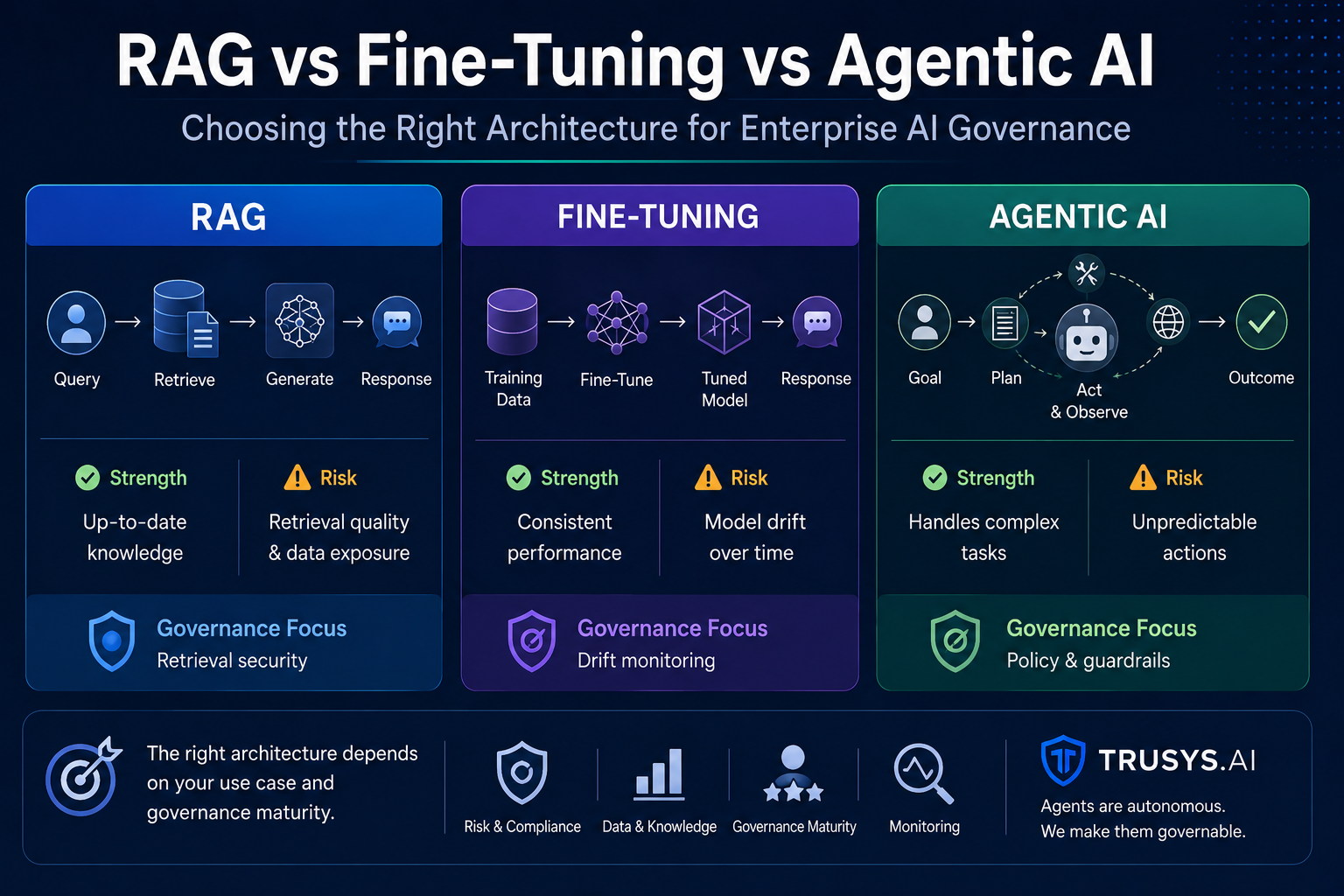
When enterprise teams choose an AI architecture, the conversation usually centers on cost, latency, and accuracy. RAG is cheaper than fine-tuning. Fine-tuning is faster at inference. Agentic systems are more capable but harder to control. These are valid tradeoffs — but they miss the question that determines whether a deployment survives its first year in production: what happens when this architecture fails, and will you be able to see it, prove it, and fix it?
Each of the three dominant architectures — retrieval-augmented generation (RAG), fine-tuning, and agentic AI — carries a distinct governance risk profile. Choosing the wrong one for your risk tolerance, compliance obligations, or monitoring maturity creates problems that no amount of prompt engineering can fix later.
This post compares the three architectures through a governance lens: what each one is good at, what breaks in production, and how you would catch it before it becomes a regulatory or reputational incident.

Retrieval-Augmented Generation (RAG)
RAG connects an LLM to an external knowledge base at query time, retrieving relevant documents and injecting them into the model's context. It's the most common architecture for enterprise knowledge assistants because it doesn't require retraining the model and keeps responses grounded in current, organisation-specific information.
What breaks in production
AI Agents Multiply Infrastructure Load
AI agents introduce an entirely new scaling challenge.
Unlike a traditional user making one request at a time, AI agents may:
- Trigger multiple chained prompts
- Query several models simultaneously
- Retry failed requests autonomously
- Launch recursive workflows
One user action can suddenly generate dozens of inference operations.
Without workload controls, traffic amplification becomes unavoidable.

Fine-Tuning
Why Rate Limit Failures Are So Dangerous
Many organizations still treat rate limit errors as minor API inconveniences.
That assumption is becoming expensive.
In reality, rate limit failures create cascading operational disruption across the enterprise.
What breaks in production
Why Rate Limit Failures Are So Dangerous
Many organizations still treat rate limit errors as minor API inconveniences.
That assumption is becoming expensive.
In reality, rate limit failures create cascading operational disruption across the enterprise.
Agentic AI
Why Rate Limit Failures Are So Dangerous
Many organizations still treat rate limit errors as minor API inconveniences.
That assumption is becoming expensive.
In reality, rate limit failures create cascading operational disruption across the enterprise.
What breaks in production
Why Rate Limit Failures Are So Dangerous
Many organizations still treat rate limit errors as minor API inconveniences.
That assumption is becoming expensive.
In reality, rate limit failures create cascading operational disruption across the enterprise.
Frequently Asked Questions
AI Agents Multiply Infrastructure Load
AI agents introduce an entirely new scaling challenge.
Unlike a traditional user making one request at a time, AI agents may:
- Trigger multiple chained prompts
- Query several models simultaneously
- Retry failed requests autonomously
- Launch recursive workflows
One user action can suddenly generate dozens of inference operations.
Without workload controls, traffic amplification becomes unavoidable.
AI Agents Multiply Infrastructure Load
AI agents introduce an entirely new scaling challenge.
Unlike a traditional user making one request at a time, AI agents may:
- Trigger multiple chained prompts
- Query several models simultaneously
- Retry failed requests autonomously
- Launch recursive workflows
One user action can suddenly generate dozens of inference operations.
Without workload controls, traffic amplification becomes unavoidable.
AI Agents Multiply Infrastructure Load
AI agents introduce an entirely new scaling challenge.
Unlike a traditional user making one request at a time, AI agents may:
- Trigger multiple chained prompts
- Query several models simultaneously
- Retry failed requests autonomously
- Launch recursive workflows
One user action can suddenly generate dozens of inference operations.
Without workload controls, traffic amplification becomes unavoidable.
AI Agents Multiply Infrastructure Load
AI agents introduce an entirely new scaling challenge.
Unlike a traditional user making one request at a time, AI agents may:
- Trigger multiple chained prompts
- Query several models simultaneously
- Retry failed requests autonomously
- Launch recursive workflows
One user action can suddenly generate dozens of inference operations.
Without workload controls, traffic amplification becomes unavoidable.
AI Agents Multiply Infrastructure Load
AI agents introduce an entirely new scaling challenge.
Unlike a traditional user making one request at a time, AI agents may:
- Trigger multiple chained prompts
- Query several models simultaneously
- Retry failed requests autonomously
- Launch recursive workflows
One user action can suddenly generate dozens of inference operations.
Without workload controls, traffic amplification becomes unavoidable.
AI Agents Multiply Infrastructure Load
AI agents introduce an entirely new scaling challenge.
Unlike a traditional user making one request at a time, AI agents may:
- Trigger multiple chained prompts
- Query several models simultaneously
- Retry failed requests autonomously
- Launch recursive workflows
One user action can suddenly generate dozens of inference operations.
Without workload controls, traffic amplification becomes unavoidable.
AI Agents Multiply Infrastructure Load
AI agents introduce an entirely new scaling challenge.
Unlike a traditional user making one request at a time, AI agents may:
- Trigger multiple chained prompts
- Query several models simultaneously
- Retry failed requests autonomously
- Launch recursive workflows
One user action can suddenly generate dozens of inference operations.
Without workload controls, traffic amplification becomes unavoidable.
AI Agents Multiply Infrastructure Load
AI agents introduce an entirely new scaling challenge.
Unlike a traditional user making one request at a time, AI agents may:
- Trigger multiple chained prompts
- Query several models simultaneously
- Retry failed requests autonomously
- Launch recursive workflows
One user action can suddenly generate dozens of inference operations.
Without workload controls, traffic amplification becomes unavoidable.
AI Agents Multiply Infrastructure Load
AI agents introduce an entirely new scaling challenge.
Unlike a traditional user making one request at a time, AI agents may:
- Trigger multiple chained prompts
- Query several models simultaneously
- Retry failed requests autonomously
- Launch recursive workflows
One user action can suddenly generate dozens of inference operations.
Without workload controls, traffic amplification becomes unavoidable.
AI Agents Multiply Infrastructure Load
AI agents introduce an entirely new scaling challenge.
Unlike a traditional user making one request at a time, AI agents may:
- Trigger multiple chained prompts
- Query several models simultaneously
- Retry failed requests autonomously
- Launch recursive workflows
One user action can suddenly generate dozens of inference operations.
Without workload controls, traffic amplification becomes unavoidable.
AI Agents Multiply Infrastructure Load
AI agents introduce an entirely new scaling challenge.
Unlike a traditional user making one request at a time, AI agents may:
- Trigger multiple chained prompts
- Query several models simultaneously
- Retry failed requests autonomously
- Launch recursive workflows
One user action can suddenly generate dozens of inference operations.
Without workload controls, traffic amplification becomes unavoidable.
AI Agents Multiply Infrastructure Load
AI agents introduce an entirely new scaling challenge.
Unlike a traditional user making one request at a time, AI agents may:
- Trigger multiple chained prompts
- Query several models simultaneously
- Retry failed requests autonomously
- Launch recursive workflows
One user action can suddenly generate dozens of inference operations.
Without workload controls, traffic amplification becomes unavoidable.
AI Agents Multiply Infrastructure Load
AI agents introduce an entirely new scaling challenge.
Unlike a traditional user making one request at a time, AI agents may:
- Trigger multiple chained prompts
- Query several models simultaneously
- Retry failed requests autonomously
- Launch recursive workflows
One user action can suddenly generate dozens of inference operations.
Without workload controls, traffic amplification becomes unavoidable.
AI Agents Multiply Infrastructure Load
AI agents introduce an entirely new scaling challenge.
Unlike a traditional user making one request at a time, AI agents may:
- Trigger multiple chained prompts
- Query several models simultaneously
- Retry failed requests autonomously
- Launch recursive workflows
One user action can suddenly generate dozens of inference operations.
Without workload controls, traffic amplification becomes unavoidable.
AI Agents Multiply Infrastructure Load
AI agents introduce an entirely new scaling challenge.
Unlike a traditional user making one request at a time, AI agents may:
- Trigger multiple chained prompts
- Query several models simultaneously
- Retry failed requests autonomously
- Launch recursive workflows
One user action can suddenly generate dozens of inference operations.
Without workload controls, traffic amplification becomes unavoidable.
AI Agents Multiply Infrastructure Load
AI agents introduce an entirely new scaling challenge.
Unlike a traditional user making one request at a time, AI agents may:
- Trigger multiple chained prompts
- Query several models simultaneously
- Retry failed requests autonomously
- Launch recursive workflows
One user action can suddenly generate dozens of inference operations.
Without workload controls, traffic amplification becomes unavoidable.
AI Agents Multiply Infrastructure Load
AI agents introduce an entirely new scaling challenge.
Unlike a traditional user making one request at a time, AI agents may:
- Trigger multiple chained prompts
- Query several models simultaneously
- Retry failed requests autonomously
- Launch recursive workflows
One user action can suddenly generate dozens of inference operations.
Without workload controls, traffic amplification becomes unavoidable.
AI Agents Multiply Infrastructure Load
AI agents introduce an entirely new scaling challenge.
Unlike a traditional user making one request at a time, AI agents may:
- Trigger multiple chained prompts
- Query several models simultaneously
- Retry failed requests autonomously
- Launch recursive workflows
One user action can suddenly generate dozens of inference operations.
Without workload controls, traffic amplification becomes unavoidable.
AI Agents Multiply Infrastructure Load
AI agents introduce an entirely new scaling challenge.
Unlike a traditional user making one request at a time, AI agents may:
- Trigger multiple chained prompts
- Query several models simultaneously
- Retry failed requests autonomously
- Launch recursive workflows
One user action can suddenly generate dozens of inference operations.
Without workload controls, traffic amplification becomes unavoidable.
AI Agents Multiply Infrastructure Load
AI agents introduce an entirely new scaling challenge.
Unlike a traditional user making one request at a time, AI agents may:
- Trigger multiple chained prompts
- Query several models simultaneously
- Retry failed requests autonomously
- Launch recursive workflows
One user action can suddenly generate dozens of inference operations.
Without workload controls, traffic amplification becomes unavoidable.
Choosing Based on Governance Maturity — Not Just Use Case
Why Rate Limit Failures Are So Dangerous
Many organizations still treat rate limit errors as minor API inconveniences.
That assumption is becoming expensive.
In reality, rate limit failures create cascading operational disruption across the enterprise.
One Platform, Every Architecture
Why Rate Limit Failures Are So Dangerous
Many organizations still treat rate limit errors as minor API inconveniences.
That assumption is becoming expensive.
In reality, rate limit failures create cascading operational disruption across the enterprise.
Stop guessing.
Start measuring.
Join teams building reliable AI with TruEval. Start with a free trial, no credit card required. Get your first evaluation running in under 10 minutes.
Questions about Trusys?
Our team is here to help. Schedule a personalized demo to see how Trusys fits your specific use case.
Book a Demo

Ready to dive in?
Check out our documentation and tutorials. Get started with example datasets and evaluation templates.
Start Free Trial
Free Trial
No credit card required
10 Min
To first evaluation
24/7
Enterprise support


Benefits
Specifications
How-to
Contact Us
Learn More

RAG vs Fine-Tuning vs Agentic AI: Choosing the Right Architecture for Enterprise AI Governance
Written by
When enterprise teams choose an AI architecture, the conversation usually centers on cost, latency, and accuracy. RAG is cheaper than fine-tuning. Fine-tuning is faster at inference. Agentic systems are more capable but harder to control. These are valid tradeoffs — but they miss the question that determines whether a deployment survives its first year in production: what happens when this architecture fails, and will you be able to see it, prove it, and fix it?
Each of the three dominant architectures — retrieval-augmented generation (RAG), fine-tuning, and agentic AI — carries a distinct governance risk profile. Choosing the wrong one for your risk tolerance, compliance obligations, or monitoring maturity creates problems that no amount of prompt engineering can fix later.
This post compares the three architectures through a governance lens: what each one is good at, what breaks in production, and how you would catch it before it becomes a regulatory or reputational incident.

Retrieval-Augmented Generation (RAG)
RAG connects an LLM to an external knowledge base at query time, retrieving relevant documents and injecting them into the model's context. It's the most common architecture for enterprise knowledge assistants because it doesn't require retraining the model and keeps responses grounded in current, organisation-specific information.
What breaks in production
AI Agents Multiply Infrastructure Load
AI agents introduce an entirely new scaling challenge.
Unlike a traditional user making one request at a time, AI agents may:
- Trigger multiple chained prompts
- Query several models simultaneously
- Retry failed requests autonomously
- Launch recursive workflows
One user action can suddenly generate dozens of inference operations.
Without workload controls, traffic amplification becomes unavoidable.

Fine-Tuning
Why Rate Limit Failures Are So Dangerous
Many organizations still treat rate limit errors as minor API inconveniences.
That assumption is becoming expensive.
In reality, rate limit failures create cascading operational disruption across the enterprise.
What breaks in production
Why Rate Limit Failures Are So Dangerous
Many organizations still treat rate limit errors as minor API inconveniences.
That assumption is becoming expensive.
In reality, rate limit failures create cascading operational disruption across the enterprise.
Agentic AI
Why Rate Limit Failures Are So Dangerous
Many organizations still treat rate limit errors as minor API inconveniences.
That assumption is becoming expensive.
In reality, rate limit failures create cascading operational disruption across the enterprise.
What breaks in production
Why Rate Limit Failures Are So Dangerous
Many organizations still treat rate limit errors as minor API inconveniences.
That assumption is becoming expensive.
In reality, rate limit failures create cascading operational disruption across the enterprise.
Frequently Asked Questions
AI Agents Multiply Infrastructure Load
AI agents introduce an entirely new scaling challenge.
Unlike a traditional user making one request at a time, AI agents may:
- Trigger multiple chained prompts
- Query several models simultaneously
- Retry failed requests autonomously
- Launch recursive workflows
One user action can suddenly generate dozens of inference operations.
Without workload controls, traffic amplification becomes unavoidable.
AI Agents Multiply Infrastructure Load
AI agents introduce an entirely new scaling challenge.
Unlike a traditional user making one request at a time, AI agents may:
- Trigger multiple chained prompts
- Query several models simultaneously
- Retry failed requests autonomously
- Launch recursive workflows
One user action can suddenly generate dozens of inference operations.
Without workload controls, traffic amplification becomes unavoidable.
AI Agents Multiply Infrastructure Load
AI agents introduce an entirely new scaling challenge.
Unlike a traditional user making one request at a time, AI agents may:
- Trigger multiple chained prompts
- Query several models simultaneously
- Retry failed requests autonomously
- Launch recursive workflows
One user action can suddenly generate dozens of inference operations.
Without workload controls, traffic amplification becomes unavoidable.
AI Agents Multiply Infrastructure Load
AI agents introduce an entirely new scaling challenge.
Unlike a traditional user making one request at a time, AI agents may:
- Trigger multiple chained prompts
- Query several models simultaneously
- Retry failed requests autonomously
- Launch recursive workflows
One user action can suddenly generate dozens of inference operations.
Without workload controls, traffic amplification becomes unavoidable.
AI Agents Multiply Infrastructure Load
AI agents introduce an entirely new scaling challenge.
Unlike a traditional user making one request at a time, AI agents may:
- Trigger multiple chained prompts
- Query several models simultaneously
- Retry failed requests autonomously
- Launch recursive workflows
One user action can suddenly generate dozens of inference operations.
Without workload controls, traffic amplification becomes unavoidable.
AI Agents Multiply Infrastructure Load
AI agents introduce an entirely new scaling challenge.
Unlike a traditional user making one request at a time, AI agents may:
- Trigger multiple chained prompts
- Query several models simultaneously
- Retry failed requests autonomously
- Launch recursive workflows
One user action can suddenly generate dozens of inference operations.
Without workload controls, traffic amplification becomes unavoidable.
AI Agents Multiply Infrastructure Load
AI agents introduce an entirely new scaling challenge.
Unlike a traditional user making one request at a time, AI agents may:
- Trigger multiple chained prompts
- Query several models simultaneously
- Retry failed requests autonomously
- Launch recursive workflows
One user action can suddenly generate dozens of inference operations.
Without workload controls, traffic amplification becomes unavoidable.
AI Agents Multiply Infrastructure Load
AI agents introduce an entirely new scaling challenge.
Unlike a traditional user making one request at a time, AI agents may:
- Trigger multiple chained prompts
- Query several models simultaneously
- Retry failed requests autonomously
- Launch recursive workflows
One user action can suddenly generate dozens of inference operations.
Without workload controls, traffic amplification becomes unavoidable.
AI Agents Multiply Infrastructure Load
AI agents introduce an entirely new scaling challenge.
Unlike a traditional user making one request at a time, AI agents may:
- Trigger multiple chained prompts
- Query several models simultaneously
- Retry failed requests autonomously
- Launch recursive workflows
One user action can suddenly generate dozens of inference operations.
Without workload controls, traffic amplification becomes unavoidable.
AI Agents Multiply Infrastructure Load
AI agents introduce an entirely new scaling challenge.
Unlike a traditional user making one request at a time, AI agents may:
- Trigger multiple chained prompts
- Query several models simultaneously
- Retry failed requests autonomously
- Launch recursive workflows
One user action can suddenly generate dozens of inference operations.
Without workload controls, traffic amplification becomes unavoidable.
AI Agents Multiply Infrastructure Load
AI agents introduce an entirely new scaling challenge.
Unlike a traditional user making one request at a time, AI agents may:
- Trigger multiple chained prompts
- Query several models simultaneously
- Retry failed requests autonomously
- Launch recursive workflows
One user action can suddenly generate dozens of inference operations.
Without workload controls, traffic amplification becomes unavoidable.
AI Agents Multiply Infrastructure Load
AI agents introduce an entirely new scaling challenge.
Unlike a traditional user making one request at a time, AI agents may:
- Trigger multiple chained prompts
- Query several models simultaneously
- Retry failed requests autonomously
- Launch recursive workflows
One user action can suddenly generate dozens of inference operations.
Without workload controls, traffic amplification becomes unavoidable.
AI Agents Multiply Infrastructure Load
AI agents introduce an entirely new scaling challenge.
Unlike a traditional user making one request at a time, AI agents may:
- Trigger multiple chained prompts
- Query several models simultaneously
- Retry failed requests autonomously
- Launch recursive workflows
One user action can suddenly generate dozens of inference operations.
Without workload controls, traffic amplification becomes unavoidable.
AI Agents Multiply Infrastructure Load
AI agents introduce an entirely new scaling challenge.
Unlike a traditional user making one request at a time, AI agents may:
- Trigger multiple chained prompts
- Query several models simultaneously
- Retry failed requests autonomously
- Launch recursive workflows
One user action can suddenly generate dozens of inference operations.
Without workload controls, traffic amplification becomes unavoidable.
AI Agents Multiply Infrastructure Load
AI agents introduce an entirely new scaling challenge.
Unlike a traditional user making one request at a time, AI agents may:
- Trigger multiple chained prompts
- Query several models simultaneously
- Retry failed requests autonomously
- Launch recursive workflows
One user action can suddenly generate dozens of inference operations.
Without workload controls, traffic amplification becomes unavoidable.
AI Agents Multiply Infrastructure Load
AI agents introduce an entirely new scaling challenge.
Unlike a traditional user making one request at a time, AI agents may:
- Trigger multiple chained prompts
- Query several models simultaneously
- Retry failed requests autonomously
- Launch recursive workflows
One user action can suddenly generate dozens of inference operations.
Without workload controls, traffic amplification becomes unavoidable.
AI Agents Multiply Infrastructure Load
AI agents introduce an entirely new scaling challenge.
Unlike a traditional user making one request at a time, AI agents may:
- Trigger multiple chained prompts
- Query several models simultaneously
- Retry failed requests autonomously
- Launch recursive workflows
One user action can suddenly generate dozens of inference operations.
Without workload controls, traffic amplification becomes unavoidable.
AI Agents Multiply Infrastructure Load
AI agents introduce an entirely new scaling challenge.
Unlike a traditional user making one request at a time, AI agents may:
- Trigger multiple chained prompts
- Query several models simultaneously
- Retry failed requests autonomously
- Launch recursive workflows
One user action can suddenly generate dozens of inference operations.
Without workload controls, traffic amplification becomes unavoidable.
AI Agents Multiply Infrastructure Load
AI agents introduce an entirely new scaling challenge.
Unlike a traditional user making one request at a time, AI agents may:
- Trigger multiple chained prompts
- Query several models simultaneously
- Retry failed requests autonomously
- Launch recursive workflows
One user action can suddenly generate dozens of inference operations.
Without workload controls, traffic amplification becomes unavoidable.
AI Agents Multiply Infrastructure Load
AI agents introduce an entirely new scaling challenge.
Unlike a traditional user making one request at a time, AI agents may:
- Trigger multiple chained prompts
- Query several models simultaneously
- Retry failed requests autonomously
- Launch recursive workflows
One user action can suddenly generate dozens of inference operations.
Without workload controls, traffic amplification becomes unavoidable.
Choosing Based on Governance Maturity — Not Just Use Case
Why Rate Limit Failures Are So Dangerous
Many organizations still treat rate limit errors as minor API inconveniences.
That assumption is becoming expensive.
In reality, rate limit failures create cascading operational disruption across the enterprise.
One Platform, Every Architecture
Why Rate Limit Failures Are So Dangerous
Many organizations still treat rate limit errors as minor API inconveniences.
That assumption is becoming expensive.
In reality, rate limit failures create cascading operational disruption across the enterprise.
Stop guessing.
Start measuring.
Join teams building reliable AI with TruEval. Start with a free trial, no credit card required. Get your first evaluation running in under 10 minutes.
Questions about Trusys?
Our team is here to help. Schedule a personalized demo to see how Trusys fits your specific use case.
Book a Demo
Ready to dive in?
Check out our documentation and tutorials. Get started with example datasets and evaluation templates.
Start Free Trial
Free Trial
No credit card required
10 Min
To first evaluation
24/7
Enterprise support
RAG vs Fine-Tuning vs Agentic AI: Choosing the Right Architecture for Enterprise AI Governance
Written by
Manish Tewari
Published on
June 14, 2026
When enterprise teams choose an AI architecture, the conversation usually centers on cost, latency, and accuracy. RAG is cheaper than fine-tuning. Fine-tuning is faster at inference. Agentic systems are more capable but harder to control. These are valid tradeoffs — but they miss the question that determines whether a deployment survives its first year in production: what happens when this architecture fails, and will you be able to see it, prove it, and fix it?
Each of the three dominant architectures — retrieval-augmented generation (RAG), fine-tuning, and agentic AI — carries a distinct governance risk profile. Choosing the wrong one for your risk tolerance, compliance obligations, or monitoring maturity creates problems that no amount of prompt engineering can fix later.
This post compares the three architectures through a governance lens: what each one is good at, what breaks in production, and how you would catch it before it becomes a regulatory or reputational incident.


Retrieval-Augmented Generation (RAG)
RAG connects an LLM to an external knowledge base at query time, retrieving relevant documents and injecting them into the model's context. It's the most common architecture for enterprise knowledge assistants because it doesn't require retraining the model and keeps responses grounded in current, organisation-specific information.
What breaks in production
RAG's governance risk lives in the retrieval layer. If your knowledge base contains outdated, conflicting, or sensitive documents, the model will retrieve and surface them with full confidence. Worse, RAG pipelines are vulnerable to poisoning — where malicious or low-quality content injected into the knowledge base gets retrieved and treated as ground truth by the model. There's also a data leakage risk: documents retrieved for one user's context can inadvertently surface in another user's session if access controls aren't enforced at the retrieval layer, not just the application layer.
Fine-Tuning
Fine-tuning adapts a base model's weights using a custom training dataset, baking domain knowledge, tone, or task-specific behaviour directly into the model. It's the right choice when you need consistent behaviour at scale, lower per-query latency, or when your use case requires patterns that retrieval alone can't capture — such as a specific reasoning style or domain-specific classification.
What breaks in production
A fine-tuned model is a frozen snapshot of a moment in time. As real-world data distributions shift — customer language changes, new products launch, regulations update — the model's outputs gradually stop matching reality. This is model drift, and unlike RAG, you can't fix it by updating a document; you need to retrain. The governance challenge compounds because fine-tuned models often inherit subtle biases from their training data that are harder to detect than in a base model, since the fine-tuning process can amplify patterns present in a narrow dataset.
Agentic AI
Agentic AI systems plan, make decisions, call tools, and execute multi-step tasks with varying degrees of autonomy. They represent the most capable — and most governance-intensive — architecture, because the model isn't just generating text; it's taking actions that can have real operational consequences: sending emails, modifying records, executing transactions, or triggering downstream workflows.
What breaks in production
Agentic systems introduce two compounding risks. First, reproducibility: the same task run twice can produce different tool-call sequences, different intermediate decisions, and different outcomes — making it difficult to predict behaviour or debug failures. Second, guardrail drift across multi-step chains: a policy that correctly blocks a single problematic output might not catch a violation that emerges only after several steps of legitimate-seeming actions compound into a harmful outcome. The longer and more autonomous the chain, the harder it is to verify that every step stayed within policy.
Choosing Based on Governance Maturity — Not Just Use Case
The right architecture often depends less on what you're trying to build and more on how mature your monitoring and governance infrastructure already is. RAG is forgiving in development but unforgiving in access control and content quality at scale. Fine-tuning is forgiving at inference time but unforgiving the moment your data distribution shifts and no one is watching. Agentic AI is the most capable but demands governance maturity at every layer — input validation, policy enforcement, reproducibility testing, and full audit logging — from day one.
Many enterprise deployments don't pick just one. A common pattern is RAG for knowledge retrieval, feeding into an agentic layer that takes action, with fine-tuning reserved for narrow, high-volume classification tasks. Whatever combination you choose, the governance question is the same: when this fails — and it will — how will you know, and what's your evidence trail?
One Platform, Every Architecture
Whether your enterprise runs RAG pipelines, fine-tuned models, agentic workflows, or all three, Trusys provides a unified layer for evaluation, security scanning, guardrail enforcement, and continuous production monitoring — so governance doesn't have to be rebuilt for every architecture you adopt.
Frequently Asked Questions
- What is the difference between RAG, fine-tuning, and agentic AI?
RAG (Retrieval-Augmented Generation) retrieves information from external knowledge sources at query time, fine-tuning modifies a model's internal weights using custom training data, and agentic AI enables models to make decisions, call tools, and execute multi-step workflows autonomously. Each architecture has different governance, security, and monitoring requirements.
- Is RAG better than fine-tuning for enterprise AI?
Not necessarily. RAG is often preferred when knowledge changes frequently because information can be updated without retraining the model. Fine-tuning is typically better for consistent behavior, specialized classification tasks, or domain-specific outputs. The right choice depends on business objectives, governance requirements, and operational constraints.
- What governance risks are associated with RAG systems?
RAG systems can introduce risks such as retrieval poisoning, outdated knowledge retrieval, unauthorized document access, sensitive data exposure, and poor retrieval quality. Effective governance requires access controls, retrieval monitoring, content validation, and continuous evaluation.
- What are the main risks of fine-tuned AI models?
Fine-tuned models are vulnerable to model drift, bias amplification, outdated knowledge, and performance degradation as business conditions change. Since knowledge is embedded within the model itself, updates often require retraining and revalidation.
- Why is agentic AI considered higher risk than traditional AI systems?
Agentic AI can take actions, make decisions, and interact with external systems. This increases governance complexity because failures can result in operational, compliance, financial, or security impacts. Organizations need stronger guardrails, audit trails, approval workflows, and monitoring capabilities.
- Can enterprises combine RAG, fine-tuning, and agentic AI?
Yes. Many enterprise architectures combine all three approaches. For example, RAG may provide knowledge retrieval, fine-tuned models may perform specialized classification tasks, and agentic workflows may orchestrate actions across business systems. Governance controls must be applied across the entire architecture.
- How do you govern an agentic AI system?
Governing agentic AI requires policy enforcement at every step of execution, tool authorization controls, reproducibility testing, human oversight mechanisms, audit logging, and continuous monitoring of agent behavior in production environments.
- How do you monitor a RAG system in production?
Production monitoring for RAG systems should track retrieval accuracy, source quality, document freshness, access control violations, hallucination rates, and whether retrieved context is actually influencing model outputs as intended.
- How can organizations reduce governance risks across different AI architectures?
Organizations can reduce risk by implementing continuous evaluation, security testing, guardrail enforcement, drift detection, audit logging, policy monitoring, and incident response processes across all AI systems regardless of architecture.
- What is the biggest mistake organizations make when selecting an AI architecture?
Many organizations optimize for accuracy, speed, or development cost while underestimating governance requirements. An architecture that performs well in testing can still fail in production if monitoring, auditability, security controls, and compliance processes are not in place.
Stop guessing.
Start measuring.
Join teams building reliable AI with Trusys. Start with a free trial, no credit card required. Get your first evaluation running in under 10 minutes.
Questions about Trusys?
Our team is here to help. Schedule a personalized demo to see how Trusys fits your specific use case.
Book a Demo
Ready to dive in?
Check out our documentation and tutorials. Get started with example datasets and evaluation templates.
Start Free Trial
Free Trial
No credit card required
10 Min
to get started
24/7
Enterprise support