The spreadsheet on your desk is now a regulated model.
Written by

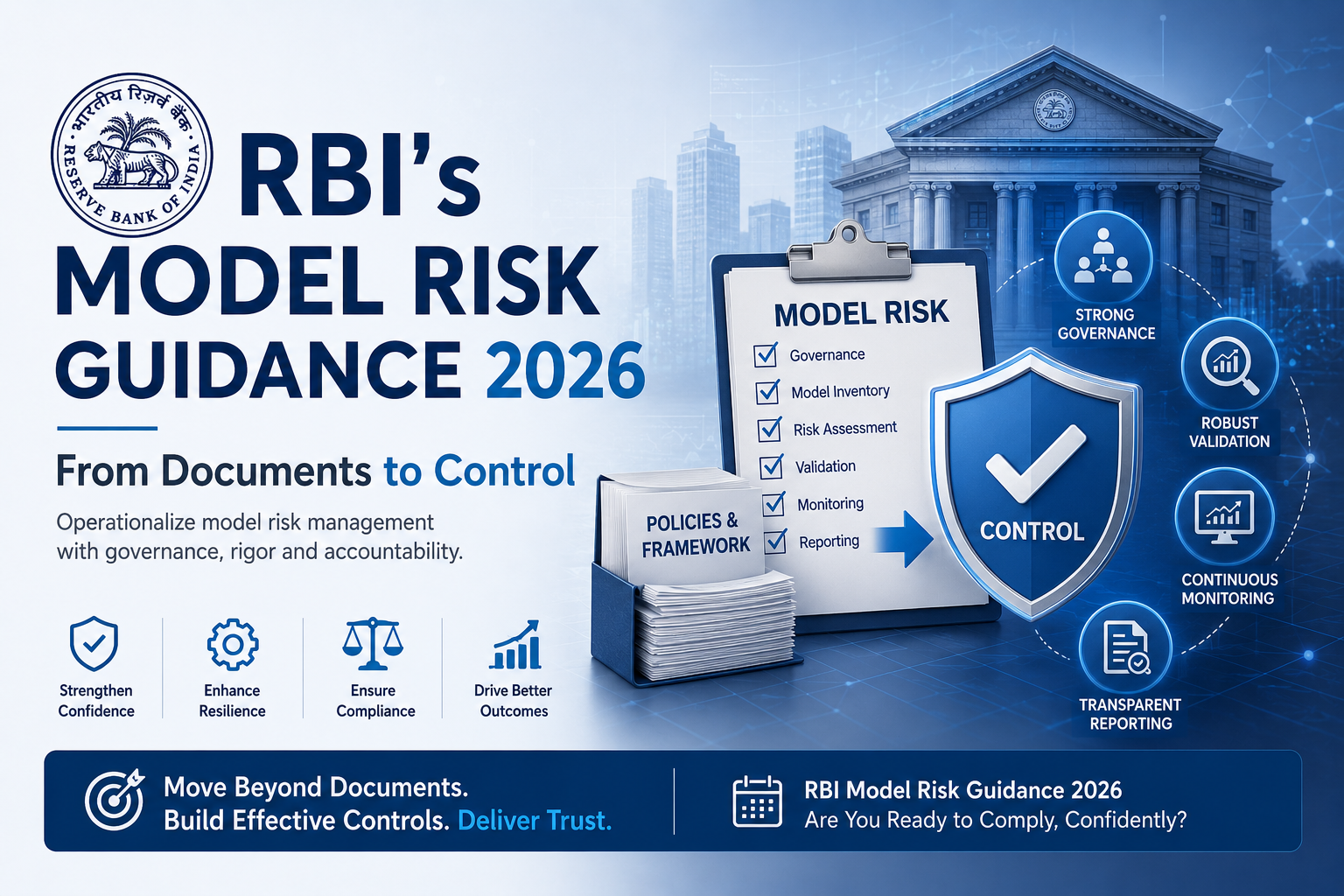
RBI has redrawn the boundaries of model risk — pulling AI, generative systems and vendor models into a single, board-accountable framework. Here is what the draft actually asks for, and what it takes to be ready.
Why Rate Limit Failures Are So Dangerous
Many organizations still treat rate limit errors as minor API inconveniences.
That assumption is becoming expensive.
In reality, rate limit failures create cascading operational disruption across the enterprise.
Wider than most teams assume
The guidance applies across the regulated landscape, not to a narrow set of large lenders. If your institution appears below, it is in scope:
sdsdsds Commercial banks Small finance & payments banks Regional rural banks Co-operative banks NBFCs — all four layers All-India Financial Institutions ARCs Credit information companies
Just as important is the breadth of what counts as a “model.” The draft deliberately casts a wide net: statistical and rule-based models, machine learning, generative AI, foundational and frontier models — and models supplied by third parties. The unifying test is function, not technology. If an output materially informs a decision, it falls within scope, whether it runs on a data-science platform or in a cell of a spreadsheet.
It starts with the Board, not the model
The defining feature of the guidance is accountability. An institution is answerable for the outcomes of every model it uses — internal, third-party or hybrid — and that accountability is anchored at the top of the house.
- The Board
- approves the Model Risk Management Framework and sets a forward-looking, stress-tested risk appetite for model risk.
- The Risk Management Committee of the Board (RMCB)
- reviews validation of high-risk models and approves their deployment, and reviews model tiering at least annually.
- Senior management
- operationalises the framework, allocates resources, and keeps the inventory and documentation current.
Why Rate Limit Failures Are So Dangerous
Many organizations still treat rate limit errors as minor API inconveniences.
That assumption is becoming expensive.
In reality, rate limit failures create cascading operational disruption across the enterprise.
Why Rate Limit Failures Are So Dangerous
Many organizations still treat rate limit errors as minor API inconveniences.
That assumption is becoming expensive.
In reality, rate limit failures create cascading operational disruption across the enterprise.
Tiering drives everything else
Why Rate Limit Failures Are So Dangerous
Many organizations still treat rate limit errors as minor API inconveniences.
That assumption is becoming expensive.
In reality, rate limit failures create cascading operational disruption across the enterprise.
Governance at the speed of the model
Why Rate Limit Failures Are So Dangerous
Many organizations still treat rate limit errors as minor API inconveniences.
That assumption is becoming expensive.
In reality, rate limit failures create cascading operational disruption across the enterprise.
- Inventory first
- No model may be used or deployed unless it is recorded in the inventory; decommissioned models are retained for at least ten years, with dependencies mapped.
- Independent validation
- Before and after deployment, on defined triggers and periodically, with reports reaching the RMCB within three months.
- Ongoing monitoring
- Continuous performance testing, with explicit attention to data drift and concept drift.
- Change management
- Any material change re-triggers validation and approval; every change is logged and versioned.
- Business continuity
- Fallback mechanisms for model unavailability, degradation or failure, and orderly decommissioning.
The throughline is cadence. A model that can change behaviour overnight cannot be governed by a review that happens once a quarter.
Where the scrutiny intensifies
The guidance reserves its most detailed expectations for AI and machine-learning systems, and especially for generative and customer-facing ones:
- Explainability thresholds
- Higher for material decisions; where full explainability is not achievable, compensating controls apply — enhanced validation, output corroboration and usage restrictions.
- Hallucination boundaries
- Defined control limits to contain fabricated or unsupported outputs in generative models.
- Bias & fairness
- Testing for discriminatory outcomes, with documented mitigation.
- Structured challenge
- Red-teaming and adversarial testing for GenAI and customer-facing models.
- Adversarial defences
- Controls against prompt injection and adversarial inputs, session and context limits, and anomaly detection.
- Dynamic-update controls
- Enhanced scrutiny for models that update automatically — strict justification, tighter data checks and stricter monitoring.
- Human in command
- Human-in- and on-the-loop, override, suspension and a kill-switch — with disclosure to users that they are interacting with AI, and a route to a human.
Vendor assurance is not your assurance
Why Rate Limit Failures Are So Dangerous
Many organizations still treat rate limit errors as minor API inconveniences.
That assumption is becoming expensive.
In reality, rate limit failures create cascading operational disruption across the enterprise.

The uncomfortable part
Most institutions still govern models with documents.
Policies written once and reviewed once a quarter describe governance well. They do not enforce it. AI models drift, they hallucinate, they can be manipulated by a single crafted prompt, and they change behaviour after a vendor update no one saw. The distance between a static policy and a live model is exactly where model risk now lives — and it is the distance the 2026 guidance asks you to close.
Why Rate Limit Failures Are So Dangerous
Many organizations still treat rate limit errors as minor API inconveniences.
That assumption is becoming expensive.
In reality, rate limit failures create cascading operational disruption across the enterprise.
What good looks like — and how Trusys helps
RBI expectation
Ch. II
Ch. III.A
Ch. III.B
Ch. IV.B
Ch. IV.E
§54(7)
§54(1)
§54(2)
§54(3)
§55
§56
§58–59
§60
Ch. V.A
What it requires
Board-approved framework, risk appetite, three lines of defence and RMCB oversight
Risk-based tiering that drives validation, approval and monitoring
Complete model inventory; nothing deployed unless registered; dependency mapping
Complete model inventory; no deployment without registration; comprehensive dependency mapping
Change management; material change re-triggers validation; versioning
Continuous monitoring; data-drift and concept-drift detection
Explainability thresholds; compensating controls where limited
Hallucination control boundaries for generative models
Bias and fairness assessment against discriminatory outcomes
Red-teaming and structured challenge for GenAI and customer-facing models
Enhanced controls for auto-updating / dynamic models
Access controls, API safeguards, prompt-injection and anomaly defences
Human-in-command: override, suspension and kill-switch
Independent validation of third-party models regardless of vendor assurance
Trusys
Governance layer
TruScout — tiering
TruScout — inventory
TruEval
TruScoerereut + TruEval
TruPulse
TruEval + TruGuard
TruGuard
TruEval
TruGuard
TruPulse + TruGuard
TruGuard
TruGuard
TruScout + TruEval
Stop guessing.
Start measuring.
Join teams building reliable AI with TruEval. Start with a free trial, no credit card required. Get your first evaluation running in under 10 minutes.
Questions about Trusys?
Our team is here to help. Schedule a personalized demo to see how Trusys fits your specific use case.
Book a Demo

Ready to dive in?
Check out our documentation and tutorials. Get started with example datasets and evaluation templates.
Start Free Trial
Free Trial
No credit card required
10 Min
To first evaluation
24/7
Enterprise support


Benefits
Specifications
How-to
Contact Us
Learn More

The spreadsheet on your desk is now a regulated model.
Written by
RBI has redrawn the boundaries of model risk — pulling AI, generative systems and vendor models into a single, board-accountable framework. Here is what the draft actually asks for, and what it takes to be ready.
Why Rate Limit Failures Are So Dangerous
Many organizations still treat rate limit errors as minor API inconveniences.
That assumption is becoming expensive.
In reality, rate limit failures create cascading operational disruption across the enterprise.
Wider than most teams assume
The guidance applies across the regulated landscape, not to a narrow set of large lenders. If your institution appears below, it is in scope:
sdsdsds Commercial banks Small finance & payments banks Regional rural banks Co-operative banks NBFCs — all four layers All-India Financial Institutions ARCs Credit information companies
Just as important is the breadth of what counts as a “model.” The draft deliberately casts a wide net: statistical and rule-based models, machine learning, generative AI, foundational and frontier models — and models supplied by third parties. The unifying test is function, not technology. If an output materially informs a decision, it falls within scope, whether it runs on a data-science platform or in a cell of a spreadsheet.
It starts with the Board, not the model
The defining feature of the guidance is accountability. An institution is answerable for the outcomes of every model it uses — internal, third-party or hybrid — and that accountability is anchored at the top of the house.
- The Board
- approves the Model Risk Management Framework and sets a forward-looking, stress-tested risk appetite for model risk.
- The Risk Management Committee of the Board (RMCB)
- reviews validation of high-risk models and approves their deployment, and reviews model tiering at least annually.
- Senior management
- operationalises the framework, allocates resources, and keeps the inventory and documentation current.
Why Rate Limit Failures Are So Dangerous
Many organizations still treat rate limit errors as minor API inconveniences.
That assumption is becoming expensive.
In reality, rate limit failures create cascading operational disruption across the enterprise.
Why Rate Limit Failures Are So Dangerous
Many organizations still treat rate limit errors as minor API inconveniences.
That assumption is becoming expensive.
In reality, rate limit failures create cascading operational disruption across the enterprise.
Tiering drives everything else
Why Rate Limit Failures Are So Dangerous
Many organizations still treat rate limit errors as minor API inconveniences.
That assumption is becoming expensive.
In reality, rate limit failures create cascading operational disruption across the enterprise.
Governance at the speed of the model
Why Rate Limit Failures Are So Dangerous
Many organizations still treat rate limit errors as minor API inconveniences.
That assumption is becoming expensive.
In reality, rate limit failures create cascading operational disruption across the enterprise.
- Inventory first
- No model may be used or deployed unless it is recorded in the inventory; decommissioned models are retained for at least ten years, with dependencies mapped.
- Independent validation
- Before and after deployment, on defined triggers and periodically, with reports reaching the RMCB within three months.
- Ongoing monitoring
- Continuous performance testing, with explicit attention to data drift and concept drift.
- Change management
- Any material change re-triggers validation and approval; every change is logged and versioned.
- Business continuity
- Fallback mechanisms for model unavailability, degradation or failure, and orderly decommissioning.
The throughline is cadence. A model that can change behaviour overnight cannot be governed by a review that happens once a quarter.
Where the scrutiny intensifies
The guidance reserves its most detailed expectations for AI and machine-learning systems, and especially for generative and customer-facing ones:
- Explainability thresholds
- Higher for material decisions; where full explainability is not achievable, compensating controls apply — enhanced validation, output corroboration and usage restrictions.
- Hallucination boundaries
- Defined control limits to contain fabricated or unsupported outputs in generative models.
- Bias & fairness
- Testing for discriminatory outcomes, with documented mitigation.
- Structured challenge
- Red-teaming and adversarial testing for GenAI and customer-facing models.
- Adversarial defences
- Controls against prompt injection and adversarial inputs, session and context limits, and anomaly detection.
- Dynamic-update controls
- Enhanced scrutiny for models that update automatically — strict justification, tighter data checks and stricter monitoring.
- Human in command
- Human-in- and on-the-loop, override, suspension and a kill-switch — with disclosure to users that they are interacting with AI, and a route to a human.
Vendor assurance is not your assurance
Why Rate Limit Failures Are So Dangerous
Many organizations still treat rate limit errors as minor API inconveniences.
That assumption is becoming expensive.
In reality, rate limit failures create cascading operational disruption across the enterprise.

The uncomfortable part
Most institutions still govern models with documents.
Policies written once and reviewed once a quarter describe governance well. They do not enforce it. AI models drift, they hallucinate, they can be manipulated by a single crafted prompt, and they change behaviour after a vendor update no one saw. The distance between a static policy and a live model is exactly where model risk now lives — and it is the distance the 2026 guidance asks you to close.
Why Rate Limit Failures Are So Dangerous
Many organizations still treat rate limit errors as minor API inconveniences.
That assumption is becoming expensive.
In reality, rate limit failures create cascading operational disruption across the enterprise.
What good looks like — and how Trusys helps
RBI expectation
Ch. II
Ch. III.A
Ch. III.B
Ch. IV.B
Ch. IV.E
§54(7)
§54(1)
§54(2)
§54(3)
§55
§56
§58–59
§60
Ch. V.A
What it requires
Board-approved framework, risk appetite, three lines of defence and RMCB oversight
Risk-based tiering that drives validation, approval and monitoring
Complete model inventory; nothing deployed unless registered; dependency mapping
Complete model inventory; no deployment without registration; comprehensive dependency mapping
Change management; material change re-triggers validation; versioning
Continuous monitoring; data-drift and concept-drift detection
Explainability thresholds; compensating controls where limited
Hallucination control boundaries for generative models
Bias and fairness assessment against discriminatory outcomes
Red-teaming and structured challenge for GenAI and customer-facing models
Enhanced controls for auto-updating / dynamic models
Access controls, API safeguards, prompt-injection and anomaly defences
Human-in-command: override, suspension and kill-switch
Independent validation of third-party models regardless of vendor assurance
Trusys
Governance layer
TruScout — tiering
TruScout — inventory
TruEval
TruScoerereut + TruEval
TruPulse
TruEval + TruGuard
TruGuard
TruEval
TruGuard
TruPulse + TruGuard
TruGuard
TruGuard
TruScout + TruEval
Stop guessing.
Start measuring.
Join teams building reliable AI with TruEval. Start with a free trial, no credit card required. Get your first evaluation running in under 10 minutes.
Questions about Trusys?
Our team is here to help. Schedule a personalized demo to see how Trusys fits your specific use case.
Book a Demo
Ready to dive in?
Check out our documentation and tutorials. Get started with example datasets and evaluation templates.
Start Free Trial
Free Trial
No credit card required
10 Min
To first evaluation
24/7
Enterprise support
The spreadsheet on your desk is now a regulated model.
Written by
Manish Tewari
Published on
July 2, 2026
RBI has redrawn the boundaries of model risk — pulling AI, generative systems and vendor models into a single, board-accountable framework. Here is what the draft actually asks for, and what it takes to be ready.
On 24 June 2026, the Reserve Bank of India released its draft Guidance on Regulatory Principles for Model Risk Management, 2026. It reads, at first, like a technical update to an old credit-modelling circular. It is not. It is a quiet redrawing of the map — one that reaches into nearly every model a regulated institution runs, including the ones nobody thinks of as models at all.
Consider a loan officer who changes a single number in a pricing spreadsheet. That number sets a lending rate. That rate touches thousands of borrowers. It was never validated, never inventoried, never called a model. Under the draft guidance, if its output drives a decision, it is one — and it now sits inside a governance framework the Board is accountable for.
For risk, compliance and data-science leaders across banking, NBFCs and fintech, the practical question is no longer whether this applies. It's how much of it your current controls can actually satisfy — and how quickly.
Wider than most teams assume
The guidance applies across the regulated landscape, not to a narrow set of large lenders. If your institution appears below, it is in scope:
sdsdsds Commercial banks Small finance & payments banks Regional rural banks Co-operative banks NBFCs — all four layers All-India Financial Institutions ARCs Credit information companies
Just as important is the breadth of what counts as a “model.” The draft deliberately casts a wide net: statistical and rule-based models, machine learning, generative AI, foundational and frontier models — and models supplied by third parties. The unifying test is function, not technology. If an output materially informs a decision, it falls within scope, whether it runs on a data-science platform or in a cell of a spreadsheet.
It starts with the Board, not the model
The defining feature of the guidance is accountability. An institution is answerable for the outcomes of every model it uses — internal, third-party or hybrid — and that accountability is anchored at the top of the house.
- The Board
- approves the Model Risk Management Framework and sets a forward-looking, stress-tested risk appetite for model risk.
- The Risk Management Committee of the Board (RMCB)
- reviews validation of high-risk models and approves their deployment, and reviews model tiering at least annually.
- Senior management
- operationalises the framework, allocates resources, and keeps the inventory and documentation current.
Underneath sits the familiar architecture of three lines of defence: model owners as the first line, an independent model-risk and validation function as the second, internal audit as the third. Independence between those who build models and those who validate them is not a nicety — it is required.
This is a boardroom obligation, not an IT checkbox. That single shift is what makes the 2026 guidance consequential.
Tiering drives everything else
Every model must be classified by risk tier, and that tier then governs how hard the rest of the framework works: the depth and frequency of validation, who approves deployment, the intensity of monitoring, and the standard of documentation. Tiering rests on two axes — materiality and complexity.
The draft is pointed on one specific trap: low complexity must not be allowed to dilute the tier of a highly material model. A simple model making high-stakes decisions still carries a high tier. Composite risk has to show through, not be averaged away.
Governance at the speed of the model
The guidance describes a disciplined lifecycle that runs from first inventory to eventual decommissioning:
- Inventory first
- No model may be used or deployed unless it is recorded in the inventory; decommissioned models are retained for at least ten years, with dependencies mapped.
- Independent validation
- Before and after deployment, on defined triggers and periodically, with reports reaching the RMCB within three months.
- Ongoing monitoring
- Continuous performance testing, with explicit attention to data drift and concept drift.
- Change management
- Any material change re-triggers validation and approval; every change is logged and versioned.
- Business continuity
- Fallback mechanisms for model unavailability, degradation or failure, and orderly decommissioning.
The throughline is cadence. A model that can change behaviour overnight cannot be governed by a review that happens once a quarter.
Where the scrutiny intensifies
The guidance reserves its most detailed expectations for AI and machine-learning systems, and especially for generative and customer-facing ones:
- Explainability thresholds
- Higher for material decisions; where full explainability is not achievable, compensating controls apply — enhanced validation, output corroboration and usage restrictions.
- Hallucination boundaries
- Defined control limits to contain fabricated or unsupported outputs in generative models.
- Bias & fairness
- Testing for discriminatory outcomes, with documented mitigation.
- Structured challenge
- Red-teaming and adversarial testing for GenAI and customer-facing models.
- Adversarial defences
- Controls against prompt injection and adversarial inputs, session and context limits, and anomaly detection.
- Dynamic-update controls
- Enhanced scrutiny for models that update automatically — strict justification, tighter data checks and stricter monitoring.
- Human in command
- Human-in- and on-the-loop, override, suspension and a kill-switch — with disclosure to users that they are interacting with AI, and a route to a human.

Vendor assurance is not your assurance
Perhaps the clause with the widest operational impact: a vendor's certification does not substitute for the institution's own independent validation. Third-party models require due diligence, contractual audit rights for both the institution and its supervisor, access to documentation, and enhanced RMCB oversight regardless of tier. Where a handful of providers dominate, concentration and supply-chain risk must be considered too.
And underpinning all of it, a short clause with a long shadow: an institution must not use a model that harms consumers, and its grievance-redressal must cover complaints arising from model-driven decisions. Model governance, in the end, is about the person on the other side of the decision.
The uncomfortable part
Most institutions still govern models with documents.
Policies written once and reviewed once a quarter describe governance well. They do not enforce it. AI models drift, they hallucinate, they can be manipulated by a single crafted prompt, and they change behaviour after a vendor update no one saw. The distance between a static policy and a live model is exactly where model risk now lives — and it is the distance the 2026 guidance asks you to close.
What good looks like — and how Trusys helps
Meeting the guidance is less about writing more policy and more about putting control in place across the whole lifecycle — discovery, validation, monitoring and runtime enforcement. This is the problem Trusys was built for: an AI-native governance platform for regulated finance, designed to operate as a system of control rather than a system of record.
The table below maps the core expectations of the draft to where they are addressed in practice.
RBI expectation
Ch. II
Ch. III.A
Ch. III.B
Ch. IV.B
Ch. IV.E
§54(7)
§54(1)
§54(2)
§54(3)
§55
§56
§58–59
§60
Ch. V.A
What it requires
Board-approved framework, risk appetite, three lines of defence and RMCB oversight
Risk-based tiering that drives validation, approval and monitoring
Complete model inventory; nothing deployed unless registered; dependency mapping
Complete model inventory; no deployment without registration; comprehensive dependency mapping
Change management; material change re-triggers validation; versioning
Continuous monitoring; data-drift and concept-drift detection
Explainability thresholds; compensating controls where limited
Hallucination control boundaries for generative models
Bias and fairness assessment against discriminatory outcomes
Red-teaming and structured challenge for GenAI and customer-facing models
Enhanced controls for auto-updating / dynamic models
Access controls, API safeguards, prompt-injection and anomaly defences
Human-in-command: override, suspension and kill-switch
Independent validation of third-party models regardless of vendor assurance
Trusys
Governance layer
TruScout — tiering
TruScout — inventory
TruEval
TruScoerereut + TruEval
TruPulse
TruEval + TruGuard
TruGuard
TruEval
TruGuard
TruPulse + TruGuard
TruGuard
TruGuard
TruScout + TruEval
Stop guessing.
Start measuring.
Join teams building reliable AI with Trusys. Start with a free trial, no credit card required. Get your first evaluation running in under 10 minutes.
Questions about Trusys?
Our team is here to help. Schedule a personalized demo to see how Trusys fits your specific use case.
Book a Demo
Ready to dive in?
Check out our documentation and tutorials. Get started with example datasets and evaluation templates.
Start Free Trial
Free Trial
No credit card required
10 Min
to get started
24/7
Enterprise support