You Can't Govern What You Can't See: The Case for Real-Time AI Agent Monitoring
Written by

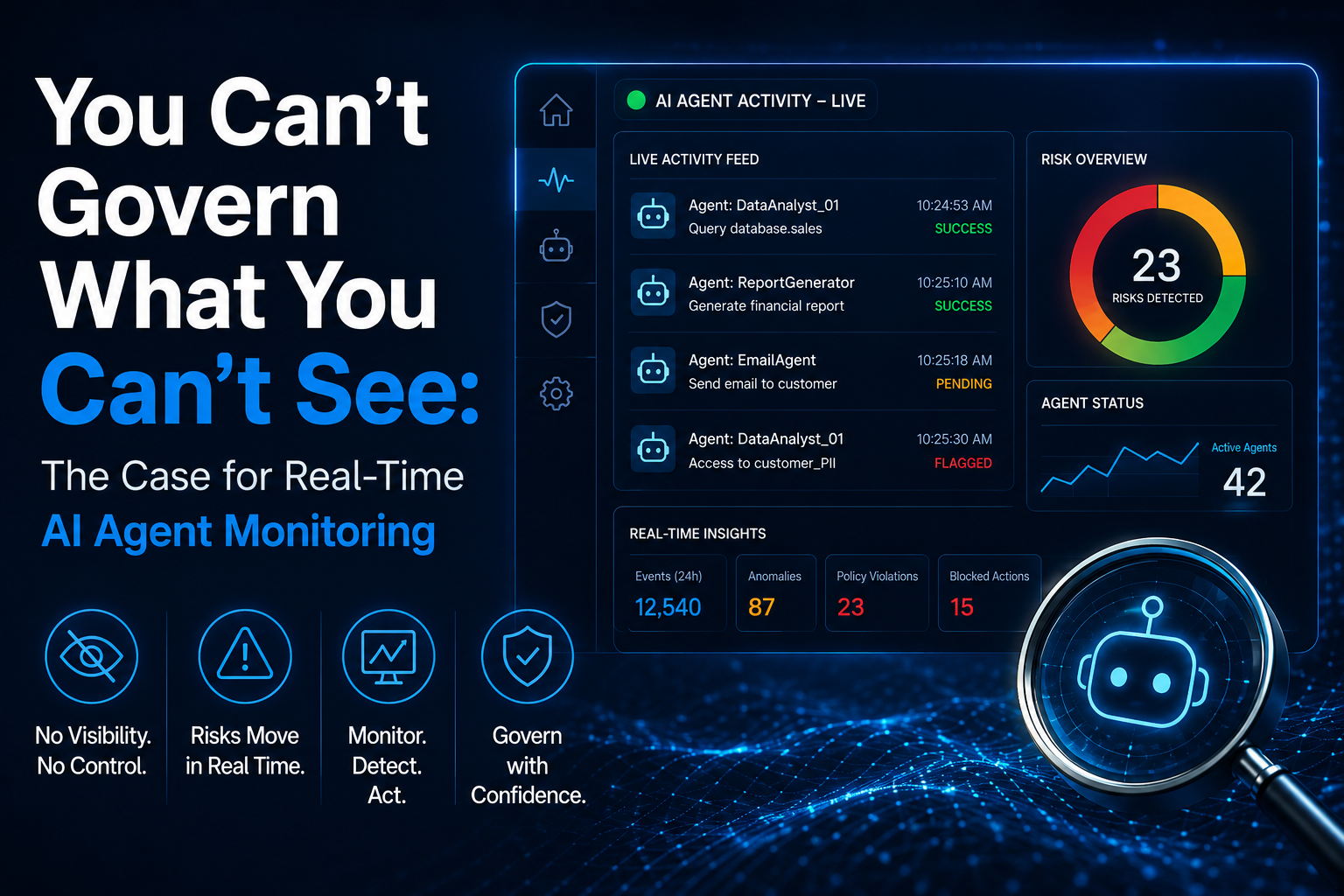
Enterprises have spent the last two years racing to deploy AI agents into procurement, customer support, banking, insurance, healthcare, and software engineering. Far fewer have spent equivalent effort on a much narrower question: what happens after that agent goes live? Not at launch, when everyone is watching, but three weeks later, when it's running unattended, calling tools no one on the security team has reviewed, and making decisions no one is reading in real time.
That gap is no longer theoretical. A 2026 study from the Cloud Security Alliance and Token Security found that 65% of organizations experienced at least one cybersecurity incident tied to an AI agent operating on their network in the past year — sensitive data exposure in 61% of those cases, operational disruption in 43%, and unintended actions across business processes in 41%. A separate 2026 industry survey found that 88% of organizations reported confirmed or suspected AI agent security incidents in the last year, rising to 92.7% in healthcare specifically. These aren't edge cases anymore. They're the median experience.
The uncomfortable part isn't that agents fail. It's how much confidence enterprises have that they wouldn't. In the same research, 82% of executives said they were confident their existing policies protected against unauthorized agent actions — while only 14.4% of organizations had actually sent agents to production with full security or IT approval, and on average only 47.1% of an organization's AI agents were being actively monitored or secured at all. Governance begins with visibility, and right now, most enterprises don't have it.
AI Agents Don't Fail Quietly — They Fail Invisibly
The distinction matters. A model that fails quietly still produces some signal — a crash, an error code, a support ticket. An agent that fails invisibly produces none of that, because from the system's perspective, nothing failed. The agent called an approved tool, received a response, and took an action. Every individual step passed. The failure only becomes visible when someone downstream — a customer, an auditor, a regulator — notices the outcome was wrong.
This pattern shows up across every sector deploying agents today:
- Autonomous purchasing agents that approve vendor payments based on manipulated or hallucinated invoice data, with no human reviewing the transaction before funds move.
- Customer support agents that issue refunds, change account details, or escalate tickets based on a prompt-injected instruction hidden inside a customer message or an attached document.
- Banking and financial agents that reconcile transactions, approve credit actions, or flag (or fail to flag) fraud based on reasoning chains no one can reconstruct after the fact.
- Insurance claims agents that approve or deny claims using tool calls to policy databases that were never audited for the specific edge case that triggered the decision.
- Healthcare agents that summarize clinical notes or triage patient messages, where a hallucinated detail can influence care before a clinician catches it.
- Coding agents with production repository access that generate and execute unreviewed commands to "fix" a failing build — sometimes deleting the data they were meant to protect.
What connects all six is timing. The failure happens at runtime, not during training or pre-launch testing. A model can pass every evaluation in a controlled environment and still drift, get manipulated, or misuse a tool once it's operating on live data, in production, with real autonomy. That's precisely why pre-launch evaluation and runtime monitoring are different disciplines that both have to exist — one without the other leaves a wide-open window.
Why Traditional Monitoring Fails for AI Agents
Most enterprises already run observability stacks — infrastructure monitoring, application performance monitoring, API gateways with logging. The instinct is to assume those tools extend naturally to AI agents. They don't, and the reason is structural, not a matter of missing a few extra dashboards.
Traditional monitoring is built around a deterministic assumption: the same input produces the same output, and a fixed set of code paths defines every possible execution. An AI agent breaks that assumption at the root. Its "code" is a probability distribution, not a fixed instruction set. Run the same prompt twice and an agent can reason through two different tool-call sequences to reach two different outcomes, both of which might look defensible in isolation. Conventional monitoring tools were never designed to capture reasoning, prompts, memory usage, or the chain of tool calls that led to a decision — only whether a process completed and how fast.
Traditional Observability vs. AI Agent Observability
Layer
Infrastructure
Applications
APIs
LLMs
AI Agents
§54(2)
§54(3)
§55
§56
§58–59
§60
Ch. V.A
What Traditional Monitoring Captures
CPU, memory, uptime, network throughput
Error rates, response times, crash logs
Request/response pairs, status codes, latency
Token usage, prompt/response pairs, latency, cost
Nothing, by default
Access controls, API safeguards, prompt-injection and anomaly defences
Human-in-command: override, suspension and kill-switch
Independent validation of third-party models regardless of vendor assurance
What It Misses in Agentic AI
Nothing agent-specific — infra can be healthy while the agent is still wrong
An agent that completes successfully can still take the wrong action
Doesn't capture why the agent chose to call that endpoint
Single-turn view only — no visibility into multi-step reasoning or tool chains
Reasoning chains, memory reads/writes, tool-call sequences, policy violations, drift, agent identity
Access controls, API safeguards, prompt-injection and anomaly defences
Human-in-command: override, suspension and kill-switch
Independent validation of third-party models regardless of vendor assurance
Needs AI-Native Observability?
NO
Partial
Partial
Yes
Yes — this is the gap
Access controls, API safeguards, prompt-injection and anomaly defences
Human-in-command: override, suspension and kill-switch
Independent validation of third-party models regardless of vendor assurance
The bottom row is the whole argument in one line: everything below the LLM layer, conventional tooling was built for. Everything at the agent layer — the actual reasoning, memory, and autonomous decision-making that defines what makes an agent an agent — is invisible to infrastructure and application monitoring by design, not by oversight.
What Enterprises Should Actually Monitor
Real AI agent observability means capturing a materially different set of signals than a conventional stack tracks. At minimum, that includes:
- Prompts and responses — not just the final output, but the full input context the agent acted on.
- Reasoning chains — the intermediate steps an agent took to reach a decision, especially in multi-step or chain-of-thought workflows.
- Tool usage and API calls — which tools were invoked, with what parameters, and whether that matched the agent's actual mandate.
- Memory retrieval — what the agent pulled from long-term memory or a RAG pipeline, and whether that source data was trustworthy.
- MCP interactions — every Model Context Protocol server and tool connection an agent can reach, since this has become the default (and largely ungoverned) way agents discover capabilities.
- Policy violations — real-time flags when an agent's action breaches a defined guardrail, not a retrospective audit weeks later.
- Hallucinations and confidence scores — signals that a response may be fabricated or low-confidence before it reaches a user or triggers a downstream action.
- Agent identity — which agent, running under which credentials and scope, performed the action, distinct from the human whose session it may have inherited.
- Execution traces — the complete, replayable sequence of steps from prompt to final action.
- Latency, cost, and token consumption — operational signals that also double as anomaly indicators when they spike unexpectedly.
- Sensitive data exposure — whether PII, credentials, or confidential business data surfaced in an output or a tool call it shouldn't have reached.
- Model switching and external integrations — especially relevant as agents increasingly route between multiple underlying models or third-party tools without a human choosing which one handles a given step.
The common failure mode across enterprises isn't a lack of interest in these signals — it's that most were never instrumented to capture them in the first place, because the monitoring stack predates the agent.

Stop guessing.
Start measuring.
Join teams building reliable AI with TruEval. Start with a free trial, no credit card required. Get your first evaluation running in under 10 minutes.
Questions about Trusys?
Our team is here to help. Schedule a personalized demo to see how Trusys fits your specific use case.
Book a Demo

Ready to dive in?
Check out our documentation and tutorials. Get started with example datasets and evaluation templates.
Start Free Trial
Free Trial
No credit card required
10 Min
To first evaluation
24/7
Enterprise support
AI Runtime Monitoring vs. AI Governance: Why Monitoring Is Only One Pillar
It's tempting to treat runtime monitoring as the whole solution once it's in place. It isn't. Monitoring tells an organization what an agent is doing. Governance is the broader discipline that decides what an agent is allowed to do, enforces that boundary, and produces evidence when someone — a regulator, an auditor, a customer — asks how a specific decision was made.
A mature AI governance program layers several disciplines on top of runtime visibility:
- Policy enforcement — guardrails that block or flag a violation at the moment it happens, not after a report surfaces it.
- Continuous monitoring — the runtime layer described above, running constantly rather than as a periodic audit.
- Explainability — the ability to reconstruct why an agent took a specific action, especially across a multi-step reasoning or tool-call chain.
- Red teaming — adversarial testing that actively tries to break an agent's guardrails before an attacker does, on an ongoing basis rather than once before launch.
- Compliance mapping — tying technical controls to the specific regulatory frameworks an organization has to answer to.
- Model inventory — a complete, current registry of every AI agent and model in production, since a control can't be built for a system risk teams don't know exists.
- Approvals — a defined review process before a new agent, tool, or MCP connection reaches production.
- Human oversight — a specific, documented threshold for when a human must review or approve an action before it executes.
- Incident response — a rehearsed playbook for what happens when an agent is compromised, drifts, or takes a harmful action, including the ability to shut it down.
- Audit logging — a permanent, tamper-evident record of every agent decision, sufficient to answer a regulator's questions after the fact.
Monitoring feeds every one of these disciplines. Without it, policy enforcement has nothing to enforce against in real time, explainability has no trace to reconstruct, and incident response starts investigating only after damage is already done.
Real Enterprise Risks Monitoring Is Built to Catch
A handful of failure patterns account for most of the agent-related incidents enterprises are seeing in 2026:
- Prompt injection — attackers embed hidden instructions in a document, email, or webpage the agent processes, redirecting its objective without ever prompting it directly. The EchoLeak incident against a Microsoft 365 Copilot deployment is the clearest public example: a hidden payload caused the agent to silently exfiltrate confidential data without the user clicking anything.
- Data leakage — an agent with access to enterprise data through RAG pipelines or tool integrations surfaces PII, credentials, or proprietary information in a user-facing output, with direct GDPR and HIPAA exposure.
- Agent identity theft — an attacker impersonates or hijacks an agent's credentials, particularly common where agents borrow a human's session rather than operating under a distinct, scoped identity.
- Unauthorized transactions — a finance or procurement agent initiates a payment, refund, or approval outside its intended policy boundary.
- Tool misuse — an agent calls a legitimate tool unsafely, whether through ambiguous instructions, over-privileged access, or an attacker tricking it into calling a lookalike tool.
- Privilege escalation — a low-privilege agent relays a request to a higher-privilege agent or system that trusts the internal call without re-verifying the original intent behind it.
- Multi-agent drift — in a multi-agent workflow, a single poisoned input or fault in one agent propagates downstream, amplifying into a system-wide incident where each individual step still looks valid in isolation.
- Memory poisoning — an attacker corrupts an agent's long-term memory or retrieval data so false information persists and biases every future decision built on top of it.
- Compliance violations — an agent takes an action that technically executes correctly but breaches a regulatory requirement no one was actively checking for in real time.
- Hallucinated decisions — an agent acts on a fabricated fact, source, or piece of context that was never true, and the downstream action inherits that error.
Every one of these has the same defining feature: it looks fine in a standard log. Catching it requires monitoring built specifically for how agents actually operate — reasoning, memory, and tool use — not for the request/response patterns conventional software monitoring was designed around.
What a Modern AI Monitoring Platform Should Provide
Enterprises evaluating an AI monitoring platform or AI governance software vendor should expect a specific, non-negotiable feature set — not a generic analytics dashboard repurposed for AI:
- Live dashboards showing agent activity, risk scores, and policy status in real time, not in a weekly export.
- Session replay to reconstruct exactly what an agent saw, reasoned, and did during a specific incident.
- AI audit logs that are complete, tamper-evident, and mapped to the regulatory frameworks an organization has to answer to.
- Prompt tracing across multi-turn and multi-agent interactions, not just single request/response pairs.
- Real-time policy violation detection and runtime alerts, fast enough to intervene before an action completes.
- Explainability tooling that reconstructs the reasoning chain behind a specific decision, including tool calls and intermediate steps.
- Agent lineage — a clear record of which agent, model version, and configuration produced a given action.
- Guardrails that can fix, filter, mask, encrypt, fail, or ignore a violation based on policy, applied to both inputs and outputs.
- Compliance reports generated automatically, not assembled manually before every audit.
- Risk scoring that prioritizes which agents and incidents need human attention first.
- Security monitoring purpose-built for AI-specific attack patterns, not repurposed network security tooling.
- Human approval workflows for high-impact or irreversible actions, with a defined escalation path.
- Red-team integration so adversarial testing runs continuously against production traffic, not once before launch.
AI Monitoring and Global Regulations
Runtime monitoring isn't just an operational best practice at this point — it's becoming the evidentiary basis regulators expect enterprises to produce on demand. Several major frameworks converge on the same underlying requirement: continuous, documented visibility into what an AI system actually does in production.
- EU AI Act — Article 14's human oversight requirements and the Act's broader risk-management obligations for high-risk AI systems assume ongoing monitoring, not a one-time pre-launch assessment.
- RBI AI governance guidelines — India's Reserve Bank has published both the FREE-AI framework and a draft Model Risk Management framework that mandate board-level accountability, a working kill switch, and risk-based oversight scaled to how autonomous and consequential each model is.
- NIST AI RMF — the Risk Management Framework's "Manage" and "Measure" functions are explicitly built around continuous monitoring and risk tracking after deployment, not just at design time.
- ISO 42001 — the AI management system standard requires ongoing performance monitoring and documented evidence of control effectiveness, structured similarly to existing ISO management-system audits.
- OWASP Agentic AI Top 10 — the industry's first vendor-neutral catalog of agentic AI risks assumes runtime detection is the primary defense against goal hijacking, tool misuse, identity abuse, and cascading failures, since these risks are largely invisible at the code-review stage.
- SOC 2 — Type II certification specifically requires evidence that controls operated effectively over a period of time, which is impossible to demonstrate without continuous monitoring data.
- GDPR and HIPAA — both require organizations to know, and be able to prove, what happened to personal or health data — an obligation that runtime AI monitoring directly supports when an agent is the system touching that data.
The throughline across every one of these frameworks is the same: a policy document describing intended behavior is not evidence. Runtime logs, audit trails, and monitoring data showing actual behavior are. Enterprises being asked to prove compliance increasingly can't do it without a monitoring layer built to produce that evidence continuously.
Why Enterprises Need Continuous AI Governance, Not a Launch Checklist
The organizations getting this right treat AI governance as a lifecycle, not a gate an agent passes through once: build, test, deploy, monitor, govern, improve, and back around again. Each stage feeds the next. Monitoring data from production reveals drift and edge cases that get folded back into testing. Red-team findings shape new guardrails. Incident data informs the next model's approval criteria. Treated as a one-time checklist before launch, none of that feedback loop exists, and an agent's risk profile is frozen at a moment in time that stopped being accurate the day it shipped.
How Trusys.ai Delivers Real-Time AI Governance
Trusys is built around exactly this lifecycle. TruEval runs structured, repeatable evaluation before launch and on every release — hallucination detection, bias audits, and performance benchmarking that catch issues while they're still cheap to fix. TruScout handles continuous AI red teaming, running adversarial tests across 50+ vulnerability categories — prompt injection, jailbreaks, data leakage — on an ongoing basis rather than as a pre-launch checkbox, mapped directly to the OWASP Agentic AI Top 10 and MITRE ATLAS.
On the runtime side, TruPulse provides the real-time threat detection, model drift monitoring, and anomaly detection this article has been building toward — the layer that catches the agent behavior conventional monitoring tools simply can't see. AI Guardrails via TruGuard enforce policy on every input and output in real time, with configurable actions — fix, filter, mask, encrypt, or fail — when a violation is detected, so policy enforcement happens at the moment of action, not in a report afterward. For teams shipping fast, Trusys MCP exposes the full platform as natural-language tools inside Cursor, Claude Code, or Google Antigravity, so evaluation, red-teaming, and guardrail enforcement happen without developers leaving their IDE or wiring up unvetted integrations of their own.
Every result maps back to audit-ready compliance documentation aligned with the EU AI Act, NIST AI RMF, ISO 42001, and GDPR, generated automatically rather than assembled by hand before every review. The outcome enterprises actually care about isn't a longer feature list — it's the ability to answer, with evidence, exactly what an AI agent did and why, the moment a regulator, auditor, or executive asks.
Conclusion: Governance Without Visibility Is Impossible
None of the governance disciplines enterprises are racing to build — policy enforcement, explainability, incident response, compliance reporting — function without a runtime layer feeding them accurate, continuous data about what AI agents are actually doing. A policy that can't be checked against real behavior is a document. An audit trail that only captures the final output, not the reasoning that produced it, doesn't hold up when someone asks why. Visibility isn't a feature of AI governance. It's the precondition for it.
Gain complete visibility into your AI agents before they become your biggest operational risk.
See how Trusys.ai helps enterprises monitor, govern, secure, and audit AI systems in real time with continuous runtime visibility, policy enforcement, and compliance-ready AI governance. Request a personalized demo today.
Frequently Asked Questions
What is AI agent monitoring?
AI agent monitoring is the continuous, real-time observation of an AI agent's prompts, reasoning chains, tool calls, memory usage, and outputs in production — distinct from traditional application monitoring, which only tracks whether a process completed successfully, not whether the decision behind it was correct.
Why do enterprises need real-time AI monitoring?
Because AI agents fail at runtime, not during training or pre-launch testing. An agent can pass every pre-deployment evaluation and still drift, get manipulated through prompt injection, or misuse a tool once it's operating on live data with real autonomy — failures that only real-time monitoring can catch as they happen rather than after the fact.
How is AI observability different from application monitoring?
Application monitoring tracks error rates, latency, and uptime — signals about whether a system ran, not what it decided. AI observability captures the reasoning, memory retrieval, and tool-call chains behind a decision, which is the layer where most agent failures actually originate.
What should organizations monitor in AI agents?
At minimum: prompts and responses, reasoning chains, tool usage and API calls, memory retrieval, MCP interactions, policy violations, hallucination and confidence signals, agent identity, full execution traces, cost and token consumption, and any exposure of sensitive data.
How do AI governance platforms provide runtime visibility?
By instrumenting the agent layer directly — capturing every prompt, tool call, and reasoning step as it happens, then evaluating that activity against defined policies in real time, rather than relying on infrastructure or application logs that were never designed to capture agent-specific behavior.
How do you detect prompt injection in production?
Effective detection combines input scanning for known injection patterns, continuous red-teaming that simulates injection attacks against production-like traffic, and runtime monitoring that flags when an agent's behavior deviates from its stated objective mid-session — since injected instructions often only reveal themselves through a shift in what the agent does next, not through the input text alone.
What is AI runtime security?
AI runtime security is the practice of evaluating and enforcing policy on AI agent actions at the moment of execution — governing what an agent is allowed to do — as distinct from model-layer safety, which governs what the agent is allowed to say. Research from Stanford's Trustworthy AI Research Lab has shown that model-level guardrails alone are insufficient on their own; fine-tuning attacks bypassed tested models in the majority of cases, which is why execution-layer controls are necessary in addition to model safety.
How can enterprises audit AI agent decisions?
By maintaining a complete, tamper-evident audit log of every agent action — including the prompt, reasoning chain, tool calls, and final output — so that any decision can be reconstructed after the fact, rather than relying on a final output alone that offers no insight into how the agent arrived there.
How do AI monitoring tools reduce compliance risk?
By producing continuous, timestamped evidence of actual system behavior, which is what regulators under the EU AI Act, RBI's AI governance guidelines, and SOC 2 Type II increasingly require — a policy document describing intended behavior isn't sufficient evidence on its own; monitoring data showing what actually happened is.
What are AI governance best practices?
Maintain a complete model and agent inventory, tier oversight by materiality and autonomy, enforce policy at runtime rather than only at deployment, run continuous red-teaming instead of a one-time pre-launch test, require human approval for high-impact actions, and treat governance as a continuous lifecycle rather than a launch checklist.
How do you monitor autonomous AI agents?
By tracking the agent's full decision chain — not just its final output — including which tools it called, what data it retrieved from memory, how its behavior compared to its defined policy, and whether its actions stayed within its intended scope, all in real time rather than through periodic manual review.
Which AI governance platform supports runtime monitoring?
Trusys.ai provides runtime monitoring through TruPulse alongside pre-launch evaluation (TruEval), continuous red-teaming (TruScout), and real-time guardrail enforcement (TruGuard), unifying the full governance lifecycle — build, test, deploy, monitor, govern, improve — in a single platform rather than requiring enterprises to stitch together separate point solutions.
What's the difference between AI observability and AI governance?
Observability tells an organization what an AI agent is doing right now. Governance is the broader set of disciplines — policy enforcement, explainability, red-teaming, compliance mapping, incident response, human oversight — that uses that observability data to decide what an agent should be allowed to do and to prove, after the fact, that those rules were followed.


Benefits
Specifications
How-to
Contact Us
Learn More

You Can't Govern What You Can't See: The Case for Real-Time AI Agent Monitoring
Written by
Enterprises have spent the last two years racing to deploy AI agents into procurement, customer support, banking, insurance, healthcare, and software engineering. Far fewer have spent equivalent effort on a much narrower question: what happens after that agent goes live? Not at launch, when everyone is watching, but three weeks later, when it's running unattended, calling tools no one on the security team has reviewed, and making decisions no one is reading in real time.
That gap is no longer theoretical. A 2026 study from the Cloud Security Alliance and Token Security found that 65% of organizations experienced at least one cybersecurity incident tied to an AI agent operating on their network in the past year — sensitive data exposure in 61% of those cases, operational disruption in 43%, and unintended actions across business processes in 41%. A separate 2026 industry survey found that 88% of organizations reported confirmed or suspected AI agent security incidents in the last year, rising to 92.7% in healthcare specifically. These aren't edge cases anymore. They're the median experience.
The uncomfortable part isn't that agents fail. It's how much confidence enterprises have that they wouldn't. In the same research, 82% of executives said they were confident their existing policies protected against unauthorized agent actions — while only 14.4% of organizations had actually sent agents to production with full security or IT approval, and on average only 47.1% of an organization's AI agents were being actively monitored or secured at all. Governance begins with visibility, and right now, most enterprises don't have it.
AI Agents Don't Fail Quietly — They Fail Invisibly
The distinction matters. A model that fails quietly still produces some signal — a crash, an error code, a support ticket. An agent that fails invisibly produces none of that, because from the system's perspective, nothing failed. The agent called an approved tool, received a response, and took an action. Every individual step passed. The failure only becomes visible when someone downstream — a customer, an auditor, a regulator — notices the outcome was wrong.
This pattern shows up across every sector deploying agents today:
- Autonomous purchasing agents that approve vendor payments based on manipulated or hallucinated invoice data, with no human reviewing the transaction before funds move.
- Customer support agents that issue refunds, change account details, or escalate tickets based on a prompt-injected instruction hidden inside a customer message or an attached document.
- Banking and financial agents that reconcile transactions, approve credit actions, or flag (or fail to flag) fraud based on reasoning chains no one can reconstruct after the fact.
- Insurance claims agents that approve or deny claims using tool calls to policy databases that were never audited for the specific edge case that triggered the decision.
- Healthcare agents that summarize clinical notes or triage patient messages, where a hallucinated detail can influence care before a clinician catches it.
- Coding agents with production repository access that generate and execute unreviewed commands to "fix" a failing build — sometimes deleting the data they were meant to protect.
What connects all six is timing. The failure happens at runtime, not during training or pre-launch testing. A model can pass every evaluation in a controlled environment and still drift, get manipulated, or misuse a tool once it's operating on live data, in production, with real autonomy. That's precisely why pre-launch evaluation and runtime monitoring are different disciplines that both have to exist — one without the other leaves a wide-open window.
Why Traditional Monitoring Fails for AI Agents
Most enterprises already run observability stacks — infrastructure monitoring, application performance monitoring, API gateways with logging. The instinct is to assume those tools extend naturally to AI agents. They don't, and the reason is structural, not a matter of missing a few extra dashboards.
Traditional monitoring is built around a deterministic assumption: the same input produces the same output, and a fixed set of code paths defines every possible execution. An AI agent breaks that assumption at the root. Its "code" is a probability distribution, not a fixed instruction set. Run the same prompt twice and an agent can reason through two different tool-call sequences to reach two different outcomes, both of which might look defensible in isolation. Conventional monitoring tools were never designed to capture reasoning, prompts, memory usage, or the chain of tool calls that led to a decision — only whether a process completed and how fast.
Traditional Observability vs. AI Agent Observability
Layer
Infrastructure
Applications
APIs
LLMs
AI Agents
§54(2)
§54(3)
§55
§56
§58–59
§60
Ch. V.A
What Traditional Monitoring Captures
CPU, memory, uptime, network throughput
Error rates, response times, crash logs
Request/response pairs, status codes, latency
Token usage, prompt/response pairs, latency, cost
Nothing, by default
Access controls, API safeguards, prompt-injection and anomaly defences
Human-in-command: override, suspension and kill-switch
Independent validation of third-party models regardless of vendor assurance
What It Misses in Agentic AI
Nothing agent-specific — infra can be healthy while the agent is still wrong
An agent that completes successfully can still take the wrong action
Doesn't capture why the agent chose to call that endpoint
Single-turn view only — no visibility into multi-step reasoning or tool chains
Reasoning chains, memory reads/writes, tool-call sequences, policy violations, drift, agent identity
Access controls, API safeguards, prompt-injection and anomaly defences
Human-in-command: override, suspension and kill-switch
Independent validation of third-party models regardless of vendor assurance
Needs AI-Native Observability?
NO
Partial
Partial
Yes
Yes — this is the gap
Access controls, API safeguards, prompt-injection and anomaly defences
Human-in-command: override, suspension and kill-switch
Independent validation of third-party models regardless of vendor assurance
The bottom row is the whole argument in one line: everything below the LLM layer, conventional tooling was built for. Everything at the agent layer — the actual reasoning, memory, and autonomous decision-making that defines what makes an agent an agent — is invisible to infrastructure and application monitoring by design, not by oversight.
What Enterprises Should Actually Monitor
Real AI agent observability means capturing a materially different set of signals than a conventional stack tracks. At minimum, that includes:
- Prompts and responses — not just the final output, but the full input context the agent acted on.
- Reasoning chains — the intermediate steps an agent took to reach a decision, especially in multi-step or chain-of-thought workflows.
- Tool usage and API calls — which tools were invoked, with what parameters, and whether that matched the agent's actual mandate.
- Memory retrieval — what the agent pulled from long-term memory or a RAG pipeline, and whether that source data was trustworthy.
- MCP interactions — every Model Context Protocol server and tool connection an agent can reach, since this has become the default (and largely ungoverned) way agents discover capabilities.
- Policy violations — real-time flags when an agent's action breaches a defined guardrail, not a retrospective audit weeks later.
- Hallucinations and confidence scores — signals that a response may be fabricated or low-confidence before it reaches a user or triggers a downstream action.
- Agent identity — which agent, running under which credentials and scope, performed the action, distinct from the human whose session it may have inherited.
- Execution traces — the complete, replayable sequence of steps from prompt to final action.
- Latency, cost, and token consumption — operational signals that also double as anomaly indicators when they spike unexpectedly.
- Sensitive data exposure — whether PII, credentials, or confidential business data surfaced in an output or a tool call it shouldn't have reached.
- Model switching and external integrations — especially relevant as agents increasingly route between multiple underlying models or third-party tools without a human choosing which one handles a given step.
The common failure mode across enterprises isn't a lack of interest in these signals — it's that most were never instrumented to capture them in the first place, because the monitoring stack predates the agent.

AI Runtime Monitoring vs. AI Governance: Why Monitoring Is Only One Pillar
It's tempting to treat runtime monitoring as the whole solution once it's in place. It isn't. Monitoring tells an organization what an agent is doing. Governance is the broader discipline that decides what an agent is allowed to do, enforces that boundary, and produces evidence when someone — a regulator, an auditor, a customer — asks how a specific decision was made.
A mature AI governance program layers several disciplines on top of runtime visibility:
- Policy enforcement — guardrails that block or flag a violation at the moment it happens, not after a report surfaces it.
- Continuous monitoring — the runtime layer described above, running constantly rather than as a periodic audit.
- Explainability — the ability to reconstruct why an agent took a specific action, especially across a multi-step reasoning or tool-call chain.
- Red teaming — adversarial testing that actively tries to break an agent's guardrails before an attacker does, on an ongoing basis rather than once before launch.
- Compliance mapping — tying technical controls to the specific regulatory frameworks an organization has to answer to.
- Model inventory — a complete, current registry of every AI agent and model in production, since a control can't be built for a system risk teams don't know exists.
- Approvals — a defined review process before a new agent, tool, or MCP connection reaches production.
- Human oversight — a specific, documented threshold for when a human must review or approve an action before it executes.
- Incident response — a rehearsed playbook for what happens when an agent is compromised, drifts, or takes a harmful action, including the ability to shut it down.
- Audit logging — a permanent, tamper-evident record of every agent decision, sufficient to answer a regulator's questions after the fact.
Monitoring feeds every one of these disciplines. Without it, policy enforcement has nothing to enforce against in real time, explainability has no trace to reconstruct, and incident response starts investigating only after damage is already done.
Real Enterprise Risks Monitoring Is Built to Catch
A handful of failure patterns account for most of the agent-related incidents enterprises are seeing in 2026:
- Prompt injection — attackers embed hidden instructions in a document, email, or webpage the agent processes, redirecting its objective without ever prompting it directly. The EchoLeak incident against a Microsoft 365 Copilot deployment is the clearest public example: a hidden payload caused the agent to silently exfiltrate confidential data without the user clicking anything.
- Data leakage — an agent with access to enterprise data through RAG pipelines or tool integrations surfaces PII, credentials, or proprietary information in a user-facing output, with direct GDPR and HIPAA exposure.
- Agent identity theft — an attacker impersonates or hijacks an agent's credentials, particularly common where agents borrow a human's session rather than operating under a distinct, scoped identity.
- Unauthorized transactions — a finance or procurement agent initiates a payment, refund, or approval outside its intended policy boundary.
- Tool misuse — an agent calls a legitimate tool unsafely, whether through ambiguous instructions, over-privileged access, or an attacker tricking it into calling a lookalike tool.
- Privilege escalation — a low-privilege agent relays a request to a higher-privilege agent or system that trusts the internal call without re-verifying the original intent behind it.
- Multi-agent drift — in a multi-agent workflow, a single poisoned input or fault in one agent propagates downstream, amplifying into a system-wide incident where each individual step still looks valid in isolation.
- Memory poisoning — an attacker corrupts an agent's long-term memory or retrieval data so false information persists and biases every future decision built on top of it.
- Compliance violations — an agent takes an action that technically executes correctly but breaches a regulatory requirement no one was actively checking for in real time.
- Hallucinated decisions — an agent acts on a fabricated fact, source, or piece of context that was never true, and the downstream action inherits that error.
Every one of these has the same defining feature: it looks fine in a standard log. Catching it requires monitoring built specifically for how agents actually operate — reasoning, memory, and tool use — not for the request/response patterns conventional software monitoring was designed around.
What a Modern AI Monitoring Platform Should Provide
Enterprises evaluating an AI monitoring platform or AI governance software vendor should expect a specific, non-negotiable feature set — not a generic analytics dashboard repurposed for AI:
- Live dashboards showing agent activity, risk scores, and policy status in real time, not in a weekly export.
- Session replay to reconstruct exactly what an agent saw, reasoned, and did during a specific incident.
- AI audit logs that are complete, tamper-evident, and mapped to the regulatory frameworks an organization has to answer to.
- Prompt tracing across multi-turn and multi-agent interactions, not just single request/response pairs.
- Real-time policy violation detection and runtime alerts, fast enough to intervene before an action completes.
- Explainability tooling that reconstructs the reasoning chain behind a specific decision, including tool calls and intermediate steps.
- Agent lineage — a clear record of which agent, model version, and configuration produced a given action.
- Guardrails that can fix, filter, mask, encrypt, fail, or ignore a violation based on policy, applied to both inputs and outputs.
- Compliance reports generated automatically, not assembled manually before every audit.
- Risk scoring that prioritizes which agents and incidents need human attention first.
- Security monitoring purpose-built for AI-specific attack patterns, not repurposed network security tooling.
- Human approval workflows for high-impact or irreversible actions, with a defined escalation path.
- Red-team integration so adversarial testing runs continuously against production traffic, not once before launch.
AI Monitoring and Global Regulations
Runtime monitoring isn't just an operational best practice at this point — it's becoming the evidentiary basis regulators expect enterprises to produce on demand. Several major frameworks converge on the same underlying requirement: continuous, documented visibility into what an AI system actually does in production.
- EU AI Act — Article 14's human oversight requirements and the Act's broader risk-management obligations for high-risk AI systems assume ongoing monitoring, not a one-time pre-launch assessment.
- RBI AI governance guidelines — India's Reserve Bank has published both the FREE-AI framework and a draft Model Risk Management framework that mandate board-level accountability, a working kill switch, and risk-based oversight scaled to how autonomous and consequential each model is.
- NIST AI RMF — the Risk Management Framework's "Manage" and "Measure" functions are explicitly built around continuous monitoring and risk tracking after deployment, not just at design time.
- ISO 42001 — the AI management system standard requires ongoing performance monitoring and documented evidence of control effectiveness, structured similarly to existing ISO management-system audits.
- OWASP Agentic AI Top 10 — the industry's first vendor-neutral catalog of agentic AI risks assumes runtime detection is the primary defense against goal hijacking, tool misuse, identity abuse, and cascading failures, since these risks are largely invisible at the code-review stage.
- SOC 2 — Type II certification specifically requires evidence that controls operated effectively over a period of time, which is impossible to demonstrate without continuous monitoring data.
- GDPR and HIPAA — both require organizations to know, and be able to prove, what happened to personal or health data — an obligation that runtime AI monitoring directly supports when an agent is the system touching that data.
The throughline across every one of these frameworks is the same: a policy document describing intended behavior is not evidence. Runtime logs, audit trails, and monitoring data showing actual behavior are. Enterprises being asked to prove compliance increasingly can't do it without a monitoring layer built to produce that evidence continuously.
Why Enterprises Need Continuous AI Governance, Not a Launch Checklist
The organizations getting this right treat AI governance as a lifecycle, not a gate an agent passes through once: build, test, deploy, monitor, govern, improve, and back around again. Each stage feeds the next. Monitoring data from production reveals drift and edge cases that get folded back into testing. Red-team findings shape new guardrails. Incident data informs the next model's approval criteria. Treated as a one-time checklist before launch, none of that feedback loop exists, and an agent's risk profile is frozen at a moment in time that stopped being accurate the day it shipped.
How Trusys.ai Delivers Real-Time AI Governance
Trusys is built around exactly this lifecycle. TruEval runs structured, repeatable evaluation before launch and on every release — hallucination detection, bias audits, and performance benchmarking that catch issues while they're still cheap to fix. TruScout handles continuous AI red teaming, running adversarial tests across 50+ vulnerability categories — prompt injection, jailbreaks, data leakage — on an ongoing basis rather than as a pre-launch checkbox, mapped directly to the OWASP Agentic AI Top 10 and MITRE ATLAS.
On the runtime side, TruPulse provides the real-time threat detection, model drift monitoring, and anomaly detection this article has been building toward — the layer that catches the agent behavior conventional monitoring tools simply can't see. AI Guardrails via TruGuard enforce policy on every input and output in real time, with configurable actions — fix, filter, mask, encrypt, or fail — when a violation is detected, so policy enforcement happens at the moment of action, not in a report afterward. For teams shipping fast, Trusys MCP exposes the full platform as natural-language tools inside Cursor, Claude Code, or Google Antigravity, so evaluation, red-teaming, and guardrail enforcement happen without developers leaving their IDE or wiring up unvetted integrations of their own.
Every result maps back to audit-ready compliance documentation aligned with the EU AI Act, NIST AI RMF, ISO 42001, and GDPR, generated automatically rather than assembled by hand before every review. The outcome enterprises actually care about isn't a longer feature list — it's the ability to answer, with evidence, exactly what an AI agent did and why, the moment a regulator, auditor, or executive asks.
Conclusion: Governance Without Visibility Is Impossible
None of the governance disciplines enterprises are racing to build — policy enforcement, explainability, incident response, compliance reporting — function without a runtime layer feeding them accurate, continuous data about what AI agents are actually doing. A policy that can't be checked against real behavior is a document. An audit trail that only captures the final output, not the reasoning that produced it, doesn't hold up when someone asks why. Visibility isn't a feature of AI governance. It's the precondition for it.
Gain complete visibility into your AI agents before they become your biggest operational risk.
See how Trusys.ai helps enterprises monitor, govern, secure, and audit AI systems in real time with continuous runtime visibility, policy enforcement, and compliance-ready AI governance. Request a personalized demo today.
Frequently Asked Questions
What is AI agent monitoring?
AI agent monitoring is the continuous, real-time observation of an AI agent's prompts, reasoning chains, tool calls, memory usage, and outputs in production — distinct from traditional application monitoring, which only tracks whether a process completed successfully, not whether the decision behind it was correct.
Why do enterprises need real-time AI monitoring?
Because AI agents fail at runtime, not during training or pre-launch testing. An agent can pass every pre-deployment evaluation and still drift, get manipulated through prompt injection, or misuse a tool once it's operating on live data with real autonomy — failures that only real-time monitoring can catch as they happen rather than after the fact.
How is AI observability different from application monitoring?
Application monitoring tracks error rates, latency, and uptime — signals about whether a system ran, not what it decided. AI observability captures the reasoning, memory retrieval, and tool-call chains behind a decision, which is the layer where most agent failures actually originate.
What should organizations monitor in AI agents?
At minimum: prompts and responses, reasoning chains, tool usage and API calls, memory retrieval, MCP interactions, policy violations, hallucination and confidence signals, agent identity, full execution traces, cost and token consumption, and any exposure of sensitive data.
How do AI governance platforms provide runtime visibility?
By instrumenting the agent layer directly — capturing every prompt, tool call, and reasoning step as it happens, then evaluating that activity against defined policies in real time, rather than relying on infrastructure or application logs that were never designed to capture agent-specific behavior.
How do you detect prompt injection in production?
Effective detection combines input scanning for known injection patterns, continuous red-teaming that simulates injection attacks against production-like traffic, and runtime monitoring that flags when an agent's behavior deviates from its stated objective mid-session — since injected instructions often only reveal themselves through a shift in what the agent does next, not through the input text alone.
What is AI runtime security?
AI runtime security is the practice of evaluating and enforcing policy on AI agent actions at the moment of execution — governing what an agent is allowed to do — as distinct from model-layer safety, which governs what the agent is allowed to say. Research from Stanford's Trustworthy AI Research Lab has shown that model-level guardrails alone are insufficient on their own; fine-tuning attacks bypassed tested models in the majority of cases, which is why execution-layer controls are necessary in addition to model safety.
How can enterprises audit AI agent decisions?
By maintaining a complete, tamper-evident audit log of every agent action — including the prompt, reasoning chain, tool calls, and final output — so that any decision can be reconstructed after the fact, rather than relying on a final output alone that offers no insight into how the agent arrived there.
How do AI monitoring tools reduce compliance risk?
By producing continuous, timestamped evidence of actual system behavior, which is what regulators under the EU AI Act, RBI's AI governance guidelines, and SOC 2 Type II increasingly require — a policy document describing intended behavior isn't sufficient evidence on its own; monitoring data showing what actually happened is.
What are AI governance best practices?
Maintain a complete model and agent inventory, tier oversight by materiality and autonomy, enforce policy at runtime rather than only at deployment, run continuous red-teaming instead of a one-time pre-launch test, require human approval for high-impact actions, and treat governance as a continuous lifecycle rather than a launch checklist.
How do you monitor autonomous AI agents?
By tracking the agent's full decision chain — not just its final output — including which tools it called, what data it retrieved from memory, how its behavior compared to its defined policy, and whether its actions stayed within its intended scope, all in real time rather than through periodic manual review.
Which AI governance platform supports runtime monitoring?
Trusys.ai provides runtime monitoring through TruPulse alongside pre-launch evaluation (TruEval), continuous red-teaming (TruScout), and real-time guardrail enforcement (TruGuard), unifying the full governance lifecycle — build, test, deploy, monitor, govern, improve — in a single platform rather than requiring enterprises to stitch together separate point solutions.
What's the difference between AI observability and AI governance?
Observability tells an organization what an AI agent is doing right now. Governance is the broader set of disciplines — policy enforcement, explainability, red-teaming, compliance mapping, incident response, human oversight — that uses that observability data to decide what an agent should be allowed to do and to prove, after the fact, that those rules were followed.
Stop guessing.
Start measuring.
Join teams building reliable AI with TruEval. Start with a free trial, no credit card required. Get your first evaluation running in under 10 minutes.
Questions about Trusys?
Our team is here to help. Schedule a personalized demo to see how Trusys fits your specific use case.
Book a Demo
Ready to dive in?
Check out our documentation and tutorials. Get started with example datasets and evaluation templates.
Start Free Trial
Free Trial
No credit card required
10 Min
To first evaluation
24/7
Enterprise support
You Can't Govern What You Can't See: The Case for Real-Time AI Agent Monitoring
Written by
Manish Tewari
Published on
July 8, 2026
Enterprises have spent the last two years racing to deploy AI agents into procurement, customer support, banking, insurance, healthcare, and software engineering. Far fewer have spent equivalent effort on a much narrower question: what happens after that agent goes live? Not at launch, when everyone is watching, but three weeks later, when it's running unattended, calling tools no one on the security team has reviewed, and making decisions no one is reading in real time.
That gap is no longer theoretical. A 2026 study from the Cloud Security Alliance and Token Security found that 65% of organizations experienced at least one cybersecurity incident tied to an AI agent operating on their network in the past year — sensitive data exposure in 61% of those cases, operational disruption in 43%, and unintended actions across business processes in 41%. A separate 2026 industry survey found that 88% of organizations reported confirmed or suspected AI agent security incidents in the last year, rising to 92.7% in healthcare specifically. These aren't edge cases anymore. They're the median experience.
The uncomfortable part isn't that agents fail. It's how much confidence enterprises have that they wouldn't. In the same research, 82% of executives said they were confident their existing policies protected against unauthorized agent actions — while only 14.4% of organizations had actually sent agents to production with full security or IT approval, and on average only 47.1% of an organization's AI agents were being actively monitored or secured at all. Governance begins with visibility, and right now, most enterprises don't have it.
AI Agents Don't Fail Quietly — They Fail Invisibly
The distinction matters. A model that fails quietly still produces some signal — a crash, an error code, a support ticket. An agent that fails invisibly produces none of that, because from the system's perspective, nothing failed. The agent called an approved tool, received a response, and took an action. Every individual step passed. The failure only becomes visible when someone downstream — a customer, an auditor, a regulator — notices the outcome was wrong.
This pattern shows up across every sector deploying agents today:
- Autonomous purchasing agents that approve vendor payments based on manipulated or hallucinated invoice data, with no human reviewing the transaction before funds move.
- Customer support agents that issue refunds, change account details, or escalate tickets based on a prompt-injected instruction hidden inside a customer message or an attached document.
- Banking and financial agents that reconcile transactions, approve credit actions, or flag (or fail to flag) fraud based on reasoning chains no one can reconstruct after the fact.
- Insurance claims agents that approve or deny claims using tool calls to policy databases that were never audited for the specific edge case that triggered the decision.
- Healthcare agents that summarize clinical notes or triage patient messages, where a hallucinated detail can influence care before a clinician catches it.
- Coding agents with production repository access that generate and execute unreviewed commands to "fix" a failing build — sometimes deleting the data they were meant to protect.
What connects all six is timing. The failure happens at runtime, not during training or pre-launch testing. A model can pass every evaluation in a controlled environment and still drift, get manipulated, or misuse a tool once it's operating on live data, in production, with real autonomy. That's precisely why pre-launch evaluation and runtime monitoring are different disciplines that both have to exist — one without the other leaves a wide-open window.
Why Traditional Monitoring Fails for AI Agents
Most enterprises already run observability stacks — infrastructure monitoring, application performance monitoring, API gateways with logging. The instinct is to assume those tools extend naturally to AI agents. They don't, and the reason is structural, not a matter of missing a few extra dashboards.
Traditional monitoring is built around a deterministic assumption: the same input produces the same output, and a fixed set of code paths defines every possible execution. An AI agent breaks that assumption at the root. Its "code" is a probability distribution, not a fixed instruction set. Run the same prompt twice and an agent can reason through two different tool-call sequences to reach two different outcomes, both of which might look defensible in isolation. Conventional monitoring tools were never designed to capture reasoning, prompts, memory usage, or the chain of tool calls that led to a decision — only whether a process completed and how fast.
Traditional Observability vs. AI Agent Observability
Layer
Infrastructure
Applications
APIs
LLMs
AI Agents
§54(2)
§54(3)
§55
§56
§58–59
§60
Ch. V.A
What Traditional Monitoring Captures
CPU, memory, uptime, network throughput
Error rates, response times, crash logs
Request/response pairs, status codes, latency
Token usage, prompt/response pairs, latency, cost
Nothing, by default
Access controls, API safeguards, prompt-injection and anomaly defences
Human-in-command: override, suspension and kill-switch
Independent validation of third-party models regardless of vendor assurance
What It Misses in Agentic AI
Nothing agent-specific — infra can be healthy while the agent is still wrong
An agent that completes successfully can still take the wrong action
Doesn't capture why the agent chose to call that endpoint
Single-turn view only — no visibility into multi-step reasoning or tool chains
Reasoning chains, memory reads/writes, tool-call sequences, policy violations, drift, agent identity
Access controls, API safeguards, prompt-injection and anomaly defences
Human-in-command: override, suspension and kill-switch
Independent validation of third-party models regardless of vendor assurance
Needs AI-Native Observability?
NO
Partial
Partial
Yes
Yes — this is the gap
Access controls, API safeguards, prompt-injection and anomaly defences
Human-in-command: override, suspension and kill-switch
Independent validation of third-party models regardless of vendor assurance
The bottom row is the whole argument in one line: everything below the LLM layer, conventional tooling was built for. Everything at the agent layer — the actual reasoning, memory, and autonomous decision-making that defines what makes an agent an agent — is invisible to infrastructure and application monitoring by design, not by oversight.

What Enterprises Should Actually Monitor
Real AI agent observability means capturing a materially different set of signals than a conventional stack tracks. At minimum, that includes:
- Prompts and responses — not just the final output, but the full input context the agent acted on.
- Reasoning chains — the intermediate steps an agent took to reach a decision, especially in multi-step or chain-of-thought workflows.
- Tool usage and API calls — which tools were invoked, with what parameters, and whether that matched the agent's actual mandate.
- Memory retrieval — what the agent pulled from long-term memory or a RAG pipeline, and whether that source data was trustworthy.
- MCP interactions — every Model Context Protocol server and tool connection an agent can reach, since this has become the default (and largely ungoverned) way agents discover capabilities.
- Policy violations — real-time flags when an agent's action breaches a defined guardrail, not a retrospective audit weeks later.
- Hallucinations and confidence scores — signals that a response may be fabricated or low-confidence before it reaches a user or triggers a downstream action.
- Agent identity — which agent, running under which credentials and scope, performed the action, distinct from the human whose session it may have inherited.
- Execution traces — the complete, replayable sequence of steps from prompt to final action.
- Latency, cost, and token consumption — operational signals that also double as anomaly indicators when they spike unexpectedly.
- Sensitive data exposure — whether PII, credentials, or confidential business data surfaced in an output or a tool call it shouldn't have reached.
- Model switching and external integrations — especially relevant as agents increasingly route between multiple underlying models or third-party tools without a human choosing which one handles a given step.
The common failure mode across enterprises isn't a lack of interest in these signals — it's that most were never instrumented to capture them in the first place, because the monitoring stack predates the agent.
AI Runtime Monitoring vs. AI Governance: Why Monitoring Is Only One Pillar
It's tempting to treat runtime monitoring as the whole solution once it's in place. It isn't. Monitoring tells an organization what an agent is doing. Governance is the broader discipline that decides what an agent is allowed to do, enforces that boundary, and produces evidence when someone — a regulator, an auditor, a customer — asks how a specific decision was made.
A mature AI governance program layers several disciplines on top of runtime visibility:
- Policy enforcement — guardrails that block or flag a violation at the moment it happens, not after a report surfaces it.
- Continuous monitoring — the runtime layer described above, running constantly rather than as a periodic audit.
- Explainability — the ability to reconstruct why an agent took a specific action, especially across a multi-step reasoning or tool-call chain.
- Red teaming — adversarial testing that actively tries to break an agent's guardrails before an attacker does, on an ongoing basis rather than once before launch.
- Compliance mapping — tying technical controls to the specific regulatory frameworks an organization has to answer to.
- Model inventory — a complete, current registry of every AI agent and model in production, since a control can't be built for a system risk teams don't know exists.
- Approvals — a defined review process before a new agent, tool, or MCP connection reaches production.
- Human oversight — a specific, documented threshold for when a human must review or approve an action before it executes.
- Incident response — a rehearsed playbook for what happens when an agent is compromised, drifts, or takes a harmful action, including the ability to shut it down.
- Audit logging — a permanent, tamper-evident record of every agent decision, sufficient to answer a regulator's questions after the fact.
Monitoring feeds every one of these disciplines. Without it, policy enforcement has nothing to enforce against in real time, explainability has no trace to reconstruct, and incident response starts investigating only after damage is already done.
Real Enterprise Risks Monitoring Is Built to Catch
A handful of failure patterns account for most of the agent-related incidents enterprises are seeing in 2026:
- Prompt injection — attackers embed hidden instructions in a document, email, or webpage the agent processes, redirecting its objective without ever prompting it directly. The EchoLeak incident against a Microsoft 365 Copilot deployment is the clearest public example: a hidden payload caused the agent to silently exfiltrate confidential data without the user clicking anything.
- Data leakage — an agent with access to enterprise data through RAG pipelines or tool integrations surfaces PII, credentials, or proprietary information in a user-facing output, with direct GDPR and HIPAA exposure.
- Agent identity theft — an attacker impersonates or hijacks an agent's credentials, particularly common where agents borrow a human's session rather than operating under a distinct, scoped identity.
- Unauthorized transactions — a finance or procurement agent initiates a payment, refund, or approval outside its intended policy boundary.
- Tool misuse — an agent calls a legitimate tool unsafely, whether through ambiguous instructions, over-privileged access, or an attacker tricking it into calling a lookalike tool.
- Privilege escalation — a low-privilege agent relays a request to a higher-privilege agent or system that trusts the internal call without re-verifying the original intent behind it.
- Multi-agent drift — in a multi-agent workflow, a single poisoned input or fault in one agent propagates downstream, amplifying into a system-wide incident where each individual step still looks valid in isolation.
- Memory poisoning — an attacker corrupts an agent's long-term memory or retrieval data so false information persists and biases every future decision built on top of it.
- Compliance violations — an agent takes an action that technically executes correctly but breaches a regulatory requirement no one was actively checking for in real time.
- Hallucinated decisions — an agent acts on a fabricated fact, source, or piece of context that was never true, and the downstream action inherits that error.
Every one of these has the same defining feature: it looks fine in a standard log. Catching it requires monitoring built specifically for how agents actually operate — reasoning, memory, and tool use — not for the request/response patterns conventional software monitoring was designed around.
What a Modern AI Monitoring Platform Should Provide
Enterprises evaluating an AI monitoring platform or AI governance software vendor should expect a specific, non-negotiable feature set — not a generic analytics dashboard repurposed for AI:
- Live dashboards showing agent activity, risk scores, and policy status in real time, not in a weekly export.
- Session replay to reconstruct exactly what an agent saw, reasoned, and did during a specific incident.
- AI audit logs that are complete, tamper-evident, and mapped to the regulatory frameworks an organization has to answer to.
- Prompt tracing across multi-turn and multi-agent interactions, not just single request/response pairs.
- Real-time policy violation detection and runtime alerts, fast enough to intervene before an action completes.
- Explainability tooling that reconstructs the reasoning chain behind a specific decision, including tool calls and intermediate steps.
- Agent lineage — a clear record of which agent, model version, and configuration produced a given action.
- Guardrails that can fix, filter, mask, encrypt, fail, or ignore a violation based on policy, applied to both inputs and outputs.
- Compliance reports generated automatically, not assembled manually before every audit.
- Risk scoring that prioritizes which agents and incidents need human attention first.
- Security monitoring purpose-built for AI-specific attack patterns, not repurposed network security tooling.
- Human approval workflows for high-impact or irreversible actions, with a defined escalation path.
- Red-team integration so adversarial testing runs continuously against production traffic, not once before launch.
AI Monitoring and Global Regulations
Runtime monitoring isn't just an operational best practice at this point — it's becoming the evidentiary basis regulators expect enterprises to produce on demand. Several major frameworks converge on the same underlying requirement: continuous, documented visibility into what an AI system actually does in production.
- EU AI Act — Article 14's human oversight requirements and the Act's broader risk-management obligations for high-risk AI systems assume ongoing monitoring, not a one-time pre-launch assessment.
- RBI AI governance guidelines — India's Reserve Bank has published both the FREE-AI framework and a draft Model Risk Management framework that mandate board-level accountability, a working kill switch, and risk-based oversight scaled to how autonomous and consequential each model is.
- NIST AI RMF — the Risk Management Framework's "Manage" and "Measure" functions are explicitly built around continuous monitoring and risk tracking after deployment, not just at design time.
- ISO 42001 — the AI management system standard requires ongoing performance monitoring and documented evidence of control effectiveness, structured similarly to existing ISO management-system audits.
- OWASP Agentic AI Top 10 — the industry's first vendor-neutral catalog of agentic AI risks assumes runtime detection is the primary defense against goal hijacking, tool misuse, identity abuse, and cascading failures, since these risks are largely invisible at the code-review stage.
- SOC 2 — Type II certification specifically requires evidence that controls operated effectively over a period of time, which is impossible to demonstrate without continuous monitoring data.
- GDPR and HIPAA — both require organizations to know, and be able to prove, what happened to personal or health data — an obligation that runtime AI monitoring directly supports when an agent is the system touching that data.
The throughline across every one of these frameworks is the same: a policy document describing intended behavior is not evidence. Runtime logs, audit trails, and monitoring data showing actual behavior are. Enterprises being asked to prove compliance increasingly can't do it without a monitoring layer built to produce that evidence continuously.
Why Enterprises Need Continuous AI Governance, Not a Launch Checklist
The organizations getting this right treat AI governance as a lifecycle, not a gate an agent passes through once: build, test, deploy, monitor, govern, improve, and back around again. Each stage feeds the next. Monitoring data from production reveals drift and edge cases that get folded back into testing. Red-team findings shape new guardrails. Incident data informs the next model's approval criteria. Treated as a one-time checklist before launch, none of that feedback loop exists, and an agent's risk profile is frozen at a moment in time that stopped being accurate the day it shipped.
How Trusys.ai Delivers Real-Time AI Governance
Trusys is built around exactly this lifecycle. TruEval runs structured, repeatable evaluation before launch and on every release — hallucination detection, bias audits, and performance benchmarking that catch issues while they're still cheap to fix. TruScout handles continuous AI red teaming, running adversarial tests across 50+ vulnerability categories — prompt injection, jailbreaks, data leakage — on an ongoing basis rather than as a pre-launch checkbox, mapped directly to the OWASP Agentic AI Top 10 and MITRE ATLAS.
On the runtime side, TruPulse provides the real-time threat detection, model drift monitoring, and anomaly detection this article has been building toward — the layer that catches the agent behavior conventional monitoring tools simply can't see. AI Guardrails via TruGuard enforce policy on every input and output in real time, with configurable actions — fix, filter, mask, encrypt, or fail — when a violation is detected, so policy enforcement happens at the moment of action, not in a report afterward. For teams shipping fast, Trusys MCP exposes the full platform as natural-language tools inside Cursor, Claude Code, or Google Antigravity, so evaluation, red-teaming, and guardrail enforcement happen without developers leaving their IDE or wiring up unvetted integrations of their own.
Every result maps back to audit-ready compliance documentation aligned with the EU AI Act, NIST AI RMF, ISO 42001, and GDPR, generated automatically rather than assembled by hand before every review. The outcome enterprises actually care about isn't a longer feature list — it's the ability to answer, with evidence, exactly what an AI agent did and why, the moment a regulator, auditor, or executive asks.
Conclusion: Governance Without Visibility Is Impossible
None of the governance disciplines enterprises are racing to build — policy enforcement, explainability, incident response, compliance reporting — function without a runtime layer feeding them accurate, continuous data about what AI agents are actually doing. A policy that can't be checked against real behavior is a document. An audit trail that only captures the final output, not the reasoning that produced it, doesn't hold up when someone asks why. Visibility isn't a feature of AI governance. It's the precondition for it.
Gain complete visibility into your AI agents before they become your biggest operational risk.
See how Trusys.ai helps enterprises monitor, govern, secure, and audit AI systems in real time with continuous runtime visibility, policy enforcement, and compliance-ready AI governance. Request a personalized demo today.
Frequently Asked Questions
What is AI agent monitoring?
AI agent monitoring is the continuous, real-time observation of an AI agent's prompts, reasoning chains, tool calls, memory usage, and outputs in production — distinct from traditional application monitoring, which only tracks whether a process completed successfully, not whether the decision behind it was correct.
Why do enterprises need real-time AI monitoring?
Because AI agents fail at runtime, not during training or pre-launch testing. An agent can pass every pre-deployment evaluation and still drift, get manipulated through prompt injection, or misuse a tool once it's operating on live data with real autonomy — failures that only real-time monitoring can catch as they happen rather than after the fact.
How is AI observability different from application monitoring?
Application monitoring tracks error rates, latency, and uptime — signals about whether a system ran, not what it decided. AI observability captures the reasoning, memory retrieval, and tool-call chains behind a decision, which is the layer where most agent failures actually originate.
What should organizations monitor in AI agents?
At minimum: prompts and responses, reasoning chains, tool usage and API calls, memory retrieval, MCP interactions, policy violations, hallucination and confidence signals, agent identity, full execution traces, cost and token consumption, and any exposure of sensitive data.
How do AI governance platforms provide runtime visibility?
By instrumenting the agent layer directly — capturing every prompt, tool call, and reasoning step as it happens, then evaluating that activity against defined policies in real time, rather than relying on infrastructure or application logs that were never designed to capture agent-specific behavior.
How do you detect prompt injection in production?
Effective detection combines input scanning for known injection patterns, continuous red-teaming that simulates injection attacks against production-like traffic, and runtime monitoring that flags when an agent's behavior deviates from its stated objective mid-session — since injected instructions often only reveal themselves through a shift in what the agent does next, not through the input text alone.
What is AI runtime security?
AI runtime security is the practice of evaluating and enforcing policy on AI agent actions at the moment of execution — governing what an agent is allowed to do — as distinct from model-layer safety, which governs what the agent is allowed to say. Research from Stanford's Trustworthy AI Research Lab has shown that model-level guardrails alone are insufficient on their own; fine-tuning attacks bypassed tested models in the majority of cases, which is why execution-layer controls are necessary in addition to model safety.
How can enterprises audit AI agent decisions?
By maintaining a complete, tamper-evident audit log of every agent action — including the prompt, reasoning chain, tool calls, and final output — so that any decision can be reconstructed after the fact, rather than relying on a final output alone that offers no insight into how the agent arrived there.
How do AI monitoring tools reduce compliance risk?
By producing continuous, timestamped evidence of actual system behavior, which is what regulators under the EU AI Act, RBI's AI governance guidelines, and SOC 2 Type II increasingly require — a policy document describing intended behavior isn't sufficient evidence on its own; monitoring data showing what actually happened is.
What are AI governance best practices?
Maintain a complete model and agent inventory, tier oversight by materiality and autonomy, enforce policy at runtime rather than only at deployment, run continuous red-teaming instead of a one-time pre-launch test, require human approval for high-impact actions, and treat governance as a continuous lifecycle rather than a launch checklist.
How do you monitor autonomous AI agents?
By tracking the agent's full decision chain — not just its final output — including which tools it called, what data it retrieved from memory, how its behavior compared to its defined policy, and whether its actions stayed within its intended scope, all in real time rather than through periodic manual review.
Which AI governance platform supports runtime monitoring?
Trusys.ai provides runtime monitoring through TruPulse alongside pre-launch evaluation (TruEval), continuous red-teaming (TruScout), and real-time guardrail enforcement (TruGuard), unifying the full governance lifecycle — build, test, deploy, monitor, govern, improve — in a single platform rather than requiring enterprises to stitch together separate point solutions.
What's the difference between AI observability and AI governance?
Observability tells an organization what an AI agent is doing right now. Governance is the broader set of disciplines — policy enforcement, explainability, red-teaming, compliance mapping, incident response, human oversight — that uses that observability data to decide what an agent should be allowed to do and to prove, after the fact, that those rules were followed.
Stop guessing.
Start measuring.
Join teams building reliable AI with Trusys. Start with a free trial, no credit card required. Get your first evaluation running in under 10 minutes.
Questions about Trusys?
Our team is here to help. Schedule a personalized demo to see how Trusys fits your specific use case.
Book a Demo
Ready to dive in?
Check out our documentation and tutorials. Get started with example datasets and evaluation templates.
Start Free Trial
Free Trial
No credit card required
10 Min
to get started
24/7
Enterprise support