AI Memory Governance: Why Persistent Agent Memory Creates New Data Privacy and Security Risks
Written by

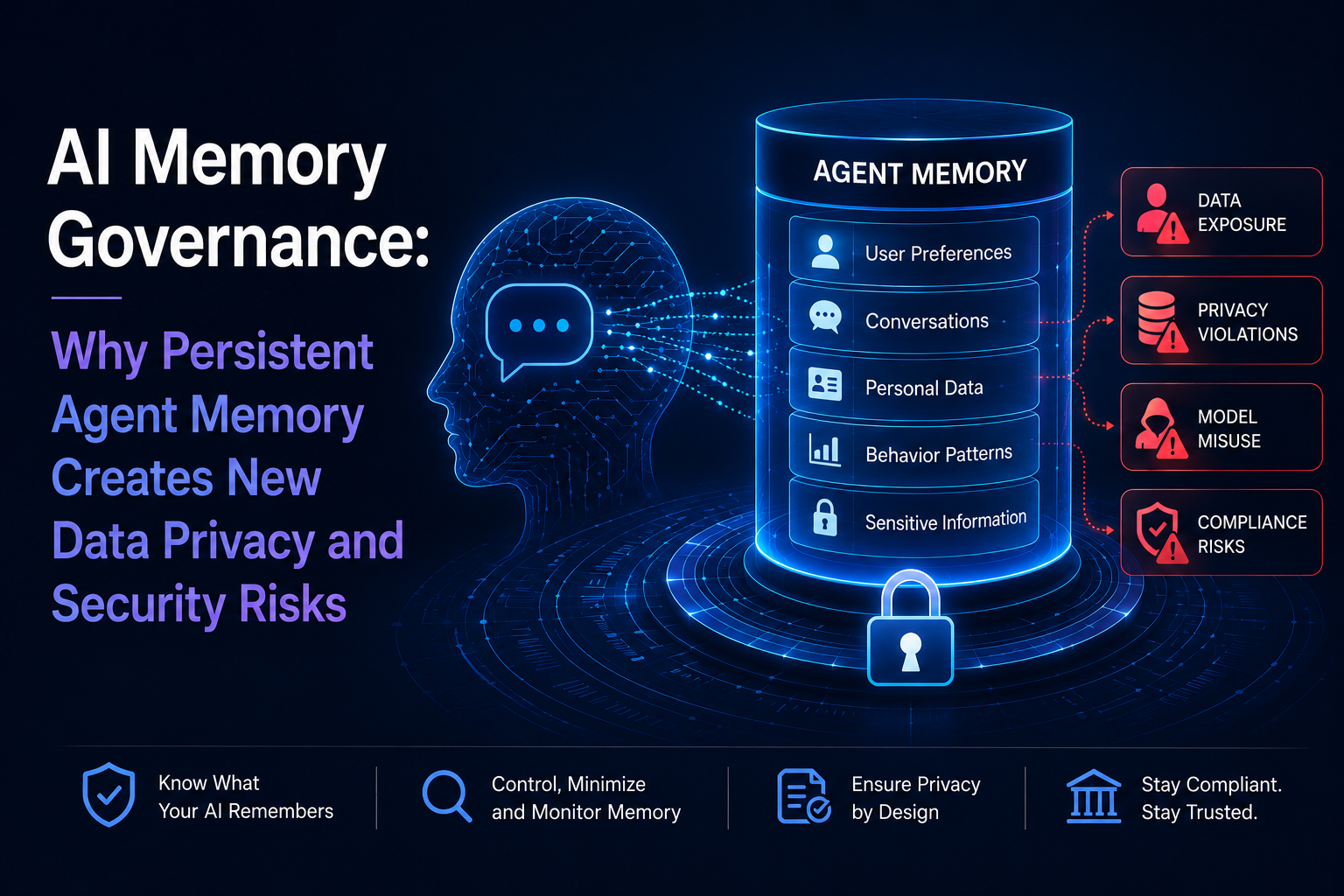
Enterprise AI is going through a quiet architectural shift. The chatbots that defined the last two years of generative AI adoption were fundamentally stateless: every session started from zero, and whatever context the model held disappeared the moment the conversation ended. The AI agents replacing them do not work that way. They carry memory forward — user preferences, prior decisions, tool outputs, organizational workflows, and the accumulated context of every interaction they have ever had.
That shift is what makes agents useful. An agent that remembers a customer's account history, a compliance team's escalation rules, or a codebase's architectural conventions can act with far less hand-holding than one that starts cold every time. But persistent memory also means the agent is no longer just processing organizational knowledge — it is storing it, indefinitely, in a system that was rarely designed with data governance as a first-class concern.
This is the gap that AI memory governance is emerging to close. It is not a rebrand of existing data governance practice. It is a distinct discipline that treats what an AI system remembers, how those memories are formed, who can access them, and when they must be forgotten as a governance surface in its own right — separate from, but connected to, model governance and prompt-level controls. Enterprises that have spent the last two years building governance around prompts and outputs are now discovering that the memory layer beneath their agents has had almost none of that scrutiny.
What Is AI Memory Governance?
AI memory governance is the set of policies, architectural controls, and operational processes that determine what an AI system is permitted to store, how that stored information is protected, who or what can retrieve it, and when it must be deleted or expire. It sits alongside — but is distinct from — model governance (which controls training data and model behavior) and prompt governance (which controls what goes into and comes out of a single interaction).
The reason memory needs its own governance layer is that "AI memory" is not one thing. It spans several architecturally distinct stores, each with different risk profiles:
Short-term context is the working memory held within a single session or context window — the immediate conversation or task state. It is transient by design, but it can still contain sensitive material that leaks into logs or downstream calls before it expires.
Conversation history is the persisted record of past interactions, often retained to give an agent continuity across sessions with the same user.
Semantic memory stores facts, preferences, and generalized knowledge extracted from interactions — the kind of memory that lets an agent "know" a user's role, a customer's product tier, or a team's naming conventions without being told again.
Episodic memory captures specific past events or decisions — what the agent did, when, and why — which is valuable for continuity but also creates a durable record of every action ever taken.
Vector memory stores embeddings for semantic retrieval, commonly used in retrieval-augmented generation (RAG) pipelines. Because embeddings are lossy representations, organizations sometimes assume they are inherently de-identified; in practice, embeddings can often be inverted or matched back to source content.
Knowledge graphs encode structured relationships between entities — people, accounts, systems — that agents traverse to reason about an organization. A poisoned or over-permissioned knowledge graph can misdirect an agent's reasoning in ways that are hard to trace back to a single bad input.
Long-term agent memory is the durable, cross-session store that lets an agent build on prior work over weeks or months rather than starting fresh.
External databases and memory plugins extend agent memory into third-party services — hosted vector stores, memory-as-a-service APIs, and framework-specific plugins — each of which introduces its own data residency, retention, and access-control model that the enterprise may not directly control.
Traditional AI governance programs were built around two checkpoints: what goes into the model (training and fine-tuning data) and what comes out of it (prompts and completions). Memory governance has to extend beyond both, because a memory store is neither training data nor a single output — it is an accumulating, queryable record that persists and compounds across every interaction the system has ever had.
Why Persistent Memory Changes Enterprise Risk
A stateless AI interaction disappears when the session ends. A memory-enabled agent does the opposite: it accumulates. Every customer conversation, every internal query, every tool call the agent makes can potentially be written into a memory store that outlives the interaction that created it. That accumulation changes the enterprise risk profile in several concrete ways.
Sensitive information accumulation. Agents deployed in customer support, HR, or internal knowledge-worker roles are exposed to personal data, health information, financial details, and credentials as a matter of course. Without deliberate filtering, memory systems tend to retain whatever they were exposed to, by default, because most memory architectures are optimized for recall quality rather than data minimization.
Privacy violations. Once personal data is embedded into semantic or vector memory, it is no longer stored as a discrete, queryable record the way it would be in a traditional database. It is diffused across embeddings and summaries, which makes it much harder to locate, redact, or prove has been deleted — a direct conflict with data-subject rights under most privacy regimes.
Long-lived business secrets. Pricing strategy, unreleased product plans, negotiation positions, and internal decision rationale can all end up embedded in an agent's memory simply because the agent was present when those topics were discussed. That memory can then resurface in a completely unrelated context weeks later.
Credential leakage. Agents that authenticate to internal systems, read configuration files, or process support tickets frequently encounter API keys, tokens, and passwords. If a memory system is not explicitly designed to detect and exclude credential-shaped data, it will store what it sees.
Customer PII retention. Customer-facing agents accumulate exactly the kind of personal data that regulators care most about, often across a much longer retention window than the original interaction warranted.
Intellectual property exposure. Proprietary methodologies, source code, and internal analysis absorbed into an agent's memory can later be surfaced to a different user, a different business unit, or — in poorly isolated multi-tenant deployments — a different customer entirely.
Shadow knowledge bases. Memory that accumulates outside of any sanctioned data governance process becomes, in effect, an unmanaged copy of organizational knowledge. Security and compliance teams frequently cannot enumerate what an agent's memory contains, because no inventory process was built for it.
Regulatory compliance challenges. Every one of the risks above intersects with an existing compliance obligation — data minimization, retention limits, the right to erasure, purpose limitation — and most memory architectures were not built with any of those obligations in mind.
New Security Risks Introduced by AI Memory
Beyond the privacy dimension, persistent memory introduces a set of security risks that have no close analogue in traditional application security. Most enterprise security tooling was built to protect data at rest and data in transit; AI memory risk lives in the space where data is continuously read, reasoned over, and rewritten by a system that behaves probabilistically.
Memory poisoning. An attacker who can influence what an agent writes to memory — through a manipulated document, a compromised data source, or a crafted interaction — can implant fabricated "facts" that the agent later treats as verified and acts on. Because the agent has no inherent way to distinguish a poisoned memory from a legitimate one, poisoned entries can persist and compound across many future interactions.
Sensitive data retention. Memory systems frequently retain information well past its legitimate business purpose simply because no expiration policy was defined. This is less a discrete attack than a slow accumulation of exposure.
Cross-user memory leakage. In multi-tenant or multi-user deployments, insufficiently scoped memory can allow one user's context to surface in another user's session — a failure mode that is often invisible until a customer notices their agent referencing information it should never have had.
Unauthorized memory access. Memory stores are frequently accessed with broader permissions than the interaction warrants, because memory read/write operations are treated as internal plumbing rather than a governed data access path with its own identity and authorization requirements.
Prompt injection targeting stored memory. Indirect prompt injection — hidden instructions embedded in a web page, email, or document the agent processes — can be specifically crafted to manipulate what the agent writes to memory, not just what it outputs in the moment. This turns memory into a durable payload delivery mechanism rather than a one-time exploit.
Insider threats. Employees with legitimate access to agent tooling can query or export memory content that was never intended to be broadly visible, particularly where memory access is not logged with the same rigor as access to traditional data stores.
Memory manipulation. Beyond outright poisoning, adversaries can incrementally shift an agent's stored context — its understanding of policy, its behavioral baseline, its trust boundaries — in ways too gradual to trigger anomaly detection built for sudden changes.
Hallucinated memory. Agents can generate and store summaries or inferences that were never explicitly stated, then retrieve and present those fabrications as established fact in later interactions — compounding a single hallucination into a persistent, self-reinforcing error.
Forgotten data not actually deleted. Deletion requests directed at an agent's front end frequently do not propagate to every downstream memory store, cache, or vector index the data was written into, creating a gap between what an organization believes it deleted and what actually still exists.
AI supply chain risks. Memory frameworks, embedding models, and vector databases are typically third-party components. A vulnerability or misconfiguration anywhere in that chain can expose or corrupt memory content the enterprise assumed was under its own control.
Third-party memory storage. Hosted memory and vector-store services introduce their own data residency, encryption, and access-control posture, which may not match the enterprise's own requirements — and is often adopted without a formal vendor risk review because it is treated as infrastructure rather than a data processor.
Memory synchronization risks. Agents that maintain memory across multiple environments — staging and production, or multiple regional deployments — can propagate stale, inconsistent, or improperly scoped data between environments that were assumed to be isolated.
Multi-agent shared memory risks. As organizations move toward multi-agent architectures, shared memory stores accessed by several agents multiply the blast radius of any single compromised or misbehaving agent, since a poisoned or leaked memory entry becomes visible to every agent with read access rather than a single compromised session.
AI Memory and Data Privacy Regulations
Persistent memory intersects with nearly every major AI and data privacy framework currently in force or coming into effect, and most of these frameworks were written with traditional data stores in mind rather than the diffuse, embedding-based memory architectures agents actually use.
GDPR requires data minimization and purpose limitation at the point of collection, and grants individuals a right to erasure. Applying that right to a vector store or a semantic memory summary — where the original personal data may no longer exist as a discrete, deletable record — is one of the least-resolved technical problems in AI memory governance today.
India's DPDP Act imposes similar consent, purpose-limitation, and data-principal-rights obligations, with its own timelines and enforcement mechanisms that enterprises operating in India need to map against their memory architecture specifically, not just their primary data stores.
HIPAA governs any agent memory that touches protected health information, and its retention, access-logging, and minimum-necessary-use requirements apply regardless of whether the data is sitting in a structured database or embedded in a vector index.
The EU AI Act introduces record-keeping and traceability obligations for high-risk AI systems, with enforcement of several high-risk provisions beginning in 2026. Where an agent's memory informs a decision within scope of the Act, that memory becomes part of the auditable decision trail the regulation requires.
ISO/IEC 42001, the AI management system standard, expects organizations to demonstrate governance over the full AI system lifecycle — which, for a memory-enabled agent, explicitly includes how memory is created, retained, and retired, not just how the model was trained.
NIST's AI Risk Management Framework treats governance, mapping, measuring, and managing risk as continuous functions rather than one-time assessments — a framing that maps naturally onto memory, which itself is a continuously evolving risk surface rather than a static asset.
SOC 2 attestations increasingly expect organizations to demonstrate access controls, monitoring, and change management over AI systems, and auditors are beginning to ask specifically how memory stores are scoped and logged.
Across all of these frameworks, several requirements recur and deserve direct architectural attention: the right to erasure must be technically enforceable across every memory store an individual's data touched, not just the primary database; data minimization means memory systems should be designed to retain less by default rather than more; purpose limitation requires that memory captured for one use case not silently become available to an unrelated one; retention policies need explicit expiration logic rather than indefinite accumulation; consent frameworks need to account for the fact that memory can outlive the interaction that generated it; and auditability and accountability require that organizations can produce evidence of what an agent remembered, when, and why — which is difficult to do retroactively if it was not built in from the start.
Essential Controls for AI Memory Governance
Governing memory effectively requires controls that operate at the architecture level, not just as policy documents layered on top of an existing system. The following controls form the core of a defensible AI memory governance program.
Memory classification. Every category of stored memory should be classified by sensitivity — personal data, credentials, business-confidential, public — so that downstream controls can be applied differentially rather than uniformly.
Memory encryption. Memory at rest and in transit should be encrypted using enterprise-standard key management, with particular attention to vector stores and embeddings, which are sometimes treated as exempt from encryption requirements because they are not human-readable in raw form.
Identity-aware memory access. Every memory read or write should carry the identity of the requesting user, agent, or service — not just the application making the call — so that access can be scoped and audited at the level of the actual actor.
Role-based controls. Memory access should follow the same least-privilege principles applied to any other sensitive data store, scoped to the specific agent, team, or workflow that has a legitimate need for it.
Memory expiration policies. Every memory category should have an explicit time-to-live or review trigger rather than defaulting to indefinite retention.
Automated deletion. Deletion requests need to propagate programmatically to every memory store, cache, and index the data reached — a manual deletion process cannot keep pace with how quickly memory replicates across a modern agent architecture.
Data masking and PII detection. Memory pipelines should screen for personal data, credentials, and other sensitive patterns before writing to long-term storage, not after.
Runtime monitoring and anomaly detection. Memory access patterns should be monitored continuously for the kind of gradual, low-signal manipulation that memory poisoning and behavioral drift rely on — a one-time audit will not catch a change that accumulates over weeks.
Continuous evaluations. Memory content and agent behavior should be evaluated on an ongoing basis, not only at deployment, since memory itself changes the system's behavior over time even when the underlying model does not.
Audit logs. Every memory write, read, and deletion should be logged with enough context to reconstruct what the agent knew at any point in time.
Human approval workflows. High-sensitivity memory writes — anything touching credentials, regulated data categories, or cross-tenant boundaries — should route through human review rather than being written automatically.
Policy enforcement. Memory-layer policies need to be enforced inline, at the point of write and retrieval, rather than checked only after the fact.
Secure memory architecture and Zero Trust principles. No component of the system — including the agent itself — should be implicitly trusted to access memory without explicit authorization; every request should be authenticated, scoped, and logged as if it originated from outside the trust boundary.
Best Practices for Enterprise AI Memory Security
Translating those controls into an operational program means working through a consistent set of steps. Start by inventorying every memory location an agent writes to — vector stores, conversation logs, knowledge graphs, third-party plugins — since a control cannot be applied to a store that is not known to exist. Then classify the information stored in each location by sensitivity and regulatory relevance, and encrypt memory both at rest and in transit as a baseline requirement rather than an enhancement.
Restrict access using least privilege, scoped to identity rather than application, and continuously monitor memory changes for patterns consistent with poisoning or drift. Build explicit processes to detect memory poisoning attempts and to validate memory before reuse, particularly for memory that influences high-stakes decisions. Define retention policies for every memory category before deployment, not retroactively, and perform regular audits to confirm those policies are actually being enforced in practice rather than existing only on paper.
Test deletion processes directly — issue a deletion request and verify it actually propagates to every downstream store — because an untested deletion pipeline is not a reliable one. Red-team AI memory systems specifically, using adversarial techniques designed to poison, extract, or manipulate stored memory rather than only testing prompts and outputs. And align every control with the compliance frameworks the organization is already subject to, so memory governance reinforces existing regulatory obligations rather than becoming a parallel, disconnected effort.
How Trusys.ai Helps
Most enterprise AI governance tooling was built to monitor models and prompts, then stretched to cover agents after the fact — which means memory, tool use, and multi-agent behavior are often the least-covered part of the stack. Trusys was built agent-native from the start, with memory treated as a first-class part of the system it evaluates and monitors rather than an afterthought.
TruPulse, Trusys's runtime observability layer, traces every agent action with full lineage — what triggered it, what data it touched, what tools it called, and what it produced — which extends directly to memory reads and writes. That lineage is what allows a security or compliance team to reconstruct what an agent actually knew at the time it took a given action, rather than reasoning about it after the fact from incomplete logs.
Behavioral drift and memory corruption are exactly the kind of slow, low-signal problem that periodic manual review tends to miss. TruPulse is designed to surface confused-deputy patterns, memory corruption, and policy violations continuously, as they appear in production, rather than waiting for a scheduled audit.
On the offensive side, TruScout runs continuous adversarial testing against agents — including the poisoned documents, hostile web content, and compromised tool responses that are the primary vector for memory poisoning — mapped to frameworks including the OWASP Agentic AI Top 10 and MITRE ATLAS, so findings translate directly into recognized risk categories rather than proprietary scoring.
Inline enforcement is handled by TruGuard, which applies policy at the agent's input, output, and action layers — including data-classification rules that can prevent sensitive information from reaching memory in the first place, rather than trying to detect and remediate exposure after it has already been written and retrieved.
Underlying all of this is Argus, the autonomous governance agent that runs continuous evaluations, investigates incidents, and generates audit-ready evidence for frameworks including the EU AI Act, ISO 42001, and India's DPDP Act — evidence that, for a memory-enabled agent, has to account for what was stored and retrieved, not only what was output in a given response.
Frequently Asked Questions
What is AI memory governance?
AI memory governance is the discipline of controlling what AI agents store in persistent memory, how that data is secured, who can access it, and when it must be deleted — extending governance beyond prompts and model outputs to the accumulating memory layer underneath.
How is AI memory different from a traditional database?
Traditional databases store discrete, queryable records that can be located and deleted individually. AI memory — particularly vector and semantic memory — diffuses information across embeddings and summaries, making it harder to locate, audit, or prove deletion of specific data.
What is memory poisoning in AI agents?
Memory poisoning occurs when an attacker manipulates what an AI agent writes to its memory — often through a compromised document or data source — so the agent later treats fabricated information as verified fact and acts on it in future interactions.
Which regulations apply to AI agent memory?
GDPR, India's DPDP Act, HIPAA, the EU AI Act, ISO/IEC 42001, and NIST's AI Risk Management Framework all impose requirements — such as data minimization, retention limits, and the right to erasure — that extend to AI memory stores, not just primary data systems.
How can enterprises secure AI agent memory?
Core controls include memory classification, encryption at rest and in transit, identity-aware access controls, automated deletion, continuous runtime monitoring for anomalies, audit logging, and regular adversarial testing (red-teaming) targeted specifically at memory poisoning and extraction.
Stop guessing.
Start measuring.
Join teams building reliable AI with TruEval. Start with a free trial, no credit card required. Get your first evaluation running in under 10 minutes.
Questions about Trusys?
Our team is here to help. Schedule a personalized demo to see how Trusys fits your specific use case.
Book a Demo

Ready to dive in?
Check out our documentation and tutorials. Get started with example datasets and evaluation templates.
Start Free Trial
Free Trial
No credit card required
10 Min
To first evaluation
24/7
Enterprise support


Benefits
Specifications
How-to
Contact Us
Learn More

AI Memory Governance: Why Persistent Agent Memory Creates New Data Privacy and Security Risks
Written by
Enterprise AI is going through a quiet architectural shift. The chatbots that defined the last two years of generative AI adoption were fundamentally stateless: every session started from zero, and whatever context the model held disappeared the moment the conversation ended. The AI agents replacing them do not work that way. They carry memory forward — user preferences, prior decisions, tool outputs, organizational workflows, and the accumulated context of every interaction they have ever had.
That shift is what makes agents useful. An agent that remembers a customer's account history, a compliance team's escalation rules, or a codebase's architectural conventions can act with far less hand-holding than one that starts cold every time. But persistent memory also means the agent is no longer just processing organizational knowledge — it is storing it, indefinitely, in a system that was rarely designed with data governance as a first-class concern.
This is the gap that AI memory governance is emerging to close. It is not a rebrand of existing data governance practice. It is a distinct discipline that treats what an AI system remembers, how those memories are formed, who can access them, and when they must be forgotten as a governance surface in its own right — separate from, but connected to, model governance and prompt-level controls. Enterprises that have spent the last two years building governance around prompts and outputs are now discovering that the memory layer beneath their agents has had almost none of that scrutiny.
What Is AI Memory Governance?
AI memory governance is the set of policies, architectural controls, and operational processes that determine what an AI system is permitted to store, how that stored information is protected, who or what can retrieve it, and when it must be deleted or expire. It sits alongside — but is distinct from — model governance (which controls training data and model behavior) and prompt governance (which controls what goes into and comes out of a single interaction).
The reason memory needs its own governance layer is that "AI memory" is not one thing. It spans several architecturally distinct stores, each with different risk profiles:
Short-term context is the working memory held within a single session or context window — the immediate conversation or task state. It is transient by design, but it can still contain sensitive material that leaks into logs or downstream calls before it expires.
Conversation history is the persisted record of past interactions, often retained to give an agent continuity across sessions with the same user.
Semantic memory stores facts, preferences, and generalized knowledge extracted from interactions — the kind of memory that lets an agent "know" a user's role, a customer's product tier, or a team's naming conventions without being told again.
Episodic memory captures specific past events or decisions — what the agent did, when, and why — which is valuable for continuity but also creates a durable record of every action ever taken.
Vector memory stores embeddings for semantic retrieval, commonly used in retrieval-augmented generation (RAG) pipelines. Because embeddings are lossy representations, organizations sometimes assume they are inherently de-identified; in practice, embeddings can often be inverted or matched back to source content.
Knowledge graphs encode structured relationships between entities — people, accounts, systems — that agents traverse to reason about an organization. A poisoned or over-permissioned knowledge graph can misdirect an agent's reasoning in ways that are hard to trace back to a single bad input.
Long-term agent memory is the durable, cross-session store that lets an agent build on prior work over weeks or months rather than starting fresh.
External databases and memory plugins extend agent memory into third-party services — hosted vector stores, memory-as-a-service APIs, and framework-specific plugins — each of which introduces its own data residency, retention, and access-control model that the enterprise may not directly control.
Traditional AI governance programs were built around two checkpoints: what goes into the model (training and fine-tuning data) and what comes out of it (prompts and completions). Memory governance has to extend beyond both, because a memory store is neither training data nor a single output — it is an accumulating, queryable record that persists and compounds across every interaction the system has ever had.
Why Persistent Memory Changes Enterprise Risk
A stateless AI interaction disappears when the session ends. A memory-enabled agent does the opposite: it accumulates. Every customer conversation, every internal query, every tool call the agent makes can potentially be written into a memory store that outlives the interaction that created it. That accumulation changes the enterprise risk profile in several concrete ways.
Sensitive information accumulation. Agents deployed in customer support, HR, or internal knowledge-worker roles are exposed to personal data, health information, financial details, and credentials as a matter of course. Without deliberate filtering, memory systems tend to retain whatever they were exposed to, by default, because most memory architectures are optimized for recall quality rather than data minimization.
Privacy violations. Once personal data is embedded into semantic or vector memory, it is no longer stored as a discrete, queryable record the way it would be in a traditional database. It is diffused across embeddings and summaries, which makes it much harder to locate, redact, or prove has been deleted — a direct conflict with data-subject rights under most privacy regimes.
Long-lived business secrets. Pricing strategy, unreleased product plans, negotiation positions, and internal decision rationale can all end up embedded in an agent's memory simply because the agent was present when those topics were discussed. That memory can then resurface in a completely unrelated context weeks later.
Credential leakage. Agents that authenticate to internal systems, read configuration files, or process support tickets frequently encounter API keys, tokens, and passwords. If a memory system is not explicitly designed to detect and exclude credential-shaped data, it will store what it sees.
Customer PII retention. Customer-facing agents accumulate exactly the kind of personal data that regulators care most about, often across a much longer retention window than the original interaction warranted.
Intellectual property exposure. Proprietary methodologies, source code, and internal analysis absorbed into an agent's memory can later be surfaced to a different user, a different business unit, or — in poorly isolated multi-tenant deployments — a different customer entirely.
Shadow knowledge bases. Memory that accumulates outside of any sanctioned data governance process becomes, in effect, an unmanaged copy of organizational knowledge. Security and compliance teams frequently cannot enumerate what an agent's memory contains, because no inventory process was built for it.
Regulatory compliance challenges. Every one of the risks above intersects with an existing compliance obligation — data minimization, retention limits, the right to erasure, purpose limitation — and most memory architectures were not built with any of those obligations in mind.
New Security Risks Introduced by AI Memory
Beyond the privacy dimension, persistent memory introduces a set of security risks that have no close analogue in traditional application security. Most enterprise security tooling was built to protect data at rest and data in transit; AI memory risk lives in the space where data is continuously read, reasoned over, and rewritten by a system that behaves probabilistically.
Memory poisoning. An attacker who can influence what an agent writes to memory — through a manipulated document, a compromised data source, or a crafted interaction — can implant fabricated "facts" that the agent later treats as verified and acts on. Because the agent has no inherent way to distinguish a poisoned memory from a legitimate one, poisoned entries can persist and compound across many future interactions.
Sensitive data retention. Memory systems frequently retain information well past its legitimate business purpose simply because no expiration policy was defined. This is less a discrete attack than a slow accumulation of exposure.
Cross-user memory leakage. In multi-tenant or multi-user deployments, insufficiently scoped memory can allow one user's context to surface in another user's session — a failure mode that is often invisible until a customer notices their agent referencing information it should never have had.
Unauthorized memory access. Memory stores are frequently accessed with broader permissions than the interaction warrants, because memory read/write operations are treated as internal plumbing rather than a governed data access path with its own identity and authorization requirements.
Prompt injection targeting stored memory. Indirect prompt injection — hidden instructions embedded in a web page, email, or document the agent processes — can be specifically crafted to manipulate what the agent writes to memory, not just what it outputs in the moment. This turns memory into a durable payload delivery mechanism rather than a one-time exploit.
Insider threats. Employees with legitimate access to agent tooling can query or export memory content that was never intended to be broadly visible, particularly where memory access is not logged with the same rigor as access to traditional data stores.
Memory manipulation. Beyond outright poisoning, adversaries can incrementally shift an agent's stored context — its understanding of policy, its behavioral baseline, its trust boundaries — in ways too gradual to trigger anomaly detection built for sudden changes.
Hallucinated memory. Agents can generate and store summaries or inferences that were never explicitly stated, then retrieve and present those fabrications as established fact in later interactions — compounding a single hallucination into a persistent, self-reinforcing error.
Forgotten data not actually deleted. Deletion requests directed at an agent's front end frequently do not propagate to every downstream memory store, cache, or vector index the data was written into, creating a gap between what an organization believes it deleted and what actually still exists.
AI supply chain risks. Memory frameworks, embedding models, and vector databases are typically third-party components. A vulnerability or misconfiguration anywhere in that chain can expose or corrupt memory content the enterprise assumed was under its own control.
Third-party memory storage. Hosted memory and vector-store services introduce their own data residency, encryption, and access-control posture, which may not match the enterprise's own requirements — and is often adopted without a formal vendor risk review because it is treated as infrastructure rather than a data processor.
Memory synchronization risks. Agents that maintain memory across multiple environments — staging and production, or multiple regional deployments — can propagate stale, inconsistent, or improperly scoped data between environments that were assumed to be isolated.
Multi-agent shared memory risks. As organizations move toward multi-agent architectures, shared memory stores accessed by several agents multiply the blast radius of any single compromised or misbehaving agent, since a poisoned or leaked memory entry becomes visible to every agent with read access rather than a single compromised session.
AI Memory and Data Privacy Regulations
Persistent memory intersects with nearly every major AI and data privacy framework currently in force or coming into effect, and most of these frameworks were written with traditional data stores in mind rather than the diffuse, embedding-based memory architectures agents actually use.
GDPR requires data minimization and purpose limitation at the point of collection, and grants individuals a right to erasure. Applying that right to a vector store or a semantic memory summary — where the original personal data may no longer exist as a discrete, deletable record — is one of the least-resolved technical problems in AI memory governance today.
India's DPDP Act imposes similar consent, purpose-limitation, and data-principal-rights obligations, with its own timelines and enforcement mechanisms that enterprises operating in India need to map against their memory architecture specifically, not just their primary data stores.
HIPAA governs any agent memory that touches protected health information, and its retention, access-logging, and minimum-necessary-use requirements apply regardless of whether the data is sitting in a structured database or embedded in a vector index.
The EU AI Act introduces record-keeping and traceability obligations for high-risk AI systems, with enforcement of several high-risk provisions beginning in 2026. Where an agent's memory informs a decision within scope of the Act, that memory becomes part of the auditable decision trail the regulation requires.
ISO/IEC 42001, the AI management system standard, expects organizations to demonstrate governance over the full AI system lifecycle — which, for a memory-enabled agent, explicitly includes how memory is created, retained, and retired, not just how the model was trained.
NIST's AI Risk Management Framework treats governance, mapping, measuring, and managing risk as continuous functions rather than one-time assessments — a framing that maps naturally onto memory, which itself is a continuously evolving risk surface rather than a static asset.
SOC 2 attestations increasingly expect organizations to demonstrate access controls, monitoring, and change management over AI systems, and auditors are beginning to ask specifically how memory stores are scoped and logged.
Across all of these frameworks, several requirements recur and deserve direct architectural attention: the right to erasure must be technically enforceable across every memory store an individual's data touched, not just the primary database; data minimization means memory systems should be designed to retain less by default rather than more; purpose limitation requires that memory captured for one use case not silently become available to an unrelated one; retention policies need explicit expiration logic rather than indefinite accumulation; consent frameworks need to account for the fact that memory can outlive the interaction that generated it; and auditability and accountability require that organizations can produce evidence of what an agent remembered, when, and why — which is difficult to do retroactively if it was not built in from the start.
Essential Controls for AI Memory Governance
Governing memory effectively requires controls that operate at the architecture level, not just as policy documents layered on top of an existing system. The following controls form the core of a defensible AI memory governance program.
Memory classification. Every category of stored memory should be classified by sensitivity — personal data, credentials, business-confidential, public — so that downstream controls can be applied differentially rather than uniformly.
Memory encryption. Memory at rest and in transit should be encrypted using enterprise-standard key management, with particular attention to vector stores and embeddings, which are sometimes treated as exempt from encryption requirements because they are not human-readable in raw form.
Identity-aware memory access. Every memory read or write should carry the identity of the requesting user, agent, or service — not just the application making the call — so that access can be scoped and audited at the level of the actual actor.
Role-based controls. Memory access should follow the same least-privilege principles applied to any other sensitive data store, scoped to the specific agent, team, or workflow that has a legitimate need for it.
Memory expiration policies. Every memory category should have an explicit time-to-live or review trigger rather than defaulting to indefinite retention.
Automated deletion. Deletion requests need to propagate programmatically to every memory store, cache, and index the data reached — a manual deletion process cannot keep pace with how quickly memory replicates across a modern agent architecture.
Data masking and PII detection. Memory pipelines should screen for personal data, credentials, and other sensitive patterns before writing to long-term storage, not after.
Runtime monitoring and anomaly detection. Memory access patterns should be monitored continuously for the kind of gradual, low-signal manipulation that memory poisoning and behavioral drift rely on — a one-time audit will not catch a change that accumulates over weeks.
Continuous evaluations. Memory content and agent behavior should be evaluated on an ongoing basis, not only at deployment, since memory itself changes the system's behavior over time even when the underlying model does not.
Audit logs. Every memory write, read, and deletion should be logged with enough context to reconstruct what the agent knew at any point in time.
Human approval workflows. High-sensitivity memory writes — anything touching credentials, regulated data categories, or cross-tenant boundaries — should route through human review rather than being written automatically.
Policy enforcement. Memory-layer policies need to be enforced inline, at the point of write and retrieval, rather than checked only after the fact.
Secure memory architecture and Zero Trust principles. No component of the system — including the agent itself — should be implicitly trusted to access memory without explicit authorization; every request should be authenticated, scoped, and logged as if it originated from outside the trust boundary.
Best Practices for Enterprise AI Memory Security
Translating those controls into an operational program means working through a consistent set of steps. Start by inventorying every memory location an agent writes to — vector stores, conversation logs, knowledge graphs, third-party plugins — since a control cannot be applied to a store that is not known to exist. Then classify the information stored in each location by sensitivity and regulatory relevance, and encrypt memory both at rest and in transit as a baseline requirement rather than an enhancement.
Restrict access using least privilege, scoped to identity rather than application, and continuously monitor memory changes for patterns consistent with poisoning or drift. Build explicit processes to detect memory poisoning attempts and to validate memory before reuse, particularly for memory that influences high-stakes decisions. Define retention policies for every memory category before deployment, not retroactively, and perform regular audits to confirm those policies are actually being enforced in practice rather than existing only on paper.
Test deletion processes directly — issue a deletion request and verify it actually propagates to every downstream store — because an untested deletion pipeline is not a reliable one. Red-team AI memory systems specifically, using adversarial techniques designed to poison, extract, or manipulate stored memory rather than only testing prompts and outputs. And align every control with the compliance frameworks the organization is already subject to, so memory governance reinforces existing regulatory obligations rather than becoming a parallel, disconnected effort.
How Trusys.ai Helps
Most enterprise AI governance tooling was built to monitor models and prompts, then stretched to cover agents after the fact — which means memory, tool use, and multi-agent behavior are often the least-covered part of the stack. Trusys was built agent-native from the start, with memory treated as a first-class part of the system it evaluates and monitors rather than an afterthought.
TruPulse, Trusys's runtime observability layer, traces every agent action with full lineage — what triggered it, what data it touched, what tools it called, and what it produced — which extends directly to memory reads and writes. That lineage is what allows a security or compliance team to reconstruct what an agent actually knew at the time it took a given action, rather than reasoning about it after the fact from incomplete logs.
Behavioral drift and memory corruption are exactly the kind of slow, low-signal problem that periodic manual review tends to miss. TruPulse is designed to surface confused-deputy patterns, memory corruption, and policy violations continuously, as they appear in production, rather than waiting for a scheduled audit.
On the offensive side, TruScout runs continuous adversarial testing against agents — including the poisoned documents, hostile web content, and compromised tool responses that are the primary vector for memory poisoning — mapped to frameworks including the OWASP Agentic AI Top 10 and MITRE ATLAS, so findings translate directly into recognized risk categories rather than proprietary scoring.
Inline enforcement is handled by TruGuard, which applies policy at the agent's input, output, and action layers — including data-classification rules that can prevent sensitive information from reaching memory in the first place, rather than trying to detect and remediate exposure after it has already been written and retrieved.
Underlying all of this is Argus, the autonomous governance agent that runs continuous evaluations, investigates incidents, and generates audit-ready evidence for frameworks including the EU AI Act, ISO 42001, and India's DPDP Act — evidence that, for a memory-enabled agent, has to account for what was stored and retrieved, not only what was output in a given response.
Frequently Asked Questions
What is AI memory governance?
AI memory governance is the discipline of controlling what AI agents store in persistent memory, how that data is secured, who can access it, and when it must be deleted — extending governance beyond prompts and model outputs to the accumulating memory layer underneath.
How is AI memory different from a traditional database?
Traditional databases store discrete, queryable records that can be located and deleted individually. AI memory — particularly vector and semantic memory — diffuses information across embeddings and summaries, making it harder to locate, audit, or prove deletion of specific data.
What is memory poisoning in AI agents?
Memory poisoning occurs when an attacker manipulates what an AI agent writes to its memory — often through a compromised document or data source — so the agent later treats fabricated information as verified fact and acts on it in future interactions.
Which regulations apply to AI agent memory?
GDPR, India's DPDP Act, HIPAA, the EU AI Act, ISO/IEC 42001, and NIST's AI Risk Management Framework all impose requirements — such as data minimization, retention limits, and the right to erasure — that extend to AI memory stores, not just primary data systems.
How can enterprises secure AI agent memory?
Core controls include memory classification, encryption at rest and in transit, identity-aware access controls, automated deletion, continuous runtime monitoring for anomalies, audit logging, and regular adversarial testing (red-teaming) targeted specifically at memory poisoning and extraction.
Stop guessing.
Start measuring.
Join teams building reliable AI with TruEval. Start with a free trial, no credit card required. Get your first evaluation running in under 10 minutes.
Questions about Trusys?
Our team is here to help. Schedule a personalized demo to see how Trusys fits your specific use case.
Book a Demo
Ready to dive in?
Check out our documentation and tutorials. Get started with example datasets and evaluation templates.
Start Free Trial
Free Trial
No credit card required
10 Min
To first evaluation
24/7
Enterprise support
AI Memory Governance: Why Persistent Agent Memory Creates New Data Privacy and Security Risks
Written by
Manish Tewari
Published on
July 31, 2026
Enterprise AI is going through a quiet architectural shift. The chatbots that defined the last two years of generative AI adoption were fundamentally stateless: every session started from zero, and whatever context the model held disappeared the moment the conversation ended. The AI agents replacing them do not work that way. They carry memory forward — user preferences, prior decisions, tool outputs, organizational workflows, and the accumulated context of every interaction they have ever had.
That shift is what makes agents useful. An agent that remembers a customer's account history, a compliance team's escalation rules, or a codebase's architectural conventions can act with far less hand-holding than one that starts cold every time. But persistent memory also means the agent is no longer just processing organizational knowledge — it is storing it, indefinitely, in a system that was rarely designed with data governance as a first-class concern.
This is the gap that AI memory governance is emerging to close. It is not a rebrand of existing data governance practice. It is a distinct discipline that treats what an AI system remembers, how those memories are formed, who can access them, and when they must be forgotten as a governance surface in its own right — separate from, but connected to, model governance and prompt-level controls. Enterprises that have spent the last two years building governance around prompts and outputs are now discovering that the memory layer beneath their agents has had almost none of that scrutiny.
What Is AI Memory Governance?
AI memory governance is the set of policies, architectural controls, and operational processes that determine what an AI system is permitted to store, how that stored information is protected, who or what can retrieve it, and when it must be deleted or expire. It sits alongside — but is distinct from — model governance (which controls training data and model behavior) and prompt governance (which controls what goes into and comes out of a single interaction).
The reason memory needs its own governance layer is that "AI memory" is not one thing. It spans several architecturally distinct stores, each with different risk profiles:
Short-term context is the working memory held within a single session or context window — the immediate conversation or task state. It is transient by design, but it can still contain sensitive material that leaks into logs or downstream calls before it expires.
Conversation history is the persisted record of past interactions, often retained to give an agent continuity across sessions with the same user.
Semantic memory stores facts, preferences, and generalized knowledge extracted from interactions — the kind of memory that lets an agent "know" a user's role, a customer's product tier, or a team's naming conventions without being told again.
Episodic memory captures specific past events or decisions — what the agent did, when, and why — which is valuable for continuity but also creates a durable record of every action ever taken.
Vector memory stores embeddings for semantic retrieval, commonly used in retrieval-augmented generation (RAG) pipelines. Because embeddings are lossy representations, organizations sometimes assume they are inherently de-identified; in practice, embeddings can often be inverted or matched back to source content.
Knowledge graphs encode structured relationships between entities — people, accounts, systems — that agents traverse to reason about an organization. A poisoned or over-permissioned knowledge graph can misdirect an agent's reasoning in ways that are hard to trace back to a single bad input.
Long-term agent memory is the durable, cross-session store that lets an agent build on prior work over weeks or months rather than starting fresh.
External databases and memory plugins extend agent memory into third-party services — hosted vector stores, memory-as-a-service APIs, and framework-specific plugins — each of which introduces its own data residency, retention, and access-control model that the enterprise may not directly control.
Traditional AI governance programs were built around two checkpoints: what goes into the model (training and fine-tuning data) and what comes out of it (prompts and completions). Memory governance has to extend beyond both, because a memory store is neither training data nor a single output — it is an accumulating, queryable record that persists and compounds across every interaction the system has ever had.
Why Persistent Memory Changes Enterprise Risk
A stateless AI interaction disappears when the session ends. A memory-enabled agent does the opposite: it accumulates. Every customer conversation, every internal query, every tool call the agent makes can potentially be written into a memory store that outlives the interaction that created it. That accumulation changes the enterprise risk profile in several concrete ways.
Sensitive information accumulation. Agents deployed in customer support, HR, or internal knowledge-worker roles are exposed to personal data, health information, financial details, and credentials as a matter of course. Without deliberate filtering, memory systems tend to retain whatever they were exposed to, by default, because most memory architectures are optimized for recall quality rather than data minimization.
Privacy violations. Once personal data is embedded into semantic or vector memory, it is no longer stored as a discrete, queryable record the way it would be in a traditional database. It is diffused across embeddings and summaries, which makes it much harder to locate, redact, or prove has been deleted — a direct conflict with data-subject rights under most privacy regimes.
Long-lived business secrets. Pricing strategy, unreleased product plans, negotiation positions, and internal decision rationale can all end up embedded in an agent's memory simply because the agent was present when those topics were discussed. That memory can then resurface in a completely unrelated context weeks later.
Credential leakage. Agents that authenticate to internal systems, read configuration files, or process support tickets frequently encounter API keys, tokens, and passwords. If a memory system is not explicitly designed to detect and exclude credential-shaped data, it will store what it sees.
Customer PII retention. Customer-facing agents accumulate exactly the kind of personal data that regulators care most about, often across a much longer retention window than the original interaction warranted.
Intellectual property exposure. Proprietary methodologies, source code, and internal analysis absorbed into an agent's memory can later be surfaced to a different user, a different business unit, or — in poorly isolated multi-tenant deployments — a different customer entirely.
Shadow knowledge bases. Memory that accumulates outside of any sanctioned data governance process becomes, in effect, an unmanaged copy of organizational knowledge. Security and compliance teams frequently cannot enumerate what an agent's memory contains, because no inventory process was built for it.
Regulatory compliance challenges. Every one of the risks above intersects with an existing compliance obligation — data minimization, retention limits, the right to erasure, purpose limitation — and most memory architectures were not built with any of those obligations in mind.
New Security Risks Introduced by AI Memory
Beyond the privacy dimension, persistent memory introduces a set of security risks that have no close analogue in traditional application security. Most enterprise security tooling was built to protect data at rest and data in transit; AI memory risk lives in the space where data is continuously read, reasoned over, and rewritten by a system that behaves probabilistically.
Memory poisoning. An attacker who can influence what an agent writes to memory — through a manipulated document, a compromised data source, or a crafted interaction — can implant fabricated "facts" that the agent later treats as verified and acts on. Because the agent has no inherent way to distinguish a poisoned memory from a legitimate one, poisoned entries can persist and compound across many future interactions.
Sensitive data retention. Memory systems frequently retain information well past its legitimate business purpose simply because no expiration policy was defined. This is less a discrete attack than a slow accumulation of exposure.
Cross-user memory leakage. In multi-tenant or multi-user deployments, insufficiently scoped memory can allow one user's context to surface in another user's session — a failure mode that is often invisible until a customer notices their agent referencing information it should never have had.
Unauthorized memory access. Memory stores are frequently accessed with broader permissions than the interaction warrants, because memory read/write operations are treated as internal plumbing rather than a governed data access path with its own identity and authorization requirements.
Prompt injection targeting stored memory. Indirect prompt injection — hidden instructions embedded in a web page, email, or document the agent processes — can be specifically crafted to manipulate what the agent writes to memory, not just what it outputs in the moment. This turns memory into a durable payload delivery mechanism rather than a one-time exploit.
Insider threats. Employees with legitimate access to agent tooling can query or export memory content that was never intended to be broadly visible, particularly where memory access is not logged with the same rigor as access to traditional data stores.
Memory manipulation. Beyond outright poisoning, adversaries can incrementally shift an agent's stored context — its understanding of policy, its behavioral baseline, its trust boundaries — in ways too gradual to trigger anomaly detection built for sudden changes.
Hallucinated memory. Agents can generate and store summaries or inferences that were never explicitly stated, then retrieve and present those fabrications as established fact in later interactions — compounding a single hallucination into a persistent, self-reinforcing error.
Forgotten data not actually deleted. Deletion requests directed at an agent's front end frequently do not propagate to every downstream memory store, cache, or vector index the data was written into, creating a gap between what an organization believes it deleted and what actually still exists.
AI supply chain risks. Memory frameworks, embedding models, and vector databases are typically third-party components. A vulnerability or misconfiguration anywhere in that chain can expose or corrupt memory content the enterprise assumed was under its own control.
Third-party memory storage. Hosted memory and vector-store services introduce their own data residency, encryption, and access-control posture, which may not match the enterprise's own requirements — and is often adopted without a formal vendor risk review because it is treated as infrastructure rather than a data processor.
Memory synchronization risks. Agents that maintain memory across multiple environments — staging and production, or multiple regional deployments — can propagate stale, inconsistent, or improperly scoped data between environments that were assumed to be isolated.
Multi-agent shared memory risks. As organizations move toward multi-agent architectures, shared memory stores accessed by several agents multiply the blast radius of any single compromised or misbehaving agent, since a poisoned or leaked memory entry becomes visible to every agent with read access rather than a single compromised session.
AI Memory and Data Privacy Regulations
Persistent memory intersects with nearly every major AI and data privacy framework currently in force or coming into effect, and most of these frameworks were written with traditional data stores in mind rather than the diffuse, embedding-based memory architectures agents actually use.
GDPR requires data minimization and purpose limitation at the point of collection, and grants individuals a right to erasure. Applying that right to a vector store or a semantic memory summary — where the original personal data may no longer exist as a discrete, deletable record — is one of the least-resolved technical problems in AI memory governance today.
India's DPDP Act imposes similar consent, purpose-limitation, and data-principal-rights obligations, with its own timelines and enforcement mechanisms that enterprises operating in India need to map against their memory architecture specifically, not just their primary data stores.
HIPAA governs any agent memory that touches protected health information, and its retention, access-logging, and minimum-necessary-use requirements apply regardless of whether the data is sitting in a structured database or embedded in a vector index.
The EU AI Act introduces record-keeping and traceability obligations for high-risk AI systems, with enforcement of several high-risk provisions beginning in 2026. Where an agent's memory informs a decision within scope of the Act, that memory becomes part of the auditable decision trail the regulation requires.
ISO/IEC 42001, the AI management system standard, expects organizations to demonstrate governance over the full AI system lifecycle — which, for a memory-enabled agent, explicitly includes how memory is created, retained, and retired, not just how the model was trained.
NIST's AI Risk Management Framework treats governance, mapping, measuring, and managing risk as continuous functions rather than one-time assessments — a framing that maps naturally onto memory, which itself is a continuously evolving risk surface rather than a static asset.
SOC 2 attestations increasingly expect organizations to demonstrate access controls, monitoring, and change management over AI systems, and auditors are beginning to ask specifically how memory stores are scoped and logged.
Across all of these frameworks, several requirements recur and deserve direct architectural attention: the right to erasure must be technically enforceable across every memory store an individual's data touched, not just the primary database; data minimization means memory systems should be designed to retain less by default rather than more; purpose limitation requires that memory captured for one use case not silently become available to an unrelated one; retention policies need explicit expiration logic rather than indefinite accumulation; consent frameworks need to account for the fact that memory can outlive the interaction that generated it; and auditability and accountability require that organizations can produce evidence of what an agent remembered, when, and why — which is difficult to do retroactively if it was not built in from the start.
Essential Controls for AI Memory Governance
Governing memory effectively requires controls that operate at the architecture level, not just as policy documents layered on top of an existing system. The following controls form the core of a defensible AI memory governance program.
Memory classification. Every category of stored memory should be classified by sensitivity — personal data, credentials, business-confidential, public — so that downstream controls can be applied differentially rather than uniformly.
Memory encryption. Memory at rest and in transit should be encrypted using enterprise-standard key management, with particular attention to vector stores and embeddings, which are sometimes treated as exempt from encryption requirements because they are not human-readable in raw form.
Identity-aware memory access. Every memory read or write should carry the identity of the requesting user, agent, or service — not just the application making the call — so that access can be scoped and audited at the level of the actual actor.
Role-based controls. Memory access should follow the same least-privilege principles applied to any other sensitive data store, scoped to the specific agent, team, or workflow that has a legitimate need for it.
Memory expiration policies. Every memory category should have an explicit time-to-live or review trigger rather than defaulting to indefinite retention.
Automated deletion. Deletion requests need to propagate programmatically to every memory store, cache, and index the data reached — a manual deletion process cannot keep pace with how quickly memory replicates across a modern agent architecture.
Data masking and PII detection. Memory pipelines should screen for personal data, credentials, and other sensitive patterns before writing to long-term storage, not after.
Runtime monitoring and anomaly detection. Memory access patterns should be monitored continuously for the kind of gradual, low-signal manipulation that memory poisoning and behavioral drift rely on — a one-time audit will not catch a change that accumulates over weeks.
Continuous evaluations. Memory content and agent behavior should be evaluated on an ongoing basis, not only at deployment, since memory itself changes the system's behavior over time even when the underlying model does not.
Audit logs. Every memory write, read, and deletion should be logged with enough context to reconstruct what the agent knew at any point in time.
Human approval workflows. High-sensitivity memory writes — anything touching credentials, regulated data categories, or cross-tenant boundaries — should route through human review rather than being written automatically.
Policy enforcement. Memory-layer policies need to be enforced inline, at the point of write and retrieval, rather than checked only after the fact.
Secure memory architecture and Zero Trust principles. No component of the system — including the agent itself — should be implicitly trusted to access memory without explicit authorization; every request should be authenticated, scoped, and logged as if it originated from outside the trust boundary.
Best Practices for Enterprise AI Memory Security
Translating those controls into an operational program means working through a consistent set of steps. Start by inventorying every memory location an agent writes to — vector stores, conversation logs, knowledge graphs, third-party plugins — since a control cannot be applied to a store that is not known to exist. Then classify the information stored in each location by sensitivity and regulatory relevance, and encrypt memory both at rest and in transit as a baseline requirement rather than an enhancement.
Restrict access using least privilege, scoped to identity rather than application, and continuously monitor memory changes for patterns consistent with poisoning or drift. Build explicit processes to detect memory poisoning attempts and to validate memory before reuse, particularly for memory that influences high-stakes decisions. Define retention policies for every memory category before deployment, not retroactively, and perform regular audits to confirm those policies are actually being enforced in practice rather than existing only on paper.
Test deletion processes directly — issue a deletion request and verify it actually propagates to every downstream store — because an untested deletion pipeline is not a reliable one. Red-team AI memory systems specifically, using adversarial techniques designed to poison, extract, or manipulate stored memory rather than only testing prompts and outputs. And align every control with the compliance frameworks the organization is already subject to, so memory governance reinforces existing regulatory obligations rather than becoming a parallel, disconnected effort.
How Trusys.ai Helps
Most enterprise AI governance tooling was built to monitor models and prompts, then stretched to cover agents after the fact — which means memory, tool use, and multi-agent behavior are often the least-covered part of the stack. Trusys was built agent-native from the start, with memory treated as a first-class part of the system it evaluates and monitors rather than an afterthought.
TruPulse, Trusys's runtime observability layer, traces every agent action with full lineage — what triggered it, what data it touched, what tools it called, and what it produced — which extends directly to memory reads and writes. That lineage is what allows a security or compliance team to reconstruct what an agent actually knew at the time it took a given action, rather than reasoning about it after the fact from incomplete logs.
Behavioral drift and memory corruption are exactly the kind of slow, low-signal problem that periodic manual review tends to miss. TruPulse is designed to surface confused-deputy patterns, memory corruption, and policy violations continuously, as they appear in production, rather than waiting for a scheduled audit.
On the offensive side, TruScout runs continuous adversarial testing against agents — including the poisoned documents, hostile web content, and compromised tool responses that are the primary vector for memory poisoning — mapped to frameworks including the OWASP Agentic AI Top 10 and MITRE ATLAS, so findings translate directly into recognized risk categories rather than proprietary scoring.
Inline enforcement is handled by TruGuard, which applies policy at the agent's input, output, and action layers — including data-classification rules that can prevent sensitive information from reaching memory in the first place, rather than trying to detect and remediate exposure after it has already been written and retrieved.
Underlying all of this is Argus, the autonomous governance agent that runs continuous evaluations, investigates incidents, and generates audit-ready evidence for frameworks including the EU AI Act, ISO 42001, and India's DPDP Act — evidence that, for a memory-enabled agent, has to account for what was stored and retrieved, not only what was output in a given response.
Frequently Asked Questions
What is AI memory governance?
AI memory governance is the discipline of controlling what AI agents store in persistent memory, how that data is secured, who can access it, and when it must be deleted — extending governance beyond prompts and model outputs to the accumulating memory layer underneath.
How is AI memory different from a traditional database?
Traditional databases store discrete, queryable records that can be located and deleted individually. AI memory — particularly vector and semantic memory — diffuses information across embeddings and summaries, making it harder to locate, audit, or prove deletion of specific data.
What is memory poisoning in AI agents?
Memory poisoning occurs when an attacker manipulates what an AI agent writes to its memory — often through a compromised document or data source — so the agent later treats fabricated information as verified fact and acts on it in future interactions.
Which regulations apply to AI agent memory?
GDPR, India's DPDP Act, HIPAA, the EU AI Act, ISO/IEC 42001, and NIST's AI Risk Management Framework all impose requirements — such as data minimization, retention limits, and the right to erasure — that extend to AI memory stores, not just primary data systems.
How can enterprises secure AI agent memory?
Core controls include memory classification, encryption at rest and in transit, identity-aware access controls, automated deletion, continuous runtime monitoring for anomalies, audit logging, and regular adversarial testing (red-teaming) targeted specifically at memory poisoning and extraction.
Stop guessing.
Start measuring.
Join teams building reliable AI with Trusys. Start with a free trial, no credit card required. Get your first evaluation running in under 10 minutes.
Questions about Trusys?
Our team is here to help. Schedule a personalized demo to see how Trusys fits your specific use case.
Book a Demo
Ready to dive in?
Check out our documentation and tutorials. Get started with example datasets and evaluation templates.
Start Free Trial
Free Trial
No credit card required
10 Min
to get started
24/7
Enterprise support