Human Approval for AI Agents: Which Decisions Need Approval, and Which Don’t?
Written by

Introduction: When Should an AI Agent Ask for Human Approval?
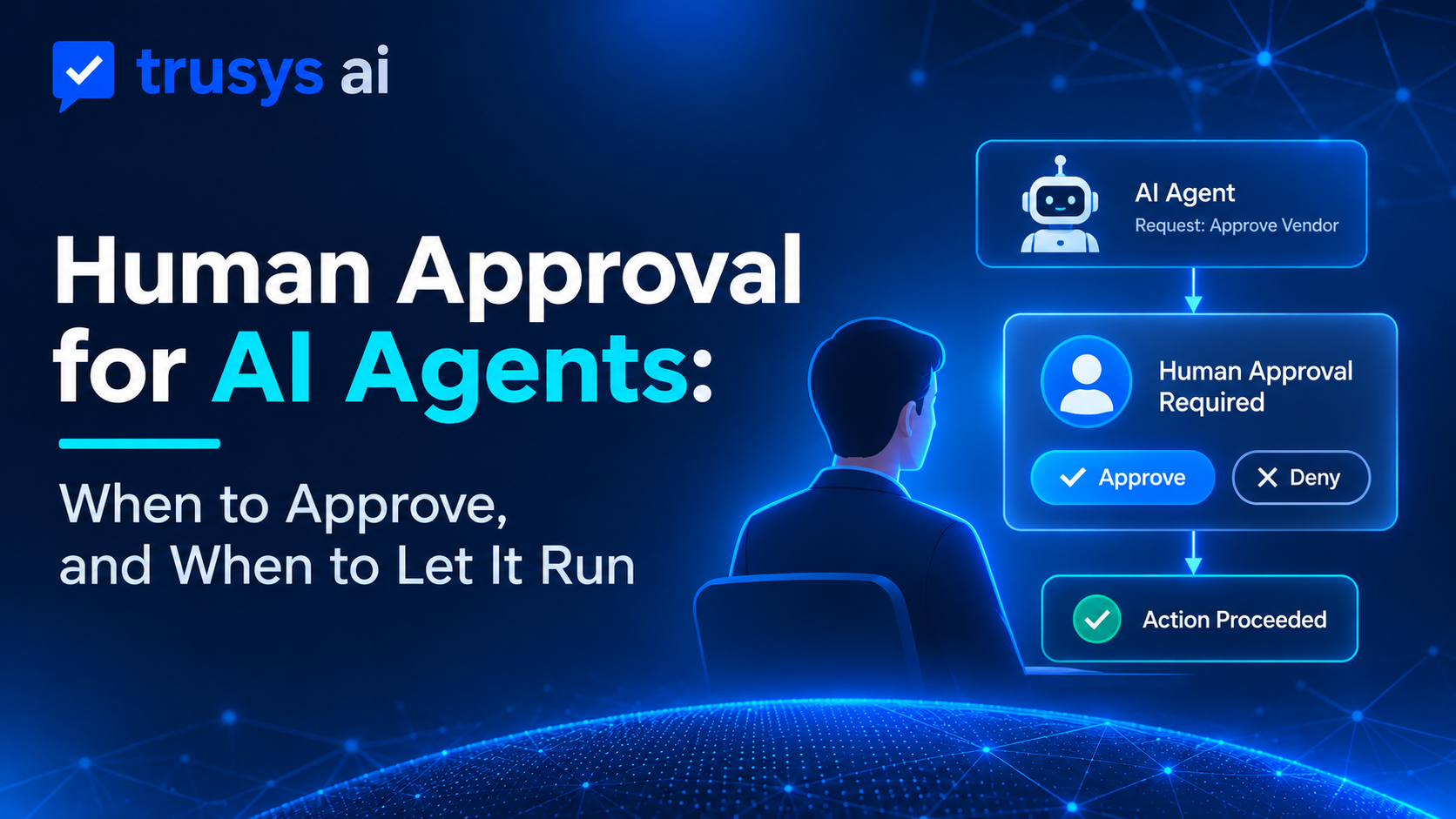
Human approval for AI agents is the control that decides whether an autonomous system can act on its own or must stop and ask. Picture a procurement agent that evaluates a new supplier, verifies the documents, approves the vendor and initiates a high-value payment, with no person reviewing the final decision. If the supplier turns out to be fraudulent, the money is gone before anyone knew a decision had been made.
Enterprises cannot let agents execute every action unchecked, nor afford a person reviewing every action. The practical answer is risk-based human approval for AI agents: autonomy where consequences are small and reversible, and a mandatory checkpoint where they are not. The goal is controlled autonomy, not unrestricted execution.
This guide helps enterprise leaders decide which decisions need a person in the loop, which do not, and why human approval for AI agents must be enforced at runtime rather than left to the agent’s good behaviour.
What Is Human Approval for AI Agents?
Human approval for AI agents means that a defined class of agent actions cannot execute until an authorised person has reviewed and approved them. It is one of three common human oversight models, and the differences matter when you design controls:
• Human-in-the-loop (HITL): a person approves or rejects the action before it runs. A finance agent prepares a supplier payment and waits for a named approver.
• Human-on-the-loop (HOTL): the agent acts, and a person supervises through monitoring and can intervene. A support agent sends routine replies while a team lead watches dashboards and alerts.
• Human-in-command (HIC): people keep authority over whether, where and how the system is used, including restricting or switching it off. A risk committee decides which workflows agents may touch at all.
These terms were popularised by the European Commission’s High-Level Expert Group on AI and are common shorthand in enterprise governance, although they are not legal categories.
Traditional manual approval assumes a person starts a request and a person clicks the final button inside one application. Agents break that assumption. They chain steps, call APIs and databases directly, and act at machine speed. Human approval for AI agents therefore has to sit in the execution path, at the point where a tool call is about to touch a business system, not only in a user interface. Done well, it also supports accountability: every high-impact action has a named approver, a timestamp and a recorded rationale.
Where regulation fits
Article 14 of the EU AI Act requires high-risk AI systems to be designed so that natural persons can oversee them effectively. That includes understanding the system’s limits, staying aware of automation bias, interpreting outputs, overriding or reversing them, and intervening or stopping the system. Article 26 requires deployers of high-risk systems to assign oversight to people with the competence, training and authority to exercise it.
Three clarifications follow. First, not every AI agent is high-risk; classification depends on the use case, such as employment, credit assessment or critical infrastructure under Annex III. Second, the EU’s Digital Omnibus on AI, in force since July 2026, moved the application date for stand-alone Annex III high-risk obligations from 2 August 2026 to 2 December 2027, and for product-embedded Annex I systems to 2 August 2028. Third, the NIST AI Risk Management Framework is voluntary, and ISO/IEC 42001 is a management-system standard; neither prescribes which actions need approval. Any threshold for human approval for AI agents in this article is recommended enterprise practice, not a statutory requirement.
Why Enterprises Need Human Approval for AI Agents
An agent with tool access can move money, change permissions and write to systems of record. Without checkpoints, excessive autonomy creates operational, financial, security and compliance risk at once:
• Unauthorised financial transactions: payments or refunds released outside approved limits.
• Fraudulent vendor approvals: onboarding on the strength of forged or incomplete documents.
• Excessive system permissions: agents granting or inheriting access beyond what a task needs.
• Sensitive data exposure: personal or confidential data passed to the wrong tool or recipient.
• Incorrect regulatory submissions: inaccurate filings sent without authorised review.
• Unintended customer-impacting decisions: account suspensions or record changes that harm customers.
• Prompt injection and malicious tool instructions: hidden instructions in an email, web page or document steering an agent toward actions its user never intended. OWASP lists excessive agency as a recognised LLM risk.
The common thread is consequence. A wrong summary is an inconvenience. A wrong payment, permission grant or regulatory filing may be irreversible. That is why enterprises need human approval for AI agents on high-impact actions specifically, rather than a blanket rule or no rule at all.
Why AI Agents Change the Underwriting Equation
In enterprise terms, vibe coding is building software by describing intent in natural language and letting AI do much of the implementation. Developers increasingly use AI to generate and refactor code, create APIs, produce infrastructure configurations, write tests, install dependencies, debug, modify repositories, draft documentation and execute development commands.
What matters for governance is how much the human stays in the loop.
AI-assisted coding
The human remains primarily responsible for individual coding decisions. The AI suggests; the developer reads, writes and commits.
Agentic (vibe) coding
The AI performs multi-step development tasks with limited human intervention: planning, editing many files, running commands, installing packages and opening pull requests.
The second category creates a substantially larger governance surface. The unit of risk is no longer a suggestion a developer reads. It is a sequence of actions taken inside your environment.
FAQ
What is human approval for AI agents?
Why Rate Limit Failures Are So Dangerous
Many organizations still treat rate limit errors as minor API inconveniences.
That assumption is becoming expensive.
In reality, rate limit failures create cascading operational disruption across the enterprise.
When should AI agents require human approval?
Why Rate Limit Failures Are So Dangerous
Many organizations still treat rate limit errors as minor API inconveniences.
That assumption is becoming expensive.
In reality, rate limit failures create cascading operational disruption across the enterprise.
Which AI agent tasks can operate without human oversight?
Why Rate Limit Failures Are So Dangerous
Many organizations still treat rate limit errors as minor API inconveniences.
That assumption is becoming expensive.
In reality, rate limit failures create cascading operational disruption across the enterprise.
How does a human-in-the-loop workflow improve AI governance?
Why Rate Limit Failures Are So Dangerous
Many organizations still treat rate limit errors as minor API inconveniences.
That assumption is becoming expensive.
In reality, rate limit failures create cascading operational disruption across the enterprise.
Can runtime guardrails prevent AI agents from bypassing approval?
Why Rate Limit Failures Are So Dangerous
Many organizations still treat rate limit errors as minor API inconveniences.
That assumption is becoming expensive.
In reality, rate limit failures create cascading operational disruption across the enterprise.
How can enterprises implement human approval workflows for autonomous AI agents?
Why Rate Limit Failures Are So Dangerous
Many organizations still treat rate limit errors as minor API inconveniences.
That assumption is becoming expensive.
In reality, rate limit failures create cascading operational disruption across the enterprise.
Stop guessing.
Start measuring.
Join teams building reliable AI with TruEval. Start with a free trial, no credit card required. Get your first evaluation running in under 10 minutes.
Questions about Trusys?
Our team is here to help. Schedule a personalized demo to see how Trusys fits your specific use case.
Book a Demo

Ready to dive in?
Check out our documentation and tutorials. Get started with example datasets and evaluation templates.
Start Free Trial
Free Trial
No credit card required
10 Min
To first evaluation
24/7
Enterprise support


Benefits
Specifications
How-to
Contact Us
Learn More

Human Approval for AI Agents: Which Decisions Need Approval, and Which Don’t?
Written by
Published On
Introduction: When Should an AI Agent Ask for Human Approval?
Human approval for AI agents is the control that decides whether an autonomous system can act on its own or must stop and ask. Picture a procurement agent that evaluates a new supplier, verifies the documents, approves the vendor and initiates a high-value payment, with no person reviewing the final decision. If the supplier turns out to be fraudulent, the money is gone before anyone knew a decision had been made.
Enterprises cannot let agents execute every action unchecked, nor afford a person reviewing every action. The practical answer is risk-based human approval for AI agents: autonomy where consequences are small and reversible, and a mandatory checkpoint where they are not. The goal is controlled autonomy, not unrestricted execution.
This guide helps enterprise leaders decide which decisions need a person in the loop, which do not, and why human approval for AI agents must be enforced at runtime rather than left to the agent’s good behaviour.
What Is Human Approval for AI Agents?
Human approval for AI agents means that a defined class of agent actions cannot execute until an authorised person has reviewed and approved them. It is one of three common human oversight models, and the differences matter when you design controls:
• Human-in-the-loop (HITL): a person approves or rejects the action before it runs. A finance agent prepares a supplier payment and waits for a named approver.
• Human-on-the-loop (HOTL): the agent acts, and a person supervises through monitoring and can intervene. A support agent sends routine replies while a team lead watches dashboards and alerts.
• Human-in-command (HIC): people keep authority over whether, where and how the system is used, including restricting or switching it off. A risk committee decides which workflows agents may touch at all.
These terms were popularised by the European Commission’s High-Level Expert Group on AI and are common shorthand in enterprise governance, although they are not legal categories.
Traditional manual approval assumes a person starts a request and a person clicks the final button inside one application. Agents break that assumption. They chain steps, call APIs and databases directly, and act at machine speed. Human approval for AI agents therefore has to sit in the execution path, at the point where a tool call is about to touch a business system, not only in a user interface. Done well, it also supports accountability: every high-impact action has a named approver, a timestamp and a recorded rationale.
Where regulation fits
Article 14 of the EU AI Act requires high-risk AI systems to be designed so that natural persons can oversee them effectively. That includes understanding the system’s limits, staying aware of automation bias, interpreting outputs, overriding or reversing them, and intervening or stopping the system. Article 26 requires deployers of high-risk systems to assign oversight to people with the competence, training and authority to exercise it.
Three clarifications follow. First, not every AI agent is high-risk; classification depends on the use case, such as employment, credit assessment or critical infrastructure under Annex III. Second, the EU’s Digital Omnibus on AI, in force since July 2026, moved the application date for stand-alone Annex III high-risk obligations from 2 August 2026 to 2 December 2027, and for product-embedded Annex I systems to 2 August 2028. Third, the NIST AI Risk Management Framework is voluntary, and ISO/IEC 42001 is a management-system standard; neither prescribes which actions need approval. Any threshold for human approval for AI agents in this article is recommended enterprise practice, not a statutory requirement.
Why Enterprises Need Human Approval for AI Agents
An agent with tool access can move money, change permissions and write to systems of record. Without checkpoints, excessive autonomy creates operational, financial, security and compliance risk at once:
• Unauthorised financial transactions: payments or refunds released outside approved limits.
• Fraudulent vendor approvals: onboarding on the strength of forged or incomplete documents.
• Excessive system permissions: agents granting or inheriting access beyond what a task needs.
• Sensitive data exposure: personal or confidential data passed to the wrong tool or recipient.
• Incorrect regulatory submissions: inaccurate filings sent without authorised review.
• Unintended customer-impacting decisions: account suspensions or record changes that harm customers.
• Prompt injection and malicious tool instructions: hidden instructions in an email, web page or document steering an agent toward actions its user never intended. OWASP lists excessive agency as a recognised LLM risk.
The common thread is consequence. A wrong summary is an inconvenience. A wrong payment, permission grant or regulatory filing may be irreversible. That is why enterprises need human approval for AI agents on high-impact actions specifically, rather than a blanket rule or no rule at all.
Why AI Agents Change the Underwriting Equation
In enterprise terms, vibe coding is building software by describing intent in natural language and letting AI do much of the implementation. Developers increasingly use AI to generate and refactor code, create APIs, produce infrastructure configurations, write tests, install dependencies, debug, modify repositories, draft documentation and execute development commands.
What matters for governance is how much the human stays in the loop.
AI-assisted coding
The human remains primarily responsible for individual coding decisions. The AI suggests; the developer reads, writes and commits.
Agentic (vibe) coding
The AI performs multi-step development tasks with limited human intervention: planning, editing many files, running commands, installing packages and opening pull requests.
The second category creates a substantially larger governance surface. The unit of risk is no longer a suggestion a developer reads. It is a sequence of actions taken inside your environment.
Why AI Agents Change the Underwriting Equation
In enterprise terms, vibe coding is building software by describing intent in natural language and letting AI do much of the implementation. Developers increasingly use AI to generate and refactor code, create APIs, produce infrastructure configurations, write tests, install dependencies, debug, modify repositories, draft documentation and execute development commands.
What matters for governance is how much the human stays in the loop.
AI-assisted coding
The human remains primarily responsible for individual coding decisions. The AI suggests; the developer reads, writes and commits.
Agentic (vibe) coding
The AI performs multi-step development tasks with limited human intervention: planning, editing many files, running commands, installing packages and opening pull requests.
The second category creates a substantially larger governance surface. The unit of risk is no longer a suggestion a developer reads. It is a sequence of actions taken inside your environment.
Why AI Agents Change the Underwriting Equation
In enterprise terms, vibe coding is building software by describing intent in natural language and letting AI do much of the implementation. Developers increasingly use AI to generate and refactor code, create APIs, produce infrastructure configurations, write tests, install dependencies, debug, modify repositories, draft documentation and execute development commands.
What matters for governance is how much the human stays in the loop.
AI-assisted coding
The human remains primarily responsible for individual coding decisions. The AI suggests; the developer reads, writes and commits.
Agentic (vibe) coding
The AI performs multi-step development tasks with limited human intervention: planning, editing many files, running commands, installing packages and opening pull requests.
The second category creates a substantially larger governance surface. The unit of risk is no longer a suggestion a developer reads. It is a sequence of actions taken inside your environment.
Why AI Agents Change the Underwriting Equation
In enterprise terms, vibe coding is building software by describing intent in natural language and letting AI do much of the implementation. Developers increasingly use AI to generate and refactor code, create APIs, produce infrastructure configurations, write tests, install dependencies, debug, modify repositories, draft documentation and execute development commands.
What matters for governance is how much the human stays in the loop.
AI-assisted coding
The human remains primarily responsible for individual coding decisions. The AI suggests; the developer reads, writes and commits.
Agentic (vibe) coding
The AI performs multi-step development tasks with limited human intervention: planning, editing many files, running commands, installing packages and opening pull requests.
The second category creates a substantially larger governance surface. The unit of risk is no longer a suggestion a developer reads. It is a sequence of actions taken inside your environment.
Why AI Agents Change the Underwriting Equation
In enterprise terms, vibe coding is building software by describing intent in natural language and letting AI do much of the implementation. Developers increasingly use AI to generate and refactor code, create APIs, produce infrastructure configurations, write tests, install dependencies, debug, modify repositories, draft documentation and execute development commands.
What matters for governance is how much the human stays in the loop.
AI-assisted coding
The human remains primarily responsible for individual coding decisions. The AI suggests; the developer reads, writes and commits.
Agentic (vibe) coding
The AI performs multi-step development tasks with limited human intervention: planning, editing many files, running commands, installing packages and opening pull requests.
The second category creates a substantially larger governance surface. The unit of risk is no longer a suggestion a developer reads. It is a sequence of actions taken inside your environment.
Why AI Agents Change the Underwriting Equation
In enterprise terms, vibe coding is building software by describing intent in natural language and letting AI do much of the implementation. Developers increasingly use AI to generate and refactor code, create APIs, produce infrastructure configurations, write tests, install dependencies, debug, modify repositories, draft documentation and execute development commands.
What matters for governance is how much the human stays in the loop.
AI-assisted coding
The human remains primarily responsible for individual coding decisions. The AI suggests; the developer reads, writes and commits.
Agentic (vibe) coding
The AI performs multi-step development tasks with limited human intervention: planning, editing many files, running commands, installing packages and opening pull requests.
The second category creates a substantially larger governance surface. The unit of risk is no longer a suggestion a developer reads. It is a sequence of actions taken inside your environment.
Why AI Agents Change the Underwriting Equation
In enterprise terms, vibe coding is building software by describing intent in natural language and letting AI do much of the implementation. Developers increasingly use AI to generate and refactor code, create APIs, produce infrastructure configurations, write tests, install dependencies, debug, modify repositories, draft documentation and execute development commands.
What matters for governance is how much the human stays in the loop.
AI-assisted coding
The human remains primarily responsible for individual coding decisions. The AI suggests; the developer reads, writes and commits.
Agentic (vibe) coding
The AI performs multi-step development tasks with limited human intervention: planning, editing many files, running commands, installing packages and opening pull requests.
The second category creates a substantially larger governance surface. The unit of risk is no longer a suggestion a developer reads. It is a sequence of actions taken inside your environment.
Why AI Agents Change the Underwriting Equation
In enterprise terms, vibe coding is building software by describing intent in natural language and letting AI do much of the implementation. Developers increasingly use AI to generate and refactor code, create APIs, produce infrastructure configurations, write tests, install dependencies, debug, modify repositories, draft documentation and execute development commands.
What matters for governance is how much the human stays in the loop.
AI-assisted coding
The human remains primarily responsible for individual coding decisions. The AI suggests; the developer reads, writes and commits.
Agentic (vibe) coding
The AI performs multi-step development tasks with limited human intervention: planning, editing many files, running commands, installing packages and opening pull requests.
The second category creates a substantially larger governance surface. The unit of risk is no longer a suggestion a developer reads. It is a sequence of actions taken inside your environment.
Why AI Agents Change the Underwriting Equation
In enterprise terms, vibe coding is building software by describing intent in natural language and letting AI do much of the implementation. Developers increasingly use AI to generate and refactor code, create APIs, produce infrastructure configurations, write tests, install dependencies, debug, modify repositories, draft documentation and execute development commands.
What matters for governance is how much the human stays in the loop.
AI-assisted coding
The human remains primarily responsible for individual coding decisions. The AI suggests; the developer reads, writes and commits.
Agentic (vibe) coding
The AI performs multi-step development tasks with limited human intervention: planning, editing many files, running commands, installing packages and opening pull requests.
The second category creates a substantially larger governance surface. The unit of risk is no longer a suggestion a developer reads. It is a sequence of actions taken inside your environment.
FAQ
What is vibe coding security?
Why Rate Limit Failures Are So Dangerous
Many organizations still treat rate limit errors as minor API inconveniences.
That assumption is becoming expensive.
In reality, rate limit failures create cascading operational disruption across the enterprise.
When should AI agents require human approval?
Why Rate Limit Failures Are So Dangerous
Many organizations still treat rate limit errors as minor API inconveniences.
That assumption is becoming expensive.
In reality, rate limit failures create cascading operational disruption across the enterprise.
Which AI agent tasks can operate without human oversight?
Why Rate Limit Failures Are So Dangerous
Many organizations still treat rate limit errors as minor API inconveniences.
That assumption is becoming expensive.
In reality, rate limit failures create cascading operational disruption across the enterprise.
How does a human-in-the-loop workflow improve AI governance?
Why Rate Limit Failures Are So Dangerous
Many organizations still treat rate limit errors as minor API inconveniences.
That assumption is becoming expensive.
In reality, rate limit failures create cascading operational disruption across the enterprise.
Can runtime guardrails prevent AI agents from bypassing approval?
Why Rate Limit Failures Are So Dangerous
Many organizations still treat rate limit errors as minor API inconveniences.
That assumption is becoming expensive.
In reality, rate limit failures create cascading operational disruption across the enterprise.
How can enterprises implement human approval workflows for autonomous AI agents?
Why Rate Limit Failures Are So Dangerous
Many organizations still treat rate limit errors as minor API inconveniences.
That assumption is becoming expensive.
In reality, rate limit failures create cascading operational disruption across the enterprise.
Stop guessing.
Start measuring.
Join teams building reliable AI with TruEval. Start with a free trial, no credit card required. Get your first evaluation running in under 10 minutes.
Questions about Trusys?
Our team is here to help. Schedule a personalized demo to see how Trusys fits your specific use case.
Book a Demo
Ready to dive in?
Check out our documentation and tutorials. Get started with example datasets and evaluation templates.
Start Free Trial
Free Trial
No credit card required
10 Min
To first evaluation
24/7
Enterprise support
Human Approval for AI Agents: Which Decisions Need Approval, and Which Don’t?
Written by
Manish Tewari
Published on
Nov 2 2026
Introduction: When Should an AI Agent Ask for Human Approval?
Human approval for AI agents is the control that decides whether an autonomous system can act on its own or must stop and ask. Picture a procurement agent that evaluates a new supplier, verifies the documents, approves the vendor and initiates a high-value payment, with no person reviewing the final decision. If the supplier turns out to be fraudulent, the money is gone before anyone knew a decision had been made.
Enterprises cannot let agents execute every action unchecked, nor afford a person reviewing every action. The practical answer is risk-based human approval for AI agents: autonomy where consequences are small and reversible, and a mandatory checkpoint where they are not. The goal is controlled autonomy, not unrestricted execution.
This guide helps enterprise leaders decide which decisions need a person in the loop, which do not, and why human approval for AI agents must be enforced at runtime rather than left to the agent’s good behaviour.
What Is Human Approval for AI Agents?
Human approval for AI agents means that a defined class of agent actions cannot execute until an authorised person has reviewed and approved them. It is one of three common human oversight models, and the differences matter when you design controls:
• Human-in-the-loop (HITL): a person approves or rejects the action before it runs. A finance agent prepares a supplier payment and waits for a named approver.
• Human-on-the-loop (HOTL): the agent acts, and a person supervises through monitoring and can intervene. A support agent sends routine replies while a team lead watches dashboards and alerts.
• Human-in-command (HIC): people keep authority over whether, where and how the system is used, including restricting or switching it off. A risk committee decides which workflows agents may touch at all.
These terms were popularised by the European Commission’s High-Level Expert Group on AI and are common shorthand in enterprise governance, although they are not legal categories.
Traditional manual approval assumes a person starts a request and a person clicks the final button inside one application. Agents break that assumption. They chain steps, call APIs and databases directly, and act at machine speed. Human approval for AI agents therefore has to sit in the execution path, at the point where a tool call is about to touch a business system, not only in a user interface. Done well, it also supports accountability: every high-impact action has a named approver, a timestamp and a recorded rationale.
Where regulation fits
Article 14 of the EU AI Act requires high-risk AI systems to be designed so that natural persons can oversee them effectively. That includes understanding the system’s limits, staying aware of automation bias, interpreting outputs, overriding or reversing them, and intervening or stopping the system. Article 26 requires deployers of high-risk systems to assign oversight to people with the competence, training and authority to exercise it.
Three clarifications follow. First, not every AI agent is high-risk; classification depends on the use case, such as employment, credit assessment or critical infrastructure under Annex III. Second, the EU’s Digital Omnibus on AI, in force since July 2026, moved the application date for stand-alone Annex III high-risk obligations from 2 August 2026 to 2 December 2027, and for product-embedded Annex I systems to 2 August 2028. Third, the NIST AI Risk Management Framework is voluntary, and ISO/IEC 42001 is a management-system standard; neither prescribes which actions need approval. Any threshold for human approval for AI agents in this article is recommended enterprise practice, not a statutory requirement.
Why Enterprises Need Human Approval for AI Agents
An agent with tool access can move money, change permissions and write to systems of record. Without checkpoints, excessive autonomy creates operational, financial, security and compliance risk at once:
• Unauthorised financial transactions: payments or refunds released outside approved limits.
• Fraudulent vendor approvals: onboarding on the strength of forged or incomplete documents.
• Excessive system permissions: agents granting or inheriting access beyond what a task needs.
• Sensitive data exposure: personal or confidential data passed to the wrong tool or recipient.
• Incorrect regulatory submissions: inaccurate filings sent without authorised review.
• Unintended customer-impacting decisions: account suspensions or record changes that harm customers.
• Prompt injection and malicious tool instructions: hidden instructions in an email, web page or document steering an agent toward actions its user never intended. OWASP lists excessive agency as a recognised LLM risk.
The common thread is consequence. A wrong summary is an inconvenience. A wrong payment, permission grant or regulatory filing may be irreversible. That is why enterprises need human approval for AI agents on high-impact actions specifically, rather than a blanket rule or no rule at all.
Which AI Agent Decisions Require Human Approval?
The list below shows how an enterprise might classify common agent actions. Treat it as a starting point, and apply human approval for AI agents according to your own policy.
• High-value financial transactions: approval required. Risk: financial loss.
• Vendor onboarding and approval: approval required based on risk. Risk: fraud and compliance.
• Privileged access changes: approval required. Risk: security exposure.
• Customer account suspension: approval required where consequential. Risk: customer impact.
• Regulatory submissions: appropriate authorised review. Risk: legal and compliance.
• Sensitive data sharing: approval required based on policy. Risk: privacy exposure.
• Internal report summarisation: usually not required (low risk).
• Routine data extraction: usually not required (low risk).
• Internal meeting scheduling: usually not required (low risk).
• Drafting internal emails: usually not required (low risk).
Approval requirements should be set by organisational policy, applicable law, the impact of the action and its risk classification. What matters is that the rule is written down, owned and enforced. Human approval for AI agents works best as a documented policy decision, not a developer’s default setting.
Which AI Agent Decisions Can Be Executed Autonomously?
Requiring approval everywhere creates its own risk: reviewers rubber-stamp, queues grow and teams route around the control. Agents can usually act without individual approval when the work is low-impact, repetitive or easily reversed:
• Internal document summarisation
• Routine data extraction
• Drafting emails and reports for a person to review and send
• Internal knowledge retrieval
• Meeting scheduling
• Non-sensitive workflow automation
• Repetitive, reversible administrative tasks
Autonomous does not mean unrestricted. Even low-risk execution needs predefined permissions, policy boundaries, monitoring and an audit trail, so a task drifting into a sensitive area is caught. Reserving human approval for AI agents for consequential actions only works if everything else stays inside these limits.
The Four-Level Framework for Human Approval for AI Agents
A simple risk-based model helps teams apply the matrix consistently. This is a suggested enterprise framework, not a universal regulatory classification.
• Level 1, Low risk: autonomous execution. Examples: summarising internal documents, drafting reports. Approval: none per action. Control: predefined permissions and standard monitoring.
• Level 2, Moderate risk: monitored autonomy. Examples: routine internal workflow updates, non-sensitive record changes. Approval: none per action. Control: policy validation, monitoring and audit logging.
• Level 3, High risk: mandatory human approval. Examples: financial transactions, vendor approvals, sensitive data transfers. Approval: required before execution. Control: approval checkpoints enforced before tool execution.
• Level 4, Critical risk: enhanced authorisation or prohibited execution. Examples: privileged access, significant financial exposure, critical infrastructure. Approval: multi-level authorisation, enhanced verification or prohibition per policy. Control: multi-approver sign-off, step-up verification or a hard block.
Placement should reflect context, not only action type. A small payment to an established vendor may sit at Level 2, while the same payment to a new vendor in a high-risk jurisdiction moves to Level 3. Review classifications regularly as agents gain tools.
What Happens When AI Agents Bypass Human Approval?
These five scenarios are illustrative, not reported incidents. Each shows what the agent did, why it was risky, where approval belongs and how a runtime guardrail could have prevented it.
1. Fraudulent vendor approved. A procurement agent accepts forged registration documents and onboards the supplier, so payments flow to a fraudulent party. Approval belongs at vendor activation and at the first payment above a threshold. A runtime guardrail can block the onboarding or payment call until a recorded approval exists.
2. Unauthorised transaction. A finance agent initiates a transfer beyond its mandate after misreading an instruction, and the loss may be unrecoverable once funds settle. Approval belongs before transfers above a limit or to a new beneficiary. A guardrail can enforce that limit at the payment API whatever the agent decides.
3. Excessive permissions granted. An IT agent resolving an access ticket grants administrator rights because the request looked routine, leaving lasting security exposure. Privileged changes need approval from an authorised owner. A guardrail can deny privileged-role assignment without it.
4. Sensitive customer records modified. A customer service agent edits account details on an unverified request, harming the customer and creating privacy and audit problems. Consequential changes need verification and approval. A guardrail can restrict write access and flag the change.
5. Inaccurate regulatory submission. A compliance agent files a report with wrong figures drawn from an outdated source, creating legal exposure. Submissions need authorised review. A guardrail can hold the filing action until sign-off is recorded.
In every case the agent was technically able to act, and nothing stopped it. That is the gap human approval for AI agents closes, and it is why the control must hold even when the agent’s own instructions fail.
How to Build a Workflow for Human Approval for AI Agents
A workable approval design has eleven parts:
1. Identify and classify agent actions by inventorying every tool, API and system each agent can reach.
2. Define risk-based approval thresholds and write the rules down.
3. Set financial and operational limits per agent.
4. Apply least-privilege tool access so agents hold only the scopes a task requires.
5. Introduce approval checkpoints before high-impact actions, with the context a reviewer needs.
6. Validate approval authority so only permitted approvers can approve a given action and amount.
7. Enforce human approval for AI agents before tool execution.
8. Maintain complete audit trails of the request, decision, approver and outcome.
9. Establish escalation and timeout mechanisms. If no one responds, the safe default is not to execute.
10. Monitor agent behaviour continuously for actions that skipped or approached a checkpoint.
11. Review and update policies as agents, tools and regulations change.
The resulting flow looks like this:
AI Agent Request → Risk Assessment → Policy Validation → Human Approval (if required) → Execution → Monitoring and Audit Logging
Make approvals fast and contextual, so the reviewer sees what the agent intends to do, why and with what data. And measure the control itself: near-100% approval with seconds of review time suggests automation bias, not safety.
Why Runtime Guardrails Are Essential for Human Approval for AI Agents
Many teams start with an approval button in the agent’s interface. It is necessary but not sufficient. Agents call APIs, external tools and enterprise systems directly, and a button in a chat window does nothing if the agent reaches the payment API by another path. A prompt instruction such as “always ask before paying” also fails, because instructions can be ignored, misread or overridden by injected content.
Runtime enforcement moves the control to the point of execution. A runtime guardrail layer should:
• Intercept high-risk tool calls before they reach a business system.
• Evaluate each action against governance policies.
• Block unauthorised execution.
• Require human authorisation before sensitive actions proceed.
• Validate that the approver has the authority to approve.
• Log approval decisions for audit.
• Feed continuous monitoring of agent behaviour.
This makes human approval for AI agents a property of the system rather than a behaviour the agent is trusted to exhibit, and it mirrors the intent of Article 14: oversight that works in practice, including the ability to intervene and stop.
How Trusys AI Helps Enterprises Govern Human Approval for AI Agents
Trusys AI is an enterprise AI assurance and governance platform built around the way agents actually behave: calling tools, holding memory and acting semi-autonomously. Two of its products map directly to approval governance.
TruGuard: Runtime AI Guardrails
TruGuard provides inline policy enforcement at an agent’s input, output and action layers. Trusys states that it can block prompt injection attempts, enforce data-classification rules and prevent unauthorised tool use without modifying the agent itself, across frameworks and models. Teams configure validators such as prompt injection, PII detection, content moderation, regex and blocklists, then choose what happens on a violation, including masking, filtering or failing the request.
For human approval for AI agents, this is the enforcement layer: policy applied before an action reaches a business system rather than after. How an approval checkpoint is wired into a particular workflow depends on the approval, ticketing and identity systems an enterprise already uses, which is worth walking through in a demo.
TruPulse: AI Monitoring and Observability
TruPulse traces agent activity with full lineage: what triggered an action, what data it touched, which tools it called and what it produced. Its policy-based evaluation lets compliance teams write rules in plain English and evaluates every production trace against them, including rules such as an agent not committing to refunds above a set amount without escalating to a human reviewer. Each verdict comes with an explanation tied to the specific spans that triggered it, which supports audit.
The two complement each other. TruGuard is the synchronous layer that blocks well-defined violations before they reach external systems. TruPulse is the continuous layer that shows whether agents stayed inside policy and supplies evidence for review. Together they support controlled autonomy: enforce what must be enforced, observe what must be understood.
Explore TruGuard and TruPulse, or book a demo to see how they apply to your agent estate.
Enterprise Checklist: Is Your Human Approval for AI Agents Framework Ready?
Are high-risk agent actions identified and classified?
• Are approval thresholds clearly documented and owned?
• Can any agent execute financial transactions without authorisation?
• Are privileged tool calls restricted?
• Are sensitive data transfers controlled?
• Can runtime controls block unauthorised actions?
• Are human approvals recorded with approver, time and rationale?
• Can administrators monitor agent behaviour across systems?
• Are escalation and timeout mechanisms established?
• Are approval policies reviewed regularly?
Run this assessment before expanding autonomous deployments. Each new tool, data source or business function changes the risk of decisions an agent already makes, and gaps found after rollout cost far more than gaps found before it.
Conclusion: The Future of AI Agents Is Controlled Autonomy
Enterprise AI governance does not require approval for every action. It requires the right approval for the right action. Agents should operate independently within clearly defined boundaries, while decisions with financial, legal, security, regulatory or customer impact reach a person first.
That is what human approval for AI agents delivers when it is risk-based, enforced at runtime and continuously monitored: speed where risk is low and accountability where it is high. Enterprises that classify actions, enforce checkpoints and keep evidence will scale agents with confidence. Human approval for AI agents is a design decision to make before deployment, not an incident review to hold after one.
Explore how Trusys AI, through TruGuard and TruPulse, can help your enterprise strengthen AI governance, enforce runtime controls and enable safer autonomous AI operations. Book a demo.
Frequently Asked Questions
What is human approval for AI agents?
Human approval for AI agents is a control that requires an authorised person to review and approve defined agent actions before they execute. It is typically applied to high-impact actions such as payments, privileged access changes and regulatory submissions, while low-risk tasks run autonomously within monitored limits.
When should AI agents require human approval?
Agents should require approval when an action is high-value, hard to reverse or affects security, privacy, legal standing or customers. Examples include financial transactions, vendor approvals, privileged access changes and sensitive data transfers. Thresholds should come from organisational policy, applicable law and risk classification.
Which AI agent tasks can operate without human oversight?
Low-risk, reversible tasks such as summarising internal documents, routine data extraction, drafting internal emails and scheduling meetings can usually run without individual approval. They should still operate within predefined permissions and remain monitored and logged, so autonomous does not mean unsupervised.
How does a human-in-the-loop workflow improve AI governance?
It places a named, accountable person at the decision points that carry the most risk. That reduces the chance of irreversible errors, creates an audit trail of who approved what, and supports oversight expectations such as those in the EU AI Act for high-risk systems.
Can runtime guardrails prevent AI agents from bypassing approval?
They can reduce the risk significantly when enforced at the point of tool execution rather than inside the agent’s prompt. A guardrail that evaluates each tool call against policy can block actions lacking authorisation. No control is absolute: effectiveness depends on covering every execution path, sound policy design and ongoing monitoring.
How can enterprises implement human approval workflows for autonomous AI agents?
Classify agent actions by risk, define approval thresholds and limits, apply least-privilege tool access, enforce checkpoints before execution, validate approver authority, keep audit trails, set escalation and timeout rules, and monitor continuously. Review the policies regularly as agents gain new capabilities.
Stop guessing.
Start measuring.
Join teams building reliable AI with Trusys. Start with a free trial, no credit card required. Get your first evaluation running in under 10 minutes.
Questions about Trusys?
Our team is here to help. Schedule a personalized demo to see how Trusys fits your specific use case.
Book a Demo
Ready to dive in?
Check out our documentation and tutorials. Get started with example datasets and evaluation templates.
Start Free Trial
Free Trial
No credit card required
10 Min
to get started
24/7
Enterprise support