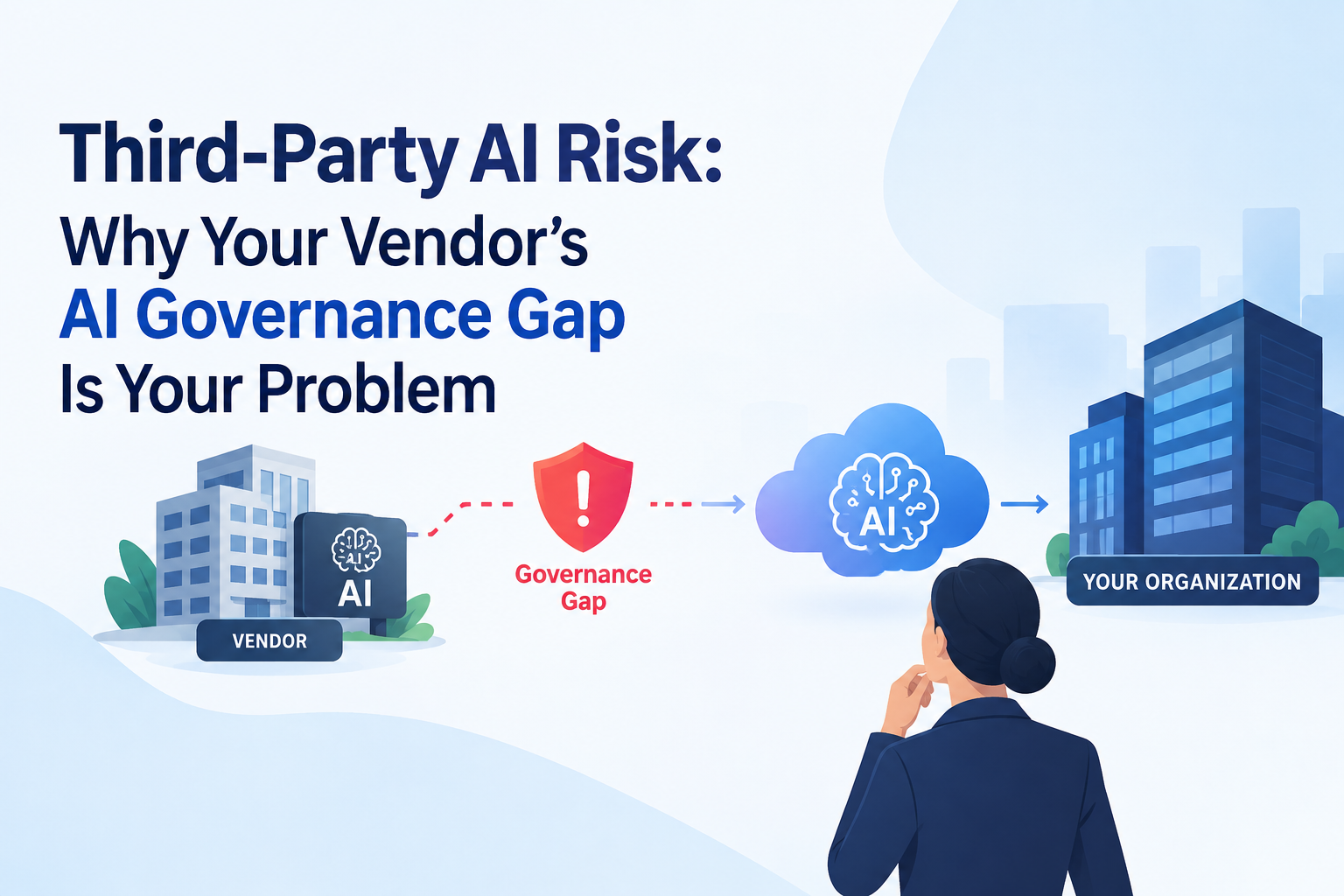
Third-Party AI Risk: Why Your Vendor’s AI Governance Gap Is Your Problem
Written by

Your Vendor’s AI Risk Becomes Your Risk
Why Rate Limit Failures Are So Dangerous
Many organizations still treat rate limit errors as minor API inconveniences.
That assumption is becoming expensive.
In reality, rate limit failures create cascading operational disruption across the enterprise.
What Is Third-Party AI Risk?
Third-party AI risk is the risk an organization inherits from AI systems, models, agents, data flows or AI-enabled services operated or supplied by external vendors.
It covers vendors that sell AI products and also vendors that quietly embed AI into existing services: SaaS platforms, cloud providers, consultants, BPO firms and analytics providers.
The main risk categories span several dimensions. AI model risk covers inaccurate, inconsistent or unsafe outputs, including hallucinations in decision support. Data privacy and leakage risk covers prompts, documents or logs exposed, retained or reused unexpectedly. Security risk includes prompt injection, insecure tool integrations, exposed API keys and poisoned training data. Regulatory and compliance risk covers obligations under AI, privacy, consumer or sector rules that flow to you as a deployer or data fiduciary. Intellectual property risk touches ownership of outputs, training on your confidential material, and infringing outputs. Bias and discrimination risk shows up in unfair outcomes in hiring, lending, insurance or customer treatment. Operational risk arises when performance degrades after a silent model update. AI agent or autonomous-action risk covers unintended actions taken in your systems or on your behalf. Business continuity risk stems from model deprecation, provider outages, or sudden pricing or policy changes. Vendor concentration risk grows as many vendors come to depend on the same handful of model providers. Model and provider dependency risk makes it difficult to swap out an underlying model without changing behavior. And reputational risk follows from public harm attributed to your brand even when the failure originated with a vendor's AI.
Where standards and regulators already point
Expectations are converging, though legal force differs. Check status and jurisdiction before relying on any of them.
- NIST AI RMF and Generative AI Profile (voluntary, US). The AI Risk Management Framework organizes AI risk work under Govern, Map, Measure and Manage. Its companion Generative AI Profile (NIST AI 600-1) names value chain and component integration as a distinct risk, including nontransparent third-party components and weak supplier vetting.
- ISO/IEC 42001 (voluntary, certifiable standard). ISO/IEC 42001 includes a control objective on third-party and customer relationships (Annex A.10), covering allocation of responsibilities and supplier management.
- EU AI Act (binding, EU). Duties are tiered by role and risk. Regulation (EU) 2026/1744, the Digital Omnibus on AI, entered into force on 27 July 2026. Per law-firm analysis, it moved high-risk obligations for Annex III systems to 2 December 2027 and for AI embedded in Annex I regulated products to 2 August 2028. The Act assigns separate duties to providers and deployers, so a provider’s compliance does not by itself discharge yours; counsel should confirm your role classification.
- US banking supervisors (non-binding guidance). OCC Bulletin 2026-13, issued with the Federal Reserve and FDIC in April 2026, covers vendor and third-party products in model risk management. It sets no enforceable standards, and secondary summaries report that it excludes generative and agentic AI from scope, pointing banks to broader governance for those systems.
- RBI (draft, India). The Reserve Bank of India’s draft Guidance on Regulatory Principles for Model Risk Management, 2026, released 24 June 2026, would cover third-party models and AI/ML models. Law-firm commentary notes entities remain accountable however a model is sourced. It is still a draft; comments closed 24 July 2026, and we found no final version.
Different instruments, one message: outsourcing the model does not outsource accountability.
Why Traditional Vendor Risk Management Falls Short for AI
SOC 2, ISO 27001, penetration tests and standard questionnaires remain necessary. They tell you whether a vendor protects its infrastructure and data with disciplined controls. They do not, on their own, tell you how the vendor’s model behaves, what it is allowed to do, or how it changes. They remain important, but they do not answer every AI governance question. Six gaps show up repeatedly:
- "Is data encrypted?" versus "How does the AI use the data?" Encryption says nothing about whether prompts, files or outputs are retained, reviewed by staff, used to improve models or passed to another provider.
- Access controls versus AI tool permissions. Role-based access governs people. An AI agent acts through service accounts, API keys and OAuth grants that can be far broader than any one user’s rights.
- Security certifications versus model behavior. A SOC 2 report examines controls over a defined system and period. It does not test hallucination, bias, prompt-injection resistance or output reliability.
- Privacy policies versus training and retention reality. "Service improvement" language can be ambiguous about training use, human review and deletion, including deletion from derived artifacts such as embeddings.
- Generic incident response versus AI failure modes. Standard playbooks cover breaches and outages. They rarely define an AI incident, such as a harmful autonomous action or a silent quality regression, or say who must be told.
- One-time approval versus continuous change. A model swap, new tool integration or new subprocessor can change the risk profile overnight while the assessment on file stays frozen at onboarding.
Why AI Agents Change the Underwriting Equation
Six categories give risk teams a shared vocabulary.
Data and Privacy Risk
AI features often move customer data into new places: prompts, uploaded documents, conversation logs, retrieval indexes and fine-tuning sets. Each is a retention and disclosure point. Assess:
- What customer data enters the AI system, including sensitive and regulated data, and whether it can be excluded or masked.
- How long prompts, outputs and derived data (embeddings, logs) are kept, and whether deletion covers them.
- Whether your data is used for training, evaluation or product improvement by the vendor or its model providers.
- Where processing happens, including cross-border transfers, and which subprocessors touch the data.
Model Risk
Models can be wrong with confidence (hallucination), skewed against groups (bias) or degrade as data and context shift (drift). Vendor-side changes add another layer: a provider may retire a model version or update one behind a stable API name, altering behavior your testing never saw. Ask how the vendor evaluates accuracy and bias on tasks like yours, and whether you can pin a version or get advance notice of changes.
AI Agent and Autonomous Action Risk
Risk changes shape when AI moves from advising to acting. An assistant that drafts a reply leaves a human as the decision point. An agent that sends emails, modifies records, approves transactions, calls APIs, accesses internal systems or runs workflows turns the AI’s error into the organization’s action, sometimes with no human review at all.
Agents also concentrate access. In August 2025, attackers stole OAuth tokens tied to the Salesloft Drift AI chat agent’s integrations and used them to pull data from customers’ Salesforce environments, affecting more than 700 organizations according to a FINRA alert. That was a conventional token compromise at the vendor, not a model failure, and that is the point: an AI agent’s integrations put broad access in one place, and your vendor’s security becomes part of your perimeter.
Ask what each agent can do, with which permissions, under what limits and approvals, and who can switch it off. Adversarial testing of AI agents, meaning testing them the way attackers would approach them, is a reasonable evidence request for any vendor whose AI can act.
AI Supply-Chain Risk and Fourth-Party AI Risk
Few AI vendors build everything. A product may depend on a foundation model provider, a cloud platform, open-source models, model APIs, embedding services, vector databases, data providers and external tools. Each dependency is a fourth-party AI risk: a supplier to your supplier that your contract does not reach. NIST’s Generative AI Profile flags this exposure, and the OWASP Top 10 for LLM Applications (2025) lists supply chain as LLM03.
Your vendor’s model provider can change terms, deprecate a model, suffer an incident or alter data handling, and you may learn late or never. Ask for the dependency map and a commitment to be told when it changes.
Security Risk in AI Systems
AI adds attack paths conventional testing may not cover:
- Prompt injection. Hidden instructions in emails, web pages or documents make the AI follow an attacker’s commands. OWASP ranks it first in its 2025 LLM list.
- Data exfiltration. Models with access to internal data can be steered into leaking it. Researchers disclosed EchoLeak (CVE-2025-32711) in 2025, a zero-click flaw in Microsoft 365 Copilot where a crafted email could lead the assistant to expose internal data. Public reporting indicates Microsoft fixed it server-side, with no in-the-wild exploitation reported. The lesson: no questionnaire would have revealed a flaw in the vendor’s AI layer.
- Model manipulation and jailbreaking. Bypassing safety controls, or tampering with data or components the model relies on.
- Insecure tool use and excessive permissions. OWASP’s Excessive Agency entry (LLM06) describes systems given more functionality, permission or autonomy than they need.
- Cross-tenant exposure and malicious inputs. Shared indexes, caches or memory that let one customer’s data surface in another’s session, and crafted files that exploit retrieval pipelines or downstream tools.
6. The Regulatory and Framework Dimension
Ask who at the vendor owns each AI system, who approves model changes, who monitors performance and safety, who investigates AI incidents and who can disable a feature. Then ask the hardest question: what happens when the vendor cannot explain an AI failure? If the answer is "we will investigate," with no defined process, evidence trail or timeline, you are relying on goodwill rather than governance. ISO/IEC 42001’s A.10 objective frames the fix as explicit allocation of responsibilities.
The AI Vendor Questionnaire: What Should You Ask?
Why Rate Limit Failures Are So Dangerous
Many organizations still treat rate limit errors as minor API inconveniences.
That assumption is becoming expensive.
In reality, rate limit failures create cascading operational disruption across the enterprise.

What Evidence Should Vendors Provide?
Why Rate Limit Failures Are So Dangerous
Many organizations still treat rate limit errors as minor API inconveniences.
That assumption is becoming expensive.
In reality, rate limit failures create cascading operational disruption across the enterprise.
AI Vendor Risk Should Be Continuous, Not a One-Time Questionnaire
Why Rate Limit Failures Are So Dangerous
Many organizations still treat rate limit errors as minor API inconveniences.
That assumption is becoming expensive.
In reality, rate limit failures create cascading operational disruption across the enterprise.
What Happens When an AI Vendor Changes Its Model?
Why Rate Limit Failures Are So Dangerous
Many organizations still treat rate limit errors as minor API inconveniences.
That assumption is becoming expensive.
In reality, rate limit failures create cascading operational disruption across the enterprise.
Contractual Controls for Third-Party AI
Why Rate Limit Failures Are So Dangerous
Many organizations still treat rate limit errors as minor API inconveniences.
That assumption is becoming expensive.
In reality, rate limit failures create cascading operational disruption across the enterprise.
Building a Third-Party AI Risk Framework
Why Rate Limit Failures Are So Dangerous
Many organizations still treat rate limit errors as minor API inconveniences.
That assumption is becoming expensive.
In reality, rate limit failures create cascading operational disruption across the enterprise.
A Practical Third-Party AI Risk Checklist
Why Rate Limit Failures Are So Dangerous
Many organizations still treat rate limit errors as minor API inconveniences.
That assumption is becoming expensive.
In reality, rate limit failures create cascading operational disruption across the enterprise.
Conclusion: Accountability Does Not Transfer With the Contract
Why Rate Limit Failures Are So Dangerous
Many organizations still treat rate limit errors as minor API inconveniences.
That assumption is becoming expensive.
In reality, rate limit failures create cascading operational disruption across the enterprise.
FAQ
What is third-party AI risk?
Why Rate Limit Failures Are So Dangerous
Many organizations still treat rate limit errors as minor API inconveniences.
That assumption is becoming expensive.
In reality, rate limit failures create cascading operational disruption across the enterprise.
How is third-party AI risk different from traditional vendor risk?
Why Rate Limit Failures Are So Dangerous
Many organizations still treat rate limit errors as minor API inconveniences.
That assumption is becoming expensive.
In reality, rate limit failures create cascading operational disruption across the enterprise.
Does a SOC 2 report or ISO 27001 certificate cover AI risk?
Why Rate Limit Failures Are So Dangerous
Many organizations still treat rate limit errors as minor API inconveniences.
That assumption is becoming expensive.
In reality, rate limit failures create cascading operational disruption across the enterprise.
What should an AI vendor assessment include?
Why Rate Limit Failures Are So Dangerous
Many organizations still treat rate limit errors as minor API inconveniences.
That assumption is becoming expensive.
In reality, rate limit failures create cascading operational disruption across the enterprise.
How often should AI vendors be reassessed?
Why Rate Limit Failures Are So Dangerous
Many organizations still treat rate limit errors as minor API inconveniences.
That assumption is becoming expensive.
In reality, rate limit failures create cascading operational disruption across the enterprise.
What is fourth-party AI risk?
Why Rate Limit Failures Are So Dangerous
Many organizations still treat rate limit errors as minor API inconveniences.
That assumption is becoming expensive.
In reality, rate limit failures create cascading operational disruption across the enterprise.
Am I still accountable if my vendor’s AI causes harm?
Why Rate Limit Failures Are So Dangerous
Many organizations still treat rate limit errors as minor API inconveniences.
That assumption is becoming expensive.
In reality, rate limit failures create cascading operational disruption across the enterprise.
Which contract terms matter most for AI vendors?
Why Rate Limit Failures Are So Dangerous
Many organizations still treat rate limit errors as minor API inconveniences.
That assumption is becoming expensive.
In reality, rate limit failures create cascading operational disruption across the enterprise.
Stop guessing.
Start measuring.
Join teams building reliable AI with TruEval. Start with a free trial, no credit card required. Get your first evaluation running in under 10 minutes.
Questions about Trusys?
Our team is here to help. Schedule a personalized demo to see how Trusys fits your specific use case.
Book a Demo

Ready to dive in?
Check out our documentation and tutorials. Get started with example datasets and evaluation templates.
Start Free Trial
Free Trial
No credit card required
10 Min
To first evaluation
24/7
Enterprise support


Benefits
Specifications
How-to
Contact Us
Learn More

Third-Party AI Risk: Why Your Vendor’s AI Governance Gap Is Your Problem
Written by
Your Vendor’s AI Risk Becomes Your Risk
Why Rate Limit Failures Are So Dangerous
Many organizations still treat rate limit errors as minor API inconveniences.
That assumption is becoming expensive.
In reality, rate limit failures create cascading operational disruption across the enterprise.
What Is Third-Party AI Risk?
Third-party AI risk is the risk an organization inherits from AI systems, models, agents, data flows or AI-enabled services operated or supplied by external vendors.
It covers vendors that sell AI products and also vendors that quietly embed AI into existing services: SaaS platforms, cloud providers, consultants, BPO firms and analytics providers.
The main risk categories span several dimensions. AI model risk covers inaccurate, inconsistent or unsafe outputs, including hallucinations in decision support. Data privacy and leakage risk covers prompts, documents or logs exposed, retained or reused unexpectedly. Security risk includes prompt injection, insecure tool integrations, exposed API keys and poisoned training data. Regulatory and compliance risk covers obligations under AI, privacy, consumer or sector rules that flow to you as a deployer or data fiduciary. Intellectual property risk touches ownership of outputs, training on your confidential material, and infringing outputs. Bias and discrimination risk shows up in unfair outcomes in hiring, lending, insurance or customer treatment. Operational risk arises when performance degrades after a silent model update. AI agent or autonomous-action risk covers unintended actions taken in your systems or on your behalf. Business continuity risk stems from model deprecation, provider outages, or sudden pricing or policy changes. Vendor concentration risk grows as many vendors come to depend on the same handful of model providers. Model and provider dependency risk makes it difficult to swap out an underlying model without changing behavior. And reputational risk follows from public harm attributed to your brand even when the failure originated with a vendor's AI.
Where standards and regulators already point
Expectations are converging, though legal force differs. Check status and jurisdiction before relying on any of them.
- NIST AI RMF and Generative AI Profile (voluntary, US). The AI Risk Management Framework organizes AI risk work under Govern, Map, Measure and Manage. Its companion Generative AI Profile (NIST AI 600-1) names value chain and component integration as a distinct risk, including nontransparent third-party components and weak supplier vetting.
- ISO/IEC 42001 (voluntary, certifiable standard). ISO/IEC 42001 includes a control objective on third-party and customer relationships (Annex A.10), covering allocation of responsibilities and supplier management.
- EU AI Act (binding, EU). Duties are tiered by role and risk. Regulation (EU) 2026/1744, the Digital Omnibus on AI, entered into force on 27 July 2026. Per law-firm analysis, it moved high-risk obligations for Annex III systems to 2 December 2027 and for AI embedded in Annex I regulated products to 2 August 2028. The Act assigns separate duties to providers and deployers, so a provider’s compliance does not by itself discharge yours; counsel should confirm your role classification.
- US banking supervisors (non-binding guidance). OCC Bulletin 2026-13, issued with the Federal Reserve and FDIC in April 2026, covers vendor and third-party products in model risk management. It sets no enforceable standards, and secondary summaries report that it excludes generative and agentic AI from scope, pointing banks to broader governance for those systems.
- RBI (draft, India). The Reserve Bank of India’s draft Guidance on Regulatory Principles for Model Risk Management, 2026, released 24 June 2026, would cover third-party models and AI/ML models. Law-firm commentary notes entities remain accountable however a model is sourced. It is still a draft; comments closed 24 July 2026, and we found no final version.
Different instruments, one message: outsourcing the model does not outsource accountability.
Why Traditional Vendor Risk Management Falls Short for AI
SOC 2, ISO 27001, penetration tests and standard questionnaires remain necessary. They tell you whether a vendor protects its infrastructure and data with disciplined controls. They do not, on their own, tell you how the vendor’s model behaves, what it is allowed to do, or how it changes. They remain important, but they do not answer every AI governance question. Six gaps show up repeatedly:
- "Is data encrypted?" versus "How does the AI use the data?" Encryption says nothing about whether prompts, files or outputs are retained, reviewed by staff, used to improve models or passed to another provider.
- Access controls versus AI tool permissions. Role-based access governs people. An AI agent acts through service accounts, API keys and OAuth grants that can be far broader than any one user’s rights.
- Security certifications versus model behavior. A SOC 2 report examines controls over a defined system and period. It does not test hallucination, bias, prompt-injection resistance or output reliability.
- Privacy policies versus training and retention reality. "Service improvement" language can be ambiguous about training use, human review and deletion, including deletion from derived artifacts such as embeddings.
- Generic incident response versus AI failure modes. Standard playbooks cover breaches and outages. They rarely define an AI incident, such as a harmful autonomous action or a silent quality regression, or say who must be told.
- One-time approval versus continuous change. A model swap, new tool integration or new subprocessor can change the risk profile overnight while the assessment on file stays frozen at onboarding.
Why AI Agents Change the Underwriting Equation
Six categories give risk teams a shared vocabulary.
Data and Privacy Risk
AI features often move customer data into new places: prompts, uploaded documents, conversation logs, retrieval indexes and fine-tuning sets. Each is a retention and disclosure point. Assess:
- What customer data enters the AI system, including sensitive and regulated data, and whether it can be excluded or masked.
- How long prompts, outputs and derived data (embeddings, logs) are kept, and whether deletion covers them.
- Whether your data is used for training, evaluation or product improvement by the vendor or its model providers.
- Where processing happens, including cross-border transfers, and which subprocessors touch the data.
Model Risk
Models can be wrong with confidence (hallucination), skewed against groups (bias) or degrade as data and context shift (drift). Vendor-side changes add another layer: a provider may retire a model version or update one behind a stable API name, altering behavior your testing never saw. Ask how the vendor evaluates accuracy and bias on tasks like yours, and whether you can pin a version or get advance notice of changes.
AI Agent and Autonomous Action Risk
Risk changes shape when AI moves from advising to acting. An assistant that drafts a reply leaves a human as the decision point. An agent that sends emails, modifies records, approves transactions, calls APIs, accesses internal systems or runs workflows turns the AI’s error into the organization’s action, sometimes with no human review at all.
Agents also concentrate access. In August 2025, attackers stole OAuth tokens tied to the Salesloft Drift AI chat agent’s integrations and used them to pull data from customers’ Salesforce environments, affecting more than 700 organizations according to a FINRA alert. That was a conventional token compromise at the vendor, not a model failure, and that is the point: an AI agent’s integrations put broad access in one place, and your vendor’s security becomes part of your perimeter.
Ask what each agent can do, with which permissions, under what limits and approvals, and who can switch it off. Adversarial testing of AI agents, meaning testing them the way attackers would approach them, is a reasonable evidence request for any vendor whose AI can act.
AI Supply-Chain Risk and Fourth-Party AI Risk
Few AI vendors build everything. A product may depend on a foundation model provider, a cloud platform, open-source models, model APIs, embedding services, vector databases, data providers and external tools. Each dependency is a fourth-party AI risk: a supplier to your supplier that your contract does not reach. NIST’s Generative AI Profile flags this exposure, and the OWASP Top 10 for LLM Applications (2025) lists supply chain as LLM03.
Your vendor’s model provider can change terms, deprecate a model, suffer an incident or alter data handling, and you may learn late or never. Ask for the dependency map and a commitment to be told when it changes.
Security Risk in AI Systems
AI adds attack paths conventional testing may not cover:
- Prompt injection. Hidden instructions in emails, web pages or documents make the AI follow an attacker’s commands. OWASP ranks it first in its 2025 LLM list.
- Data exfiltration. Models with access to internal data can be steered into leaking it. Researchers disclosed EchoLeak (CVE-2025-32711) in 2025, a zero-click flaw in Microsoft 365 Copilot where a crafted email could lead the assistant to expose internal data. Public reporting indicates Microsoft fixed it server-side, with no in-the-wild exploitation reported. The lesson: no questionnaire would have revealed a flaw in the vendor’s AI layer.
- Model manipulation and jailbreaking. Bypassing safety controls, or tampering with data or components the model relies on.
- Insecure tool use and excessive permissions. OWASP’s Excessive Agency entry (LLM06) describes systems given more functionality, permission or autonomy than they need.
- Cross-tenant exposure and malicious inputs. Shared indexes, caches or memory that let one customer’s data surface in another’s session, and crafted files that exploit retrieval pipelines or downstream tools.
6. The Regulatory and Framework Dimension
Ask who at the vendor owns each AI system, who approves model changes, who monitors performance and safety, who investigates AI incidents and who can disable a feature. Then ask the hardest question: what happens when the vendor cannot explain an AI failure? If the answer is "we will investigate," with no defined process, evidence trail or timeline, you are relying on goodwill rather than governance. ISO/IEC 42001’s A.10 objective frames the fix as explicit allocation of responsibilities.
The AI Vendor Questionnaire: What Should You Ask?
Why Rate Limit Failures Are So Dangerous
Many organizations still treat rate limit errors as minor API inconveniences.
That assumption is becoming expensive.
In reality, rate limit failures create cascading operational disruption across the enterprise.

What Evidence Should Vendors Provide?
Why Rate Limit Failures Are So Dangerous
Many organizations still treat rate limit errors as minor API inconveniences.
That assumption is becoming expensive.
In reality, rate limit failures create cascading operational disruption across the enterprise.
AI Vendor Risk Should Be Continuous, Not a One-Time Questionnaire
Why Rate Limit Failures Are So Dangerous
Many organizations still treat rate limit errors as minor API inconveniences.
That assumption is becoming expensive.
In reality, rate limit failures create cascading operational disruption across the enterprise.
What Happens When an AI Vendor Changes Its Model?
Why Rate Limit Failures Are So Dangerous
Many organizations still treat rate limit errors as minor API inconveniences.
That assumption is becoming expensive.
In reality, rate limit failures create cascading operational disruption across the enterprise.
Contractual Controls for Third-Party AI
Why Rate Limit Failures Are So Dangerous
Many organizations still treat rate limit errors as minor API inconveniences.
That assumption is becoming expensive.
In reality, rate limit failures create cascading operational disruption across the enterprise.
Building a Third-Party AI Risk Framework
Why Rate Limit Failures Are So Dangerous
Many organizations still treat rate limit errors as minor API inconveniences.
That assumption is becoming expensive.
In reality, rate limit failures create cascading operational disruption across the enterprise.
A Practical Third-Party AI Risk Checklist
Why Rate Limit Failures Are So Dangerous
Many organizations still treat rate limit errors as minor API inconveniences.
That assumption is becoming expensive.
In reality, rate limit failures create cascading operational disruption across the enterprise.
Conclusion: Accountability Does Not Transfer With the Contract
Why Rate Limit Failures Are So Dangerous
Many organizations still treat rate limit errors as minor API inconveniences.
That assumption is becoming expensive.
In reality, rate limit failures create cascading operational disruption across the enterprise.
FAQ
What is third-party AI risk?
Why Rate Limit Failures Are So Dangerous
Many organizations still treat rate limit errors as minor API inconveniences.
That assumption is becoming expensive.
In reality, rate limit failures create cascading operational disruption across the enterprise.
How is third-party AI risk different from traditional vendor risk?
Why Rate Limit Failures Are So Dangerous
Many organizations still treat rate limit errors as minor API inconveniences.
That assumption is becoming expensive.
In reality, rate limit failures create cascading operational disruption across the enterprise.
Does a SOC 2 report or ISO 27001 certificate cover AI risk?
Why Rate Limit Failures Are So Dangerous
Many organizations still treat rate limit errors as minor API inconveniences.
That assumption is becoming expensive.
In reality, rate limit failures create cascading operational disruption across the enterprise.
What should an AI vendor assessment include?
Why Rate Limit Failures Are So Dangerous
Many organizations still treat rate limit errors as minor API inconveniences.
That assumption is becoming expensive.
In reality, rate limit failures create cascading operational disruption across the enterprise.
How often should AI vendors be reassessed?
Why Rate Limit Failures Are So Dangerous
Many organizations still treat rate limit errors as minor API inconveniences.
That assumption is becoming expensive.
In reality, rate limit failures create cascading operational disruption across the enterprise.
What is fourth-party AI risk?
Why Rate Limit Failures Are So Dangerous
Many organizations still treat rate limit errors as minor API inconveniences.
That assumption is becoming expensive.
In reality, rate limit failures create cascading operational disruption across the enterprise.
Am I still accountable if my vendor’s AI causes harm?
Why Rate Limit Failures Are So Dangerous
Many organizations still treat rate limit errors as minor API inconveniences.
That assumption is becoming expensive.
In reality, rate limit failures create cascading operational disruption across the enterprise.
Which contract terms matter most for AI vendors?
Why Rate Limit Failures Are So Dangerous
Many organizations still treat rate limit errors as minor API inconveniences.
That assumption is becoming expensive.
In reality, rate limit failures create cascading operational disruption across the enterprise.
Stop guessing.
Start measuring.
Join teams building reliable AI with TruEval. Start with a free trial, no credit card required. Get your first evaluation running in under 10 minutes.
Questions about Trusys?
Our team is here to help. Schedule a personalized demo to see how Trusys fits your specific use case.
Book a Demo
Ready to dive in?
Check out our documentation and tutorials. Get started with example datasets and evaluation templates.
Start Free Trial
Free Trial
No credit card required
10 Min
To first evaluation
24/7
Enterprise support
Third-Party AI Risk: Why Your Vendor’s AI Governance Gap Is Your Problem
Written by
Manish Tewari
Published on
Sep 26, 2026
Your Vendor’s AI Risk Becomes Your Risk
Picture a scenario that plays out in many enterprises. A financial services firm buys an AI-powered customer service platform from an established SaaS vendor. The vendor holds a current SOC 2 report and an ISO 27001 certificate, answers the security questionnaire cleanly, and clears procurement in a few weeks. (This is an illustrative scenario, not a specific incident.)
Six months later the vendor moves to a newer foundation model, connects the assistant to the customer’s ticketing and payments systems, and lets it issue refunds without a human review step. No contract clause was breached. No new questionnaire was sent. But the system now operating inside the customer’s environment is not the system that was approved.
That gap is the heart of third-party AI risk: the risk an organization inherits when it relies on AI that another organization builds, hosts, updates and controls. Vendor approval is not the same as AI risk approval. A vendor can run a well-secured platform and still ship AI behavior its customers cannot see, test or stop.
The exposure is not hypothetical. A 2023 MIT Sloan Management Review and BCG survey of 1,240 executives found that 78% of organizations used third-party AI tools and that 55% of the AI-related failures respondents reported stemmed from those tools. It is a self-reported, sponsored 2023 survey, so treat the numbers as directional.
This article is written for CISOs, risk and compliance leaders, general counsel, third-party risk teams and procurement. It covers where conventional vendor assessments fall short, what to ask, what evidence to demand, and how to keep watching after the contract is signed.
What Is Third-Party AI Risk?
Third-party AI risk is the risk an organization inherits from AI systems, models, agents, data flows or AI-enabled services operated or supplied by external vendors.
It covers vendors that sell AI products and also vendors that quietly embed AI into existing services: SaaS platforms, cloud providers, consultants, BPO firms and analytics providers.
The main risk categories span several dimensions. AI model risk covers inaccurate, inconsistent or unsafe outputs, including hallucinations in decision support. Data privacy and leakage risk covers prompts, documents or logs exposed, retained or reused unexpectedly. Security risk includes prompt injection, insecure tool integrations, exposed API keys and poisoned training data. Regulatory and compliance risk covers obligations under AI, privacy, consumer or sector rules that flow to you as a deployer or data fiduciary. Intellectual property risk touches ownership of outputs, training on your confidential material, and infringing outputs. Bias and discrimination risk shows up in unfair outcomes in hiring, lending, insurance or customer treatment. Operational risk arises when performance degrades after a silent model update. AI agent or autonomous-action risk covers unintended actions taken in your systems or on your behalf. Business continuity risk stems from model deprecation, provider outages, or sudden pricing or policy changes. Vendor concentration risk grows as many vendors come to depend on the same handful of model providers. Model and provider dependency risk makes it difficult to swap out an underlying model without changing behavior. And reputational risk follows from public harm attributed to your brand even when the failure originated with a vendor's AI.
Where standards and regulators already point
Expectations are converging, though legal force differs. Check status and jurisdiction before relying on any of them.
- NIST AI RMF and Generative AI Profile (voluntary, US). The AI Risk Management Framework organizes AI risk work under Govern, Map, Measure and Manage. Its companion Generative AI Profile (NIST AI 600-1) names value chain and component integration as a distinct risk, including nontransparent third-party components and weak supplier vetting.
- ISO/IEC 42001 (voluntary, certifiable standard). ISO/IEC 42001 includes a control objective on third-party and customer relationships (Annex A.10), covering allocation of responsibilities and supplier management.
- EU AI Act (binding, EU). Duties are tiered by role and risk. Regulation (EU) 2026/1744, the Digital Omnibus on AI, entered into force on 27 July 2026. Per law-firm analysis, it moved high-risk obligations for Annex III systems to 2 December 2027 and for AI embedded in Annex I regulated products to 2 August 2028. The Act assigns separate duties to providers and deployers, so a provider’s compliance does not by itself discharge yours; counsel should confirm your role classification.
- US banking supervisors (non-binding guidance). OCC Bulletin 2026-13, issued with the Federal Reserve and FDIC in April 2026, covers vendor and third-party products in model risk management. It sets no enforceable standards, and secondary summaries report that it excludes generative and agentic AI from scope, pointing banks to broader governance for those systems.
- RBI (draft, India). The Reserve Bank of India’s draft Guidance on Regulatory Principles for Model Risk Management, 2026, released 24 June 2026, would cover third-party models and AI/ML models. Law-firm commentary notes entities remain accountable however a model is sourced. It is still a draft; comments closed 24 July 2026, and we found no final version.
Different instruments, one message: outsourcing the model does not outsource accountability.
Why Traditional Vendor Risk Management Falls Short for AI
SOC 2, ISO 27001, penetration tests and standard questionnaires remain necessary. They tell you whether a vendor protects its infrastructure and data with disciplined controls. They do not, on their own, tell you how the vendor’s model behaves, what it is allowed to do, or how it changes. They remain important, but they do not answer every AI governance question. Six gaps show up repeatedly:
- "Is data encrypted?" versus "How does the AI use the data?" Encryption says nothing about whether prompts, files or outputs are retained, reviewed by staff, used to improve models or passed to another provider.
- Access controls versus AI tool permissions. Role-based access governs people. An AI agent acts through service accounts, API keys and OAuth grants that can be far broader than any one user’s rights.
- Security certifications versus model behavior. A SOC 2 report examines controls over a defined system and period. It does not test hallucination, bias, prompt-injection resistance or output reliability.
- Privacy policies versus training and retention reality. "Service improvement" language can be ambiguous about training use, human review and deletion, including deletion from derived artifacts such as embeddings.
- Generic incident response versus AI failure modes. Standard playbooks cover breaches and outages. They rarely define an AI incident, such as a harmful autonomous action or a silent quality regression, or say who must be told.
- One-time approval versus continuous change. A model swap, new tool integration or new subprocessor can change the risk profile overnight while the assessment on file stays frozen at onboarding.
The Major Categories of Third-Party AI Risk
Six categories give risk teams a shared vocabulary.
Data and Privacy Risk
AI features often move customer data into new places: prompts, uploaded documents, conversation logs, retrieval indexes and fine-tuning sets. Each is a retention and disclosure point. Assess:
- What customer data enters the AI system, including sensitive and regulated data, and whether it can be excluded or masked.
- How long prompts, outputs and derived data (embeddings, logs) are kept, and whether deletion covers them.
- Whether your data is used for training, evaluation or product improvement by the vendor or its model providers.
- Where processing happens, including cross-border transfers, and which subprocessors touch the data.
Model Risk
Models can be wrong with confidence (hallucination), skewed against groups (bias) or degrade as data and context shift (drift). Vendor-side changes add another layer: a provider may retire a model version or update one behind a stable API name, altering behavior your testing never saw. Ask how the vendor evaluates accuracy and bias on tasks like yours, and whether you can pin a version or get advance notice of changes.
AI Agent and Autonomous Action Risk
Risk changes shape when AI moves from advising to acting. An assistant that drafts a reply leaves a human as the decision point. An agent that sends emails, modifies records, approves transactions, calls APIs, accesses internal systems or runs workflows turns the AI’s error into the organization’s action, sometimes with no human review at all.
Agents also concentrate access. In August 2025, attackers stole OAuth tokens tied to the Salesloft Drift AI chat agent’s integrations and used them to pull data from customers’ Salesforce environments, affecting more than 700 organizations according to a FINRA alert. That was a conventional token compromise at the vendor, not a model failure, and that is the point: an AI agent’s integrations put broad access in one place, and your vendor’s security becomes part of your perimeter.
Ask what each agent can do, with which permissions, under what limits and approvals, and who can switch it off. Adversarial testing of AI agents, meaning testing them the way attackers would approach them, is a reasonable evidence request for any vendor whose AI can act.
AI Supply-Chain Risk and Fourth-Party AI Risk
Few AI vendors build everything. A product may depend on a foundation model provider, a cloud platform, open-source models, model APIs, embedding services, vector databases, data providers and external tools. Each dependency is a fourth-party AI risk: a supplier to your supplier that your contract does not reach. NIST’s Generative AI Profile flags this exposure, and the OWASP Top 10 for LLM Applications (2025) lists supply chain as LLM03.
Your vendor’s model provider can change terms, deprecate a model, suffer an incident or alter data handling, and you may learn late or never. Ask for the dependency map and a commitment to be told when it changes.
Security Risk in AI Systems
AI adds attack paths conventional testing may not cover:
- Prompt injection. Hidden instructions in emails, web pages or documents make the AI follow an attacker’s commands. OWASP ranks it first in its 2025 LLM list.
- Data exfiltration. Models with access to internal data can be steered into leaking it. Researchers disclosed EchoLeak (CVE-2025-32711) in 2025, a zero-click flaw in Microsoft 365 Copilot where a crafted email could lead the assistant to expose internal data. Public reporting indicates Microsoft fixed it server-side, with no in-the-wild exploitation reported. The lesson: no questionnaire would have revealed a flaw in the vendor’s AI layer.
- Model manipulation and jailbreaking. Bypassing safety controls, or tampering with data or components the model relies on.
- Insecure tool use and excessive permissions. OWASP’s Excessive Agency entry (LLM06) describes systems given more functionality, permission or autonomy than they need.
- Cross-tenant exposure and malicious inputs. Shared indexes, caches or memory that let one customer’s data surface in another’s session, and crafted files that exploit retrieval pipelines or downstream tools.
Governance and Accountability Risk
Ask who at the vendor owns each AI system, who approves model changes, who monitors performance and safety, who investigates AI incidents and who can disable a feature. Then ask the hardest question: what happens when the vendor cannot explain an AI failure? If the answer is "we will investigate," with no defined process, evidence trail or timeline, you are relying on goodwill rather than governance. ISO/IEC 42001’s A.10 objective frames the fix as explicit allocation of responsibilities.

The AI Vendor Questionnaire: What Should You Ask?
Use these as a starting set for AI vendor due diligence, tiered by how much data and autonomy the AI has.
Security
- How is our tenant isolated from other customers in prompts, memory, caches and retrieval indexes?
- What defenses exist against direct and indirect prompt injection, and how are they tested?
- What monitoring detects anomalous AI behavior or attempted data exfiltration?
- How often, and by whom, are AI-specific vulnerabilities tested?
- Does your incident response plan define AI incidents, and how fast will you notify us?
Privacy
- What data does the AI process, retain and log, and for how long?
- Is our data used to train or fine-tune any model, yours or a provider’s?
- How and when is data deleted, including embeddings, logs and backups?
- Which subprocessors and model providers receive our data?
- Where is data processed and stored, and can we restrict residency?
AI Governance
- Which models power each feature, and who supplies them?
- How are models evaluated for accuracy, bias and safety, and can you share results?
- How are model changes versioned, tested and rolled out?
- What human oversight applies to outputs and decisions?
- How do you classify AI risk internally, and against which framework?
AI Agents
- What tools, systems and permissions can the AI use, and are they least-privilege?
- Which actions run autonomously, and which require human approval?
- Can we set approval checkpoints and transaction or rate limits?
- Can we disable the AI, or specific actions, immediately without ending the service?
- Are AI actions logged in enough detail to reconstruct what happened and why?
Legal and Compliance
- Who is contractually responsible for AI errors, and how is liability allocated?
- Which AI incidents trigger notification, and on what timeline?
- Which AI regulations do you consider yourself subject to, and in which role?
- What audit and testing rights do we have?
- How will you notify us of material model, subprocessor or capability changes?
What Evidence Should Vendors Provide?
Questionnaire answers are claims. Evidence shows a control operating. There is a large difference between "We have an AI governance policy" and "Here is evidence showing how that governance operates in production." Reasonable requests, scaled to risk tier, include:
- AI system documentation and model cards where applicable
- Evaluation results on tasks relevant to your use case
- Red-team and security testing summaries, with scope and remediation status
- AI risk assessments and data-flow diagrams
- Subprocessor and model-provider lists
- Change-management procedures and model or version change records
- AI incident response procedures, and how past incidents were handled
- Sample audit logs and configuration of human oversight controls
Vendors may decline to share proprietary detail. That is common and not automatically disqualifying, but it should move the risk rating and the compensating controls you require, such as narrower permissions or more logging on your side. The RBI draft takes a similar view: where a provider supplies inadequate information, identify the risks and apply mitigants, including limiting use.
AI Vendor Risk Should Be Continuous, Not a One-Time Questionnaire
AI vendors change after procurement in ways ordinary software rarely does: new models, new capabilities, new integrations, new subprocessors, altered training or retention practices, expanded autonomous actions, and shifts in model behavior even when nothing was announced. An annual review captures a snapshot of a moving target.
Continuous AI monitoring of third parties means tracking those changes and the AI’s behavior in your environment, and tying both to reassessment. A workable lifecycle:
- Discover. Inventory every AI-enabled vendor, including AI features added to products you already approved.
- Assess. Tier by data sensitivity, system access and autonomy, then run the AI-specific assessment.
- Approve. Record conditions: permitted use cases, permission limits, required controls and contract terms.
- Monitor. Watch vendor change notices, subprocessor lists, security advisories and AI behavior in your environment.
- Reassess. Review on material change and on a schedule set by tier.
- Respond. Escalate, contain or disable AI functionality when thresholds are breached, using a defined AI incident process.
Some of this monitoring is vendor-side and depends on contract terms. Some can be generated on your own side of the boundary by testing and observing the behavior of AI systems you deploy and connect. Trusys AI, which works on AI governance, security testing and continuous monitoring of AI behavior in production, is one of the organizations building tooling for that second category.
What Happens When an AI Vendor Changes Its Model?
A vendor initially sells a text-generation assistant that drafts summaries for analysts. The original assessment covered data handling, retention and access controls. Six months later the vendor introduces an agentic workflow that can query enterprise systems and act on the results, and moves to a different underlying model to power it.
Data now flows from more systems, the AI acts rather than advises, its behavior differs from what was tested, and a new provider may sit in the chain. The certifications on file have not changed and say little about any of this. Controls that catch it:
- Material-change notification duties covering model, capability, subprocessor and data-use changes
- Reassessment triggers defined in advance, not debated after the fact
- Model and version tracking, backed by vendor-supplied change records
- Permission reviews before any new integration or tool is enabled
- A new AI risk assessment and security testing of the new agentic paths
- Contractual rights to defer, opt out of or disable the change
Contractual Controls for Third-Party AI
Contracts turn expectations into obligations. With qualified legal counsel, consider whether your agreements address:
- AI use restrictions and permitted use cases
- Data-use limits, including restrictions on training with your data
- Security requirements specific to AI, such as testing, isolation and logging
- Notification of new subprocessors and model providers
- Notification of material AI changes (model, capability, autonomy, data use)
- Audit and testing rights, including access to relevant evidence
- AI incident definitions and notification timelines
- AI-specific service levels where measurable
- Data deletion, including embeddings and logs, and exit support
- Model and version transparency where appropriate
- Termination rights tied to material AI change or unresolved incidents
- Business continuity if a model provider withdraws service
- Liability allocation for AI-caused harm
This article is educational and is not legal advice. Contract terms should be reviewed by qualified legal counsel, and the right balance varies by jurisdiction, sector and risk tier. Regulated financial institutions should also map contract terms to their supervisor’s expectations; our overview of AI governance for banks and NBFCs is one place to start.
Building a Third-Party AI Risk Framework
These eight steps extend existing third-party risk processes rather than replacing them. Teams that already run an AI governance framework can attach them to it. Assign named owners across the business, security, legal and risk for each tier.
Step 1 — Inventory. Identify every third-party AI system, including AI embedded in existing SaaS and AI adopted informally by teams.
Step 2 — Classify. Record what the AI does, what data it touches, which systems it can reach and whether it can act. Tier accordingly.
Step 3 — Assess. Evaluate AI-specific risks across the six categories above, scaled to tier.
Step 4 — Validate. Request evidence and, for high-tier systems, test on your side.
Step 5 — Contract. Write AI-specific obligations into the agreement.
Step 6 — Monitor. Track model, capability, data and vendor changes, plus the AI’s behavior in your environment.
Step 7 — Reassess. Trigger review on a new model, integration, subprocessor, level of autonomy, incident or regulatory change.
Step 8 — Respond. Maintain escalation paths, containment options and a tested way to disable AI functionality.
A Practical Third-Party AI Risk Checklist
Use this as a one-page screen. Any "no" or "unknown" on a high-tier system should trigger follow-up.
☐ Which AI models does the vendor use, and who supplies them?
☐ Is our data used to train or improve any model?
☐ Where is our data processed and stored?
☐ Which subprocessors and model providers receive our data?
☐ How long are prompts, outputs and logs retained, and can we require deletion?
☐ Can the underlying model change without notice to us?
☐ How are model updates tested before rollout?
☐ What evaluation results exist for accuracy, bias and safety on our use case?
☐ Does the AI have access to our enterprise systems, and with what permissions?
☐ What actions can the AI take autonomously?
☐ Are human approval checkpoints available and configurable?
☐ Are AI actions logged in a form we can review and export?
☐ How does the vendor address prompt injection and data exfiltration?
☐ When was the AI last security or red-team tested, and what was found?
☐ How does the vendor detect and classify AI incidents?
☐ How quickly must AI incidents be reported to us?
☐ Can we disable AI functionality, in whole or in part, without ending the service?
☐ What events trigger reassessment, and who owns it on each side?
Conclusion: Accountability Does Not Transfer With the Contract
Your organization may outsource AI infrastructure, but it does not outsource accountability for the risk created by that AI. Guidance from the EU, India and the US banking agencies points in a similar direction: responsibility for outcomes stays with the organization that puts the system to work.
Managing third-party AI risk means moving beyond the one-time questionnaire toward continuous visibility into what AI is in use and how it changes, evidence over assertion, monitoring after approval and risk-based reassessment. Start modestly: build the inventory, tier by data and autonomy, ask better questions, and write change-notification and disable rights into your contracts. Third-party AI risk management is not a separate program from vendor risk management. It is what that program needs to become.
Trusys AI works on AI governance, security testing and monitoring for enterprise AI systems. To discuss how these practices apply in your environment, book a demo.
FAQ
What is third-party AI risk?
Third-party AI risk is the set of risks an organization inherits when it uses AI models, AI-powered SaaS products, AI agents, copilots, APIs or AI infrastructure that another organization builds, hosts or controls. It covers data use, model behavior, autonomous actions, security, supply-chain dependencies and accountability.
How is third-party AI risk different from traditional vendor risk?
Traditional vendor risk focuses on whether a vendor protects data and delivers a reliable service. Third-party AI risk adds questions about model behavior, evaluation, data use in prompts and training, tool permissions, model changes and AI-specific incidents. It also needs continuous reassessment because AI systems can change without a conventional software release.
Does a SOC 2 report or ISO 27001 certificate cover AI risk?
Not by themselves. These assurances remain valuable for infrastructure and security controls, but they generally do not test model accuracy, bias, prompt-injection resistance, agent permissions or how model changes are governed. Ask for AI-specific evidence alongside them.
What should an AI vendor assessment include?
A strong AI vendor assessment covers data handling and retention, training use, model inventory and evaluation, human oversight, agent tool permissions and approval checkpoints, AI-specific security testing, subprocessors and model providers, incident response, change management and contractual controls. Request evidence, not only questionnaire answers.
How often should AI vendors be reassessed?
On a schedule set by risk tier and whenever risk materially changes, such as a new model, new integration, new subprocessor, expanded autonomy, changed data practices or an AI incident. Continuous monitoring of vendor changes and AI behavior is more reliable than an annual review alone.
What is fourth-party AI risk?
Fourth-party AI risk comes from the suppliers your AI vendor depends on, such as foundation model providers, cloud platforms, embedding services, vector databases and data providers. You usually have no contract with them, so you need visibility and change-notification commitments from your direct vendor.
Am I still accountable if my vendor’s AI causes harm?
Generally, organizations remain accountable for the risks of systems they deploy, and regulators increasingly say so, but the specifics depend on your jurisdiction, your role and the contract. Outsourcing a system does not by itself outsource accountability. Have qualified legal counsel review your position.
Which contract terms matter most for AI vendors?
Commonly considered terms include limits on using your data for training, notification of material model or subprocessor changes, AI incident notification timelines, audit and testing rights, deletion obligations, the ability to disable AI functionality, termination rights and liability allocation. Legal counsel should review specific wording.
Stop guessing.
Start measuring.
Join teams building reliable AI with Trusys. Start with a free trial, no credit card required. Get your first evaluation running in under 10 minutes.
Questions about Trusys?
Our team is here to help. Schedule a personalized demo to see how Trusys fits your specific use case.
Book a Demo
Ready to dive in?
Check out our documentation and tutorials. Get started with example datasets and evaluation templates.
Start Free Trial
Free Trial
No credit card required
10 Min
to get started
24/7
Enterprise support