Tool Poisoning Is the New Prompt Injection — Why Every Enterprise Needs an AI Runtime Security Platform
Written by

What Is Tool Poisoning?
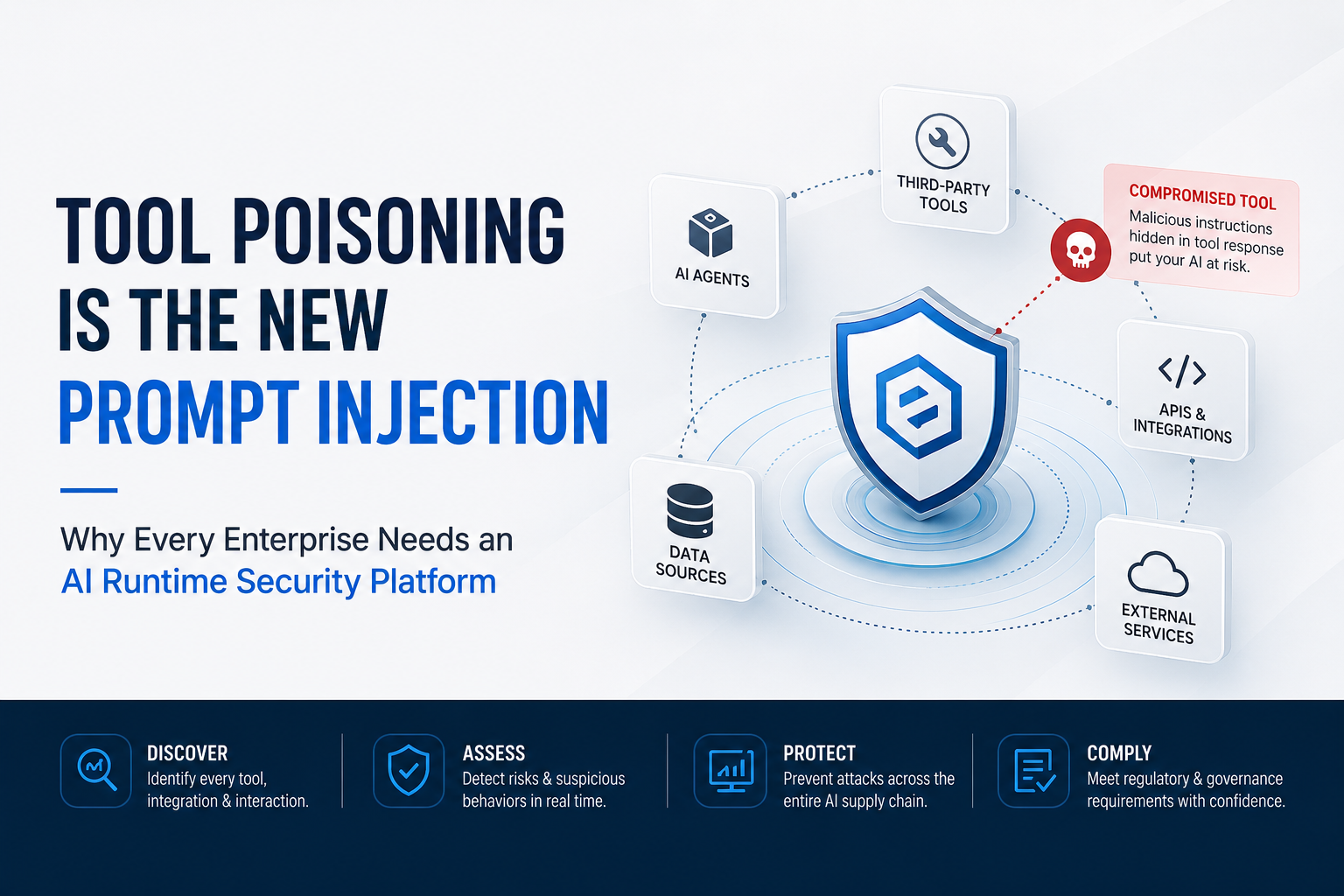
Tool poisoning is an attack on the layer AI agents trust most: the metadata that tells them what a tool does and how to call it. Rather than manipulating a prompt, an attacker manipulates the description, schema, or output of a tool the agent is already authorized to use. In practice, this shows up as:
- Malicious tool descriptions that hide instructions inside routine-looking formatting guidance
- Poisoned API documentation that redefines what a legitimate endpoint does
- Compromised MCP servers that alter tool metadata after an agent has already approved the connection
- Manipulated tool metadata and parameter schemas that redirect how an agent fills in a call
- Hidden instructions embedded inside plugins and browser extensions an agent relies on
- Function-calling manipulation that tricks an agent into invoking a higher-privilege action than intended
- Poisoned OpenAPI specifications that misrepresent an endpoint's scope or required parameters
- Malicious tool manifests introduced through typosquatted or compromised packages
Large language models increasingly treat tool metadata as part of their reasoning context — the same context that shapes planning and decision-making. That is precisely why attackers have shifted focus. Prompt injection targets a channel security teams actively watch. Tool poisoning targets a channel that looks like configuration, not instruction, and is rarely reviewed with the same scrutiny.
Tool Poisoning vs. Prompt Injection
The two threats are related but distinct, and the distinction determines what defenses actually work.
Prompt Injection
Manipulates prompts
Usually temporary
Easier to detect
Limited scope
Visible attack
Targets model input
Human-in-command: override, suspension and kill-switch
Independent validation of third-party models regardless of vendor assurance
Limited scope
Limited scope
Visible attack
Manipulates trusted tools
Often persistent
Much harder to detect
Hidden attack
Organization-wide impact
Targets execution layer
Hidden attack
Hidden attack
Prompt injection defenses — input sanitization, jailbreak detection, output filtering — were built for a user-controlled, largely visible attack surface. Tool poisoning is infrastructure-controlled and frequently invisible to the user entirely, which means prompt-layer defenses alone are no longer sufficient protection for an agent that can act.
Stop guessing.
Start measuring.
Join teams building reliable AI with TruEval. Start with a free trial, no credit card required. Get your first evaluation running in under 10 minutes.
Questions about Trusys?
Our team is here to help. Schedule a personalized demo to see how Trusys fits your specific use case.
Book a Demo

Ready to dive in?
Check out our documentation and tutorials. Get started with example datasets and evaluation templates.
Start Free Trial
Free Trial
No credit card required
10 Min
To first evaluation
24/7
Enterprise support
For the past year, enterprise security teams have poured their attention into a single threat model: prompt injection. Red-team budgets, LLM firewalls, and jailbreak filters were all built to answer one question — can an attacker manipulate what a model says? That question mattered, and it still does. But it is no longer the most dangerous one.
Today's AI agents don't just generate text. They call APIs, query databases, execute code, and take action across SaaS applications, internal tools, and MCP servers — often with the same privileges as the employees they assist. That shift has opened a new attack surface that most enterprise security programs are not yet built to see: tool poisoning. An attacker who compromises the tools an agent trusts can manipulate its behavior without ever touching the user's prompt — which is exactly why organizations are turning to an AI runtime security platform to close the gap.
The biggest AI security risk is no longer what the model says — it's what the model is instructed to do through compromised tools.
Real Enterprise Attack Scenarios
Scenario 1 — Poisoned MCP Server
An attacker compromises an MCP server an agent connects to for enrichment or retrieval, injecting hidden instructions into the metadata or the content returned. The agent incorporates that content into its reasoning and makes unsafe decisions — without any indication in the user-facing conversation that anything went wrong.
Scenario 2 — Third-Party SaaS Plugin
A CRM plugin used by a customer-support agent is modified so that every customer lookup silently exposes additional confidential fields. The plugin's function signature and description remain unchanged; only its behavior does.
Scenario 3 — Internal API Manipulation
An insider — or a compromised credential — edits internal API documentation so that a routine agent action unintentionally invokes a privileged administrative function the agent was never meant to reach.
Scenario 4 — AI Supply Chain Attack
A widely used open-source tool dependency in the AI stack is compromised upstream, silently affecting every enterprise deployment that pulled in the poisoned package — a single point of failure multiplied across hundreds of organizations.
Why Traditional AI Security Isn't Enough
Closing that gap requires continuous, real-time visibility into what agents actually do once they're deployed — not just what they were tested to do before launch. That means monitoring across:
- AI agents and their decision-making patterns
- MCP servers and the tools they expose
- APIs the agent is authorized to call
- Tool execution itself, in real time
- Retrieval pipelines and vector databases
- Plugins and browser or IDE extensions
- Agent memory as it accumulates across sessions
- Workflow automation and multi-agent handoffs
- Third-party integrations added after initial deployment
This is the missing layer in most enterprise AI security programs today. Point-in-time testing and periodic red-teaming can validate an agent at launch, but they say nothing about what that agent's tool connections look like six months later. An AI runtime security platform is built specifically to answer that ongoing question — continuously, not on a testing cycle.
What an AI Runtime Security Platform Should Do
Evaluating vendors in this category should come down to a short list of capabilities that map directly onto the tool-poisoning threat model:
Runtime Monitoring
Continuous observation of every agent decision and tool invocation as it happens, with full lineage — what triggered the action, what data it touched, what tool it called, and what it produced.
Tool Governance
Tracking exactly which tools each agent can access, and enforcing policy over that access rather than granting it once and forgetting it.
Runtime Threat Detection
Detecting tool poisoning, suspicious API behavior, privilege escalation, unauthorized tool execution, and anomalous workflows as they occur in production.
AI Agent Monitoring
Ongoing visibility into agent decisions, tool selection, API usage, and end-to-end workflow execution — not a dashboard snapshot, but a continuous trace.
MCP Security
As MCP becomes the standard way enterprise agents discover and connect to tools, runtime platforms need visibility into what happens over that connection: which tools an agent's MCP servers expose, what those tools are actually called to do in production, and whether a connected server's behavior changes after approval.
Policy Enforcement
The ability to automatically block an unsafe or unauthorized action before it executes, not just log it afterward.
AI Supply Chain Visibility
A living inventory of every tool, API, plugin, framework, dependency, and external integration an agent touches — discovered automatically, not maintained by hand.
Compliance Mapping
Automatically mapping runtime events to the frameworks security and compliance teams are already accountable to — including the OWASP Top 10 for LLM Applications, MITRE ATLAS, the NIST AI Risk Management Framework, the EU AI Act, and ISO/IEC 42001.
Trusys was built around this exact set of capabilities. TruPulse provides the runtime observability layer — tracing every agent action with full lineage and flagging behavioral drift, memory corruption, and confused-deputy patterns the moment they appear. TruGuard enforces inline policy at the agent's input, output, and action layers, blocking unauthorized tool use without modifying the agent itself. TruScout red-teams agents the way attackers actually operate — through poisoned emails, hostile websites, malicious documents, and compromised tool responses — with campaigns mapped to the OWASP Agentic AI Top 10 and MITRE ATLAS. And Argus, the autonomous governance agent at the core of the platform, ties these together: it auto-discovers each agent's tool inventory, memory stores, and egress paths on connection, then runs evaluation, red-teaming, and policy enforcement continuously, around the clock.
Enterprise AI Runtime Security Checklist
- Inventory every AI tool your agents can reach
- Monitor runtime tool execution, not just prompts and outputs
- Validate MCP server integrity before and after connection
- Continuously scan tool metadata for unreviewed changes
- Enforce least-privilege access for every agent-tool pairing
- Audit every agent action, not just flagged incidents
- Detect anomalous behavior against an established baseline
- Monitor third-party integrations added after initial deployment
- Protect AI supply chains, including open-source dependencies
- Apply runtime governance policies consistently across every agent
- Generate compliance evidence automatically rather than manually
Why Runtime AI Governance Is the Future
AI governance built on periodic model testing, one-time red-teaming, prompt filtering, and static policy documents cannot keep pace with agents that act continuously and autonomously. Governance has to move to where the risk actually lives: agent reasoning, tool execution, memory usage, retrieval, API calls, permissions, and runtime behavior across autonomous workflows.
Runtime security isn't an add-on to enterprise AI governance anymore — it's becoming its foundation. An organization that can only test an agent before launch has no way of knowing what that agent's tool relationships look like in production a month later. An organization with continuous runtime visibility does.
Conclusion
Prompt injection remains a real and ongoing risk, and the defenses built for it — filtering, sanitization, jailbreak detection — still matter. But tool poisoning represents a more persistent, more organization-wide, and considerably harder-to-detect threat, because it targets the trusted execution layer AI agents depend on to act. As enterprises deploy increasingly autonomous agents across email, code, customer data, and financial systems, runtime visibility stops being optional.
Trusys brings the pieces of an AI runtime security platform together in one place: continuous agent monitoring through TruPulse, inline tool and policy enforcement through TruGuard, adversarial tool-poisoning and prompt-injection testing through TruScout, and autonomous, always-on orchestration of all three through Argus. The result is a platform enterprises can use to monitor AI agents continuously, detect runtime threats, govern tool access, protect AI supply chains, enforce policy, and generate audit-ready compliance evidence — without waiting for an incident to find the gap first.
If your security team is still relying on point-in-time testing to cover a fleet of agents that call tools every hour of every day, it's worth seeing what continuous runtime coverage actually looks like. Book a demo with Trusys to see how runtime monitoring, tool governance, and adversarial testing come together for agents already running in production.
Frequently Asked Questions
What is tool poisoning in AI?
Tool poisoning is an attack in which the metadata an AI agent relies on to use a tool — its name, description, parameter schema, or the data it returns — is manipulated to redirect the agent's behavior. Because the agent reads this metadata as trusted instruction, a poisoned tool can trigger unauthorized actions without any change to the user's prompt.
How is tool poisoning different from prompt injection?
Prompt injection manipulates the text a user or an external document feeds into a model's context. Tool poisoning manipulates the tools, APIs, and MCP servers an agent is already authorized to call. It is typically infrastructure-controlled rather than user-controlled, harder to spot in a normal security review, and can persist across every session that touches the compromised tool.
Why are AI agents vulnerable to tool poisoning?
Modern agents plan and act using function calling, MCP connections, tool registries, and retrieval pipelines. To do that, they must trust the descriptions and schemas those systems provide. That trust relationship is exactly what tool poisoning exploits — the agent has no reliable way to tell a legitimate tool update from a malicious one.
What is an AI Runtime Security Platform?
An AI runtime security platform continuously monitors AI agents while they operate in production — tracking tool calls, API usage, memory changes, and workflow execution — rather than only inspecting prompts and outputs. It is the operational layer that gives security and compliance teams visibility into what agents are actually doing, in real time.
How does runtime AI security protect enterprise AI systems?
It closes the gap left by prompt filters and static policy engines by watching the execution layer itself: which tools an agent calls, what data those calls touch, and whether the resulting behavior matches approved patterns. Anomalies — an unexpected privilege escalation, an unfamiliar tool call sequence — can be flagged or blocked before they complete.
How can organizations secure MCP servers and AI tools?
Start with an inventory of every MCP server and tool an agent can reach, apply least-privilege access and human confirmation for sensitive actions, treat tool output as untrusted data rather than instruction, and maintain continuous runtime visibility into tool calls rather than relying on a one-time approval at connection time.
What role does runtime governance play in AI security?
Runtime governance shifts AI oversight from periodic red-teaming and static policy reviews to continuous, always-on evaluation of agent behavior, memory, and tool use. As agents become more autonomous, this continuous layer is what allows organizations to catch drift and misuse as it happens rather than after an incident.
How does Trusys help protect AI agents from runtime threats?
Trusys combines TruPulse, which traces every agent action and tool call with full lineage; TruGuard, which enforces inline policy and can block unauthorized tool use as it happens; and TruScout, which red-teams agents with adversarial payloads — including compromised tool responses — mapped to the OWASP Agentic AI Top 10 and MITRE ATLAS. Argus, the autonomous governance agent at the core of the platform, ties these together into continuous, always-on oversight of the agent estate.


Benefits
Specifications
How-to
Contact Us
Learn More

Tool Poisoning Is the New Prompt Injection — Why Every Enterprise Needs an AI Runtime Security Platform
Written by
For the past year, enterprise security teams have poured their attention into a single threat model: prompt injection. Red-team budgets, LLM firewalls, and jailbreak filters were all built to answer one question — can an attacker manipulate what a model says? That question mattered, and it still does. But it is no longer the most dangerous one.
Today's AI agents don't just generate text. They call APIs, query databases, execute code, and take action across SaaS applications, internal tools, and MCP servers — often with the same privileges as the employees they assist. That shift has opened a new attack surface that most enterprise security programs are not yet built to see: tool poisoning. An attacker who compromises the tools an agent trusts can manipulate its behavior without ever touching the user's prompt — which is exactly why organizations are turning to an AI runtime security platform to close the gap.
The biggest AI security risk is no longer what the model says — it's what the model is instructed to do through compromised tools.
What Is Tool Poisoning?
Tool poisoning is an attack on the layer AI agents trust most: the metadata that tells them what a tool does and how to call it. Rather than manipulating a prompt, an attacker manipulates the description, schema, or output of a tool the agent is already authorized to use. In practice, this shows up as:
- Malicious tool descriptions that hide instructions inside routine-looking formatting guidance
- Poisoned API documentation that redefines what a legitimate endpoint does
- Compromised MCP servers that alter tool metadata after an agent has already approved the connection
- Manipulated tool metadata and parameter schemas that redirect how an agent fills in a call
- Hidden instructions embedded inside plugins and browser extensions an agent relies on
- Function-calling manipulation that tricks an agent into invoking a higher-privilege action than intended
- Poisoned OpenAPI specifications that misrepresent an endpoint's scope or required parameters
- Malicious tool manifests introduced through typosquatted or compromised packages
Large language models increasingly treat tool metadata as part of their reasoning context — the same context that shapes planning and decision-making. That is precisely why attackers have shifted focus. Prompt injection targets a channel security teams actively watch. Tool poisoning targets a channel that looks like configuration, not instruction, and is rarely reviewed with the same scrutiny.
Tool Poisoning vs. Prompt Injection
The two threats are related but distinct, and the distinction determines what defenses actually work.
Prompt Injection
Manipulates prompts
Usually temporary
Easier to detect
Limited scope
Visible attack
Targets model input
Human-in-command: override, suspension and kill-switch
Independent validation of third-party models regardless of vendor assurance
Limited scope
Limited scope
Visible attack
Manipulates trusted tools
Often persistent
Much harder to detect
Hidden attack
Organization-wide impact
Targets execution layer
Hidden attack
Hidden attack
Prompt injection defenses — input sanitization, jailbreak detection, output filtering — were built for a user-controlled, largely visible attack surface. Tool poisoning is infrastructure-controlled and frequently invisible to the user entirely, which means prompt-layer defenses alone are no longer sufficient protection for an agent that can act.
Real Enterprise Attack Scenarios
Scenario 1 — Poisoned MCP Server
An attacker compromises an MCP server an agent connects to for enrichment or retrieval, injecting hidden instructions into the metadata or the content returned. The agent incorporates that content into its reasoning and makes unsafe decisions — without any indication in the user-facing conversation that anything went wrong.
Scenario 2 — Third-Party SaaS Plugin
A CRM plugin used by a customer-support agent is modified so that every customer lookup silently exposes additional confidential fields. The plugin's function signature and description remain unchanged; only its behavior does.
Scenario 3 — Internal API Manipulation
An insider — or a compromised credential — edits internal API documentation so that a routine agent action unintentionally invokes a privileged administrative function the agent was never meant to reach.
Scenario 4 — AI Supply Chain Attack
A widely used open-source tool dependency in the AI stack is compromised upstream, silently affecting every enterprise deployment that pulled in the poisoned package — a single point of failure multiplied across hundreds of organizations.
Why Traditional AI Security Isn't Enough
Closing that gap requires continuous, real-time visibility into what agents actually do once they're deployed — not just what they were tested to do before launch. That means monitoring across:
- AI agents and their decision-making patterns
- MCP servers and the tools they expose
- APIs the agent is authorized to call
- Tool execution itself, in real time
- Retrieval pipelines and vector databases
- Plugins and browser or IDE extensions
- Agent memory as it accumulates across sessions
- Workflow automation and multi-agent handoffs
- Third-party integrations added after initial deployment
This is the missing layer in most enterprise AI security programs today. Point-in-time testing and periodic red-teaming can validate an agent at launch, but they say nothing about what that agent's tool connections look like six months later. An AI runtime security platform is built specifically to answer that ongoing question — continuously, not on a testing cycle.
What an AI Runtime Security Platform Should Do
Evaluating vendors in this category should come down to a short list of capabilities that map directly onto the tool-poisoning threat model:
Runtime Monitoring
Continuous observation of every agent decision and tool invocation as it happens, with full lineage — what triggered the action, what data it touched, what tool it called, and what it produced.
Tool Governance
Tracking exactly which tools each agent can access, and enforcing policy over that access rather than granting it once and forgetting it.
Runtime Threat Detection
Detecting tool poisoning, suspicious API behavior, privilege escalation, unauthorized tool execution, and anomalous workflows as they occur in production.
AI Agent Monitoring
Ongoing visibility into agent decisions, tool selection, API usage, and end-to-end workflow execution — not a dashboard snapshot, but a continuous trace.
MCP Security
As MCP becomes the standard way enterprise agents discover and connect to tools, runtime platforms need visibility into what happens over that connection: which tools an agent's MCP servers expose, what those tools are actually called to do in production, and whether a connected server's behavior changes after approval.
Policy Enforcement
The ability to automatically block an unsafe or unauthorized action before it executes, not just log it afterward.
AI Supply Chain Visibility
A living inventory of every tool, API, plugin, framework, dependency, and external integration an agent touches — discovered automatically, not maintained by hand.
Compliance Mapping
Automatically mapping runtime events to the frameworks security and compliance teams are already accountable to — including the OWASP Top 10 for LLM Applications, MITRE ATLAS, the NIST AI Risk Management Framework, the EU AI Act, and ISO/IEC 42001.
Trusys was built around this exact set of capabilities. TruPulse provides the runtime observability layer — tracing every agent action with full lineage and flagging behavioral drift, memory corruption, and confused-deputy patterns the moment they appear. TruGuard enforces inline policy at the agent's input, output, and action layers, blocking unauthorized tool use without modifying the agent itself. TruScout red-teams agents the way attackers actually operate — through poisoned emails, hostile websites, malicious documents, and compromised tool responses — with campaigns mapped to the OWASP Agentic AI Top 10 and MITRE ATLAS. And Argus, the autonomous governance agent at the core of the platform, ties these together: it auto-discovers each agent's tool inventory, memory stores, and egress paths on connection, then runs evaluation, red-teaming, and policy enforcement continuously, around the clock.
Enterprise AI Runtime Security Checklist
- Inventory every AI tool your agents can reach
- Monitor runtime tool execution, not just prompts and outputs
- Validate MCP server integrity before and after connection
- Continuously scan tool metadata for unreviewed changes
- Enforce least-privilege access for every agent-tool pairing
- Audit every agent action, not just flagged incidents
- Detect anomalous behavior against an established baseline
- Monitor third-party integrations added after initial deployment
- Protect AI supply chains, including open-source dependencies
- Apply runtime governance policies consistently across every agent
- Generate compliance evidence automatically rather than manually
Why Runtime AI Governance Is the Future
AI governance built on periodic model testing, one-time red-teaming, prompt filtering, and static policy documents cannot keep pace with agents that act continuously and autonomously. Governance has to move to where the risk actually lives: agent reasoning, tool execution, memory usage, retrieval, API calls, permissions, and runtime behavior across autonomous workflows.
Runtime security isn't an add-on to enterprise AI governance anymore — it's becoming its foundation. An organization that can only test an agent before launch has no way of knowing what that agent's tool relationships look like in production a month later. An organization with continuous runtime visibility does.
Conclusion
Prompt injection remains a real and ongoing risk, and the defenses built for it — filtering, sanitization, jailbreak detection — still matter. But tool poisoning represents a more persistent, more organization-wide, and considerably harder-to-detect threat, because it targets the trusted execution layer AI agents depend on to act. As enterprises deploy increasingly autonomous agents across email, code, customer data, and financial systems, runtime visibility stops being optional.
Trusys brings the pieces of an AI runtime security platform together in one place: continuous agent monitoring through TruPulse, inline tool and policy enforcement through TruGuard, adversarial tool-poisoning and prompt-injection testing through TruScout, and autonomous, always-on orchestration of all three through Argus. The result is a platform enterprises can use to monitor AI agents continuously, detect runtime threats, govern tool access, protect AI supply chains, enforce policy, and generate audit-ready compliance evidence — without waiting for an incident to find the gap first.
If your security team is still relying on point-in-time testing to cover a fleet of agents that call tools every hour of every day, it's worth seeing what continuous runtime coverage actually looks like. Book a demo with Trusys to see how runtime monitoring, tool governance, and adversarial testing come together for agents already running in production.
Frequently Asked Questions
What is tool poisoning in AI?
Tool poisoning is an attack in which the metadata an AI agent relies on to use a tool — its name, description, parameter schema, or the data it returns — is manipulated to redirect the agent's behavior. Because the agent reads this metadata as trusted instruction, a poisoned tool can trigger unauthorized actions without any change to the user's prompt.
How is tool poisoning different from prompt injection?
Prompt injection manipulates the text a user or an external document feeds into a model's context. Tool poisoning manipulates the tools, APIs, and MCP servers an agent is already authorized to call. It is typically infrastructure-controlled rather than user-controlled, harder to spot in a normal security review, and can persist across every session that touches the compromised tool.
Why are AI agents vulnerable to tool poisoning?
Modern agents plan and act using function calling, MCP connections, tool registries, and retrieval pipelines. To do that, they must trust the descriptions and schemas those systems provide. That trust relationship is exactly what tool poisoning exploits — the agent has no reliable way to tell a legitimate tool update from a malicious one.
What is an AI Runtime Security Platform?
An AI runtime security platform continuously monitors AI agents while they operate in production — tracking tool calls, API usage, memory changes, and workflow execution — rather than only inspecting prompts and outputs. It is the operational layer that gives security and compliance teams visibility into what agents are actually doing, in real time.
How does runtime AI security protect enterprise AI systems?
It closes the gap left by prompt filters and static policy engines by watching the execution layer itself: which tools an agent calls, what data those calls touch, and whether the resulting behavior matches approved patterns. Anomalies — an unexpected privilege escalation, an unfamiliar tool call sequence — can be flagged or blocked before they complete.
How can organizations secure MCP servers and AI tools?
Start with an inventory of every MCP server and tool an agent can reach, apply least-privilege access and human confirmation for sensitive actions, treat tool output as untrusted data rather than instruction, and maintain continuous runtime visibility into tool calls rather than relying on a one-time approval at connection time.
What role does runtime governance play in AI security?
Runtime governance shifts AI oversight from periodic red-teaming and static policy reviews to continuous, always-on evaluation of agent behavior, memory, and tool use. As agents become more autonomous, this continuous layer is what allows organizations to catch drift and misuse as it happens rather than after an incident.
How does Trusys help protect AI agents from runtime threats?
Trusys combines TruPulse, which traces every agent action and tool call with full lineage; TruGuard, which enforces inline policy and can block unauthorized tool use as it happens; and TruScout, which red-teams agents with adversarial payloads — including compromised tool responses — mapped to the OWASP Agentic AI Top 10 and MITRE ATLAS. Argus, the autonomous governance agent at the core of the platform, ties these together into continuous, always-on oversight of the agent estate.
Stop guessing.
Start measuring.
Join teams building reliable AI with TruEval. Start with a free trial, no credit card required. Get your first evaluation running in under 10 minutes.
Questions about Trusys?
Our team is here to help. Schedule a personalized demo to see how Trusys fits your specific use case.
Book a Demo
Ready to dive in?
Check out our documentation and tutorials. Get started with example datasets and evaluation templates.
Start Free Trial
Free Trial
No credit card required
10 Min
To first evaluation
24/7
Enterprise support
Tool Poisoning Is the New Prompt Injection — Why Every Enterprise Needs an AI Runtime Security Platform
Written by
Manish Tewari
Published on
Aug 07, 2026
For the past year, enterprise security teams have poured their attention into a single threat model: prompt injection. Red-team budgets, LLM firewalls, and jailbreak filters were all built to answer one question — can an attacker manipulate what a model says? That question mattered, and it still does. But it is no longer the most dangerous one.
Today's AI agents don't just generate text. They call APIs, query databases, execute code, and take action across SaaS applications, internal tools, and MCP servers — often with the same privileges as the employees they assist. That shift has opened a new attack surface that most enterprise security programs are not yet built to see: tool poisoning. An attacker who compromises the tools an agent trusts can manipulate its behavior without ever touching the user's prompt — which is exactly why organizations are turning to an AI runtime security platform to close the gap.
The biggest AI security risk is no longer what the model says — it's what the model is instructed to do through compromised tools.
What Is Tool Poisoning?
Tool poisoning is an attack on the layer AI agents trust most: the metadata that tells them what a tool does and how to call it. Rather than manipulating a prompt, an attacker manipulates the description, schema, or output of a tool the agent is already authorized to use. In practice, this shows up as:
- Malicious tool descriptions that hide instructions inside routine-looking formatting guidance
- Poisoned API documentation that redefines what a legitimate endpoint does
- Compromised MCP servers that alter tool metadata after an agent has already approved the connection
- Manipulated tool metadata and parameter schemas that redirect how an agent fills in a call
- Hidden instructions embedded inside plugins and browser extensions an agent relies on
- Function-calling manipulation that tricks an agent into invoking a higher-privilege action than intended
- Poisoned OpenAPI specifications that misrepresent an endpoint's scope or required parameters
- Malicious tool manifests introduced through typosquatted or compromised packages
Large language models increasingly treat tool metadata as part of their reasoning context — the same context that shapes planning and decision-making. That is precisely why attackers have shifted focus. Prompt injection targets a channel security teams actively watch. Tool poisoning targets a channel that looks like configuration, not instruction, and is rarely reviewed with the same scrutiny.
Tool Poisoning vs. Prompt Injection
The two threats are related but distinct, and the distinction determines what defenses actually work.
Prompt Injection
Manipulates prompts
Usually temporary
Easier to detect
Limited scope
Visible attack
Targets model input
Human-in-command: override, suspension and kill-switch
Independent validation of third-party models regardless of vendor assurance
Limited scope
Limited scope
Visible attack
Manipulates trusted tools
Often persistent
Much harder to detect
Organization-wide impact
Hidden attack
Targets execution layer
Hidden attack
Hidden attack
Prompt injection defenses — input sanitization, jailbreak detection, output filtering — were built for a user-controlled, largely visible attack surface. Tool poisoning is infrastructure-controlled and frequently invisible to the user entirely, which means prompt-layer defenses alone are no longer sufficient protection for an agent that can act.
Real Enterprise Attack Scenarios
Scenario 1 — Poisoned MCP Server
An attacker compromises an MCP server an agent connects to for enrichment or retrieval, injecting hidden instructions into the metadata or the content returned. The agent incorporates that content into its reasoning and makes unsafe decisions — without any indication in the user-facing conversation that anything went wrong.
Scenario 2 — Third-Party SaaS Plugin
A CRM plugin used by a customer-support agent is modified so that every customer lookup silently exposes additional confidential fields. The plugin's function signature and description remain unchanged; only its behavior does.
Scenario 3 — Internal API Manipulation
An insider — or a compromised credential — edits internal API documentation so that a routine agent action unintentionally invokes a privileged administrative function the agent was never meant to reach.
Scenario 4 — AI Supply Chain Attack
A widely used open-source tool dependency in the AI stack is compromised upstream, silently affecting every enterprise deployment that pulled in the poisoned package — a single point of failure multiplied across hundreds of organizations.
Why Traditional AI Security Isn't Enough
Closing that gap requires continuous, real-time visibility into what agents actually do once they're deployed — not just what they were tested to do before launch. That means monitoring across:
- AI agents and their decision-making patterns
- MCP servers and the tools they expose
- APIs the agent is authorized to call
- Tool execution itself, in real time
- Retrieval pipelines and vector databases
- Plugins and browser or IDE extensions
- Agent memory as it accumulates across sessions
- Workflow automation and multi-agent handoffs
- Third-party integrations added after initial deployment
This is the missing layer in most enterprise AI security programs today. Point-in-time testing and periodic red-teaming can validate an agent at launch, but they say nothing about what that agent's tool connections look like six months later. An AI runtime security platform is built specifically to answer that ongoing question — continuously, not on a testing cycle.
What an AI Runtime Security Platform Should Do
Evaluating vendors in this category should come down to a short list of capabilities that map directly onto the tool-poisoning threat model:
Runtime Monitoring
Continuous observation of every agent decision and tool invocation as it happens, with full lineage — what triggered the action, what data it touched, what tool it called, and what it produced.
Tool Governance
Tracking exactly which tools each agent can access, and enforcing policy over that access rather than granting it once and forgetting it.
Runtime Threat Detection
Detecting tool poisoning, suspicious API behavior, privilege escalation, unauthorized tool execution, and anomalous workflows as they occur in production.
AI Agent Monitoring
Ongoing visibility into agent decisions, tool selection, API usage, and end-to-end workflow execution — not a dashboard snapshot, but a continuous trace.
MCP Security
As MCP becomes the standard way enterprise agents discover and connect to tools, runtime platforms need visibility into what happens over that connection: which tools an agent's MCP servers expose, what those tools are actually called to do in production, and whether a connected server's behavior changes after approval.
Policy Enforcement
The ability to automatically block an unsafe or unauthorized action before it executes, not just log it afterward.
AI Supply Chain Visibility
A living inventory of every tool, API, plugin, framework, dependency, and external integration an agent touches — discovered automatically, not maintained by hand.
Compliance Mapping
Automatically mapping runtime events to the frameworks security and compliance teams are already accountable to — including the OWASP Top 10 for LLM Applications, MITRE ATLAS, the NIST AI Risk Management Framework, the EU AI Act, and ISO/IEC 42001.
Trusys was built around this exact set of capabilities. TruPulse provides the runtime observability layer — tracing every agent action with full lineage and flagging behavioral drift, memory corruption, and confused-deputy patterns the moment they appear. TruGuard enforces inline policy at the agent's input, output, and action layers, blocking unauthorized tool use without modifying the agent itself. TruScout red-teams agents the way attackers actually operate — through poisoned emails, hostile websites, malicious documents, and compromised tool responses — with campaigns mapped to the OWASP Agentic AI Top 10 and MITRE ATLAS. And Argus, the autonomous governance agent at the core of the platform, ties these together: it auto-discovers each agent's tool inventory, memory stores, and egress paths on connection, then runs evaluation, red-teaming, and policy enforcement continuously, around the clock.
Enterprise AI Runtime Security Checklist
- Inventory every AI tool your agents can reach
- Monitor runtime tool execution, not just prompts and outputs
- Validate MCP server integrity before and after connection
- Continuously scan tool metadata for unreviewed changes
- Enforce least-privilege access for every agent-tool pairing
- Audit every agent action, not just flagged incidents
- Detect anomalous behavior against an established baseline
- Monitor third-party integrations added after initial deployment
- Protect AI supply chains, including open-source dependencies
- Apply runtime governance policies consistently across every agent
- Generate compliance evidence automatically rather than manually
Why Runtime AI Governance Is the Future
AI governance built on periodic model testing, one-time red-teaming, prompt filtering, and static policy documents cannot keep pace with agents that act continuously and autonomously. Governance has to move to where the risk actually lives: agent reasoning, tool execution, memory usage, retrieval, API calls, permissions, and runtime behavior across autonomous workflows.
Runtime security isn't an add-on to enterprise AI governance anymore — it's becoming its foundation. An organization that can only test an agent before launch has no way of knowing what that agent's tool relationships look like in production a month later. An organization with continuous runtime visibility does.
Conclusion
Prompt injection remains a real and ongoing risk, and the defenses built for it — filtering, sanitization, jailbreak detection — still matter. But tool poisoning represents a more persistent, more organization-wide, and considerably harder-to-detect threat, because it targets the trusted execution layer AI agents depend on to act. As enterprises deploy increasingly autonomous agents across email, code, customer data, and financial systems, runtime visibility stops being optional.
Trusys brings the pieces of an AI runtime security platform together in one place: continuous agent monitoring through TruPulse, inline tool and policy enforcement through TruGuard, adversarial tool-poisoning and prompt-injection testing through TruScout, and autonomous, always-on orchestration of all three through Argus. The result is a platform enterprises can use to monitor AI agents continuously, detect runtime threats, govern tool access, protect AI supply chains, enforce policy, and generate audit-ready compliance evidence — without waiting for an incident to find the gap first.
If your security team is still relying on point-in-time testing to cover a fleet of agents that call tools every hour of every day, it's worth seeing what continuous runtime coverage actually looks like. Book a demo with Trusys to see how runtime monitoring, tool governance, and adversarial testing come together for agents already running in production.
Frequently Asked Questions
What is tool poisoning in AI?
Tool poisoning is an attack in which the metadata an AI agent relies on to use a tool — its name, description, parameter schema, or the data it returns — is manipulated to redirect the agent's behavior. Because the agent reads this metadata as trusted instruction, a poisoned tool can trigger unauthorized actions without any change to the user's prompt.
How is tool poisoning different from prompt injection?
Prompt injection manipulates the text a user or an external document feeds into a model's context. Tool poisoning manipulates the tools, APIs, and MCP servers an agent is already authorized to call. It is typically infrastructure-controlled rather than user-controlled, harder to spot in a normal security review, and can persist across every session that touches the compromised tool.
Why are AI agents vulnerable to tool poisoning?
Modern agents plan and act using function calling, MCP connections, tool registries, and retrieval pipelines. To do that, they must trust the descriptions and schemas those systems provide. That trust relationship is exactly what tool poisoning exploits — the agent has no reliable way to tell a legitimate tool update from a malicious one.
What is an AI Runtime Security Platform?
An AI runtime security platform continuously monitors AI agents while they operate in production — tracking tool calls, API usage, memory changes, and workflow execution — rather than only inspecting prompts and outputs. It is the operational layer that gives security and compliance teams visibility into what agents are actually doing, in real time.
How does runtime AI security protect enterprise AI systems?
It closes the gap left by prompt filters and static policy engines by watching the execution layer itself: which tools an agent calls, what data those calls touch, and whether the resulting behavior matches approved patterns. Anomalies — an unexpected privilege escalation, an unfamiliar tool call sequence — can be flagged or blocked before they complete.
How can organizations secure MCP servers and AI tools?
Start with an inventory of every MCP server and tool an agent can reach, apply least-privilege access and human confirmation for sensitive actions, treat tool output as untrusted data rather than instruction, and maintain continuous runtime visibility into tool calls rather than relying on a one-time approval at connection time.
What role does runtime governance play in AI security?
Runtime governance shifts AI oversight from periodic red-teaming and static policy reviews to continuous, always-on evaluation of agent behavior, memory, and tool use. As agents become more autonomous, this continuous layer is what allows organizations to catch drift and misuse as it happens rather than after an incident.
How does Trusys help protect AI agents from runtime threats?
Trusys combines TruPulse, which traces every agent action and tool call with full lineage; TruGuard, which enforces inline policy and can block unauthorized tool use as it happens; and TruScout, which red-teams agents with adversarial payloads — including compromised tool responses — mapped to the OWASP Agentic AI Top 10 and MITRE ATLAS. Argus, the autonomous governance agent at the core of the platform, ties these together into continuous, always-on oversight of the agent estate.
Stop guessing.
Start measuring.
Join teams building reliable AI with Trusys. Start with a free trial, no credit card required. Get your first evaluation running in under 10 minutes.
Questions about Trusys?
Our team is here to help. Schedule a personalized demo to see how Trusys fits your specific use case.
Book a Demo
Ready to dive in?
Check out our documentation and tutorials. Get started with example datasets and evaluation templates.
Start Free Trial
Free Trial
No credit card required
10 Min
to get started
24/7
Enterprise support