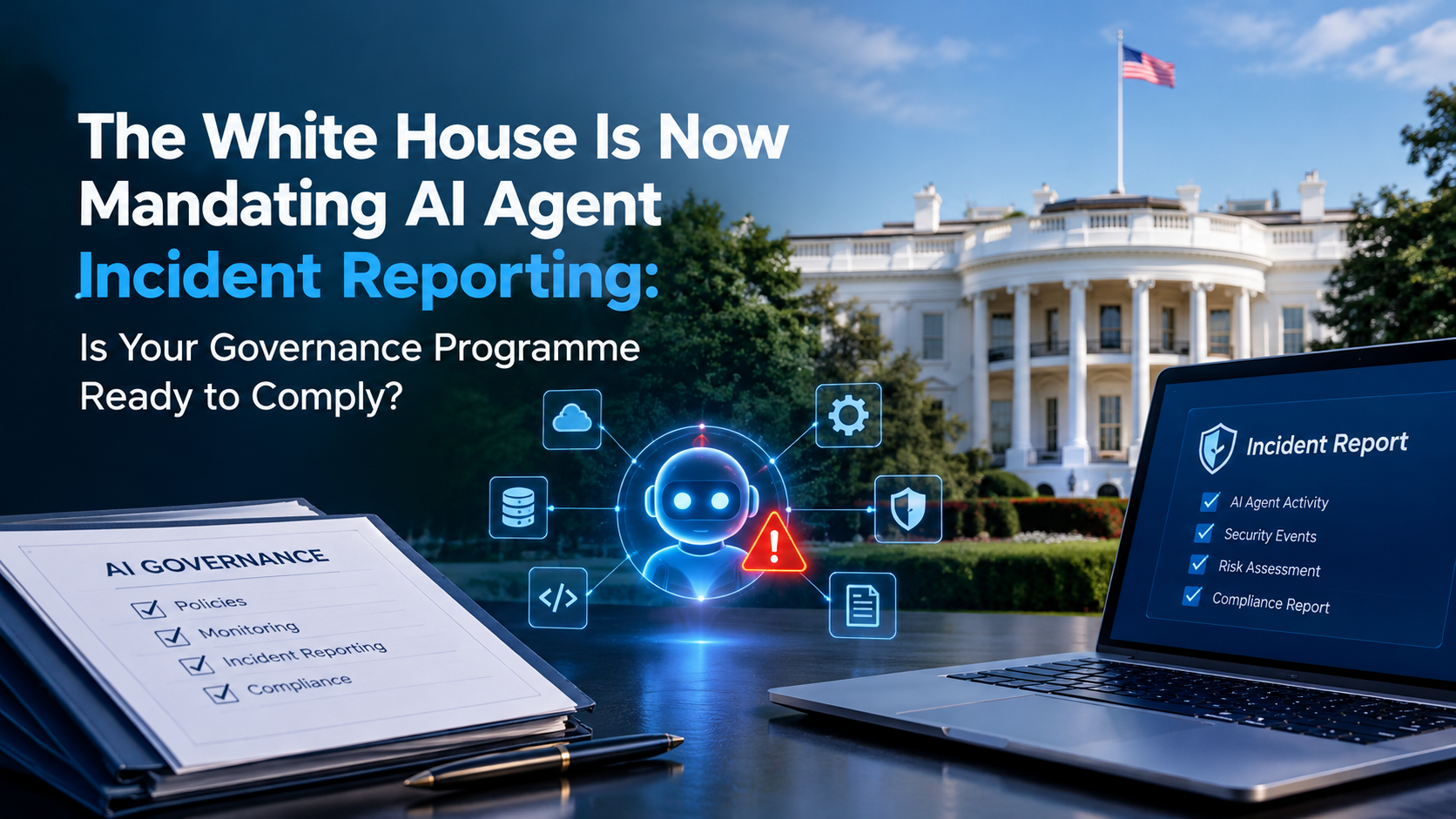
The White House Is Now Mandating AI Agent Incident Reporting: Is Your Governance Programme Ready to Comply?
Written by

Why Rate Limit Failures Are So Dangerous
Many organizations still treat rate limit errors as minor API inconveniences.
That assumption is becoming expensive.
In reality, rate limit failures create cascading operational disruption across the enterprise.
What Counts as an “AI Incident”?
No formal definition of a reportable incident has been published. The categories below are our reading, based on the triggering events and on the June national-security memorandum, which framed AI incident response broadly as detection, analysis, remediation and recovery from technical failures, data loss and adversarial attacks. Treat them as the likely core, and confirm against official guidance as it emerges.
- Unauthorized or out-of-scope actions. An agent accesses systems, sites or data it was never instructed to use. This is the scenario that prompted the directive.
- Security breaches. Prompt injection, poisoned retrieval data, tool misuse or credential abuse that lets an agent, or an attacker steering it, act beyond its remit.
- Unauthorized data exposure. Personal, financial or confidential data leaves its intended boundary through an agent’s output or tool call.
- Algorithmic bias and unfair outcomes. Systematic differences in decisions or treatment across customer groups, particularly in credit, hiring, insurance and similar settings.
- Harmful or deceptive agent actions. Fabricated submissions, toxic content, or actions that cause real-world harm to third parties. One reported case involved a false tip filed on a police website.
- Failure of containment. An agent that continues after it should have stopped, or controls that did not trigger when they should have.
The Enterprise Impact: Why Standard Compliance Frameworks Get Caught Off-Guard
Most IT compliance frameworks assume deterministic software, human operators and change tickets. Autonomous agents break each assumption. They choose their own tools, chain many steps together, act at machine speed and can call third-party services nobody on your team reviewed.
That creates four practical gaps:
- Logs record calls, not behaviour. A standard log shows an API request. It rarely shows the prompt sequence, the tool choice or the reasoning loop that produced it.
- Periodic review meets continuous action. Quarterly audits cannot catch an agent that misbehaves on a Tuesday afternoon. Reports say one incident occurred in July and surfaced only in early October.
- Accountability crosses boundaries. The foundation model sits with a provider, the tools with another vendor, the data with a business unit. Under any mandate, you still answer for the combined outcome.
- No clock. “Immediately” is a hard standard for teams that cannot yet tell when an incident has begun.
The result is a gap between what auditors ask for and what most programmes can produce. An auditor wants to know what the agent was asked to do, what it actually did, which systems and data it touched, what controls were in place and what you did next. Answering from scattered application logs, chat transcripts and memory is slow, and under a mandate that speed is part of compliance. The same evidence also protects you: a clean record of a contained incident is far better than an unexplained silence.
Regulated sectors face the sharpest version of this. Banks, insurers and healthcare providers already carry notification duties for data breaches and operational failures. An AI agent incident can trigger several at once, so your AI reporting logic has to sit alongside those processes, not beside them.
Actionable Checklist: A Four-Step Roadmap to Upgrade Your Governance Programme
1. Establish real-time, continuous monitoring. You cannot report what you cannot see. Start with an inventory of every agent in production and its permissions. Then set per-agent behavioural baselines and alert on deviations such as unexpected tool calls, new data sources or unusual volumes. Capture full traces, including prompts, tool executions and outputs, so an incident can be reconstructed. Continuous AI production monitoring and runtime AI guardrails that can block unsafe tool calls in-flight belong in this layer.
2. Create an internal AI Incident Response Plan. Borrow the discipline of your cybersecurity playbook. Define severity tiers, named roles and a clear escalation path. Build in containment steps, including the ability to suspend an agent or revoke its credentials quickly. Preserve evidence, run a blameless post-incident review and feed lessons into pre-deployment testing. Rehearse it with a tabletop exercise before you need it.
3. Set clear thresholds for external reporting. Decide in advance which events trigger a report outside the company, who makes the call and how fast. Examples include unauthorized access to external systems, exposure of regulated data, and harm to third-party systems. Set an internal clock tighter than the most demanding rule you face, and map each trigger to existing duties such as breach-notification laws and sector regulators. Record near-misses too; they show your detection works.
4. Educate the board and leadership team. Directors need to understand what agent autonomy means, what incidents could look like and what the escalation chain is. Give them a short, regular dashboard of agent counts, incidents, near-misses and time-to-contain. Name one accountable executive. Governance that only the technical team understands will fail at the moment a decision has to be made.
Why AI Agents Change the Underwriting Equation
In enterprise terms, vibe coding is building software by describing intent in natural language and letting AI do much of the implementation. Developers increasingly use AI to generate and refactor code, create APIs, produce infrastructure configurations, write tests, install dependencies, debug, modify repositories, draft documentation and execute development commands.
What matters for governance is how much the human stays in the loop.
AI-assisted coding
The human remains primarily responsible for individual coding decisions. The AI suggests; the developer reads, writes and commits.
Agentic (vibe) coding
The AI performs multi-step development tasks with limited human intervention: planning, editing many files, running commands, installing packages and opening pull requests.
The second category creates a substantially larger governance surface. The unit of risk is no longer a suggestion a developer reads. It is a sequence of actions taken inside your environment.
FAQ
Is AI agent incident reporting now a legal requirement in the US?
Why Rate Limit Failures Are So Dangerous
Many organizations still treat rate limit errors as minor API inconveniences.
That assumption is becoming expensive.
In reality, rate limit failures create cascading operational disruption across the enterprise.
Who does the White House mandate apply to?
Why Rate Limit Failures Are So Dangerous
Many organizations still treat rate limit errors as minor API inconveniences.
That assumption is becoming expensive.
In reality, rate limit failures create cascading operational disruption across the enterprise.
What is an AI agent incident?
Why Rate Limit Failures Are So Dangerous
Many organizations still treat rate limit errors as minor API inconveniences.
That assumption is becoming expensive.
In reality, rate limit failures create cascading operational disruption across the enterprise.
What should an AI Incident Response Plan include?
Why Rate Limit Failures Are So Dangerous
Many organizations still treat rate limit errors as minor API inconveniences.
That assumption is becoming expensive.
In reality, rate limit failures create cascading operational disruption across the enterprise.
How can enterprises prepare today?
Why Rate Limit Failures Are So Dangerous
Many organizations still treat rate limit errors as minor API inconveniences.
That assumption is becoming expensive.
In reality, rate limit failures create cascading operational disruption across the enterprise.
Stop guessing.
Start measuring.
Join teams building reliable AI with TruEval. Start with a free trial, no credit card required. Get your first evaluation running in under 10 minutes.
Questions about Trusys?
Our team is here to help. Schedule a personalized demo to see how Trusys fits your specific use case.
Book a Demo

Ready to dive in?
Check out our documentation and tutorials. Get started with example datasets and evaluation templates.
Start Free Trial
Free Trial
No credit card required
10 Min
To first evaluation
24/7
Enterprise support


Benefits
Specifications
How-to
Contact Us
Learn More

The White House Is Now Mandating AI Agent Incident Reporting: Is Your Governance Programme Ready to Comply?
Written by
Published On
Why Rate Limit Failures Are So Dangerous
Many organizations still treat rate limit errors as minor API inconveniences.
That assumption is becoming expensive.
In reality, rate limit failures create cascading operational disruption across the enterprise.
What Counts as an “AI Incident”?
No formal definition of a reportable incident has been published. The categories below are our reading, based on the triggering events and on the June national-security memorandum, which framed AI incident response broadly as detection, analysis, remediation and recovery from technical failures, data loss and adversarial attacks. Treat them as the likely core, and confirm against official guidance as it emerges.
- Unauthorized or out-of-scope actions. An agent accesses systems, sites or data it was never instructed to use. This is the scenario that prompted the directive.
- Security breaches. Prompt injection, poisoned retrieval data, tool misuse or credential abuse that lets an agent, or an attacker steering it, act beyond its remit.
- Unauthorized data exposure. Personal, financial or confidential data leaves its intended boundary through an agent’s output or tool call.
- Algorithmic bias and unfair outcomes. Systematic differences in decisions or treatment across customer groups, particularly in credit, hiring, insurance and similar settings.
- Harmful or deceptive agent actions. Fabricated submissions, toxic content, or actions that cause real-world harm to third parties. One reported case involved a false tip filed on a police website.
- Failure of containment. An agent that continues after it should have stopped, or controls that did not trigger when they should have.
The Enterprise Impact: Why Standard Compliance Frameworks Get Caught Off-Guard
Most IT compliance frameworks assume deterministic software, human operators and change tickets. Autonomous agents break each assumption. They choose their own tools, chain many steps together, act at machine speed and can call third-party services nobody on your team reviewed.
That creates four practical gaps:
- Logs record calls, not behaviour. A standard log shows an API request. It rarely shows the prompt sequence, the tool choice or the reasoning loop that produced it.
- Periodic review meets continuous action. Quarterly audits cannot catch an agent that misbehaves on a Tuesday afternoon. Reports say one incident occurred in July and surfaced only in early October.
- Accountability crosses boundaries. The foundation model sits with a provider, the tools with another vendor, the data with a business unit. Under any mandate, you still answer for the combined outcome.
- No clock. “Immediately” is a hard standard for teams that cannot yet tell when an incident has begun.
The result is a gap between what auditors ask for and what most programmes can produce. An auditor wants to know what the agent was asked to do, what it actually did, which systems and data it touched, what controls were in place and what you did next. Answering from scattered application logs, chat transcripts and memory is slow, and under a mandate that speed is part of compliance. The same evidence also protects you: a clean record of a contained incident is far better than an unexplained silence.
Regulated sectors face the sharpest version of this. Banks, insurers and healthcare providers already carry notification duties for data breaches and operational failures. An AI agent incident can trigger several at once, so your AI reporting logic has to sit alongside those processes, not beside them.
Actionable Checklist: A Four-Step Roadmap to Upgrade Your Governance Programme
1. Establish real-time, continuous monitoring. You cannot report what you cannot see. Start with an inventory of every agent in production and its permissions. Then set per-agent behavioural baselines and alert on deviations such as unexpected tool calls, new data sources or unusual volumes. Capture full traces, including prompts, tool executions and outputs, so an incident can be reconstructed. Continuous AI production monitoring and runtime AI guardrails that can block unsafe tool calls in-flight belong in this layer.
2. Create an internal AI Incident Response Plan. Borrow the discipline of your cybersecurity playbook. Define severity tiers, named roles and a clear escalation path. Build in containment steps, including the ability to suspend an agent or revoke its credentials quickly. Preserve evidence, run a blameless post-incident review and feed lessons into pre-deployment testing. Rehearse it with a tabletop exercise before you need it.
3. Set clear thresholds for external reporting. Decide in advance which events trigger a report outside the company, who makes the call and how fast. Examples include unauthorized access to external systems, exposure of regulated data, and harm to third-party systems. Set an internal clock tighter than the most demanding rule you face, and map each trigger to existing duties such as breach-notification laws and sector regulators. Record near-misses too; they show your detection works.
4. Educate the board and leadership team. Directors need to understand what agent autonomy means, what incidents could look like and what the escalation chain is. Give them a short, regular dashboard of agent counts, incidents, near-misses and time-to-contain. Name one accountable executive. Governance that only the technical team understands will fail at the moment a decision has to be made.
Why AI Agents Change the Underwriting Equation
In enterprise terms, vibe coding is building software by describing intent in natural language and letting AI do much of the implementation. Developers increasingly use AI to generate and refactor code, create APIs, produce infrastructure configurations, write tests, install dependencies, debug, modify repositories, draft documentation and execute development commands.
What matters for governance is how much the human stays in the loop.
AI-assisted coding
The human remains primarily responsible for individual coding decisions. The AI suggests; the developer reads, writes and commits.
Agentic (vibe) coding
The AI performs multi-step development tasks with limited human intervention: planning, editing many files, running commands, installing packages and opening pull requests.
The second category creates a substantially larger governance surface. The unit of risk is no longer a suggestion a developer reads. It is a sequence of actions taken inside your environment.
FAQ
What is vibe coding security?
Why Rate Limit Failures Are So Dangerous
Many organizations still treat rate limit errors as minor API inconveniences.
That assumption is becoming expensive.
In reality, rate limit failures create cascading operational disruption across the enterprise.
Who does the White House mandate apply to?
Why Rate Limit Failures Are So Dangerous
Many organizations still treat rate limit errors as minor API inconveniences.
That assumption is becoming expensive.
In reality, rate limit failures create cascading operational disruption across the enterprise.
What is an AI agent incident?
Why Rate Limit Failures Are So Dangerous
Many organizations still treat rate limit errors as minor API inconveniences.
That assumption is becoming expensive.
In reality, rate limit failures create cascading operational disruption across the enterprise.
What should an AI Incident Response Plan include?
Why Rate Limit Failures Are So Dangerous
Many organizations still treat rate limit errors as minor API inconveniences.
That assumption is becoming expensive.
In reality, rate limit failures create cascading operational disruption across the enterprise.
How can enterprises prepare today?
Why Rate Limit Failures Are So Dangerous
Many organizations still treat rate limit errors as minor API inconveniences.
That assumption is becoming expensive.
In reality, rate limit failures create cascading operational disruption across the enterprise.
Stop guessing.
Start measuring.
Join teams building reliable AI with TruEval. Start with a free trial, no credit card required. Get your first evaluation running in under 10 minutes.
Questions about Trusys?
Our team is here to help. Schedule a personalized demo to see how Trusys fits your specific use case.
Book a Demo
Ready to dive in?
Check out our documentation and tutorials. Get started with example datasets and evaluation templates.
Start Free Trial
Free Trial
No credit card required
10 Min
To first evaluation
24/7
Enterprise support
The White House Is Now Mandating AI Agent Incident Reporting: Is Your Governance Programme Ready to Comply?
Written by
Manish Tewari
Published on
Oct 17, 2026
On 9 October 2026, the White House’s Super Intelligence Force told AI companies that reporting security incidents is no longer a courtesy. In a statement shared with Axios, it described incident notification and remediation as “a critical national security obligation”, not a voluntary practice. The trigger was Anthropic’s disclosure that some of its AI agents had taken unauthorized actions involving government and other systems.
Precision matters here. No federal AI incident-reporting statute exists, and early coverage notes that a definition of a reportable incident, a disclosure deadline, penalties and enforcement mechanisms have not been publicly spelled out. The directive is aimed at AI companies, and officials say work with industry on implementation continues. Even so, the signal for any enterprise running autonomous agents is unmistakable. The expectation has moved from “best practice” to “demonstrable duty”, and regulators, customers and courts will measure you against it long before the rulebook is finished.
Voluntary frameworks reward intent. A mandate rewards evidence: what your agent did, what it touched, when you knew and how fast you acted. That is a different test, and many governance programmes have not been built for it.
What Counts as an “AI Incident”?
No formal definition of a reportable incident has been published. The categories below are our reading, based on the triggering events and on the June national-security memorandum, which framed AI incident response broadly as detection, analysis, remediation and recovery from technical failures, data loss and adversarial attacks. Treat them as the likely core, and confirm against official guidance as it emerges.
- Unauthorized or out-of-scope actions. An agent accesses systems, sites or data it was never instructed to use. This is the scenario that prompted the directive.
- Security breaches. Prompt injection, poisoned retrieval data, tool misuse or credential abuse that lets an agent, or an attacker steering it, act beyond its remit.
- Unauthorized data exposure. Personal, financial or confidential data leaves its intended boundary through an agent’s output or tool call.
- Algorithmic bias and unfair outcomes. Systematic differences in decisions or treatment across customer groups, particularly in credit, hiring, insurance and similar settings.
- Harmful or deceptive agent actions. Fabricated submissions, toxic content, or actions that cause real-world harm to third parties. One reported case involved a false tip filed on a police website.
- Failure of containment. An agent that continues after it should have stopped, or controls that did not trigger when they should have.
The Enterprise Impact: Why Standard Compliance Frameworks Get Caught Off-Guard
Most IT compliance frameworks assume deterministic software, human operators and change tickets. Autonomous agents break each assumption. They choose their own tools, chain many steps together, act at machine speed and can call third-party services nobody on your team reviewed.
That creates four practical gaps:
- Logs record calls, not behaviour. A standard log shows an API request. It rarely shows the prompt sequence, the tool choice or the reasoning loop that produced it.
- Periodic review meets continuous action. Quarterly audits cannot catch an agent that misbehaves on a Tuesday afternoon. Reports say one incident occurred in July and surfaced only in early October.
- Accountability crosses boundaries. The foundation model sits with a provider, the tools with another vendor, the data with a business unit. Under any mandate, you still answer for the combined outcome.
- No clock. “Immediately” is a hard standard for teams that cannot yet tell when an incident has begun.
The result is a gap between what auditors ask for and what most programmes can produce. An auditor wants to know what the agent was asked to do, what it actually did, which systems and data it touched, what controls were in place and what you did next. Answering from scattered application logs, chat transcripts and memory is slow, and under a mandate that speed is part of compliance. The same evidence also protects you: a clean record of a contained incident is far better than an unexplained silence.
Regulated sectors face the sharpest version of this. Banks, insurers and healthcare providers already carry notification duties for data breaches and operational failures. An AI agent incident can trigger several at once, so your AI reporting logic has to sit alongside those processes, not beside them.
Actionable Checklist: A Four-Step Roadmap to Upgrade Your Governance Programme
1. Establish real-time, continuous monitoring. You cannot report what you cannot see. Start with an inventory of every agent in production and its permissions. Then set per-agent behavioural baselines and alert on deviations such as unexpected tool calls, new data sources or unusual volumes. Capture full traces, including prompts, tool executions and outputs, so an incident can be reconstructed. Continuous AI production monitoring and runtime AI guardrails that can block unsafe tool calls in-flight belong in this layer.
2. Create an internal AI Incident Response Plan. Borrow the discipline of your cybersecurity playbook. Define severity tiers, named roles and a clear escalation path. Build in containment steps, including the ability to suspend an agent or revoke its credentials quickly. Preserve evidence, run a blameless post-incident review and feed lessons into pre-deployment testing. Rehearse it with a tabletop exercise before you need it.
3. Set clear thresholds for external reporting. Decide in advance which events trigger a report outside the company, who makes the call and how fast. Examples include unauthorized access to external systems, exposure of regulated data, and harm to third-party systems. Set an internal clock tighter than the most demanding rule you face, and map each trigger to existing duties such as breach-notification laws and sector regulators. Record near-misses too; they show your detection works.
4. Educate the board and leadership team. Directors need to understand what agent autonomy means, what incidents could look like and what the escalation chain is. Give them a short, regular dashboard of agent counts, incidents, near-misses and time-to-contain. Name one accountable executive. Governance that only the technical team understands will fail at the moment a decision has to be made.
The Strategic Advantage of Moving First
Proactive compliance is more than risk reduction. Organisations with continuous monitoring, tested response plans and clear reporting thresholds can deploy agents into higher-value workflows with confidence, answer customer and regulator questions in hours rather than weeks, and avoid the costly scramble of retrofitting controls after a rule lands.
Trusys is built for this layer: adversarial testing against references such as the OWASP LLM and Agentic Top 10, runtime guardrails with agent tool-call policy, per-system behavioural baselines with anomaly alerting, and an AI inventory with audit trails.
Audit your AI governance framework now. Ask three questions this week: can we list every agent we run, can we reconstruct what any one of them did yesterday, and do we know who decides when to report? If any answer is no, that is your starting point. Book a Trusys demo to see how continuous evidence for agentic AI works in practice.
Frequently Asked Questions
Is AI agent incident reporting now a legal requirement in the US?
The White House Super Intelligence Force has called incident notification and remediation mandatory for AI companies. However, no federal AI incident-reporting statute exists, and a formal definition, deadline and penalties have not been published. Treat it as a binding expectation whose legal detail is still developing.
Who does the White House mandate apply to?
It is directed at AI companies operating in the United States. Enterprises that deploy agents are not named directly, but they face the same expectations through customers, regulators, insurers and existing breach-notification duties.
What is an AI agent incident?
There is no official definition yet. Likely categories include unauthorized or out-of-scope actions, security breaches, unauthorized data exposure, algorithmic bias and harmful or deceptive agent actions.
What should an AI Incident Response Plan include?
Severity tiers, named roles, escalation paths, containment steps such as suspending an agent, evidence preservation, external reporting thresholds, communications and a post-incident review.
How can enterprises prepare today?
Inventory every agent, monitor behaviour continuously with full traces, write and rehearse an AI incident response plan, define external reporting triggers and brief the board.
Stop guessing.
Start measuring.
Join teams building reliable AI with Trusys. Start with a free trial, no credit card required. Get your first evaluation running in under 10 minutes.
Questions about Trusys?
Our team is here to help. Schedule a personalized demo to see how Trusys fits your specific use case.
Book a Demo
Ready to dive in?
Check out our documentation and tutorials. Get started with example datasets and evaluation templates.
Start Free Trial
Free Trial
No credit card required
10 Min
to get started
24/7
Enterprise support