Why 79% of Enterprises Deploy AI Agents But Only 11% Run Them in Production — The Hidden Governance Gap
2026-05-14
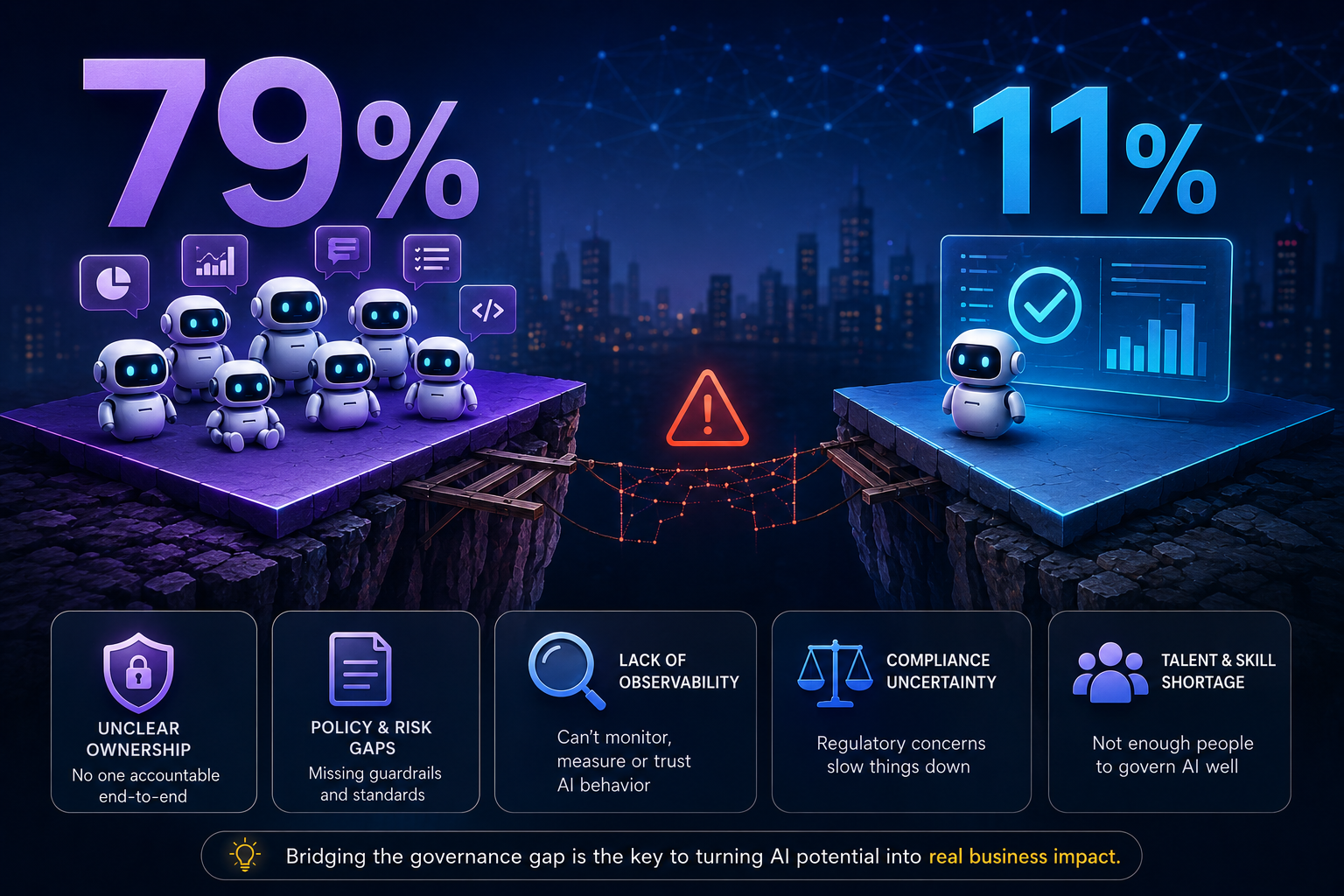
Enterprise AI adoption is accelerating faster than most organizations can govern it.
Across industries, companies are investing heavily in autonomous AI agents, copilots, workflow automation systems, and multi-agent architectures designed to streamline operations and improve productivity. Yet despite the momentum, one reality is becoming impossible to ignore:
Most AI agents never make it to production.
Organizations are successfully building prototypes, running pilots, and demonstrating internal proofs of concept. But when it comes to deploying AI agents into real enterprise environments — connected to sensitive systems, customer data, APIs, and business workflows — confidence drops dramatically.
The problem is not innovation.
The problem is governance.
This growing disconnect between experimentation and operational deployment represents the hidden governance gap in enterprise AI.
And until organizations solve it, AI agents will remain stuck in controlled demos instead of delivering real business value at scale.
The Rise of Enterprise AI Agents
AI agents are rapidly evolving from simple chatbots into autonomous operational systems capable of reasoning, planning, retrieving information, executing tasks, and interacting with external tools.
Modern enterprises are now experimenting with AI copilots for employees, autonomous workflow orchestration, multi-agent systems, AI-driven customer support, security automation agents, knowledge retrieval assistants, AI coding assistants, and agentic process automation.
Unlike traditional AI models that generate outputs from prompts, AI agents can take actions, make decisions, and execute workflows independently. That shift changes everything.
For enterprises, AI agents offer enormous potential: reduced operational costs, faster decision-making, increased employee productivity, automated support operations, continuous workflow execution, and scalable internal knowledge systems.
From healthcare and finance to SaaS and manufacturing, organizations are racing to operationalize agentic AI systems. But while experimentation is easy, production deployment is not.
Why Most AI Agents Never Reach Production
The gap between a successful AI demo and a production-ready enterprise system is massive.
An AI agent may appear impressive during testing, yet still pose serious operational, compliance, and security risks in live environments. The core challenge is unpredictability. Traditional software behaves deterministically. AI agents do not.
An AI agent can access tools dynamically, interpret instructions differently, generate unexpected outputs, chain reasoning autonomously, retrieve inaccurate information, interact with external systems, and make decisions without explicit programming. This creates entirely new categories of enterprise risk.
Hallucinations and Unreliable Outputs
AI agents can generate incorrect answers with high confidence. In low-risk environments, hallucinations are frustrating. In enterprise systems, they become dangerous — a financial operations agent generating inaccurate reports, a legal assistant providing non-compliant recommendations, a healthcare support agent retrieving incorrect records, or a coding agent introducing insecure code into production systems. Without runtime validation and evaluation, these risks scale quickly.
Prompt Injection and Security Risks
AI agents often rely on external inputs, memory systems, retrieval pipelines, APIs, and third-party tools. That dramatically increases the attack surface. Threats now include prompt injection attacks, data exfiltration, malicious tool execution, unauthorized API access, sensitive information leakage, memory poisoning, and unsafe autonomous behavior. Traditional application security tools were not designed for AI reasoning systems — that leaves enterprises exposed.
Lack of Observability
One of the biggest barriers to production AI deployment is visibility. Enterprise teams frequently ask: What did the agent access? Why did it make this decision? Which tools did it call? What data influenced the output? Can we audit the reasoning chain later? What happens if the agent fails autonomously? In many deployments, organizations simply cannot answer these questions. Without observability, enterprises cannot trust autonomous systems.
Compliance and Auditability Challenges
AI agents increasingly interact with regulated data and sensitive workflows. That introduces serious governance concerns related to GDPR, HIPAA, SOC 2, ISO 27001, financial compliance standards, and internal enterprise policies. Organizations need audit trails, traceability, policy enforcement, access controls, runtime governance, and decision accountability. Most AI prototypes lack all of these.
The Hidden Governance Gap
This is where the real enterprise challenge emerges. The issue is not whether AI agents are useful. The issue is whether they are governable.
What Is AI Agent Governance?
AI Agent Governance refers to the systems, controls, policies, monitoring, and assurance mechanisms used to ensure AI agents operate safely, securely, compliantly, and reliably in production environments. It includes runtime oversight, security controls, policy enforcement, evaluation frameworks, observability systems, human review workflows, continuous monitoring, and risk detection. Governance transforms AI agents from experimental tools into operational enterprise systems.
Why Traditional Governance Fails for Agentic AI
Most governance models were built for traditional software. AI agents operate differently. Static rule-based governance does not work well for systems that reason dynamically, interact with external tools, use long-term memory, adapt behavior based on context, and execute autonomous actions. Traditional monitoring tools also fail to capture reasoning chains, agent decision paths, context evolution, prompt-level vulnerabilities, and multi-step autonomous workflows. Agentic AI requires runtime governance — not just pre-deployment approval processes.
The Core Pillars of AI Agent Governance
Effective enterprise AI governance requires multiple operational layers working together.
1. AI Guardrails
Guardrails define acceptable AI behavior. They help prevent harmful outputs, policy violations, unsafe actions, sensitive data exposure, and prompt injection attacks. Runtime AI guardrails validate both inputs and outputs continuously. This becomes especially critical for autonomous agents with tool access. TruGuard by Trusys provides inline policy enforcement at the agent's input, output, and action layers — blocking injection attempts and preventing unauthorized tool use without modifying the agent itself.
2. Observability and Tracing
Production AI systems require deep operational visibility. AI observability enables teams to monitor agent decisions, tool usage, latency, failure patterns, retrieval quality, token usage, prompt flows, and reasoning paths. Tracing helps enterprises reconstruct exactly what happened during agent execution. Without observability, root-cause analysis becomes nearly impossible. TruPulse traces every agent action with full lineage — what triggered it, what data it touched, what tools it called, and what it produced.
3. Adversarial Testing
AI agents must be tested against malicious and edge-case scenarios before deployment. Adversarial testing evaluates prompt injection resistance, jailbreak vulnerabilities, unsafe behaviors, security weaknesses, tool misuse risks, and reliability under stress. This process is essential for identifying hidden vulnerabilities before production exposure. TruScout tests agents the way attackers actually attack them — through poisoned emails, hostile websites, malicious documents, and compromised tool responses — with campaigns mapped to the OWASP Agentic AI Top 10 and MITRE ATLAS.
4. Continuous Evaluation
AI agents cannot be evaluated once and considered "safe forever." Models evolve, prompts change, and workflows adapt. Enterprise AI systems require continuous evaluation pipelines that assess accuracy, relevance, safety, compliance, reliability, and decision quality. TruEval goes beyond prompt benchmarks to evaluate how agents actually behave — across tool use, multi-turn reasoning, memory persistence, sub-agent delegation, and inter-agent collaboration — with 75+ scoring metrics and regulator-ready reports.
5. Policy Enforcement
Enterprises need runtime policy enforcement mechanisms that define what agents can access, which tools agents may use, which workflows require approvals, what data agents can retrieve, and which actions are prohibited. Policy enforcement acts as operational containment for autonomous systems.
6. Human-in-the-Loop Controls
Not every decision should be fully autonomous. High-risk workflows often require human approvals, escalation pathways, manual review checkpoints, confidence scoring, and exception handling. Human oversight remains a critical governance layer for enterprise AI deployment.
7. Compliance and Auditability
Production AI systems must support audit logs, decision traceability, regulatory reporting, access tracking, and security event analysis. Compliance is no longer optional for enterprise AI adoption — it is foundational. Trusys generates audit-ready evidence automatically for frameworks including OWASP Top 10, MITRE ATLAS, EU AI Act, and ISO 42001.
8. Runtime Risk Detection
AI risks evolve in real time. Production governance systems should continuously detect unsafe outputs, suspicious prompts, abnormal behavior, unauthorized access attempts, data leakage indicators, and policy violations. Runtime monitoring enables proactive risk mitigation before incidents escalate.
What Production-Ready AI Governance Looks Like
Mature enterprise AI governance combines security, observability, compliance, and operational oversight into a unified runtime framework. A production-ready AI governance architecture typically includes real-time AI monitoring, agent behavior tracing, guardrail enforcement, security scanning, evaluation pipelines, risk scoring, output validation, human approval workflows, governance dashboards, compliance reporting, and runtime policy engines.
This is where AI assurance platforms become essential. Instead of treating governance as a manual process, enterprises are increasingly operationalizing AI governance directly into deployment pipelines.
What makes Trusys distinct is Argus — the autonomous governance AI at the heart of the platform. Argus runs continuous evaluations through TruEval, watches production traces through TruPulse, executes red-team campaigns through TruScout, and enforces policy through TruGuard — around the clock, at the speed agents actually run. It surfaces only what needs human judgement, rather than generating dashboards that require manual review.
TruScan additionally helps teams identify AI-related vulnerabilities earlier in the development lifecycle, shifting security left before deployment.
The future of enterprise AI depends on continuous governance — not static approval checklists.
Governance Is the Unlock for Enterprise AI Scale
Many organizations mistakenly view governance as a barrier to innovation. In reality, governance is what enables scale.
Without governance: security teams block deployments, compliance teams reject production usage, leadership loses confidence, operational risks increase, and AI systems remain trapped in pilots.
With governance: trust increases, deployment accelerates, risks become manageable, automation expands safely, and enterprises operationalize AI confidently.
The organizations that successfully scale agentic AI will not necessarily have the most advanced models. They will have the strongest governance foundations. AI Agent Governance is rapidly becoming a competitive advantage.
How Trusys AI Helps Enterprises Govern AI Agents in Production
As enterprises move from experimentation to operational AI deployment, governance can no longer be treated as an afterthought.
Trusys AI helps organizations operationalize AI governance through a unified platform spanning the full agent lifecycle:
- TruScout — Continuous adversarial testing and red-teaming
- TruEval — Behavioural evaluation across tool use, memory, and multi-agent workflows
- TruPulse — Runtime observability and production monitoring
- TruGuard — Inline guardrails and policy enforcement
- TruScan — AI code scanning for early vulnerability detection
- Argus — The autonomous governance AI that orchestrates it all
Instead of relying on fragmented tooling, enterprises can centralize AI assurance, governance, and runtime oversight across their entire agent ecosystem.
As agentic AI adoption accelerates, organizations need more than powerful models. They need production trust. And that trust comes from governance.
Book a demo to see how Trusys governs AI agents in production.
FAQ: AI Agent Governance
What is AI Agent Governance? AI Agent Governance refers to the policies, monitoring systems, guardrails, evaluations, and controls used to ensure AI agents operate safely and reliably in production environments.
Why do most enterprise AI agents fail to reach production? Most AI agents fail because enterprises lack governance frameworks for security, observability, compliance, reliability, and runtime risk management.
What are the biggest risks of deploying AI agents? Common risks include hallucinations, prompt injection, data leakage, unsafe tool usage, compliance violations, confused-deputy attacks, behavioural drift, and lack of auditability.
Why is AI observability important for agentic AI? AI observability helps organizations monitor decisions, trace reasoning paths, analyze failures, and maintain operational trust in autonomous systems.
How can enterprises safely scale AI agents? Enterprises can safely scale AI agents by implementing governance frameworks that include guardrails, evaluations, monitoring, adversarial testing, and runtime policy enforcement — as provided by the Trusys AI platform.
Stop guessing.
Start measuring.
Join teams building reliable AI with TruEval. Start with a free trial, no credit card required. Get your first evaluation running in under 10 minutes.
Questions about Trusys?
Our team is here to help. Schedule a personalized demo to see how Trusys fits your specific use case.
Book a Demo

Ready to dive in?
Check out our documentation and tutorials. Get started with example datasets and evaluation templates.
Start Free Trial
Free Trial
No credit card required
10 Min
To first evaluation
24/7
Enterprise support


Benefits
Specifications
How-to
Contact Us
Learn More

Why 79% of Enterprises Deploy AI Agents But Only 11% Run Them in Production — The Hidden Governance Gap
2026-05-14
Enterprise AI adoption is accelerating faster than most organizations can govern it.
Across industries, companies are investing heavily in autonomous AI agents, copilots, workflow automation systems, and multi-agent architectures designed to streamline operations and improve productivity. Yet despite the momentum, one reality is becoming impossible to ignore:
Most AI agents never make it to production.
Organizations are successfully building prototypes, running pilots, and demonstrating internal proofs of concept. But when it comes to deploying AI agents into real enterprise environments — connected to sensitive systems, customer data, APIs, and business workflows — confidence drops dramatically.
The problem is not innovation.
The problem is governance.
This growing disconnect between experimentation and operational deployment represents the hidden governance gap in enterprise AI.
And until organizations solve it, AI agents will remain stuck in controlled demos instead of delivering real business value at scale.
The Rise of Enterprise AI Agents
AI agents are rapidly evolving from simple chatbots into autonomous operational systems capable of reasoning, planning, retrieving information, executing tasks, and interacting with external tools.
Modern enterprises are now experimenting with AI copilots for employees, autonomous workflow orchestration, multi-agent systems, AI-driven customer support, security automation agents, knowledge retrieval assistants, AI coding assistants, and agentic process automation.
Unlike traditional AI models that generate outputs from prompts, AI agents can take actions, make decisions, and execute workflows independently. That shift changes everything.
For enterprises, AI agents offer enormous potential: reduced operational costs, faster decision-making, increased employee productivity, automated support operations, continuous workflow execution, and scalable internal knowledge systems.
From healthcare and finance to SaaS and manufacturing, organizations are racing to operationalize agentic AI systems. But while experimentation is easy, production deployment is not.
Why Most AI Agents Never Reach Production
The gap between a successful AI demo and a production-ready enterprise system is massive.
An AI agent may appear impressive during testing, yet still pose serious operational, compliance, and security risks in live environments. The core challenge is unpredictability. Traditional software behaves deterministically. AI agents do not.
An AI agent can access tools dynamically, interpret instructions differently, generate unexpected outputs, chain reasoning autonomously, retrieve inaccurate information, interact with external systems, and make decisions without explicit programming. This creates entirely new categories of enterprise risk.
Hallucinations and Unreliable Outputs
AI agents can generate incorrect answers with high confidence. In low-risk environments, hallucinations are frustrating. In enterprise systems, they become dangerous — a financial operations agent generating inaccurate reports, a legal assistant providing non-compliant recommendations, a healthcare support agent retrieving incorrect records, or a coding agent introducing insecure code into production systems. Without runtime validation and evaluation, these risks scale quickly.
Prompt Injection and Security Risks
AI agents often rely on external inputs, memory systems, retrieval pipelines, APIs, and third-party tools. That dramatically increases the attack surface. Threats now include prompt injection attacks, data exfiltration, malicious tool execution, unauthorized API access, sensitive information leakage, memory poisoning, and unsafe autonomous behavior. Traditional application security tools were not designed for AI reasoning systems — that leaves enterprises exposed.
Lack of Observability
One of the biggest barriers to production AI deployment is visibility. Enterprise teams frequently ask: What did the agent access? Why did it make this decision? Which tools did it call? What data influenced the output? Can we audit the reasoning chain later? What happens if the agent fails autonomously? In many deployments, organizations simply cannot answer these questions. Without observability, enterprises cannot trust autonomous systems.
Compliance and Auditability Challenges
AI agents increasingly interact with regulated data and sensitive workflows. That introduces serious governance concerns related to GDPR, HIPAA, SOC 2, ISO 27001, financial compliance standards, and internal enterprise policies. Organizations need audit trails, traceability, policy enforcement, access controls, runtime governance, and decision accountability. Most AI prototypes lack all of these.
The Hidden Governance Gap
This is where the real enterprise challenge emerges. The issue is not whether AI agents are useful. The issue is whether they are governable.
What Is AI Agent Governance?
AI Agent Governance refers to the systems, controls, policies, monitoring, and assurance mechanisms used to ensure AI agents operate safely, securely, compliantly, and reliably in production environments. It includes runtime oversight, security controls, policy enforcement, evaluation frameworks, observability systems, human review workflows, continuous monitoring, and risk detection. Governance transforms AI agents from experimental tools into operational enterprise systems.
Why Traditional Governance Fails for Agentic AI
Most governance models were built for traditional software. AI agents operate differently. Static rule-based governance does not work well for systems that reason dynamically, interact with external tools, use long-term memory, adapt behavior based on context, and execute autonomous actions. Traditional monitoring tools also fail to capture reasoning chains, agent decision paths, context evolution, prompt-level vulnerabilities, and multi-step autonomous workflows. Agentic AI requires runtime governance — not just pre-deployment approval processes.
The Core Pillars of AI Agent Governance
Effective enterprise AI governance requires multiple operational layers working together.
1. AI Guardrails
Guardrails define acceptable AI behavior. They help prevent harmful outputs, policy violations, unsafe actions, sensitive data exposure, and prompt injection attacks. Runtime AI guardrails validate both inputs and outputs continuously. This becomes especially critical for autonomous agents with tool access. TruGuard by Trusys provides inline policy enforcement at the agent's input, output, and action layers — blocking injection attempts and preventing unauthorized tool use without modifying the agent itself.
2. Observability and Tracing
Production AI systems require deep operational visibility. AI observability enables teams to monitor agent decisions, tool usage, latency, failure patterns, retrieval quality, token usage, prompt flows, and reasoning paths. Tracing helps enterprises reconstruct exactly what happened during agent execution. Without observability, root-cause analysis becomes nearly impossible. TruPulse traces every agent action with full lineage — what triggered it, what data it touched, what tools it called, and what it produced.
3. Adversarial Testing
AI agents must be tested against malicious and edge-case scenarios before deployment. Adversarial testing evaluates prompt injection resistance, jailbreak vulnerabilities, unsafe behaviors, security weaknesses, tool misuse risks, and reliability under stress. This process is essential for identifying hidden vulnerabilities before production exposure. TruScout tests agents the way attackers actually attack them — through poisoned emails, hostile websites, malicious documents, and compromised tool responses — with campaigns mapped to the OWASP Agentic AI Top 10 and MITRE ATLAS.
4. Continuous Evaluation
AI agents cannot be evaluated once and considered "safe forever." Models evolve, prompts change, and workflows adapt. Enterprise AI systems require continuous evaluation pipelines that assess accuracy, relevance, safety, compliance, reliability, and decision quality. TruEval goes beyond prompt benchmarks to evaluate how agents actually behave — across tool use, multi-turn reasoning, memory persistence, sub-agent delegation, and inter-agent collaboration — with 75+ scoring metrics and regulator-ready reports.
5. Policy Enforcement
Enterprises need runtime policy enforcement mechanisms that define what agents can access, which tools agents may use, which workflows require approvals, what data agents can retrieve, and which actions are prohibited. Policy enforcement acts as operational containment for autonomous systems.
6. Human-in-the-Loop Controls
Not every decision should be fully autonomous. High-risk workflows often require human approvals, escalation pathways, manual review checkpoints, confidence scoring, and exception handling. Human oversight remains a critical governance layer for enterprise AI deployment.
7. Compliance and Auditability
Production AI systems must support audit logs, decision traceability, regulatory reporting, access tracking, and security event analysis. Compliance is no longer optional for enterprise AI adoption — it is foundational. Trusys generates audit-ready evidence automatically for frameworks including OWASP Top 10, MITRE ATLAS, EU AI Act, and ISO 42001.
8. Runtime Risk Detection
AI risks evolve in real time. Production governance systems should continuously detect unsafe outputs, suspicious prompts, abnormal behavior, unauthorized access attempts, data leakage indicators, and policy violations. Runtime monitoring enables proactive risk mitigation before incidents escalate.
What Production-Ready AI Governance Looks Like
Mature enterprise AI governance combines security, observability, compliance, and operational oversight into a unified runtime framework. A production-ready AI governance architecture typically includes real-time AI monitoring, agent behavior tracing, guardrail enforcement, security scanning, evaluation pipelines, risk scoring, output validation, human approval workflows, governance dashboards, compliance reporting, and runtime policy engines.
This is where AI assurance platforms become essential. Instead of treating governance as a manual process, enterprises are increasingly operationalizing AI governance directly into deployment pipelines.
What makes Trusys distinct is Argus — the autonomous governance AI at the heart of the platform. Argus runs continuous evaluations through TruEval, watches production traces through TruPulse, executes red-team campaigns through TruScout, and enforces policy through TruGuard — around the clock, at the speed agents actually run. It surfaces only what needs human judgement, rather than generating dashboards that require manual review.
TruScan additionally helps teams identify AI-related vulnerabilities earlier in the development lifecycle, shifting security left before deployment.
The future of enterprise AI depends on continuous governance — not static approval checklists.
Governance Is the Unlock for Enterprise AI Scale
Many organizations mistakenly view governance as a barrier to innovation. In reality, governance is what enables scale.
Without governance: security teams block deployments, compliance teams reject production usage, leadership loses confidence, operational risks increase, and AI systems remain trapped in pilots.
With governance: trust increases, deployment accelerates, risks become manageable, automation expands safely, and enterprises operationalize AI confidently.
The organizations that successfully scale agentic AI will not necessarily have the most advanced models. They will have the strongest governance foundations. AI Agent Governance is rapidly becoming a competitive advantage.
How Trusys AI Helps Enterprises Govern AI Agents in Production
As enterprises move from experimentation to operational AI deployment, governance can no longer be treated as an afterthought.
Trusys AI helps organizations operationalize AI governance through a unified platform spanning the full agent lifecycle:
- TruScout — Continuous adversarial testing and red-teaming
- TruEval — Behavioural evaluation across tool use, memory, and multi-agent workflows
- TruPulse — Runtime observability and production monitoring
- TruGuard — Inline guardrails and policy enforcement
- TruScan — AI code scanning for early vulnerability detection
- Argus — The autonomous governance AI that orchestrates it all
Instead of relying on fragmented tooling, enterprises can centralize AI assurance, governance, and runtime oversight across their entire agent ecosystem.
As agentic AI adoption accelerates, organizations need more than powerful models. They need production trust. And that trust comes from governance.
Book a demo to see how Trusys governs AI agents in production.
FAQ: AI Agent Governance
What is AI Agent Governance? AI Agent Governance refers to the policies, monitoring systems, guardrails, evaluations, and controls used to ensure AI agents operate safely and reliably in production environments.
Why do most enterprise AI agents fail to reach production? Most AI agents fail because enterprises lack governance frameworks for security, observability, compliance, reliability, and runtime risk management.
What are the biggest risks of deploying AI agents? Common risks include hallucinations, prompt injection, data leakage, unsafe tool usage, compliance violations, confused-deputy attacks, behavioural drift, and lack of auditability.
Why is AI observability important for agentic AI? AI observability helps organizations monitor decisions, trace reasoning paths, analyze failures, and maintain operational trust in autonomous systems.
How can enterprises safely scale AI agents? Enterprises can safely scale AI agents by implementing governance frameworks that include guardrails, evaluations, monitoring, adversarial testing, and runtime policy enforcement — as provided by the Trusys AI platform.
Stop guessing.
Start measuring.
Join teams building reliable AI with TruEval. Start with a free trial, no credit card required. Get your first evaluation running in under 10 minutes.
Questions about Trusys?
Our team is here to help. Schedule a personalized demo to see how Trusys fits your specific use case.
Book a Demo
Ready to dive in?
Check out our documentation and tutorials. Get started with example datasets and evaluation templates.
Start Free Trial
Free Trial
No credit card required
10 Min
To first evaluation
24/7
Enterprise support
Why 79% of Enterprises Deploy AI Agents But Only 11% Run Them in Production — The Hidden Governance Gap
2026-05-14
Enterprise AI adoption is accelerating faster than most organizations can govern it.
Across industries, companies are investing heavily in autonomous AI agents, copilots, workflow automation systems, and multi-agent architectures designed to streamline operations and improve productivity. Yet despite the momentum, one reality is becoming impossible to ignore:
Most AI agents never make it to production.
Organizations are successfully building prototypes, running pilots, and demonstrating internal proofs of concept. But when it comes to deploying AI agents into real enterprise environments — connected to sensitive systems, customer data, APIs, and business workflows — confidence drops dramatically.
The problem is not innovation.
The problem is governance.
This growing disconnect between experimentation and operational deployment represents the hidden governance gap in enterprise AI.
And until organizations solve it, AI agents will remain stuck in controlled demos instead of delivering real business value at scale.
The Rise of Enterprise AI Agents
AI agents are rapidly evolving from simple chatbots into autonomous operational systems capable of reasoning, planning, retrieving information, executing tasks, and interacting with external tools.
Modern enterprises are now experimenting with AI copilots for employees, autonomous workflow orchestration, multi-agent systems, AI-driven customer support, security automation agents, knowledge retrieval assistants, AI coding assistants, and agentic process automation.
Unlike traditional AI models that generate outputs from prompts, AI agents can take actions, make decisions, and execute workflows independently. That shift changes everything.
For enterprises, AI agents offer enormous potential: reduced operational costs, faster decision-making, increased employee productivity, automated support operations, continuous workflow execution, and scalable internal knowledge systems.
From healthcare and finance to SaaS and manufacturing, organizations are racing to operationalize agentic AI systems. But while experimentation is easy, production deployment is not.
Why Most AI Agents Never Reach Production
The gap between a successful AI demo and a production-ready enterprise system is massive.
An AI agent may appear impressive during testing, yet still pose serious operational, compliance, and security risks in live environments. The core challenge is unpredictability. Traditional software behaves deterministically. AI agents do not.
An AI agent can access tools dynamically, interpret instructions differently, generate unexpected outputs, chain reasoning autonomously, retrieve inaccurate information, interact with external systems, and make decisions without explicit programming. This creates entirely new categories of enterprise risk.
Hallucinations and Unreliable Outputs
AI agents can generate incorrect answers with high confidence. In low-risk environments, hallucinations are frustrating. In enterprise systems, they become dangerous — a financial operations agent generating inaccurate reports, a legal assistant providing non-compliant recommendations, a healthcare support agent retrieving incorrect records, or a coding agent introducing insecure code into production systems. Without runtime validation and evaluation, these risks scale quickly.
Prompt Injection and Security Risks
AI agents often rely on external inputs, memory systems, retrieval pipelines, APIs, and third-party tools. That dramatically increases the attack surface. Threats now include prompt injection attacks, data exfiltration, malicious tool execution, unauthorized API access, sensitive information leakage, memory poisoning, and unsafe autonomous behavior. Traditional application security tools were not designed for AI reasoning systems — that leaves enterprises exposed.
Lack of Observability
One of the biggest barriers to production AI deployment is visibility. Enterprise teams frequently ask: What did the agent access? Why did it make this decision? Which tools did it call? What data influenced the output? Can we audit the reasoning chain later? What happens if the agent fails autonomously? In many deployments, organizations simply cannot answer these questions. Without observability, enterprises cannot trust autonomous systems.
Compliance and Auditability Challenges
AI agents increasingly interact with regulated data and sensitive workflows. That introduces serious governance concerns related to GDPR, HIPAA, SOC 2, ISO 27001, financial compliance standards, and internal enterprise policies. Organizations need audit trails, traceability, policy enforcement, access controls, runtime governance, and decision accountability. Most AI prototypes lack all of these.
The Hidden Governance Gap
This is where the real enterprise challenge emerges. The issue is not whether AI agents are useful. The issue is whether they are governable.
What Is AI Agent Governance?
AI Agent Governance refers to the systems, controls, policies, monitoring, and assurance mechanisms used to ensure AI agents operate safely, securely, compliantly, and reliably in production environments. It includes runtime oversight, security controls, policy enforcement, evaluation frameworks, observability systems, human review workflows, continuous monitoring, and risk detection. Governance transforms AI agents from experimental tools into operational enterprise systems.
Why Traditional Governance Fails for Agentic AI
Most governance models were built for traditional software. AI agents operate differently. Static rule-based governance does not work well for systems that reason dynamically, interact with external tools, use long-term memory, adapt behavior based on context, and execute autonomous actions. Traditional monitoring tools also fail to capture reasoning chains, agent decision paths, context evolution, prompt-level vulnerabilities, and multi-step autonomous workflows. Agentic AI requires runtime governance — not just pre-deployment approval processes.
The Core Pillars of AI Agent Governance
Effective enterprise AI governance requires multiple operational layers working together.
1. AI Guardrails
Guardrails define acceptable AI behavior. They help prevent harmful outputs, policy violations, unsafe actions, sensitive data exposure, and prompt injection attacks. Runtime AI guardrails validate both inputs and outputs continuously. This becomes especially critical for autonomous agents with tool access. TruGuard by Trusys provides inline policy enforcement at the agent's input, output, and action layers — blocking injection attempts and preventing unauthorized tool use without modifying the agent itself.
2. Observability and Tracing
Production AI systems require deep operational visibility. AI observability enables teams to monitor agent decisions, tool usage, latency, failure patterns, retrieval quality, token usage, prompt flows, and reasoning paths. Tracing helps enterprises reconstruct exactly what happened during agent execution. Without observability, root-cause analysis becomes nearly impossible. TruPulse traces every agent action with full lineage — what triggered it, what data it touched, what tools it called, and what it produced.
3. Adversarial Testing
AI agents must be tested against malicious and edge-case scenarios before deployment. Adversarial testing evaluates prompt injection resistance, jailbreak vulnerabilities, unsafe behaviors, security weaknesses, tool misuse risks, and reliability under stress. This process is essential for identifying hidden vulnerabilities before production exposure. TruScout tests agents the way attackers actually attack them — through poisoned emails, hostile websites, malicious documents, and compromised tool responses — with campaigns mapped to the OWASP Agentic AI Top 10 and MITRE ATLAS.
4. Continuous Evaluation
AI agents cannot be evaluated once and considered "safe forever." Models evolve, prompts change, and workflows adapt. Enterprise AI systems require continuous evaluation pipelines that assess accuracy, relevance, safety, compliance, reliability, and decision quality. TruEval goes beyond prompt benchmarks to evaluate how agents actually behave — across tool use, multi-turn reasoning, memory persistence, sub-agent delegation, and inter-agent collaboration — with 75+ scoring metrics and regulator-ready reports.
5. Policy Enforcement
Enterprises need runtime policy enforcement mechanisms that define what agents can access, which tools agents may use, which workflows require approvals, what data agents can retrieve, and which actions are prohibited. Policy enforcement acts as operational containment for autonomous systems.
6. Human-in-the-Loop Controls
Not every decision should be fully autonomous. High-risk workflows often require human approvals, escalation pathways, manual review checkpoints, confidence scoring, and exception handling. Human oversight remains a critical governance layer for enterprise AI deployment.
7. Compliance and Auditability
Production AI systems must support audit logs, decision traceability, regulatory reporting, access tracking, and security event analysis. Compliance is no longer optional for enterprise AI adoption — it is foundational. Trusys generates audit-ready evidence automatically for frameworks including OWASP Top 10, MITRE ATLAS, EU AI Act, and ISO 42001.
8. Runtime Risk Detection
AI risks evolve in real time. Production governance systems should continuously detect unsafe outputs, suspicious prompts, abnormal behavior, unauthorized access attempts, data leakage indicators, and policy violations. Runtime monitoring enables proactive risk mitigation before incidents escalate.
What Production-Ready AI Governance Looks Like
Mature enterprise AI governance combines security, observability, compliance, and operational oversight into a unified runtime framework. A production-ready AI governance architecture typically includes real-time AI monitoring, agent behavior tracing, guardrail enforcement, security scanning, evaluation pipelines, risk scoring, output validation, human approval workflows, governance dashboards, compliance reporting, and runtime policy engines.
This is where AI assurance platforms become essential. Instead of treating governance as a manual process, enterprises are increasingly operationalizing AI governance directly into deployment pipelines.
What makes Trusys distinct is Argus — the autonomous governance AI at the heart of the platform. Argus runs continuous evaluations through TruEval, watches production traces through TruPulse, executes red-team campaigns through TruScout, and enforces policy through TruGuard — around the clock, at the speed agents actually run. It surfaces only what needs human judgement, rather than generating dashboards that require manual review.
TruScan additionally helps teams identify AI-related vulnerabilities earlier in the development lifecycle, shifting security left before deployment.
The future of enterprise AI depends on continuous governance — not static approval checklists.
Governance Is the Unlock for Enterprise AI Scale
Many organizations mistakenly view governance as a barrier to innovation. In reality, governance is what enables scale.
Without governance: security teams block deployments, compliance teams reject production usage, leadership loses confidence, operational risks increase, and AI systems remain trapped in pilots.
With governance: trust increases, deployment accelerates, risks become manageable, automation expands safely, and enterprises operationalize AI confidently.
The organizations that successfully scale agentic AI will not necessarily have the most advanced models. They will have the strongest governance foundations. AI Agent Governance is rapidly becoming a competitive advantage.
How Trusys AI Helps Enterprises Govern AI Agents in Production
As enterprises move from experimentation to operational AI deployment, governance can no longer be treated as an afterthought.
Trusys AI helps organizations operationalize AI governance through a unified platform spanning the full agent lifecycle:
- TruScout — Continuous adversarial testing and red-teaming
- TruEval — Behavioural evaluation across tool use, memory, and multi-agent workflows
- TruPulse — Runtime observability and production monitoring
- TruGuard — Inline guardrails and policy enforcement
- TruScan — AI code scanning for early vulnerability detection
- Argus — The autonomous governance AI that orchestrates it all
Instead of relying on fragmented tooling, enterprises can centralize AI assurance, governance, and runtime oversight across their entire agent ecosystem.
As agentic AI adoption accelerates, organizations need more than powerful models. They need production trust. And that trust comes from governance.
Book a demo to see how Trusys governs AI agents in production.
FAQ: AI Agent Governance
What is AI Agent Governance? AI Agent Governance refers to the policies, monitoring systems, guardrails, evaluations, and controls used to ensure AI agents operate safely and reliably in production environments.
Why do most enterprise AI agents fail to reach production? Most AI agents fail because enterprises lack governance frameworks for security, observability, compliance, reliability, and runtime risk management.
What are the biggest risks of deploying AI agents? Common risks include hallucinations, prompt injection, data leakage, unsafe tool usage, compliance violations, confused-deputy attacks, behavioural drift, and lack of auditability.
Why is AI observability important for agentic AI? AI observability helps organizations monitor decisions, trace reasoning paths, analyze failures, and maintain operational trust in autonomous systems.
How can enterprises safely scale AI agents? Enterprises can safely scale AI agents by implementing governance frameworks that include guardrails, evaluations, monitoring, adversarial testing, and runtime policy enforcement — as provided by the Trusys AI platform.
Stop guessing.
Start measuring.
Join teams building reliable AI with Trusys. Start with a free trial, no credit card required. Get your first evaluation running in under 10 minutes.
Questions about Trusys?
Our team is here to help. Schedule a personalized demo to see how Trusys fits your specific use case.
Book a Demo

Ready to dive in?
Check out our documentation and tutorials. Get started with example datasets and evaluation templates.
Start Free Trial
Free Trial
No credit card required
10 Min
to get started
24/7
Enterprise support