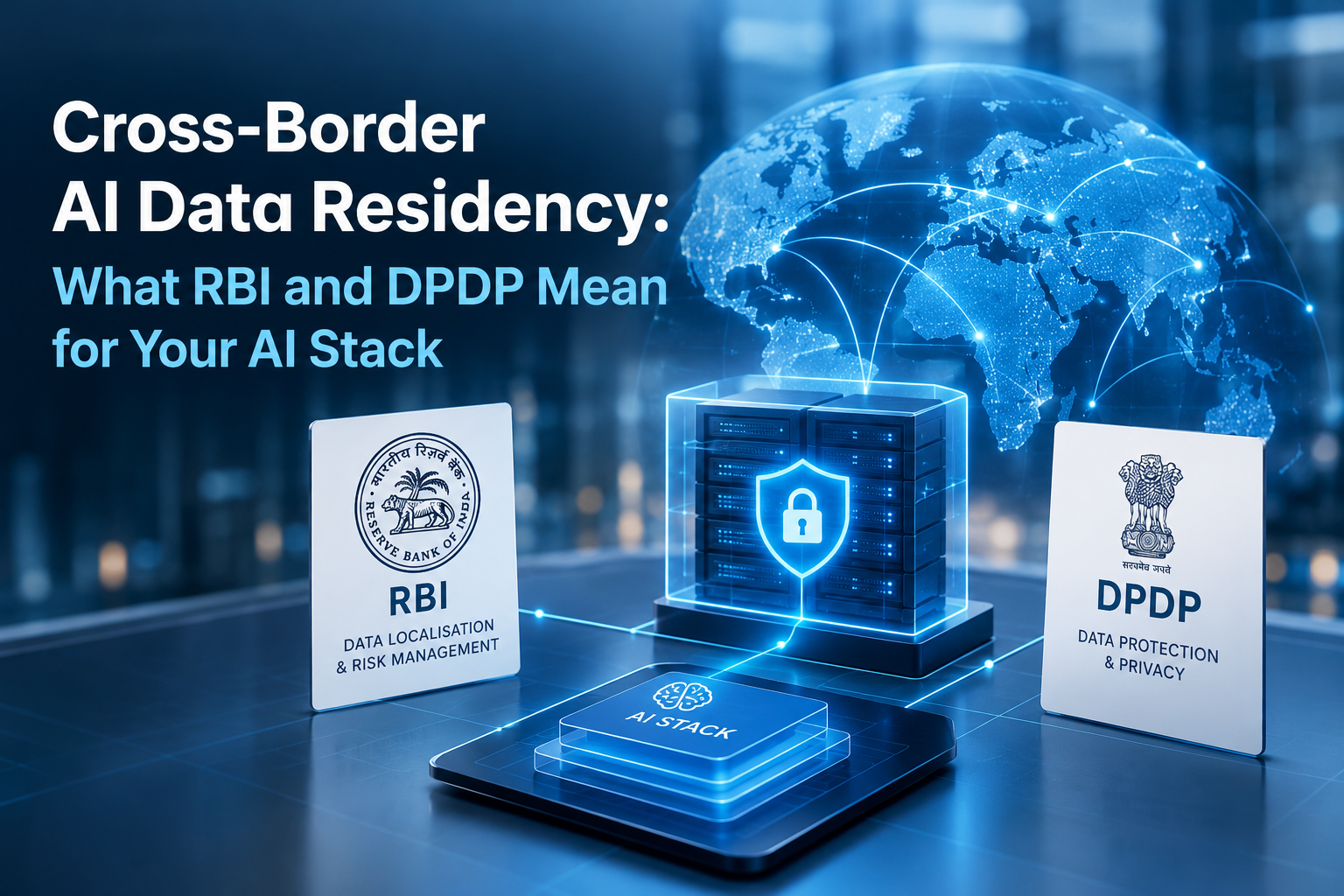
Cross-Border AI Data Residency: What RBI and DPDP Mean for Your AI Stack
Written by

Your AI Stack Has a Cross-Border Data Problem
Why Rate Limit Failures Are So Dangerous
Many organizations still treat rate limit errors as minor API inconveniences.
That assumption is becoming expensive.
In reality, rate limit failures create cascading operational disruption across the enterprise.
Understanding RBI, DPDP, and the Global AI Data Residency Landscape
Four terms are often confused. Data residency is where data is physically stored and processed, usually an organisational choice. Data localisation is a legal requirement that data stay within a territory. Data sovereignty concerns which country’s laws and authorities can reach the data, wherever it sits. Cross-border transfer compliance is the legal basis for moving personal data across borders. A system can satisfy one and fail another, and no regulation applies to every organisation.
India: RBI
RBI’s April 2018 circular on Storage of Payment System Data directs authorised payment system providers to store payment data only in systems located in India. RBI’s FAQs clarify that processing abroad is permitted, but the data must be deleted abroad and brought back to India within one business day or 24 hours of processing, whichever is earlier. For an AI stack, a prompt carrying payment data sent to an offshore inference endpoint is processing abroad, and any cache, log or embedding retained there may conflict with the deletion expectation. Scope matters: the circular is addressed to payment system providers, so coverage depends on the entity and the data.
RBI’s Master Direction on Outsourcing of IT Services, in force since 1 October 2023, adds expectations for regulated entities using cloud services: address the data lifecycle end to end, account for multi-location storage and processing, and understand the risks of service providers in other jurisdictions. RBI’s FREE-AI framework and its 2026 draft model risk guidance add AI-specific supervisory expectations for banks and NBFCs (see our RBI FREE-AI framework page).
India: DPDP Act and Rules
The Digital Personal Data Protection Act, 2023 and the DPDP Rules, 2025 (notified in November 2025) phase in over 18 months. As of October 2026, Section 16 and Rule 15, the cross-border transfer provisions, have not yet commenced; the commencement notification points to 13 May 2027, alongside most operational obligations such as security safeguards and breach notification. When they apply, Section 16 follows a negative-list model: transfers are permitted except to countries the Central Government restricts, and Section 16(2) preserves stricter sectoral laws, so RBI requirements continue to apply on top. Rule 13(4) also contemplates that specified data handled by Significant Data Fiduciaries may have to stay in India. Confirm current status with counsel before relying on any date.
EU: GDPR Chapter V
The GDPR restricts transfers of personal data outside the EEA unless there is an adequacy decision (Article 45), appropriate safeguards such as Standard Contractual Clauses or Binding Corporate Rules (Article 46), or a narrow derogation (Article 49) that is a poor fit for routine, repetitive AI traffic. Regulators treat remote access from a third country as a transfer, so a support engineer viewing traces can count. The EU–US Data Privacy Framework adequacy decision remains in force after the General Court upheld it in September 2025, though an appeal is pending before the Court of Justice. Plan a fallback mechanism.
Why AI Agents Change the Underwriting Equation
In enterprise terms, vibe coding is building software by describing intent in natural language and letting AI do much of the implementation. Developers increasingly use AI to generate and refactor code, create APIs, produce infrastructure configurations, write tests, install dependencies, debug, modify repositories, draft documentation and execute development commands.
What matters for governance is how much the human stays in the loop.
AI-assisted coding
The human remains primarily responsible for individual coding decisions. The AI suggests; the developer reads, writes and commits.
Agentic (vibe) coding
The AI performs multi-step development tasks with limited human intervention: planning, editing many files, running commands, installing packages and opening pull requests.
The second category creates a substantially larger governance surface. The unit of risk is no longer a suggestion a developer reads. It is a sequence of actions taken inside your environment.
FAQ
What is AI data residency?
Why Rate Limit Failures Are So Dangerous
Many organizations still treat rate limit errors as minor API inconveniences.
That assumption is becoming expensive.
In reality, rate limit failures create cascading operational disruption across the enterprise.
Does India’s DPDP Act ban sending personal data to foreign AI providers?
Why Rate Limit Failures Are So Dangerous
Many organizations still treat rate limit errors as minor API inconveniences.
That assumption is becoming expensive.
In reality, rate limit failures create cascading operational disruption across the enterprise.
Does hosting my AI application in an in-country region guarantee residency?
Why Rate Limit Failures Are So Dangerous
Many organizations still treat rate limit errors as minor API inconveniences.
That assumption is becoming expensive.
In reality, rate limit failures create cascading operational disruption across the enterprise.
Does the GDPR apply to AI prompts?
Why Rate Limit Failures Are So Dangerous
Many organizations still treat rate limit errors as minor API inconveniences.
That assumption is becoming expensive.
In reality, rate limit failures create cascading operational disruption across the enterprise.
Do we need to run every AI workload on-premises?
Why Rate Limit Failures Are So Dangerous
Many organizations still treat rate limit errors as minor API inconveniences.
That assumption is becoming expensive.
In reality, rate limit failures create cascading operational disruption across the enterprise.
Stop guessing.
Start measuring.
Join teams building reliable AI with TruEval. Start with a free trial, no credit card required. Get your first evaluation running in under 10 minutes.
Questions about Trusys?
Our team is here to help. Schedule a personalized demo to see how Trusys fits your specific use case.
Book a Demo

Ready to dive in?
Check out our documentation and tutorials. Get started with example datasets and evaluation templates.
Start Free Trial
Free Trial
No credit card required
10 Min
To first evaluation
24/7
Enterprise support


Benefits
Specifications
How-to
Contact Us
Learn More

Cross-Border AI Data Residency: What RBI and DPDP Mean for Your AI Stack
Written by
Published On
Your AI Stack Has a Cross-Border Data Problem
Why Rate Limit Failures Are So Dangerous
Many organizations still treat rate limit errors as minor API inconveniences.
That assumption is becoming expensive.
In reality, rate limit failures create cascading operational disruption across the enterprise.
Understanding RBI, DPDP, and the Global AI Data Residency Landscape
Four terms are often confused. Data residency is where data is physically stored and processed, usually an organisational choice. Data localisation is a legal requirement that data stay within a territory. Data sovereignty concerns which country’s laws and authorities can reach the data, wherever it sits. Cross-border transfer compliance is the legal basis for moving personal data across borders. A system can satisfy one and fail another, and no regulation applies to every organisation.
India: RBI
RBI’s April 2018 circular on Storage of Payment System Data directs authorised payment system providers to store payment data only in systems located in India. RBI’s FAQs clarify that processing abroad is permitted, but the data must be deleted abroad and brought back to India within one business day or 24 hours of processing, whichever is earlier. For an AI stack, a prompt carrying payment data sent to an offshore inference endpoint is processing abroad, and any cache, log or embedding retained there may conflict with the deletion expectation. Scope matters: the circular is addressed to payment system providers, so coverage depends on the entity and the data.
RBI’s Master Direction on Outsourcing of IT Services, in force since 1 October 2023, adds expectations for regulated entities using cloud services: address the data lifecycle end to end, account for multi-location storage and processing, and understand the risks of service providers in other jurisdictions. RBI’s FREE-AI framework and its 2026 draft model risk guidance add AI-specific supervisory expectations for banks and NBFCs (see our RBI FREE-AI framework page).
India: DPDP Act and Rules
The Digital Personal Data Protection Act, 2023 and the DPDP Rules, 2025 (notified in November 2025) phase in over 18 months. As of October 2026, Section 16 and Rule 15, the cross-border transfer provisions, have not yet commenced; the commencement notification points to 13 May 2027, alongside most operational obligations such as security safeguards and breach notification. When they apply, Section 16 follows a negative-list model: transfers are permitted except to countries the Central Government restricts, and Section 16(2) preserves stricter sectoral laws, so RBI requirements continue to apply on top. Rule 13(4) also contemplates that specified data handled by Significant Data Fiduciaries may have to stay in India. Confirm current status with counsel before relying on any date.
EU: GDPR Chapter V
The GDPR restricts transfers of personal data outside the EEA unless there is an adequacy decision (Article 45), appropriate safeguards such as Standard Contractual Clauses or Binding Corporate Rules (Article 46), or a narrow derogation (Article 49) that is a poor fit for routine, repetitive AI traffic. Regulators treat remote access from a third country as a transfer, so a support engineer viewing traces can count. The EU–US Data Privacy Framework adequacy decision remains in force after the General Court upheld it in September 2025, though an appeal is pending before the Court of Justice. Plan a fallback mechanism.
Why AI Agents Change the Underwriting Equation
In enterprise terms, vibe coding is building software by describing intent in natural language and letting AI do much of the implementation. Developers increasingly use AI to generate and refactor code, create APIs, produce infrastructure configurations, write tests, install dependencies, debug, modify repositories, draft documentation and execute development commands.
What matters for governance is how much the human stays in the loop.
AI-assisted coding
The human remains primarily responsible for individual coding decisions. The AI suggests; the developer reads, writes and commits.
Agentic (vibe) coding
The AI performs multi-step development tasks with limited human intervention: planning, editing many files, running commands, installing packages and opening pull requests.
The second category creates a substantially larger governance surface. The unit of risk is no longer a suggestion a developer reads. It is a sequence of actions taken inside your environment.
Why AI Agents Change the Underwriting Equation
In enterprise terms, vibe coding is building software by describing intent in natural language and letting AI do much of the implementation. Developers increasingly use AI to generate and refactor code, create APIs, produce infrastructure configurations, write tests, install dependencies, debug, modify repositories, draft documentation and execute development commands.
What matters for governance is how much the human stays in the loop.
AI-assisted coding
The human remains primarily responsible for individual coding decisions. The AI suggests; the developer reads, writes and commits.
Agentic (vibe) coding
The AI performs multi-step development tasks with limited human intervention: planning, editing many files, running commands, installing packages and opening pull requests.
The second category creates a substantially larger governance surface. The unit of risk is no longer a suggestion a developer reads. It is a sequence of actions taken inside your environment.
Why AI Agents Change the Underwriting Equation
In enterprise terms, vibe coding is building software by describing intent in natural language and letting AI do much of the implementation. Developers increasingly use AI to generate and refactor code, create APIs, produce infrastructure configurations, write tests, install dependencies, debug, modify repositories, draft documentation and execute development commands.
What matters for governance is how much the human stays in the loop.
AI-assisted coding
The human remains primarily responsible for individual coding decisions. The AI suggests; the developer reads, writes and commits.
Agentic (vibe) coding
The AI performs multi-step development tasks with limited human intervention: planning, editing many files, running commands, installing packages and opening pull requests.
The second category creates a substantially larger governance surface. The unit of risk is no longer a suggestion a developer reads. It is a sequence of actions taken inside your environment.
Why AI Agents Change the Underwriting Equation
In enterprise terms, vibe coding is building software by describing intent in natural language and letting AI do much of the implementation. Developers increasingly use AI to generate and refactor code, create APIs, produce infrastructure configurations, write tests, install dependencies, debug, modify repositories, draft documentation and execute development commands.
What matters for governance is how much the human stays in the loop.
AI-assisted coding
The human remains primarily responsible for individual coding decisions. The AI suggests; the developer reads, writes and commits.
Agentic (vibe) coding
The AI performs multi-step development tasks with limited human intervention: planning, editing many files, running commands, installing packages and opening pull requests.
The second category creates a substantially larger governance surface. The unit of risk is no longer a suggestion a developer reads. It is a sequence of actions taken inside your environment.
Why AI Agents Change the Underwriting Equation
In enterprise terms, vibe coding is building software by describing intent in natural language and letting AI do much of the implementation. Developers increasingly use AI to generate and refactor code, create APIs, produce infrastructure configurations, write tests, install dependencies, debug, modify repositories, draft documentation and execute development commands.
What matters for governance is how much the human stays in the loop.
AI-assisted coding
The human remains primarily responsible for individual coding decisions. The AI suggests; the developer reads, writes and commits.
Agentic (vibe) coding
The AI performs multi-step development tasks with limited human intervention: planning, editing many files, running commands, installing packages and opening pull requests.
The second category creates a substantially larger governance surface. The unit of risk is no longer a suggestion a developer reads. It is a sequence of actions taken inside your environment.
Why AI Agents Change the Underwriting Equation
In enterprise terms, vibe coding is building software by describing intent in natural language and letting AI do much of the implementation. Developers increasingly use AI to generate and refactor code, create APIs, produce infrastructure configurations, write tests, install dependencies, debug, modify repositories, draft documentation and execute development commands.
What matters for governance is how much the human stays in the loop.
AI-assisted coding
The human remains primarily responsible for individual coding decisions. The AI suggests; the developer reads, writes and commits.
Agentic (vibe) coding
The AI performs multi-step development tasks with limited human intervention: planning, editing many files, running commands, installing packages and opening pull requests.
The second category creates a substantially larger governance surface. The unit of risk is no longer a suggestion a developer reads. It is a sequence of actions taken inside your environment.
Why AI Agents Change the Underwriting Equation
In enterprise terms, vibe coding is building software by describing intent in natural language and letting AI do much of the implementation. Developers increasingly use AI to generate and refactor code, create APIs, produce infrastructure configurations, write tests, install dependencies, debug, modify repositories, draft documentation and execute development commands.
What matters for governance is how much the human stays in the loop.
AI-assisted coding
The human remains primarily responsible for individual coding decisions. The AI suggests; the developer reads, writes and commits.
Agentic (vibe) coding
The AI performs multi-step development tasks with limited human intervention: planning, editing many files, running commands, installing packages and opening pull requests.
The second category creates a substantially larger governance surface. The unit of risk is no longer a suggestion a developer reads. It is a sequence of actions taken inside your environment.
Why AI Agents Change the Underwriting Equation
In enterprise terms, vibe coding is building software by describing intent in natural language and letting AI do much of the implementation. Developers increasingly use AI to generate and refactor code, create APIs, produce infrastructure configurations, write tests, install dependencies, debug, modify repositories, draft documentation and execute development commands.
What matters for governance is how much the human stays in the loop.
AI-assisted coding
The human remains primarily responsible for individual coding decisions. The AI suggests; the developer reads, writes and commits.
Agentic (vibe) coding
The AI performs multi-step development tasks with limited human intervention: planning, editing many files, running commands, installing packages and opening pull requests.
The second category creates a substantially larger governance surface. The unit of risk is no longer a suggestion a developer reads. It is a sequence of actions taken inside your environment.
Why AI Agents Change the Underwriting Equation
In enterprise terms, vibe coding is building software by describing intent in natural language and letting AI do much of the implementation. Developers increasingly use AI to generate and refactor code, create APIs, produce infrastructure configurations, write tests, install dependencies, debug, modify repositories, draft documentation and execute development commands.
What matters for governance is how much the human stays in the loop.
AI-assisted coding
The human remains primarily responsible for individual coding decisions. The AI suggests; the developer reads, writes and commits.
Agentic (vibe) coding
The AI performs multi-step development tasks with limited human intervention: planning, editing many files, running commands, installing packages and opening pull requests.
The second category creates a substantially larger governance surface. The unit of risk is no longer a suggestion a developer reads. It is a sequence of actions taken inside your environment.
Why AI Agents Change the Underwriting Equation
In enterprise terms, vibe coding is building software by describing intent in natural language and letting AI do much of the implementation. Developers increasingly use AI to generate and refactor code, create APIs, produce infrastructure configurations, write tests, install dependencies, debug, modify repositories, draft documentation and execute development commands.
What matters for governance is how much the human stays in the loop.
AI-assisted coding
The human remains primarily responsible for individual coding decisions. The AI suggests; the developer reads, writes and commits.
Agentic (vibe) coding
The AI performs multi-step development tasks with limited human intervention: planning, editing many files, running commands, installing packages and opening pull requests.
The second category creates a substantially larger governance surface. The unit of risk is no longer a suggestion a developer reads. It is a sequence of actions taken inside your environment.
FAQ
What is vibe coding security?
Why Rate Limit Failures Are So Dangerous
Many organizations still treat rate limit errors as minor API inconveniences.
That assumption is becoming expensive.
In reality, rate limit failures create cascading operational disruption across the enterprise.
Does India’s DPDP Act ban sending personal data to foreign AI providers?
Why Rate Limit Failures Are So Dangerous
Many organizations still treat rate limit errors as minor API inconveniences.
That assumption is becoming expensive.
In reality, rate limit failures create cascading operational disruption across the enterprise.
Does hosting my AI application in an in-country region guarantee residency?
Why Rate Limit Failures Are So Dangerous
Many organizations still treat rate limit errors as minor API inconveniences.
That assumption is becoming expensive.
In reality, rate limit failures create cascading operational disruption across the enterprise.
Does the GDPR apply to AI prompts?
Why Rate Limit Failures Are So Dangerous
Many organizations still treat rate limit errors as minor API inconveniences.
That assumption is becoming expensive.
In reality, rate limit failures create cascading operational disruption across the enterprise.
Do we need to run every AI workload on-premises?
Why Rate Limit Failures Are So Dangerous
Many organizations still treat rate limit errors as minor API inconveniences.
That assumption is becoming expensive.
In reality, rate limit failures create cascading operational disruption across the enterprise.
Stop guessing.
Start measuring.
Join teams building reliable AI with TruEval. Start with a free trial, no credit card required. Get your first evaluation running in under 10 minutes.
Questions about Trusys?
Our team is here to help. Schedule a personalized demo to see how Trusys fits your specific use case.
Book a Demo
Ready to dive in?
Check out our documentation and tutorials. Get started with example datasets and evaluation templates.
Start Free Trial
Free Trial
No credit card required
10 Min
To first evaluation
24/7
Enterprise support
Cross-Border AI Data Residency: What RBI and DPDP Mean for Your AI Stack
Written by
Manish Tewari
Published on
Oct 21 2026
Your AI Stack Has a Cross-Border Data Problem
Picture a regional operations head at a multinational who approves an AI support agent. The application runs in an in-country cloud region. Procurement holds a signed data processing agreement. Six weeks after launch, an architecture review finds that the agent’s prompts, which contain customer names, account details and case notes, reach a model endpoint served from another jurisdiction. The vector database replicates embeddings across regions for resilience. Trace logs ship to an analytics service hosted elsewhere, and a vendor support team can read those traces during escalations. Nobody acted in bad faith; nobody had the full picture. (An illustrative composite, not a reported incident.)
That gap is why AI data residency solutions now appear on enterprise shortlists. Enterprise AI data residency involves far more than choosing a cloud region. It covers every place prompts, customer records, embeddings, logs and telemetry are processed, stored, copied or viewed, including places the architecture diagram never shows.
Organisations must keep shipping AI, operate globally, satisfy several regulators and stay in control of sensitive data, all at once. This guide explains how RBI and DPDP requirements sit alongside GDPR and other regimes, where exposure happens, how to evaluate vendors, and what a governed architecture looks like.
Understanding RBI, DPDP, and the Global AI Data Residency Landscape
Four terms are often confused. Data residency is where data is physically stored and processed, usually an organisational choice. Data localisation is a legal requirement that data stay within a territory. Data sovereignty concerns which country’s laws and authorities can reach the data, wherever it sits. Cross-border transfer compliance is the legal basis for moving personal data across borders. A system can satisfy one and fail another, and no regulation applies to every organisation.
India: RBI
RBI’s April 2018 circular on Storage of Payment System Data directs authorised payment system providers to store payment data only in systems located in India. RBI’s FAQs clarify that processing abroad is permitted, but the data must be deleted abroad and brought back to India within one business day or 24 hours of processing, whichever is earlier. For an AI stack, a prompt carrying payment data sent to an offshore inference endpoint is processing abroad, and any cache, log or embedding retained there may conflict with the deletion expectation. Scope matters: the circular is addressed to payment system providers, so coverage depends on the entity and the data.
RBI’s Master Direction on Outsourcing of IT Services, in force since 1 October 2023, adds expectations for regulated entities using cloud services: address the data lifecycle end to end, account for multi-location storage and processing, and understand the risks of service providers in other jurisdictions. RBI’s FREE-AI framework and its 2026 draft model risk guidance add AI-specific supervisory expectations for banks and NBFCs (see our RBI FREE-AI framework page).
India: DPDP Act and Rules
The Digital Personal Data Protection Act, 2023 and the DPDP Rules, 2025 (notified in November 2025) phase in over 18 months. As of October 2026, Section 16 and Rule 15, the cross-border transfer provisions, have not yet commenced; the commencement notification points to 13 May 2027, alongside most operational obligations such as security safeguards and breach notification. When they apply, Section 16 follows a negative-list model: transfers are permitted except to countries the Central Government restricts, and Section 16(2) preserves stricter sectoral laws, so RBI requirements continue to apply on top. Rule 13(4) also contemplates that specified data handled by Significant Data Fiduciaries may have to stay in India. Confirm current status with counsel before relying on any date.
EU: GDPR Chapter V
The GDPR restricts transfers of personal data outside the EEA unless there is an adequacy decision (Article 45), appropriate safeguards such as Standard Contractual Clauses or Binding Corporate Rules (Article 46), or a narrow derogation (Article 49) that is a poor fit for routine, repetitive AI traffic. Regulators treat remote access from a third country as a transfer, so a support engineer viewing traces can count. The EU–US Data Privacy Framework adequacy decision remains in force after the General Court upheld it in September 2025, though an appeal is pending before the Court of Justice. Plan a fallback mechanism.
Other regimes
Data leaves a jurisdiction through more pathways in AI systems than in conventional applications:
- Public and enterprise LLM APIs. Prompts, retrieved context and tool outputs reach endpoints whose serving region may differ from the contracted one or change with failover.
- Cloud-hosted AI applications and inference services. Managed services can process outside the deployment region, and control planes often sit elsewhere.
- AI agents and MCP integrations. Agents call tools and Model Context Protocol servers that reach SaaS systems, databases and third-party APIs, each a potential egress path the original design never listed.
- Vector databases and embedding providers. Text sent to an embedding service leaves the boundary, and embeddings derived from personal data can themselves carry personal information.
- Prompt histories, observability and analytics. Debugging tools often store full prompts and responses, putting customer data in a second system with different retention rules.
- Plugins, subprocessors, backups and support access. Subprocessor chains, cross-region backups and vendor support access extend the footprint beyond the primary provider.
An illustrative example. An Indian lender hosts a relationship-manager assistant in an Indian cloud region. A manager asks it to summarise a borrower’s repayment history. The application attaches the borrower’s name and account number and calls a model endpoint in a second country. The retrieval layer writes embeddings to a managed vector store that replicates to a third region. The trace is copied to a monitoring service, and the model provider retains prompts under its default terms. One question produced four separate data movements. The hosting region stayed in-country throughout, so the exposure was invisible to anyone checking only that setting.
Where Cross-Border Data Exposure Happens in an AI Stack
Other frameworks add their own conditions, including China’s PIPL, Saudi Arabia’s PDPL and the EU’s DORA on ICT third-party risk for financial entities, and healthcare and insurance regulators layer on more. Map the regimes that apply to your entities, data subjects and sectors.
Why Traditional Data Residency Controls Are Not Enough
Knowing where data is stored is not the same as knowing where it is processed, transmitted, accessed, retained or exposed. Supervisors increasingly ask about all of these. Four familiar controls each leave a gap:
- Cloud-region selection fixes where a service is deployed, not where its dependencies, control plane, failover targets or support staff are.
- Contractual assurances set obligations but do not verify behaviour. A subprocessor change or a new default setting can invalidate an assumption without anyone noticing.
- Network controls can restrict destinations, but they cannot tell whether an encrypted request contains a customer record or a harmless question.
- Conventional DLP was designed for files, email and structured fields. Prompts are free text, agent actions are chained, and sensitive data can be assembled by a tool call mid-workflow.
AI systems need controls that understand AI traffic: visibility into which models, tools and destinations are in use, real-time policy evaluation of what is being sent, identity controls for agents and other non-human identities, and oversight of third-party AI integrations. Our guide to preventing model data leakage covers the leakage side in more depth.
How to Evaluate AI Data Residency Solutions
The market labelled “AI data residency solutions” mixes categories: cloud sovereignty offerings, network and gateway controls, DLP extensions, and AI governance and assurance platforms. Decide which gap you are closing, then test vendors against one checklist.
Vendor evaluation checklist
- AI data-flow discovery. Can it find models, agents, APIs, MCP servers and vector stores in use, including unapproved ones?
- Sensitive-data detection. Does it identify personal, financial and confidential information in prompts, responses and tool calls, and can you tune detection to your data categories?
- Policy controls. Can policies be set by model, tool, destination and data category, and enforced inline rather than only reported afterwards?
- Agent and MCP governance. Does it show what an agent did, what data it touched and which tools it called, and can it limit unauthorised tool use?
- Credential protection and least privilege. How are secrets kept out of agent configurations, and permissions scoped?
- Audit and reporting. Are logs complete, tamper-evident and exportable? Can you reconstruct an incident for an auditor?
- Deployment models. Does it support cloud, private cloud and on-premises options, so the governance layer respects your residency requirements?
- Integration. Does it work with your SIEM, IAM and GRC tooling, and across frameworks and model providers?
- Implementation and outcomes. How long does onboarding take, how does it scale, and what measurable results can the vendor show?
Questions to ask in a product demonstration
- Show discovery running against an environment like ours. What does it find that we missed?
- Which actions are blocked in real time, and which only flagged? What latency is added?
- Where do the platform’s own logs and traces live, and can they stay inside our boundary?
- What evidence can we export for a regulator, and in what format?
- What do you not cover, and which controls must we still provide ourselves?
A good AI governance platform operationalises these controls without forcing every workload on-premises. It adds visibility and policy enforcement at the AI layer, so teams can use approved global services where law and risk appetite allow, and keep sensitive workloads local where they do not.
Building a Governed, Cross-Border AI Architecture
- A practical architecture has seven components:
- An approved AI access layer. Route model and tool access through sanctioned integration points, not direct application calls.
- Data classification and policy evaluation. Classify data at the point of use and evaluate each request against policy before it leaves.
- Model and destination allowlisting. Approve providers, regions and endpoints per data category; deny the rest by default.
- Identity and secrets management. Give each agent its own least-privilege identity, and keep credentials in a vault, not configuration files.
- Agent and tool-use monitoring. Trace actions, tool calls and data touched, so a misbehaving agent is visible quickly.
- Logging, auditability and incident response. Retain evidence in your own control plane and rehearse investigations.
- Continuous governance. Re-evaluate as providers, regions, subprocessors and regulations change. Residency is maintained, not finished.
- Together these controls reduce unintended transfers while keeping legitimate global AI operations running.
-
Industry-Specific AI Data Residency Challenges
Banking and financial services. A bank’s customer-service assistant may handle payment data subject to RBI storage rules in India and personal data subject to GDPR elsewhere. Provider, log retention and vendor access must fit the strictest rule for each data set.
Healthcare and life sciences. A clinical documentation tool sends visit notes to a hosted model. Health data often carries stricter transfer conditions, so de-identification before the call and confirmed provider processing locations matter.
Insurance. Claims agents read policyholder documents, medical reports and photographs. Reinsurers, TPAs and AI vendors each add a hop.
SaaS and technology. A SaaS provider embeds an LLM feature across customers in many regions. Contracts may promise regional processing, so model routing and telemetry must honour each tenant’s commitment.
Manufacturing and global enterprises. Engineering copilots ingest design files and supplier data, and intra-group transfers can be cross-border transfers in their own right. Trade secrets, not just personal data, are at stake.
These scenarios are illustrative; real obligations depend on the entity, data and jurisdictions.
How Trusys AI Supports Enterprise AI Governance
Trusys AI is an AI assurance and governance platform. Based on its current product documentation, these capabilities map to the challenges above:
- Visibility into agent estates. When an agent is connected through API, SDK or MCP, Argus, the platform’s governance agent, discovers its tool inventory, memory stores and egress paths. This addresses the pathways teams often cannot enumerate.
- Inline policy enforcement. TruGuard applies validators, including PII detection, regex and blocklists, to inputs and outputs, with configurable on-fail actions such as mask, encrypt, filter or block. This supports sensitive-data detection before content moves onward.
- Runtime traceability. TruPulse traces agent actions with lineage: what triggered them, what data they touched, which tools they called and what they produced. That supports the audit and incident-investigation needs in the checklist.
- Exfiltration testing. TruScout tests agents against attacks such as indirect prompt injection and confused-deputy data exfiltration, mapped to the OWASP Agentic AI Top 10 and MITRE ATLAS.
- Coding-agent integration. Trusys MCP brings the same assurance workflow to coding agents such as Cursor and Claude Code.
- Deployment flexibility. Trusys offers cloud-hosted and on-premises deployment, and its site describes data-residency support for DPDP and EU jurisdictions, with agent traces remaining in the customer’s control plane.
Boundaries matter. Trusys does not replace region selection, network egress controls, contractual safeguards or legal analysis, and using any platform does not by itself make an organisation compliant. Compliance remains the organisation’s responsibility, and platform evidence supports, but does not replace, legal determinations. Ask for a demonstration against your own architecture. For banks and NBFCs, our AI governance for banks and NBFCs page describes the sector-specific view.
Implementation Roadmap for Global AI Data Governance
- Phase 1: Inventory. List AI models, agents, APIs, vendors and the data categories each touches.
- Phase 2: Map data flows. Record processing locations, retention and access, including vendor support.
- Phase 3: Identify obligations. Determine which jurisdictional and sector rules apply to which entities and data sets, with legal input.
- Phase 4: Set policy. Define data-handling rules and approved AI destinations by data category.
- Phase 5: Enforce. Deploy monitoring, access controls and policy enforcement, starting with the highest-risk workloads.
- Phase 6: Validate and reassess. Test controls, document evidence and reassess risk as providers and regulations change.
Turn AI Data Residency Into a Governance Capability
Cross-border AI data residency is an architectural and governance challenge, not simply a hosting decision. Enterprises need to know where sensitive data travels, which providers can reach it and how AI systems handle it, and keep knowing as the answers change. Treated as a capability, with discovery, policy, enforcement and evidence working together, it lets organisations scale AI under regulatory scrutiny. When you evaluate AI data residency solutions, favour those that give you verifiable visibility and control over how your AI ecosystem actually behaves.
Gain greater visibility and control over your enterprise AI ecosystem. Explore how Trusys AI can support your AI governance strategy. Book a demo to discuss your requirements. Prefer to explore first? See how Argus and TruGuard work.
Frequently Asked Questions
What is AI data residency?
It is the practice of controlling and documenting where data used by AI systems, including prompts, retrieved records, embeddings, logs and telemetry, is stored and processed. It goes beyond choosing a cloud region
Does India’s DPDP Act ban sending personal data to foreign AI providers?
No. Section 16 takes a negative-list approach: transfers are permitted unless the government restricts a country. As of October 2026 it has not commenced (expected 13 May 2027), and stricter sectoral rules, such as RBI’s, continue to apply.
Does hosting my AI application in an in-country region guarantee residency?
No. Model endpoints, vector stores, logging tools, backups and support access can operate elsewhere. Map every component, not just the application host.
Does the GDPR apply to AI prompts?
If a prompt contains personal data of people in scope of the GDPR, it is personal data processing, and transferring it outside the EEA needs a Chapter V mechanism, such as adequacy, SCCs or BCRs.
Do we need to run every AI workload on-premises?
Not necessarily. Many organisations combine approved global services for lower-risk data with local or private deployments for regulated data, backed by policy enforcement and monitoring.
Stop guessing.
Start measuring.
Join teams building reliable AI with Trusys. Start with a free trial, no credit card required. Get your first evaluation running in under 10 minutes.
Questions about Trusys?
Our team is here to help. Schedule a personalized demo to see how Trusys fits your specific use case.
Book a Demo
Ready to dive in?
Check out our documentation and tutorials. Get started with example datasets and evaluation templates.
Start Free Trial
Free Trial
No credit card required
10 Min
to get started
24/7
Enterprise support