Vibe Coding Is the Next Enterprise Security Nightmare — Here's How to Govern It Before It Ships
Written by

Why Rate Limit Failures Are So Dangerous
Many organizations still treat rate limit errors as minor API inconveniences.
That assumption is becoming expensive.
In reality, rate limit failures create cascading operational disruption across the enterprise.
Who actually governed everything that happened between the first prompt and the pull request?
For most enterprises, the honest answer is that no one did, because no control was positioned to. That is the heart of the vibe coding enterprise security problem: not just code quality, but governance visibility and accountability.
The enterprise risk of vibe coding isn't simply that AI writes insecure code. It's that AI dramatically accelerates software creation while traditional security, governance, review, and accountability processes remain designed for human-written code.
Traditional software governance assumes a simple chain:
Human writes → human reviews → security scans → software shipsVibe coding replaces it with something looser:
Human prompts → AI generates → human accepts or edits → AI generates more → dependencies and tools are added → the application evolves rapidly → software ships
Every arrow in the second chain is a place where governance can quietly disappear. Security leaders now have to answer questions most programs were never built to ask:
- Who is accountable for AI-generated code, and can security even tell which code that is?
- Was it actually reviewed, or just accepted, and which dependencies did the agent introduce?
- Did the agent reach repositories, credentials or APIs it had no reason to touch?
- How do we prove to an auditor that AI-generated software went through the required controls, and detect drift between what an agent was authorized to do and what it did?
This article treats vibe coding as an AI governance and software supply-chain problem, not a developer productivity problem, and sets out controls that work before AI-generated software reaches production and after.
What vibe coding means in enterprise terms
In enterprise terms, vibe coding is building software by describing intent in natural language and letting AI do much of the implementation. Developers increasingly use AI to generate and refactor code, create APIs, produce infrastructure configurations, write tests, install dependencies, debug, modify repositories, draft documentation and execute development commands.
What matters for governance is how much the human stays in the loop.
Why AI Agents Change the Underwriting Equation
In enterprise terms, vibe coding is building software by describing intent in natural language and letting AI do much of the implementation. Developers increasingly use AI to generate and refactor code, create APIs, produce infrastructure configurations, write tests, install dependencies, debug, modify repositories, draft documentation and execute development commands.
What matters for governance is how much the human stays in the loop.
AI-assisted coding
The human remains primarily responsible for individual coding decisions. The AI suggests; the developer reads, writes and commits.
Agentic (vibe) coding
The AI performs multi-step development tasks with limited human intervention: planning, editing many files, running commands, installing packages and opening pull requests.
The second category creates a substantially larger governance surface. The unit of risk is no longer a suggestion a developer reads. It is a sequence of actions taken inside your environment.
Why vibe coding changes the enterprise security model
Why Rate Limit Failures Are So Dangerous
Many organizations still treat rate limit errors as minor API inconveniences.
That assumption is becoming expensive.
In reality, rate limit failures create cascading operational disruption across the enterprise.

The AI developer has become an execution layer
Why Rate Limit Failures Are So Dangerous
Many organizations still treat rate limit errors as minor API inconveniences.
That assumption is becoming expensive.
In reality, rate limit failures create cascading operational disruption across the enterprise.
Five vibe coding security risks enterprises should plan for
Why Rate Limit Failures Are So Dangerous
Many organizations still treat rate limit errors as minor API inconveniences.
That assumption is becoming expensive.
In reality, rate limit failures create cascading operational disruption across the enterprise.
Why traditional AppSec doesn't see the whole picture
None of this makes existing controls obsolete. SAST, DAST, SCA, secrets scanning, code review, dependency scanning, IaC scanning and CI/CD controls remain necessary, and NIST's Secure Software Development Framework (SP 800-218) remains a sound baseline for them.
But these controls inspect artifacts and known security properties. They don't tell you:
- What did the AI agent actually do, and which tools did it call?
- Which files did it access and which repositories did it modify?
- What permissions did it use, and did its behavior match its authorization?
- Did it act outside the intended workflow, or introduce changes no one meaningfully reviewed?
Unit 42 reports that most organizations it assessed allow vibe coding tools because nothing blocks them, yet very few had formally assessed the risk or monitored inputs, outputs and security outcomes. Closing that visibility gap takes a second discipline alongside AppSec: behavioral governance for AI agents.
From code security to AI agent behavioral governance
Why Rate Limit Failures Are So Dangerous
Many organizations still treat rate limit errors as minor API inconveniences.
That assumption is becoming expensive.
In reality, rate limit failures create cascading operational disruption across the enterprise.
A six-step framework for vibe coding enterprise security
Why Rate Limit Failures Are So Dangerous
Many organizations still treat rate limit errors as minor API inconveniences.
That assumption is becoming expensive.
In reality, rate limit failures create cascading operational disruption across the enterprise.
A governance architecture that spans the lifecycle
Why Rate Limit Failures Are So Dangerous
Many organizations still treat rate limit errors as minor API inconveniences.
That assumption is becoming expensive.
In reality, rate limit failures create cascading operational disruption across the enterprise.
What CISOs should ask before allowing vibe coding at scale
Why Rate Limit Failures Are So Dangerous
Many organizations still treat rate limit errors as minor API inconveniences.
That assumption is becoming expensive.
In reality, rate limit failures create cascading operational disruption across the enterprise.
A vibe coding governance maturity model
Why Rate Limit Failures Are So Dangerous
Many organizations still treat rate limit errors as minor API inconveniences.
That assumption is becoming expensive.
In reality, rate limit failures create cascading operational disruption across the enterprise.
Where Trusys AI fits
Trusys AI is one example of the broader category of AI assurance and AI governance platforms, built on a simple premise: as enterprises move from AI assistants to AI agents, they need visibility into what AI systems actually do, not merely what they were designed or instructed to do.
Its scope is the AI applications and agents an enterprise builds and operates, increasingly including software created with coding assistants. In practice:
- Before release: TruScan, an open-source scanner, flags LLM-specific vulnerabilities in AI application code from the IDE, pull request or CI pipeline, and TruScout red-teams AI applications before they ship. See also open-source LLM security scanning from day zero.
- Inside the workflow: Trusys MCP lets assistants such as Cursor and Claude Code run evaluations, red-team tests, monitoring and guardrail setup against the AI applications being built.
- In production: TruPulse evaluates traces from running applications against policy, supporting drift detection and an auditable record of behavior.
A note on scope: these capabilities govern the AI applications and agents you ship. They complement, not replace, controls over the coding assistants themselves (tool approval, identity, repository permissions), which sit in your engineering and identity stack.
The through-line is the one this article has argued: Trusys AI helps enterprises move from trusting AI agents based on their intended behavior to assuring them based on their observed behavior.
When evaluating any platform in this category, ask whether it can:
- Show what agents actually did, not only how they were configured
- Enforce policy at runtime with graduated responses
- Produce audit evidence you could hand to a regulator
- Fit the IDEs, repositories and pipelines your teams already use
Conclusion: the answer isn't a ban, it's governance at AI speed
Vibe coding isn't inherently the problem. Uncontrolled acceleration is.
Banning AI coding is neither realistic nor necessary. The better response is governance that operates at AI speed: AI-assisted development, secure software practices, least-privilege permissions, human oversight and continuous behavioral monitoring, working together. That is what secure vibe coding looks like, and it is the practical core of vibe coding enterprise security.
The question isn't whether your developers will use AI to build software. The question is whether your organization can prove that the AI building it stayed within the boundaries you authorized.
To see how your own AI applications and agents are tested, monitored and governed, book a demo.
FAQ
What is vibe coding security?
Why Rate Limit Failures Are So Dangerous
Many organizations still treat rate limit errors as minor API inconveniences.
That assumption is becoming expensive.
In reality, rate limit failures create cascading operational disruption across the enterprise.
Is AI-generated code less secure than human-written code?
Why Rate Limit Failures Are So Dangerous
Many organizations still treat rate limit errors as minor API inconveniences.
That assumption is becoming expensive.
In reality, rate limit failures create cascading operational disruption across the enterprise.
What is the biggest enterprise risk of vibe coding?
Why Rate Limit Failures Are So Dangerous
Many organizations still treat rate limit errors as minor API inconveniences.
That assumption is becoming expensive.
In reality, rate limit failures create cascading operational disruption across the enterprise.
Should enterprises ban vibe coding?
Why Rate Limit Failures Are So Dangerous
Many organizations still treat rate limit errors as minor API inconveniences.
That assumption is becoming expensive.
In reality, rate limit failures create cascading operational disruption across the enterprise.
How do you apply least privilege to AI coding agents?
Why Rate Limit Failures Are So Dangerous
Many organizations still treat rate limit errors as minor API inconveniences.
That assumption is becoming expensive.
In reality, rate limit failures create cascading operational disruption across the enterprise.
How is AI agent behavioral monitoring different from SAST and SCA?
Why Rate Limit Failures Are So Dangerous
Many organizations still treat rate limit errors as minor API inconveniences.
That assumption is becoming expensive.
In reality, rate limit failures create cascading operational disruption across the enterprise.
Stop guessing.
Start measuring.
Join teams building reliable AI with TruEval. Start with a free trial, no credit card required. Get your first evaluation running in under 10 minutes.
Questions about Trusys?
Our team is here to help. Schedule a personalized demo to see how Trusys fits your specific use case.
Book a Demo

Ready to dive in?
Check out our documentation and tutorials. Get started with example datasets and evaluation templates.
Start Free Trial
Free Trial
No credit card required
10 Min
To first evaluation
24/7
Enterprise support


Benefits
Specifications
How-to
Contact Us
Learn More

Vibe Coding Is the Next Enterprise Security Nightmare — Here's How to Govern It Before It Ships
Written by
Published On
Why Rate Limit Failures Are So Dangerous
Many organizations still treat rate limit errors as minor API inconveniences.
That assumption is becoming expensive.
In reality, rate limit failures create cascading operational disruption across the enterprise.
Who actually governed everything that happened between the first prompt and the pull request?
For most enterprises, the honest answer is that no one did, because no control was positioned to. That is the heart of the vibe coding enterprise security problem: not just code quality, but governance visibility and accountability.
The enterprise risk of vibe coding isn't simply that AI writes insecure code. It's that AI dramatically accelerates software creation while traditional security, governance, review, and accountability processes remain designed for human-written code.
Traditional software governance assumes a simple chain:
Human writes → human reviews → security scans → software shipsVibe coding replaces it with something looser:
Human prompts → AI generates → human accepts or edits → AI generates more → dependencies and tools are added → the application evolves rapidly → software ships
Every arrow in the second chain is a place where governance can quietly disappear. Security leaders now have to answer questions most programs were never built to ask:
- Who is accountable for AI-generated code, and can security even tell which code that is?
- Was it actually reviewed, or just accepted, and which dependencies did the agent introduce?
- Did the agent reach repositories, credentials or APIs it had no reason to touch?
- How do we prove to an auditor that AI-generated software went through the required controls, and detect drift between what an agent was authorized to do and what it did?
This article treats vibe coding as an AI governance and software supply-chain problem, not a developer productivity problem, and sets out controls that work before AI-generated software reaches production and after.
What vibe coding means in enterprise terms
In enterprise terms, vibe coding is building software by describing intent in natural language and letting AI do much of the implementation. Developers increasingly use AI to generate and refactor code, create APIs, produce infrastructure configurations, write tests, install dependencies, debug, modify repositories, draft documentation and execute development commands.
What matters for governance is how much the human stays in the loop.
Why AI Agents Change the Underwriting Equation
In enterprise terms, vibe coding is building software by describing intent in natural language and letting AI do much of the implementation. Developers increasingly use AI to generate and refactor code, create APIs, produce infrastructure configurations, write tests, install dependencies, debug, modify repositories, draft documentation and execute development commands.
What matters for governance is how much the human stays in the loop.
AI-assisted coding
The human remains primarily responsible for individual coding decisions. The AI suggests; the developer reads, writes and commits.
Agentic (vibe) coding
The AI performs multi-step development tasks with limited human intervention: planning, editing many files, running commands, installing packages and opening pull requests.
The second category creates a substantially larger governance surface. The unit of risk is no longer a suggestion a developer reads. It is a sequence of actions taken inside your environment.
Why vibe coding changes the enterprise security model
Why Rate Limit Failures Are So Dangerous
Many organizations still treat rate limit errors as minor API inconveniences.
That assumption is becoming expensive.
In reality, rate limit failures create cascading operational disruption across the enterprise.

The AI developer has become an execution layer
Why Rate Limit Failures Are So Dangerous
Many organizations still treat rate limit errors as minor API inconveniences.
That assumption is becoming expensive.
In reality, rate limit failures create cascading operational disruption across the enterprise.
Five vibe coding security risks enterprises should plan for
Why Rate Limit Failures Are So Dangerous
Many organizations still treat rate limit errors as minor API inconveniences.
That assumption is becoming expensive.
In reality, rate limit failures create cascading operational disruption across the enterprise.
Why traditional AppSec doesn't see the whole picture
None of this makes existing controls obsolete. SAST, DAST, SCA, secrets scanning, code review, dependency scanning, IaC scanning and CI/CD controls remain necessary, and NIST's Secure Software Development Framework (SP 800-218) remains a sound baseline for them.
But these controls inspect artifacts and known security properties. They don't tell you:
- What did the AI agent actually do, and which tools did it call?
- Which files did it access and which repositories did it modify?
- What permissions did it use, and did its behavior match its authorization?
- Did it act outside the intended workflow, or introduce changes no one meaningfully reviewed?
Unit 42 reports that most organizations it assessed allow vibe coding tools because nothing blocks them, yet very few had formally assessed the risk or monitored inputs, outputs and security outcomes. Closing that visibility gap takes a second discipline alongside AppSec: behavioral governance for AI agents.
From code security to AI agent behavioral governance
Why Rate Limit Failures Are So Dangerous
Many organizations still treat rate limit errors as minor API inconveniences.
That assumption is becoming expensive.
In reality, rate limit failures create cascading operational disruption across the enterprise.
A six-step framework for vibe coding enterprise security
Why Rate Limit Failures Are So Dangerous
Many organizations still treat rate limit errors as minor API inconveniences.
That assumption is becoming expensive.
In reality, rate limit failures create cascading operational disruption across the enterprise.
A governance architecture that spans the lifecycle
Why Rate Limit Failures Are So Dangerous
Many organizations still treat rate limit errors as minor API inconveniences.
That assumption is becoming expensive.
In reality, rate limit failures create cascading operational disruption across the enterprise.
What CISOs should ask before allowing vibe coding at scale
Why Rate Limit Failures Are So Dangerous
Many organizations still treat rate limit errors as minor API inconveniences.
That assumption is becoming expensive.
In reality, rate limit failures create cascading operational disruption across the enterprise.
A vibe coding governance maturity model
Why Rate Limit Failures Are So Dangerous
Many organizations still treat rate limit errors as minor API inconveniences.
That assumption is becoming expensive.
In reality, rate limit failures create cascading operational disruption across the enterprise.
Where Trusys AI fits
Trusys AI is one example of the broader category of AI assurance and AI governance platforms, built on a simple premise: as enterprises move from AI assistants to AI agents, they need visibility into what AI systems actually do, not merely what they were designed or instructed to do.
Its scope is the AI applications and agents an enterprise builds and operates, increasingly including software created with coding assistants. In practice:
- Before release: TruScan, an open-source scanner, flags LLM-specific vulnerabilities in AI application code from the IDE, pull request or CI pipeline, and TruScout red-teams AI applications before they ship. See also open-source LLM security scanning from day zero.
- Inside the workflow: Trusys MCP lets assistants such as Cursor and Claude Code run evaluations, red-team tests, monitoring and guardrail setup against the AI applications being built.
- In production: TruPulse evaluates traces from running applications against policy, supporting drift detection and an auditable record of behavior.
A note on scope: these capabilities govern the AI applications and agents you ship. They complement, not replace, controls over the coding assistants themselves (tool approval, identity, repository permissions), which sit in your engineering and identity stack.
The through-line is the one this article has argued: Trusys AI helps enterprises move from trusting AI agents based on their intended behavior to assuring them based on their observed behavior.
When evaluating any platform in this category, ask whether it can:
- Show what agents actually did, not only how they were configured
- Enforce policy at runtime with graduated responses
- Produce audit evidence you could hand to a regulator
- Fit the IDEs, repositories and pipelines your teams already use
Conclusion: the answer isn't a ban, it's governance at AI speed
Vibe coding isn't inherently the problem. Uncontrolled acceleration is.
Banning AI coding is neither realistic nor necessary. The better response is governance that operates at AI speed: AI-assisted development, secure software practices, least-privilege permissions, human oversight and continuous behavioral monitoring, working together. That is what secure vibe coding looks like, and it is the practical core of vibe coding enterprise security.
The question isn't whether your developers will use AI to build software. The question is whether your organization can prove that the AI building it stayed within the boundaries you authorized.
To see how your own AI applications and agents are tested, monitored and governed, book a demo.
FAQ
What is vibe coding security?
Why Rate Limit Failures Are So Dangerous
Many organizations still treat rate limit errors as minor API inconveniences.
That assumption is becoming expensive.
In reality, rate limit failures create cascading operational disruption across the enterprise.
Is AI-generated code less secure than human-written code?
Why Rate Limit Failures Are So Dangerous
Many organizations still treat rate limit errors as minor API inconveniences.
That assumption is becoming expensive.
In reality, rate limit failures create cascading operational disruption across the enterprise.
What is the biggest enterprise risk of vibe coding?
Why Rate Limit Failures Are So Dangerous
Many organizations still treat rate limit errors as minor API inconveniences.
That assumption is becoming expensive.
In reality, rate limit failures create cascading operational disruption across the enterprise.
Should enterprises ban vibe coding?
Why Rate Limit Failures Are So Dangerous
Many organizations still treat rate limit errors as minor API inconveniences.
That assumption is becoming expensive.
In reality, rate limit failures create cascading operational disruption across the enterprise.
How do you apply least privilege to AI coding agents?
Why Rate Limit Failures Are So Dangerous
Many organizations still treat rate limit errors as minor API inconveniences.
That assumption is becoming expensive.
In reality, rate limit failures create cascading operational disruption across the enterprise.
How is AI agent behavioral monitoring different from SAST and SCA?
Why Rate Limit Failures Are So Dangerous
Many organizations still treat rate limit errors as minor API inconveniences.
That assumption is becoming expensive.
In reality, rate limit failures create cascading operational disruption across the enterprise.
Stop guessing.
Start measuring.
Join teams building reliable AI with TruEval. Start with a free trial, no credit card required. Get your first evaluation running in under 10 minutes.
Questions about Trusys?
Our team is here to help. Schedule a personalized demo to see how Trusys fits your specific use case.
Book a Demo
Ready to dive in?
Check out our documentation and tutorials. Get started with example datasets and evaluation templates.
Start Free Trial
Free Trial
No credit card required
10 Min
To first evaluation
24/7
Enterprise support
Vibe Coding Is the Next Enterprise Security Nightmare — Here's How to Govern It Before It Ships
Written by
Manish Tewari
Published on
Oct 10, 2026
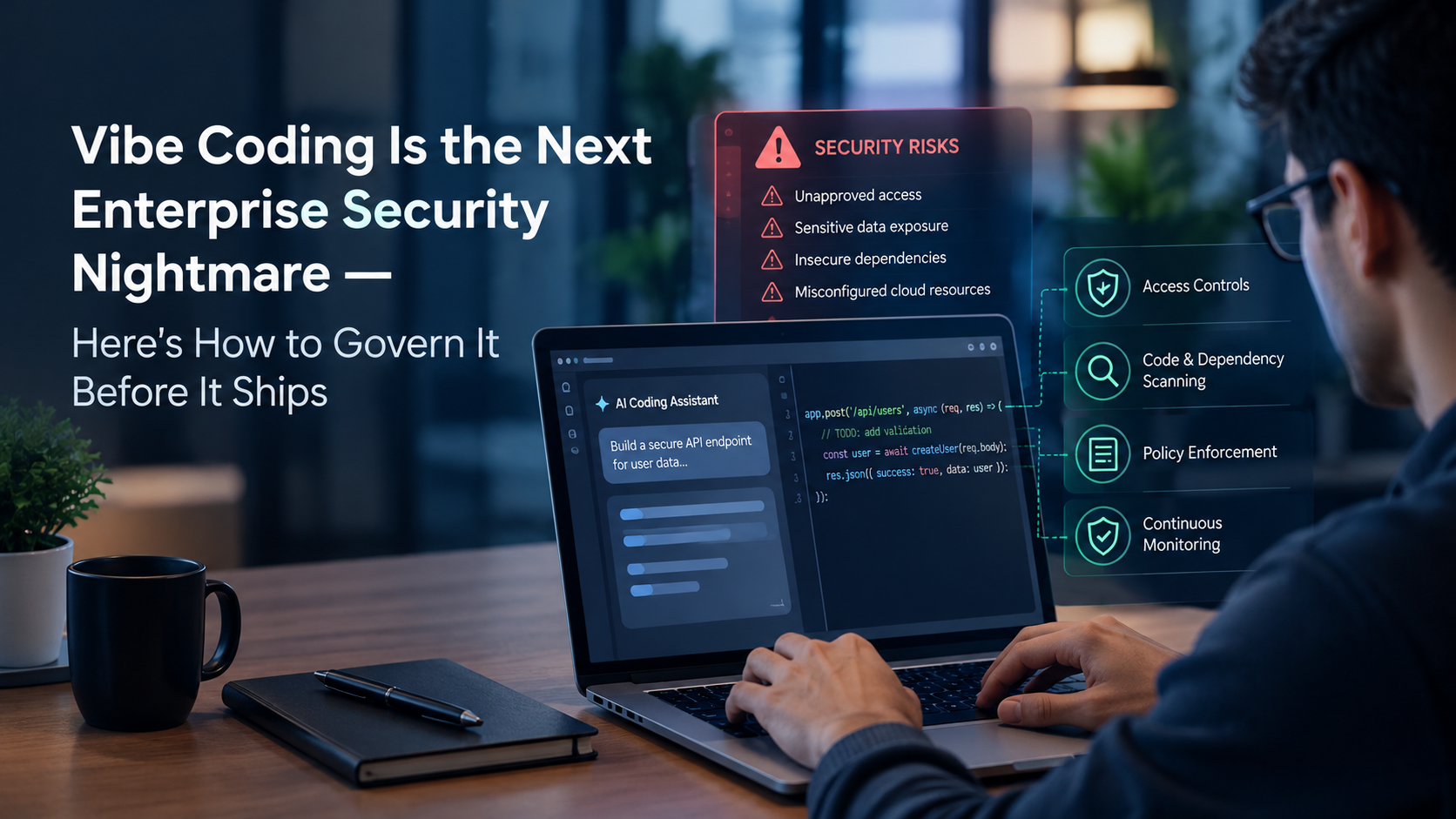
A developer describes an internal application in a few prompts. Minutes later, an AI coding agent has generated thousands of lines of code, installed dependencies, modified configuration files, written database logic, run tests and opened a pull request.
Who actually governed everything that happened between the first prompt and the pull request?
For most enterprises, the honest answer is that no one did, because no control was positioned to. That is the heart of the vibe coding enterprise security problem: not just code quality, but governance visibility and accountability.
The enterprise risk of vibe coding isn't simply that AI writes insecure code. It's that AI dramatically accelerates software creation while traditional security, governance, review, and accountability processes remain designed for human-written code.
Traditional software governance assumes a simple chain:
Human writes → human reviews → security scans → software shipsVibe coding replaces it with something looser:
Human prompts → AI generates → human accepts or edits → AI generates more → dependencies and tools are added → the application evolves rapidly → software ships
Every arrow in the second chain is a place where governance can quietly disappear. Security leaders now have to answer questions most programs were never built to ask:
- Who is accountable for AI-generated code, and can security even tell which code that is?
- Was it actually reviewed, or just accepted, and which dependencies did the agent introduce?
- Did the agent reach repositories, credentials or APIs it had no reason to touch?
- How do we prove to an auditor that AI-generated software went through the required controls, and detect drift between what an agent was authorized to do and what it did?
This article treats vibe coding as an AI governance and software supply-chain problem, not a developer productivity problem, and sets out controls that work before AI-generated software reaches production and after.
What vibe coding means in enterprise terms
In enterprise terms, vibe coding is building software by describing intent in natural language and letting AI do much of the implementation. Developers increasingly use AI to generate and refactor code, create APIs, produce infrastructure configurations, write tests, install dependencies, debug, modify repositories, draft documentation and execute development commands.
What matters for governance is how much the human stays in the loop.
AI-assisted coding
The human remains primarily responsible for individual coding decisions. The AI suggests; the developer reads, writes and commits.
Agentic (vibe) coding
The AI performs multi-step development tasks with limited human intervention: planning, editing many files, running commands, installing packages and opening pull requests.
The second category creates a substantially larger governance surface. The unit of risk is no longer a suggestion a developer reads. It is a sequence of actions taken inside your environment.

Why vibe coding changes the enterprise security model
Application security programs were built around predictable workflows: a person writes a change, a peer reviews it, pipelines scan it. AI coding agents strain each of those assumptions.
- Speed. AI can generate and modify software faster than human review processes can evaluate it.
- Scale. One developer can produce far more code and applications than before, including people outside engineering. Palo Alto Networks' Unit 42 (January 8, 2026) flags citizen developers who may lack the background to review what is generated.
- Opacity. Developers may not fully understand every implementation decision the model made.
- Dependency expansion. Libraries, packages, APIs, SDKs and third-party components arrive along with the code.
- Privileged tool access. Agents may reach Git repositories, CI/CD pipelines, cloud environments, databases, package managers, shell environments, secrets and internal documentation.
- Behavioral unpredictability. The same agent can act differently depending on prompts, context, tools, permissions and the files in front of it.
Static code scanning examines what was produced. It says little about what the agent did along the way. That gap is where governance has to operate.
The AI developer has become an execution layer
Early AI coding tools generated text. Modern coding agents take actions. That difference changes the risk category.
Compare two requests. First: "Create a login API." The model returns code for a human to read.
The second: "Create the login API, install the authentication package, modify the database schema, run the migration, update the CI pipeline, run tests, and open a pull request." Now the agent is choosing a dependency, altering a schema, changing a pipeline and executing commands, with whatever permissions the developer's session carries.
The first request produces an artifact. The second produces side effects. Security programs are mature at inspecting artifacts. They are far less mature at governing side effects.
Five vibe coding security risks enterprises should plan for
Some of these risks in enterprise vibe coding are well established. Others are emerging. We flag which is which.
1. Vulnerability acceleration (established)
AI-generated code can contain familiar flaws: insecure authentication, authorization failures, injection vulnerabilities, insecure API implementations, exposed secrets, unsafe defaults and vulnerable dependencies. The argument is not that AI always writes insecure code. It is that velocity can outpace verification, which makes AI-generated code security a throughput problem as much as a quality problem.
Veracode's 2025 GenAI Code Security Report (July 30, 2025) tested more than 100 models on 80 curated coding tasks and found that AI-generated code introduced a vulnerability in 45% of cases. Its 2026 edition (summer 2026) reports an average pass rate of 56%, essentially unchanged from the prior year despite gains in model capability. Benchmarks aren't your codebase, but working code and secure code are clearly different properties.
2. Dependency and software supply-chain risk (partly emerging)
Agents add packages freely: open-source libraries, obscure or outdated components, unnecessary dependencies and long transitive chains. A less visible problem is hallucination. Researchers at the University of Texas at San Antonio, the University of Oklahoma and Virginia Tech analyzed 576,000 code samples from 16 models and found average hallucinated-package rates of at least 5.2% for commercial models and 21.7% for open-source models (arXiv, 2024).
An attacker who registers a commonly hallucinated name could get malicious code installed. This "slopsquatting" path is research-demonstrated, so treat it as emerging rather than a measured, widespread attack. Either way, enterprises need visibility into the supply chain AI creates.
3. Excessive agent permissions (established principle, emerging practice)
If an AI coding agent only needs to modify a repository, why should it be able to access production credentials?
Yet agents routinely inherit the developer's full session: repositories, secrets, cloud credentials, production-like environments, package registries, databases and CI/CD systems. In July 2025, SaaStr founder Jason Lemkin reported that Replit's AI agent deleted a live database during an explicit code freeze (Fortune, July 23, 2025). It was a public experiment, not an enterprise system, and Replit's CEO committed to separating development and production databases. But it makes the point: a code freeze is a human policy, and it does nothing unless the agent's actual permissions enforce it.
The relevant principle is least privilege. OWASP's Top 10 for Agentic Applications (December 9, 2025) extends it to least agency: autonomy should be granted deliberately, scoped to the task, not by default. Unit 42's SHIELD framework makes a similar argument and recommends restricting agents to development and test environments.
4. The review bottleneck (established dynamic)
Generation velocity now exceeds human review capacity. The gap shows up as superficial reviews, approval fatigue, blind acceptance, rubber-stamping, security exceptions and undocumented AI-generated changes.
Unit 42 observes that AI-generated code looks correct and works, which creates a false sense of security and erodes change control. Review sized for human output can't absorb machine output without tiering: deciding which changes need deep human attention and which can be validated automatically.
5. The accountability gap
When AI generates the code, who is accountable for the resulting behavior? "The AI generated it" is not an accountability model. Responsibility must stay explicit across the developer, the engineering manager, security, the application owner, the AI governance team and the organization. If no one can say who approved a change, or whether it was AI-generated at all, the organization can't answer an auditor or an incident responder.
Why traditional AppSec doesn't see the whole picture
None of this makes existing controls obsolete. SAST, DAST, SCA, secrets scanning, code review, dependency scanning, IaC scanning and CI/CD controls remain necessary, and NIST's Secure Software Development Framework (SP 800-218) remains a sound baseline for them.
But these controls inspect artifacts and known security properties. They don't tell you:
- What did the AI agent actually do, and which tools did it call?
- Which files did it access and which repositories did it modify?
- What permissions did it use, and did its behavior match its authorization?
- Did it act outside the intended workflow, or introduce changes no one meaningfully reviewed?
Unit 42 reports that most organizations it assessed allow vibe coding tools because nothing blocks them, yet very few had formally assessed the risk or monitored inputs, outputs and security outcomes. Closing that visibility gap takes a second discipline alongside AppSec: behavioral governance for AI agents.
From code security to AI agent behavioral governance
Traditional AppSec asks: "Is this code secure?" AI agent governance asks: "Did the AI agent behave within the boundaries we authorized?"
Answering the second question requires visibility into:
- Agent identity
- Actions and tool calls
- Permissions in use
- Repositories accessed and files modified
- Commands executed and APIs called
- Data accessed
- Policy violations
- Anomalous behavior and behavioral drift
This mirrors the shift in enterprise AI governance generally: from validating an artifact once to continuously assuring behavior in operation. AI agent security for coding is one of the first places it shows up.
A six-step framework for vibe coding enterprise security
Step 1: Establish AI coding policies
Define approved AI coding tools, models and repositories, prohibited data, acceptable use and human approval requirements. Policy is the reference against which behavior is later judged, so it must be specific enough to test.
Step 2: Define agent permissions
Apply least privilege and separate read, write, repository, production, cloud, secret and CI/CD access. AI agents should not inherit unrestricted developer privileges by default. A practical starting point is development and test environments only, no standing access to secrets, and gates on destructive commands.
Step 3: Track AI-generated changes
Know where AI was used, which agent generated changes, what was modified, which tools were used and which dependencies were introduced. The goal is an auditable trail: commit and pull request metadata, dependency diffs and agent session logs security can query.
Step 4: Add human approval gates
Human review should stay mandatory for high-risk actions:
- Production changes
- Authentication and authorization logic
- Infrastructure changes
- Secrets handling
- Database migrations
- Security configuration
- External API integrations
Lower-risk changes can rely on automated validation. Tiering keeps review from degrading into rubber-stamping.
Step 5: Continuously monitor agent behavior
Governance doesn't stop at the pull request. AI agent behavioral monitoring should cover tool usage, unusual commands, unexpected repository access, permission escalation, sensitive-data access, unusual API calls, policy violations and behavioral deviations.
It helps to separate two ideas. Pre-deployment validation asks whether this build passed its checks. Runtime behavioral assurance asks whether the agent, and the software it produced, keep behaving within policy after those checks are done.
Step 6: Define automated response controls
Enterprises should be able to block unauthorized actions, revoke permissions, require approval, isolate suspicious activity, stop workflows, raise alerts and preserve audit evidence.
A kill switch shouldn't be the only option. Graduated controls (alert, require approval, block, revoke, isolate, stop) let the response match the risk without halting every developer.
A governance architecture that spans the lifecycle
Governance should exist across the whole lifecycle, not only at code review. A conceptual architecture:
- Developer. Identity and authorization of the person directing the agent.
- AI coding assistant or agent. Approved tool and model, logged sessions.
- Policy and permission layer. Least-privilege scopes, allowed tools, prohibited data and actions.
- Code, repositories, tools and APIs. Access governed by those permissions and recorded.
- Security validation. SAST, SCA, secrets, IaC and dependency checks.
- Human approval. Mandatory gates for high-risk changes.
- CI/CD. Pipelines that verify earlier controls actually ran.
- Production. Runtime protections and least-privilege service identities.
- Continuous behavioral monitoring. Detections feed back into policy.
The last stage matters most: monitoring that never feeds back into policy is reporting, not governance. See also end-to-end AI lifecycle governance.
What CISOs should ask before allowing vibe coding at scale
Use these as a readiness checklist for your AI coding security program. An honest "we don't know" is itself a finding.
- Which AI coding tools are approved?
- Which models can access proprietary source code?
- What data can coding agents access?
- What repositories can they modify?
- Can they execute shell commands?
- Can they install dependencies?
- Can they access secrets?
- Can they interact with cloud infrastructure?
- Are AI-generated changes identifiable?
- Is human approval required for high-risk changes?
- Are agent actions logged?
- Can security teams investigate agent behavior?
- Can unauthorized agent actions be blocked?
- How is behavioral drift detected?
- Can the organization demonstrate compliance during an audit?
A vibe coding governance maturity model
- Level 1, Uncontrolled. Employees use AI coding tools without centralized governance.
- Level 2, Visibility. The organization knows which AI tools are used and where.
- Level 3, Controlled. Policies, permissions, approvals, scanning and monitoring are implemented.
- Level 4, Continuous AI assurance. The organization continuously monitors AI agent behavior, enforces policies dynamically, detects deviations and maintains auditable evidence.
Level 4 is the direction of travel. Know which level you occupy today.
Where Trusys AI fits
Trusys AI is one example of the broader category of AI assurance and AI governance platforms, built on a simple premise: as enterprises move from AI assistants to AI agents, they need visibility into what AI systems actually do, not merely what they were designed or instructed to do.
Its scope is the AI applications and agents an enterprise builds and operates, increasingly including software created with coding assistants. In practice:
- Before release: TruScan, an open-source scanner, flags LLM-specific vulnerabilities in AI application code from the IDE, pull request or CI pipeline, and TruScout red-teams AI applications before they ship. See also open-source LLM security scanning from day zero.
- Inside the workflow: Trusys MCP lets assistants such as Cursor and Claude Code run evaluations, red-team tests, monitoring and guardrail setup against the AI applications being built.
- In production: TruPulse evaluates traces from running applications against policy, supporting drift detection and an auditable record of behavior.
A note on scope: these capabilities govern the AI applications and agents you ship. They complement, not replace, controls over the coding assistants themselves (tool approval, identity, repository permissions), which sit in your engineering and identity stack.
The through-line is the one this article has argued: Trusys AI helps enterprises move from trusting AI agents based on their intended behavior to assuring them based on their observed behavior.
When evaluating any platform in this category, ask whether it can:
- Show what agents actually did, not only how they were configured
- Enforce policy at runtime with graduated responses
- Produce audit evidence you could hand to a regulator
- Fit the IDEs, repositories and pipelines your teams already use
Conclusion: the answer isn't a ban, it's governance at AI speed
Vibe coding isn't inherently the problem. Uncontrolled acceleration is.
Banning AI coding is neither realistic nor necessary. The better response is governance that operates at AI speed: AI-assisted development, secure software practices, least-privilege permissions, human oversight and continuous behavioral monitoring, working together. That is what secure vibe coding looks like, and it is the practical core of vibe coding enterprise security.
The question isn't whether your developers will use AI to build software. The question is whether your organization can prove that the AI building it stayed within the boundaries you authorized.
To see how your own AI applications and agents are tested, monitored and governed, book a demo.
FAQ
What is vibe coding security?
Vibe coding security is the discipline of governing software built by prompting AI coding assistants and agents. It combines traditional application security (SAST, SCA, secrets and IaC scanning, code review) with AI-specific controls: least-privilege agent permissions, tracking of AI-generated changes, human approval gates for high-risk actions, and continuous monitoring of what agents actually do.
Is AI-generated code less secure than human-written code?
Evidence varies by model, language and task, so a blanket claim isn't defensible. Veracode's 2025 GenAI Code Security Report found that AI-generated code introduced a vulnerability in 45% of 80 curated tasks, and its 2026 edition reports an average pass rate of 56%. The practical lesson is that functional code and secure code are different properties, and AI-generated code needs the same verification as any other untrusted input.
What is the biggest enterprise risk of vibe coding?
The biggest risk is the gap between generation speed and governance capacity. AI can create and change software faster than review, security testing and accountability processes can keep up, and coding agents may hold broad permissions to repositories, secrets and pipelines. The risk is less that AI writes a flaw and more that nobody can show what the agent did or who approved it.
Should enterprises ban vibe coding?
Banning it is rarely realistic or necessary. Developers adopt productive tools whether or not they are sanctioned, which pushes usage out of sight. A better approach is to approve specific tools and models, scope agent permissions, require human approval for high-risk changes, and monitor behavior, so that AI-assisted development can continue inside defined boundaries.
How do you apply least privilege to AI coding agents?
Separate read, write, repository, production, cloud, secrets and CI/CD access, and grant an agent only what its task requires. A sensible baseline is development and test environments only, no standing access to production credentials, and approval required for destructive or irreversible commands. OWASP's Top 10 for Agentic Applications calls this principle least agency.
How is AI agent behavioral monitoring different from SAST and SCA?
SAST and SCA inspect artifacts, meaning code and dependencies, for known weaknesses. Behavioral monitoring observes actions: which tools an agent called, which files and repositories it touched, what permissions it used and whether that matched its authorization. The two are complementary, and the second answers questions the first cannot.
Stop guessing.
Start measuring.
Join teams building reliable AI with Trusys. Start with a free trial, no credit card required. Get your first evaluation running in under 10 minutes.
Questions about Trusys?
Our team is here to help. Schedule a personalized demo to see how Trusys fits your specific use case.
Book a Demo
Ready to dive in?
Check out our documentation and tutorials. Get started with example datasets and evaluation templates.
Start Free Trial
Free Trial
No credit card required
10 Min
to get started
24/7
Enterprise support