What Is an Acceptable AI Hallucination Rate? A Risk-Based Framework for Enterprise Teams
Written by

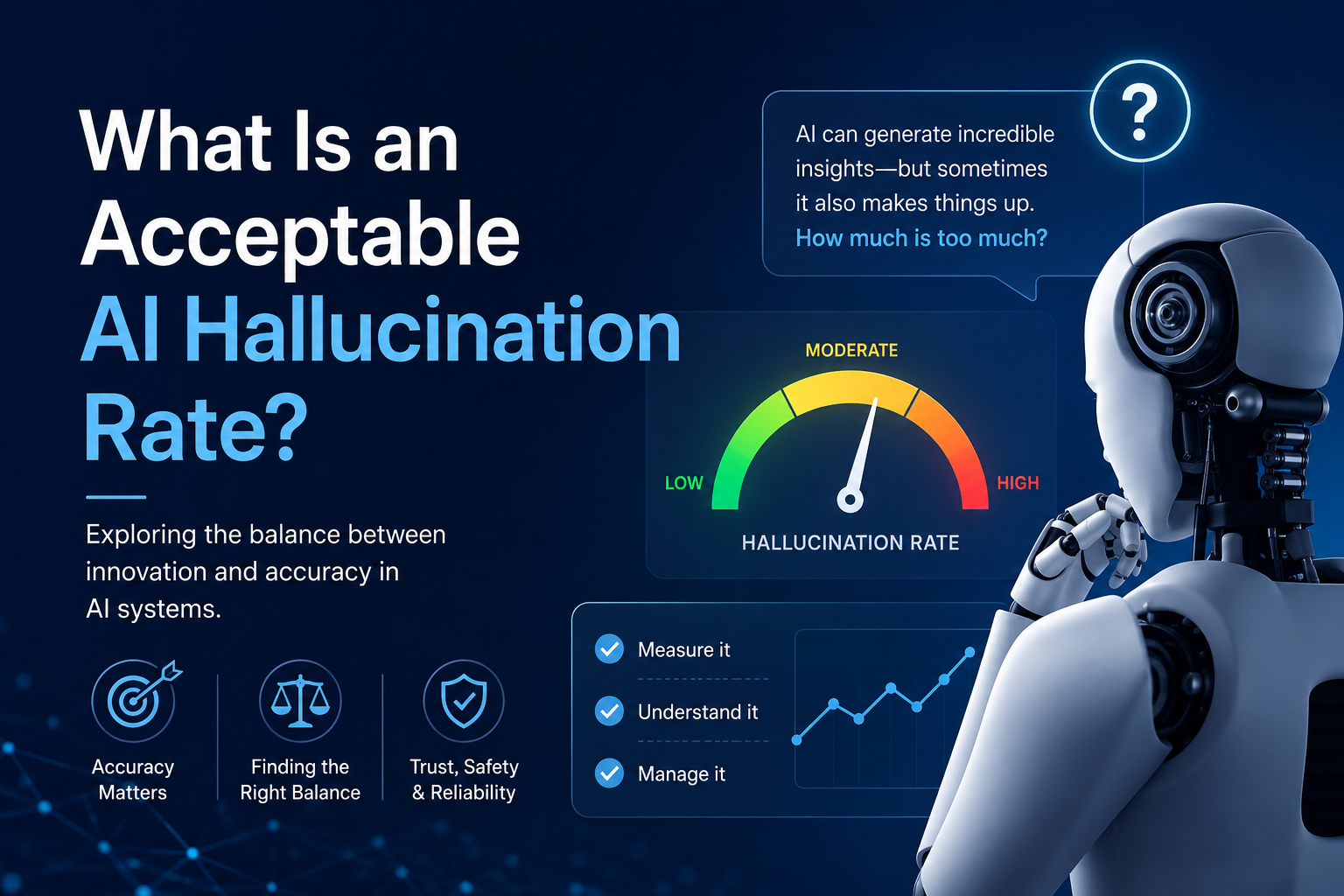
Ask five AI leaders what hallucination rate they consider acceptable, and the answers usually fall apart under one follow-up question: acceptable for what? A 2% hallucination rate might be a non-issue in an internal research assistant and a regulatory liability in a financial advisory chatbot. Our AI Agent Testing Checklist flags hallucination measurement as one of twelve required pre-launch checks for exactly this reason — the number only means something once it's attached to a use case and a risk tier.
This post lays out a practical, risk-based framework for setting, defending, and monitoring AI hallucination thresholds across an enterprise AI portfolio — instead of chasing an arbitrary “zero” that no production LLM system can actually deliver.

Why “Zero Hallucinations” Isn’t a Realistic Target
Hallucination is a structural property of how large language models generate text, not a bug that gets patched away in the next model release. Even so, the rate at which it occurs varies enormously by task. On Vectara’s Hughes Hallucination Evaluation Model leaderboard, which scores factual consistency on document summarization, leading models now post rates under 5%, with some approaching 1%. That looks reassuring — until the task changes.
Move from summarization to open-ended legal research, and the picture flips. Stanford’s RegLab found that general-purpose LLMs hallucinate on 69% to 88% of specific legal queries when used without retrieval grounding. That gap between roughly 1% and roughly 80% isn’t a quality difference between models — it’s the same underlying technology applied to tasks with very different amounts of available grounding and very different tolerance for error.
The consequences of getting this wrong are no longer hypothetical. Courts handed down a record level of sanctions against attorneys for AI-fabricated case citations in the first quarter of 2026, and the trend has kept climbing as legal teams have adopted these tools faster than they’ve adopted verification workflows around them. That’s the pattern enterprise teams need to avoid: deploying based on a headline accuracy number from a vendor benchmark, then discovering the real-world rate for their specific use case months later — in production, in front of a customer or a regulator.
The Real Question Isn’t “How Low” — It’s “How Risky”
AI Agents Multiply Infrastructure Load
AI agents introduce an entirely new scaling challenge.
Unlike a traditional user making one request at a time, AI agents may:
- Trigger multiple chained prompts
- Query several models simultaneously
- Retry failed requests autonomously
- Launch recursive workflows
One user action can suddenly generate dozens of inference operations.
Without workload controls, traffic amplification becomes unavoidable.

A Risk-Tiered Framework for Setting Hallucination Thresholds
Why Rate Limit Failures Are So Dangerous
Many organizations still treat rate limit errors as minor API inconveniences.
That assumption is becoming expensive.
In reality, rate limit failures create cascading operational disruption across the enterprise.
How to Actually Measure Your Hallucination Rate
Why Rate Limit Failures Are So Dangerous
Many organizations still treat rate limit errors as minor API inconveniences.
That assumption is becoming expensive.
In reality, rate limit failures create cascading operational disruption across the enterprise.
Thresholds Aren’t Static — Watch for Drift
Why Rate Limit Failures Are So Dangerous
Many organizations still treat rate limit errors as minor API inconveniences.
That assumption is becoming expensive.
In reality, rate limit failures create cascading operational disruption across the enterprise.
Mapping Thresholds to Compliance Obligations
Why Rate Limit Failures Are So Dangerous
Many organizations still treat rate limit errors as minor API inconveniences.
That assumption is becoming expensive.
In reality, rate limit failures create cascading operational disruption across the enterprise.
Frequently Asked Questions
AI Agents Multiply Infrastructure Load
AI agents introduce an entirely new scaling challenge.
Unlike a traditional user making one request at a time, AI agents may:
- Trigger multiple chained prompts
- Query several models simultaneously
- Retry failed requests autonomously
- Launch recursive workflows
One user action can suddenly generate dozens of inference operations.
Without workload controls, traffic amplification becomes unavoidable.
AI Agents Multiply Infrastructure Load
AI agents introduce an entirely new scaling challenge.
Unlike a traditional user making one request at a time, AI agents may:
- Trigger multiple chained prompts
- Query several models simultaneously
- Retry failed requests autonomously
- Launch recursive workflows
One user action can suddenly generate dozens of inference operations.
Without workload controls, traffic amplification becomes unavoidable.
AI Agents Multiply Infrastructure Load
AI agents introduce an entirely new scaling challenge.
Unlike a traditional user making one request at a time, AI agents may:
- Trigger multiple chained prompts
- Query several models simultaneously
- Retry failed requests autonomously
- Launch recursive workflows
One user action can suddenly generate dozens of inference operations.
Without workload controls, traffic amplification becomes unavoidable.
AI Agents Multiply Infrastructure Load
AI agents introduce an entirely new scaling challenge.
Unlike a traditional user making one request at a time, AI agents may:
- Trigger multiple chained prompts
- Query several models simultaneously
- Retry failed requests autonomously
- Launch recursive workflows
One user action can suddenly generate dozens of inference operations.
Without workload controls, traffic amplification becomes unavoidable.
AI Agents Multiply Infrastructure Load
AI agents introduce an entirely new scaling challenge.
Unlike a traditional user making one request at a time, AI agents may:
- Trigger multiple chained prompts
- Query several models simultaneously
- Retry failed requests autonomously
- Launch recursive workflows
One user action can suddenly generate dozens of inference operations.
Without workload controls, traffic amplification becomes unavoidable.
AI Agents Multiply Infrastructure Load
AI agents introduce an entirely new scaling challenge.
Unlike a traditional user making one request at a time, AI agents may:
- Trigger multiple chained prompts
- Query several models simultaneously
- Retry failed requests autonomously
- Launch recursive workflows
One user action can suddenly generate dozens of inference operations.
Without workload controls, traffic amplification becomes unavoidable.
AI Agents Multiply Infrastructure Load
AI agents introduce an entirely new scaling challenge.
Unlike a traditional user making one request at a time, AI agents may:
- Trigger multiple chained prompts
- Query several models simultaneously
- Retry failed requests autonomously
- Launch recursive workflows
One user action can suddenly generate dozens of inference operations.
Without workload controls, traffic amplification becomes unavoidable.
AI Agents Multiply Infrastructure Load
AI agents introduce an entirely new scaling challenge.
Unlike a traditional user making one request at a time, AI agents may:
- Trigger multiple chained prompts
- Query several models simultaneously
- Retry failed requests autonomously
- Launch recursive workflows
One user action can suddenly generate dozens of inference operations.
Without workload controls, traffic amplification becomes unavoidable.
AI Agents Multiply Infrastructure Load
AI agents introduce an entirely new scaling challenge.
Unlike a traditional user making one request at a time, AI agents may:
- Trigger multiple chained prompts
- Query several models simultaneously
- Retry failed requests autonomously
- Launch recursive workflows
One user action can suddenly generate dozens of inference operations.
Without workload controls, traffic amplification becomes unavoidable.
AI Agents Multiply Infrastructure Load
AI agents introduce an entirely new scaling challenge.
Unlike a traditional user making one request at a time, AI agents may:
- Trigger multiple chained prompts
- Query several models simultaneously
- Retry failed requests autonomously
- Launch recursive workflows
One user action can suddenly generate dozens of inference operations.
Without workload controls, traffic amplification becomes unavoidable.
Multi-Agent Systems Raise the Stakes
Why Rate Limit Failures Are So Dangerous
Many organizations still treat rate limit errors as minor API inconveniences.
That assumption is becoming expensive.
In reality, rate limit failures create cascading operational disruption across the enterprise.
Stop guessing.
Start measuring.
Join teams building reliable AI with TruEval. Start with a free trial, no credit card required. Get your first evaluation running in under 10 minutes.
Questions about Trusys?
Our team is here to help. Schedule a personalized demo to see how Trusys fits your specific use case.
Book a Demo

Ready to dive in?
Check out our documentation and tutorials. Get started with example datasets and evaluation templates.
Start Free Trial
Free Trial
No credit card required
10 Min
To first evaluation
24/7
Enterprise support


Benefits
Specifications
How-to
Contact Us
Learn More

What Is an Acceptable AI Hallucination Rate? A Risk-Based Framework for Enterprise Teams
Written by
Ask five AI leaders what hallucination rate they consider acceptable, and the answers usually fall apart under one follow-up question: acceptable for what? A 2% hallucination rate might be a non-issue in an internal research assistant and a regulatory liability in a financial advisory chatbot. Our AI Agent Testing Checklist flags hallucination measurement as one of twelve required pre-launch checks for exactly this reason — the number only means something once it's attached to a use case and a risk tier.
This post lays out a practical, risk-based framework for setting, defending, and monitoring AI hallucination thresholds across an enterprise AI portfolio — instead of chasing an arbitrary “zero” that no production LLM system can actually deliver.

Why “Zero Hallucinations” Isn’t a Realistic Target
Hallucination is a structural property of how large language models generate text, not a bug that gets patched away in the next model release. Even so, the rate at which it occurs varies enormously by task. On Vectara’s Hughes Hallucination Evaluation Model leaderboard, which scores factual consistency on document summarization, leading models now post rates under 5%, with some approaching 1%. That looks reassuring — until the task changes.
Move from summarization to open-ended legal research, and the picture flips. Stanford’s RegLab found that general-purpose LLMs hallucinate on 69% to 88% of specific legal queries when used without retrieval grounding. That gap between roughly 1% and roughly 80% isn’t a quality difference between models — it’s the same underlying technology applied to tasks with very different amounts of available grounding and very different tolerance for error.
The consequences of getting this wrong are no longer hypothetical. Courts handed down a record level of sanctions against attorneys for AI-fabricated case citations in the first quarter of 2026, and the trend has kept climbing as legal teams have adopted these tools faster than they’ve adopted verification workflows around them. That’s the pattern enterprise teams need to avoid: deploying based on a headline accuracy number from a vendor benchmark, then discovering the real-world rate for their specific use case months later — in production, in front of a customer or a regulator.
The Real Question Isn’t “How Low” — It’s “How Risky”
AI Agents Multiply Infrastructure Load
AI agents introduce an entirely new scaling challenge.
Unlike a traditional user making one request at a time, AI agents may:
- Trigger multiple chained prompts
- Query several models simultaneously
- Retry failed requests autonomously
- Launch recursive workflows
One user action can suddenly generate dozens of inference operations.
Without workload controls, traffic amplification becomes unavoidable.

A Risk-Tiered Framework for Setting Hallucination Thresholds
Why Rate Limit Failures Are So Dangerous
Many organizations still treat rate limit errors as minor API inconveniences.
That assumption is becoming expensive.
In reality, rate limit failures create cascading operational disruption across the enterprise.
How to Actually Measure Your Hallucination Rate
Why Rate Limit Failures Are So Dangerous
Many organizations still treat rate limit errors as minor API inconveniences.
That assumption is becoming expensive.
In reality, rate limit failures create cascading operational disruption across the enterprise.
Thresholds Aren’t Static — Watch for Drift
Why Rate Limit Failures Are So Dangerous
Many organizations still treat rate limit errors as minor API inconveniences.
That assumption is becoming expensive.
In reality, rate limit failures create cascading operational disruption across the enterprise.
Mapping Thresholds to Compliance Obligations
Why Rate Limit Failures Are So Dangerous
Many organizations still treat rate limit errors as minor API inconveniences.
That assumption is becoming expensive.
In reality, rate limit failures create cascading operational disruption across the enterprise.
Frequently Asked Questions
AI Agents Multiply Infrastructure Load
AI agents introduce an entirely new scaling challenge.
Unlike a traditional user making one request at a time, AI agents may:
- Trigger multiple chained prompts
- Query several models simultaneously
- Retry failed requests autonomously
- Launch recursive workflows
One user action can suddenly generate dozens of inference operations.
Without workload controls, traffic amplification becomes unavoidable.
AI Agents Multiply Infrastructure Load
AI agents introduce an entirely new scaling challenge.
Unlike a traditional user making one request at a time, AI agents may:
- Trigger multiple chained prompts
- Query several models simultaneously
- Retry failed requests autonomously
- Launch recursive workflows
One user action can suddenly generate dozens of inference operations.
Without workload controls, traffic amplification becomes unavoidable.
AI Agents Multiply Infrastructure Load
AI agents introduce an entirely new scaling challenge.
Unlike a traditional user making one request at a time, AI agents may:
- Trigger multiple chained prompts
- Query several models simultaneously
- Retry failed requests autonomously
- Launch recursive workflows
One user action can suddenly generate dozens of inference operations.
Without workload controls, traffic amplification becomes unavoidable.
AI Agents Multiply Infrastructure Load
AI agents introduce an entirely new scaling challenge.
Unlike a traditional user making one request at a time, AI agents may:
- Trigger multiple chained prompts
- Query several models simultaneously
- Retry failed requests autonomously
- Launch recursive workflows
One user action can suddenly generate dozens of inference operations.
Without workload controls, traffic amplification becomes unavoidable.
AI Agents Multiply Infrastructure Load
AI agents introduce an entirely new scaling challenge.
Unlike a traditional user making one request at a time, AI agents may:
- Trigger multiple chained prompts
- Query several models simultaneously
- Retry failed requests autonomously
- Launch recursive workflows
One user action can suddenly generate dozens of inference operations.
Without workload controls, traffic amplification becomes unavoidable.
AI Agents Multiply Infrastructure Load
AI agents introduce an entirely new scaling challenge.
Unlike a traditional user making one request at a time, AI agents may:
- Trigger multiple chained prompts
- Query several models simultaneously
- Retry failed requests autonomously
- Launch recursive workflows
One user action can suddenly generate dozens of inference operations.
Without workload controls, traffic amplification becomes unavoidable.
AI Agents Multiply Infrastructure Load
AI agents introduce an entirely new scaling challenge.
Unlike a traditional user making one request at a time, AI agents may:
- Trigger multiple chained prompts
- Query several models simultaneously
- Retry failed requests autonomously
- Launch recursive workflows
One user action can suddenly generate dozens of inference operations.
Without workload controls, traffic amplification becomes unavoidable.
AI Agents Multiply Infrastructure Load
AI agents introduce an entirely new scaling challenge.
Unlike a traditional user making one request at a time, AI agents may:
- Trigger multiple chained prompts
- Query several models simultaneously
- Retry failed requests autonomously
- Launch recursive workflows
One user action can suddenly generate dozens of inference operations.
Without workload controls, traffic amplification becomes unavoidable.
AI Agents Multiply Infrastructure Load
AI agents introduce an entirely new scaling challenge.
Unlike a traditional user making one request at a time, AI agents may:
- Trigger multiple chained prompts
- Query several models simultaneously
- Retry failed requests autonomously
- Launch recursive workflows
One user action can suddenly generate dozens of inference operations.
Without workload controls, traffic amplification becomes unavoidable.
AI Agents Multiply Infrastructure Load
AI agents introduce an entirely new scaling challenge.
Unlike a traditional user making one request at a time, AI agents may:
- Trigger multiple chained prompts
- Query several models simultaneously
- Retry failed requests autonomously
- Launch recursive workflows
One user action can suddenly generate dozens of inference operations.
Without workload controls, traffic amplification becomes unavoidable.
Multi-Agent Systems Raise the Stakes
Why Rate Limit Failures Are So Dangerous
Many organizations still treat rate limit errors as minor API inconveniences.
That assumption is becoming expensive.
In reality, rate limit failures create cascading operational disruption across the enterprise.
Stop guessing.
Start measuring.
Join teams building reliable AI with TruEval. Start with a free trial, no credit card required. Get your first evaluation running in under 10 minutes.
Questions about Trusys?
Our team is here to help. Schedule a personalized demo to see how Trusys fits your specific use case.
Book a Demo
Ready to dive in?
Check out our documentation and tutorials. Get started with example datasets and evaluation templates.
Start Free Trial
Free Trial
No credit card required
10 Min
To first evaluation
24/7
Enterprise support
What Is an Acceptable AI Hallucination Rate? A Risk-Based Framework for Enterprise Teams
Written by
Manish Tewari
Published on
June 20, 2026
Ask five AI leaders what hallucination rate they consider acceptable, and the answers usually fall apart under one follow-up question: acceptable for what? A 2% hallucination rate might be a non-issue in an internal research assistant and a regulatory liability in a financial advisory chatbot. Our AI Agent Testing Checklist flags hallucination measurement as one of twelve required pre-launch checks for exactly this reason — the number only means something once it's attached to a use case and a risk tier.
This post lays out a practical, risk-based framework for setting, defending, and monitoring AI hallucination thresholds across an enterprise AI portfolio — instead of chasing an arbitrary “zero” that no production LLM system can actually deliver.


Why “Zero Hallucinations” Isn’t a Realistic Target
Hallucination is a structural property of how large language models generate text, not a bug that gets patched away in the next model release. Even so, the rate at which it occurs varies enormously by task. On Vectara’s Hughes Hallucination Evaluation Model leaderboard, which scores factual consistency on document summarization, leading models now post rates under 5%, with some approaching 1%. That looks reassuring — until the task changes.
Move from summarization to open-ended legal research, and the picture flips. Stanford’s RegLab found that general-purpose LLMs hallucinate on 69% to 88% of specific legal queries when used without retrieval grounding. That gap between roughly 1% and roughly 80% isn’t a quality difference between models — it’s the same underlying technology applied to tasks with very different amounts of available grounding and very different tolerance for error.
The consequences of getting this wrong are no longer hypothetical. Courts handed down a record level of sanctions against attorneys for AI-fabricated case citations in the first quarter of 2026, and the trend has kept climbing as legal teams have adopted these tools faster than they’ve adopted verification workflows around them. That’s the pattern enterprise teams need to avoid: deploying based on a headline accuracy number from a vendor benchmark, then discovering the real-world rate for their specific use case months later — in production, in front of a customer or a regulator.
The Real Question Isn’t “How Low” — It’s “How Risky”
Because hallucination rate is task-dependent, the right question isn’t “what’s the industry-standard acceptable rate.” There isn’t one, and any vendor who quotes a single number across all use cases is oversimplifying. The right question is: given everything that could go wrong with this specific AI system, what hallucination rate can we tolerate before the cost of an error exceeds the value the system delivers?
That’s a risk-tiering exercise, and it follows the same logic enterprises already apply to other forms of AI risk. Our Responsible AI Governance Frameworks: A Practical Leader’s Guide walks through how organizations map AI systems to risk categories under frameworks like the EU AI Act and ISO/IEC 42001. Hallucination rate thresholds should sit inside that same risk-tiering exercise rather than being set as an isolated technical metric.
Five factors typically drive where a given AI system lands on that risk spectrum:
• Reversibility: Can a human catch and undo the error before it causes harm, or does the system act autonomously?
• Audience exposure: Is the output seen internally, by a single customer, or published at scale?
• Regulatory exposure: Does the use case fall under EU AI Act high-risk categories, HIPAA, or financial services regulation?
• Grounding availability: Is the system grounded in verified retrieval (RAG), or relying on parametric knowledge alone?
• Severity of a single error: Would one hallucinated output cause a minor inconvenience or a six- or seven-figure loss?
A Risk-Tiered Framework for Setting Hallucination Thresholds
Mapping each AI system against these factors produces a tier, and each tier implies a different starting threshold and a different set of required controls:
Tier 1 — Internal & Reviewed. Example use cases: internal drafting, research summarization, knowledge search with human sign-off. A hallucination rate up to roughly 8–10% may be workable here, provided the minimum control is in place: mandatory human review before any output is acted on.
Tier 2 — Customer-Facing, Informational. Example use cases: support chatbots, FAQ assistants, non-binding product guidance. Target a rate under 3–5%, grounded in RAG. Minimum controls: RAG grounding, confidence flagging, and a clear escalation path to a human.
Tier 3 — Regulated or Financially Binding. Example use cases: underwriting, KYC, claims processing, medical information. Target a rate under 1%, near-zero for high-severity errors. Minimum controls: mandatory grounding, guardrail enforcement, a full audit trail, and human sign-off on binding decisions.
Tier 4 — Autonomous Agentic Action. Example use cases: agents executing transactions, tool calls, or workflows without review. Target near-zero on action-triggering outputs. Minimum controls: tool-use authorization boundaries, real-time guardrails, and continuous drift monitoring.
These ranges are starting points for discussion, not certified industry benchmarks — no regulator or standards body publishes a single official number, and that’s by design. Your own cost-of-error analysis should set the final threshold for each system, but having a tiered starting point keeps that conversation from happening for the first time during a post-incident review.
How to Actually Measure Your Hallucination Rate
Setting a threshold is meaningless without a reliable way to measure against it. Our AI Agent Testing Checklist covers this under “Measure Hallucination Rate Under Stress” — testing not just under ideal conditions, but at high query volume, with low-context inputs, and against adversarial prompts designed to induce confabulation. The methodology for building that measurement pipeline is covered in more depth in AI Hallucination Detection: How to Identify and Prevent LLM Errors in Production.
In practice, this means building a golden test set specific to your use case, scoring outputs against it with an automated faithfulness model, and supplementing that with human spot-checks — automated detectors aren’t perfect either. Even strong detection models top out around 67% balanced accuracy on adversarial hallucination benchmarks, which is why teams that rely on a single automated pass tend to underestimate their real-world rate. TruEval runs this kind of structured evaluation across input and output boundaries as part of a continuous test suite, rather than a one-time pre-launch check.
Thresholds Aren’t Static — Watch for Drift
A hallucination rate measured at launch is a snapshot, not a guarantee. Model version updates, changes to a retrieval source, prompt edits, and shifts in real-world query patterns can all move the number after deployment — often silently. LLM Monitoring for Enterprise: Observability, Reliability, and AI Compliance at Scale covers the broader monitoring architecture this requires, and The Reproducibility Problem in LLM Testing looks at a related failure mode — the same input producing different outputs across runs, which complicates hallucination measurement itself.
This is where pre-launch testing and production monitoring need to connect. TruPulse provides continuous production monitoring with configurable alert thresholds, so a hallucination rate that creeps from 2% to 6% after a model update triggers a review instead of surfacing for the first time in a customer complaint or a compliance audit.
Mapping Thresholds to Compliance Obligations
For regulated industries, the hallucination threshold conversation overlaps directly with compliance obligations. Under the EU AI Act, high-risk AI systems carry specific requirements around transparency (Article 12) and human oversight (Article 14) — both of which depend on knowing your system’s actual error rate and having a defined response when it’s exceeded. ISO/IEC 42001 similarly requires documented risk assessment and governance controls, which means your hallucination threshold — and the evidence behind it — needs to be written down, not just understood informally by the team that built the system.
TruScout maps agent behavior to compliance requirements across the EU AI Act, ISO 42001, and the NIST AI RMF, which is useful when the hallucination threshold for a Tier 3 system needs to be defended to an auditor rather than just an internal stakeholder.
Multi-Agent Systems Raise the Stakes
Hallucination thresholds get harder to manage once a single agent’s output becomes another agent’s input. In multi-agent and agentic AI architectures, a hallucinated fact or fabricated tool result from one step can propagate through every downstream step, compounding what started as a small error by the time a human sees the final output. Managing Risk in Multi-Agent AI Systems: Governance and Security Challenges looks at this compounding-risk problem in more detail. TruGuard’s real-time guardrails are designed to intercept and flag suspect outputs at each step, rather than relying on a single check at the end of the chain.
Frequently Asked Questions
- What is a good hallucination rate for an AI agent?
There’s no single good rate across all systems — it depends on the risk tier of the use case. A reviewed internal drafting tool can tolerate a higher rate than a system making binding financial or medical decisions. Set your threshold using a risk-tiered framework like the one above, not a single industry benchmark.
- How do you measure AI hallucination rate in production?
Build a use-case-specific golden test set, score outputs with an automated faithfulness model, and supplement with human review, since automated detectors miss a meaningful share of nuanced hallucinations. Measurement should continue in production, not stop after pre-launch testing, since the rate can shift after model updates or retrieval source changes.
- Does RAG eliminate hallucinations?
No. Retrieval-augmented generation reduces hallucination rate by grounding responses in retrieved source material, but it doesn’t eliminate the risk — models can still misread, misattribute, or fabricate beyond what was retrieved, particularly under adversarial prompts or when retrieval quality is poor.
- What hallucination rate triggers EU AI Act compliance risk?
The EU AI Act doesn’t specify a numeric hallucination threshold. Instead, high-risk systems must demonstrate documented risk assessment, transparency, and human oversight proportional to the system’s error rate and the severity of potential harm. A higher hallucination rate without corresponding oversight controls increases compliance exposure even without a specific number being breached. See our AI Hallucinations in Enterprise Systems: Causes, Risks, and Prevention for a broader look at causes and prevention strategies.
- Set the Threshold Before Production Sets It for You
An acceptable AI hallucination rate isn’t a fixed percentage you can look up — it’s the output of a risk-tiering exercise specific to each system you deploy. Enterprises that skip this exercise tend to land in one of two places: thresholds set too loose, which surface as silent production failures, or thresholds left unmeasured entirely, which stall deployment indefinitely because no one can say with confidence whether the system is within tolerance.
Stop guessing.
Start measuring.
Join teams building reliable AI with Trusys. Start with a free trial, no credit card required. Get your first evaluation running in under 10 minutes.
Questions about Trusys?
Our team is here to help. Schedule a personalized demo to see how Trusys fits your specific use case.
Book a Demo
Ready to dive in?
Check out our documentation and tutorials. Get started with example datasets and evaluation templates.
Start Free Trial
Free Trial
No credit card required
10 Min
to get started
24/7
Enterprise support